Disclosure: airfryerkitchensupply.com is reader-supported. When you buy through links on our site, we may earn an affiliate commission at no extra cost to you.
Where to buy
If you are shopping for best hand mixers to shred chicken, Amazon is the most practical place to compare the current versions of the models in this guide, because hand and stand mixers are sold in several colors, bundle configurations, and model-year revisions that look nearly identical in photos. Every linked pick below was matched to a verified listing before this guide was written, and each one is presented with a live price check instead of a fixed number, because mixer pricing shifts with color, season, and seller.
A hand mixer shreds cooked chicken with its standard beaters — there is no special shredding model to hunt for, which means the listings below are ordinary, verified hand mixers chosen for the specific demands of the job: enough motor to pull warm chicken apart without stalling, low speeds that shred instead of launching, and beaters that rinse clean after contact with cooked meat. Confirm the beater type on the listing before ordering; smooth, easy-clean beaters handle this job best.
- Hamilton Beach 6-Speed Electric Hand Mixer with Easy Clean Beaters (62636J) (Best Overall for Shredding Chicken) — check price on Amazon
- KitchenAid 9 Speed Hand Mixer (KHM926) (Best for Large Batches) — check price on Amazon
- Hamilton Beach 6-Speed Electric Hand Mixer (62682G) (Best Budget for Shredding) — check price on Amazon
- Cuisinart Power Advantage Plus 9-Speed Hand Mixer (HM-90S) (Best for Controlled, Low-Splatter Shredding) — check price on Amazon
- Breville Handy Mixer (BHM800SIL) (Best Premium for Frequent Shredding) — check price on Amazon
- KitchenAid 5 Ultra Power Speed Hand Mixer (KHM512) (Best Lightweight for Small Batches) — check price on Amazon
The best hand mixers to shred chicken are not a separate product category, and that is the first useful thing to know. The viral kitchen shortcut — press a running hand mixer’s beaters into a bowl of warm, cooked chicken and watch it pull apart into shreds in under a minute — works with the beaters already in most drawers. What separates a good shredding mixer from a frustrating one is not a shredding mode; it is motor headroom, low-speed manners, and beaters that do not trap meat in fiddly joints.
The job itself is specific. Chicken must be warm — ideally straight from cooking and rested just long enough to handle — because cold, refrigerated chicken resists shredding and makes the motor work brutally hard for stringy results. The bowl must be deep, because beaters throw shreds. And the mixer must be able to run at a genuinely low speed under load: too fast and you get chicken on the walls; too weak and the motor strains, heats, and smells like it is negotiating.
This guide picks six verified hand mixers for that job, from a budget workhorse to a premium option for households that shred chicken in bulk every week for meal prep, tacos, salads, and soups. It also covers the food-safety and technique details that make the difference between tender shreds and a dry, overworked bowl — because the mixer is only half the method.
In this guide
Quick Picks
For most kitchens, the Hamilton Beach Easy Clean six-speed is the shredding sweet spot: enough motor, beaters that rinse clean after meat contact, and a case for storage. Bulk meal-preppers should step up to the KitchenAid 9 Speed or the Breville for headroom, while the Cuisinart HM-90S is the pick when flying shreds are your main complaint.
- Hamilton Beach 6-Speed Electric Hand Mixer with Easy Clean Beaters (62636J) — Best Overall for Shredding Chicken: a 275-watt motor, smooth easy-clean beaters that release meat and rinse fast, plus a whisk for the sauces that follow. Check on Amazon
- KitchenAid 9 Speed Hand Mixer (KHM926) — Best for Large Batches: nine speeds with a truly gentle bottom gear for controlled shredding, and dishwasher-safe accessories for the cleanup afterward. Check on Amazon
- Hamilton Beach 6-Speed Electric Hand Mixer (62682G) — Best Budget for Shredding: a 250-watt six-speed with QuickBurst and a bowl-rest feature, at the lowest tier in this guide. Check on Amazon
- Cuisinart Power Advantage Plus 9-Speed Hand Mixer (HM-90S) — Best for Controlled, Low-Splatter Shredding: a named SmoothStart system that eases into speed, keeping shreds in the bowl instead of on the counter. Check on Amazon
- Breville Handy Mixer (BHM800SIL) — Best Premium for Frequent Shredding: nine settings plus boost for households that shred often and want precise control with reserve power on demand. Check on Amazon
- KitchenAid 5 Ultra Power Speed Hand Mixer (KHM512) — Best Lightweight for Small Batches: a light, simple five-speed that shreds one or two breasts beautifully and stores anywhere. Check on Amazon
How These Picks Were Chosen
Picks were verified against current Amazon listings before writing, with model numbers and included attachments confirmed from the listing titles. Only mixers whose beaters and motor class suit the shredding job were kept; novelty mini mixers and whisk-only gadgets were excluded because they cannot pull warm chicken apart without abusing the motor.
The shredding-specific criteria were, in order: motor wattage class where the listing states it, because shredding is a loaded, dragging task rather than a whipping task; low-speed control, because the work happens at the bottom of the range; beater geometry, favoring smooth profiles that release meat and rinse clean; and included attachments, since a whisk in the box makes the same mixer useful for the sauces and dressings that shredded chicken usually meets next.
Every pick also had to be a genuinely good general hand mixer, because no household buys a mixer solely to shred chicken. Each one below earns its drawer space on cakes, whipped cream, and mashed potatoes the rest of the week, and shreds chicken as a well-supported party trick rather than its only skill.
The 6 Best Hand Mixers to Shred Chicken
Badges in this guide describe shredding roles specifically, so a mixer’s badge here may differ from its badge in a general baking guide. Read the trade-offs carefully: shredding is hard, dragging work, and the honest limits of each motor are stated plainly rather than smoothed over.
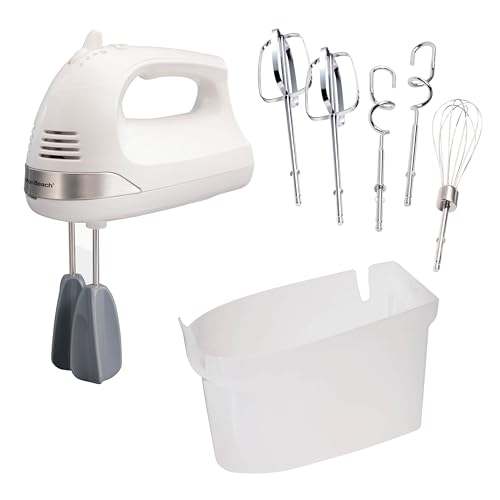
Hamilton Beach 6-Speed Electric Hand Mixer with Easy Clean Beaters (62636J) — Best Overall for Shredding Chicken
Start here unless you shred chicken by the tray. The 62636J pairs a 275-watt motor — the strongest stated wattage among the budget and mid-range hand mixers in this guide — with easy-clean beaters whose smooth profile is exactly what you want in cooked meat: shreds slide off instead of packing into crossbar joints, and the beaters rinse clean in seconds, which matters when the tool has touched poultry.
Strengths
- Stated 275-watt motor gives real headroom for pulling warm chicken apart at low speed
- Easy-clean beater profile releases meat shreds and rinses without brush work
- Whisk and dough hooks in the box cover the dressings, sauces, and flatbreads that complete the meal
Trade-offs
- Six speeds mean the lowest gear is a little livelier than the nine-speed models; start carefully in a deep bowl
- Budget-tier body; treat it as a workhorse, not a showpiece
- Snap-on case adds storage bulk in shallow drawers
Key specs (from the verified listing)
- Speeds: 6
- Motor (verified listing): 275 watts
- Attachments (verified listing): traditional easy-clean beaters, dough hooks, whisk; snap-on storage case
Shredding technique with this mixer is simple and repeatable: place warm chicken — two to four breasts or equivalent thighs — in a deep bowl, rest the beaters on the meat, and run the lowest speed in short passes, lifting and repositioning rather than grinding in one spot. The meat separates into shreds in well under a minute per batch. Work in batches rather than crowding the bowl; an overfilled bowl throws pieces and leaves the center unshredded.
Cleanup is where this pick quietly wins the category. Cooked chicken leaves protein film on beaters, and traditional beaters with tight joints need soaking and brushing to be genuinely clean. The easy-clean profile goes under the tap, gets a quick soapy wash, and is done — a small thing that decides whether the shredding shortcut actually gets used on busy weeknights or quietly abandoned.
Best for: Weekly meal-prep households shredding a few chicken breasts at a time / Not suited for: Catering-scale batches, which belong to a stand mixer with a paddle or to two forks and patience
Check on Amazon — check price on Amazon for the current configuration and color.

KitchenAid 9 Speed Hand Mixer (KHM926) — Best for Large Batches
Choose the KHM926 when shredding is a bulk ritual — a rotisserie chicken every Sunday, a tray of poached breasts for the week’s lunches — and control matters as much as power. Nine speeds mean the lowest settings are genuinely low, so you can start pulling meat apart without the first-second explosion that faster-starting mixers produce, then step up briefly to finish the last stubborn chunks.
Strengths
- Finest low-speed control in this guide, which is the core skill shredding rewards
- Dishwasher-safe beaters and accessories simplify the post-poultry cleanup
- Pro whisk included for slaws, dressings, and sauces built around the shredded chicken
Trade-offs
- Premium tier; overkill if you shred chicken twice a year
- Stainless beaters are smooth but not the quick-release easy-clean profile of the Hamilton Beach
- Dough hooks are for dough, not shredding; use the beaters for meat, always
Key specs (from the verified listing)
- Speeds: 9
- Attachments (verified listing): Pro whisk, Stainless Steel Turbo Beater II beaters, dough hook
- Care: dishwasher-safe accessories
Batch discipline is this mixer’s home turf. Shred in two-breast batches, moving finished shreds to a holding bowl, and the nine-speed ladder lets you keep one rhythm: start at the bottom, work the beaters in slow arcs, lift, turn the bowl a quarter, repeat. The result is the most even shred texture in this guide — long, separate strands rather than a mix of chunks and mush — which is what you want for chicken salad and pulled-chicken sandwiches.
A note on texture control: the longer you run any mixer, the finer and drier the shred becomes as it loses surface moisture to the bowl and air. With nine speeds you can stop precisely at the texture each dish wants — coarse for soups, medium for tacos, fine for salad — instead of accepting whatever a two-speed tool decides. Stop early; you can always run it five seconds more, and you can never un-shred.
Best for: Bulk meal-preppers who shred whole chickens or large batches weekly / Not suited for: Occasional shredders, for whom the budget pick does the same job for less
Check on Amazon — check price on Amazon for the current configuration and color.

Hamilton Beach 6-Speed Electric Hand Mixer (62682G) — Best Budget for Shredding
The 62682G is the budget shredding pick: a 250-watt motor, six speeds, a QuickBurst button for a momentary extra push, and a bowl-rest feature that lets the mixer perch on the bowl edge between batches — a small mercy when your hands are managing warm chicken and a holding bowl at the same time. Its traditional beaters shred perfectly well; they simply ask for a soak afterward.
Strengths
- Lowest-cost verified route to motorized shredding in this guide
- QuickBurst helps break the first whole piece into shreddable sections
- Bowl-rest feature is genuinely handy mid-task when both hands are busy
Trade-offs
- Traditional beaters trap meat in their joints; budget cleanup time accordingly
- 250-watt class motor wants warm chicken and modest batches; cold meat will strain it
- No whisk in the box, so dressings need another tool
Key specs (from the verified listing)
- Speeds: 6 with QuickBurst
- Motor (verified listing): 250 watts
- Features (verified listing): bowl rest; snap-on storage case
Use QuickBurst the way it was designed: a one-second press to crack a whole breast into sections at the start, then back to the lowest steady speed for the actual shredding. Holding burst continuously turns shredding into flinging. With that discipline, this budget mixer produces shreds indistinguishable from the premium picks; the difference shows up in cleanup and in how hard the motor works on the fifth consecutive batch, not in the first.
Because the beaters are the traditional pattern, build the soak into your routine: beaters into hot soapy water the moment shredding ends, while you season the chicken. By the time the food is plated, the beaters need only a rinse. It is a fair trade at this price, and naming it honestly is the difference between a budget pick that satisfies and one that disappoints.
Best for: Budget buyers and first-time shredders testing whether the shortcut suits them / Not suited for: High-volume preppers who will feel the cleanup and motor limits weekly
Check on Amazon — check price on Amazon for the current configuration and color.

Cuisinart Power Advantage Plus 9-Speed Hand Mixer (HM-90S) — Best for Controlled, Low-Splatter Shredding
If your one shredding attempt so far ended with chicken on the counter, the walls, and possibly the cook, the HM-90S is your pick. Its verified listing names a SmoothStart anti-splatter feature that ramps the beaters up gently, and shredding is precisely the task where a gentle ramp matters most: the first second, when whole pieces meet spinning beaters, is when kitchens get redecorated.
Strengths
- SmoothStart ramp directly addresses shredding’s messiest moment
- Nine speeds allow fine texture control from coarse pulls to fine shreds
- Snap-on case keeps meat-contact beaters stored cleanly and together
Trade-offs
- White finish shows every splash; wipe the body down promptly after meat work
- Case storage needs drawer depth
- Premium-mid pricing for a feature set casual shredders may not need
Key specs (from the verified listing)
- Speeds: 9
- Feature (verified listing): SmoothStart anti-splatter
- Storage: snap-on storage case included
The technique pairing is natural: SmoothStart plus a deep bowl plus warm chicken equals the tidiest shredding in this guide. Start the mixer resting on the meat, let the ramp bring the beaters up, and work in slow passes. Because the start is calm, you can use a slightly smaller bowl than with jumpier mixers, which helps small kitchens where the deepest bowl is also the serving bowl.
Food-safety housekeeping is easy here but not optional: wash beaters and wipe the mixer body after poultry contact, and store the clean, dry beaters in the case rather than loose in a drawer where they contact other tools. The case, again, turns out to be a hygiene feature disguised as a storage feature.
Best for: Mess-averse cooks and small kitchens that need calm starts and tidy storage / Not suited for: Buyers who want the absolute strongest stated wattage at this tier
Check on Amazon — check price on Amazon for the current configuration and color.

Breville Handy Mixer (BHM800SIL) — Best Premium for Frequent Shredding
The Breville is the premium shredding pick for the household that has made pulled chicken a weekly institution and wants the job to feel effortless. Nine settings give you the fine ladder for texture, and the boost function is the reserve gear for the moment a batch includes a stubborn, cooler piece: a short boost breaks it down, then you return to shredding speed instead of forcing the whole batch faster.
Strengths
- Boost function handles stubborn pieces without raising the whole batch’s speed
- Fine nine-setting ladder gives the most deliberate texture control alongside the KitchenAid
- Premium control feel suits frequent, repetitive meal-prep sessions
Trade-offs
- Highest tier in this guide; value depends on shredding and baking often
- Verified listing is concise on attachments, so confirm in-box contents on the listing
- Boost tempts overuse; held down, it flings shreds and dries the meat
Key specs (from the verified listing)
- Speeds: 9 settings plus boost (verified listing)
- Positioning: premium tier
Frequent shredders develop opinions about texture, and this is the mixer for them. Run most of a batch at low speed for long strands, then finish a portion longer for the fine shred that binds chicken salad. The control ladder makes those two textures a deliberate choice within one bowl session, which is the kind of nuance that only matters — and only pays — when you do this every week.
Keep the premium tool premium by respecting the same rule as the budget tools: warm chicken only, modest batches, beaters washed promptly. A flagship motor abused on refrigerator-cold chicken ages exactly like a cheap one. The difference you are paying for is control and feel, and both survive only if the workload stays inside the category’s real limits.
Best for: Weekly pulled-chicken households that also bake frequently / Not suited for: Anyone whose shredding happens a few times a year
Check on Amazon — check price on Amazon for the current configuration and color.

KitchenAid 5 Ultra Power Speed Hand Mixer (KHM512) — Best Lightweight for Small Batches
Not every shredding job is a meal-prep marathon. For one or two breasts destined for tonight’s tacos or a single chicken’s worth of salad, the KHM512’s light body and five simple speeds are honestly the right tool: quick to grab, quick to shred, and its beaters go straight into the dishwasher, which settles the poultry-cleanup question with zero effort.
Strengths
- Lightest, simplest handling in this guide; ideal for small, frequent batches
- Dishwasher-safe beaters make post-chicken cleanup a non-event
- Swivel cord locks aside, keeping it out of the bowl while you maneuver
Trade-offs
- Five speeds and a smaller motor class; large or cool batches strain it
- Beaters only — no whisk for accompanying sauces
- Not a bulk tool; respect the small-batch brief and it excels
Key specs (from the verified listing)
- Speeds: 5
- Attachments (verified listing): Turbo Beaters
- Care: dishwasher-safe beaters; lockable swivel cord
Small-batch shredding has its own technique advantage: with less meat in the bowl, the beaters contact everything quickly, and a light mixer you can angle freely produces even shreds faster than a heavy one you wrestle. Two breasts, warm, deep cereal-bowl-plus scale, lowest speed, thirty seconds — that is the entire recipe, and this mixer makes it feel like nothing, which is why small households actually repeat it.
Know the boundary and this pick never disappoints: if the bowl holds more than about three breasts, split the batch. The motor will tell you when you have crossed the line — rising pitch, slowing beaters — and the correct response is always to divide the work, never to push through. Every hand mixer in this guide obeys that rule; the small ones just announce it sooner.
Best for: Small households shredding one or two pieces at a time, often / Not suited for: Bulk preppers and anyone shredding whole chickens weekly
Check on Amazon — check price on Amazon for the current configuration and color.
Comparison Table
| Pick | Badge | Key spec | Best for |
|---|---|---|---|
| Hamilton Beach 6-Speed Electric Hand Mixer with Easy Clean Beaters (62636J) | Best Overall for Shredding Chicken | 275-watt motor; easy-clean beaters; whisk and dough hooks included | Weekly meal-prep households shredding a few chicken breasts at a time |
| KitchenAid 9 Speed Hand Mixer (KHM926) | Best for Large Batches | 9 speeds; Turbo Beater II beaters; dishwasher-safe accessories | Bulk meal-preppers who shred whole chickens or large batches weekly |
| Hamilton Beach 6-Speed Electric Hand Mixer (62682G) | Best Budget for Shredding | 6 speeds with QuickBurst; 250-watt motor; bowl rest | Budget buyers and first-time shredders testing whether the shortcut suits them |
| Cuisinart Power Advantage Plus 9-Speed Hand Mixer (HM-90S) | Best for Controlled, Low-Splatter Shredding | 9 speeds; SmoothStart anti-splatter; snap-on storage case | Mess-averse cooks and small kitchens that need calm starts and tidy storage |
| Breville Handy Mixer (BHM800SIL) | Best Premium for Frequent Shredding | 9 speed settings plus boost | Weekly pulled-chicken households that also bake frequently |
| KitchenAid 5 Ultra Power Speed Hand Mixer (KHM512) | Best Lightweight for Small Batches | 5 speeds; Turbo Beaters; dishwasher-safe beaters | Small households shredding one or two pieces at a time, often |
How to Choose the Best Hand Mixer for Shredding Chicken
Motor headroom is the first filter, because shredding is dragging work: the beaters pull against meat fibers continuously, unlike whipping, where resistance is brief. Where a listing states wattage, treat the 250-to-275-watt class as the comfortable zone for regular shredding, and treat unstated-wattage premium models as control purchases rather than power purchases. Any hand mixer will shred a warm breast once; the question is how it feels on the fiftieth batch.
Low-speed manners are the second filter, and for many cooks the deciding one. The work happens at the bottom two speeds. A mixer whose first gear is already frantic will throw shreds no matter how strong its motor is, while a calm starter with a fine ladder — the nine-speed models here — gives you texture control. If you test one thing in a store or in the return window, test speed one in a bowl of cooked chicken.
Beater geometry is the third filter and the most underrated. Smooth, open, easy-clean profiles release meat and rinse clean; traditional crossbar beaters shred just as well but hold onto shreds and demand a soak. Since the tool contacts cooked poultry, cleanup is a food-safety feature, not a convenience feature, and it deserves real weight in the decision.
Shredding Chicken Safely: Temperature, Timing, and Texture
Shred warm, never cold and never steaming-beyond-handling. Chicken shreds best in the window after cooking when it has rested briefly — hot enough that fibers separate willingly, cool enough that handling the bowl is comfortable. Refrigerated chicken fights the beaters, strains the motor, and tears into ragged chunks instead of strands. If your chicken has cooled completely, warm it gently before shredding rather than forcing the mixer to do a knife’s job.
Respect standard cooked-poultry handling throughout: shred promptly after cooking rather than leaving chicken sitting out, refrigerate shredded chicken quickly in shallow containers, and wash beaters, bowl, and any contacted surfaces promptly. The mixer body itself should be wiped down after meat work, since splashes travel further than you think at beater height.
Texture is a timing decision. Short runs give coarse, strand-like shreds for soups and sandwiches; longer runs give the fine shred for salads and fillings, at the cost of some moisture. Add a spoonful of the cooking liquid or broth back to finely shredded chicken if it reads dry — a restaurant habit that rescues many home batches — and always shred before saucing, never after, unless you enjoy cleaning sauce off the walls.
How to Shred Chicken With a Hand Mixer, Step by Step
This is the complete method the picks above were chosen for. It assumes boneless cooked chicken — poached, baked, rotisserie, or slow-cooked all work — and a deep bowl, which is not optional equipment.
- Cook and rest. Cook the chicken fully, then rest it just until the bowl is comfortable to handle. Keep the cooking liquid; you may want a spoonful of it later.
- Stage the bowl. Place the warm chicken in a deep, wide bowl — deeper than feels necessary. If a piece is very thick, tear it once by hand into two flatter pieces so the beaters can engage it.
- Start at the lowest speed, beaters resting on the meat. Never start the mixer in the air above the chicken. Run the lowest speed and let the beaters pull the first piece apart in short passes.
- Work in arcs, batch by batch. Move the mixer slowly around the bowl, lifting and repositioning. Two to four pieces per batch shred evenly; a crowded bowl does not. Move finished shreds aside as you go.
- Stop at texture, not at the timer. Coarse strands take well under a minute. Check early and often — five extra seconds is a texture change, and over-shredded chicken turns dry and stringy.
- Season, sauce, and store. Add broth or cooking liquid if the shreds look dry, then season or sauce. Refrigerate leftovers promptly in shallow containers.
- Wash everything that touched poultry. Beaters get a hot soapy wash or the dishwasher; wipe the mixer body and the counter at beater height. Do not return meat-contact beaters to a drawer unwashed.
Once the sequence is familiar it takes less time than finding two clean forks, which is the entire point of the shortcut. The mixers in this guide simply make the shortcut calm, repeatable, and easy to clean up after.
Rotisserie, Poached, Baked, Slow-Cooked: Matching the Method to the Bird
Each cooking method hands the mixer a slightly different shredding job, and adjusting takes seconds. Rotisserie chicken arrives warm, seasoned, and mixed in texture — dark meat shreds finer than breast under identical treatment — so shred the two separately if texture matters, and mind the skin, which should be removed first since it wraps beaters rather than shredding. Poached chicken is the shredder’s ideal: uniformly moist, evenly textured, and already sitting in the liquid you will add back for moisture. Work it in its poaching liquid’s bowl, not in the pot, so the beaters have room.
Baked chicken, especially breast, is the driest candidate and the one most likely to punish over-running: shred it in the shortest passes of any method, check earliest, and plan on adding moisture — a spoonful of pan juices, broth, or the destination sauce worked in by hand afterward. Slow-cooked chicken is the opposite extreme: it can be so tender that the mixer turns it toward paste in seconds, so give it the fewest, gentlest passes of all, at the lowest speed, and consider whether forks are honestly the better tool for that batch. The mixer is a means; texture is the end.
Thighs deserve a specific note, because their fans are loyal and correct: thigh meat shreds into longer, more succulent strands than breast and forgives an extra few seconds of beater time. Mixed batches of breast and thigh shred unevenly — the thigh finishes while the breast is still chunking — so separate them when the dish cares, as chicken salad does, and combine them when it does not, as soups and enchiladas do not.
Building the Meal-Prep System Around the Shred
Households that keep this shortcut do so because it anchors a system, and the system is worth describing once. A weekly batch — a whole chicken or a tray of breasts — shreds in minutes and becomes the protein base for four distinct meals with no repeated flavor: chicken salad from the fine shred, tacos from the coarse, a soup from the mid-range strands, and a grain bowl from whatever remains. Season at the meal level, never at the batch level; unseasoned shreds are a blank ingredient, while pre-seasoned shreds are a commitment.
Storage discipline completes the system: shred, cool promptly in shallow containers, refrigerate, and portion some for the freezer in flat bags that thaw fast. Label with the date without exception — shredded chicken’s anonymity in a freezer is legendary. Within that system, the mixer’s role is the two minutes that make the rest possible, which is why the picks in this guide were judged on repeatability and cleanup as much as on shredding power: a tool used fifty times a year must be pleasant fifty times a year.
One final systems note: shred before you sauce, always, and keep the beaters’ wash in the same motion as the shredding itself — beaters into soapy water while the chicken seasons. Systems fail at their friction points, and in this one the friction point is a pair of poultry-filmed beaters discovered in the sink at midnight. Remove that moment and the system, like the shortcut inside it, survives.
Troubleshooting the Shred: Five Fixes
Problem: the chicken tears into chunks instead of shredding. The meat is too cold or the pieces are too thick. Warm the chicken gently, tear thick pieces once by hand into flatter sections, and restart at the lowest speed — chunks are a temperature and geometry problem, never a power problem. Problem: shreds fly out of the bowl. The bowl is too shallow or the speed crept up. Move to the deepest bowl you own, return to the lowest speed, and keep the beaters buried in the meat rather than riding on its surface.
Problem: the texture turns fine and dry before the chunks are gone. The batch is mixed in age — some pieces cooked longer or cooled more. Sort as you go: pull finished shreds to a holding bowl at each check, and give only the remaining chunks further passes. Problem: the motor smells hot and slows. The batch is too large or too cold; split it, warm it, and let the motor rest a minute between batches — the smell is information, and honoring it is how budget mixers live long lives. Problem: beaters emerge coated and tangled. The meat was over-shredded into long fibers that wrap; shorter passes and an earlier stop prevent it, and a fork under the tap clears it when prevention failed.
Notice that none of the five fixes is a different mixer. The shred is a robust technique whose failures are staging failures, and staging — warmth, depth, batch size, speed, timing — is entirely in the cook’s hands. That is good news: it means the mixer you already own is probably adequate, and the mixers in this guide simply make the staging easier to repeat.
What to Serve the Shred With: A Quick Pairing Note
Shredded chicken is an ingredient, not a dish, and the mixer’s work ends where seasoning begins — but the pairing choices are worth one short section because they explain the texture choices the guide keeps emphasizing. For chicken salad, shred fine and cool the shreds before dressing them, because warm chicken thins mayonnaise-based dressings and dulls their flavor; the fine shred’s surface area is what makes a salad cohesive rather than chunky. For tacos and burritos, shred coarse, keep the meat warm, and season it in a pan with its own juices and spices for a few minutes, letting the strands drink the seasoning rather than wearing it.
For soups, shred medium and add the chicken late, because strands that simmer for an hour dissolve into strings; a late addition keeps them distinct in the bowl. For sandwiches and melts, the coarse shred again, piled rather than packed, with the sauce on the bread rather than in the meat. None of this requires a different mixer — it requires stopping the same mixer at different seconds, which is the whole argument for the control-focused picks in this guide.
Key Takeaways for Mixer Shredding
The method in one breath: warm cooked chicken, deep bowl, standard beaters, lowest speed, short passes, stop at texture, wash everything promptly. The mixer in one breath: enough motor to pull without straining, low speeds calm enough to control, beaters smooth enough to rinse clean — the Hamilton Beach Easy Clean for most kitchens, the nine-speed models for bulk and finesse, the little five-speed for small and often. The safety rule in one breath: shred promptly, refrigerate promptly, and treat poultry-filmed beaters in a drawer as the one unacceptable outcome in an otherwise forgiving technique.
Everything else in this guide is refinement of those three breaths. Buy the mixer whose cleanup you will actually perform at your actual batch size, keep the chicken warm and the bowl deep, and the shortcut will still be saving you time years from now — which is the only test a kitchen shortcut ultimately has to pass.
Common Buying Mistakes
- Shredding cold chicken. The number-one motor killer in this category. Cold meat resists, tears, and overheats small motors; warm it first.
- Using a shallow bowl. Beaters throw shreds at any speed. A deep bowl is the difference between a shortcut and a cleanup project.
- Starting at high speed. High speed flings before it shreds. The whole job lives at the bottom of the speed range.
- Using dough hooks or a whisk to shred. Hooks knead and tangle; whisks bend. Standard beaters are the shredding attachment, full stop.
- Skipping the prompt wash. Poultry residue on beaters stored in a case or drawer is a genuine hygiene problem, not a tidiness preference.
Final Recommendation
For most kitchens, buy the Hamilton Beach Easy Clean 62636J (B08XFJ7CKG): the stated motor, the quick-rinse beaters, and the included whisk make it the shredding pick with no asterisks. Bulk preppers should choose between the KitchenAid 9 Speed for control and dishwasher cleanup, and the Cuisinart HM-90S for the calmest starts. The Breville rewards frequent shredders who also bake, and the little KitchenAid five-speed is the right answer for small, often-repeated batches.
Whichever you choose, keep the method with the machine: warm chicken, deep bowl, lowest speed, short passes, prompt washing. The shortcut is only a shortcut when all five habits travel together.
Start your comparison with the top picks from this guide: Hamilton Beach 6-Speed Electric Hand Mixer with Easy Clean Beaters (62636J), KitchenAid 9 Speed Hand Mixer (KHM926), Hamilton Beach 6-Speed Electric Hand Mixer (62682G) — check price on Amazon for each before deciding.
Related guides in this series: Best Hand Mixers Oster; Best Handheld Food Mixers; Best Handheld Mixers For Baking; Best Hand Mixers With Slow Start; Best Heavy Duty Bread Mixers.
Frequently Asked Questions
What kind of chicken shreds best with a hand mixer?
Boneless, skinless chicken — breasts or thighs — that is fully cooked and still warm shreds best. Poached, baked, rotisserie, and slow-cooked chicken all work. Warmth is the key variable: warm fibers separate willingly under the beaters, while refrigerated chicken resists, tears into chunks, and strains the motor. If your chicken has cooled completely, warm it gently before shredding rather than forcing the mixer to do a knife’s job, and save a spoonful of the cooking liquid to add back if the finished shreds look dry.
Which attachment do I use to shred chicken?
The standard twin beaters — never the dough hooks and never a whisk. Hooks tangle and knead the meat into a paste-like mass, and whisk wires bend under the load. Beaters pull the fibers apart along their natural grain, which is exactly the motion shredding needs. If your mixer shipped with only one attachment type and it is not beaters, shred with two forks instead; the shortcut is only a shortcut with the right attachment fitted.
How long does it take to shred chicken with a hand mixer?
Well under a minute per batch once the chicken is staged: warm pieces in a deep bowl, beaters resting on the meat, lowest speed, working in short passes. A batch is two to four pieces; crowding the bowl with more slows everything down and shreds unevenly. Total time for a family meal’s worth of chicken, including moving batches through, is typically a few minutes — substantially faster than two forks, and with a more even texture than most people manage by hand.
How do I keep shredded chicken from turning dry or stringy?
Stop early. The shred gets finer and drier the longer the beaters run, so check texture after the first short passes and stop at the coarseness your dish wants — coarse for soups, medium for tacos, fine for salads. Work with warm chicken, which shreds before it dries, and add a spoonful of cooking liquid, broth, or the dish’s sauce back into finely shredded chicken to restore moisture. Over-shredding is the only irreversible step in the method, so treat the first check as the decision point.
Is it safe to use a hand mixer on cooked chicken?
Yes, with normal cooked-poultry hygiene applied to the tool. Shred promptly after cooking rather than leaving chicken sitting at room temperature, refrigerate the shredded chicken quickly in shallow containers, and wash the beaters promptly in hot soapy water or the dishwasher — poultry residue left on beaters stored in a case or drawer is a genuine hygiene problem. Wipe the mixer body down as well, since small splashes travel further than expected at beater height during shredding.
Can I shred other meats with a hand mixer?
The same method works for other tender, warm, cooked meats that pull apart naturally — pork shoulder cooked to pulling tenderness is the classic second use, and turkey breast behaves like chicken. Dense or sliced meats do not shred this way; the technique depends on long fibers that separate under the beaters. Keep batches modest, meat warm, and speeds low, exactly as with chicken, and wash everything that touched the meat promptly afterward.


