Disclosure: airfryerkitchensupply.com is reader-supported. When you buy through links on our site, we may earn an affiliate commission at no extra cost to you.
Where to buy
The fastest way to buy best hand meat grinders is through Amazon, where every pick below that carries a verified listing can be checked for current availability in a couple of clicks. Picks with a link have been cross-checked against Amazon’s own catalogue data before this guide was published, so the link lands on the exact model reviewed, not a look-alike. Where a pick is described without a link, it is an unlinked recommendation: use the full product name in Amazon search and match the details in its review section before you order. Prices move constantly on measuring tools, small appliances and footwear alike, so this guide never prints a fixed price — use the check-price links to see today’s figure.
- Huanyu Manual Meat Grinder, 304 Stainless Steel #M8 with Sausage Stuffer (Best Overall) — Check the current price on Amazon
- VEVOR Manual Stainless Steel Meat Grinder with 1.8-Inch Clamp (Best Heavy-Duty Stainless) — Check the current price on Amazon
- VEVOR Manual Meat Grinder #8, 304 Stainless Steel with Steel Table Clamp (Best Mid-Size Value) — Check the current price on Amazon
- Phaniteces Manual Meat Grinder #10 with Steel Table Clamp and 3 Sausage Tubes (Best for Sausage Making) — Check the current price on Amazon
- Huanyu Manual Meat Grinder, Heavy Duty Stainless Steel Hand Crank Machine (Best for Pet Food and Weekly Use) — Check the current price on Amazon
- LEM Products #10 Clamp-On Hand Grinder (Best Traditional Cast Iron) — Check the current price on Amazon
The best hand meat grinders occupy a niche that refuses to disappear: grinding meat without electricity, at human pace, with total control over texture. Butchers had them, farmhouses kept them, and modern buyers rediscover them for sausage making, raw pet food, off-grid cooking, hunting camp and the simple desire to know exactly what went into the mince. This guide compares six manual grinders across stainless and cast iron, #5-adjacent compacts up to #10 family machines, clamp and — in the companion crank guide — suction mounting.
A hand grinder is a commitment to a method, so this article is frank about the method’s terms. You will cube meat, chill it, crank steadily and wash the tool by hand or dishwasher depending on its material. In exchange you get grind texture that cheap electrics smear into paste, a machine with no motor to fail, and silence. Each review states its pick’s batch comfort zone plainly, because the commonest disappointment in this category is a good grinder asked to do the wrong amount of work.
The buying guide after the reviews covers sizing, materials, mounting and the pet-food boundary every manual grinder owner should know, and the how-to section walks the full grind sequence step by step.
A note on scope: this guide treats hand grinders as the household tool class — the machines bought for weekly mince, family sausage and pet food — while its companion article in this cluster goes deep on the crank tradition itself, with game processing and seasonal volume. Read this one for the domestic decision; read the other when a hunting season or a sausage weekend is the real use case. Between them, the category is covered without a repeated paragraph.
In this guide
Quick Picks
If you only read one section, make it this one. These six best hand meat grinders earned their places for different reasons, and the badge on each pick in this list is the same badge used at the top of its full review further down, so you can jump straight from the shortlist to the detail that matters to you.
- Huanyu Manual Meat Grinder, 304 Stainless Steel #M8 with Sausage Stuffer — Best Overall. An #M8-format 304 stainless hand grinder with two plates, a sausage stuffer, table clamp and dishwasher-safe construction — the most balanced manual grinder in this guide. — check price on Amazon
- VEVOR Manual Stainless Steel Meat Grinder with 1.8-Inch Clamp — Best Heavy-Duty Stainless. A stainless hand grinder with a wide 1.8-inch clamp jaw, two plates and a sausage stuffer, positioned by its maker for home kitchens, restaurants and butcher’s shops alike. — check price on Amazon
- VEVOR Manual Meat Grinder #8, 304 Stainless Steel with Steel Table Clamp — Best Mid-Size Value. The #8 sweet spot in 304 stainless at a value position: two cutting plates and a sausage tube for beef, chilli and pork on any clampable tabletop. — check price on Amazon
- Phaniteces Manual Meat Grinder #10 with Steel Table Clamp and 3 Sausage Tubes — Best for Sausage Making. A #10 hand grinder sold as a sausage system: steel table clamp, three sausage tubes and a heavy-duty build for home, restaurant and outdoor sausage work. — check price on Amazon
- Huanyu Manual Meat Grinder, Heavy Duty Stainless Steel Hand Crank Machine — Best for Pet Food and Weekly Use. The space-saving stainless Huanyu, dishwasher safe and explicitly suited to pet food prep — the hygienic weekly grinder for small kitchens and raw-feeding households. — check price on Amazon
- LEM Products #10 Clamp-On Hand Grinder — Best Traditional Cast Iron. Cast iron and tin plating in the classic #10 clamp-on pattern from a game-processing specialist — the traditionalist’s hand grinder, built to be inherited. — check price on Amazon
How These Picks Were Chosen
The shortlist was built from catalogue-verified manual grinders only — auger, knife, plate and hand crank — excluding electric models and stand-mixer attachments, which are different tools answering different questions. Within the manual field, picks were spread deliberately across the size classes and materials a buyer actually chooses between, so the guide compares philosophies rather than six near-identical machines.
Accessory kits were compared from the verified listings: plates and sausage tubes included in the box are stated per pick, because a grinder’s first-weekend usefulness depends on them. Hygiene was weighted heavily — several picks serve pet-food and frequent-use households where dishwasher-safe stainless is a functional requirement, not a luxury — while cast iron’s place was protected for the seasonal, high-volume work where its mass and standard sizing shine.
Badges mark the job each grinder does best: overall balance, heavy-duty mounting, mid-size value, sausage focus, pet-food hygiene and traditional iron. There is no single winner because there is no single grinding household; there is a right answer per kitchen, and the final recommendation maps them.
Weight and storage were assessed as household realities rather than specifications. A grinder that lives assembled on a counter gets used for small jobs; a grinder that must be excavated from a garage shelf gets used for none. The stainless picks here were favoured for cupboard-friendly formats, the iron pick for owners with a permanent processing corner, and every review states its storage character so a buyer can match the machine to the space it will actually occupy.
The 6 Best Hand Meat Grinders

Huanyu Manual Meat Grinder, 304 Stainless Steel #M8 with Sausage Stuffer — Best Overall
The #8 size is where hand grinding gets serious without getting huge, and Huanyu builds its #M8 in 304 stainless with the full working kit: a sharp blade, two grinding plates, a sausage stuffer and a table clamp. It is portable enough to move between kitchen, garden table and camp, yet substantial enough that a family batch of pork or beef is a task, not an ordeal.
Stainless construction carries the daily argument. The grinder is dishwasher safe, so the hygiene routine after raw meat is a machine cycle rather than a ceremony, and 304-grade steel shrugs off the wet work of grinding beef, pork and chilli meat, plus the pet-food batches the listing calls out. For a single hand grinder that has to do everything a household asks, this is the centre of the category.
Strengths
- #8 format balances capacity, effort and storage
- 304 stainless, dishwasher safe, with sausage stuffer included
- Two plates cover coarse and finer home grinds
Trade-offs
- Clamp mounting needs a suitable edge
- Costs more than cast iron equivalents of similar size
- Hand effort still applies — big game days want a #10 or electric
| Size | #M8 (#8 class) |
| Body | 304 stainless steel |
| Included | Blade, 2 grinding plates, sausage stuffer |
| Mounting | Table clamp |
| Care | Dishwasher safe |
Buy the #M8 if you want one manual grinder, full stop. It is big enough for sausage weekends, small enough for a weeknight pound of mince, cleanable without ritual and portable enough for the friend’s-house sausage day that every grinding household eventually hosts. The two-plate kit and stuffer mean no accessory purchases stand between you and the first batch. In a category full of specialists, this is the generalist done right — and for most homes the generalist is the correct purchase.
Best for: households wanting one do-everything hand grinder / Not suited for: high-volume game processors who need #10-plus throughput
Check on Amazon — check the current price on Amazon before you decide, and confirm the size, colour or configuration in the review above is the one selected on the listing.
VEVOR Manual Stainless Steel Meat Grinder with 1.8-Inch Clamp — Best Heavy-Duty Stainless
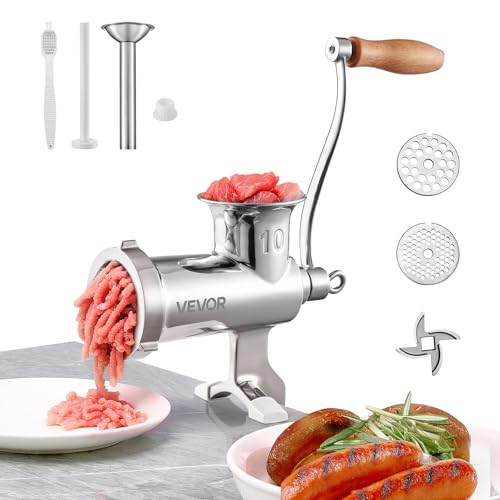
Clamp jaw width is a specification nobody reads and everybody feels: a grinder whose clamp cannot open wide enough for your worktop simply does not mount. VEVOR specifies a 1.8-inch clamp on this stainless model, which covers the thick worktops and butcher’s blocks that defeat narrower clamps, and positions the tool for restaurant and small butcher’s shop duty as well as home kitchens.
Two grinding plates and a sausage stuffer complete a workmanlike package in rust-proof stainless. This is a grinder for places where the tool works often and gets hosed down after — a farm shop, a small deli making house sausage, a keen home charcutier. The build brief is durability and sanitation over delicacy, and it reads honestly in that role.
Strengths
- 1.8-inch clamp jaw fits thick worktops and blocks
- Stainless build sanitises easily for frequent use
- Plates and sausage stuffer included
Trade-offs
- Utilitarian finishing — function over beauty
- Heavier-duty than a small household strictly needs
- Clamp-only mounting, like most stainless models here
| Body | Stainless steel |
| Clamp | 1.8-inch jaw |
| Included | 2 grinding plates, sausage stuffer |
| Use | Home, restaurant, butcher’s shop |
Choose this VEVOR when the mounting question is your deciding factor or when the grinder will work several days a week. The wide clamp opens installations — thick farmhouse tables, workbench tops, commercial counters — that rule out half the category, and stainless construction suits food-business hygiene routines. Home users with a chunky worktop should measure theirs before ordering anything in this guide; if the number is large, this pick is probably your shortlist of one.
Best for: thick worktops, farm shops and frequent grinders / Not suited for: occasional users who want the lightest, cheapest tool
Check on Amazon — check the current price on Amazon before you decide, and confirm the size, colour or configuration in the review above is the one selected on the listing.

VEVOR Manual Meat Grinder #8, 304 Stainless Steel with Steel Table Clamp — Best Mid-Size Value
If the Huanyu #M8 is the polished generalist, this VEVOR #8 is its value-minded sibling: same productive size class, 304 stainless construction, steel table clamp, two cutting plates and a sausage tube, aimed by its maker at beef, chilli and pork. The #8 format is the one most home grinders settle on after outgrowing a #5, because the throat takes honest cubes and the cranking rhythm stays friendly across a family batch.
Value here does not mean flimsy; it means the money sits in the steel and the plates rather than in finishing flourishes. For chilli meat ground coarse, pork for meatballs and dumplings, and a first run at homemade sausage, the kit is complete on arrival. Dishwasher-friendly stainless manners keep the cleanup proportional to the batch.
Strengths
- #8 size is the home-grinding sweet spot
- 304 stainless at a value tier position
- Two plates and sausage tube in the box
Trade-offs
- One sausage tube versus the Huanyu’s stuffer setup
- Finishing is functional rather than premium
- Same clamp-edge requirement as its rivals
| Size | #8 |
| Body | 304 stainless steel |
| Included | 2 cutting plates, 1 sausage tube |
| Mounting | Steel table clamp |
This is the grinder to buy when the decision is ‘a proper #8, stainless, without paying for polish’. It will be the main grinder in most kitchens that own it, handling the weekly mince and the monthly sausage batch with the same uncomplaining competence. Spend the savings on a second plate grind or good casings. Owners who later escalate to electric usually keep an #8 manual like this one as the power-cut, camp and small-batch backup — a role it fills perfectly.
Best for: value buyers who want a full-size stainless #8 / Not suited for: buyers who want the most complete stuffer kit included
Check on Amazon — check the current price on Amazon before you decide, and confirm the size, colour or configuration in the review above is the one selected on the listing.

Phaniteces Manual Meat Grinder #10 with Steel Table Clamp and 3 Sausage Tubes — Best for Sausage Making
Most grinders treat sausage as an accessory; this #10 treats it as the headline. The Phaniteces arrives as a heavy-duty hand crank mincer and sausage stuffer maker in one, with a steel table clamp and three sausage tubes covering the casing sizes home sausage makers actually use, from slim links to plumper fresh sausage.
The #10 throat supports the workflow sausage demands: grind a batch, season, then stuff — with the larger format keeping both passes moving. Its stated territory spans home kitchen, restaurant and outdoor use, and the clamp-on format travels between them. Three tubes matter more than they sound: casing choice is how sausage styles differ, and a kit that includes the range removes the accessory order that delays a first sausage day by a week.
Strengths
- Three sausage tubes included — the sausage-first kit
- #10 format keeps grinding and stuffing moving
- Heavy-duty build for home, restaurant and outdoor use
Trade-offs
- Larger and heavier to store than #5/#8 models
- Brand support is thinner than LEM or Huanyu
- Over-sized for a weekly one-pound mince household
| Size | #10 |
| Mounting | Steel table clamp |
| Included | 3 sausage tubes |
| Colour | Silver |
Buy this if sausage is the reason the grinder is entering your kitchen. The combination of #10 capacity and a three-tube kit means breakfast links, Italian-style fresh sausage and larger casings are all first-weekend projects, and the same machine grinds the meat for them. Households whose grinding is mostly burgers and mince will find an #8 more proportionate; households dreaming in casings should start here and spend their learning curve on seasoning and stuffing technique instead of equipment limits.
Best for: sausage makers who want capacity and tubes in one box / Not suited for: small households grinding a pound at a time
Check on Amazon — check the current price on Amazon before you decide, and confirm the size, colour or configuration in the review above is the one selected on the listing.

Huanyu Manual Meat Grinder, Heavy Duty Stainless Steel Hand Crank Machine — Best for Pet Food and Weekly Use
Raw pet food has quietly become one of the main reasons households buy a hand grinder, and it changes the priorities: hygiene and washability outrank tradition, batch sizes are moderate and frequent, and the tool lives in a normal kitchen, not a processing shed. Huanyu’s space-saving stainless machine fits that brief precisely, and its listing names pet food alongside beef and sausage without embarrassment.
Dishwasher-safe stainless is the core of the appeal — after raw poultry or organ meats, a full hot machine wash is the cleanup standard most owners actually want. The compact format stores in a cupboard rather than colonising a counter, and the hand crank layout handles the moderate, regular batches of a feeding routine comfortably.
Strengths
- Dishwasher-safe stainless suits raw pet-food hygiene
- Space-saving format for normal kitchens
- Equally capable for beef and sausage between pet batches
Trade-offs
- Moderate batch size — not a whole-animal tool
- Bone is beyond any hand grinder here; meat and soft tissue only
- Premium over basic cast iron equivalents
| Body | Stainless steel |
| Care | Dishwasher safe |
| Design | Space-saving |
| Use | Beef, sausage, pet food |
A necessary honesty for pet-food buyers: hand grinders grind meat, organs and soft tissue — not weight-bearing bones, which defeat manual augers and can damage plates. Within that boundary, this Huanyu is the most sensible pet-food pick in the guide because its cleanup matches the task’s hygiene demands and its size matches the task’s rhythm. The same virtues serve any weekly small-batch grinder, which is why it also appears in this cluster’s hand crank guide wearing a different badge and a different argument.
Best for: raw pet-food makers and weekly small-batch grinders / Not suited for: anyone expecting to grind bone or process whole animals
Check on Amazon — check the current price on Amazon before you decide, and confirm the size, colour or configuration in the review above is the one selected on the listing.

LEM Products #10 Clamp-On Hand Grinder — Best Traditional Cast Iron
Some buyers want the modern answer; some want the original one, maintained properly. LEM’s #10 clamp-on is cast iron with tin plating in the classic pattern, from a company whose customers process game seriously. The tin layer protects the iron, the #10 format feeds meat at a satisfying rate, and the whole object has the planted, mechanical honesty that plastic and light steel cannot imitate.
In this guide to hand grinders generally — rather than the crank-focused companion — the LEM represents the heritage end of the category: the tool for hunters’ cabins, farmhouse kitchens and anyone who believes a grinder should be repairable, standard-sized and effectively immortal. Its care ritual is the price of admission: dry it, oil the working faces, store it dry.
Strengths
- #10 capacity in the classic cast iron pattern
- Tin plating moderates iron’s rust appetite
- Specialist brand with standard-size parts ecosystem
Trade-offs
- Requires the cast iron care ritual after every use
- Heaviest style of grinder in this guide
- Clamp needs a proper edge to mount
| Size | #10 |
| Body | Cast iron, tin plated |
| Mounting | Table/counter clamp |
Heritage tools earn their keep across decades, and the economics here are compelling for the right owner: one purchase, standard #10 plates and knives available indefinitely, no motor or electronics to obsolesce. The LEM suits the household that grinds seasonally and substantially — game, a pig share, a freezer-filling sausage day — and keeps its tools the way it keeps cast iron pans. If that description fits, no stainless convenience pick will satisfy you as completely as this iron one will.
Best for: traditionalists, hunters and seasonal batch processors / Not suited for: dishwasher-only, low-maintenance households
Check on Amazon — check the current price on Amazon before you decide, and confirm the size, colour or configuration in the review above is the one selected on the listing.
Comparison Table
| Pick | Badge | Key spec | Best for |
|---|---|---|---|
| Huanyu Manual Meat Grinder, 304 Stainless Steel #M8 with Sausage Stuffer | Best Overall | #8 304 stainless, 2 plates, stuffer, dishwasher safe | households wanting one do-everything hand grinder |
| VEVOR Manual Stainless Steel Meat Grinder with 1.8-Inch Clamp | Best Heavy-Duty Stainless | Stainless, 1.8in clamp, 2 plates + stuffer | thick worktops, farm shops and frequent grinders |
| VEVOR Manual Meat Grinder #8, 304 Stainless Steel with Steel Table Clamp | Best Mid-Size Value | #8 304 stainless, 2 plates, value tier | value buyers who want a full-size stainless #8 |
| Phaniteces Manual Meat Grinder #10 with Steel Table Clamp and 3 Sausage Tubes | Best for Sausage Making | #10, 3 sausage tubes, stuffer-focused | sausage makers who want capacity and tubes in one box |
| Huanyu Manual Meat Grinder, Heavy Duty Stainless Steel Hand Crank Machine | Best for Pet Food and Weekly Use | Stainless, dishwasher safe, space-saving | raw pet-food makers and weekly small-batch grinders |
| LEM Products #10 Clamp-On Hand Grinder | Best Traditional Cast Iron | #10 cast iron, tin plated, clamp-on | traditionalists, hunters and seasonal batch processors |
Read the table as a map, not a verdict. The right best hand meat grinders pick depends on how you actually cook, brew, grind or live day to day, and the sections after the table explain the trade-offs behind each row in plain language.
How to Choose a Hand Meat Grinder: Size, Steel, Iron and Mount
Size first, because it governs everything else. Manual grinders use the plate-number system: #5 machines are compact and suit a pound or two; #8 is the household sweet spot for family batches and sausage days; #10 moves meat noticeably faster per crank and suits seasonal volume. Your arm is the motor, so bigger is not automatically better — a #10 is wasted on a weekly pound of mince and a #5 is a punishment on a deer. State your typical batch honestly and buy the number that matches it.
Material second. Stainless steel — especially 304 — is the hygienic, low-care choice: dishwasher safe, rust-proof, ideal for frequent small batches and pet food. Cast iron is the traditional, heavy, standard-sized choice: cheaper per unit of capacity, effectively immortal, and wedded to a dry-and-oil ritual after washing. Neither grinds better; the knife-and-plate partnership decides texture, and both materials house excellent partnerships. Choose by your cleaning temperament and use rhythm.
Mounting third, and practically. Most hand grinders clamp to an edge; measure your worktop’s thickness and check underneath for aprons or lips, and note the VEVOR in this guide whose 1.8-inch clamp exists for thick tops. If your kitchen offers no clampable edge at all, the hand crank companion guide covers a suction-base model built for exactly that problem. A grinder that cannot mount securely cannot grind well, full stop — auger pressure needs a fixed frame.
Finally, budget with the tool’s lifespan in view. Manual grinders do not obsolesce; a sound one serves for decades and its wear parts — knives and plates — are cheap standard items. The budget tier buys cast iron value, the mid tier buys stainless convenience or accessory generosity, and the premium spent on a specialist brand buys parts support and fit. Cost per year is tiny in every tier, so let batch size and care preference decide, not the headline figure.
One practical test before ordering any clamp model: walk to your intended worktop with a tape measure. Record the edge thickness, check underneath for drawers, aprons or lips that intrude into the clamp’s swing, and confirm a seated person or standing cook can crank with the handle clearing the counter’s face through its full circle. Two minutes of measuring prevents the category’s commonest return reason — a good grinder that simply cannot mount in the kitchen it was bought for — and tells you immediately whether the wide-clamp or suction designs are your real shortlist.
Hand Grinder Safety and the Pet-Food Boundary
Two safety topics belong in any honest hand grinder guide. The first is the pusher rule: the auger pulls material down with real force, and fingers must never substitute for the pusher tool, especially in the last cubes of a batch when the throat looks empty and attention drifts. Keep the pusher in your feeding hand for the entire session and teach every helper the same rule before their first crank.
The second is bones. Manual grinders are meat tools. Soft tissue, organs and well-trimmed meat pass happily; weight-bearing bones and hard frozen chunks stall the auger, strain the mount and can chip a knife edge or crack a plate. Pet-food recipes that call for bone belong to specialist heavy grinders or to pre-ground bone products, not to any machine in this guide. Recipes built on meat, organs and soft tissue, by contrast, are exactly what the stainless picks here serve well — with dishwasher sanitation as the finishing step.
Hygiene rounds out the picture. Grind cold, work in batches that return to refrigeration, and wash the tool immediately — dried meat residue is the enemy of both sanitation and future good temper. Stainless picks go through the dishwasher where the maker allows; iron picks get hot soapy water, complete drying and a whisper of oil on the cutting faces. A grinder treated this way is a food-safe tool for decades; a grinder left dirty overnight is a chore with a crank.
A last hygiene habit separates careful households from lucky ones: grind in an order that respects contamination. Vegetables and cooked ingredients first if they share a session, raw poultry last among meats, and a full wash before anything ready-to-eat touches the machine. The grinder does not know what it ground an hour ago; the cook has to be its memory. Written into a routine, this costs no time at all — it is simply the order you were going to work in anyway, chosen deliberately instead of by chance.
Maintaining a Hand Grinder: Sharpening, Storage and Spare Parts
A hand grinder’s maintenance list is short enough to memorise: wash, dry, protect the cutting pair, and store the machine assembled or with its parts nested safely. The cutting pair — knife and plate — is where performance lives. Both parts wear by friction against each other, which is why they should always be stored together and replaced or professionally sharpened together; a new knife against a dished old plate cuts no better than the old pair did. A simple test tells you when attention is due: the grinder starts demanding more effort and the grind’s particles lose their clean, crumbly definition.
Storage discipline differs by material. Stainless grinders ask only for dryness. Cast iron asks for the full ritual — complete drying, warmth if your kitchen is damp, and a thin film of food-safe oil on knife and plate faces — and repays it with indefinite life. Wrapping the cutting pair in an oiled cloth inside the grinder body is the traditional solution and still the best one. Keep the pusher with the machine; it is the part most often lost and the one part safety depends on.
Spares are this category’s quiet luxury. Plates in different grinds, replacement knives and extra sausage tubes follow long-standing size standards for the numbered formats, so a #8 or #10 machine bought today can be re-plated, re-knifed and re-tubed for years from multiple suppliers. Before buying any manual grinder, confirm its size number and that standard parts fit it; a machine with a proprietary plate is a machine with an expiry date, which defeats the entire point of choosing manual.
How to Grind Meat by Hand: The Full Sequence From Cube to Cleanup
This is the complete working method for any pick in this guide. Learn it once and every manual grinder you ever meet will behave.
- Trim and cube: remove hard sinew, silverskin and any bone or gristle chunks, then cube the meat to suit your grinder’s throat — smaller for a #5, generous one-inch pieces for #8 and #10 machines. Mix fat and lean cubes together now for an even blend.
- Chill the cubes on a tray until stiff at the edges, roughly thirty minutes in the freezer, and chill the grinder’s knife, plate and auger alongside. Cold fat cuts; warm fat smears — this step is the texture of your finished grind.
- Mount and assemble: clamp the grinder firmly (or seat it per its design), fit auger, knife and plate with the knife’s cutting edges against the plate, and tighten the front ring snug. A loose ring means a wandering knife and a smeared grind.
- Grind at a steady rhythm, feeding a few cubes at a time with the pusher. Catch the grind in a cold bowl. For finer results, chill and re-grind through the finer plate rather than forcing a fine plate on the first pass.
- If stuffing sausage, swap to the tube, slide on soaked casings, and re-fill the hopper with the seasoned grind, cranking slowly while a partner guides the casing off the tube with even tension.
- Clean immediately: disassemble fully, wash hot and soapy (or dishwasher for stainless where allowed), dry completely, oil iron cutting faces lightly, and store the knife and plate wrapped or oiled so their edges stay true.
Notice what the sequence never includes: force. A hand grinder working correctly turns with steady, moderate resistance, and any spike in effort is information — sinew on the knife, a warming batch, a loosening mount. Stop, reverse a quarter-turn, fix the cause, continue. That conversation between cook and tool is the thing electric grinding removes, and it is why hand-ground texture, done properly, is so consistently good.
Finally, portion the grind before it warms: weigh and wrap in recipe-sized amounts, flatten freezer bags for fast thawing, and label with the blend and date. The grinder’s job ends at the plate, but the cook’s job ends at a freezer full of usable portions. Households that build this habit find the hand grinder paying for itself in a currency beyond money — weeknight meals that start from mince they trust, seasoned the way the house likes it, ground from cuts they chose themselves.
Common Buying Mistakes
Expecting a hand grinder to grind bones. It will not, and forcing the attempt damages knives and plates. Manual grinders are for meat, fat and soft tissue; bone-in pet food needs specialist equipment or pre-ground bone.
Skipping the chill because the batch is small. Even a pound smears when warm. Twenty minutes of chilling is the difference between defined mince and paste, at every batch size, in every grinder in this guide.
Leaving the grinder unwashed ‘until later’. Later means dried, cemented residue and a sanitation problem. Wash immediately — the job takes three minutes fresh and thirty minutes postponed.
Buying by price without checking the size number. A bargain #5 asked to do #10 work makes a miserable afternoon and an unfair reputation for hand grinding. The number on the grinder is its capacity promise; match it to your batches.
Storing the knife and plate loose in a drawer. The knife edge and plate face are a matched cutting pair; drawer rattling dulls both. Store them wrapped, oiled or in the grinder body so the partnership survives storage.
Assuming the dishwasher question has one answer. Stainless picks in this guide are dishwasher safe; cast iron must never soak or machine-wash its way to rust, and some stainless models still prefer hand washing for their cutting edges. Read your own model’s care basis — stated in each review above — rather than applying a blanket rule. More grinders are ruined by confident, wrong cleaning than by any amount of honest grinding, and the damage is always discovered at the start of the next session, which is the worst possible time.
Final Recommendation
Most households should buy the Huanyu #M8: the balanced #8 format in dishwasher-safe stainless with plates and stuffer included. Thick-worktop owners and frequent grinders should look at the wide-clamp VEVOR; value buyers at its #8 sibling; sausage-first buyers at the three-tube Phaniteces #10; pet-food makers at the compact Huanyu; and traditionalists at the LEM iron #10, which will outlive us all if oiled. Six jobs, six answers — the badge that describes your kitchen is your grinder.
Whichever you choose, learn the sequence in the how-to section before the first batch: trim, chill, mount, crank, clean. Hand grinding rewards method and punishes hurry, and a cook who accepts those terms gets a tool — and a texture — that no bargain electric can take away.
And if the grinder is a gift — for a sausage enthusiast, a raw-feeding friend, a young cook setting up a serious kitchen — include the lesson with the tool: a note about chilling meat and respecting the pusher turns a good present into a competent grinder owner, which is the outcome that actually matters.
One more encouragement for the hesitant: your first batch does not need to be sausage. A pound of beef, ground coarse for chilli, teaches the whole method in ten minutes and forgives every beginner wobble — start there, and let confidence, not ambition, set the second batch.
Trust the method, size the machine to the batch, keep the meat cold, and the rest is simply rhythm.
Grind once a week with method and the machine disappears into your cooking life, which is the highest compliment a working tool can earn — it stops being equipment and becomes simply how your kitchen makes mince, sausage and pet food, on your terms and your schedule.
The three picks most readers end up choosing between are Huanyu Manual Meat Grinder, 304 Stainless Steel #M8 with Sausage Stuffer, VEVOR Manual Stainless Steel Meat Grinder with 1.8-Inch Clamp, VEVOR Manual Meat Grinder #8, 304 Stainless Steel with Steel Table Clamp — check price on Amazon for each, compare the configurations against the reviews above, and buy the one whose badge matches your kitchen.
Keep exploring the cluster before you check out — these companion guides cover the neighbouring questions buyers in this category usually ask next:
- Best Hand Crank Meat Grinders
- Best Meat Grinders
- Best Electric Meat Grinders
- Best Meat Grinders For Deer
- Best Meat Grinder Attachments
Frequently Asked Questions
How much meat can a hand grinder handle at once?
Comfort zones run by size: a #5 handles a pound or two happily, an #8 manages family batches and sausage days of several pounds, and a #10 suits seasonal volume. You can always grind successive batches — the limit is your arm and the meat’s temperature, not the machine.
Can a hand meat grinder make pet food?
Yes, for meat, organ and soft-tissue recipes, and stainless dishwasher-safe models suit the hygiene routine best. It cannot grind weight-bearing bones — no manual grinder in this guide can — so bone-in recipes need pre-ground bone or specialist equipment.
Is a hand grinder better than an electric one?
For texture control, silence, portability and small-to-medium batches, often yes. For large volume and zero effort, electric wins. Many serious households own both: electric for the season’s bulk, manual for weekly freshness and camp use.
Why does my hand grinder keep clogging?
Almost always sinew or silverskin wrapping the knife, or meat too warm. Trim thoroughly, chill until stiff-edged, and clear a clog by reversing a quarter-turn and removing the wrapped fibres rather than forcing forward.
How long will a hand meat grinder last?
Decades, with ordinary care. The body has no failure-prone parts; knives and plates are inexpensive standard replacements. Cast iron needs rust discipline, stainless needs almost nothing, and both outlast electric equivalents comfortably.
Do I need a separate sausage stuffer?
Not to start. Most picks here include stuffing tubes that mount on the grinder, which handle home sausage volumes well. Dedicated stuffers earn their place when sausage becomes a high-volume, regular production rather than a project.
Can I grind vegetables or other foods in a hand meat grinder?
Yes — manual grinders mince vegetables, cooked grains, peppers and mushrooms effectively, which is why several listings mention them. Clean the machine thoroughly between meat and vegetable work, and expect soft, wet vegetables to need mixing with something firmer for the auger to grip. It is a capable mincer beyond meat, as long as meat-level hygiene separates the sessions.
Are hand grinders suitable for older cooks or smaller hands?
Generally yes, with the right size: a #5 or #8 in good order, fed cold trimmed meat, cranks with moderate, steady effort and no sudden force. The technique matters more than strength — rhythm beats power. Anyone who finds even that demanding should look at the electric companion guides rather than struggling with a manual tool that will end up unused.