Disclosure: airfryerkitchensupply.com is reader-supported. When you buy through links on our site, we may earn an affiliate commission at no extra cost to you.
Where to buy
The fastest way to buy best hand crank meat grinders is through Amazon, where every pick below that carries a verified listing can be checked for current availability in a couple of clicks. Picks with a link have been cross-checked against Amazon’s own catalogue data before this guide was published, so the link lands on the exact model reviewed, not a look-alike. Where a pick is described without a link, it is an unlinked recommendation: use the full product name in Amazon search and match the details in its review section before you order. Prices move constantly on measuring tools, small appliances and footwear alike, so this guide never prints a fixed price — use the check-price links to see today’s figure.
- LEM Products #10 Clamp-On Hand Grinder (Best Overall) — Check the current price on Amazon
- Huanyu Manual Meat Grinder, Heavy Duty Stainless Steel Hand Crank (Best Stainless Steel) — Check the current price on Amazon
- VEVOR Manual Meat Grinder, Heavy Duty Cast Iron with Steel Table Clamp (Best Budget Cast Iron) — Check the current price on Amazon
- VEVOR Manual Meat Grinder #5, 304 Stainless Steel with Steel Table Clamp (Best Compact Stainless) — Check the current price on Amazon
- CucinaPro Meat Grinder with Tabletop Clamp, Cast Iron (Best Classic Design) — Check the current price on Amazon
- LHS Manual Meat Grinder with Stainless Steel Blades, Suction Base (Best No-Clamp Option) — Check the current price on Amazon
The best hand crank meat grinders ask something modern appliances do not: your arm. In return they offer control no budget electric matches — you feel the meat feed, you set the pace, you stop the instant the texture is right — plus silence, portability and a tool that cannot burn out mid-season. This guide compares six hand crank models across the category’s real divide: traditional cast iron clamp-ons, modern stainless machines and one suction-base design for kitchens with nothing to clamp to.
Hand cranking is not nostalgia for its own sake. Hunters processing game at camp, sausage makers who grind a few pounds at a time, off-grid and small-space cooks, and anyone burned by a cheap electric grinder’s stripped gears all have practical reasons to crank. The reviews below are honest about the effort involved and about batch sizes: a hand grinder is a superb tool inside its working range and the wrong tool beyond it, and each pick’s verdict says where that line sits.
After the reviews, the buying guide explains grinder sizes, plate selection and the chilling technique that decides grind quality more than any brand does.
This article is the crank-specific half of a pair. Its companion covers hand grinders in the round — hygiene, pet food and household roles — while this one stays with the crank itself: mounting, sizing, plates and the seasonal work these machines were invented for. Two benchmark models appear in both, deliberately, because a category guide without its benchmark is incomplete; they are argued from different angles in each, and the remaining picks are unique to this page.
In this guide
Quick Picks
If you only read one section, make it this one. These six best hand crank meat grinders earned their places for different reasons, and the badge on each pick in this list is the same badge used at the top of its full review further down, so you can jump straight from the shortlist to the detail that matters to you.
- LEM Products #10 Clamp-On Hand Grinder — Best Overall. The classic #10 clamp-on from a brand built on game processing: cast iron with tin plating, a proper table clamp and the throat size that makes hand cranking feel reasonable instead of heroic. — check price on Amazon
- Huanyu Manual Meat Grinder, Heavy Duty Stainless Steel Hand Crank — Best Stainless Steel. A stainless hand crank grinder that goes in the dishwasher — the low-maintenance answer to cast iron, sized for home kitchens, small restaurants and outdoor use. — check price on Amazon
- VEVOR Manual Meat Grinder, Heavy Duty Cast Iron with Steel Table Clamp — Best Budget Cast Iron. Heavy cast iron, a steel table clamp, two cutting plates and three sausage tubes in the box — the most complete budget starter kit for grinding and stuffing by hand. — check price on Amazon
- VEVOR Manual Meat Grinder #5, 304 Stainless Steel with Steel Table Clamp — Best Compact Stainless. A #5-format 304 stainless grinder with two plates and four sausage tubes — compact, rust-proof and sized for chilli meat, pork and small family batches. — check price on Amazon
- CucinaPro Meat Grinder with Tabletop Clamp, Cast Iron — Best Classic Design. The old-school tabletop grinder — heavy cast iron, two cutting disks, sausage-making ability and a portable clamp design aimed squarely at homemade burgers and fresh mince. — check price on Amazon
- LHS Manual Meat Grinder with Stainless Steel Blades, Suction Base — Best No-Clamp Option. A suction-base manual grinder with stainless blades that mounts to a smooth counter with no clamp and no suitable table edge required — the renter-friendly hand grinder. — check price on Amazon
How These Picks Were Chosen
Candidates had to be genuinely hand crank machines — auger, knife, plate and crank — verified as manual models in the catalogue data, not electric grinders with a manual-sounding name. Within that set, picks were chosen to cover the category’s three construction families (cast iron clamp-on, stainless clamp-on, suction base) and its useful size range from #5 to #10, because size is the specification that decides how a hand grinder feels in use.
Accessory honesty was the second filter: plates and sausage tubes included in the box are stated in each review from the verified listing, so a buyer can compare a two-disk classic against a four-tube modern kit without guessing. The third filter was role clarity — each pick had to be the best answer to a distinct question, from game processing to renter-friendly grinding, and badges were assigned on that basis.
Effort claims were treated sceptically throughout. No hand grinder is effortless with warm, sinewy meat; all of them are pleasant with well-chilled, well-trimmed cubes. The reviews therefore describe each tool’s behaviour under proper technique, and the how-to section teaches that technique, rather than repeating marketing promises about cranking that the physics does not support.
One more word on sizing honesty, because it shaped the shortlist: listings for manual grinders rarely state throughput, and this guide does not invent any. Instead, each review describes the batch sizes its format handles comfortably, in the qualitative terms experienced grinders use — a pound or two, a family batch, a season’s animal. Those descriptions come from the format’s physics: throat diameter, plate size and the sustainable rhythm of a human arm. Any guide promising electric-style throughput from a crank is selling something; this one would rather sell you the right size.
The 6 Best Hand Crank Meat Grinders

LEM Products #10 Clamp-On Hand Grinder — Best Overall
LEM built its name on hunters and home processors, and this #10 clamp-on grinder is the traditional tool in its purest form: cast iron body, tin plating to protect the iron, a clamp that bites onto a table or counter edge, and a hand crank driving a #10 plate system. The #10 size matters more than any other specification here — the throat and plate are large enough that meat cubes feed willingly and each crank revolution moves a meaningful amount of meat.
In hand-crank terms, that translates to rhythm instead of wrestling. You settle into a steady turn, feed with the other hand, and a few pounds of venison, pork shoulder or beef trim become grind in minutes. The classic design has no motor to burn out, no cord to manage and nothing electronic to fail during hunting season, which is precisely when these tools earn their keep.
Strengths
- #10 plate size feeds meat fast for a manual grinder
- Cast iron body with protective tin plating
- Backed by a specialist game-processing brand
Trade-offs
- Cast iron needs drying and light oiling after washing
- Clamp needs a suitable table or counter edge to bite
- Heavier than the stainless and suction-base alternatives
| Size | #10 |
| Body | Cast iron, tin plated |
| Mounting | Table/counter clamp |
Choose the LEM if your grinding is seasonal and serious — a deer or two, a pig share, a big sausage weekend. The #10 format also means plates and knives follow a widely available standard size, so replacements and additional plate grinds are easy to source years from now. Treat the iron kindly after washing, keep the knife and plate faces lightly oiled in storage, and this is the grinder that gets handed down. Among hand crank models it is the benchmark the others in this guide are measured against.
Best for: hunters, game processors and sausage makers doing real batches by hand / Not suited for: apartment cooks with no clampable edge or anyone who hates tool care
Check on Amazon — check the current price on Amazon before you decide, and confirm the size, colour or configuration in the review above is the one selected on the listing.

Huanyu Manual Meat Grinder, Heavy Duty Stainless Steel Hand Crank — Best Stainless Steel
The honest objection to classic hand grinders is not the cranking; it is the cleanup ritual cast iron demands. Huanyu removes it. This grinder is stainless steel, sold as dishwasher safe, and built in a space-saving format for home kitchens that grind beef, make sausage or prepare pet food without wanting a cast-iron maintenance hobby attached.
The hand crank machine layout is conventional in the best way — feed tray, auger, knife, plate, crank — so technique transfers from any manual grinder you have used before, and the stainless construction tolerates the wet, acidic reality of raw meat work without the rust anxiety that follows iron into a damp cupboard. For restaurants and keen home cooks alike, wash-and-done is a genuine feature.
Strengths
- Stainless steel — dishwasher safe, no seasoning ritual
- Space-saving footprint for real kitchens
- Versatile across beef, sausage and homemade pet food
Trade-offs
- Costs more than basic cast iron equivalents
- Smaller batches than the #10 and #22-class tools
- Stainless is lighter, so clamp discipline matters while cranking
| Body | Stainless steel |
| Care | Dishwasher safe |
| Use | Beef, sausage, pet food; home/restaurant/outdoor |
This is the pick for the cook who grinds weekly rather than seasonally. Weekly use punishes maintenance-heavy tools, because a grinder that needs drying, oiling and careful storage after every small batch quietly stops being used. The Huanyu asks for none of that: grind, wash, dry on the rack, done. It also suits raw pet-food preparation, where hygiene and easy sanitising matter more than tradition. If your batches are a few pounds at a time and your patience for tool care is limited, this is the hand crank grinder that stays in rotation.
Best for: weekly home grinders and raw pet-food makers who want dishwasher cleanup / Not suited for: traditionalists who prefer cast iron heft and ritual
Check on Amazon — check the current price on Amazon before you decide, and confirm the size, colour or configuration in the review above is the one selected on the listing.

VEVOR Manual Meat Grinder, Heavy Duty Cast Iron with Steel Table Clamp — Best Budget Cast Iron
VEVOR’s cast iron grinder is the value play of this guide: a heavy iron body on a steel table clamp, one cutting blade, two cutting plates for different grinds, and three sausage tubes so the same purchase covers grinding and stuffing. For a first hand grinder, that completeness matters — beginners rarely know which accessories they need until the first sausage day arrives without them.
The listing’s own examples — beef, pepper, mushroom — hint at the tool’s wider life as a food mincer beyond meat, and cast iron’s mass works in your favour while cranking: the body stays planted, the auger turns against a stable frame, and the whole machine feels like the farmhouse tool it imitates. It asks for the standard iron care in return: wash, dry thoroughly, oil lightly.
Strengths
- Two plates and three sausage tubes included
- Heavy cast iron body stays planted while cranking
- Lowest-cost complete grinding-plus-stuffing kit here
Trade-offs
- Cast iron care routine is mandatory, not optional
- Budget-tier finishing is functional rather than refined
- Clamp mounting only — no suction alternative in the box
| Body | Cast iron |
| Included | 1 blade, 2 cutting plates, 3 sausage tubes |
| Mounting | Steel table clamp |
Buy this to learn whether hand grinding suits your kitchen before spending premium money. It will grind burgers, mince for dumplings and stuff a first batch of sausages without another purchase, and its limitations — iron care, basic finishing — are the honest limitations of the tier rather than hidden flaws. Many owners keep it for years as the camp, cabin or backup grinder even after upgrading, because a tool with no motor has no failure mode that a wash and an oil cannot fix.
Best for: first-time hand grinders and budget sausage makers / Not suited for: anyone unwilling to dry and oil cast iron after use
Check on Amazon — check the current price on Amazon before you decide, and confirm the size, colour or configuration in the review above is the one selected on the listing.
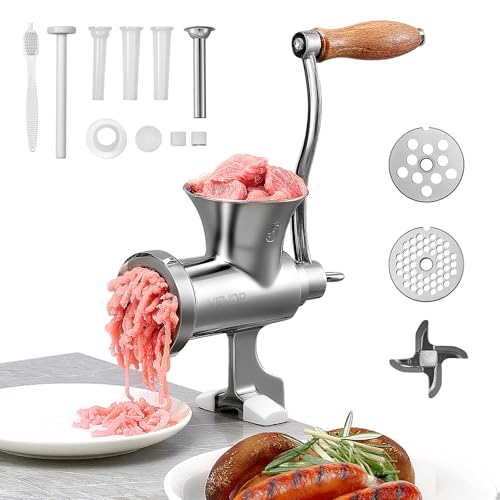
VEVOR Manual Meat Grinder #5, 304 Stainless Steel with Steel Table Clamp — Best Compact Stainless
The #5 is the small end of the numbered grinder formats, and VEVOR builds this one in 304 stainless with a steel table clamp, two cutting plates and a generous four sausage tubes. That combination suits the way most households actually grind: a chilli’s worth of beef, a small pork batch for dumplings or meatballs, a few sausages at a time — work a #10 would swallow but a #5 handles without dominating the cupboard.
Stainless 304 is the right material at this size. Small grinders live in drawers and get washed often relative to their use, and a rust-proof body with dishwasher-friendly manners keeps a compact tool convenient instead of precious. The clamp format keeps it honest under crank load, which suction bases at this size sometimes are not.
Strengths
- 304 stainless — rust-proof and easy to sanitise
- Four sausage tubes included, most in this guide
- Compact #5 format stores in a drawer
Trade-offs
- #5 throat means smaller cubes and slower big batches
- Not the tool for whole-animal processing days
- Clamp needs an edge of suitable thickness
| Size | #5 |
| Body | 304 stainless steel |
| Included | 2 cutting plates, 4 sausage tubes |
| Mounting | Steel table clamp |
Think of this as the apartment-and-small-family grinder. It earns its place if your grinding is measured in pounds per session rather than per animal, and if storage space is a real constraint. The sausage tube count is a quiet bonus — different tube sizes open up everything from breakfast links to larger salami-style casings without an accessory hunt. Paired with a habit of chilling meat well before grinding, this little stainless machine produces grind quality that embarrasses many cheap electric units.
Best for: small households grinding chilli, pork and small sausage batches / Not suited for: high-volume processors who need a #10 or larger throat
Check on Amazon — check the current price on Amazon before you decide, and confirm the size, colour or configuration in the review above is the one selected on the listing.

CucinaPro Meat Grinder with Tabletop Clamp, Cast Iron — Best Classic Design
CucinaPro’s grinder is the design your grandparents would recognise instantly: cast iron, tabletop clamp, two cutting disks, and a hand crank that asks nothing of the electrical grid. Its listing leads with homemade burger patties and fresh ground beef, which is exactly the centre of gravity for this tool — weeknight-scale grinding with farmhouse manners.
Portability is its understated strength. A clamp-on iron grinder travels to a cabin, a hunting camp or a friend’s sausage day in a way a countertop electric cannot, and it sets up on any sturdy table edge. The two disks cover coarse and fine work for most home recipes, and the sausage-maker function extends it beyond mince. As with all cast iron here: wash, dry, oil, and it will outlive its owner.
Strengths
- Timeless cast iron design, portable between kitchens
- Two cutting disks cover coarse and fine grinds
- Sausage making included alongside mincing
Trade-offs
- Two disks is fewer plates than the VEVOR kits include
- Cast iron weight and care as usual
- Basic format — no dishwasher shortcut
| Body | Cast iron |
| Included | 2 cutting disks |
| Mounting | Tabletop clamp |
| Design | Portable |
This pick serves the traditionalist and the traveller in equal measure. If your mental image of grinding involves a farmhouse table and a bowl of seasoned pork, this is your tool; if your reality involves grinding at a holiday cabin or a market stall, its clamp-and-go nature fits that too. It lacks the accessory generosity of the VEVOR cast iron kit and the stainless convenience of the Huanyu, but it counters with the longest design pedigree in the guide — a pattern of grinder that has been in continuous use for over a century because it works.
Best for: traditionalists, cabin and camp grinding, burger lovers / Not suited for: buyers who want the largest accessory kit in the box
Check on Amazon — check the current price on Amazon before you decide, and confirm the size, colour or configuration in the review above is the one selected on the listing.

LHS Manual Meat Grinder with Stainless Steel Blades, Suction Base — Best No-Clamp Option
Every clamp grinder in this guide shares one hidden requirement: a table or counter edge of the right thickness, with clearance below. Modern fitted kitchens often lack exactly that. The LHS answers with a powerful suction base that locks the grinder to a smooth countertop, so renters and fitted-kitchen owners can grind without modifying furniture or hunting for a clampable edge.
Stainless steel blades do the cutting, and the design brief is fast, effortless home grinding across meats rather than heavy seasonal processing. Suction mounting has an honest condition attached — it needs a smooth, clean, non-porous surface and a firm press to seal — but on the right counter it is secure, quick to set up and even quicker to put away, with no clamp left biting a table edge.
Strengths
- Suction base mounts where clamps cannot
- Fast setup and removal — nothing stays attached
- Stainless blades; compact home-use format
Trade-offs
- Suction needs a smooth, clean counter to hold
- Not built for the heaviest processing volumes
- Plastic-class body lacks cast iron’s planted feel
| Mounting | Suction base |
| Blades | Stainless steel |
| Colour | Black |
| Use | Home use, all meats |
Judge this grinder by its brief and it wins its category outright: it is the only pick here that works in a kitchen with no clampable edge, and that kitchen describes a large share of modern apartments. It will not process a deer, and it does not pretend to. For weekly mince, dumpling filling, burger blends and pet food in a rented flat, it converts an impossible category into a Tuesday-evening task. Keep the counter clean, press the base down firmly before the first crank, and re-seat it if a long session loosens the seal.
Best for: renters and fitted kitchens with no clampable edge / Not suited for: high-volume or game processing
Check on Amazon — check the current price on Amazon before you decide, and confirm the size, colour or configuration in the review above is the one selected on the listing.
Comparison Table
| Pick | Badge | Key spec | Best for |
|---|---|---|---|
| LEM Products #10 Clamp-On Hand Grinder | Best Overall | #10 cast iron clamp-on, tin plated | hunters, game processors and sausage makers doing real batches by hand |
| Huanyu Manual Meat Grinder, Heavy Duty Stainless Steel Hand Crank | Best Stainless Steel | Stainless hand crank, dishwasher safe | weekly home grinders and raw pet-food makers who want dishwasher cleanup |
| VEVOR Manual Meat Grinder, Heavy Duty Cast Iron with Steel Table Clamp | Best Budget Cast Iron | Cast iron, 2 plates, 3 sausage tubes included | first-time hand grinders and budget sausage makers |
| VEVOR Manual Meat Grinder #5, 304 Stainless Steel with Steel Table Clamp | Best Compact Stainless | #5 304 stainless, 2 plates, 4 sausage tubes | small households grinding chilli, pork and small sausage batches |
| CucinaPro Meat Grinder with Tabletop Clamp, Cast Iron | Best Classic Design | Cast iron tabletop clamp, 2 disks | traditionalists, cabin and camp grinding, burger lovers |
| LHS Manual Meat Grinder with Stainless Steel Blades, Suction Base | Best No-Clamp Option | Suction base, stainless blades, no clamp needed | renters and fitted kitchens with no clampable edge |
Read the table as a map, not a verdict. The right best hand crank meat grinders pick depends on how you actually cook, brew, grind or live day to day, and the sections after the table explain the trade-offs behind each row in plain language.
How to Choose a Hand Crank Meat Grinder: Sizes, Materials and Mounts
Grinder numbers — #5, #8, #10, #12 and up — describe the plate diameter and throat size, and they are the closest thing this category has to a capacity rating. A #5 suits a pound or two at a time and small households. A #8 or #10 is the home-processing sweet spot: cubes feed faster, cranking rhythm improves, and a sausage day of ten pounds is realistic. Bigger numbers exist, but in hand-crank form the human arm becomes the limiting motor, so match the size to your batches rather than buying the largest iron you can lift.
Material is the second decision. Cast iron is heavy, stable and effectively immortal, and it demands a care ritual: wash, dry completely, oil the knife and plate faces before storage, because ground-meat moisture plus iron plus time equals rust. Tin plating, as on the LEM, softens that demand without removing it. Stainless steel trades some planted weight for dishwasher freedom and zero seasoning — the right trade for weekly small-batch grinders, the wrong one for romantics. Suction-base models trade ultimate stability for mounting freedom in clamp-less kitchens.
Mounting deserves more thought than it gets. A clamp needs an edge: measure your table or counter thickness and check for an apron or lip underneath that could block the clamp screw. If no edge qualifies, do not force the issue — choose the suction design and a smooth stretch of counter. A grinder that shifts mid-crank is not merely annoying; shifting breaks the knife-to-plate contact that clean cutting depends on, and the grind turns to smear.
Budget framing: the budget tier buys cast iron kits with generous accessories, the mid tier buys stainless convenience or a specialist brand’s fit and finish, and the premium end of hand cranking is still modest compared with quality electric machines. Since a hand grinder has no motor to fail, money spent here buys decades — allocate it to the size and material that match your batches and your tolerance for care, not to the longest feature list.
Accessories deserve a closing check before you order. Count what the box includes — plates by grind, sausage tubes by size, and whether a pusher is present — against the first three jobs you actually plan. A grinder that arrives one plate short of your chilli recipe has not saved money; it has scheduled a second purchase and a delay. The kits in this guide were compared on exactly that basis, and the reviews state their contents plainly so the comparison takes seconds rather than a trip through each listing’s fine print.
Plates, Knives and Grind Texture: The Parts That Decide Quality
A grinder does not chop meat; it shears it. The auger pushes cubes against a rotating cross knife, which cuts them against the holes of a fixed plate. Everything about texture follows from that partnership. A sharp knife and a flat, true plate give clean-cut particles that cook into crumbly, juicy mince. A dull knife or a worn plate smears fat and tears protein, giving the pasty, grey grind that ruins sausage texture no matter how good the seasoning is. When a grinder ‘stops working well’, it is almost always this partnership asking for a sharpen or a replacement, not the body failing.
Plate hole sizes map to jobs. Coarse plates suit chilli meat, rustic sausage and a first pass for large batches. Medium plates are the burger and general-mince standard. Fine plates suit emulsified sausage, dumpling fillings and pet food. Two plates in the box — the pattern most picks here follow — cover the vast majority of home work; grinders with a single plate should be bought only when that plate is the one your cooking actually uses. Grinding twice, coarse then medium, is the classic technique for large or tough batches and is easier on the arm than forcing a fine plate in one pass.
Fat behaviour is the other quality lever, and it is about temperature, not hardware. Fat smears at kitchen temperature and cuts cleanly when near freezing. Chill cubed meat until it is stiff at the edges, chill the grinder’s metal parts alongside it, and work in small batches that return to the freezer between grinds on big days. Follow that discipline and a mid-priced hand grinder produces texture that shames a powerful electric fed warm meat — the honest secret of everyone whose homemade sausage gets requested.
Hand Crank vs Electric: An Honest Comparison for Home Grinders
The electric grinder’s case is obvious: volume and effortlessness. Feed it twenty pounds and it simply works, and for a household processing multiple animals each season that case is decisive. But the comparison is not one-way. Budget electrics — the ones priced against these manual machines — typically use smaller throats, lighter knives and plates, and motors that strain audibly on exactly the cold, dense meat that grinds best. Their grind quality at the price point is often worse than a hand machine’s, because the hand machine’s entire budget went into iron, steel and the cutting partnership instead of a motor.
Control is the hand crank’s second argument. You feel resistance change as fat content changes; you can stop mid-cube, reverse to clear, and grind a half-pound test batch for seasoning without committing the whole bowl. Sausage makers in particular value the stuffing pace a crank allows — slow, even, responsive to the casing in a partner’s hands. Electric stuffing at home scale is famously either too fast or a separate machine’s job.
The honest verdict is about batch profile, not ideology. A few pounds weekly, sausage projects, camp and cabin use, pet food, power-cut resilience: hand crank wins on quality per pound and per pound sterling of purchase. Tens of pounds per session, several times a season: electric earns its noise. Many experienced households end with both, and notably, the manual one is rarely the one that gets sold.
How to Use a Hand Crank Meat Grinder: Chill, Cube, Crank, Clean
Good grinding is a procedure, not a talent. This sequence works for every pick in this guide, clamp or suction, iron or steel.
- Cube the meat into pieces that fit the throat loosely — roughly one-inch cubes for #8 and #10 grinders, smaller for a #5 — trimming away hard sinew and silverskin that wrap the auger and stall the crank.
- Spread the cubes on a tray and chill until stiff at the edges but not frozen solid, about thirty minutes in the freezer. Put the grinder’s knife, plate and, if removable, the auger in to chill too.
- Mount the grinder before the meat comes out: clamp firmly to a suitable edge or press the suction base onto a clean, smooth counter, then assemble knife against plate with the cutting edges in contact and the ring snug, not forced.
- Crank at a steady, moderate rhythm and feed cubes a few at a time with the pusher — never fingers. If resistance spikes, stop, reverse a quarter turn to clear, and continue; forcing a hand grinder smears the grind and strains the mount.
- For fine textures, pass the coarse grind through a second time on the finer plate, keeping the meat cold between passes. Catch the grind in a chilled bowl set over ice on warm days.
- Disassemble immediately after use, wash every part in hot soapy water, and dry completely. Stainless parts may go in the dishwasher where the maker allows; cast iron gets dried on a warm stove eye and oiled lightly on the knife and plate faces before storage.
The two steps beginners skip are chilling and immediate cleaning, and they are the two that matter most. Cold meat grinds cleanly and tastes better; a grinder washed at once never develops the dried residue that makes the next session miserable. Build those habits and a hand crank grinder becomes one of the most satisfying tools in the kitchen — quiet, capable and entirely under your control.
With practice, the sequence compresses: experienced grinders chill meat as a reflex while preparing everything else, mount the machine one-handed, and clean it while the grind rests. Do not rush the learning curve by skipping steps on day one — the steps are the skill. After a dozen sessions the rhythm becomes the pleasure people describe when they defend hand grinding to sceptics: quiet, physical, exact, and finished with a bowl of mince whose contents you can vouch for completely, because your own hands put every cube through the plate.
Common Buying Mistakes
Grinding warm meat. Warm fat smears, the texture turns pasty, and cranking effort doubles. Thirty minutes of chilling fixes all three problems at once and is the cheapest quality upgrade in grinding.
Forcing the crank through resistance. A stall means sinew on the knife or an over-full throat. Reverse a quarter turn, clear it, and continue — forcing strains clamps, loosens suction seals and smears the batch you are trying to save.
Putting cast iron away damp. One damp storage can rust a plate face enough to ruin its cutting partnership with the knife. Dry iron parts completely, warm them if needed, and oil the working faces before the cupboard.
Buying a #5 for animal-processing ambitions. Size is capacity. A small grinder asked to do a season’s game will exhaust the cook and disappoint the sausage. Match the number to the batch honestly, as the reviews above lay out.
Using fingers as the pusher. The pusher exists because the auger does not distinguish meat from fingertips. Keep the pusher in hand for every cube, especially near the end of a batch when attention wanders.
Grinding in long sleeves with the crank hand near the throat. Loose cuffs, dangling jewellery and the feeding hand drifting toward the auger are how careful people have careless moments. Roll sleeves, keep the pusher in the feeding hand, and let the cranking hand do nothing but crank. The machine is simple, strong and entirely without judgement about what it pulls in — the discipline has to come from the operator, every session, including the tired last batch of a long processing day.
Final Recommendation
The LEM #10 is the benchmark pick for serious hand processing — hunters, sausage weekends, buy-for-decades buyers. The Huanyu stainless is the weekly grinder’s choice for its dishwasher manners, the VEVOR cast iron kit is the budget way in, its #5 stainless sibling is the compact small-batch answer, the CucinaPro is the classic portable, and the LHS suction model is the only pick that works where nothing can be clamped. Every one of them will outperform its owner fed warm meat and reward its owner fed cold meat — learn the chill-cube-crank routine and the badge that fits your kitchen is the right purchase.
If your batches are growing beyond what an arm wants to crank, the electric companion guides in this cluster cover the step up; but for a few pounds at a time, nothing in a motorised box matches the control of a crank in your own hand.
If you are still deciding between two badges, decide by your next grinding day rather than your dream one: the batch you will actually make this month is the batch the grinder must serve beautifully. Dream batches have a way of shrinking to real ones, and a right-sized grinder used weekly beats a heroic one used twice.
Crank well, eat well: it really is that direct a line from the handle in your hand to the texture on the plate at dinner.
The three picks most readers end up choosing between are LEM Products #10 Clamp-On Hand Grinder, Huanyu Manual Meat Grinder, Heavy Duty Stainless Steel Hand Crank, VEVOR Manual Meat Grinder, Heavy Duty Cast Iron with Steel Table Clamp — check price on Amazon for each, compare the configurations against the reviews above, and buy the one whose badge matches your kitchen.
Keep exploring the cluster before you check out — these companion guides cover the neighbouring questions buyers in this category usually ask next:
- Best Hand Meat Grinders
- Best Meat Grinders
- Best Electric Meat Grinders
- Best Meat Grinders For Home Use
- Best Sausage Stuffers
Frequently Asked Questions
Is hand cranking a meat grinder hard work?
With well-chilled, well-trimmed cubes in a correctly sized grinder, it is steady moderate effort — a few pounds takes minutes at a comfortable rhythm. Warm meat, sinew and an undersized grinder are what make it feel like a workout, and all three are avoidable.
What size hand grinder should I buy?
Match the number to the batch: #5 for a pound or two, #8–#10 for family sausage days and game. Larger plates feed faster and crank easier per pound, but the grinder itself gets heavier and larger to store.
Can a hand crank grinder make sausage, or only mince?
Both. Most picks here include sausage tubes that fit the grinder’s front, letting you stuff casings with the same machine. Crank slowly and evenly while a second person guides the casing for the best fill.
How do I stop my grind coming out mushy?
Chill everything — meat until stiff-edged, and the metal parts too — trim sinew, keep the knife sharp against the plate, and grind twice through progressively finer plates for large batches instead of forcing one fine pass.
Cast iron or stainless for a hand grinder?
Cast iron for weight, tradition and lowest cost, with a dry-and-oil care ritual. Stainless for dishwasher cleanup and zero rust worry, at a higher price and lighter feel. Both grind identically when the knife and plate are sharp.
Can I grind frozen meat in a hand grinder?
No — rock-hard frozen meat stalls the auger and can damage the knife edge or strain the mount. Aim for the stage before freezing solid: cubes stiff and icy at the edges but still yielding to a knife when cubed.
How long does it take to hand-grind a typical batch?
As a working rhythm, expect a few pounds of well-chilled, trimmed meat to take several unhurried minutes including feeding and catching — fast enough that grinding stays a step in cooking rather than an event. The pace collapses only when meat is warm, sinewy or forced through too fine a plate on the first pass, which the technique section exists to prevent.
What is tin plating on a cast iron grinder?
A thin coat of tin over the iron that slows rust and keeps the surface food-friendly, traditional on quality cast iron food tools. It moderates the care ritual rather than removing it: still dry the grinder fully after washing and oil the knife and plate faces for storage.