A backyard cookout needs a griddle that can handle a crowd, so size, stable legs and storage matter more than portability. The larger flat top griddle grills give you a wide plate, several burners and side shelves for trays and tools, and they sit well on a patio or deck.
The six models below lean toward large, cart-style cookers that work for family gatherings. We have not used these products ourselves, so confirm the cooking area, burner count and any hood or accessories on the current listing before buying.
As an Amazon Associate we earn from qualifying purchases. Links below are affiliate links, and they do not change the product information we give.
What to Look For
| Feature | Why it matters |
|---|---|
| Plate size | A wide plate cooks a full meal in one pass for a big group |
| Burners | Independent zones let you sear, cook and keep food warm |
| Shelves and storage | Side shelves and a lower rack keep tools within reach |
| Hood | A lid or hood helps with melting cheese and holding heat |
In this guide
Specs at a Glance
| Griddle | Fuel | Size class | Notes |
|---|---|---|---|
| Blackstone Iron Forged 36 inch with Hood | Propane | Large, four burners | Hood included on this model |
| Camp Chef Flat Top Grill 900 | Propane | Large | Removable griddle top |
| Traeger Flatrock | Propane | Large | Rear grease management |
| Weber Slate 30 inch Griddle | Propane | Large | Rolled steel plate with side tables |
| Pit Boss 4-Burner Ultimate Griddle | Propane | Large | Lift-off top |
| Cuisinart 36 inch Gas Griddle | Propane | Large | Four burners; check the listing |
The 6 Best Griddle Grills for Backyards

Top pickBest for big families that cook outside often
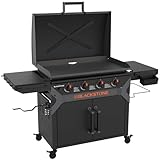
1. Blackstone Iron Forged 36 Inch Griddle with Hood
A four-burner propane flat top on a cart, with a hood that closes over the plate. The wide cooking area and side shelves suit family cookouts and big breakfasts.
Suits: big families that cook outside often. Strengths: a large plate and a hood for cheese melting. Weaknesses: takes a lot of patio space. Skip it if your yard or deck is small.
View Blackstone Iron Forged 36 Inch Griddle with Hood on Amazon
Best for a cook who may add accessories later
2. Camp Chef Flat Top Grill 900
A large multi-burner flat top from a brand with a long outdoor cooking history. The top lifts off, so the same base can take other Camp Chef cooking surfaces.
Suits: a cook who may add accessories later. Strengths: room for a crowd and a removable top. Weaknesses: accessories are sold separately. Skip it if you want everything in the box.
View Camp Chef Flat Top Grill 900 on Amazon
Best for a cook who already owns Traeger gear
3. Traeger Flatrock Flat Top Grill
A flat top from a company better known for pellet grills. It is aimed at backyard cooks who want a large steel plate with managed grease flow and a clean look.
Suits: a cook who already owns Traeger gear. Strengths: a large plate and a polished design. Weaknesses: a premium brand with fewer accessory options than Blackstone. Skip it if you want a premium large flat top.
View Traeger Flatrock Flat Top Grill on Amazon
Best for a buyer who wants an established grill brand
4. Weber Slate 30 Inch Griddle
A rolling propane griddle from a famous grill maker, with a rolled steel plate and side tables for prep. Weber is known for build quality and a strong support network.
Suits: a buyer who wants an established grill brand. Strengths: solid build and good service. Weaknesses: a smaller plate than 36 inch rivals. Skip it if you want the largest cooking area.
View Weber Slate 30 Inch Griddle on Amazon

Best for a budget-minded family
5. Pit Boss 4-Burner Ultimate Lift-Off Griddle
A four-burner propane flat top with a lift-off plate, which makes deep cleaning easier. It is aimed at buyers who want a big cooker from a value-focused brand.
Suits: a budget-minded family. Strengths: four burners and a removable plate. Weaknesses: a lifted plate is heavy and awkward. Skip it if you cannot lift heavy steel.


Best for someone loyal to Cuisinart
6. Cuisinart 36 Inch Four-Burner Gas Griddle
A large four-burner propane griddle from a familiar kitchen brand. Confirm the burner layout and what is included in the current listing, since sizes and kits differ.
Suits: someone loyal to Cuisinart. Strengths: a big plate with separate burners. Weaknesses: less outdoor-cooking history than the leaders. Skip it if you want a long accessory range.

Care and Setup
- Place the cooker on level ground, away from walls and fences.
- Season the plate again after a long storage break.
- Cover the unit when it is not in use.
- Empty the grease trap after every cook.
Mistakes to Avoid
- Parking the cooker where wind will blow out the burners.
- Using a plate that is too small for the crowd.
- Skipping a cover through rainy months.
- Cleaning a hot plate with cold water.
Griddle Plate Versus Open Grates
The phrase “griddle grill” covers cookers built around a solid steel plate, and it helps to understand how that differs from a traditional grill. Open grates give you char marks, smoke from dripping fat and a sense of fire. A solid plate gives complete surface contact, which suits foods that would fall through grates or stick, like eggs, pancakes, diced vegetables, fried rice and thin burgers. Fat stays on the plate or drains to a trap, so flare-ups are less common.
The trade-off is flavor and technique. You do not get the same smoky character as a flame-licked grate, though you do get deep browning. Some people use both: a griddle for breakfast and quick dinners, a grate grill for steaks and long cooks. If you can only choose one, consider how you cook. A griddle excels at variety and speed; a grill excels at traditional grilled flavors.
Some products combine the two with a plate on one side and grates on the other, or removable plates. These hybrids add versatility but may involve compromises in size or heat. Read the listing to see how any switching works, and think about storage space for the extra parts. Whichever type you choose, understand that a steel plate needs seasoning and cleanup habits that differ from a standard grill.
Hoods, Lift-Off Plates and Accessories
Some backyard cookers include a hood, a lift-off top or a plate that can be removed. A hood traps heat and lets you steam or melt, and in some models, convert the cooker into a more oven-like space. Hoods can add weight and cost, but they offer protection when you are not cooking. Check whether the hood is part of the base model or an option.
Lift-off plates allow you to take the cooking surface off for cleaning or to swap for another surface. They can make deep cleaning easier but are heavy, so be careful. Check the dimensions and weight in the listing and decide whether you can handle it safely. Some designs let you lift the plate and use the base as a grill or even a small fire pit; if so, follow the manual precisely.
Accessories broaden what the cooker can do. Common additions include side shelves, a cutting board, a paper towel holder, a lid for steaming and a griddle top cover. Griddle weights, pressing tools and basting domes help with burgers and sandwiches. Cleaning kits make maintenance easy. Do not buy every add-on at the start; pick what supports your cooking habits and compare compatibility with your specific model.
Stability and Patio Layout
A big cooker has to be stable. The legs, the cart frame and the wheels should hold the plate level and resist tipping. Uneven ground makes grease run in the wrong direction and can make a heavy plate dangerous, so level the cooker before each use. Look for locking casters and a sturdy frame. If you use a deck, check that it can support the weight of the cooker plus you.
Plan the layout around the cooker. You need clear space to stand, a surface for prep, and a safe path for carrying plates. Keep it away from walls, fences, overhead branches and furniture with cushions. Make sure there is room for the hood to open and for the grease trap to be removed. Position it where smoke will not drift into windows or neighbors’ spaces.
Also consider lighting and power. Evening cooks need light, and a grill-side lamp or nearby light helps with seeing doneness. Some cookers have electronic igniters that run on batteries, so keep spares handy. If you cook in cold or windy areas, consider windbreaks or a covered area with ample ventilation. Never use a gas cooker in an enclosed space. A tidy, thoughtful layout makes cooking more pleasant and reduces accidents.
Cooking Techniques on a Large Plate
A large plate offers more control than it first appears. Use zones: run one burner high for searing, another medium for general cooking and another low for warming or resting. Preheat for several minutes, and test with a drop of water: it should skitter and evaporate quickly on a hot plate. Add a thin layer of oil for foods that stick.
Smash burgers need a hot plate and a firm press. Pancakes and eggs prefer medium heat, with the plate seasoned and lightly oiled. Vegetables cook well when cut into similar sizes, and stir fry works with a hot plate, a bit of oil and constant movement. For thicker proteins, start on high heat for browning and finish on lower heat or under a hood so the inside cooks without burning.
Keep the plate clean as you go. Scrape residue into the grease trap, wipe with a cloth and re-oil lightly between batches if needed. Avoid overcrowding, since food releases moisture and steams if packed tightly. Be careful with sugary marinades, which can burn quickly. Learning the layout of your plate’s hot and cool spots helps you place food accordingly. A little planning for timing, like starting items that take longer first, makes feeding a crowd smoother.
Storage, Weather and Long-Term Care
Weather is the main enemy of a steel plate. Moisture and humidity cause rust, and sun and rain wear down finishes. A fitted cover is the simplest protection; choose one that fits the cart snugly and has straps for wind. A hood adds protection, but it does not replace a cover in rainy or humid climates.
Before storing for the season, clean the plate thoroughly, apply a thin film of oil, disconnect and store the propane cylinder as local guidance advises, and cover the cooker. If you have a garage or shed, storing the cooker there can extend its life, provided there is ventilation and no gas cylinder inside. Check the cart for rust, loose bolts and worn wheels before the next season.
Inspect gas parts regularly. Look at the hose, regulator and connections for cracks and wear, and check burner ports for blockages. Replace damaged parts with approved ones. Signs it is time to replace the cooker include a warped plate, rust-through, burners that fail to light after cleaning and a frame that can no longer support the load. Ask about parts availability before buying. A cooker with replaceable plates and burners tends to last longer and be more economical in the long run.
Planning a Griddle Cook for a Crowd
Large griddles are made for group cooking, and planning keeps the session relaxed. Think about the order of dishes before you light the burners, because the surface cannot do everything at the same moment. Heat zones help: keep one zone hot for searing, another warm for holding food, and a third for toasting buns or warming tortillas.
A rough order that works for many gatherings:
- Begin with breakfast items or vegetables that cook quickly and can sit warm.
- Move to proteins, using the hottest zone for browning and a cooler zone to finish.
- Toast buns or bread on a clean part of the surface.
- Cook any sauces or sides last, using a pan if needed.
- Clean the surface between very different foods to avoid mixing flavors.
Have all ingredients cut, portioned and within reach before you light the burners. A tray of prepared food next to the cooker prevents scrambling. Keep a separate platter for cooked food, away from raw ingredients, as food safety guidance advises.
Comparing Griddle Features: A Table for Backyard Cooks
Large flat top cookers share a basic idea but differ in features. Here is what each commonly means in practice.
| Feature | What it offers | Things to consider |
|---|---|---|
| Number of burners | Separate heat zones | More burners need a bigger gas supply |
| Hood or lid | Helps steam, melt and protect | Adds weight and cost to the unit’s size |
| Side shelves | Space for tools and plates | Fold-down shelves save room in storage |
| Grease management | Channels fat into a cup | The cup needs regular emptying |
| Wheels and legs | Make it mobile | Lockable wheels give stability |
| Cooking surface thickness | Affects heat retention | Thicker plates are heavier |
Choose the combination that matches how you cook and where you store the cooker. If you have a small patio, a smaller griddle may serve you better than a huge one you cannot move.
Leveling, Grease Flow and Placement
A griddle that is not level will push oil and grease to one side, which can cause pooling or a messy overflow. Place the unit on a firm, flat, non-combustible surface and adjust the legs or feet according to the manual. A small bubble level helps. The grease channel should slope gently toward the drain.
- Keep the cooker clear of walls, fences, branches and overhangs.
- Never use it inside a garage or any enclosed space.
- Lock the wheels before you light it.
- Check that the grease cup is in place and empty before cooking.
- Keep a lid or cover available for rain, and let the surface cool before covering it.
If you smell gas, shut off the supply and move away. Contact a qualified professional or the relevant authorities and do not use the cooker until it has been checked.
Cleaning After a Big Cook
The easiest time to clean a griddle is while it is still warm. Scrape food and oil into the grease channel with a flat scraper. Wipe the surface with paper towels or a cloth, adding a little water if the maker allows it to loosen stuck bits. Dry the plate and apply a thin coat of oil, as the care guide describes, to protect it from moisture.
Empty the grease cup regularly, and dispose of the contents as local rules advise. Do not pour grease down a drain. If rust spots appear, scrub them off, wash the area, then reseason it. A griddle left uncovered in damp weather will rust quickly, so use a cover designed for it.
When to Call for Service
Gas parts and regulators are not do-it-yourself items. If burners will not light, flames look uneven or yellow, or hoses seem cracked, stop using the cooker and contact the maker or a qualified technician. Do not alter gas fittings. For cosmetic or non-gas issues, such as a loose shelf or a sticking wheel, the maker’s parts department can often supply replacements.
A Short Glossary of Griddle Terms
Large flat tops use plain words that are worth defining before you compare models.
- Flat top: a solid steel cooking plate heated from below.
- Cold-rolled steel: steel commonly used for griddle plates that needs seasoning to protect it.
- Burner tube: the metal pipe under the plate that carries gas and flame.
- Ignition: the spark system that lights the burners, which can be push button or battery driven.
- Propane regulator: a valve that controls gas pressure from the tank to the burners.
- Warming rack: an elevated rack for keeping cooked food warm without direct heat.
- Squeeze bottle: a handy tool for applying oil in thin lines.
When a listing uses a term you do not recognize, check the maker’s description. Some words, such as seasoned or pre-seasoned, are used loosely.
Protecting the Surface From Weather and Moisture
Steel plates and moisture do not get along. Rain, heavy dew and humid nights can bring on rust within a day or two. A fitted cover, a hard lid or a hood helps, as does storing the cooker in a garage or shed once it is cold, if the maker allows it. Always let the plate cool and apply a thin coat of oil before covering. Check under the cover from time to time for condensation, and wipe the plate if it has formed.
What a Griddle Does Better Than Any Other Surface
A griddle earns its place by offering a wide, even, open cooking surface where many portions cook side by side and the cook can see and reach everything at once. Breakfast is the classic example, with eggs, bacon, pancakes and hash browns sharing one plate, but the same openness suits smash burgers, fajitas, fried rice, sandwiches and vegetables that would fall through grill grates. Heat zones are part of the craft: one area sears, another holds finished food warm, and a cooler corner waits for delicate items. When you read the picks above, judge them by how well they support that style of cooking for your household, including surface size in relation to your usual portions, rather than by feature lists alone.
Heat, Material and the Surface You Cook On
Griddle surfaces differ in how they take heat, hold it and release it to food, and those differences shape daily results. Heavier materials tend to recover temperature steadily when cold food lands, while lighter surfaces respond faster but can swing more. Seasoned steel and cast iron build a cooking layer over time and reward regular use and simple care, while coated surfaces offer easy release and gentle cleanup but ask for softer tools and more careful heat. None of these is the wrong answer; the match depends on whether you cook outdoors over burners, on a stovetop, or on an electric unit at the counter, and on how much maintenance you genuinely enjoy. Use the notes in the guide above to connect each pick’s surface to the cooking you actually do, from delicate eggs to high heat searing.
Sizing the Griddle to Your Household and Space
Size is a balance between cooking room and everything else the griddle demands: storage, lifting, fuel or counter space, and the time it takes to heat and clean. A generous surface is a joy when friends gather and a burden on a quiet Tuesday if it dominates the kitchen or patio. Count your typical portions honestly, including the sides that share the plate, and leave working room around each item rather than planning to fill every corner. Consider also who cooks, who cleans, and where the griddle lives between uses. A slightly smaller model that is easy to set up, pleasant to clean and simple to store will be used far more often than an impressive one that feels like an event every time it comes out.
Comparing the Picks in This Guide, Side by Side in Practice
Specifications alone do not tell you how the choices in this guide to griddle grills for backyards differ in a real kitchen or on a real patio. The notes above already record, for each pick, who it suits, where it is strong and where it falls short. The most useful comparison is to lay those judgements against your own routine, one pick at a time, and notice which strengths keep mattering to the meals you actually cook. The paragraphs below walk through the list in that spirit, without adding claims beyond what the guide has already set out.
Consider Blackstone Iron Forged 36 Inch Griddle with Hood through the lens of how it fits the space and equipment you already own. Go back to its entry above and read the suits, strengths and weaknesses lines as a short verdict, then ask whether that verdict describes your household. If the strength speaks to your weekly cooking and the weakness concerns an occasional case, it is a strong candidate. If the reverse is true, keep moving down the list, because another pick in this same guide was included precisely to cover a different kind of cook, kitchen or budget of effort.
Consider Camp Chef Flat Top Grill 900 through the lens of how much setup and cleanup it asks of you on an ordinary day. Go back to its entry above and read the suits, strengths and weaknesses lines as a short verdict, then ask whether that verdict describes your household. If the strength speaks to your weekly cooking and the weakness concerns an occasional case, it is a strong candidate. If the reverse is true, keep moving down the list, because another pick in this same guide was included precisely to cover a different kind of cook, kitchen or budget of effort.
Consider Traeger Flatrock Flat Top Grill through the lens of how well its strengths match the meals you repeat most often. Go back to its entry above and read the suits, strengths and weaknesses lines as a short verdict, then ask whether that verdict describes your household. If the strength speaks to your weekly cooking and the weakness concerns an occasional case, it is a strong candidate. If the reverse is true, keep moving down the list, because another pick in this same guide was included precisely to cover a different kind of cook, kitchen or budget of effort.
Consider Weber Slate 30 Inch Griddle through the lens of whether its noted limitation touches something you care about or something you rarely do. Go back to its entry above and read the suits, strengths and weaknesses lines as a short verdict, then ask whether that verdict describes your household. If the strength speaks to your weekly cooking and the weakness concerns an occasional case, it is a strong candidate. If the reverse is true, keep moving down the list, because another pick in this same guide was included precisely to cover a different kind of cook, kitchen or budget of effort.
Consider Pit Boss 4-Burner Ultimate Lift-Off Griddle through the lens of how naturally it would slot into the routine you already have. Go back to its entry above and read the suits, strengths and weaknesses lines as a short verdict, then ask whether that verdict describes your household. If the strength speaks to your weekly cooking and the weakness concerns an occasional case, it is a strong candidate. If the reverse is true, keep moving down the list, because another pick in this same guide was included precisely to cover a different kind of cook, kitchen or budget of effort.
Consider Cuisinart 36 Inch Four-Burner Gas Griddle through the lens of how it fits the space and equipment you already own. Go back to its entry above and read the suits, strengths and weaknesses lines as a short verdict, then ask whether that verdict describes your household. If the strength speaks to your weekly cooking and the weakness concerns an occasional case, it is a strong candidate. If the reverse is true, keep moving down the list, because another pick in this same guide was included precisely to cover a different kind of cook, kitchen or budget of effort.
Putting It to Work: Three Everyday Situations
First, the ordinary weeknight. Time is short, ingredients are whatever is on hand, and the best equipment is the equipment that is already set up, heats or prepares without fuss and cleans down quickly afterwards. Judge every pick for griddle grills for backyards against that tired Tuesday test, because that is where most cooking actually happens. Second, the weekend session, when there is time to try a new recipe, cook for a few more people and enjoy the process itself. Here, capacity, control and comfort matter more than raw speed, and a choice that feels slightly large on a weeknight may come into its own. Third, the gathering, when timing and flow decide whether the cook enjoys the day. Equipment that lets you prepare ahead, cook in calm batches and serve without a last minute scramble earns its place in that third situation, even if it is not the one you reach for daily. A pick that handles two of these three situations well is usually a better buy than one that excels at a single rare occasion.
There is also a fourth, quieter situation worth considering: teaching and sharing. If children, partners or friends join you in the kitchen or at the patio, clear controls, forgiving behaviour and simple cleanup make the experience welcoming rather than stressful. Equipment that a second person can understand at a glance gets shared, and shared equipment gets used more, maintained better and enjoyed longer. Keep that in mind if your cooking is social, because the best choice for a household is not always the best choice for a solo specialist.
Keeping Records That Actually Help
A few brief notes after notable cooks will improve your results faster than memory alone. Record what you cooked, the setup you used, anything you changed, and one thing you would do differently, in whatever notebook or phone note you will actually keep. Over time those notes reveal your own patterns: the portions your household really eats, the settings you return to, the timing that works in your space with your equipment. They also stop you repeating an experiment that already failed and help you repeat a success on purpose for guests. Keep the habit light, a line or two at a time, because a simple record kept consistently beats a detailed log abandoned after a week.
Making Cleanup Part of the Cook
Cleanup goes better when it is planned as the last stage of cooking rather than discovered afterwards. While food rests or is being served, deal with the surfaces and tools that are easiest to clean while still warm, following the maker’s care guidance for the materials involved. Keep a dedicated spot for used utensils, a way to carry hot or greasy items safely, and a routine for cooling, washing, drying and putting things away dry. Drying matters as much as washing for metal tools and cooking surfaces, because stored moisture is what invites rust and stale smells. A tidy reset also means the next cook starts calmly, with everything findable and ready, which is a quiet but real part of enjoying outdoor and countertop cooking alike.
How to Judge Value Without Chasing Numbers
Value in this category rarely comes from the longest feature list. It comes from how often the item is used, how well it fits the equipment and space you already have, and how gracefully it handles ordinary wear. A simple, well made choice that suits your routine will outlast and outperform a complicated one that fights your habits. Think about cost of ownership in practical terms: replacement parts, consumables, storage, and the time each cook takes to set up and clean down. When two picks in the guide seem close, choose the one whose strengths match your most common meals and whose weaknesses fall on the things you do least, because that alignment is what you will feel every time you cook.
Adapting the Same Equipment to Different Seasons
Cooking equipment earns more of its keep when it adapts across the year. In warmer months, outdoor setups invite larger gatherings, longer sessions and foods that benefit from open air and generous space. In cooler months, the same habits shift toward smaller, quicker cooks, sheltered spots and meals that make the most of stored heat and covered cooking. Storage and protection matter more in the off season, when equipment may sit for weeks between uses, so a clean, dry, covered rest is part of seasonal care. Planning a few dishes for each season, rather than repeating one menu, keeps skills fresh and spreads use across the year, which is the simplest way to get full value from a considered purchase.
Checking Details on the Listing Before You Decide
Listings change, bundles change and included extras change, so the final check before buying should always be the current product page for the exact option you intend to order. Confirm what is included, the size or version, the materials where they are stated, any care instructions the maker gives, and what is not included that you might have assumed. Look at the questions and answers section for practical points about fit and compatibility, and treat photographs as a guide to shape rather than proof of scale. This habit takes a few minutes and prevents most mismatches, whether the item is for your own kitchen or a gift for someone else. If a detail that matters to you is not stated clearly, choose the option whose details you can confirm.
A Simple Routine for the First Few Cooks
The first few sessions with anything in this guide set the habits that follow, so keep them deliberately simple. Choose familiar food, allow more time than you think you need, and pay attention to how the equipment behaves rather than chasing a perfect result. Notice where heat gathers, how controls respond, how cleaning feels while things are still warm, and what you wish you had within reach. Write nothing down if that feels like a chore, but do repeat the same meal once or twice, because repetition is what turns first impressions into reliable judgement. By the third or fourth cook, the setup, timing and cleanup will already feel more natural, and you will know which accessories or adjustments would genuinely help, rather than buying solutions to problems you do not have.
Teaching a Beginner on Your Setup
If someone new will use this equipment, a short, friendly introduction prevents most accidents and most disappointing results. Show them where the heat is strongest, how to tell when a surface is ready, which tools belong with which surface, and how cleaning is done while things are still warm. Let them handle a forgiving food first, something with clear visual cues for doneness, and stay nearby without taking over. Beginners often press, poke and move food too much, so explain the value of leaving things alone to develop colour. A good first experience builds a second cook who wants to help again, which over a season is worth more than any single accessory.
Cooking for a Crowd Without Losing Your Calm
Feeding more people is mostly a logistics problem, and the equipment in this guide helps when you plan the flow before the first item hits the heat. Prepare ingredients in the order they will cook, group portions so they can go on and come off together, and keep a clear landing area for finished food that is separate from raw ingredients. Cook in relaxed batches rather than filling every space at once, because crowded surfaces cook unevenly and create a backlog of half finished items. Hold finished food warm in a low oven or a covered spot as the maker of your equipment allows, and communicate simply with anyone helping. A calm sequence, even a slower one, serves better food than a rush, and it leaves the cook able to enjoy the gathering too.
One More Consideration for Griddle Grills For Backyards
It is worth pausing on how a choice for griddle grills for backyards will feel after the novelty has worn off, because that settled, everyday feeling is the true measure of a purchase. In the first week, almost anything new is interesting. By the second month, what matters is whether it has found a natural home in your space, whether its care routine has become automatic, and whether you reach for it without thinking twice. Choices that demand a special effort every time slowly drift to the back of a cupboard or the corner of a patio, whatever their merits on paper. Choices that fit your habits disappear into the routine in the best possible way, doing their job quietly each time. As you make a final decision among the picks above, trust the option you can most easily picture yourself using on an ordinary day, in your own kitchen or outdoor space, with the people you usually cook for. That picture, more than any feature comparison, predicts whether you will still be glad of the decision a year from now, and it is the standard this guide’s notes on who each pick suits were written to help you apply.
Backyard Griddle FAQ
What size is best for a backyard?
A 36 inch plate suits larger groups, while a 28 or 30 inch plate suits most families.
Is a hood worth having?
Yes, if you melt cheese or steam vegetables. A hood also helps hold heat on cool evenings.
Do I need extra tools?
A pair of wide spatulas, a scraper and a squeeze bottle for oil cover most cooking.
How do I protect the plate?
Wipe on a thin film of oil after cleaning and use a fitted cover.
Is a griddle grill good for steaks?
It can sear steaks well with a hot plate, though you will not get grate marks or the same smoky flavor. Use high heat and avoid crowding the plate.
Can I use cast iron tools on a steel plate?
Metal spatulas and scrapers are commonly used on steel plates. Avoid them on coated surfaces and check the maker's guidance.
How do I level a heavy cooker?
Park it on firm, flat ground and use the wheel locks. If the surface is uneven, use shims under the legs or move it, and check that grease drains toward the trap.
Can a griddle grill be used in the rain?
Rain can cause rust and make surfaces slippery, so cook under a safe, open shelter if needed. Never cook in an enclosed space.
How do I know the plate is hot enough?
A few drops of water should skitter and evaporate quickly. An infrared thermometer gives a more reliable reading.
Is it okay to cook acidic sauces on the plate?
Acidic foods can strip seasoning if left for long. Cook them briefly and clean the plate afterward.
What should I do if grease overflows?
Let the cooker cool, empty the trap and clean the area. Check that the cooker is level and the trap is the right size for your cooking.
How do I choose between the picks in this guide?
Start with the meal or job you repeat most often, then read the strengths and limitations noted for each pick against that routine. The right choice is usually the one whose strengths serve your common cooks and whose weaknesses affect only things you rarely do. Confirm size, version and included items on the current listing, and favour the option that fits the space and equipment you already have, because a good fit gets used far more than a theoretically better option that is awkward to store or set up.
What should I check before the first use?
Read the maker’s instructions that come with the item, wash or prepare parts exactly as directed, and check that everything included is present and undamaged. Do a gentle first use with familiar food rather than an ambitious meal for guests, and pay attention to heat, fit and cleanup. If anything smells, fits or behaves in a way the manual does not describe, stop and check the maker’s guidance rather than improvising, because early care sets up both safety and the life of the product.
How do I clean and store this properly?
Follow the maker’s care instructions for the specific materials, clean while residue is easiest to remove, and dry everything thoroughly before storage. Store pieces where air can circulate and where they will not be knocked, stacked under heavy items or left damp. Metal cooking surfaces generally benefit from the light protective care their makers describe, while fabrics and covers should be clean and fully dry before they are put away. A consistent five minute routine after each use prevents most of the rust, odours and damage that shorten a product’s life.
What is the most common mistake buyers make?
The most common mistake is choosing by headline size or bundle count instead of by fit for real routines. Buyers picture the biggest gathering of the year and end up with equipment that is heavy, awkward or oversized for ordinary weeks, so it gets used less. Picture your typical cook first, then check how the item stores, cleans and works with what you already own. That order of thinking, routine first and features second, leads to purchases that feel right long after the first use.
How do I know whether it will work with my existing setup?
Compare the details stated on the listing with your own equipment: dimensions, fuel or power type, materials and any compatibility notes the maker gives. Measure your space rather than estimating it, including clearance and storage, and look at what you already use successfully, because similar shapes and materials usually behave similarly. If a compatibility point is not stated clearly, treat it as unconfirmed and choose an option whose fit you can verify, rather than hoping a mismatch will work out in practice.
When does it make sense to replace rather than keep using an older item?
Replace when wear affects safety, performance or hygiene in ways cleaning and simple care cannot restore: damaged surfaces, unreliable parts, warped fits or materials that no longer clean properly. Cosmetic marks from honest use are not a reason by themselves. If an older item still does its job safely and you enjoy using it, keeping it and adding one missing piece from a guide like this one is often the sensible path. When you do replace, pass on, recycle or dispose of the old item responsibly as local guidance allows.
Can I use this for cooking beyond the obvious dishes?
Usually yes, within the maker’s intended use. Equipment in this category tends to be more versatile than its headline dish suggests, because the underlying skills, heat control, spacing, timing and resting, transfer across many foods. Start with foods that have clear doneness cues, keep portions modest while you learn how a new dish behaves, and adjust one variable at a time. Stay within the fuels, temperatures and placements the maker describes, and let your own notes from each attempt guide the next one.
How can I get more consistent results over time?
Consistency comes from controlling the few variables that matter most: preparation done before cooking starts, even portions, a properly heated surface, sensible spacing, and the same cleanup and storage routine afterwards. Change one thing at a time when you experiment, and keep brief notes on what worked. Most disappointing results trace back to rushing one of those basics, such as starting before the surface is ready or crowding too much food on at once, rather than to the equipment itself.
The Short Version
For a hood-equipped cart, the Blackstone Iron Forged. For swappable tops, the Camp Chef 900. For a polished look, the Traeger Flatrock. For a known grill brand, the Weber Slate. For a budget-friendly four burner, the Pit Boss. For a kitchen brand, the Cuisinart.