A flat top grill is a gas-fired steel griddle plate on a stand or tabletop frame. It cooks smash burgers, breakfast spreads, fried rice and fajita vegetables on one wide surface, which an ordinary grate cannot do. Most run on propane, and many have side shelves and a grease trap.
The six griddles below cover large stations, a mid-size cart, a tabletop model and a round cooking center. We have not used these products ourselves, so treat every detail as unconfirmed and check the current listing for size, fuel and included parts before buying.
As an Amazon Associate we earn from qualifying purchases. Links below are affiliate links, and they do not change the product information we give.
What to Look For
| Feature | Why it matters |
|---|---|
| Cooking surface | Bigger plates feed a crowd; smaller ones heat faster and store easily |
| Burner layout | Several independent burners let you build hot and cooler zones |
| Plate material | Cold rolled steel needs seasoning but holds heat well |
| Portability | Tabletop models travel to campsites; carts stay in the yard |
| Grease handling | A rear or side trap keeps cleanup manageable |
In this guide
Specs at a Glance
| Griddle | Type | Size class | Notes |
|---|---|---|---|
| Blackstone 36 inch Griddle Cooking Station | Four-burner cart | Large | Side shelf and storage |
| Blackstone 28 inch Griddle Cooking Station | Two-burner cart | Mid-size | Fits a smaller patio |
| Blackstone 22 inch Tabletop Griddle | Tabletop | Compact | Portable propane model |
| Camp Chef Flat Top Grill 600 | Cart with legs | Large | Multi-burner layout |
| Cuisinart 360 Griddle Cooking Center | Tabletop round | Mid-size | Wide circular plate |
| Pit Boss portable griddle | Tabletop | Compact | Two burners; check the listing |
The 6 Best Flat Top Grills

Top pickBest for big families and group cookouts
1. Blackstone 36 inch Griddle Cooking Station
The best-known name in flat tops, this four-burner cart gives a very wide cooking surface with a side shelf and a rear grease system. It is the model many backyard cooks picture first.
Suits: big families and group cookouts. Strengths: a wide plate and independent burner zones. Weaknesses: needs a roomy spot and some seasoning. Skip it if you cook for one or two people.

Best for couples and small patios
2. Blackstone 28 inch Griddle Cooking Station
A two-burner cart in the same family, sized for smaller patios. It still gives plenty of room for pancakes and burgers at once, with folding side shelves on many versions.
Suits: couples and small patios. Strengths: a sensible mid-size plate. Weaknesses: less room for a big spread. Skip it if you regularly cook for ten or more.
View Blackstone 28 inch Griddle Cooking Station on Amazon

Best for camping, tailgates and tight storage
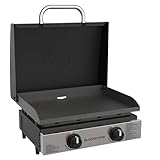
3. Blackstone 22 inch Tabletop Griddle
A compact propane griddle that sits on a table or tailgate. It is the easy way to try griddle cooking without buying a full cart, and it packs into a car.
Suits: camping, tailgates and tight storage. Strengths: portability and a short heat-up. Weaknesses: a small plate and no built-in shelves. Skip it if you need a permanent patio setup.
Best for cooks who like modular add-ons
4. Camp Chef Flat Top Grill 600
A cart-style flat top with a wide plate and multiple burners, built by a company known for outdoor cookers. Many versions accept add-on accessories from the same maker, so check what ships in the box.
Suits: cooks who like modular add-ons. Strengths: a sturdy outdoor-cooker pedigree. Weaknesses: accessories cost extra. Skip it if you want the simplest possible setup.
View Camp Chef Flat Top Grill 600 on Amazon
Best for patio tables and small groups
5. Cuisinart 360 Griddle Cooking Center
A round tabletop griddle with a wide circular plate and a lid on some versions. The shape suits gathering around and cooking in several zones at once.
Suits: patio tables and small groups. Strengths: a wide cooking area in a tidy package. Weaknesses: less storage than a cart. Skip it if you prefer a rectangular plate.
View Cuisinart 360 Griddle Cooking Center on Amazon
Best for simple portable cooking
6. Pit Boss portable griddle
A two-burner tabletop griddle from a brand better known for pellet grills. It is aimed at simple carry-and-cook use. Check the listing for the exact plate size and what the box includes.
Suits: simple portable cooking. Strengths: easy transport and a familiar brand. Weaknesses: fewer accessories than bigger rivals. Skip it if you want a hood and cart.
View Pit Boss portable griddle on Amazon
Care and Setup
- Season the plate with a thin coat of cooking oil before the first cook.
- Scrape and wipe the plate while it is still warm, then oil it lightly.
- Keep the grease trap clear to avoid flare ups and messy spills.
- Cover the griddle outdoors to limit rust, and store propane safely.
Mistakes to Avoid
- Skipping the seasoning step on a new steel plate.
- Pouring cold water onto a very hot plate.
- Buying a cart that will not fit your patio space.
- Ignoring the propane connection type listed for the model.
Seasoning the Plate Properly
Seasoning is the layer of baked-on oil that protects a steel griddle plate from rust and gives it a more nonstick surface over time. A new plate often arrives with a protective coating from the factory, and the manual will tell you how to remove it, usually by washing and drying the plate before the first seasoning. After that, you heat the griddle and add thin coats of cooking oil, letting each coat smoke and darken before the next.
Use the oil and process the maker recommends. Common choices are oils with a high smoke point, such as flaxseed, canola, vegetable or a purpose-made seasoning product, but check your manual. Apply the oil in a thin, even layer with a paper towel or cloth held with tongs. Too much oil leaves a sticky, uneven coating that can flake or turn gummy. Several thin coats are better than one heavy one.
Expect the plate to change color. It will go from silver to tan to dark brown or black as the seasoning builds. Uneven color early on is normal. Cooking fatty foods such as bacon and burgers helps build the layer, while acidic foods and long sessions of simmering sauces can wear it down at first.
Re-season whenever the plate looks dull, patchy or starts to show rust. A quick wipe of oil after each cook keeps the layer in good condition. If rust appears, scrub it off with a suitable tool, wipe the plate clean and repeat the seasoning steps. It is a normal part of ownership of bare steel and does not mean the griddle is ruined.
Building Heat Zones and Cooking Technique
A flat top shines when you use its zones. Most multi-burner griddles let you set each burner separately, which creates a hot area for searing, a medium area for cooking through and a cooler area for keeping food warm. Plan your cook so that you move food between zones rather than trying to do everything on one setting. A two-burner or small tabletop griddle has fewer zones, so you work with a more limited range, but you can still make a hotter and a cooler side.
Preheat the plate before adding food. Give it a few minutes, then check the temperature by sprinkling a few drops of water, which should dance and evaporate quickly on a hot surface. An infrared thermometer can give a more accurate reading, if you own one. Heat is not evenly distributed on every plate, so learn where your hot spots are by watching how food browns.
Use the right tools. Wide spatulas let you flip and scrape, and a scraper helps with smash burgers. Squeeze bottles for oil and water make it easier to control moisture. A basting dome or lid, where available, traps steam to melt cheese or steam vegetables.
Keep food moving and avoid overcrowding. Too much cold food at once drops the plate temperature and leads to steaming rather than browning. Cook in batches, keep finished food on the cooler side and let the plate recover between rounds. Control grease by pushing it toward the trap with a scraper as you cook.
Propane Connections and Gas Safety
Most flat tops in this guide run on propane, so gas safety is part of ownership. Connect the regulator and hose to the tank as the manual shows, and check the connection for leaks before the first use and after any tank swap. A common method is to brush a mix of soap and water onto the fittings, open the tank valve slowly and watch for bubbles, which indicate a leak. If you see bubbles, close the valve and fix the connection before lighting.
Different models use different tank types. Tabletop griddles often use small disposable cylinders, while carts typically use a larger refillable tank. Confirm what the listing says about the tank, the regulator and any adapter included, because the fittings are not all interchangeable. If you want to use a different tank type, check with the maker about what is safe and compatible.
Use the griddle outdoors in an open space with plenty of ventilation, well away from walls, fences, overhangs and flammable items. Never use it indoors, in a garage or inside a tent. Follow the lighting steps in the manual, and keep the lid or any cover open while lighting if the instructions say so. Keep your face and body away from the burners as you light.
Turn off the burners and then the tank valve when you finish. Keep tanks upright, secure and out of direct heat. Inspect hoses for cracks or wear and replace them with parts recommended by the maker. If you smell gas, shut off the supply and move away from the griddle until you have found and fixed the cause.
Space, Wind and Portability Planning
Before buying, think about where the griddle will live and how you will use it. A cart-style griddle needs a flat, stable area with room for the plate, side shelves and your working space, plus clearance from walls and railings. Measure the width with shelves open and check that you can fit it through gates and doors. Keep it off decks or balconies unless you have checked the rules for your building and area, since some places restrict propane cooking in those spots.
Wind affects flat tops more than many people expect. Because the plate is open, wind can blow out flames, cool parts of the surface and make temperatures uneven. Some griddles include wind guards or have sides that help, and you can pick a sheltered spot for cooking. Check the listing for wind guards or lids. Avoid placing a windbreak in a way that traps heat or gas near the burners.
For tabletop models, the surface underneath matters. The table must be sturdy, level and non-combustible, and it must be able to handle heat that radiates below. Use a heat-resistant mat or a table made for the purpose if the manual advises it. Do not put a hot griddle on a plastic table or a delicate surface.
Portability is a trade-off. Tabletop models travel to campsites and tailgates but have smaller plates and fewer shelves. Carts offer storage and space but are harder to move. Match the format to how you cook and how much storage room you have.
Cleaning Routine and Grease Management
A flat top is easiest to clean while it is still warm. After cooking, scrape the plate with a scraper to push food bits and grease toward the grease trap. For stuck bits, a little water on the warm plate loosens them, and steam does some of the work. Wipe the plate with paper towels or a cloth, and then apply a thin coat of oil to protect the seasoning. Be careful with steam and hot surfaces, and avoid pouring cold water on a very hot plate, which can warp some steel.
Empty the grease trap or cup regularly so it never overflows. Overflowing grease can cause flare-ups and attract pests. Line the trap with foil or a liner if the maker allows it, and dispose of used grease in a sealed container rather than pouring it down the drain or onto the ground.
Clean the rest of the griddle every so often. Wipe side shelves and the frame with warm soapy water, check the burner area for debris and make sure burners are not clogged. Uneven flames can mean a blocked burner. Keep an eye on the ignition, hoses and knobs.
Cover the griddle once it has cooled, using a cover that fits and is made for outdoor use. If the griddle has a hard lid, use it as directed. In wet or humid climates, check the plate more often for rust.
Signs it is time to replace parts include a warped plate that no longer sits flat, burners with heavy corrosion, cracked hoses or a regulator that does not hold steady pressure. Many makers sell replacement parts, so check what is available before replacing the whole unit. If safety is in doubt, stop using the griddle until it has been inspected.
Cooking Zones, Burners and Surface Size
A flat top grill is defined by its steel cooking surface and the burners underneath. Larger models have multiple burners that you can set to different heat levels, so you can sear on one side and keep food warm on the other. Count the burners and look at how the heat is divided across the plate, because a single burner under a wide plate may leave cooler spots. Surface size sets how many items you can cook at once, from a few burgers on a portable model to a full breakfast for a crowd on a station with four burners.
| Model type | Typical use |
|---|---|
| Tabletop portable | Camping, tailgating and small patios |
| Cart with two burners | Family cooking in a backyard |
| Four burner station | Large gatherings and heavy use |
| Griddle insert for a grill | Adds flat cooking to an existing grill |
Seasoning the Steel and Preventing Rust
Bare steel needs seasoning, which is a thin baked-on layer of oil that protects the plate and helps food release. The maker’s manual describes the process for your model. In general, you wash off any factory coating, heat the plate, and apply thin coats of cooking oil until the surface darkens. After each cook, scrape the plate while it is warm, wipe it, and apply a light film of oil. Cover the unit and keep it dry between uses, because moisture is the main cause of rust.
Fuel, Placement and Safety
Most flat top grills run on propane, and some portable versions use small canisters. Follow the maker’s instructions for connecting the fuel, checking hoses and lighting the burners. Keep the grill outdoors on a level, non-combustible surface, away from walls, railings and overhangs, and never use it in an enclosed space. If you suspect a gas leak, follow the maker’s guidance and contact a qualified professional.
Grease Management and Cleanup
Look at where the grease drains and how you empty the catch tray. A rear or side drain makes cleanup easier, and liners can simplify disposal. Let the plate cool before heavy cleaning, and use the tools the maker recommends.
Cooking Ideas and Heat Management
A flat top suits foods that fall through the gaps of a normal grate, such as eggs, fried rice, thin vegetables and smash burgers. Learn how your grill responds, because steel holds heat and reacts slowly to burner changes. Preheat the plate before food goes on, and create zones so one area is hot while another stays moderate. Use long spatulas and a scraper, keep oil within reach, and wipe the surface between batches to prevent sticking. A basting dome traps heat and steam to melt cheese or finish thicker items. Always cook food to the safe internal temperatures that official food safety agencies list, and use a thermometer for meat and poultry.
Choosing a Flat top grills Around Your Real Routine
Specifications only tell half the story with flat top grills. The other half is your routine: what you actually cook, how often you cook it, and who else uses the kitchen. A model that suits a household frying breakfasts, searing burgers and smash patties, cooking pancakes, fajitas and large batches of vegetables outdoors several times a week can be the wrong shape entirely for someone who only reaches for it at weekends. Before you compare the picks above any further, spend ten minutes being honest about your patterns, because the right flat top griddle is the one that removes friction from the cooking you already do, not the cooking you imagine doing once a year.
Start With Your Three Most Common Jobs
Write down the three jobs you will ask of this flat top griddle most often. For most households that list centres on frying breakfasts, searing burgers and smash patties, cooking pancakes, fajitas and large batches of vegetables outdoors. Now judge every candidate against those three jobs first and treat everything else as a bonus. Features that serve your top three jobs earn their place in the budget; features aimed at jobs you do twice a year rarely do. This simple test also explains why two reviewers can disagree about the same product: they are quietly scoring it against different lists. Your list is the only one that matters, and it should drive which of the reviews above you read most closely.
Household Size Is Only Part of the Capacity Question
Capacity advice is usually given per person, but appetite, batch cooking and entertaining habits matter just as much. A couple who batch-cooks on Sundays may need more usable space than a family of four who cook fresh each evening. Think about your biggest realistic load rather than your average one, then check it against the honest discussion of usable space in the reviews above. Remember that headline capacity and usable capacity are different things: shape, layout and the way items are arranged decide how much of the stated volume you can genuinely use on a busy day.
Who Else Will Use It?
If teenagers, older relatives or housemates will also use this flat top griddle, controls and access matter more than the brochure suggests. Clear labelling, predictable behaviour and a layout that does not demand strength or reach will decide whether everyone uses it confidently or one person becomes the only operator. Think about height, grip, visibility of markings and how forgiving the controls are when someone is in a hurry. A slightly simpler model that the whole household uses well will outperform a sophisticated one that only one person understands.
A Pre-Purchase Checklist That Catches Expensive Surprises
Most returns and regrets with flat top grills come from a short list of avoidable surprises rather than from the product itself. Work through these checks before you order, while changing your mind is still free.
- Measure the space, then measure the route. Check a level outdoor surface, clearance from fences and walls, shelter from wind and a safe route for the gas bottle, and also the doorways, corners and stairs the unit must pass through to reach its home.
- Confirm the services it needs. Power, water, drainage, fuel or ventilation, whichever apply, should be verified in your kitchen rather than assumed from the listing.
- Read the manual before the box arrives. Most manufacturers publish it online. The installation and care pages reveal clearances, restrictions and upkeep that listings gloss over.
- Plan where the accessories live. Think through a fitted cover, utensils and oil bottles stored dry, plus the gas bottle kept upright and outdoors before the new arrival creates a storage problem elsewhere.
- Check what is included. Racks, trays, hoses, fittings and starter accessories vary between models, and the extras you must buy separately change the real cost of ownership.
- Keep the paperwork. Photograph the serial plate, save the receipt and register the warranty in the first week, while it is still at the front of your mind.
None of these checks takes long, and together they prevent the classic pattern of a good product installed badly, in the wrong place, missing a part, and blamed for all three. If a check raises a question you cannot answer, the manufacturer’s support line or a local installer will usually answer it in minutes, and that call is far cheaper than a return collection.
Getting the Best From It Day to Day
The first fortnight with a new flat top griddle sets the habits that decide how well it serves you for years. Resist the urge to test it with your most ambitious recipe first. Start with familiar food you already know how to sear and fry, so the only new variable is the equipment. Note what you changed, what worked and what you would adjust, because those early notes become your personal settings guide long after the novelty fades. Most owners find their results improve steadily over the first month simply because they learn how their particular unit behaves, and that learning curve is normal rather than a sign of a bad purchase.
Build a small rotation of reliable everyday uses before experimenting. In practice that means leaning on the flat top griddle for frying breakfasts, searing burgers and smash patties, cooking pancakes, fajitas and large batches of vegetables outdoors, and paying attention to timing, arrangement and portion size as you go. Crowding, rushing and guessing are the three habits that spoil results most often, whatever the category. Give items room, let the unit do its work without constant interference, and change one variable at a time when you are troubleshooting, so you actually learn what fixed the problem.
Finally, think in terms of workflow rather than single tasks. Decide where ingredients wait before cooking, where hot or finished items land afterwards, and what gets washed as you go. A flat top griddle that fits your workflow feels effortless; the same unit fighting your workflow feels disappointing, even when it performs exactly as designed.
Cleaning and Care: A Routine That Actually Sticks
Care advice fails when it asks for too much at once. Split it into three rhythms. After each use, deal with the obvious: spills, splashes and crumbs are always easier now than next week. Weekly, wipe down the plate surface, the grease trap, the burners you can access and the side shelves, and check for the early signs of build-up that a deep clean will later have to fight. Monthly or seasonally, do the slower jobs the manual describes, the ones involving soaking, descaling, deep degreasing or a thorough inspection, as they apply to this type of flat top griddle.
Use gentle tools first. Soft cloths, non-scratch sponges and warm soapy water handle most kitchen soil, and they do not damage the finishes, seals and coatings that keep the unit working properly. Harsh abrasives and improvised chemicals cause a surprising share of the damage owners later blame on build quality. Where the manufacturer names a specific product or method, follow it: warranty support is much easier when you can honestly say the care instructions were followed.
Keep a small care kit together near the unit: a cloth, a soft brush, your chosen cleaner and a note of when the last deep clean happened. That tiny bit of organisation turns maintenance from a project into a five-minute habit, and a well-kept flat top griddle not only lasts longer, it performs more consistently, because seals seal, surfaces heat or cool evenly, and moving parts move as they should.
Comparing the Picks in This Guide Against Each Other
The shortlist above — Blackstone 36 inch Griddle Cooking Station, Blackstone 28 inch Griddle Cooking Station, Blackstone 22 inch Tabletop Griddle, Camp Chef Flat Top Grill 600, Cuisinart 360 Griddle Cooking Center, Pit Boss portable griddle — was chosen because each model earns its place for a slightly different buyer. Comparing them well means resisting the urge to find a single winner and instead matching each pick to the household it suits. Re-read the individual reviews with your own top three jobs in mind, and notice which strengths keep mattering to you and which you can honestly live without.
Blackstone 36 inch Griddle Cooking Station is the opening pick, which sets the benchmark the rest are judged against. The fairest way to judge it is against the job list you wrote earlier: if its strengths line up with the tasks you do weekly, it deserves to be on your final two; if its appeal rests on capabilities you would rarely use, the reviews above give you permission to pass it by, however impressive it looks in isolation. Pay particular attention in its review to the honest limitation noted there, because limitations matter only when they collide with your routine.
Blackstone 28 inch Griddle Cooking Station is a strong alternative whose appeal lies in a different balance of strengths. The fairest way to judge it is against the job list you wrote earlier: if its strengths line up with the tasks you do weekly, it deserves to be on your final two; if its appeal rests on capabilities you would rarely use, the reviews above give you permission to pass it by, however impressive it looks in isolation. Pay particular attention in its review to the honest limitation noted there, because limitations matter only when they collide with your routine.
Blackstone 22 inch Tabletop Griddle is a mid-shortlist option that suits buyers who prioritise everyday ease. The fairest way to judge it is against the job list you wrote earlier: if its strengths line up with the tasks you do weekly, it deserves to be on your final two; if its appeal rests on capabilities you would rarely use, the reviews above give you permission to pass it by, however impressive it looks in isolation. Pay particular attention in its review to the honest limitation noted there, because limitations matter only when they collide with your routine.
Camp Chef Flat Top Grill 600 is a pick that makes most sense for a specific style of cooking or household. The fairest way to judge it is against the job list you wrote earlier: if its strengths line up with the tasks you do weekly, it deserves to be on your final two; if its appeal rests on capabilities you would rarely use, the reviews above give you permission to pass it by, however impressive it looks in isolation. Pay particular attention in its review to the honest limitation noted there, because limitations matter only when they collide with your routine.
Cuisinart 360 Griddle Cooking Center is an option worth serious attention if the earlier picks do not fit your space or routine. The fairest way to judge it is against the job list you wrote earlier: if its strengths line up with the tasks you do weekly, it deserves to be on your final two; if its appeal rests on capabilities you would rarely use, the reviews above give you permission to pass it by, however impressive it looks in isolation. Pay particular attention in its review to the honest limitation noted there, because limitations matter only when they collide with your routine.
Pit Boss portable griddle is the closing pick, which rounds out the shortlist for buyers with different priorities. The fairest way to judge it is against the job list you wrote earlier: if its strengths line up with the tasks you do weekly, it deserves to be on your final two; if its appeal rests on capabilities you would rarely use, the reviews above give you permission to pass it by, however impressive it looks in isolation. Pay particular attention in its review to the honest limitation noted there, because limitations matter only when they collide with your routine.
A useful final exercise is to reduce the shortlist to two and then ask a single question of each: what would I notice about this flat top griddle on an ordinary Tuesday evening, six months from now? The answer is rarely a headline feature. It is the loading, the cleaning, the controls, the noise, the fit in the room. Those everyday qualities are where satisfaction is won, and the reviews above give you the material to judge them if you read for them deliberately.
More Mistakes Worth Avoiding
Beyond the mistakes covered earlier in this guide, a few patterns catch out even experienced buyers of flat top grills. The first is buying for the biggest day of the year. Sizing everything for a holiday feast or a once-a-year gathering leaves you with a unit that is awkward, hungry for space and harder to clean for the other fifty weeks. Buy for your heavy-but-normal week, and borrow, batch or improvise for the exceptional day.
The second is ignoring running costs and consumables. Filters, fuel, specialist cleaners, replacement parts and accessories add up across years of ownership, and they differ between models in ways listings rarely highlight. The third is skipping the first-use steps: the initial cleaning, seasoning, calibration or test run the manual describes exists because it affects both performance and flavour or hygiene from day one. The fourth is judging too quickly. Almost every flat top griddle has a learning curve, and verdicts delivered after a single rushed use say more about the cook’s evening than the equipment.
The last pattern is letting the purchase end the thinking. The owners who get the most from equipment like this review their setup after a month: what lives where, what gets used, what annoys them. Small changes to arrangement, accessories or routine at that point pay back for years, and they cost almost nothing compared with replacing a unit that was never quite set up properly.
Safety, Efficiency and Considerate Use
Safe use of a flat top griddle is mostly about respect for the obvious risks: hot plate edges, grease flare-ups, gas connections and never cooking in an enclosed garage or tent. Build the small habits that neutralise them. Keep the area around the unit clear while it works, use the right protective equipment for hot or heavy items, supervise children and pets around it, and never defeat a safety feature because it slows you down. If anything about the unit’s behaviour changes suddenly — a new noise, a smell, a seal that no longer sits right — stop, check the manual’s troubleshooting section, and treat the change as information rather than an annoyance to ignore.
Efficiency follows a similar pattern of small habits. Use the flat top griddle at sensible loads rather than nearly empty or hopelessly overfilled, keep seals, filters and surfaces clean so it does not work harder than it should, and match the size of the job to the size of the equipment where you have a choice. None of this requires specialist knowledge; it requires only the decision to treat efficiency as part of everyday use rather than a separate project, and over years of ownership those habits are worth real money and a longer working life.
Long-Term Ownership: Repairs, Parts and Knowing When to Replace
A flat top griddle should be judged across its whole life, not its first month. Keep the manual, the receipt and a note of the model and serial details somewhere findable, because every future conversation about parts, service or warranty starts with them. Consumable and wear parts — seals, filters, racks, trays and similar items depending on the type — are worth replacing promptly: a tired wear part can make a healthy unit perform badly and tempt you towards a replacement you do not need.
When something does go wrong, describe the symptom precisely before you book help: when it happens, what you were doing, and what has changed. That detail saves diagnostic time and money. Weigh repair against replacement honestly, considering the unit’s age, the cost and availability of parts, and how well it still suits your household. Replacement makes sense when repairs repeat, parts disappear, or your needs have genuinely outgrown the unit; repair makes sense when the fault is isolated and the rest of the machine is sound. Either way, the decision is easier when the unit has been maintained, because its history is known rather than guessed.
Living With a Flat top grills: Practical Notes
One underrated skill with any new kitchen equipment is learning to read results instead of instructions alone. When something comes out better or worse than expected, ask what actually changed: the load, the arrangement, the timing, the temperature of the ingredients at the start, or simply how long the door stayed open while you decided. Keeping those variables in mind turns every ordinary meal into useful information, and within a few weeks you will be adjusting by instinct rather than by guesswork. That instinct, more than any single feature, is what separates owners who love their equipment from owners who tolerate it.
More Flat top grills Questions, Answered
How long should a unit like this realistically last?
Longevity depends far more on use and care than on the badge. A unit that is loaded sensibly, cleaned on the simple rhythm described above and given prompt attention when a wear part tires will serve for many years, while a neglected unit can feel old quickly. Keep the paperwork, follow the manual’s care schedule, and treat small changes in behaviour as early warnings; that combination does more for lifespan than any single buying decision.
What should I do in the first week of ownership?
Start with the manual’s first-use steps, then cook familiar food rather than ambitious projects. Note the settings, timings and arrangements that work for your household, check that the installation is level, sealed and ventilated as required, and register the warranty while the receipt is still to hand. By the end of the first week you should know how the unit behaves on your everyday jobs, which is the knowledge everything else builds on.
How do I know whether a problem is mine or the product’s?
Change one variable at a time and retest with a simple, familiar job. If results improve, the issue was technique or setup, which is good news because it is free to fix. If the same fault appears regardless of load, arrangement and settings, consult the troubleshooting section of the manual and then the manufacturer’s support, describing the symptom precisely. Keeping a brief note of what you tried makes that conversation far more productive.
Are extended warranties and service plans worth it?
They are worth judging case by case rather than by habit. Consider the unit’s complexity, the availability of local repair, and whether you would genuinely claim or simply replace. Read what is excluded as carefully as what is covered, especially around consumables and cosmetic damage. A plan that covers the parts most likely to fail, from a provider who actually answers, can be sensible; a vague plan bought under pressure at the checkout rarely is.
What is the single best habit for getting value from this purchase?
Use it for your real routine, consistently, and keep it clean as you go. Equipment earns its cost through hundreds of ordinary uses, not a handful of special occasions. The owners who report the highest satisfaction are rarely those who bought the most features; they are the ones whose unit fits their space, whose household all use it confidently, and whose care routine is light enough to survive busy weeks.
When is it time to stop repairing and replace instead?
Replace when faults start repeating, when parts become hard to source, when running it has become noticeably less efficient or less safe, or when your household’s needs have genuinely changed. Repair when the fault is isolated, the rest of the unit is sound and the cost is modest relative to a replacement you would actually want. Decide with the unit’s full history in front of you, which is another reason the simple ownership notes recommended above are worth keeping.
Flat Top Grill FAQ
How is a flat top different from a regular grill?
A flat top cooks on a solid steel plate rather than a grate. Food sits in its own fat, which suits smash burgers, eggs and chopped vegetables. It does not give the grill marks or smoke of an open grate.
Do these use propane or electricity?
The models here are gas-fired and generally run on propane. Check the current listing for the exact fuel and any regulator or adapter included.
How do I stop the plate from rusting?
Keep a thin film of oil on the steel after cleaning and store it covered. Rust is a care issue with bare steel, not a defect in itself.
What oil should I use to season a griddle?
Follow your manual first. Many people use thin coats of an oil with a high smoke point, such as flaxseed, canola or vegetable oil, or a seasoning product made for griddles.
Why is my seasoning sticky or flaking?
It is usually caused by oil applied too thickly. Scrape off loose bits, wipe the plate clean and rebuild the layer with thinner coats.
Can I cook on a griddle when it is windy?
You can, but wind cools the plate and can disturb the flames. Choose a sheltered spot, use wind guards if your model has them and watch the heat.
How do I check for a propane leak?
Brush a soap and water mix on the fittings, open the tank valve slowly and look for bubbles. If bubbles appear, close the valve and fix the connection before lighting.
Can I use a griddle on a balcony or in a garage?
Rules vary, and garages and enclosed spaces are unsafe for gas cooking. Check your building rules and local regulations, and use it only in open, ventilated outdoor areas.
Is it safe to pour water on a hot plate?
Small amounts of water for cleaning are common, but cold water poured onto a very hot plate can cause warping or steam burns. Let it cool a little and use care.
How often should I empty the grease trap?
Check it every time you cook and empty it before it fills. A full trap can overflow and cause flare-ups.
How do I fix rust on the plate?
Scrub it off with a suitable tool, wipe the plate clean and dry, then re-season with thin coats of oil. Rust on bare steel is a care issue and can be repaired.
The Short Version
For the biggest family cookouts, the Blackstone 36 inch. For smaller patios, the Blackstone 28 inch. For camping, the Blackstone 22 inch tabletop. For add-ons, the Camp Chef. For a round plate, the Cuisinart 360. For a simple portable, the Pit Boss.


