Disclosure: airfryerkitchensupply.com is reader-supported. When you buy through links on our site, we may earn an affiliate commission at no extra cost to you.
Where to buy
Every product named in this guide to the best gauge stainless for kitchen sinks was checked against Amazon listing data before it earned a place here, and the links below go to the exact verified listings. Prices change constantly, so each pick is linked with a live price check instead of a printed number:
- Kraus KHU100-28 Standart Pro, 16 Gauge — Check the current price on Amazon
- Kraus KHU100-26 Standart Pro, 16 Gauge — Check the current price on Amazon
- Kraus KHU111-25 Standart Pro, 16 Gauge — Check the current price on Amazon
- SANYCASA 24-Inch Undermount, 11 Gauge — Check the current price on Amazon
- Oxwiser 30 x 18 Undermount Set, 16 Gauge — Check the current price on Amazon
- Elkay ECTRU17179TC Crosstown, 18 Gauge — Check the current price on Amazon
Ask ten sellers for the best gauge stainless for kitchen sinks and you will get one number shouted ten ways. The honest answer depends on three things the shout leaves out: how the sink mounts, how wide it stretches, and what shape it takes. A 36-inch undermount bowl, a 25-inch drop-in and a square island prep sink ask completely different things of their steel. This guide works through that matrix with six verified sinks — five at the full 16-gauge specification (plus one small-bowl outlier at 11 gauge) and one 18-gauge prep specialist — so the thickness you buy matches the job the sink will actually do.
The pattern to notice: undermount family sinks cluster at 16 gauge in this list, in 25, 26 and 28-inch sizes, because hanging bowls need rigid, flat rims and wide floors need stiffness. The compact end splits by philosophy — a 25-inch Kraus holding the mainstream line, an 11-gauge SANYCASA taking thickness to its limit in a 24-inch bowl, and Elkay’s square 18-gauge Crosstown proving that a small prep span, well formed, is the one place thinner steel is a decision rather than a compromise. Every gauge here is quoted from the sink’s verified Amazon listing connection.
Read the picks by your mounting and measurement reality first, your cooking second. The buying guide then gives you the matrix in full, so a sink this guide did not list can still be judged by the same rules.
In this guide
Quick Picks
- Kraus KHU100-28 Standart Pro, 16 Gauge — Best for Standard Family Kitchens: the 28-inch Standart Pro: 16-gauge steel in the size that fits the most common cabinets while still taking serious cookware — Check the current price on Amazon
- Kraus KHU100-26 Standart Pro, 16 Gauge — Best for Smaller Family Kitchens: the 26-inch Standart Pro keeps the family’s 16-gauge specification for kitchens one cabinet size down — Check the current price on Amazon
- Kraus KHU111-25 Standart Pro, 16 Gauge — Best for Tight Undermount Fits: a 25-inch, 16-gauge undermount single bowl: the tight-fit option that keeps the Standart Pro steel specification intact — Check the current price on Amazon
- SANYCASA 24-Inch Undermount, 11 Gauge — Best Ultra-Thick for Small Bowls: the small-bowl extreme: a 24-inch undermount in stated 11-gauge steel with quiet-drain design and a bottom grid included — Check the current price on Amazon
- Oxwiser 30 x 18 Undermount Set, 16 Gauge — Best Complete 30-Inch Kit: a 30 by 18 inch 16-gauge undermount sold as a five-item set — sink, bottom grid, drain assembly, drain cap and towel — for one-box installs — Check the current price on Amazon
- Elkay ECTRU17179TC Crosstown, 18 Gauge — Best Square Prep Bowl: an 18.5-inch square Crosstown prep bowl in 18 gauge: the second-sink specialist whose shape, not size, is the point — Check the current price on Amazon
How These Picks Were Chosen
Selection began with the installation matrix rather than with brands: we required verified listings across the common undermount sizes (24 to 30 inches in this guide’s slice of the market), at least one ultra-thick compact option, and one honestly-specified smaller-gauge prep bowl to mark where the value line sits. Gauge had to be stated in the verified listing; mounting style, dimensions and included kit were recorded from the same source and appear in the spec boxes.
The Kraus Standart Pro family anchors three places because it is the rare range that holds one construction standard across sizes — letting this guide compare sizes without the steel changing underneath the comparison. The Oxwiser earns its place on kit completeness, with the brand caveat stated in its review. The Elkay closes the list deliberately: an 18-gauge sink recommended without apology, in the one role — square, compact, prep duty — where its specification is the right engineering, not the cheap option.
The 6 Best Gauge Stainless Sinks Matched to Mount, Size and Shape

Kraus KHU100-28 Standart Pro, 16 Gauge — Best for Standard Family Kitchens
Most kitchen sinks in most homes live in the 28- to 30-inch class, because that is what the standard 33- to 36-inch sink base honestly fits — and the KHU100-28 is this guide’s answer for that reality. Its verified listing states 16-gauge stainless in a 28-inch undermount single bowl from Kraus’s Standart Pro family, the same construction lineage as the 30- and 32-inch anchors of our companion guides. Thickness by mounting and size starts here: undermount, family size, full gauge.
Why does undermount argue for the full gauge at this size? The bowl hangs beneath the counter, carried by clips and adhesive, and its rim must sit dead flat against the stone for a clean seal and a wipe-clean reveal. Rigid, well-formed steel holds that flatness for decades of thermal cycles and disposal vibration; thin or poorly formed rims are where undermounts develop the rocking and seal failures owners blame on installers. Sixteen gauge is not vanity in an undermount — it is the mounting system’s working material.
Choose the 28 when your cabinet is standard and your cooking is serious. It takes the roasting pan, keeps the steel promise, and leaves budget room for the faucet the 32-inch flagship would have eaten.
Strengths
- The fit-most-cabinets size at the no-compromise gauge
- Standart Pro construction language: formed corners, drainage-minded floor
- Big enough for roasting pans, small enough for standard bases
Trade-offs
- Still check the stated cabinet minimum against your base unit
- Single bowl only in this configuration
- Undermount counter requirements apply
| Specification | Verified detail |
|---|---|
| Gauge | 16-gauge stainless steel, per the verified listing |
| Size | 28-inch undermount single bowl |
| Line | Kraus Standart Pro family |
Check the current price on Amazon
Best for: standard cabinets and family cooking: the undermount mainstream at full gauge / Not suited for: very wide bases that could host a 32- or 33-inch bowl instead
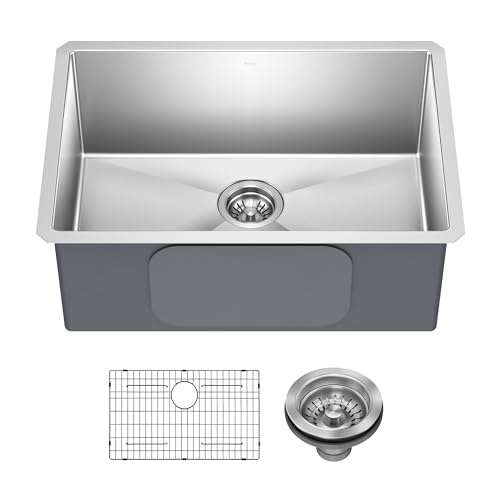
Kraus KHU100-26 Standart Pro, 16 Gauge — Best for Smaller Family Kitchens
Twenty-six inches is the size where product ranges start apologising — thinner steel, vaguer alloys, kits stripped bare — on the theory that smaller kitchens care less. The KHU100-26’s verified listing refuses the apology: 16-gauge stainless, undermount single bowl, Standart Pro family. For apartments with real cooks, galley kitchens and compact remodels, it delivers the same steel contract as its bigger siblings in the footprint the cabinet allows.
The physics flatter small bowls — shorter spans flex less — so a 26-inch sink at 16 gauge feels notably dense and quiet, closer to a commercial prep bowl than to domestic thinware. That solidity is the daily reward for holding the gauge line when downsizing: the sink stops being the kitchen’s apology and becomes one of its best-made objects. Pair it with a pull-down faucet and a grid, and a small kitchen gains a workstation-grade washing station.
Buy it when the base cabinet sets a hard ceiling near 26 inches and the cooking stays ambitious. If the cabinet can take 28, the extra width of the pick above is worth having; measure first, then decide.
Strengths
- Full-thickness steel at a size many makers downgrade
- Suits 30-inch-class sink bases that cannot host 28-plus-inch bowls
- Single bowl maximises the usable space the width allows
Trade-offs
- Sheet pans sit at an angle; this is a cook’s sink, not a baker’s bath
- Confirm the cabinet minimum before ordering, as with every undermount
- Fewer bundle variants than the best-selling 30-inch size
| Specification | Verified detail |
|---|---|
| Gauge | 16-gauge stainless steel, per the verified listing |
| Size | 26-inch undermount single bowl |
| Line | Kraus Standart Pro family |
Check the current price on Amazon
Best for: compact kitchens and 30-inch-class cabinets that still cook seriously / Not suited for: bakers who need flat half-sheet-pan soaking as a daily routine

Kraus KHU111-25 Standart Pro, 16 Gauge — Best for Tight Undermount Fits
There is a specific remodel moment this sink exists for: the cabinet is measured, the counter is chosen, and the honest undermount width is 25 inches — at which point most ranges offer their thinnest apologies. The KHU111-25’s verified listing instead states 16-gauge stainless in a 25-inch undermount single bowl within the Standart Pro family. Tight fit, full specification. For a small kitchen’s only sink, a butler’s pantry or an island position, it is the difference between a compromise and a decision.
At this size the gauge question inverts pleasantly: the bowl is small enough that 16-gauge steel makes it feel almost over-engineered — dense, damped, indifferent to the filled stockpot. Mounting benefits too, since a rigid rim seals cleanly even where clip access is awkward. The trade is purely dimensional: pans wash one at a time, sheet pans lean, and the household adapts its soaking habits to a bowl that rewards washing-as-you-go.
Specify it when the tape measure has spoken and quality still matters. It is also the connoisseur’s second sink: matched in steel to a 16-gauge main bowl, it keeps a two-sink kitchen feeling like one specification.
Strengths
- Genuine 16-gauge construction in a 25-inch undermount footprint
- Ideal main sink for small kitchens and premium second-sink installations
- Standart Pro fit and finish rather than a stripped compact variant
Trade-offs
- Twenty-five inches is a firm ceiling for pan washing
- Undermount fitting in tight cabinets needs an installer comfortable with clips in close quarters
- Accessory choice is narrower than for the 30-inch mainstream
| Specification | Verified detail |
|---|---|
| Gauge | 16-gauge stainless steel, per the verified listing |
| Size | 25-inch undermount single bowl |
| Line | Kraus Standart Pro family |
Check the current price on Amazon
Best for: tight undermount fits, small kitchens and quality second sinks / Not suited for: households whose cookware fleet demands a 30-inch washing bay

SANYCASA 24-Inch Undermount, 11 Gauge — Best Ultra-Thick for Small Bowls
If the 25-inch Kraus is the rational tight-fit answer, this SANYCASA is the maximalist one: its verified listing states 11-gauge stainless in a 24-inch undermount single bowl, sold with a bottom grid and a quiet-drain design. Eleven gauge at 24 inches is armour on a span that barely needs it — and that is precisely its appeal for a certain buyer: the prep sink as a permanent object, indifferent to dropped bottles, freezer packs and the occasional cast-iron skillet parked without ceremony.
Small bowls are where ultra-thick steel makes its most sensible extreme case, because the weight penalty stays manageable and the mounting span stays short. The included grid matters more than the headline number in daily life — it keeps glassware and produce off the floor and completes the quiet system the listing describes. Install it with the same support care as its 30-inch sibling from our first gauge guide, and it will feel less like a sink than like a fixture machined into the counter.
Buy it for a forever-home prep station or a bar sink specified to outlast trends. Rationalists should take the Kraus 25-inch and spend the difference on the faucet; this pick is for the buyer who smiled at the words ’11 gauge’ — you know who you are.
Strengths
- Plate-thick steel in a compact bowl: dent resistance far beyond domestic need
- Included grid and quiet-drain design complete the small-sink package
- A prep or bar sink that will outlast the kitchen around it
Trade-offs
- Heavy for its size; support and clip planning matter even at 24 inches
- Thickness this extreme is a preference, not a necessity, at this span
- Premium positioning for a secondary-sink role
| Specification | Verified detail |
|---|---|
| Gauge | 11-gauge stainless steel, per the verified listing title |
| Size | 24-inch undermount single bowl |
| Kit | Bottom grid included; quiet-drain design per listing |
Check the current price on Amazon
Best for: forever-home prep and bar sinks where maximum thickness in a small bowl is the point / Not suited for: budget-led projects, where the 25-inch Kraus delivers the sense at saner cost

Oxwiser 30 x 18 Undermount Set, 16 Gauge — Best Complete 30-Inch Kit
Install day has a classic failure mode: the sink is perfect and the drain assembly is a separate order arriving Thursday. The Oxwiser set is built against that day — its verified listing describes a 30 by 18 inch undermount in 16-gauge stainless sold as a five-item bundle: sink, bottom grid, drain assembly, drain cap and towel. The size is the family mainstream, the gauge is the full one, and the box contains the whole job. For a remodel running on a tight schedule, that completeness is a feature with real cash value.
Judge it as a system and it holds up: the grid protects the 16-gauge floor from day one rather than from whenever the accessory order lands, and the matched drain assembly removes a compatibility gamble. The brand caveat applies honestly — this is not Kraus or Elkay, so the delivery inspection in our how-to section (flatness, grain, knuckle test, paperwork) is not optional, and the alloy grade should be confirmed in the full specification before purchase. Verified gauge, stated bundle, mainstream size: with the checks run, it is a pragmatic flagship alternative.
Choose the Oxwiser when the project timeline is tight and one-box certainty beats brand lineage. Choose the Kraus KHU100-30 from our first gauge guide when the deepest documentation matters more than the bundled towel.
Strengths
- The complete kit in one box: grid and drain assembly included, no accessory scavenger hunt
- Mainstream 30 by 18 footprint fits the standard family cabinet
- Full 16-gauge steel under the convenience
Trade-offs
- Lesser-known brand than Kraus or Elkay — run the full delivery inspection
- Bundle contents are fixed; keen cooks may still upgrade the grid or strainer later
- Confirm alloy grade in the full specification before ordering
| Specification | Verified detail |
|---|---|
| Gauge | 16-gauge stainless steel, per the verified listing title |
| Size | 30 x 18 inches, undermount single bowl |
| Bundle | 5 items: sink, bottom grid, drain assembly, drain cap, towel |
Check the current price on Amazon
Best for: schedule-driven remodels wanting a complete 16-gauge 30-inch kit in one delivery / Not suited for: brand-first buyers who prefer Kraus or Elkay documentation and ecosystems

Elkay ECTRU17179TC Crosstown, 18 Gauge — Best Square Prep Bowl
Shape is the last variable in the thickness equation, and the square prep bowl is its clearest case. Elkay’s ECTRU17179TC — verified as an 18-gauge, 18-1/2 by 18-1/2 by 9 inch Crosstown undermount kit — puts a deep square bowl where islands, bars and prep corners actually are. At this span and duty, 18-gauge steel from a maker of Elkay’s calibre is not a compromise at all: the spans are short, the loads are produce, glassware and saucepans, and the forming quality keeps the square geometry crisp and cleanable.
The depth deserves emphasis: nine inches in an 18-inch bowl makes it a real working vessel — soaking a saucepan, holding ice and bottles at a party, rinsing a colander under a high tap without splash-out. Square bowls maximise flat floor within a small cutout, which is why prep chefs favour them; the trade is corner care, since tight square corners ask for a deliberate wipe rather than a casual rinse.
Specify it as the second sink in a serious kitchen, or the only sink in a bar or studio where its shape fits the plan. It closes this guide’s argument: thickness follows mounting, size, shape and duty — and when those are honestly assessed, the right gauge chooses itself.
Strengths
- Square format suits prep, bar and island positions that rectangular bowls serve awkwardly
- Elkay Crosstown forming quality at the prep-sink tier
- Nine-inch depth gives a small bowl genuine soaking capacity
Trade-offs
- Eighteen gauge: correct for prep duty, wrong as a heavy main sink
- Square corners in small bowls need a wipe routine to stay pristine
- A specialist shape — resale kitchens may prefer conventional proportions
| Specification | Verified detail |
|---|---|
| Gauge | 18-gauge stainless steel, per the verified listing title |
| Size | 18-1/2 x 18-1/2 x 9 inches, square single bowl |
| Format | Crosstown undermount sink kit |
Check the current price on Amazon
Best for: island, bar and prep positions wanting a deep square bowl from a proven maker / Not suited for: duty as a family kitchen’s main sink, where width and gauge should both rise
Comparison Table
| Pick | Badge | Key spec | Best for |
|---|---|---|---|
| Kraus KHU100-28 Standart Pro, 16 Gauge | Best for Standard Family Kitchens | 16-gauge stainless steel, 28-inch undermount single bowl | standard cabinets and family cooking: the undermount mainstream at full gauge |
| Kraus KHU100-26 Standart Pro, 16 Gauge | Best for Smaller Family Kitchens | 16-gauge stainless steel, 26-inch undermount single bowl | compact kitchens and 30-inch-class cabinets that still cook seriously |
| Kraus KHU111-25 Standart Pro, 16 Gauge | Best for Tight Undermount Fits | 16-gauge stainless steel, 25-inch undermount single bowl | tight undermount fits, small kitchens and quality second sinks |
| SANYCASA 24-Inch Undermount, 11 Gauge | Best Ultra-Thick for Small Bowls | 11-gauge stainless steel, 24-inch undermount single bowl, bottom grid included | forever-home prep and bar sinks where maximum thickness in a small bowl is the point |
| Oxwiser 30 x 18 Undermount Set, 16 Gauge | Best Complete 30-Inch Kit | 16-gauge stainless steel, 30 x 18 in undermount single bowl, 5-item bundle | schedule-driven remodels wanting a complete 16-gauge 30-inch kit in one delivery |
| Elkay ECTRU17179TC Crosstown, 18 Gauge | Best Square Prep Bowl | 18-gauge stainless steel, 18-1/2 x 18-1/2 x 9 in single bowl undermount kit | island, bar and prep positions wanting a deep square bowl from a proven maker |
How to Choose the Best Gauge Stainless for Kitchen Sinks by Mount and Size
Mounting style: what the steel has to do
Undermount sinks hang. The bowl is clipped and bonded beneath the counter, so the rim must be flat, the flange rigid and the body unwilling to flex under a disposal’s vibration — because any movement works on the seal for years. That is why every undermount in this guide’s family sizes carries 16 gauge, and why forming quality (the Standart Pro family’s calling card) matters as much as the number. When you shop undermounts, read rim and flange descriptions as structural claims, not styling.
Drop-in sinks rest. Their decks carry the load onto the counter, so deck thickness and flatness become the structural story — our companion guide’s Kraus drop-in states a 4mm deck for exactly this reason — while the bowl still wants full gauge for dent duty. Farmhouse aprons add a third case: the exposed front is furniture, touched daily, and full-gauge steel keeps it dent-free and quiet against accidental contact. Match the steel to the structure your mounting actually uses.
Size: the span decides the stiffness budget
Steel floors flex as spans widen, roughly and relentlessly. A 24- or 25-inch bowl is a short span: even 18 gauge feels composed, and 16 gauge feels machined. A 28- to 30-inch bowl is the family span: 16 gauge is the specification that keeps it quiet and dent-resistant under real cookware. Beyond 32 inches, thickness becomes structural necessity, as the 36-inch pick in our stainless roundup shows. Buyers downsizing a sink sometimes keep the old gauge assumption; run the span calculation fresh for the new size.
Depth multiplies the effect. Deep bowls catch more dropped-pot energy and their walls are drawn thinner in forming, so a deep 10-inch bowl argues one tier thicker than a shallow 7-inch bowl of the same width. The deep, wide mainstream — 30 inches by 10 inches — is therefore the natural home of 16 gauge, and the shallow, narrow prep bowl is the natural home of the honest 18.
Shape: squares, rectangles and the corner question
Rectangular single bowls dominate because they fit pans and cabinets; within them, corner radius is the daily-living variable. Tight, near-zero-radius corners look architectural and fit marginally more, but ask for brush-level cleaning; rounded corners rinse clean and suit family duty. Gauge interacts quietly: crisp corners are formed by stretching steel, so full-gauge starting stock leaves crisp corners with more substance — one more reason design-led sinks should be held to the 16-gauge line.
Square bowls, like our Elkay prep pick, maximise flat floor per inch of cutout and suit islands and bars where the sink is a station, not a destination. Double bowls divide the span — stiffening each side — but halve the pan fit; if a divider is your answer to thin steel, price the full-gauge single bowl first, because undivided capacity is the thing owners miss longest.
Putting the matrix together: three worked examples
Example one: a 33-inch cabinet, stone counters, family cooking. The matrix says undermount, 28- to 30-inch span, full duty — 16 gauge, as in our 28-inch anchor pick or its 30-inch sibling from the first gauge guide. Example two: a laminate-counter retrofit, 33-inch cutout, mixed duty. Drop-in mounting with a serious deck and 16-gauge bowl — the workstation drop-in from our stainless roundup. Example three: an island prep station, 24-inch cutout, produce and glassware duty. Here the matrix relaxes: the square 18-gauge Elkay is correct engineering, the 25-inch Kraus is the belt-and-braces choice, and the 11-gauge SANYCASA is the connoisseur’s indulgence. Same question, three right answers — because the mounting, size and shape differed.
Run your own kitchen through those three questions before opening a single listing. The gauge that falls out of the matrix will be defensible in a way no headline number ever is — and you will recognise the listings that agree with it, because they are the ones stating their specifications in the open.
How to Match a Sink to Your Cabinet, Counter and Plumbing
Thickness chosen, the install still has to fit. These checks connect the matrix to your actual kitchen before money moves:
- Measure the base cabinet inside, twice. Inside width, front-to-back depth and the height from cabinet floor to counter underside. Compare all three with the sink’s stated dimensions and minimum cabinet size.
- Decide mounting by counter, not by fashion. Undermount needs stone or solid surface with a supported, sealed cut; laminate and worn cutouts point to drop-in. Let the counter you own — or are actually buying — make the call.
- Walk the plumbing. Bowl depth plus drain position decides disposal fit and trap fall. Deep bowls in shallow cabinets are the classic collision; measure the vertical stack before ordering.
- Check the reveal you want. Undermount reveals (positive, negative, flush) change cleaning and the visible rim. Agree the reveal with your fabricator while the sink is on site, not from a listing photo.
- Plan support for thick and wide bowls. Eleven-gauge compacts and wide 16-gauge bowls are heavy filled. Rails, a sink base cradle or fabricator-installed support should be in the plan, not improvised on the day.
- Dry-fit faucet, dispenser and filter tap. Deck space, hole counts and rear clearance differ by model. Confirm the whole ensemble fits the sink and counter together before drilling anything.
Counter Materials, Reveals and the Edges Where Sinks Meet Rooms
A sink’s gauge gets the headlines, but its edges decide how the installation ages. Undermount reveals — the sliver of counter edge visible inside the bowl’s rim — come in three philosophies: the negative reveal hides the rim entirely and wipes cleanest but demands the most precise cutting; the flush reveal aligns counter and bowl for a machined look that shows every imperfection of both; the positive reveal leaves a small ledge of sink rim exposed, forgiving to cut and kind to crumb-catching, at the cost of a visible step. Rigid, full-gauge rims hold whichever reveal you choose against years of thermal movement and disposal vibration; thin rims are where reveals go to open up. When your fabricator asks which reveal you want, the correct preliminary question is whether the sink’s rim deserves one — the Standart Pro family’s flatness is the unglamorous feature that makes all three answers available.
Counter material votes alongside mounting. Stone and quartz take undermounts beautifully and hold clips forever. Solid surface allows the most integrated looks. Laminate, honest material that it is, cannot seal a raw undermount cut against a decade of water — which is why the drop-in format exists and why our companion guide’s full-gauge drop-in workstation matters: it lets a laminate kitchen keep both its counter and its steel standards. Butcher block sits between: an undermount is possible with rigorous sealing, and a drop-in is kinder to the wood’s maintenance rhythm. Choose the pairing as a system — counter, mounting, gauge — rather than falling for a sink and negotiating with reality afterwards.
The second sink, specified like you mean it
Kitchens with two sinks live or die by the second one’s specification, because it is chosen last, funded by leftovers and used daily anyway. The framework of this guide applies unchanged: role first (prep, bar, baking station, coffee point), then span, then gauge by duty. A prep sink beside the range takes produce and saucepans — the square Elkay’s honest 18 gauge or the 25-inch Kraus’s full specification both serve, at different budgets of money and conscience. A bar sink takes glass and ice — gentler loads, harsher acoustics if thin, which argues for padding as much as gauge. An island sink in an open-plan room argues for the quietest system the budget holds, because its audience is everyone you have ever invited to dinner.
What the second sink should never be is the first sink’s inferior by accident. Match alloy across both, keep finishes in the same family, and let the gauges differ only where the matrix — span and duty — honestly says they may. Two sinks specified as one system make a kitchen feel designed; two specified as a flagship and an afterthought make it feel renovated in instalments, which, in fairness, it was.
A Word on Warranties, Returns and the First Thirty Days
The first thirty days of sink ownership are a diagnostic window, and the wise buyer uses it deliberately. Run the disposal at full song and listen for rattles that betray a loose clip. Fill the bowl to the rim and watch the drain and the seal line for the weep that only appears under load. Cook the messiest meal your kitchen produces — the curry, the beetroot, the red-wine reduction — and learn how your finish and corners behave while an exchange is still a phone call rather than a renovation. Check the grid’s feet, the strainer’s seating and the ledge’s level with a board and a marble’s worth of curiosity. Defects in forming, finish and fit announce themselves early to owners who look; they announce themselves late, and expensively, to owners who assume.
Warranties in this market reward the paperwork habit this series keeps recommending: keep the invoice, the model number and the specification sheet together, register the product where the maker invites it, and photograph the installed sink with its grid and accessories in place. Kraus- and Elkay-class makers run real support organisations; the value brands in these guides are served best by buyers who document the delivery-day condition while the retailer’s returns window stands open behind them. None of this is pessimism — the picks here were chosen to make it unnecessary. It is simply the recognition that a fixture installed under stone deserves the diligence of a fixture that cannot be casually returned, and thirty attentive days is a trivial premium on a twenty-year policy.
Renters, landlords and the removable question
One audience reads gauge guides with a special constraint: people improving kitchens they do not own, and owners improving kitchens others will use. For renters, the sink is usually the landlord’s fixture and the honest advice is maintenance, not purchase — a grid to protect the existing bowl, a mat to quiet it, and the knowledge, banked for a future owned kitchen, of exactly which specification you will buy when the counter is yours. For landlords, the framework of this guide applies with the durability dial turned up: full gauge, brushed finish, declared alloy, because the cheapest sink over ten tenancies is the one installed once. The compact Kraus and Elkay picks serve that maths at small sizes; the 28-inch anchor serves it at family size. Thickness, in rental economics, is not a luxury line — it is the depreciation schedule, written in steel.
Common Buying Mistakes
- Choosing gauge before choosing mounting. The mounting decides what the steel must do. Settle undermount versus drop-in first; the correct thickness follows from it.
- Carrying a big-sink gauge assumption into a small sink — or the reverse. Span changes the stiffness maths in both directions. Recompute for the size you are actually buying.
- Ignoring bowl depth in the plumbing plan. A deep bowl plus a tall disposal plus a low wall stub equals a trap that will not fit. Measure the stack, not just the width.
- Treating the second sink as an afterthought. Prep and bar sinks get used daily for decades. Specify their steel deliberately — full gauge, ultra-thick or honest 18 by role — rather than accepting the range’s cheapest leftover.
- Skipping support planning for heavy bowls. Thick steel is heavy steel, and water adds more. Support is part of the sink purchase, not an installer’s surprise.
- Judging a square prep bowl by main-sink standards. Different shape, different duty, different right answer. The Elkay’s 18 gauge is correct for its role; the same number in a 32-inch main bowl would not be.
Workstation Ledges, Aprons and Decks: The Three Special Structures
Three structures recur across the gauge guides, and each makes its own demand of the steel. The workstation ledge is a shelf asked to behave like a countertop: it carries boards under knife load, racks under wet weight and colanders under boiling drainage. Flex is its enemy and gauge is its answer, which is why every workstation recommended across these guides carries full 16-gauge steel or sits at a span short enough to forgive less. When you assess a workstation listing, look for the ledge described as integrated or machined rather than folded as an afterthought, and press it in the showroom if you can — a shelf should feel like furniture, not like a diving board.
The farmhouse apron is the second structure: a vertical face of steel presented to the room, to knees, to belt buckles and to the occasional collision with a laundry basket. Aprons advertise their gauge honestly because they cannot hide behind a cabinet; a thin apron dents in the most visible square foot of the kitchen, while a full-gauge apron in a brushed finish absorbs the years with dignity. Our wider research pool holds several 16-gauge farmhouse models verified for exactly this role, and the rule generalises: any steel the room can touch should be steel at the flagship number.
The deck is the third, and the quietest. On drop-in sinks the deck is rim, structure and seal in one; on faucet decks it is the platform that must not flex when a tall tap is swung a thousand times a year. Thickness stated for a deck — the 4mm figure in our companion guide’s drop-in pick — is a structural claim to be prized exactly as a bowl gauge is. Judge all three structures by the same question this whole series asks: is the steel’s thickness stated, and does the structure’s job justify it? Where the answer to both is yes, you are looking at a sink designed by someone who has installed one.
Final Recommendation
Thickness, properly chosen, disappears into a sink that simply feels right for its place. For the standard family undermount, that is the 16-gauge Kraus line — the 28-inch KHU100-28 for the mainstream cabinet, the 26- and 25-inch members as cabinets tighten, none of them surrendering the specification. For the complete-kit shopper, the Oxwiser’s 30-inch bundle puts the full gauge and the whole install in one box. For small bowls with big ambitions, the 11-gauge SANYCASA is the delightful extreme; for the square prep role, Elkay’s 18-gauge Crosstown is the engineer’s answer. Mounting, size, shape, duty — in that order — and the gauge chooses itself.
The companion guides complete the set: Best Gauge For Kitchen Sinks for the need-first overview, Best Gauge For Ss Kitchen Sinks for grade and gauge together, and Best Gauge Kitchen Stainless Steel Sinks for size-by-size buying. For the broader sink field at the flagship tier, see Best 16 Gauge Stainless Steel Undermount Kitchen Sinks.
Before the matrix hardens into a purchase, one last reality check deserves its moment: water pressure and habits. A high-pressure tap into a shallow, wide bowl is a splash machine at any gauge, and a household that rinses under a fully opened tap will judge a sink by splash behaviour its specification never mentioned. Deep bowls forgive pressure; shallow prep bowls demand a gentler hand or an aerator’s diplomacy. Match the bowl’s depth to the tap you own and the habits you actually have — the matrix in this guide assumes ordinary use, and your kitchen’s ordinary is the only version that matters.
That is the whole method: measure the kitchen, name the mounting, respect the span, and let the steel follow.
Shortlist for convenience — Kraus KHU100-28 Standart Pro, 16 Gauge, Kraus KHU100-26 Standart Pro, 16 Gauge, Kraus KHU111-25 Standart Pro, 16 Gauge: check price on Amazon, check price on Amazon, check price on Amazon.
Frequently Asked Questions
What gauge should an undermount kitchen sink be?
Sixteen gauge is the working standard for undermount family sinks: the rim stays flat for a durable seal, the floor resists family cookware, and padded models stay quiet. Smaller undermount prep bowls can justify 18 gauge from a top maker; wide ones cannot.
Does a drop-in sink need thick steel too?
Yes — in the bowl for dent resistance, and in the deck for structure. A drop-in rests on its deck, so deck thickness and flatness matter as much as bowl gauge. Full-gauge drop-ins exist and are the ones to buy, as our companion stainless guide’s workstation pick shows.
Is 18 gauge acceptable for a small sink?
Yes, in the right role. A compact prep or bar bowl — short span, lighter loads, quality forming — is the honest home of 18 gauge, especially from makers like Elkay. The same gauge stretched across a 32-inch main bowl is where the tier stops being value and starts being compromise.
Why would anyone buy an 11-gauge sink?
For maximum dent resistance and a machined, permanent feel — most sensibly in a compact prep or bar bowl, where the weight stays manageable. It is beyond need for most households, and that is fine: some fixtures are bought as heirlooms, and thickness is how a sink becomes one.
How does bowl depth affect the gauge I need?
Deeper bowls are formed by stretching the steel further and meet dropped cookware with more energy at the floor. As depth grows toward 10 inches, argue one tier thicker: the deep mainstream belongs at 16 gauge, while shallow prep bowls can live honestly at 18.
What cabinet size do I need for a 28-inch sink?
Check the maker’s stated minimum cabinet for the specific model rather than assuming — undermount bowls need clip room beyond the bowl’s width. The Standart Pro listings state their requirements; measure your base unit’s inside width and compare before ordering.


