Disclosure: airfryerkitchensupply.com is reader-supported. When you buy through links on our site, we may earn an affiliate commission at no extra cost to you.
Where to buy
Every product named in this guide to the best gauge kitchen stainless steel sinks was checked against Amazon listing data before it earned a place here, and the links below go to the exact verified listings. Prices change constantly, so each pick is linked with a live price check instead of a printed number:
- Kraus KA1US33B 33-Inch, 16 Gauge — Check the current price on Amazon
- Kraus 33-Inch Drop-In Workstation, 16 Gauge — Check the current price on Amazon
- Lordear 36-Inch Undermount, 16 Gauge — Check the current price on Amazon
- Kichae 30-Inch Undermount, 16 Gauge — Check the current price on Amazon
- Kraus Dex KD1US33B 33-Inch, 16 Gauge — Check the current price on Amazon
- Elkay Crosstown Workstation 25.5-Inch, 18 Gauge — Check the current price on Amazon
Shopping for the best gauge kitchen stainless steel sinks usually starts with a number and ends with a headache, because listings scatter 16, 18 and 20 across every size and style as if they were interchangeable. They are not. This guide organises the stainless market the way you will actually buy it: by the sizes and formats on your shortlist, with the gauge each one deserves stated in its verified listing. Sixteen gauge anchors the list — five of our six picks carry it — because at family sizes it is simply the correct specification. The sixth pick shows where 18 gauge, honestly made, still wins.
Notice what the picks have in common beyond thickness: every gauge quoted here comes from the sink’s verified Amazon listing, pulled connection, and the spec boxes repeat only what those listings state. That discipline matters because gauge is the easiest specification to exaggerate and the hardest to check after the counter is cut. A sink is a ten-to-twenty-year purchase installed under stone; the time to verify its steel is before it ships, and this guide is built to let you do exactly that.
Use the picks as size-matched answers — 33-inch flagship, drop-in workstation, 36-inch capacity, handmade-look value, contemporary design, compact workstation — then read the buying guide for the reasoning that connects gauge to size, mounting and duty, so the sink you choose is right for reasons you can explain.
In this guide
Quick Picks
- Kraus KA1US33B 33-Inch, 16 Gauge — Best Overall: a 33-inch 16-gauge undermount whose radiant pearl finish is made to mask scratches, with rounded corners and foil-layer NoiseDefend soundproofing — Check the current price on Amazon
- Kraus 33-Inch Drop-In Workstation, 16 Gauge — Best Drop-In at Full Gauge: proof drop-in does not mean downgrade: a 16-gauge TRU16 workstation with integrated ledge, board, roll-up rack and a 4mm mounting deck — Check the current price on Amazon
- Lordear 36-Inch Undermount, 16 Gauge — Best Extra-Large: a 36-inch 16-gauge single bowl for serious capacity — the size where thin steel fails first and this one does not — Check the current price on Amazon
- Kichae 30-Inch Undermount, 16 Gauge — Best Handmade-Look Value: a handmade-style 30 by 18 inch 16-gauge undermount with rounded corners and a modern rectangular profile at a value-tier position — Check the current price on Amazon
- Kraus Dex KD1US33B 33-Inch, 16 Gauge — Best Contemporary Design: the Dex line’s clean-lined 33-inch undermount in 16-gauge steel, for kitchens where the sink is part of the architecture — Check the current price on Amazon
- Elkay Crosstown Workstation 25.5-Inch, 18 Gauge — Best Small Workstation: Elkay’s workstation idea at 25.5 inches and 18 gauge: the Crosstown ledge in a compact kit for small kitchens and second sinks — Check the current price on Amazon
How These Picks Were Chosen
We selected for coverage of the real shortlist: the sizes buyers actually compare (25.5 to 36 inches), both mounting styles, and the three styling families — standard, handmade-look and contemporary — that dominate stainless today. Each pick’s gauge had to be stated in its verified listing; listings that hid the number were excluded regardless of price or appearance. Included equipment and named sound treatment broke ties, because they decide the true cost and the daily sound of the installed sink.
Two picks carry honest caveats rather than silent passes: where a listing’s title leads with gauge and dimensions instead of alloy grade, the review says so and points to the pre-purchase check. That is the standard this guide applies throughout — verification over promotion — and it is why the 18-gauge Elkay closes the list proudly instead of apologetically: declared, well-formed thin steel beats undeclared thick claims every time.
The 6 Best Gauge Kitchen Stainless Steel Sinks by Size and Style

Kraus KA1US33B 33-Inch, 16 Gauge — Best Overall
Buying stainless by gauge usually ends at a 33-inch single bowl, because that is the size family kitchens actually live in — and the KA1US33B is what the end of that search looks like. Its verified listing states 16-gauge TRU16 steel across a 33-inch undermount single bowl, finished in a radiant pearl surface the listing describes as masking scratches, with rounded corners and NoiseDefend foil-layer soundproofing underneath. Every line answers a real ownership complaint about big stainless bowls: scratches, noise, grime-trapping corners.
The gauge earns its place at this size more than at any other. A 33-inch floor is a wide span of steel; in 18 gauge it can flex and drum, and in cheap 16 gauge with poor forming it can still oil-can under a filled pot. Kraus’s Standart-family forming keeps the big floor composed, and the foil-layer padding keeps the disposal’s opinion to itself. This is the pick for buyers who have done the gauge homework and simply want the mainstream answer executed without a weak line in the specification.
If your cabinet takes it and your cooking fills it, stop shopping here. The rest of this list exists for the kitchens this sink does not fit — smaller bases, drop-in counters, even bigger bowls — not because this one leaves a box unticked.
Strengths
- Thirty-three inches of full 16-gauge steel: the family-kitchen flagship size done properly
- Pearl finish is the pragmatic choice for a big bowl that will see daily pan traffic
- Foil-layer soundproofing addresses the big-bowl drum effect at its source
Trade-offs
- Needs a genuinely wide sink base; 33-inch bowls punish optimistic measuring
- Single bowl format only — dividers fans should look at double-bowl families
- Undermount install with stone or solid surface is assumed
| Specification | Verified detail |
|---|---|
| Gauge / steel | 16-gauge TRU16 steel, per the verified listing |
| Size | 33-inch undermount single bowl |
| Finish | Radiant pearl finish, described as masking scratches |
| Details | Rounded corners; NoiseDefend foil-layer soundproofing |
Check the current price on Amazon
Best for: family kitchens with a wide cabinet wanting the definitive 16-gauge 33-inch bowl / Not suited for: cabinets that cannot meet the width, or cooks who insist on a divided bowl
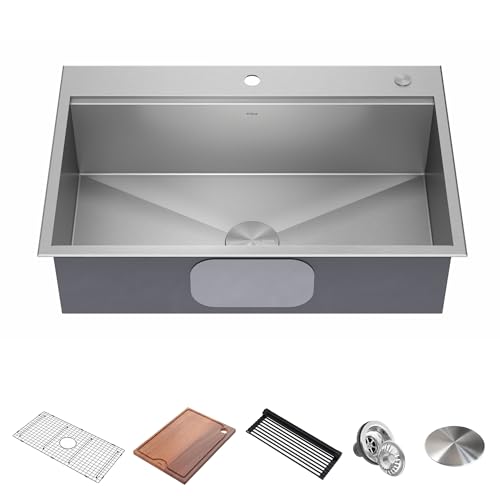
Kraus 33-Inch Drop-In Workstation, 16 Gauge — Best Drop-In at Full Gauge
Drop-in sinks carry an unfair reputation as the thin option, earned by decades of flimsy top-mount bowls in rental kitchens. This Kraus dismantles it: the verified listing describes 16-gauge TRU16 steel, an integrated workstation ledge, a cutting board and roll-up rack in the box, and a 4mm mounting deck — the rim structure that decides whether a drop-in feels planted or trampoliny when you lean on it. For laminate counters, retrofits and any project where undermount is off the table, this is how you keep full gauge anyway.
The deck detail deserves its moment. On a drop-in, the rim is both structure and seal: too thin and it flexes, lifts sealant and drums; a proper deck sits flat, clamps evenly and stays quiet. Pair that with 16-gauge bowl steel and the ownership experience converges with the undermount picks above — same dent resistance, same damped sound, same workstation workflow — at the price of a visible rim that needs a wipe along its seam.
Choose this when the counter material or the project scope rules out undermount, and refuse the idea that the mounting style should cost you two gauges of steel. It should not, and here it does not.
Strengths
- Full 16-gauge steel in a drop-in format that suits laminate and retrofit projects
- Thick 4mm deck keeps the rim rigid where drop-in sinks usually feel weakest
- Workstation ledge and included accessories bring undermount-style function to a top-mount install
Trade-offs
- Drop-in rims sit proud of the counter; the seam needs the usual cleaning attention
- Thirty-three inches still demands the cabinet and cutout to match
- Workstation accessories are model-fit; replacements come from the same line
| Specification | Verified detail |
|---|---|
| Gauge / steel | 16-gauge TRU16 steel, per the verified listing |
| Mounting | Drop-in / top-mount with 4mm mounting deck |
| Format | Workstation with integrated ledge; cutting board and roll-up rack included |
Check the current price on Amazon
Best for: laminate counters and retrofits that want workstation function at full 16 gauge / Not suited for: buyers chasing the flush, rimless look of an undermount at any cost

Lordear 36-Inch Undermount, 16 Gauge — Best Extra-Large
At 36 inches, gauge stops being a preference and becomes structural advice. The wider a single bowl stretches, the more its floor behaves like a membrane, and thin steel in a 36-inch bowl flexes, drums and dents with an enthusiasm that surprises buyers who saved money at exactly the wrong dimension. The Lordear’s verified listing puts 16-gauge stainless across the full 36-inch undermount span, which is the correct specification for the size — and the reason it, rather than any thinner extra-large rival, represents the category here.
The use case is capacity without theatre: a turkey roaster soaking whole, two sheet pans stacked, a canning kettle under the tap. Kitchens that cook for crowds, process garden produce or host constantly will feel the size daily; kitchens that do not will feel the water bill for filling it. As with the BoomHoze in our SS guide, we note plainly that the listing title leads with gauge and size rather than alloy grade, so run the grade confirmation in the full specification before ordering — the check takes a minute and protects a decades-long purchase.
Buy the Lordear when the cabinet is wide, the cooking is big and the household is done compromising on capacity. Everyone else is better served — and better fitted — by the 30- to 33-inch picks.
Strengths
- Maximum mainstream capacity with the gauge a span this wide requires
- Single uninterrupted bowl takes the largest roasters and sheet pans whole
- Kit format keeps the install-day parts list together
Trade-offs
- Demands a very wide base cabinet and a confident installer
- A bowl this big uses more water to fill for soaking
- Grade is foregrounded less in the title than Kraus’s T-304 language — confirm the alloy in full specs before ordering
| Specification | Verified detail |
|---|---|
| Gauge | 16-gauge stainless steel, per the verified listing title |
| Size | 36-inch undermount single bowl |
| Format | Large single-bowl kit format |
Check the current price on Amazon
Best for: crowd-cooking households with a very wide cabinet and genuine 36-inch needs / Not suited for: standard cabinets, or small households paying to heat soak-water for a bowl they rarely fill

Kichae 30-Inch Undermount, 16 Gauge — Best Handmade-Look Value
The handmade look — tight corners, flat planes, a bowl that reads as fabricated rather than stamped — is the defining stainless style of the moment, and it is also where gauge claims get creative. The Kichae’s verified listing keeps it simple: 16-gauge stainless, 30 by 18 inches, undermount single bowl, rounded corners balancing the rectangular handmade profile. It earns its place as the value route to the look, with the thickness stated where buyers can check it.
Rounded corners inside a modern profile is the right compromise: near-square geometry for pan fit and appearance, enough radius to wipe clean without a brush ritual. Sixteen gauge gives the flat planes their composure — thin handmade-look bowls are the worst offenders for oil-canning floors, because flatness advertises every flex. Keep the delivery checks from this guide in hand, confirm the alloy in the full specification, and the Kichae delivers the aesthetic at a tier the big brands reserve for plainer shapes.
Choose it when the kitchen’s design language is contemporary and the budget has already fought the counter and cabinet battles. Choose the Kraus Standart family when declared T-304 paperwork matters more than the silhouette.
Strengths
- Handmade aesthetic — tight profile, modern lines — without handmade pricing theatre
- Full 16-gauge steel under the styling, where lookalike rivals quietly thin out
- Rounded corners keep the contemporary shape easy to clean
Trade-offs
- Smaller maker than Kraus or Elkay; inspect finish and flatness carefully on arrival
- Accessory ecosystem is thinner than the big brands’ workstation lines
- Confirm grade and kit contents in the full listing before ordering
| Specification | Verified detail |
|---|---|
| Gauge | 16-gauge stainless steel, per the verified listing title |
| Size | 30 x 18 inches, undermount single bowl |
| Style | Handmade-look rectangular profile with rounded corners |
Check the current price on Amazon
Best for: design-led remodels wanting the handmade look with stated 16-gauge steel at a value position / Not suited for: paperwork-first buyers who want the alloy grade declared in the title itself

Kraus Dex KD1US33B 33-Inch, 16 Gauge — Best Contemporary Design
Design-led sinks fail in a predictable way: the styling budget eats the steel budget, and a beautiful silhouette arrives in thin, loud metal. The Dex avoids the trap by keeping the number that matters — its verified listing states 16-gauge stainless across the 33-inch undermount single bowl — while the Dex line’s clean, architectural lines do the visual work. It is the pick for kitchens where the sink is deliberately part of the room’s composition, not hidden under a drying rack.
Living with a design sink means accepting its terms: minimal surfaces show water spots, so a quick wipe-down rhythm and a grid become part of the routine, and the payoff is a bowl that still looks intentional in year five. The gauge underwrites that longevity — crisp edges and flat planes only stay crisp if the steel holds its shape against daily cookware, which is precisely what 16 gauge is for.
Buy the Dex when the remodel’s design coherence is a real priority and the budget can hold both style and specification. Buy the KA1US33B when finish forgiveness matters more than silhouette; they are the same size and gauge philosophy wearing different clothes.
Strengths
- Design-forward Dex styling backed by full 16-gauge construction
- Thirty-three-inch single bowl keeps family capacity inside the clean lines
- Kraus manufacturing consistency behind a style-led product
Trade-offs
- Contemporary minimalism shows water spots more than forgiving pearl finishes
- Premium line positioning; the Standart Pro family is the value route at the same gauge
- Undermount only, with the usual counter requirements
| Specification | Verified detail |
|---|---|
| Gauge | 16-gauge stainless steel, per the verified listing title |
| Size | 33-inch undermount single bowl |
| Line | Kraus Dex contemporary series |
Check the current price on Amazon
Best for: contemporary kitchens that want architectural styling without surrendering gauge / Not suited for: households that know a minimalist bowl will live under a permanent pile of washing-up
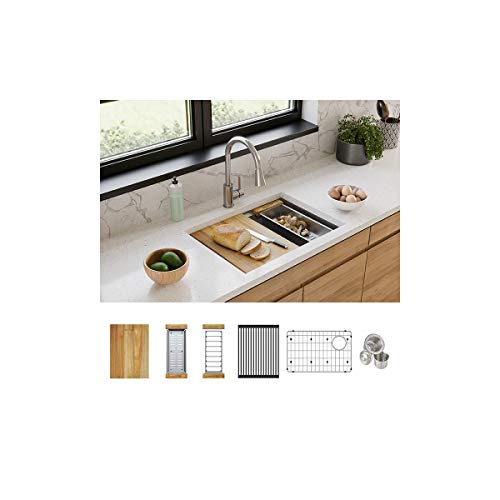
Elkay Crosstown Workstation 25.5-Inch, 18 Gauge — Best Small Workstation
Small kitchens face a false choice between function and fit: workstations start at 30 inches, product pages imply, so compact kitchens go without. Elkay’s 25.5-inch Crosstown workstation refutes it — the verified listing describes an 18-gauge workstation kit at 25-1/2 by 18-1/2 by 9 inches, bringing the ledge-and-accessory workflow to galley kitchens, apartments and second-sink positions where the big Kraus workstations physically cannot go.
The 18-gauge specification is defensible here in a way it is not at 36 inches: a 25-inch span is naturally stiffer, the loads in a prep role are lighter, and Elkay’s forming keeps the small bowl composed. Add the grid, treat cast iron with ordinary care, and the tier’s compromises shrink to near theory. What does not shrink is the workflow gain — prep over the bowl, drain over the bowl, clear counters in a kitchen that has none to spare.
This is the closing argument of the guide in miniature: gauge chosen by size and duty, from a maker that declares its specification. If every buyer shopped that way, guides like this one could be much shorter.
Strengths
- Workstation ledge functionality in a genuinely compact footprint
- Elkay forming quality carries the 18-gauge tier at small sizes, where thin steel is most forgivable
- Ideal second-sink or small-kitchen specification with a real brand behind it
Trade-offs
- Eighteen gauge asks for grid discipline with heavy pans
- Twenty-five inches will not host the largest cookware flat
- Workstation accessories are an ecosystem cost beyond the kit
| Specification | Verified detail |
|---|---|
| Gauge | 18-gauge stainless steel, per the verified listing title |
| Size | 25-1/2 x 18-1/2 x 9 inches |
| Format | Workstation single-bowl undermount sink kit |
Check the current price on Amazon
Best for: small kitchens and second sinks that want workstation function in a compact, declared package / Not suited for: a large family’s only sink, where width and gauge should both step up
Comparison Table
| Pick | Badge | Key spec | Best for |
|---|---|---|---|
| Kraus KA1US33B 33-Inch, 16 Gauge | Best Overall | 16-gauge TRU16 steel, 33-inch undermount single bowl, radiant pearl finish | family kitchens with a wide cabinet wanting the definitive 16-gauge 33-inch bowl |
| Kraus 33-Inch Drop-In Workstation, 16 Gauge | Best Drop-In at Full Gauge | 16-gauge TRU16 steel, 33-inch drop-in workstation, 4mm mounting deck, ledge accessories included | laminate counters and retrofits that want workstation function at full 16 gauge |
| Lordear 36-Inch Undermount, 16 Gauge | Best Extra-Large | 16-gauge stainless steel, 36-inch undermount single bowl kit | crowd-cooking households with a very wide cabinet and genuine 36-inch needs |
| Kichae 30-Inch Undermount, 16 Gauge | Best Handmade-Look Value | 16-gauge stainless steel, 30 x 18 in undermount single bowl, rounded corners, handmade style | design-led remodels wanting the handmade look with stated 16-gauge steel at a value position |
| Kraus Dex KD1US33B 33-Inch, 16 Gauge | Best Contemporary Design | 16-gauge stainless steel, 33-inch undermount single bowl, Dex contemporary line | contemporary kitchens that want architectural styling without surrendering gauge |
| Elkay Crosstown Workstation 25.5-Inch, 18 Gauge | Best Small Workstation | 18-gauge stainless steel workstation kit, 25-1/2 x 18-1/2 x 9 in single bowl undermount | small kitchens and second sinks that want workstation function in a compact, declared package |
How to Choose the Best Gauge Kitchen Stainless Steel Sinks
The gauge ladder, rung by rung
Sixteen gauge (about 1.5mm) is the flagship tier: dent-resistant, rigid across wide spans, and quiet with padding. It is the correct default for main sinks of 28 inches and above, for workstations whose ledges must behave like shelves, and for any household whose cookware runs heavy. Five of our six picks live here because the market’s centre of gravity does.
Eighteen gauge (about 1.2mm) is the engineered value tier. From serious makers — Elkay’s Crosstown line is the standing example — it delivers declared alloy, proper forming and full function at smaller sizes and lighter duties, asking only for grid discipline in return. Twenty gauge (about 0.9mm) is the rental and budget-replacement tier: light, loud and dent-prone. It has legitimate uses where a sink is a commodity, but it has no place on a remodel shortlist, and no verified 20-gauge listing met this guide’s bar for recommendation.
Size votes first, gauge second
The most useful rule in this guide: let the bowl’s width set the gauge floor. Under 26 inches, spans are short and stiff; 18-gauge from a declared maker is a rational buy, as our compact Elkay shows. From 28 to 33 inches — the family mainstream — 16 gauge is the specification to hold, because floors widen and loads grow. At 36 inches, 16 gauge stops being premium and becomes necessary; the Lordear’s span in thinner steel would flex and drum its way out of this list.
Depth votes too. Deep bowls (10 inches) are drawn further during forming and meet more dropped-pot energy at the floor; both argue a tier up in thickness. Workstation ledges vote the same way: a ledge is a shelf, and shelves should not flex. When two factors vote thicker — big and deep, big and workstation — believe them.
Mounting style changes the steel’s job
Undermount bowls hang from the counter and rely on clips and adhesive; their rims must be flat and their bodies rigid, which is forming quality as much as gauge. Drop-in sinks rest on their decks, and the deck becomes the structure to inspect: our Kraus drop-in’s stated 4mm mounting deck is the detail that separates a planted rim from a flexing one. Farmhouse aprons expose the front panel to knee and hip contact for decades — another argument for full gauge where the body meets the room.
Whichever mounting you choose, remember the counter is part of the system. Undermounts need stone or solid surface with a sealed, supported cut; drop-ins forgive laminate and tired cutouts. Choose the mounting your counter can honestly support, then buy the fullest gauge that format offers — as the drop-in Kraus proves, the format no longer forces a downgrade.
Reading a stainless listing like an inspector
Four lines decide a listing’s credibility. Gauge: stated as a number, for the bowl. Grade: stated as 304/T-304/SUS304, not as an adjective. Dimensions: external, bowl and minimum cabinet, all three. Sound: a named padding or coating system, not silence. Our top picks print most of these in their titles; where one is missing, the review flags it and the full specification becomes your homework.
Apply the same reading to photography. Handmade-look sinks should show consistent corners and even grain; workstation ledges should sit level in side views; big bowls should not ripple across the floor in raking light. Listings are auditions. The sinks above passed theirs with their specifications in the open, which is the only kind of audition that matters for a fixture you cannot easily return once the stone is cut.
How to Measure and Dry-Fit Before Your Stainless Sink Is Installed
Gauge verification gets the headlines, but most sink regret is dimensional. Run these steps while the project is still reversible:
- Confirm the cabinet minimum first. Compare the listing’s minimum cabinet size with your base unit’s inside width, allowing for clip clearance on undermounts. Do this before the counter template is taken.
- Template the pan test. Cut cardboard to your largest sheet pan and roasting pan footprints and lay them in the intended bowl size at the showroom or on the counter plan. Flat fit now prevents a decade of angled soaking.
- Check depth against plumbing. Deep bowls lower the drain; confirm the disposal body and trap arm still fit with fall to the wall stub. Measure the cabinet’s under-sink vertical space honestly.
- Verify faucet and accessory clearances. On drop-ins and decks, confirm hole spacing and the rear ledge room for your faucet, dispenser and any filter tap before the counter is drilled.
- Inspect on delivery, in order. Flatness of flange or deck, evenness of brushed grain, corner quality, then the knuckle and floor-press tests for the gauge you paid for. Photograph anything questionable before signing off.
- Keep the paperwork with the house file. Gauge, grade, model and cutout template belong with your counter documents; the next owner — or the next faucet installer — will thank you.
The Real Cost of a Gauge: Project Maths Buyers Actually Face
Gauge decisions are rarely made in isolation, because the sink is one line in a project that includes counters, a faucet, plumbing time and often an installer. Thinking in project maths changes the answer in useful ways. The step from an unbranded thin sink to a declared 16-gauge Kraus or an 18-gauge Elkay is typically the cost of a modest dinner out, spread across a fixture used a dozen times a day for fifteen years. The step from 18 gauge to 16 within a good brand is smaller still. Against that, the cost of the wrong sink is not the purchase price — it is the counter, cut once, and the labour of living with or replacing what sits in the hole. Sinks are the cheapest place in a remodel to buy certainty and the most expensive place to have saved money.
Where budgets genuinely bind, the honest cuts are elsewhere in the project: the faucet can be upgraded in year two with a wrench, the disposal can wait a season, accessories can arrive as gifts. The sink cannot be upgraded without stone work, which is why this guide’s value picks are engineered compromises — declared alloy, proper forming, grid discipline — rather than cheap ones. The Elkay compact workstation closes our list because it demonstrates the principle: money saved by engineering, at a size where the saving is safe, from a maker whose name underwrites the thinner number.
Resale, rentals and the second owner
A declared-gauge, declared-grade sink is also a document. When the house sells, ’16-gauge T-304 undermount’ in a listing description is a line a buyer’s inspector nods at; when a rental turns over, a thick brushed bowl absorbs tenant life that would tattoo a thin polished one. Owners of rental property sometimes ask whether 20 gauge is the rational landlord spec, and for a sink treated as a consumable it can be — but the maths usually reverses on inspection: one replacement cycle of labour costs more than the gauge steps saved, and the thick sink is still there, unbothered, at the second and third tenancy. Buy the sink for the building’s life, not the budget meeting’s mood.
Second owners inherit your paperwork, which is the last argument for buying declared specifications from declared makers: the spec sheet in the house file tells the next household what they own, which grid to reorder and which faucet cartridge matches. Mystery sinks bequeath mystery maintenance. The sinks in this guide were chosen to be explainable — to you now, and to whoever owns your kitchen next.
Showroom Tests Worth Stealing
If you shop in person, steal the inspector’s routine and run it in the aisle. First, the palm press: firm pressure at the centre of the bowl floor and along any workstation ledge, feeling for flex or the faint oil-can pop of thin or poorly supported steel. Second, the knuckle rap across floor, walls and — on drop-ins — the deck, listening for the difference between a damped thud and a drum. Third, the flange check: run a straight edge or a phone’s flat back along an undermount’s rim; light showing under it is a seal problem scheduled for year three. Fourth, the corner inspection: look inside the bowl’s corners for the smoothness that predicts easy cleaning, and outside them for the fullness that predicts the steel was not starved in forming.
Fifth, the paperwork test, which most showrooms fail on your behalf if you let them: ask for the specification sheet and find the gauge, the grade and the minimum cabinet in print. A retailer who can produce it is selling a specified product; a retailer who offers adjectives is selling a photograph. Sixth and last, the grid test: set the intended grid in the bowl and rock it. A fitted grid sits dead still; a universal one ticks and slides, previewing a decade of small annoyances. None of these tests requires tools, expertise or courage — only the willingness to treat a four-figure project component with the same scepticism you would bring to a used car. The sinks in this guide were chosen because their listings survive the paperwork test from your sofa; the showroom routine is for every sink that asks you to take its number on faith.
The one-page version of this entire guide
For readers who have reached this depth and want the argument distilled before they shop: state your size honestly, from the cabinet outward. Hold 16 gauge for any main sink of 28 inches or more, any workstation, any deep bowl and any apron the room will touch. Accept 18 gauge only from a maker who declares its alloy and its dimensions, only at compact sizes or prep duties, and only with a grid in the bowl from the first day. Refuse any listing, at any price, that will not print its gauge and its grade where you can read them. Choose the finish your household’s habits can keep beautiful — brushed or pearl for working kitchens, polished only for disciplined ones. Buy the fitted grid with the sink. Keep the paperwork forever. Every pick in this guide satisfies that paragraph, and every paragraph of this guide exists to explain why it is enough.
Common Buying Mistakes
- Comparing sinks by gauge alone across different sizes. A 36-inch bowl needs more steel than a 25-inch bowl to feel equally solid. Judge gauge relative to span, as this guide’s picks do.
- Assuming drop-in means thin. The Kraus drop-in workstation carries 16-gauge steel and a 4mm deck. Mounting style and steel quality are separate decisions.
- Falling for the handmade look without checking the number. Flat planes advertise flex. Handmade styling demands full gauge more, not less — verify it in the listing, as the Kichae states it.
- Ignoring the finish’s maintenance personality. Pearl and brushed finishes forgive; mirror-minimal surfaces document every spot. Match the finish to the household’s actual wipe-down habits.
- Letting the counter be cut before the sink arrives. Templates drift and listings round numbers. The physical sink — measured, inspected, approved — should be on site before stone is cut around it.
- Forgetting the grid in the budget. At any gauge, the grid is cheap insurance for the bowl floor. Several picks include one; for the rest, add it to the order, not to a later wish list.
Faucets, Disposals and Grids: Specifying the Sink’s Working Partners
A sink is bought alone and used in company, and the partners chosen with it decide as much of the daily experience as the gauge does. Start with the faucet, because its reach must match the bowl you have just sized: a 33- or 36-inch single bowl wants a pull-down spray that genuinely reaches the corners, mounted with enough height to clear your tallest pot under the arc — or low enough, in the case of deep bowls, to keep splashing inside them. The Lordear’s 36-inch span with a short-reach faucet is a kitchen that washes its largest bowl in sections; the pairing, not the parts, is the product.
The disposal is the second partner, and it negotiates with depth. Deep 9- and 10-inch bowls lower the drain outlet; the disposal body then sits lower; the trap arm’s fall to the wall stub shrinks. Most kitchens absorb this without drama, but the combination of a deep bowl, a tall disposal and a high wall stub is the classic under-sink collision, and it is discoverable with a tape measure before any purchase. Sound belongs in the same conversation: a disposal bolted under a padded 16-gauge bowl is a appliance; under a thin unpadded bowl it is a percussion section, one more reason the gauge and padding decisions in this guide pay rent every single day.
The grid is the third partner and the cheapest. Beyond protecting the floor, it defines a second working level in the bowl — glasses drain above the rinse water, produce rests out of the soak, a hot pan lands without meeting the steel at full temperature. Several picks include theirs; for the rest, order the maker’s fitted grid with the sink, because universal grids fit universally poorly. Add a fitted rack or board for workstation models at the same moment, while the model numbers are in front of you. A sink specified as a system — bowl, faucet, disposal, grid — arrives as a kitchen. A sink specified as a bowl arrives as a project.
Final Recommendation
Bought by gauge, stainless resolves into a short list of right answers. The Kraus KA1US33B is the 33-inch flagship: full 16-gauge steel, a forgiving pearl finish and proper sound treatment. The drop-in Kore workstation proves mounting style need not cost thickness, and the 36-inch Lordear serves genuine capacity with the gauge its span requires. The Kichae brings the handmade look at a value position with its thickness stated, the Dex serves design-first kitchens without surrendering the number, and Elkay’s compact Crosstown workstation shows 18 gauge, declared and well formed, winning where size and duty allow.
Keep going with the companion guides: Best Gauge For Kitchen Sinks for the need-by-need answer, Best Gauge For Ss Kitchen Sinks for the alloy deep-dive, and Best Gauge Stainless For Kitchen Sinks for thickness matched to mounting and bowl size. If a specific width is your constraint, Best 24 Kitchen Sinks and the wider size roundups on this site carry the same verified approach.
One more consideration belongs in the size conversation, because it changes which sink a household should buy even at the same gauge: the working triangle’s third point. A sink placed far from the hob and fridge collects drips across the floor a dozen times a day, and no thickness of steel compensates for a layout that makes the sink the kitchen’s distant outpost. When a remodel lets you move the sink even a metre toward the action, that metre is worth more than a gauge step. Conversely, a perfectly placed 18-gauge Elkay will serve a household better than a marooned 16-gauge flagship — placement first, span second, steel third, in the order this guide has quietly argued all along. Buyers keeping their current layout can skip the sermon and return to the picks; buyers with a pencil and a floor plan should hear it before the counter is cut.
Keep that one-page discipline in your pocket on shopping day and the stainless market loses its power to confuse: the listings that deserve your money are the ones that can survive being read like documents, and the six above already have.
Print it, pin it inside the cabinet door if you like, and let it referee every listing you meet from here on.
Shortlist for convenience — Kraus KA1US33B 33-Inch, 16 Gauge, Kraus 33-Inch Drop-In Workstation, 16 Gauge, Lordear 36-Inch Undermount, 16 Gauge: check price on Amazon, check price on Amazon, check price on Amazon.
Frequently Asked Questions
What gauge is best for a stainless steel kitchen sink?
Sixteen gauge for main sinks of 28 inches and up, workstations and heavy-cookware households. Eighteen gauge from a declared maker suits compact sinks, prep duty and managed budgets. The picks above are organised so each size carries the gauge its span deserves.
Are all 16-gauge stainless sinks equally good?
No. Forming quality, corner construction, alloy grade and sound padding separate the best from the merely thick. That is why this guide favours listings that declare grade and construction details — Kraus’s T-304 language, Elkay’s kit specifications — over bare numbers.
Is a drop-in stainless sink weaker than an undermount?
Not inherently. A drop-in’s strength lives in its deck and bowl steel; our Kraus drop-in pick pairs a 4mm mounting deck with 16-gauge steel and feels planted. Judge the specific construction, not the category.
What size sink fits a 36-inch cabinet?
Typically a 30- to 33-inch sink, depending on mounting and the maker’s stated minimum cabinet — which is printed in good listings and must be checked, not assumed. The 33-inch picks in this guide exist for exactly that common cabinet, while the 36-inch Lordear needs a wider base still.
Does gauge affect how loud a sink is?
Yes, as part of a system. Thicker steel resonates less, and bonded padding damps what remains. A padded 16-gauge sink is the quiet mainstream choice; an unpadded thin sink is the loud one, whatever its other virtues.
Should I buy a grid with a 16-gauge sink too?
Yes. Grids protect the floor from dragged cookware and keep items out of rinse water at every gauge. Thickness buys dent resistance; the grid prevents the scratches and point impacts that even thick steel would rather avoid.


