Disclosure: airfryerkitchensupply.com is reader-supported. When you buy through links on our site, we may earn an affiliate commission at no extra cost to you.
Where to buy
Every product named in this guide to the best gauge for kitchen sinks was checked against Amazon listing data before it earned a place here, and the links below go to the exact verified listings. Prices change constantly, so each pick is linked with a live price check instead of a printed number:
- SANYCASA 30-Inch Undermount Workstation, 11 Gauge — Check the current price on Amazon
- Kraus KHU100-30 Standart Pro, 16 Gauge — Check the current price on Amazon
- Kraus KWU110-30 Kore Workstation, 16 Gauge — Check the current price on Amazon
- Elkay Crosstown Workstation 31.5-Inch, 18 Gauge — Check the current price on Amazon
- Kraus KWU610-30 Fairlane, 18 Gauge — Check the current price on Amazon
- Ruvati RVM4132 24-Inch, 16 Gauge — Check the current price on Amazon
If you are asking what the best gauge for kitchen sinks is, you have already found the one specification that quietly decides how a stainless sink ages. Gauge is steel thickness measured backwards: the lower the number, the thicker the steel. Sixteen gauge is thicker than 18, 18 is thicker than 20, and the difference decides dent resistance, sound, rigidity and — more than most listings admit — how premium the sink feels every time a pan lands in it. This guide answers the gauge question the way it should be answered: by need, not by slogan, with six verified sinks that show what each tier actually buys you.
The short version, before the detail: 16 gauge is the best gauge for most households, most of the time. It is thick enough to resist dents from everyday cookware, quiet enough with proper padding to avoid the drum effect, and common enough that the best makers compete hard at the tier, which keeps quality honest. Eighteen gauge is the value tier — genuinely good sinks live there, made by serious brands, and the savings are real. Twenty gauge belongs to lightweight, price-first sinks and rental-grade replacements; this guide discusses it honestly but recommends no 20-gauge pick, because every 20-gauge listing we checked asked you to accept compromises the picks below avoid. And at the far end, specialty sinks like the 11-gauge SANYCASA show how far thickness can go when a household is truly hard on equipment.
Every pick below was verified connection, and the gauges quoted are the gauges stated in the verified listings — not copied from marketing roundups. Where a listing states its steel grade, dimensions or included kit, those details appear in the spec boxes; where it does not, we say nothing rather than guess. Read the picks as a map of the gauge scale, then use the buying guide after them to place your own kitchen on it.
In this guide
Quick Picks
- SANYCASA 30-Inch Undermount Workstation, 11 Gauge — Best for Maximum Thickness: an 11-gauge (3mm) integrated-ledge workstation that sits far beyond the usual 16-gauge ceiling, for buyers who want the thickest steel on this list and will plan the cabinet and lifting help around it — Check the current price on Amazon
- Kraus KHU100-30 Standart Pro, 16 Gauge — Best Overall: the reference 16-gauge answer: T-304 steel, a 30 by 18 inch footprint with a 10-inch-deep bowl, and a full kit with grid, drain assembly and towel in the box — Check the current price on Amazon
- Kraus KWU110-30 Kore Workstation, 16 Gauge — Best 16-Gauge Workstation: a 16-gauge undermount workstation with an integrated ledge, cutting board and roll-up rack included, for cooks who prep at the sink — Check the current price on Amazon
- Elkay Crosstown Workstation 31.5-Inch, 18 Gauge — Best 18-Gauge Value: proof that 18 gauge done by a serious maker beats anonymous 16 gauge: a 31.5-inch workstation kit with Elkay’s tight-corner Crosstown design — Check the current price on Amazon
- Kraus KWU610-30 Fairlane, 18 Gauge — Best 18-Gauge with Accessories Included: Kraus’s 18-gauge Fairlane workstation: a 30-inch undermount single bowl that ships with accessories, softening the tier’s usual add-on costs — Check the current price on Amazon
- Ruvati RVM4132 24-Inch, 16 Gauge — Best Compact 16 Gauge: a 24-inch 16-gauge undermount with a brushed finish that hides scratches, proving small sinks do not have to drop a gauge — Check the current price on Amazon
How These Picks Were Chosen
Picks were chosen to span the gauge scale honestly rather than to crown one number. We required each sink’s gauge to be stated in its verified Amazon listing, favoured listings that also state steel grade and dimensions, and weighted included equipment — grids, drain assemblies, workstation accessories — because those items change the true cost of each tier. Sound treatment mattered: a thick sink with no padding can still sound hollow, so listings describing soundproofing systems scored well.
We deliberately included one sink past the premium end (11 gauge) and two from the value tier (18 gauge), because a guide to the best gauge that only lists 16-gauge sinks answers nothing. The 24-inch Ruvati proves compact sinks need not drop a tier; the two Kraus 16-gauge models show the difference a workstation ledge makes at the same thickness. Twenty gauge is covered in the buying guide as a tier to understand — and, for most readers, to skip with a clear conscience.
The 6 Best Gauge Choices for Kitchen Sinks, From Thickest to Best Value
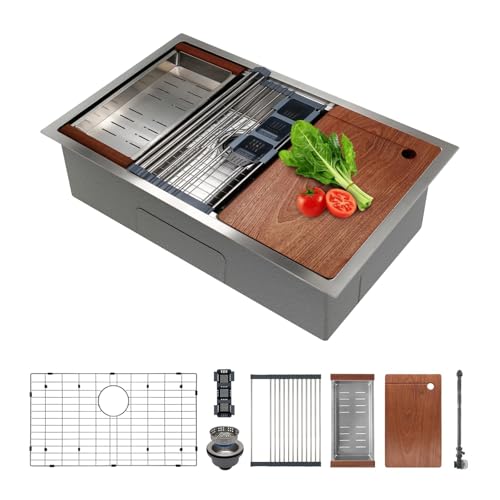
SANYCASA 30-Inch Undermount Workstation, 11 Gauge — Best for Maximum Thickness
Start with the honest framing: 11 gauge is not a normal kitchen-sink specification. The verified listing for this SANYCASA describes 11-gauge, 3mm stainless steel in a 30-inch undermount workstation format, which makes it the outlier at the top of this entire guide. Most premium sinks stop at 16 gauge. This one keeps going, and that is exactly why it earns a place here: the question ‘what is the best gauge for kitchen sinks’ deserves to show buyers where the scale actually ends, not just where the marketing clusters.
Who does steel this thick genuinely suit? Households that are hard on sinks: cast iron that gets set down fast, canning kettles, big-batch cooking with heavy stockpots, and anyone who has already dented a thinner sink and does not intend to repeat the experience. Thickness buys dent resistance and a deadened, solid sound when water and pans hit the bowl. What it does not buy is better drainage, easier cleaning or a nicer finish — those come from geometry and surface treatment, which is why the picks below it on this list still win for most kitchens.
The workstation format matters as much as the gauge here. An integrated ledge lets boards and racks slide at counter level, which changes how a 30-inch bowl gets used day to day: prep over the sink, scraps straight into the bowl, dishes staged on a rack instead of the counter. If you choose this sink, budget the install conversation with your fabricator early — a heavy undermount bowl wants proper support rails or a sink base built for the load, and that is a planning step, not a defect.
Strengths
- Thickest steel in this roundup by a wide margin, so dropped cookware meets far more resistance to denting
- Integrated ledge turns the bowl into a workstation for boards and racks at counter height
- Single deep bowl swallows sheet pans and stockpots that defeat divided sinks
Trade-offs
- Very heavy for its size class; undermount clips and cabinet support need to be planned, not improvised
- Thickness this extreme is past the point of daily benefit for gentle households
- Workstation accessories add to the total project cost beyond the sink itself
| Specification | Verified detail |
|---|---|
| Gauge | 11 gauge (3mm) stainless steel, per the verified listing title |
| Size | 30-inch undermount single bowl |
| Format | Integrated-ledge multifunctional workstation set |
Check the current price on Amazon
Best for: hard-use kitchens that have dented thinner sinks and want the maximum verified thickness available / Not suited for: DIY installs without cabinet support planning, or gentle households paying for thickness they will never test

Kraus KHU100-30 Standart Pro, 16 Gauge — Best Overall
If a reader asks for one sink that answers ‘best gauge’ with the least argument, it is this one. The Kraus KHU100-30 is a 16-gauge T-304 undermount whose verified details read like a checklist of what this guide tells you to look for: stated steel grade, stated gauge, a 30 by 18 inch external footprint, a 28 by 16 by 10 inch bowl, a declared 33-inch minimum cabinet, and a kit that includes the bottom grid, drain assembly with strainer, mounting hardware, cutout template and even a towel. Nothing important is left for you to guess or buy separately.
Sixteen gauge earns its ‘best overall’ reputation in daily use rather than on paper. Pans land with a muted thud instead of a clang, the bowl floor resists the slow oil-canning flex that thinner sinks develop, and the sides feel rigid when you lean a heavy Dutch oven against them. Paired with the NoiseDefend padding Kraus describes for this line, it is the gauge most households can buy once and stop thinking about — which is the real definition of best for a fixture you will use a dozen times a day for a decade or more.
Choose it if you are replacing a builder-grade sink during a counter upgrade and want the safe, proven centre of the market. Skip it if your cabinet is under 33 inches — the 23- and 25-inch members of this same family exist for exactly that problem, and forcing an oversize bowl into a small base helps nobody.
Strengths
- The complete, documented 16-gauge package: steel grade, dimensions and cabinet minimum are all stated plainly
- Deep 10-inch bowl handles stockpots and roasting pans without splash-out drama
- Rounded corners and channel grooves make daily cleaning and drainage genuinely easier
Trade-offs
- Undermount only, so it needs a solid-surface or stone counter, not laminate with a raw cut edge
- Single bowl means soaking and rinsing share one space unless you add a rack routine
- At 30 inches it needs the full 33-inch cabinet; measure before falling for it
| Specification | Verified detail |
|---|---|
| Gauge / steel | 16-gauge T-304 stainless steel (TRU16), from API fetch features |
| External size | 30 x 18 inches |
| Bowl size | 28 x 16 x 10 inches |
| Minimum cabinet | 33 inches |
| In the box | Bottom grid, drain assembly with strainer, mounting hardware, cutout template, towel |
Check the current price on Amazon
Best for: most remodels wanting the proven 16-gauge standard in the most useful 30-inch size / Not suited for: cabinets under 33 inches or laminate counters that cannot take an undermount cut

Kraus KWU110-30 Kore Workstation, 16 Gauge — Best 16-Gauge Workstation
Workstation sinks are where gauge quietly matters twice. The bowl takes the same daily impacts as any sink, and the ledge — the stepped shelf inside the rim that carries boards and racks — is a long, flat span of steel that shows flex and vibration sooner than a curved bowl wall does. Building that ledge from 16-gauge TRU16 steel, as the verified listing for the KWU110-30 describes, keeps boards sitting solidly instead of drumming while you chop.
The daily case for this pick is workflow. Chop over the bowl and sweep scraps straight in. Rest a colander of pasta on the roll-up rack and drain into the sink, not onto the counter. Park washed glasses on the same rack and let the counter stay clear. For keen cooks in compact kitchens, that reclaimed workspace is worth more than any single specification on this page — and because the steel underneath it is full 16 gauge, you are not trading durability to get it.
Pick this over the plainer KHU100-30 if you actually cook most nights and your prep space is tight. Pick the plainer sink if accessories tend to migrate to a drawer in your house and never come back; an unused ledge is just a narrower bowl.
Strengths
- Same 16-gauge confidence as the KHU100-30, plus a ledge that earns its keep every prep session
- Included board and roll-up rack mean the workstation works on day one, not after accessory shopping
- Roll-up rack doubles as a trivet and a drainer, freeing counter space in small kitchens
Trade-offs
- The ledge slightly reduces the open bowl width at the top compared with a plain bowl
- Accessory-led kitchens collect one more set of items to wash and store
- Still an undermount: same counter and cabinet requirements as any 30-inch undermount
| Specification | Verified detail |
|---|---|
| Gauge / steel | 16-gauge TRU16 steel, per the verified listing |
| Format | 30-inch undermount single bowl with integrated ledge |
| Included | Cutting board and roll-up dish rack; NoiseDefend soundproofing |
Check the current price on Amazon
Best for: daily cooks with limited counter space who will genuinely use ledge accessories / Not suited for: households that know sink accessories end up forgotten in a drawer

Elkay Crosstown Workstation 31.5-Inch, 18 Gauge — Best 18-Gauge Value
This is the pick that keeps the gauge debate honest. Eighteen gauge is thinner than 16 — that is arithmetic, not opinion — and yet a well-engineered 18-gauge sink from Elkay will out-serve a careless 16-gauge sink from an unknown seller every day of the week. The Crosstown workstation’s verified listing is plain about what it is: an 18-gauge, 31-1/2 by 18-1/2 by 9 inch single-bowl undermount kit. What the listing cannot show, and ownership of this line consistently demonstrates, is forming quality: flat mounting flanges, consistent corners and a finish that cleans evenly.
Where does the thinner steel actually show? Sound and dent margin. An 18-gauge bowl rings a little more under a dropped pan and asks for the bottom grid that this kit format supports. In exchange you typically get a lower project cost and a lighter sink that is easier to handle during install — and you keep the workstation ledge that transforms prep. For households whose heaviest regular load is a filled pasta pot rather than cast iron moved carelessly, that trade is rational, not cheap.
Choose the Crosstown if your budget has to cover counters, faucet and install as well as the sink, and you refuse to gamble on an unknown brand to save the difference. The money this tier saves is real; spend a little of it on the grid and the accessories and the gap to 16 gauge narrows to near-invisible in daily use.
Strengths
- Workstation functionality at the 18-gauge tier, where most rivals are plain bowls
- Elkay’s manufacturing consistency: corners, flatness and finish are the tier’s benchmark
- Generous 31.5-inch width fits half-sheet pans flat, the test many 30-inch bowls fail
Trade-offs
- Thinner steel than the 16-gauge picks: heavy cast iron deserves a grid and a gentler set-down
- Workstation accessories for the Crosstown ledge are a separate ecosystem to buy into
- Nine-inch depth is a touch shallower than the deepest 16-gauge bowls here
| Specification | Verified detail |
|---|---|
| Gauge | 18-gauge stainless steel, per the verified listing title |
| Size | 31-1/2 x 18-1/2 x 9 inches |
| Format | Single-bowl undermount workstation sink kit |
Check the current price on Amazon
Best for: value-focused remodels that want workstation function and a proven maker at 18 gauge / Not suited for: cast-iron-heavy cooks who set heavy pans down hard and often

Kraus KWU610-30 Fairlane, 18 Gauge — Best 18-Gauge with Accessories Included
The Fairlane exists because Kraus understands the 18-gauge buyer: the budget is real, but so is the wish list. Its verified listing describes an 18-gauge, 30-inch undermount workstation single bowl sold with accessories — a combination that matters because workstation add-ons bought separately can quietly erase the saving that pushed a buyer down a gauge in the first place. Here the ledge-and-accessory idea arrives in one box, at the tier where every line of the project budget is being watched.
Set expectations by tier and this sink satisfies. The steel will not shrug off a dropped skillet the way the 16-gauge Kraus models above it do, and the bowl will sound less damped unless you keep the grid in place. But the geometry is modern, the corners are formed for cleaning rather than for the brochure, and the day-to-day experience — washing, rinsing, prepping over the ledge — feels like a workstation, not like a compromise someone talked you into.
Buy it if you want the workstation layout and a known brand, and your total budget simply will not stretch to 16 gauge without cutting something else important, like the faucet. That is a grown-up trade, and this is the sink built for it.
Strengths
- Accessory-inclusive box narrows the real cost gap with plainer rivals
- Kraus soundproofing approach carries down from its 16-gauge lines
- Thirty-inch size fits the common 33-inch cabinet without drama
Trade-offs
- Same 18-gauge dent margin as any sink in this tier; a grid is close to mandatory
- Fairlane styling is contemporary; very traditional kitchens may prefer plainer lines
- Accessory fit is model-specific, so replacements come from the same maker
| Specification | Verified detail |
|---|---|
| Gauge | 18-gauge stainless steel, per the verified listing title |
| Size | 30-inch undermount single bowl |
| Format | Fairlane workstation, accessories included per listing |
Check the current price on Amazon
Best for: budget-managed remodels that still want a branded workstation with accessories in the box / Not suited for: buyers who will resent any dent risk and could stretch to 16 gauge by trimming elsewhere

Ruvati RVM4132 24-Inch, 16 Gauge — Best Compact 16 Gauge
Small sinks are where manufacturers quietly downgrade steel, on the theory that a prep sink leads an easier life. The Ruvati RVM4132 refuses that logic: its verified listing states 16-gauge stainless in a 24-inch undermount single bowl with a brushed finish the listing itself notes hides scratches. As the second sink in a large kitchen, the island prep bowl, or the only sink in a compact apartment kitchen, it brings the same dent resistance as the full-size 16-gauge picks to a footprint that fits where they cannot.
Gauge matters in a small bowl for a specific reason: the floor is a smaller, flatter span, and thin small sinks drum and flex under a filled pot in a way that feels cheap every single time. Sixteen gauge keeps a 24-inch bowl feeling machined rather than stamped. The brushed finish is the right partner for it — prep sinks take knife-adjacent abuse, onion skins, grit from vegetables, and the finish hides the evidence instead of advertising it.
Choose this Ruvati when the cabinet, not the wish list, sets the size. It is also the honest answer for a bar or butler’s pantry sink that will see bottles and glassware daily: thick enough to feel solid, small enough to fit, finished to age gracefully.
Strengths
- Full 16-gauge steel in a compact footprint for small cabinets and prep stations
- Brushed finish shrugs off the visible scratching that plagues polished bowls
- Single deep bowl format suits bar, prep and small-kitchen duty equally
Trade-offs
- Twenty-four inches will not take a half-sheet pan flat; it is a second sink or a small kitchen’s compromise
- Undermount install rules still apply despite the small size
- Fewer bundled accessories than the 30-inch Kraus kits
| Specification | Verified detail |
|---|---|
| Gauge | 16-gauge stainless steel, per the verified listing |
| Size | 24-inch undermount single bowl |
| Finish | Brushed finish, noted in the listing as hiding scratches |
Check the current price on Amazon
Best for: small kitchens, island prep stations and bar sinks that still deserve full 16-gauge steel / Not suited for: main sinks for big households; 24 inches is a hard ceiling on pan size
Comparison Table
| Pick | Badge | Key spec | Best for |
|---|---|---|---|
| SANYCASA 30-Inch Undermount Workstation, 11 Gauge | Best for Maximum Thickness | 11 gauge (3mm) stainless steel, 30-inch single bowl, integrated ledge workstation | hard-use kitchens that have dented thinner sinks and want the maximum verified thickness available |
| Kraus KHU100-30 Standart Pro, 16 Gauge | Best Overall | 16-gauge T-304 steel; 30 x 18 in external, bowl 28 x 16 x 10 in; minimum cabinet 33 in | most remodels wanting the proven 16-gauge standard in the most useful 30-inch size |
| Kraus KWU110-30 Kore Workstation, 16 Gauge | Best 16-Gauge Workstation | 16-gauge TRU16 steel, 30-inch undermount, integrated ledge with cutting board and roll-up rack | daily cooks with limited counter space who will genuinely use ledge accessories |
| Elkay Crosstown Workstation 31.5-Inch, 18 Gauge | Best 18-Gauge Value | 18-gauge stainless steel workstation kit, 31-1/2 x 18-1/2 x 9 in single bowl undermount | value-focused remodels that want workstation function and a proven maker at 18 gauge |
| Kraus KWU610-30 Fairlane, 18 Gauge | Best 18-Gauge with Accessories Included | 18-gauge stainless steel, 30-inch undermount workstation single bowl with accessories | budget-managed remodels that still want a branded workstation with accessories in the box |
| Ruvati RVM4132 24-Inch, 16 Gauge | Best Compact 16 Gauge | 16-gauge stainless steel, 24-inch undermount single bowl, brushed finish | small kitchens, island prep stations and bar sinks that still deserve full 16-gauge steel |
How to Choose the Best Gauge for Kitchen Sinks
What gauge actually means, in millimetres and in use
Gauge is an old sheet-metal scale, and for stainless kitchen sinks the working range is narrow: 16 gauge is roughly 1.5mm of steel, 18 gauge roughly 1.2mm, and 20 gauge roughly 0.9mm. Those fractions sound trivial until you remember stiffness rises fast with thickness — a 16-gauge bowl floor resists flexing and denting far out of proportion to the small numerical gap. The 11-gauge SANYCASA in our picks, at a stated 3mm, is closer to plate than to sheet, which is why it behaves like equipment rather than like a basin.
In daily use, thickness shows up three ways. First, denting: a cast-iron skillet set down hard, a frozen turkey dropped to thaw, a ladder of stacked pans — thicker steel absorbs these with less trace. Second, sound: thin bowls ring and drum under running water and disposal vibration unless heavily padded; thick bowls start quieter before padding is even added. Third, feel: the rim and ledge of a thick sink feel machined and still, while thin steel can flex under a leaning hand. None of these decide drainage, capacity or cleaning — geometry does that — which is why gauge is a durability decision, not a size decision.
Matching gauge to how your kitchen actually cooks
Be honest about your cookware and your habits. Households cooking nightly with cast iron, enamelled Dutch ovens and heavy roasting tins belong at 16 gauge; the steel will meet that cookware thousands of times. Households whose heaviest regular item is a saucepan, and whose sink mostly sees plates, produce and pasta water, are well served at 18 gauge by a serious maker — the Elkay and Kraus 18-gauge picks above exist for exactly this kitchen. Twenty gauge fits a rental refresh, a laundry tub role or a strict budget replacement where the sink is not the kitchen’s workhorse.
Also match gauge to bowl size. Large single bowls — 32 inches and up — have wide, flat floors that flex and drum more readily, so bigger bowls argue for thicker steel. Small prep bowls are naturally stiffer, yet our 24-inch Ruvati shows the better makers keep 16 gauge even there. Double bowls divide the span, which helps thinner steel, but dividers bring their own pan-fit problems; thickness is the simpler fix.
Gauge is not grade: the 304 question
Buyers conflate two different specifications. Gauge is thickness. Grade is the alloy — and for kitchen sinks the grade to look for is 304 (often written T-304 or 18/8, 18/10 in European style), whose chromium and nickel content gives stainless its rust resistance and its ability to take a brushed finish evenly. A 16-gauge sink in a lesser alloy can stain and tea-spot where an 18-gauge 304 sink stays clean. Our Kraus picks state T-304 in their verified listings, which is part of why they anchor this guide: thickness and alloy, both declared.
Practical rule: never trade grade for gauge. If a listing shouts a low gauge number but will not state its alloy anywhere, treat the silence as the specification. Conversely, a stated 304 grade at 18 gauge — like the TSIBOMU discussed in our sister guide to SS sinks — is a rational buy for lighter-duty kitchens. The spec boxes in this guide only repeat what the verified listings state, so you can see at a glance which makers declare both numbers.
Sound, padding and the grid: the supporting cast
Two sinks of identical gauge can sound completely different. Rubber pads bonded to the bowl’s underside, undercoating spray, and the mounting method decide how much of the disposal’s hum and the tap’s rush reaches the room. Kraus describes its NoiseDefend approach across the lines in our picks; Elkay’s Crosstown kits are similarly engineered. When you compare listings, treat a named sound system as a real feature, not garnish — in an open-plan kitchen it is the difference between a sink and an instrument.
Finally, the bottom grid. A stainless grid protects any gauge from its worst enemy — cookware dragged and dropped directly on the bowl floor — and it keeps items elevated out of rinse water. Several picks include one; for those that do not, budget for it. A grid under an 18-gauge sink closes much of the practical gap to 16 gauge, which is the smartest money move in this entire guide.
How to Check a Sink’s Real Gauge and Fit Before You Commit
Listings can be optimistic and cabinets are unforgiving, so run these checks before any sink — at any gauge — becomes a hole in your counter:
- Measure the cabinet, not the counter. Compare the sink’s stated minimum cabinet size (33 inches for the KHU100-30) with the inside width of your sink base. Undermount bowls need room for clips as well as the bowl itself.
- Confirm gauge and grade in writing. Find both numbers — gauge and 304/T-304 — in the listing or the maker’s specification sheet. If either is missing, ask the seller before ordering, and keep the answer.
- Do the knuckle test on delivery. Rap the bowl floor and walls with a knuckle before installation. A well-made thick sink answers with a dull thud; a drum-like ring on a sink sold as premium gauge is a reason to pause and re-check what arrived.
- Press the bowl floor. Firm palm pressure at the centre of the floor should meet resistance, not visible flexing or oil-can popping. Test before the counter is cut, while returns are still easy.
- Dry-fit the drain and disposal. Check the drain opening position against your trap and disposal clearance, especially with deep 10-inch bowls that lower everything beneath them.
- Plan support for heavy bowls. Thick-gauge and workstation sinks are heavy before water and cookware. Confirm the cabinet or support rails are rated for the filled weight, particularly for undermount installs.
Gauge in Real Kitchens: Three Households, Three Right Answers
Specifications turn into decisions when real households apply them, so consider three kitchens this guide hears from constantly. The first cooks nightly for five, owns cast iron in three sizes, and has already replaced one dented builder-grade sink. For that household the gauge question is not close: 16 gauge is the floor of acceptable, the KHU100-30 is the natural answer, and the only real debate is whether the workstation version’s ledge earns its premium. Their pans will meet the bowl thousands of times; the steel’s job is to make each meeting unmemorable.
The second household is a couple in a first renovation, where the sink budget competes with counters, a faucet and an electrician. Their cookware is ordinary, their heaviest pot is a pasta vessel, and their honesty about that is what makes 18 gauge correct for them rather than cheap. An Elkay Crosstown or the Fairlane, a grid from day one, and the savings redirected to the faucet they will touch more often than the bowl’s floor — that is not a compromised kitchen; it is a well-allocated one. The gauge framework exists to bless exactly this decision with evidence instead of guilt.
The third household is the hard-use outlier: a farmhouse kitchen processing garden produce, canning through the autumn and soaking stockpots that lesser sinks fear. For them the conversation starts where the mainstream ends — the 11-gauge SANYCASA’s plate-thick bowl is not theatre but insurance bought once against a decade of heavy work. Notice that all three households used the same framework and reached three different gauges. That is the framework working. Any guide that gives every kitchen the same number is selling something; this one would rather give you the reasoning and let your cookware vote.
What gauge cannot fix — and what to check instead
Thickness is a durability property, and buyers routinely ask it to solve problems that belong to other specifications. A sink that sounds loud may need padding more than gauge. A sink that stains needs grade, not thickness. A sink whose pans do not fit needs geometry — width, depth, corner radius — and no gauge ever ground will widen a bowl. When you catch yourself hoping a lower gauge number will rescue a shortlist, stop and name the actual complaint; the fix is usually in a different column of the comparison table, and it is usually cheaper than two extra tenths of a millimetre of steel.
The reverse error exists too: dismissing gauge because a thin sink survived a showroom. Showrooms do not drop skillets. The honest test is the delivery-day routine in this guide — knuckle, palm, paperwork — applied to the actual sink in your actual kitchen, while the return window is still a door rather than a memory.
Common Buying Mistakes
- Assuming lower gauge numbers mean thinner steel. The scale runs backwards: 16 gauge is thicker than 18, and 20 is the thinnest common tier. Every comparison inverts if you get this backwards.
- Buying gauge and ignoring grade. Thick steel in an unstated alloy can still stain. Look for 304/T-304 declared alongside the gauge, as the Kraus picks do.
- Believing a headline gauge without checking the listing. Some listings lead with the deck or rim thickness. Verify the bowl’s stated gauge in the specification details, not the banner.
- Skipping the bottom grid to save money. The grid is what lets an 18-gauge sink live a 16-gauge life. Cutting it is the classic false economy of sink buying.
- Forgetting the cabinet minimum. A 30-inch sink that needs a 33-inch cabinet does not fit a 30-inch base. The minimum is printed in good listings — read it before the counter is cut.
- Choosing thickness for a sink that is the wrong shape. Gauge cannot fix a bowl your pans do not fit. Confirm pan fit and depth first; then buy the thickest steel your budget allows in that shape.
Installation Day: Getting the Gauge You Paid For Into the Counter You Own
The finest gauge decision can be undone by an average installation, so treat install day as part of the purchase. For undermounts — five of this guide’s six picks — the bowl should be on site before the counter is templated, physically measured by the fabricator, and dry-fitted against the cabinet with its clips, grid and drain assembly all present. Deep bowls like the SANYCASA and the KHU100-30 lower the drain line; the time to discover a disposal clearance problem is with the sink sitting in the uncut cabinet, not with the stone already drilled. Bring the faucet to the same rehearsal: deck space, spray clearance over a 10-inch bowl and the swing of a high-arc tap are geometry problems that solve themselves on paper and punish improvisation in granite.
Sealing and support decide the decade after. A rigid 16-gauge rim gives adhesive and clips a flat, honest surface; the installer should still follow the maker’s support guidance, particularly for the heavy 11-gauge bowl and any workstation carrying a loaded cutting board on its ledge. Ask, without embarrassment, how the sink is supported besides the clips — rails, a cradle or cabinet reinforcement are all respectable answers, and silence is not. After install, run the disposal and a full bowl of water before signing off, listening for the rattles that reveal a loose clip while the installer is still in the room.
Finally, file the paperwork the day the sink goes in: model, gauge, grade, cutout dimensions, grid size and drain specification. Sinks outlive faucets, disposals and sometimes kitchens; the next tradesperson who works under your counter will bless the folder. And keep the delivery inspection habit for the accessories too — a grid that rocks or a strainer that sits proud is a five-minute exchange on day one and a permanent irritation by day thirty. The gauge framework got you the right steel; install day is how the right steel becomes the right sink.
Final Recommendation
So, what is the best gauge for kitchen sinks? For most households, the answer is 16 gauge, and the Kraus KHU100-30 is its cleanest expression: declared T-304 steel, a useful 30-inch footprint, a deep bowl and the full kit in the box. Cooks who prep at the sink should take the same thickness in workstation form with the KWU110-30. If the project budget is genuinely tight, drop to 18 gauge with a serious maker — the Elkay Crosstown workstation or the accessory-inclusive Kraus Fairlane — and put a grid in from day one. If you are truly hard on sinks, the 11-gauge SANYCASA shows the ceiling. And whatever the size, do not let a small footprint talk you out of thick steel: the 24-inch Ruvati keeps 16 gauge where rivals quietly thin out.
Round out your research with our related guides: Best Gauge For Ss Kitchen Sinks for the alloy side of the story, Best Gauge Kitchen Stainless Steel Sinks for buying by gauge tier, and Best Gauge Stainless For Kitchen Sinks for matching thickness to mounting style and bowl size. If your shortlist is forming around a specific size, see Best 16 Gauge Stainless Steel Kitchen Sinks and Best 18 Gauge Kitchen Sinks for the full fields at each tier.
Shortlist for convenience — SANYCASA 30-Inch Undermount Workstation, 11 Gauge, Kraus KHU100-30 Standart Pro, 16 Gauge, Kraus KWU110-30 Kore Workstation, 16 Gauge: check price on Amazon, check price on Amazon, check price on Amazon.
Frequently Asked Questions
What is the best gauge for a kitchen sink for most homes?
Sixteen gauge. It is thick enough to resist dents from everyday cookware, feels solid and quiet with proper padding, and is the tier where the best makers compete hardest. Eighteen gauge from a reputable brand is the sensible value alternative; 20 gauge is best reserved for light-duty or budget replacements.
Is 18 gauge too thin for a kitchen sink?
No — not from a serious manufacturer. An 18-gauge Elkay or Kraus with sound treatment and a bottom grid serves most households well for years. It will dent more readily than 16 gauge under dropped cast iron, so honest self-assessment about your cookware matters more than the number alone.
Does a thicker gauge resist scratches better?
Not directly. Scratching is governed by finish, not thickness — brushed finishes hide scratches, polished finishes advertise them. Thickness governs dents, flex and sound. That is why our compact pick pairs 16-gauge steel with a brushed finish: each property doing its own job.
What does T-304 mean, and should I care?
T-304 is the alloy grade — the chromium-nickel stainless standard for quality sinks. It governs rust resistance and finish quality, while gauge governs thickness. Care about both: the strongest position is a stated 304 grade at your chosen gauge, exactly as the Kraus listings in this guide declare.
Is a sink thicker than 16 gauge worth it?
For most kitchens, no; for genuinely hard-use kitchens, it can be. The 11-gauge SANYCASA in our picks resists denting far beyond normal need, but it is heavy and demands install planning. Buy past 16 gauge for a reason — past damage, commercial-style use — not for bragging rights.
Can I feel the difference between 16 and 18 gauge in the shop?
Yes. Rap the bowl with a knuckle and press the floor with your palm. The 16-gauge bowl answers duller and flexes less. Showrooms rarely stock both side by side, which is why the checks in our how-to section are written for the delivery day instead.


