Disclosure: airfryerkitchensupply.com is reader-supported. When you buy through links on our site, we may earn an affiliate commission at no extra cost to you.
Where to buy
This guide to the best gas powered grills covers six verified models, each cross-checked before it earned a link. Every grill below is sold on Amazon in the configuration reviewed, and several lines offer natural gas versions of the same model — confirm the fuel variant on the product page before ordering, and check price on Amazon since grill pricing moves with the season.
- Weber Spirit E-310 Gas Grill — Best Overall: check price on Amazon
- Weber Genesis E-415 Gas Grill — Best Premium Upgrade: check price on Amazon
- Charbroil Classic 3-Burner Propane Gas Grill — Best Budget: check price on Amazon
- Coleman RoadTrip 285 Portable Propane Grill — Best Portable: check price on Amazon
- Royal Gourmet GA6402S 6-Burner Propane Gas Grill — Best for Crowds: check price on Amazon
- Weber Q 2800N+ Portable Grill — Best Compact Premium: check price on Amazon
The best gas powered grills earn that title the unglamorous way: they light every time, heat evenly, hold their temperature, and do it again next week and next year. Gas remains the default fuel of home grilling for one reason — convenience that does not compromise the food. No charcoal to light and ash to empty, no pellets to store, just a burner that answers a knob in seconds and a lid that makes the whole thing behave like an outdoor oven.
This roundup is deliberately the generalist’s list. The other guides in this series chase specific features — sear burners, side burners, smoker chambers, flat tops. This one answers the broader question a first-time buyer or a replacing buyer actually asks: which gas powered grills, across sizes and tiers, are simply the best to own? The answer spans a compact three-burner that suits most households, a premium four-burner, a budget classic, two portables at opposite ends of the spectrum, and a six-burner built for crowds.
Every pick was cross-checked against Amazon’s catalog data before earning a link. The buying guide covers the fundamentals that separate a good gas grill from a disappointing one at any price — burner quality, grate material, heat distribution, and parts support — so you can judge models beyond this list with the same tools.
In this guide
Quick Picks
Weber Spirit E-310 Gas Grill — Best Overall. The Spirit E-310 is the mainstream benchmark: three burners, cast-iron grates, and Weber’s build and parts support in a right-sized cart. Check the current price on Amazon.
Weber Genesis E-415 Gas Grill — Best Premium Upgrade. The Genesis E-415 steps up to four PureBlu burners and a larger, more refined firebox — the Spirit’s formula with more of everything that matters. Check the current price on Amazon.
Charbroil Classic 3-Burner Propane Gas Grill — Best Budget. Char-Broil’s Classic three-burner is the honest budget benchmark: 360 square inches, porcelain-coated grates, and side shelves at an entry price. Check the current price on Amazon.
Coleman RoadTrip 285 Portable Propane Grill — Best Portable. The RoadTrip 285 folds three burners and 20,000 BTU into a collapsible stand-up grill that cooks like a home unit and travels like camp gear. Check the current price on Amazon.
Royal Gourmet GA6402S 6-Burner Propane Gas Grill — Best for Crowds. Royal Gourmet’s six-burner flagship spreads 74,000 BTU and a side burner across the widest grate here — party capacity at a value tier. Check the current price on Amazon.
Weber Q 2800N+ Portable Grill — Best Compact Premium. Weber’s Q 2800N+ packs a 250-to-700-degree range and a searing burner into a compact portable — the small grill that refuses to cook small. Check the current price on Amazon.
How These Picks Were Chosen
Each pick had to be a complete, mainstream gas grill from a line with a real track record — the kind of model whose replacement parts, from burners to igniters, remain orderable years later. One-hit imports with no support history were excluded regardless of their feature lists, because a gas grill is a five-to-ten-year appliance and its ownership curve matters more than its unboxing.
Within that filter, we balanced the list deliberately: sizes from portable to six-burner, tiers from budget to premium, and designs from cart to tabletop. Cooking fundamentals decided the order — burner layout for two-zone cooking, grate material, firebox construction, and ignition reliability — rather than headline BTU, which this guide treats with the skepticism it deserves.
Every ASIN was verified connection, matching listed titles to the models reviewed, including fuel variants where a line sells both propane and natural gas versions.
The 6 Best Gas Powered Grills

Weber Spirit E-310 Gas Grill — Best Overall
If this guide had to keep one grill, it would be this one. The E-310 covers the way most households actually cook — weeknight dinners for two to five, weekend batches for a few more — with three burners that allow genuine two-zone cooking and porcelain-enameled cast-iron grates that sear properly. It suits the buyer who wants the decision to be easy and durable. It lacks a side burner and a dedicated sear zone, which is why its siblings exist; buyers who need those should read those roundups.
Strengths
- Porcelain-enameled cast-iron grates sear and release food well
- Three-burner layout gives true hot and cool zones
- Snap-Jet ignition and Weber parts support promise a long life
Trade-offs
- No side burner or dedicated sear zone
- Mid-tier pricing above budget brands
- Grate size caps out for very large parties
| Fuel | Propane |
| Burners | 3 burners |
| Grates | Porcelain-enameled cast iron (per Amazon title) |
| Ignition | Snap-Jet (per Amazon title) |
The Spirit line’s reputation rests on boring virtues executed consistently: burners that light together, heat that spreads without savage hot spots, a grease system that channels drippings instead of pooling them, and a firebox that feels like one piece of engineering rather than a kit. None of that photographs well, and all of it is what ownership feels like in year three, which is when cheap grills start asking for forgiveness and this one does not.
Cooking on it is equally uneventful in the best way. The cast-iron grates hold enough heat to mark a steak honestly, the three burners stage a proper indirect zone for chicken and roasts, and the whole unit preheats in the time it takes to prep the food. For the household buying its first serious grill — or replacing a disappointing one — the E-310 is the answer that ends the research.
Best for: most households — the default recommendation / Not suited for: cooks who need a side burner or sear zone built in
Check on Amazon to see the current configuration and check price on Amazon before you order.

Weber Genesis E-415 Gas Grill — Best Premium Upgrade
The Genesis is the upgrade path for cooks who have outgrown a three-burner: four burners widen the grate and sharpen zone control, and the PureBlu burner design is Weber’s current answer to even, reliable flame. It suits frequent grillers and larger families who felt the Spirit’s ceiling. It costs meaningfully more and takes more patio, so the upgrade should be driven by cooking volume, not by the badge.
Strengths
- Four burners widen capacity and zone precision
- PureBlu burners are designed for even, consistent flame
- Cast-iron grates carry over the line’s searing ability
Trade-offs
- Premium step up in price from the Spirit
- Larger footprint and heavier build
- More grill than occasional cooks will use
| Fuel | Propane |
| Burners | 4 PureBlu burners (per Amazon title) |
| Grates | Porcelain-enameled cast iron (per Amazon title) |
| Line | Genesis series |
The Genesis difference shows up in the cooks that stress a grill: a full grate of chicken thighs at two temperatures, a roast indirect while vegetables char direct, a dozen burgers with a holding zone that actually holds. Four burners make those layouts roomier and more forgiving, and the firebox’s construction — heavier, tighter, better sealed — keeps heat where the knobs say it should be.
It is also the more future-proof purchase in the Weber line, the model owners keep when grilling becomes a weekly ritual rather than a seasonal event. If your Spirit-era cooking has started to feel cramped, this is the natural next grill. If you are buying your first, start with the E-310 and let your own cooking tell you whether the Genesis’s extra room is a need or a want.
Best for: enthusiasts who grill often and want more room and refinement / Not suited for: small patios or strict budgets
Check on Amazon to see the current configuration and check price on Amazon before you order.

Charbroil Classic 3-Burner Propane Gas Grill — Best Budget
The Classic is what a budget gas grill should be: a simple three-burner that cooks properly, with enough area for a family’s burgers and chicken and shelves to work from. It suits first-time buyers, renters, and small households whose grilling is a weekly pleasure rather than a daily discipline. It will not age like a Weber — thinner materials and coated grates set a shorter horizon — and pretending otherwise would be unfair to both grills.
Strengths
- Three burners and 360 sq. in. cover family basics
- Side shelves give prep space budget grills often skip
- Simple design is easy to assemble, use, and clean
Trade-offs
- Porcelain-coated grates are the wear item to watch
- Thinner construction than mid-tier rivals
- Parts support exists but the grill’s horizon is shorter
| Fuel | Propane |
| Burners | 3 burners, 30,000 BTU (per Amazon title) |
| Cooking area | 360 sq. in. (per Amazon title) |
| Grates | Porcelain-coated (per Amazon title) |
Budget grills fail in two ways: they cook badly from day one, or they cook well and disintegrate by year three. The Classic avoids the first failure completely — its burner layout is conventional and competent, its heat is usable across the grate, and a family can cook real dinners on it tonight. The second failure is managed, not eliminated: keep it covered, treat the coated grates gently, and the Classic returns several seasons of honest service, which at its tier is the correct bargain.
It is also a genuinely good first grill pedagogically. Everything a new griller needs to learn — preheating, two-zone cooking, grate care, grease management — happens on the Classic exactly as it does on premium hardware. Buyers who catch the grilling bug will upgrade with knowledge; buyers who do not have spent budget money on a tool that fit their actual life.
Best for: first-time buyers and small households on a budget / Not suited for: heavy year-round grillers who need decade-grade build
Check on Amazon to see the current configuration and check price on Amazon before you order.
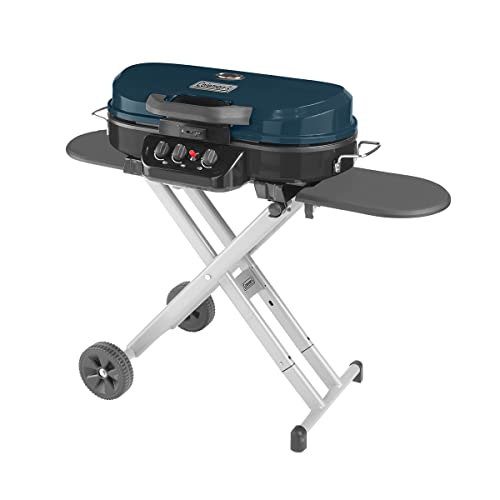
Coleman RoadTrip 285 Portable Propane Grill — Best Portable
Most portable grills are one or two burners of compromise; the RoadTrip 285 is a three-burner grill that happens to fold. That third burner matters — it preserves two-zone cooking on the road, which is the difference between camp grilling and real grilling in a prettier location. It suits tailgaters, RV travelers, and balcony cooks. It is too big for minimalist packing and too portable-featured to be the cheapest way to grill at home.
Strengths
- Three burners keep real zone control in a portable
- Collapsible stand sets up at home or away
- Instastart ignition lights without matches
Trade-offs
- Bulkiest portable in this roundup
- Stand format takes minutes to set and pack
- Home-only cooks pay for travel features they will not use
| Fuel | Propane |
| Burners | 3 burners |
| Total output | 20,000 BTU (per Amazon title) |
| Ignition | Instastart (per Amazon title) |
The RoadTrip’s party trick is that there is no trick: it preheats, zones, and cooks with the competence of a small patio grill, then folds into a trunk. For the household whose outdoor cooking splits between a balcony and a lake house, or whose tailgate is a standing appointment, that dual citizenship is worth more than any single specification.
Its limits are logistical rather than culinary. It is a two-handed carry, it wants a few minutes at each end of the trip, and its grate, while generous for a portable, still batches a big crowd. Within those limits, it is the portable this guide recommends first — the one that makes ‘away’ cooking feel like cooking, not coping.
Best for: tailgaters, campers, and apartment balconies / Not suited for: backpackers or cooks who need a permanent patio fixture
Check on Amazon to see the current configuration and check price on Amazon before you order.

Royal Gourmet GA6402S 6-Burner Propane Gas Grill — Best for Crowds
The GA6402S exists for the cook whose regular Saturday involves fifteen people. Six burners mean the grate can run a searing zone, two cooking zones, and a holding zone simultaneously, and the side burner keeps the pot work out of the way. It suits hosts, big families, and community cooks. For a household of three, it is a fuel-hungry, cleaning-heavy monument to a party that happens twice a year.
Strengths
- Six burners give unmatched zone flexibility here
- 74,000 BTU supports fast recovery under full loads
- Side burner included for pots and sauces
Trade-offs
- Very large footprint, fuel appetite, and cleaning load
- Value-tier components reward covered storage
- Overkill for everyday family dinners
| Fuel | Propane |
| Burners | 6 main burners plus side burner |
| Total output | 74,000 BTU (per Amazon title) |
| Body | Silver finish |
Volume grilling is a logistics problem disguised as a cooking problem: food must finish together, in batches that do not cool while their successors cook. Six burners solve it structurally — there is always a hot zone ready and a warm zone waiting — and the GA6402S’s output keeps the zones honest when the grate is fully loaded and the lid keeps opening for a crowd’s worth of checking.
The ownership terms are the value-tier ones stated throughout this series: cover it, clean the burners each spring, and expect to maintain rather than merely use it. Hosts who accept those terms get the roundup’s most capable crowd machine for a fraction of flagship money. Everyone else should buy the Spirit and rent the extra capacity from a neighbor’s grill twice a year, in the time-honored way.
Best for: hosts and big families cooking in volume / Not suited for: small households or small patios
Check on Amazon to see the current configuration and check price on Amazon before you order.

Weber Q 2800N+ Portable Grill — Best Compact Premium
The Q line has always been the answer for cooks whose space is small but whose standards are not, and the 2800N+ extends the range at both ends: low enough for gentle roasting, hot enough — with its searing burner — for a genuine steak crust. It suits couples, balcony cooks, and travelers who grill seriously in small batches. Groups and multi-zone menus exceed it by design.
Strengths
- Wide 250–700°F range covers roasting through searing (per Amazon title)
- Weber build quality in a truly portable body
- Compact footprint suits balconies and RV storage
Trade-offs
- Single-zone cooking limits menu complexity
- Capacity is two to four servings per round
- Premium pricing for its size class
| Fuel | Propane |
| Temperature range | 250–700°F (per Amazon title) |
| Feature | Burner for searing, low-temperature roasting |
| Format | Portable, midnight black |
Small grills usually fail at the extremes — they cannot go low without going out, or high enough to sear — and the Q 2800N+ is engineered specifically against that failure. The wide temperature range means the same compact unit roasts a chicken gently on Sunday and sears steaks hard on Friday, which is a range of cooking that most small grills only pretend to offer.
As with all Q models, the ownership experience is Weber-grade: it lights, it cooks evenly within its size, and its parts remain available. For the small household that grills often and travels sometimes, it is the compact pick that asks for no apologies — the rare portable whose owners describe it the way patio-grill owners describe their Spirits: as the grill, not the small grill.
Best for: small households, balconies, and travelers who want Weber quality in miniature / Not suited for: feeding groups or cooks who need multiple zones
Check on Amazon to see the current configuration and check price on Amazon before you order.
Comparison Table
| Pick | Badge | Key spec | Best for |
|---|---|---|---|
| Weber Spirit E-310 Gas Grill | Best Overall | 3 burners, porcelain-enameled cast-iron grates, Snap-Jet ignition (per Amazon title) | most households — the default recommendation |
| Weber Genesis E-415 Gas Grill | Best Premium Upgrade | 4 PureBlu burners, porcelain-enameled cast-iron grates (per Amazon title) | enthusiasts who grill often and want more room and refinement |
| Charbroil Classic 3-Burner Propane Gas Grill | Best Budget | 3 burners, 30,000 BTU, 360 sq. in., porcelain-coated grates, side shelves (per Amazon title) | first-time buyers and small households on a budget |
| Coleman RoadTrip 285 Portable Propane Grill | Best Portable | 3 burners, 20,000 BTU, Instastart ignition, collapsible stand (per Amazon title) | tailgaters, campers, and apartment balconies |
| Royal Gourmet GA6402S 6-Burner Propane Gas Grill | Best for Crowds | 6 burners plus side burner, 74,000 BTU total (per Amazon title) | hosts and big families cooking in volume |
| Weber Q 2800N+ Portable Grill | Best Compact Premium | Portable propane grill, 250–700°F temperature range, searing burner (per Amazon title) | small households, balconies, and travelers who want Weber quality in miniature |
Notice what the table does not rank: headline BTU. Output only matters relative to the firebox it heats, which is why a compact Q sears beautifully on a fraction of the six-burner’s figure. Read burner count as zone count and grate material as longevity, and the right row usually selects itself.
How to Choose the Best Gas Powered Grills for Your Household
Start with burner count, because it is really zone count. Two burners is the minimum for a hot side and a cool side; three is the comfortable standard for family cooking; four and five widen the canvas for hosts; six is party infrastructure. Match the count to your typical cook, then check the firebox around the burners: cast aluminum and heavy steel hold heat and resist rust, while thin painted steel is where budget grills quietly shorten their own lives.
Grates decide daily happiness. Porcelain-enameled cast iron — the Weber standard in this roundup — sears well and cleans easily if you avoid chipping it. Stainless rods last longest and tolerate abuse. Porcelain-coated steel is the budget tier’s wear item. Finally, weigh the brand’s parts ecosystem as heavily as the grill itself: a grill whose burners, grates, and igniters are orderable in year six is a different purchase from one that is disposable in year three, even if they cook identically in year one.
- Three burners is the sweet spot for most households; buy zones, not headlines
- Ignore total BTU unless you also know the firebox size it heats
- Cast-iron or stainless grates outlast coated steel by years
- Check that replacement burners and igniters are sold for the exact model
- A fitted cover is part of the purchase price — budget for it
Propane or Natural Gas: Choosing Your Fuel Supply
Most models in this roundup are propane grills, and several lines sell natural gas versions of the same design. Propane’s virtues are freedom and simplicity: the grill goes anywhere, the tank swaps in a minute, and nothing needs a plumber. Its costs are the tank ritual — refills, spares, and the small chance of running dry mid-cook, which a spare tank eliminates entirely.
Natural gas trades mobility for permanence and convenience: no tank ever empties, fuel costs less per cook, and the grill becomes a fixed appliance plumbed into the house. It suits a settled patio and a household that grills year-round from one spot. It does not suit renters, rearrangers, or anyone whose five-year plan includes a different backyard. Neither fuel cooks better — the burners are the same — so choose by logistics, not by flavor mythology.
What the First Season With a New Grill Teaches You
Every grill has a personality that no review can fully hand over: the corner that runs hot, the burner that lights a breath later than its brothers, the way the lid’s thermometer relates to the grate’s real temperature. The first season is when an owner learns that personality, and the learning is faster with a little deliberateness — the bread test for hot spots in week one, a few cooks where one variable changes at a time, and grace for the meals that come out as tuition rather than triumph.
By the second season, the relationship inverts: the cook stops thinking about the grill and starts thinking through it, the way a driver stops thinking about pedals. That is the state every pick in this roundup is capable of reaching, and it is worth saying that the state depends more on the cook’s repetitions than on the model chosen. A mid-tier grill cooked on weekly teaches its owner more, and feeds them better, than a flagship lit monthly.
This is also the honest answer to the upgrade question new owners ask by autumn: not yet. Learn the grill you have until its limits, not your own, are what constrain the menu — then the next purchase chooses itself, and it is usually a specific feature from one of this series’ other roundups rather than a bigger version of the same grill.
Resale, Hand-Me-Downs, and the Second Life of a Good Grill
A well-kept gas grill from a major brand has an afterlife that budget grills never see. Spirits and Genesis grills move through classified listings, get handed to adult children setting up first homes, and serve as the lake-house grill after a patio upgrade. That second life is part of the purchase’s value, and it is earned by the same habits this guide repeats: the cover, the seasonal cleaning, the replaced igniter instead of the abandoned grill.
It is also a buying channel worth knowing. A used premium grill with a sound firebox, bought for the price of a new budget model and refreshed with new grates or burners from the manufacturer’s catalog, can be the smartest purchase in the category. The inspection is simple: firebox integrity, burner condition, grate state, and whether the model still has parts support — the same four checks, run in reverse.
Either direction, the principle holds: in gas grills, durability is not a luxury feature. It is the feature that decides what the purchase costs per year, what it is worth when you are done with it, and whether it cooks at a second address after yours. Buy the grill whose second life you can picture, and you will rarely buy wrong.
Grilling for Health and Weeknight Sanity: The Gas Advantage
The least discussed virtue of gas is behavioral: a grill that lights in seconds gets used on weeknights, and weeknight grilling changes what a household eats. Chicken, fish, and vegetables that might have been takeout become a fifteen-minute outdoor cook with one pan’s worth of cleanup — no oven to preheat, no stove to scrub, and a kitchen that stays cool in summer. Nutrition follows convenience more faithfully than it follows intention, and the gas grill is the most convenient cooking appliance most homes own.
Technique supports the pattern. The two-zone setup lets lean proteins cook gently without drying, vegetables char at the edges without oil baths, and marinades do the flavor work that sauces do indoors. A drip pan under indirect items keeps flare-ups — and the charring they cause — in check. None of this requires a special model; it requires the grill to be ready when the cook is, which is the entire design brief of the picks in this roundup.
If there is a single sentence to carry out of this guide, it is that one: the best gas powered grill is the one standing ready on your patio, covered, maintained, and matched to your household’s real size, because readiness is what turns grilling from an event into a habit — and the habit is where all the value lives.
Heat Distribution: Why Evenness Beats Intensity
The specification shoppers chase is heat; the one that decides dinner is evenness. Every gas grill has hot spots — above burner ports, at the firebox’s center — but well-designed grills narrow the gap between the hottest and coolest corners until the whole grate is usable. That is what burner design, heat tents, and firebox shape are quietly for, and it is why two grills with identical BTU figures cook so differently: one concentrates its output into stripes, the other spreads it into a field.
You can map any grill’s field in five minutes with the bread test: cover the preheated grate with slices of white bread, run it briefly, and read the toast pattern like a weather map. Do it on a new grill and you will cook better on it forever, because you will know where the gentle corners are for the foods that need them. Do it on a grill you are evaluating in a store’s demo or a friend’s patio and you will learn more than the spec sheet offers.
For buyers choosing among this roundup’s picks, evenness is the Spirit and Genesis lines’ core claim — the reason they anchor the list despite unremarkable headline numbers. Intensity is easy to buy; a six-burner value grill has plenty. Evenness is engineering, and it is what you are actually paying for when you step up a tier.
The Igniter, the Hose, and the Regulator: Small Parts, Whole Grill
Ask a grill repair person what actually ends a gas grill’s day and the answer is rarely the firebox. It is the small systems: an igniter that stops sparking, a regulator that restricts flow after a surge, a hose that cracks with age. The good news is that all three are inexpensive, replaceable, and diagnosable at home. A grill that lights with a match but not its button has an igniter or electrode problem, not a burner problem. A grill whose burners all burn low and lazy at once usually has a regulator that needs the reset ritual — everything off, tank closed, a minute’s wait, then a slow reopening.
This is also where brand choice pays its quiet dividend. On a Weber or Char-Broil, these parts are catalog items with model numbers; on an orphan import, they are a research project. When this guide weights parts support heavily, it is these unglamorous components it has in mind — the ones standing between a ten-year-old grill and the curb.
The seasonal habit that protects all three is simple: keep the grill covered, store the hose without kinks, and test connections with soapy water when the tank changes. Five minutes a season, and the small systems stop being the grill’s lifespan.
Sizing Honestly: The Tuesday Test
This guide has repeated one sizing philosophy across categories, and it applies most of all to the generalist purchase: buy for your typical Tuesday, not your biggest Saturday. The Tuesday test asks three questions. How many people eat on an ordinary grilling night? How much of the grate do they actually fill? And how many times a month does the grill light? A household answering four people, half a grate, and six nights a month needs a three-burner and will be annoyed by a six-burner’s preheat and cleaning for a decade.
The Saturday problem — the twice-a-year crowd — has cheaper solutions than a permanently oversized grill: cook in batches with a holding zone, borrow capacity from a flat top or the oven, or accept that the party menu is burgers in rounds, which guests experience as fresh food arriving continuously rather than as a compromise. Parties are forgiving; Tuesdays are forever.
Run the test in reverse, too. The household that grills for eight every Sunday and hosts monthly is not ‘oversizing’ with a five- or six-burner — that is their Tuesday, and the Royal Gourmet or Genesis class is the honest fit. The test is not about buying small; it is about buying true.
Gas Grilling and the Weather: A Short Field Guide
Gas grills are the most weather-tolerant cookers in this series — no charcoal to keep dry, no pellets to swell — but weather still writes itself into the cooking. Wind is the main author: it steals heat from the firebox’s vents, cools one side of the grate, and lengthens every preheat. Positioning the grill with its back to the prevailing wind, and giving it extra preheat minutes on blustery days, restores most of what the wind takes. Rain matters less to the cooking than to the cook, though a grill should never be wheeled into a garage to escape it — gas appliances belong in open air, always.
Cold weather changes fuel behavior at the margins: propane pressure dips as the tank chills, so a deep-winter cook on a nearly empty tank can feel underpowered. A fuller tank and a wind-sheltered position are the practical fixes. Heat, at the other extreme, mostly tests the cook — and the grease tray, which deserves more frequent emptying in the season when the grill runs daily.
None of this should deter anyone; it should simply set the patio up correctly the first time. A grill placed thoughtfully — sheltered, level, close enough to the kitchen to be convenient and far enough from siding to be safe — cooks well in almost any weather its owner is willing to stand in. The appliance is ready more days than the cook is, which is as it should be.
One Last Habit: The Five-Minute Shutdown
Grills are mostly killed by how they are put away, so end every cook the same way. Run the burners on high for a few minutes after the food comes off and brush the grates while they are hot, when residue releases instead of hardening overnight. Turn everything off at the knobs and then at the tank, let the grill cool with the lid open, and pull the cover on once the metal is merely warm. Empty the grease tray whenever it is visibly filling rather than when it announces itself. Five minutes, every time, is the cheapest insurance in this entire guide — it protects the grates, starves the rust, keeps the next preheat fast, and means the grill you light next week behaves like the grill you read about this week. Owners who keep the ritual rarely shop for grills; owners who skip it shop often, and usually blame the brand for failures that began, quietly and entirely avoidably, with a cover left hanging on the patio railing through one wet month after another, in weather the grill was never once given a chance to be protected from.
How to Set Up Two-Zone Cooking on Any Gas Grill
Two-zone cooking — a hot side and a cool side — is the single technique that separates gas grill owners who struggle from those who do not. It takes one minute to set up and applies to every grill in this roundup with two or more burners.
- Light all burners and preheat the grill fully with the lid closed, about ten to fifteen minutes.
- Turn the burners on one side down to low or off entirely; leave the other side on high. That is your map: direct heat and indirect heat.
- Sear and char over the hot side, where food sits directly above lit burners.
- Move food to the cool side to finish, roast, or hold — it cooks gently there by the firebox’s ambient heat with the lid closed.
- For long indirect cooks, place a drip pan under the food on the cool side to catch fat and simplify cleanup.
- Rest finished food on the cool side’s edge while the last items finish over the heat.
Once the map is set, most grilling problems solve themselves: chicken that flares moves to the cool side, thick steaks sear hot then coast cool, vegetables char at the hot edge while the main dish roasts. If you learn one thing from this guide, learn the two zones — they matter more than any model choice on this page.
Common Buying Mistakes
Gas grill buyers repeat a short list of errors, and nearly all of them are visible before the first cook if you know where to look.
- Choosing by total BTU without asking how large a firebox it heats
- Buying a six-burner for a three-person household and dreading its fuel and cleaning
- Skipping the cover to save money, then paying in rust and igniter failures
- Never checking burner ports or the grease tray until performance collapses
- Judging a grill by its first cook instead of its parts availability in year five
- Grilling everything on high, everywhere, and calling the results the grill’s fault
Final Recommendation
For most households the answer is the Weber Spirit E-310: right size, right grates, right support, no wasted features. Frequent grillers with room should step up to the Genesis E-415, budget buyers to the Charbroil Classic, travelers to the RoadTrip 285 or the compact Q 2800N+, and hosts to the Royal Gourmet six-burner. Every one of them cooks honestly; they differ in size, tier, and travel habits, not in whether dinner turns out.
Buy the grill that matches your typical Tuesday, keep it covered, and learn the two-zone setup in the how-to above. That combination — right size, basic care, one real technique — is what ‘best gas powered grill’ actually means in a backyard, as opposed to in a headline.
Start your comparison with the three picks most buyers end up choosing between: Weber Spirit E-310 Gas Grill, Weber Genesis E-415 Gas Grill, Charbroil Classic 3-Burner Propane Gas Grill — check price on Amazon for each, confirm the fuel version and configuration, and match the layout to the way your household actually cooks.
Best Gas Grills With Side Burner Best Gas Grills With Searing Burner Best Gas Outdoor Flat Top Grills
Frequently Asked Questions
Are gas grills better than charcoal grills?
They are better at convenience, consistency, and weeknight speed; charcoal is better at high-heat searing and smoke flavor. Most households that grill weekly choose gas for the lighting speed alone. The honest answer is that the best grill is the one you will light on a Tuesday, and for most people that is gas.
How many burners do I need?
Three suits most households: enough for a hot zone, a cool zone, and a middle ground. Two is workable for small cooking, four or more serves hosts and big families, and six is party equipment. Count zones, not burners — each burner is a temperature you can hold.
How long should a gas grill last?
A well-built grill from a major brand, kept covered and cleaned seasonally, commonly serves eight to twelve years, with an igniter or burner replacement along the way. Budget grills typically serve three to five. The difference is materials and parts support more than cooking ability.
Is a higher BTU grill always hotter?
No. BTU measures total fuel consumption, not temperature. A compact grill with modest BTU concentrates its heat in a small firebox and can sear harder than a huge grill with a bigger number spread thin. Judge heat by firebox size, burner design, and grate material together.
Propane or natural gas — which should I choose?
Propane for flexibility and simple setup; natural gas for a permanent patio where never refilling a tank is worth the plumbing. The cooking is identical. Renters and movers should stay with propane; settled homeowners who grill year-round often prefer natural gas.
What maintenance does a gas grill actually need?
Brush grates after cooks, empty the grease tray regularly, check burner ports each spring, and keep the grill covered. Once a season, inspect the hose and connections with soapy water for leaks. That modest routine is most of the difference between a five-year grill and a ten-year grill.
Best Gas Grills With Stainless Steel Grates Best Gas Grills With Smoker Box Best Gas Grills With Stove


