Disclosure: airfryerkitchensupply.com is reader-supported. When you buy through links on our site, we may earn an affiliate commission at no extra cost to you.
Where to buy
This guide to the best gas grills with stove covers six verified models, each cross-checked before it earned a link. Every unit below is sold on Amazon in the configuration reviewed. Most of these run on one-pound propane canisters or standard tanks with an adapter, so check which connection the listing includes, and check price on Amazon before ordering.
- Coleman Tabletop 2-in-1 Grill & Stove — Best Overall: check price on Amazon
- ROVSUN 2-in-1 Portable Camping Stove & Propane Grill — Best Value Two-in-One: check price on Amazon
- Magma Marine Kettle3 Combo Stove & Gas Grill (17-Inch) — Best for Boats and RVs: check price on Amazon
- Camco Kuuma Stow N’ Go 216 Elite Propane Grill — Best Compact for Small Spaces: check price on Amazon
- Blackstone 2364 Camping Griddle with Side Burner — Best Griddle-Plus-Stove Combo: check price on Amazon
- Coleman RoadTrip 285 Portable Propane Grill — Best Patio-Portable With Stove Versatility: check price on Amazon
The best gas grills with stove functionality answer a specific outdoor problem: you want to grill the main dish and boil, fry, or simmer the rest of the meal in the same spot, without a second appliance or a trip back to the kitchen. The market answers it two ways. Camp-style two-in-one units split their burners between a grill grate and a flat stove burner that takes a pot or pan. Full-size patio grills answer it with a side burner, which is a stove burner in everything but name. This roundup focuses on the two-in-one and portable end, where the grill-and-stove idea is the entire design, and closes with the patio-scale option for cooks who want the same trick at home.
These units live a double life that cart grills never attempt: tailgates, campsites, boat decks, RV trips, fishing piers, and small apartment balconies where a full grill cannot go. That portability shapes everything about them — one-pound canisters or compact tanks, folding legs and latching lids, cooking areas measured for two to six people rather than a block party.
The six picks below were cross-checked against Amazon’s catalog data before earning a link, including two models verified in a fresh Amazon listing data search for this batch. They range from the classic Coleman two-in-one to a marine-grade kettle built for boats, and the buying guide explains how to judge the stove half of these hybrids as rigorously as the grill half.
In this guide
Quick Picks
Coleman Tabletop 2-in-1 Grill & Stove — Best Overall. Coleman’s tabletop two-in-one splits 20,000 BTU between a grill grate and a stove burner with wind guards, the classic full-meal camp cooker. Check the current price on Amazon.
ROVSUN 2-in-1 Portable Camping Stove & Propane Grill — Best Value Two-in-One. ROVSUN’s two-in-one pairs a camp stove burner with a grill and enamel griddle surface, piezo ignition, and a wind panel in a handled, portable case format. Check the current price on Amazon.
Magma Marine Kettle3 Combo Stove & Gas Grill (17-Inch) — Best for Boats and RVs. Magma’s Kettle3 is a marine-grade stainless kettle that works as both stove and grill, built for boats, camps, and RVs where corrosion never sleeps. Check the current price on Amazon.
Camco Kuuma Stow N’ Go 216 Elite Propane Grill — Best Compact for Small Spaces. Kuuma’s Stow N’ Go folds its legs away for storage, carries a built-in thermometer and warming rack, and doubles as a camping stove surface for pots. Check the current price on Amazon.
Blackstone 2364 Camping Griddle with Side Burner — Best Griddle-Plus-Stove Combo. Blackstone’s camping unit pairs a 12-by-14 griddle plate with a true side burner, so flat-top cooking and pot cooking share one portable frame. Check the current price on Amazon.
Coleman RoadTrip 285 Portable Propane Grill — Best Patio-Portable With Stove Versatility. The RoadTrip 285 is the larger, stand-up end of portable: three burners and 20,000 BTU on a collapsible frame, with swappable cooktops that extend it toward stove duty. Check the current price on Amazon.
How These Picks Were Chosen
A unit qualified only if it genuinely cooks both ways — a grill surface and a stove burner that accepts a pot or pan — as named in its verified listing. Pure grills with swap-in griddle plates were considered separately, and pure camp stoves with no grill function were excluded. Within the qualifiers, we weighted the stove burner’s usefulness: pot support, wind protection, and whether the grill and stove sides can run at the same time at different temperatures.
Portability features were judged as cooking features, because a hybrid that is miserable to transport gets left behind. Latching lids, folding or removable legs, carry handles, and canister-versus-tank flexibility all counted. So did honest capacity: these are small cookers, and the reviews state plainly how many people each one feeds.
Every ASIN was verified connection. The Coleman Tabletop 2-in-1 and the ROVSUN 2-in-1 were verified in a dedicated search for this batch; the rest come from the program’s verified Grills cache.
The 6 Best Gas Grills With Stove Burners

Coleman Tabletop 2-in-1 Grill & Stove — Best Overall
This is the reference design for the category: one burner under a grill grate, one open burner for a pot, independent controls, push-button ignition, and wind guards that fold around the cooking area. It suits campers, tailgaters, and small households cooking complete meals away from a kitchen. It does not suit anyone feeding a crowd — 130 square inches of grill is a four-person surface on its best day.
Strengths
- True two-in-one layout: grill and pot burner run simultaneously
- Wind guards make the stove side usable in real weather
- Push-button ignition and adjustable burners keep control simple
Trade-offs
- Grilling area is sized for small groups only
- Tabletop format needs a stable surface to sit on
- One-pound canisters empty quickly on long cooks
| Fuel | Propane |
| Burners | 2 adjustable burners |
| Total output | 20,000 BTU (per Amazon title) |
| Grilling area | 130 sq. in. (per Amazon title) |
The Coleman’s enduring appeal is sequencing. Burgers grill on the left while beans warm on the right; in the morning, coffee perks on the stove burner while eggs fry in a skillet on the grill side with the grate swapped or a pan set over it. The wind guards are not decoration — a camp stove burner in open air loses heat so fast that boiling becomes theoretical, and Coleman’s folding panels are the difference between a stove that works at a breezy campsite and one that merely lights.
Ownership is simple in the way good camp gear is simple: it packs flat-ish, latches shut, and asks for a wipedown and a dry storage spot. Add the optional tank adapter hose if your trips run long, because the one-pound canister economy only makes sense for short cooks. For the classic two-person-to-small-family outdoor meal, this remains the unit to beat.
Best for: campers and tailgaters who cook full meals outdoors / Not suited for: groups larger than four or windy, exposed sites
Check on Amazon to see the current configuration and check price on Amazon before you order.

ROVSUN 2-in-1 Portable Camping Stove & Propane Grill — Best Value Two-in-One
The ROVSUN covers the same brief as the Coleman — grill on one side, stove on the other, portable enough for the car trunk — at a value-tier position, and adds an enamel griddle surface that broadens breakfast duty. It suits budget-conscious campers and festival-goers. The trade is the usual one at this tier: thinner materials and a shorter support history, which matters less on a portable that lives in a closet than on a patio fixture.
Strengths
- Two-in-one layout with an enamel griddle for breakfast cooking
- Piezo igniter and wind panel included
- Built-in handle and case format travel well
Trade-offs
- Materials and finish trail the Coleman
- Griddle and grill share space, so big meals need sequencing
- Long-term parts support is unproven
| Fuel | Propane |
| Format | Tabletop camp stove and grill with handle |
| Ignition | Piezo (per Amazon title) |
| Extras | Enamel griddle, wind panel (per Amazon title) |
Value two-in-ones earn their place by covering the menu honestly, and the ROVSUN’s griddle is its best argument: pancakes, eggs, and bacon on the flat surface while the stove burner handles coffee is the campsite breakfast that sells people on outdoor cooking, and it arrives here without buying a second appliance. The grill side then covers lunch and dinner in the usual way.
Set care expectations to the tier. Dry it before storing — enamel and steel edges chip if it rattles around a trunk wet — and keep the piezo igniter’s electrode clean for reliable starts. This model was verified in a fresh Amazon listing data search for this batch, and for campers counting dollars per trip rather than decades of service, it is the sensible doorway into grill-and-stove cooking.
Best for: budget campers who want the two-in-one layout for less / Not suited for: buyers who prioritize the longest brand track record
Check on Amazon to see the current configuration and check price on Amazon before you order.

Magma Marine Kettle3 Combo Stove & Gas Grill (17-Inch) — Best for Boats and RVs
The Kettle3 exists for the harshest cooking environment in this roundup: salt air. Its marine-grade stainless construction and kettle format — a lidded round cooker that serves as a pot stove with the grate removed and a grill with it in place — suit boaters first, and RVers and coastal campers second. The party-size 17-inch diameter feeds a small crew. It is premium-priced for its size, and landlocked picnickers can get the same meal from cheaper units.
Strengths
- Marine-grade stainless shrugs off salt air and spray
- Kettle design converts between stove and grill duty
- Compact footprint suits boat decks and RV storage
Trade-offs
- Premium price for a compact cooker
- Round grate limits how much food fits at once
- Mounting hardware for rail or deck use is a separate consideration
| Fuel | Propane |
| Size | 17-inch party size (per Amazon title) |
| Body | Marine-grade stainless steel |
| Use | Stove and grill combo for boats, camp, RV (per Amazon title) |
Marine gear earns its premium in the second and third season, when lesser metals bloom with rust and fittings seize. The Kettle3’s stainless build and simple, serviceable design are specified for exactly that environment, and its kettle shape is practical afloat: the lid contains splatter, the round body sheds wind better than a flat box, and the whole unit stores in a locker-sized space.
As a stove, it takes a pot the way a kettle stand does — stable and centered — and as a grill it cooks like the kettle grills landlubbers know, with the lid doing real work to hold heat. For a boat that cooks, it is close to the default answer. For a backyard, it is a charming over-specification, and this guide says so plainly so the premium lands where it belongs: on the water.
Best for: boaters, RVers, and anyone cooking in salt air / Not suited for: large groups or shoppers on a tight budget
Check on Amazon to see the current configuration and check price on Amazon before you order.

Camco Kuuma Stow N’ Go 216 Elite Propane Grill — Best Compact for Small Spaces
The Kuuma approaches the grill-and-stove brief from the storage side: a compact grill that folds down to stow in an RV bay or balcony corner, with legs that set it up anywhere and a grate that accepts a pot for stove-style cooking. It suits space-starved cooks who need one unit to disappear between uses. It does not offer a separate open burner, so simultaneous grill-plus-pot cooking is limited compared with the two-in-ones above.
Strengths
- Fold-away legs make it genuinely stowable
- Built-in thermometer and push-button igniter
- Removable warming rack adds a second level for small items
Trade-offs
- No dedicated open stove burner for a large pot
- Compact grate cooks for two to four at most
- Stove use means pausing grill use on the same surface
| Fuel | Propane |
| Format | Compact grill with fold-away legs |
| Ignition | Push-button (per Amazon title) |
| Extras | Built-in thermometer, removable warming rack |
The Stow N’ Go’s honest category is ‘one surface, two jobs, zero storage footprint.’ On a boat locker or RV bay shelf, that trade is exactly right: the grill cooks dinner, then a kettle or small pot goes on for tea or a sauce, then the whole thing folds away. Sequential cooking is the price of the format, and for two people it rarely feels like one.
Build details suit the traveling life — the thermometer removes guesswork when the wind is stealing heat, and the warming rack keeps finished food hot while the next batch grills. Buyers who need to grill and boil at the same moment should take the Coleman; buyers who need a cooker that vanishes should take the Kuuma and enjoy the closet space it returns.
Best for: balconies, RVs, and campers who also pot-cook on the grate / Not suited for: cooks who need a separate open stove burner
Check on Amazon to see the current configuration and check price on Amazon before you order.
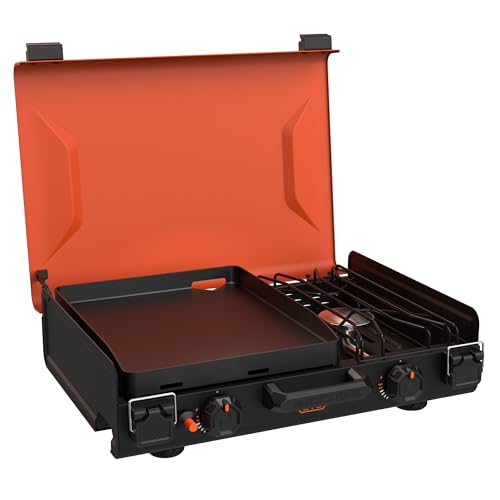
Blackstone 2364 Camping Griddle with Side Burner — Best Griddle-Plus-Stove Combo
This unit answers the griddle camper’s one complaint: a flat top cannot boil water for coffee or pasta. Blackstone’s answer is a compact camping griddle with a side burner beside it, latching together for transport with leveling feet for uneven picnic tables. It suits campers whose menu is smash burgers, breakfasts, and stir-fries, plus a pot on the side. If your camping menu centers on grilled steaks with marks, a grate-based two-in-one serves you better.
Strengths
- Griddle and open side burner in one portable unit
- Leveling feet stabilize it on real campsite surfaces
- Latching design keeps it closed and tidy in transit
Trade-offs
- Griddle area is compact — this is a small-group cooker
- No grill grate for marked, open-flame cooking
- Flat top needs seasoning care like any steel griddle
| Fuel | Propane |
| Griddle | 12 x 14 inches (per Amazon title) |
| Burner | Side burner for pots and pans |
| Format | Portable with latches and leveling feet |
The side burner on a griddle unit sounds minor until the first morning it boils the coffee water while bacon fries — the two-station rhythm that makes camp cooking feel like cooking rather than coping. The griddle itself follows Blackstone’s usual logic: a steel plate that seasons with use, cooks everything from eggs to fajitas, and scrapes clean in a minute.
Leveling feet deserve their mention because campsite tables are never level, and on a griddle, tilt is destiny — eggs migrate, oil pools, and one corner cooks faster than the rest. Feet that correct the surface turn a frustrating plate into a reliable one. For the camper whose menu is flat-top-first, this is the most coherent grill-and-stove answer here.
Best for: campers who cook on a flat top but still need a pot burner / Not suited for: grill-mark traditionalists
Check on Amazon to see the current configuration and check price on Amazon before you order.
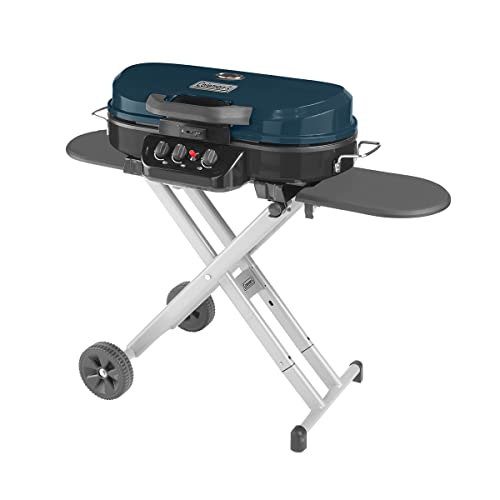
Coleman RoadTrip 285 Portable Propane Grill — Best Patio-Portable With Stove Versatility
The RoadTrip 285 stretches the category’s definition usefully. It is a portable grill first — three burners, real grate area, a stand that folds for the trunk — and its interchangeable cooktop system lets a griddle or stove grate replace part of the grill surface, which is how it earns its place in a grill-and-stove roundup. It suits apartment dwellers and tailgaters who want one cooker for home and away. It is far too much machine for a hike-in site.
Strengths
- Three burners give real two-zone control in a portable
- Swappable cooktops add griddle and stove-grate options
- Collapsible stand format works on patios and at tailgates
Trade-offs
- Heaviest and bulkiest unit in this roundup
- Stove function comes via accessory cooktops, not a built-in open burner
- Assembly and packing take longer than the tabletops
| Fuel | Propane |
| Burners | 3 burners |
| Total output | 20,000 BTU (per Amazon title) |
| Ignition | Instastart (per Amazon title) |
What the RoadTrip understands is that many households have exactly one cooking space outdoors and it is a balcony or a small patio. A grill that lives there all season, then folds into a trunk for the game or the lake house, covers more of life than either a pure patio grill or a pure camp stove. The three-burner layout is the substance: genuine zones, genuine capacity for six, and preheat behavior closer to a home grill than to camp gear.
Be clear-eyed about the stove side: it is a cooktop accessory path, not a second open burner like the Coleman’s. A pot goes on the stove grate section while the rest grills, which serves most real menus — sauce, beans, a small pot of water — perfectly well. Buyers who boil large pots constantly should take the two-in-one; buyers who grill mostly and pot-cook sometimes will find the RoadTrip the most complete single unit here.
Best for: apartment and tailgate cooks wanting a bigger grill that still travels / Not suited for: backpackers or anyone counting ounces
Check on Amazon to see the current configuration and check price on Amazon before you order.
Comparison Table
| Pick | Badge | Key spec | Best for |
|---|---|---|---|
| Coleman Tabletop 2-in-1 Grill & Stove | Best Overall | 2 adjustable burners, 20,000 BTU total, 130 sq. in. grilling area (per Amazon title) | campers and tailgaters who cook full meals outdoors |
| ROVSUN 2-in-1 Portable Camping Stove & Propane Grill | Best Value Two-in-One | Portable stove plus grill with enamel griddle, piezo igniter, wind panel, built-in handle (per Amazon title) | budget campers who want the two-in-one layout for less |
| Magma Marine Kettle3 Combo Stove & Gas Grill (17-Inch) | Best for Boats and RVs | 17-inch party size, dual-purpose stove and grill, marine-grade stainless (per Amazon title) | boaters, RVers, and anyone cooking in salt air |
| Camco Kuuma Stow N’ Go 216 Elite Propane Grill | Best Compact for Small Spaces | Compact propane grill with thermometer, push-button igniter, fold-away legs, warming rack (per Amazon title) | balconies, RVs, and campers who also pot-cook on the grate |
| Blackstone 2364 Camping Griddle with Side Burner | Best Griddle-Plus-Stove Combo | 12 x 14-inch camping griddle with side burner, latches, leveling feet (per Amazon title) | campers who cook on a flat top but still need a pot burner |
| Coleman RoadTrip 285 Portable Propane Grill | Best Patio-Portable With Stove Versatility | 3 burners, 20,000 BTU, Instastart ignition, portable stand format (per Amazon title) | apartment and tailgate cooks wanting a bigger grill that still travels |
The layout column is the decision: simultaneous two-station cooking belongs to the Coleman, ROVSUN, and Blackstone; sequential one-surface cooking belongs to the Kuuma and Magma; the RoadTrip splits the difference with swappable cooktops. Match the layout to whether your meals need both stations at the same moment.
How to Choose the Best Gas Grills With Stove Burners
Decide first whether your cooking is simultaneous or sequential. If the pot must boil while the meat grills — the full-meal pattern — you need a true two-station unit with independent burners, like the Coleman or ROVSUN. If your meals naturally take turns, a single-surface unit like the Kuuma or Magma kettle is smaller, simpler, and often better built for the same money. Most buyers overestimate their simultaneity; be honest about whether the beans really cannot wait ten minutes.
Then judge the stove burner as a stove. It needs a stable pot support that does not wobble under a full kettle, wind protection if you cook outdoors in real weather, and a control knob with a genuine low end for simmering. Fuel logistics close the decision: one-pound canisters are convenient and expensive per hour, while a tank adapter pays for itself in a single long weekend. Check which connection the listing includes and price the adapter into the comparison.
- Choose two stations for simultaneous cooking, one surface for simplicity
- Test pot stability mentally: wide, low supports beat tall, narrow ones
- Wind guards matter more than burner output for real-world boiling
- Budget for a tank adapter hose if you cook longer than an hour at a time
- Match capacity to your group: these are two-to-six-person cookers
Safety Rules That Matter More Outdoors
Portable gas cookers concentrate their risks in a few predictable places, and the habits are simple. Always set the unit on a stable, level, non-flammable surface — never on a plastic folding table that can soften, and never inside a tent or enclosed vehicle space, where carbon monoxide collects invisibly. Keep the fuel connection checked with soapy water when you swap canisters or tanks: bubbles mean a leak, and the fix is a reseated or replaced connection, never a flame test.
Wind deserves respect beyond cooking performance. A gust can blow a small burner’s flame sideways or out entirely while gas continues to flow, so stay present while a portable cooker runs, and if a burner blows out, turn it off, let gas clear, and relight. Let the unit cool fully before packing — griddles and grates hold burn-worthy heat long after the flame is out, and the trunk of a car is a bad place to learn that. These are the same rules as any gas appliance, applied with the extra attention portable gear’s small size sometimes tempts people to skip.
Breakfast: The Meal That Sells the Two-in-One
Ask owners when their grill-and-stove unit earns its keep and breakfast wins by a distance, because breakfast is the meal a single-surface grill does worst and a two-station unit does best. Coffee or a kettle belongs on a burner. Eggs, bacon, and pancakes belong on a flat surface or in a skillet. Toast wants dry heat nearby. A grated grill alone forces all of that into one pan in sequence; the two-in-one runs it in parallel, and the meal that took forty minutes of juggling takes fifteen minutes of calm.
The technique is the same sequencing the how-to section teaches, applied to morning food: kettle on first, skillet or griddle warming while the coffee perks, bacon before eggs because the eggs take two minutes and forgive nothing. At a campsite this reads as luxury; on a balcony it reads as a reason to eat outside three seasons a year. Either way, it is the use case to test in your first week, because a unit that does breakfast well has proven both of its halves under real conditions.
It also explains the category’s loyalty. Owners replace these units when they wear out, usually with the same layout, because the habit the unit creates — full meals, outdoors, from one box — outlives any particular brand. Buy the layout that fits your mornings and the rest of the day tends to follow.
What ‘Portable’ Really Costs: Weight, Packing, and Setup Time
Portability is a spectrum the listings flatten. The tabletop two-in-ones pack in minutes and ride in any trunk, but they borrow their stand from whatever table the destination provides — a real consideration at sites with no picnic table. The RoadTrip-class units bring their own legs and cook like home grills, at the price of a heavier, bulkier pack that eats trunk space and asks two hands and five minutes at each end of the trip. Neither is better; they are portable for different vehicles and different trips.
Setup time deserves the honesty weight gets. A unit that takes twenty minutes to assemble at the site will, by the third trip, be left home in favor of sandwiches. Time yourself on the first setup in the driveway, including lighting and preheat, and believe that number: it is the single best predictor of whether the cooker becomes a habit or a storage problem. The units in this roundup were chosen partly because none of them fails that test egregiously.
Packing has its own discipline: cool fully, latch or fold, and keep the regulator and hose from dangling where they can be crushed or kinked. Most portable-cooker damage happens in transit, not in cooking — a truth that argues for the handled, latching formats and against tossing an open tabletop into a trunk full of camp chairs.
Fuel Economics: Canisters, Tanks, and Adapters
The fuel decision quietly determines what a portable hybrid costs to own. One-pound canisters are the convenience option: light, clean, available everywhere, and by far the most expensive way to buy propane per hour of cooking. They make sense for short trips and occasional use, where the alternative — hauling a tank — costs more in hassle than the fuel saves. The math flips fast with frequency. A household cooking on the unit every weekend burns through canisters at a rate that makes the adapter hose and a refillable tank the cheapest accessory in this entire guide.
There is a middle behavior worth copying from experienced campers: run the unit on canisters for quick weeknight balcony cooks, and on the tank for trips and long cooks. The adapter hose makes switching a two-minute job, and each fuel serves the situation it suits. Whichever you use, store canisters and tanks upright, outdoors or in a ventilated space, away from heat — and never store spare canisters inside a hot vehicle or a living space.
Cold weather deserves a footnote, because it surprises new owners every autumn. Small canisters lose pressure as they chill, and a burner that roared in July can sulk in November. Keeping the canister at ambient warmth, shielding the unit from wind, and switching to a tank for cold-weather cooking are the standard fixes, and none of them indicate a defective grill.
The Balcony and Small-Patio Case for Hybrids
For apartment and townhouse cooks, a grill-and-stove hybrid is often not a compromise but the correct primary grill. A full cart grill assumes a suburban patio; a tabletop two-in-one assumes a railing-side table and a storage closet, and it cooks complete meals — not just grilled items — in that footprint. Breakfast on the stove side, skewers on the grill side, and nothing about the menu feels like a reduced version of cooking.
The constraints are real and worth naming. Capacity tops out at four people comfortably. Wind exposure on high floors is worse than in a sheltered yard, which pushes the choice toward units with serious wind guards. And building rules govern everything: many properties restrict or prohibit gas grills on balconies, and no product choice overrides a lease or a fire code. Check first, buy second.
Where the rules allow it, the hybrid’s small footprint returns something valuable: the rest of the balcony. A cooker that folds into a closet leaves the outdoor space for chairs, plants, and people, instead of dedicating it permanently to an appliance used three evenings a week. For small-space households, that trade is often the deciding one, and it is a legitimate thing to decide on.
Maintaining a Portable: The Ten-Minute Routine
Portable cookers die of storage, not use. They come home from trips damp and greasy, get latched shut, and sit for a month — the exact recipe for rust, stale grease odors, and clogged jets. The routine that prevents it takes ten minutes: while the unit is still warm, scrape the grate or griddle; once home and cool, wipe surfaces dry, empty any drip tray, and leave the lid open for an hour before latching it for storage. That hour of airing is the step everyone skips and the one that matters most.
Jets and igniters want a seasonal check. A soft brush clears the burner ports; a clogged jet on a canister unit usually clears with the manufacturer’s recommended method, never with a wire forced into it. The piezo or push-button igniter’s electrode should sit clean and correctly gapped — a wipedown restores most ‘dead’ igniters. Check the hose and regulator connection with soapy water at the start of each season, and replace any hose that has cracked or stiffened.
Store the unit dry, indoors where possible, with canisters removed and stored separately. Treated this way, a portable hybrid lasts the way good camp gear lasts — not forever, but through years of trips without drama — and it is ready on the Friday you decide, at four o’clock, that the weekend starts at the lake.
Matching the Hybrid to Your Trip Style
Car campers should weight capacity and two-station simultaneity highest, because weight barely matters and group meals are the point — the Coleman and RoadTrip live here. Festival and tailgate cooks should weight setup speed and latch-and-go packing, since the cooker goes up and down in parking lots and fields where a lost knob is gone forever. Boaters and RVers should weight corrosion resistance and stowage dimensions above all, which is why the Magma and Kuuma exist despite their premiums and limits.
Backpackers, honestly, should weight this entire category zero: even the smallest unit here is car-camping equipment, and the honest recommendation for trail cooking is a dedicated ultralight stove, which this guide does not sell. Naming that boundary matters, because the most disappointed hybrid owners are the ones who bought car gear for a foot journey.
Households between categories — the balcony cook who also camps twice a year — should buy for the weekly use and let the twice-a-year use adapt. A tabletop two-in-one that serves the balcony all season and rides to the campsite in July is a better purchase than a specialized unit that excels on the trip and crowds the home. Frequency, as in most of this guide’s categories, is the truest specification.
A Final Note on Buying for the Cook You Actually Are
Every category in outdoor cooking contains a version of the same trap: buying for the cook you imagine becoming rather than the one your calendar describes. Grill-and-stove hybrids are unusually honest appliances — they do two simple jobs, in small spaces, for small groups — and they reward buyers who match them to real patterns. Count the outdoor meals you cooked last season and where you cooked them. If the honest answer is a dozen campsite and balcony meals for two to four people, a tabletop two-in-one is not a compromise purchase; it is the precisely correct one, and the money it saves against a patio flagship is better spent on the trips themselves. Buy for your life as it is, and the cooker will be used the way its designers hoped — often, casually, and without ceremony, season after season, wherever your table happens to be, from the first spring breakfast to the last autumn tailgate of the year.
How to Cook a Full Meal on a Grill-and-Stove Combo
The two-station meal is a sequencing exercise. The method below uses a classic camp menu — grilled chicken, a pot of rice or beans, and a skillet side — and works on any two-station unit in this roundup.
- Start the stove side first: get the pot of rice, beans, or water going on a medium burner, since grains take the longest and hold well.
- While the pot works, light the grill side and preheat it fully with the lid closed.
- Grill the protein over the hot zone, using the cooler edge for thicker pieces to finish gently.
- When the pot is nearly done, turn its burner to the lowest simmer to hold without scorching.
- Use the final grill minutes for bread, corn, or a quick vegetable char while the protein rests.
- Serve from both stations at once, then shut down the grill side first and let the stove side cool last if it held the pot.
The habit that makes this effortless is staging everything before lighting anything: protein seasoned, pot filled, tools laid out. Portable cookers have no counter space to forgive a mid-cook scramble, and the cook who preps first discovers that a two-station unit genuinely replaces a kitchen for a weekend — which is the entire promise of the category.
Common Buying Mistakes
Hybrid cookers punish a few specific misunderstandings, most of them about what ‘portable’ and ‘two-in-one’ actually promise.
- Expecting a tabletop hybrid to feed a party-sized group
- Judging the grill side and never testing whether the stove side can boil
- Cooking in wind without guards and concluding the burner is weak
- Burning through one-pound canisters on long cooks instead of using a tank adapter
- Packing the unit hot or wet, inviting burns and rust
- Using the cooker on an unstable or flammable surface
Final Recommendation
Most campers and tailgaters should start with the Coleman Tabletop 2-in-1: it is the layout the category is measured against, with a stove side that genuinely works. Budget buyers get the same idea from the ROVSUN, boaters should go straight to the Magma Kettle3, and space-starved cooks to the folding Kuuma. Griddle-first campers will be happiest with the Blackstone, and households wanting one cooker for balcony and road alike should take the RoadTrip 285.
Whichever you choose, test the stove side on day one with a pot of water. A hybrid that boils cheerfully is a kitchen in a box; one that cannot is a grill with a decoration, and it is far better to learn which you bought while returning it is still easy.
Start your comparison with the three picks most buyers end up choosing between: Coleman Tabletop 2-in-1 Grill & Stove, ROVSUN 2-in-1 Portable Camping Stove & Propane Grill, Magma Marine Kettle3 Combo Stove & Gas Grill (17-Inch) — check price on Amazon for each, confirm the fuel version and configuration, and match the layout to the way your household actually cooks.
Best Gas Grills With Side Burner Best Gas Outdoor Flat Top Grills Best Gas Powered Grills
Frequently Asked Questions
What is the difference between a grill with a stove and a grill with a side burner?
Functionally, very little — a side burner is a stove burner mounted on a grill’s shelf. The distinction is format: ‘grill and stove’ usually describes portable two-in-one camp units where both functions share a compact body, while ‘side burner’ describes the auxiliary burner on a full-size patio grill. This roundup covers the portable two-in-one designs.
Can these portable units really boil a pot of water?
Yes, with the right expectations. A two-burner camp unit boils a quart or two readily, especially with wind guards up and a lid on the pot. Large stockpots are slow work on any portable burner. If boiling big pots is central to your cooking, choose a full-size grill with a side burner or a dedicated high-output camp stove.
How long does a one-pound propane canister last?
On a two-burner unit running both sides at moderate heat, expect roughly one to two hours of cooking — enough for a couple of meals, not a long weekend. Frequent cooks should add a tank adapter hose and run from a standard refillable tank, which cuts fuel cost dramatically.
Are grill-and-stove combos safe on a balcony?
They are gas appliances, so the rules are: stable non-flammable surface, open air, attended while lit, and compliance with your building’s rules, which may restrict grills on balconies regardless of size. Check the rules first; where gas is prohibited, no portable format changes that.
Can I use a skillet on the grill side instead of the stove burner?
Yes — a cast-iron skillet on the grill grate is a time-honored technique, and on two-in-one units it effectively gives you a second pan station. It ties up grill space, so it suits smaller meals. For a pot of liquid, the stove burner is safer and more efficient than balancing it on a grate.
What should I cook first on a new two-in-one?
A simple two-station meal that tests both sides: burgers or chicken on the grill, a pot of beans or corn on the stove. It teaches you the burner’s low end, the grill’s hot spots, and the timing rhythm in one low-stakes cook — everything you need before taking it on the road.
Best Gas Grills With Searing Burner Best Gas Grills With Smoker Box Best Gas Range Grills


