Disclosure: airfryerkitchensupply.com is reader-supported. When you buy through links on our site, we may earn an affiliate commission at no extra cost to you.
Where to buy
If you are shopping for best gas grills for outdoors, start here: every grill in this guide was confirmed through Amazon listing for this site, so the links below go to the exact model reviewed. Availability and configuration (propane or natural gas, with or without a cart) change over time, so check price on Amazon and confirm the fuel type on the listing before ordering:
- Weber Genesis E-415 Gas Grill (Propane) — check price on Amazon
- Napoleon Prestige 500 RSIB Propane Gas Grill (P500RSIBPSS-3) — check price on Amazon
- Weber Spirit E-435 Gas Grill (Liquid Propane) — check price on Amazon
- Royal Gourmet GA6402S 6-Burner Propane Gas Grill with Side Burner — check price on Amazon
- Monument Grills 77352 6+1 Burner Rotisserie — check price on Amazon
- Broil King Baron 490 Pro Shadow 4-Burner Propane Gas Grill (674144) — check price on Amazon
The best gas grills for outdoors are the ones built for a life lived outside: standing on the patio through every season, lighting in a breeze, cooking for whoever the weekend brings, and aging gracefully because their parts can be replaced and their materials tolerate weather. That is a different brief from indoor-adjacent home use — exposure is constant, gatherings are bigger, and the grill is a permanent piece of the outdoor room. This guide therefore weights weather-worthy construction, capacity for crowds and events, and long-term parts support, with every pick verified. If the home-use guide is about Tuesday dinner, this one is about the grill as outdoor infrastructure.
In this guide
Quick Picks
- Weber Genesis E-415 Gas Grill (Propane) — Best Overall for Outdoor Living: A grill that lives outdoors year-round needs capacity for gatherings, construction that tolerates weather, and parts support for the long haul. The Genesis E-415 is the most complete outdoor resident in this guide. Check on Amazon
- Napoleon Prestige 500 RSIB Propane Gas Grill (P500RSIBPSS-3) — Best Premium Outdoor Grill: Napoleon’s Prestige 500 RSIB is the premium outdoor anchor: stainless construction, infrared side and rear burners, and the presence of a grill that is meant to be seen standing on the patio in February and used in July. Check on Amazon
- Weber Spirit E-435 Gas Grill (Liquid Propane) — Best Outdoor All-Rounder: The Spirit E-435 is the outdoor all-rounder: four burners, a Boost sear zone, a side burner, and the parts support that makes year-round outdoor life practical at a mainstream tier. Check on Amazon
- Royal Gourmet GA6402S 6-Burner Propane Gas Grill with Side Burner — Best Outdoor Grill for Crowds: When the outdoors brief is really ‘feed everyone at the lake house, the reunion, the block party,’ this six-burner Royal Gourmet — 74,000 BTU with a side burner, per the listing — is the capacity answer. Check on Amazon
- Monument Grills 77352 6+1 Burner Rotisserie — Best Outdoor Grill With Rotisserie: Monument’s 77352 builds the outdoor event into the grill: a 6+1 burner stainless cabinet with a side burner, built-in thermometer, and a rotisserie kit included rather than sold as an afterthought. Check on Amazon
- Broil King Baron 490 Pro Shadow 4-Burner Propane Gas Grill (674144) — Best Outdoor Mid-Tier With Rotisserie Burners: The Baron 490 Pro brings Broil King’s build quality to the outdoor brief with the detail event cooks look for: a rear rotisserie burner alongside its four main burners and side burner, in the Shadow finish. Check on Amazon
How These Picks Were Chosen
We started from the exposure requirement: construction and materials suited to permanent outdoor residence, with brands whose parts support turns weather aging into maintenance rather than replacement. Painted budget boxes that assume garage storage were excluded from the top ranks regardless of their cooking scores.
Capacity was the second axis, because outdoor cooking skews social. Four burners is this guide’s working minimum for a primary outdoor grill, and the list extends to six-burner and rotisserie-equipped stations for properties and households that host at volume. Side and rear burners scored as event infrastructure, not garnish.
Finally, we required outdoor manners: ignition and flame behavior that cope with breeze, cabinets that keep the station self-contained, and cleaning systems sized for the grease loads of gathering-scale cooking. A grill that performs in a showroom but sulks in a crosswind is not an outdoor grill.
This guide’s exclusions follow its brief. Apartment-scale tabletops were left to the balcony guide, however charming — a grill that must be carried inside is not outdoor infrastructure. Indoor-adjacent electrics were out by fuel and by spirit. And budget boxes whose construction assumes a garage were ranked below their cooking ability, because in this category the residence is the requirement: a grill that cannot live where it cooks is a guest, not an anchor. What remains is a field of grills that can stand in weather and be maintained there, which is a shorter and more honest list than the market suggests.
We also gave weight to a quality that resists specification: composure. Outdoor grills work in wind, cold, glare, and gathering chaos, and the ones that stay lit, stay readable, and stay controllable in those conditions are the ones hosts trust in November as in June. Composure is built from unglamorous parts — burner design, lid fit, control clarity — and it is why established outdoor lines dominate this list over novelty acts.
The 6 Best Gas Grills for Outdoors

Weber Genesis E-415 Gas Grill (Propane) — Best Overall for Outdoor Living
A grill that lives outdoors year-round needs capacity for gatherings, construction that tolerates weather, and parts support for the long haul. The Genesis E-415 is the most complete outdoor resident in this guide.
Strengths
- Four-burner capacity handles year-round outdoor cooking from weeknight dinners to gatherings
- Genesis construction and parts support suit a grill that lives outside permanently
- PureBlu burners keep flame consistent in the variable conditions outdoor grills face
Trade-offs
- Needs a fitted cover to fulfill its lifespan promise outdoors — budget for it
- Large footprint claims a permanent patio position
- Premium tier pricing
| Spec | Detail (from listing) |
|---|---|
| Burners | 4 PureBlu burners (per listing) |
| Grates | Porcelain-enameled cast-iron |
| Platform | Weber Genesis series |
The outdoors brief differs from the home-use brief in one word: exposure. This grill is not wheeled into a garage; it stands on the patio through rain, heat, and frost, and cooks in all of it. The Genesis platform suits that life because its structure and enamel-protected grates tolerate weather better than budget construction, and because Weber’s parts ecosystem means a weather-aged igniter or burner is a replaceable part, not a death sentence. The four PureBlu burners give the outdoor cook real range — low and slow for a winter roast with the lid down, full zones for a summer gathering — and consistent flame behavior matters more outdoors, where wind and cold are regular ingredients. Pair it with a fitted cover used religiously and a seasonal deep clean, and this is the grill that anchors an outdoor living space for years rather than seasons.
Best for: households whose grill lives on the patio year-round and cooks in every season / Not suited for: anyone with covered or indoor grill storage who does not need this weather tolerance
Check the current price on Amazon

Napoleon Prestige 500 RSIB Propane Gas Grill (P500RSIBPSS-3) — Best Premium Outdoor Grill
Napoleon’s Prestige 500 RSIB is the premium outdoor anchor: stainless construction, infrared side and rear burners, and the presence of a grill that is meant to be seen standing on the patio in February and used in July.
Strengths
- Stainless construction is the right material family for permanent outdoor residence
- Infrared side burner sears regardless of wind better than open-flame stations
- Rear burner and rotisserie capability extend outdoor cooking into roasts and events
Trade-offs
- Premium investment that demands premium care — washing stainless is part of ownership
- Large and heavy; its patio position is effectively permanent
- Specialized infrared parts should be sourced by exact model number
| Spec | Detail (from listing) |
|---|---|
| Burners | Main burners plus infrared side and rear burners (per listing) |
| Construction | Stainless steel (per listing) |
| Model | Prestige 500 RSIB (P500RSIBPSS-3) |
Outdoor permanence rewards stainless done properly, and the Prestige is Napoleon’s statement of it — stainless across the cooking system, not as a decorative skin. The infrared side burner earns its keep outdoors specifically: radiant heat is less perturbed by wind than an open side burner flame, so the sear station works on the breezy evenings that are half of outdoor cooking. The rear infrared burner and rotisserie turn the grill into an event appliance for roasts, which suits the household whose patio is genuinely a second kitchen. Ownership outdoors is a care contract: wash the stainless a few times a season to protect its passive layer, keep the cover on between cooks, and clear snow load off the cover rather than the lid. Kept that way, this grill does not just survive outdoors — it looks like it belongs there, which for a premium patio is part of the product.
Best for: premium patios and second-kitchen households cooking outdoors year-round / Not suited for: budget shoppers, or covered-storage owners paying for weather tolerance they will not use
Check the current price on Amazon

Weber Spirit E-435 Gas Grill (Liquid Propane) — Best Outdoor All-Rounder
The Spirit E-435 is the outdoor all-rounder: four burners, a Boost sear zone, a side burner, and the parts support that makes year-round outdoor life practical at a mainstream tier.
Strengths
- Sear Zone with Boost plus a side burner cover the full outdoor menu in one footprint
- Spirit parts support is the deepest in mainstream grilling — outdoor wear is replaceable
- Four burners zone well for mixed loads in changing weather
Trade-offs
- Spirit structure is a tier below Genesis for multi-year outdoor exposure — cover discipline is essential
- No enclosed premium cabinetry at this level
- Cast-iron grate enamel must be protected from standing moisture
| Spec | Detail (from listing) |
|---|---|
| Burners | 4 burners with Sear Zone and Boost (per listing) |
| Extras | Side burner |
| Line | Weber Spirit series |
Outdoor cooking is varied cooking — steaks that want the sear zone, vegetables that want moderation, sauces that want the side burner, and weather that wants a word in all of it. This grill’s layout answers each in turn, and its two-zone discipline doubles as wind discipline: the sheltered side of the box becomes the finishing zone on gusty evenings. The outdoor-specific point is support. A grill living outside ages its igniter, burners, and heat bars faster than a garaged grill, and the Spirit line’s enormous installed base keeps every one of those parts cheap and available. That converts outdoor aging from a countdown into a maintenance schedule, which is the realistic definition of a good outdoor grill at this price. Add the fitted cover, the seasonal clean, and the grease discipline, and the E-435 gives a household the full outdoor repertoire without the flagship investment.
Best for: households wanting full outdoor capability and easy parts support at a mainstream tier / Not suited for: buyers who will leave a grill uncovered — step down a tier or change the habit
Check the current price on Amazon

Royal Gourmet GA6402S 6-Burner Propane Gas Grill with Side Burner — Best Outdoor Grill for Crowds
When the outdoors brief is really ‘feed everyone at the lake house, the reunion, the block party,’ this six-burner Royal Gourmet — 74,000 BTU with a side burner, per the listing — is the capacity answer.
Strengths
- Six burners and 74,000 BTU cook for a crowd in one wave — no batching at gatherings
- Cabinet format stores the tank and tools at the grill, where outdoor cooking needs them
- Side burner completes the outdoor station for sides and sauces
Trade-offs
- The largest footprint here; it owns its corner of the patio
- Six burners are fuel-hungry if lit carelessly — zone discipline is a running cost issue
- More burners and area mean the longest cleaning sessions in this guide
| Spec | Detail (from listing) |
|---|---|
| Burners | 6 burners plus side burner (per listing) |
| Output | 74,000 BTU total (per listing) |
| Construction | Silver finish, cabinet style |
Crowd cooking outdoors has a specific failure mode: the grill becomes the bottleneck, batches stretch the event, and the cook never leaves the patio corner. Six burners attack that arithmetic directly. A full load of burgers or chicken fits at once, zones separate the searing from the holding, and the side burner keeps the beans or corn on station instead of in the house. The cabinet format matters outdoors too — tank enclosed, tools stored at the point of use, one self-contained station that does not sprawl across the deck. The honest costs are scale-related: this grill claims real estate, drinks fuel when all six burners run, and asks the most cleaning time of any pick here. For the property and the household that genuinely host at volume, those costs buy the thing they actually need — an outdoor cooking station that keeps pace with the gathering.
Best for: lake houses, large properties, and hosts who regularly cook for crowds outdoors / Not suited for: small patios and small households, for whom this is mostly parked capacity
Check the current price on Amazon

Monument Grills 77352 6+1 Burner Rotisserie — Best Outdoor Grill With Rotisserie
Monument’s 77352 builds the outdoor event into the grill: a 6+1 burner stainless cabinet with a side burner, built-in thermometer, and a rotisserie kit included rather than sold as an afterthought.
Strengths
- Included rotisserie kit turns outdoor gatherings into roast events
- 6+1 burner layout gives zones for rotisserie drippings management and side dishes simultaneously
- Stainless cabinet presents as a permanent outdoor station
Trade-offs
- Rotisserie cooking is a learned skill — expect a practice bird
- Large cabinet footprint and assembly effort
- Rotisserie components need cleaning and dry storage to stay ready
| Spec | Detail (from listing) |
|---|---|
| Burners | 6+1 burner configuration with side burner (per listing) |
| Extras | Rotisserie kit, built-in thermometer (per listing) |
| Construction | Stainless steel cabinet style |
Rotisserie is the outdoor technique that justifies a big grill’s existence. A whole chicken or roast turning over the burners, self-basting, with a drip pan of vegetables underneath, is a centerpiece no batch of burgers matches — and it is a weekend, outdoors, gathering kind of cook, which is exactly this guide’s brief. The 6+1 layout supports it properly: burners arranged around the rotisserie zone, side stations for everything else, and enough total area that the roast does not evict the rest of the menu. The built-in thermometer and stainless cabinet complete the permanent-station feel. Practical notes: balance the load on the spit carefully, truss poultry properly, and keep the rotisserie parts cleaned and stored dry so the kit is ready when the occasion appears. For households whose outdoor cooking peaks at celebrations, this is the pick that rises to them.
Best for: hosts whose outdoor cooking centers on roasts and celebration meals / Not suited for: weeknight-focused cooks who will rarely mount the rotisserie
Check the current price on Amazon
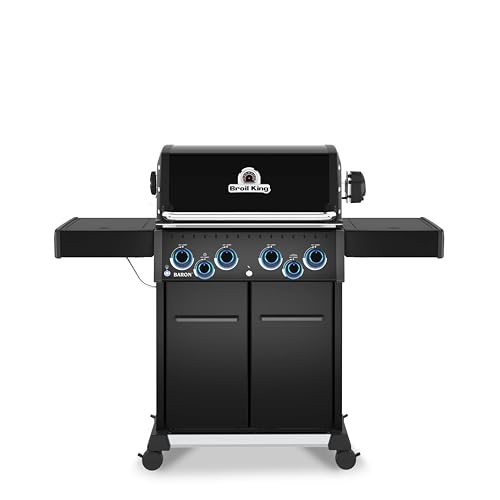
Broil King Baron 490 Pro Shadow 4-Burner Propane Gas Grill (674144) — Best Outdoor Mid-Tier With Rotisserie Burners
The Baron 490 Pro brings Broil King’s build quality to the outdoor brief with the detail event cooks look for: a rear rotisserie burner alongside its four main burners and side burner, in the Shadow finish.
Strengths
- A dedicated rear rotisserie burner is the correct heat source for spit cooking
- Broil King construction culture suits a grill living outdoors full-time
- Four main burners keep everyday outdoor cooking proportionate
Trade-offs
- Rear-burner rotisserie is a premium feature at a mid-premium price
- Shadow finish shows dust and pollen outdoors — cosmetic upkeep
- Confirm whether the rotisserie kit itself is included in the listing configuration
| Spec | Detail (from listing) |
|---|---|
| Burners | 4 burners with side burner and rear rotisserie burner (per listing) |
| Line | Broil King Baron 490 Pro Shadow (674144) |
| Fuel | Propane (per listing) |
A rear rotisserie burner matters because spit roasting over main burners is a compromise — direct heat from below chars drippings and flares, while a rear radiant burner cooks the turning food evenly and lets the drip pan do its work beneath. Pair that with Broil King’s burner and cook-box engineering, and you have an outdoor grill split intelligently between the everyday and the celebratory: four burners for the weekly rhythm, a proper rotisserie station for the monthly event. The Shadow finish is the aesthetic choice — dark, modern, and honest about showing the pollen and dust that outdoor life deposits, so a wipe-down joins the routine. Verify the listing for exactly which rotisserie components are included before ordering. For the outdoor household that wants one grill to cover both registers without reaching the flagship tier, this is the balanced answer.
Best for: outdoor cooks wanting Broil King quality plus a true rear rotisserie burner / Not suited for: buyers who never rotisserie — the rear burner premium buys them nothing
Check the current price on Amazon
Comparison Table
| Pick | Badge | Key spec | Best for |
|---|---|---|---|
| Weber Genesis E-415 Gas Grill (Propane) | Best Overall for Outdoor Living | 4 PureBlu burners (per listing) | households whose grill lives on the patio year-round and cooks in every season |
| Napoleon Prestige 500 RSIB Propane Gas Grill (P500RSIBPSS-3) | Best Premium Outdoor Grill | Main burners plus infrared side and rear burners (per listing) | premium patios and second-kitchen households cooking outdoors year-round |
| Weber Spirit E-435 Gas Grill (Liquid Propane) | Best Outdoor All-Rounder | 4 burners with Sear Zone and Boost (per listing) | households wanting full outdoor capability and easy parts support at a mainstream tier |
| Royal Gourmet GA6402S 6-Burner Propane Gas Grill with Side Burner | Best Outdoor Grill for Crowds | 6 burners plus side burner (per listing) | lake houses, large properties, and hosts who regularly cook for crowds outdoors |
| Monument Grills 77352 6+1 Burner Rotisserie | Best Outdoor Grill With Rotisserie | 6+1 burner configuration with side burner (per listing) | hosts whose outdoor cooking centers on roasts and celebration meals |
| Broil King Baron 490 Pro Shadow 4-Burner Propane Gas Grill (674144) | Best Outdoor Mid-Tier With Rotisserie Burners | 4 burners with side burner and rear rotisserie burner (per listing) | outdoor cooks wanting Broil King quality plus a true rear rotisserie burner |
How to Choose the Best Gas Grills for Outdoors Year-Round
Buy materials for the climate you actually have. Humid and coastal air punishes painted steel and rewards stainless and enamel-protected components; dry climates forgive more but add dust and UV. The grill lives in your weather, not the manufacturer’s — choose its construction for your zip code’s worst month, not its best.
Size for your gathering pattern, then check the patio honestly. Outdoor grills grow: four burners for family-plus-friends, five to six for regular crowds, rotisserie stations for event households. Measure the space with the lid open and working room around it, and remember the grill also needs its safety clearances from structures and overhangs in its permanent spot.
Treat the cover as part of the grill, purchased the same day. Permanent outdoor residence without a cover is the single largest lifespan error in this category. A fitted cover, used every time, plus a seasonal deep clean, is the entire difference between a five-year grill and a twelve-year grill at the same tier.
Value wind competence. Outdoor grills cook in moving air: lids that seal reasonably, burners that hold flame, and layouts that let you finish food on the sheltered side all matter more outside than any feature list. Infrared side burners, being radiant, are notably less wind-sensitive than open side burners.
Plan the station, not just the grill. Outdoor cooking works when the tank, tools, platter space, and a side surface live at the grill — cabinet storage, side shelves, and side burners are what make a grill a station. Budget for the station and the outdoor kitchen you build around this grill will actually get used.
Fuel strategy is an outdoor-specific decision. A grill that lives outside and cooks for gatherings drinks more propane than a weeknight appliance, and the empty-tank-at-the-party failure is an outdoor classic. Hosts solve it with a spare tank stored correctly — outdoors, upright, ventilated — or, where a gas line exists, a natural-gas-configured model from the same lines featured here. Check the listing’s fuel configuration before buying; conversion between fuels is a manufacturer-parts matter, not an assumption.
Lighting and hours change the outdoor brief in ways showrooms ignore. Much outdoor cooking happens at dusk, in the months when dinner and darkness overlap. Lid thermometers you can read at a glance, knobs with clear settings, and — on the premium picks — control lighting stop being features and become the interface you actually cook by. When comparing finalists, imagine each one at 8 p.m. in October with a platter in one hand. The right choice usually announces itself.
Think about the grill’s audience when you place it, because outdoors, the grill is a hearth. Guests will gather where it stands; the cook will hold court there; children will be warned away from exactly that corner. Place it where that gathering makes sense — near the seating, out of the through-route, with the cook facing the party rather than the fence. The technical clearances in this guide are the floor; the social geometry is the design. Get both right and the patio organizes itself around the grill for a decade.
Budget a small annual line for the outdoor grill the way you would for any infrastructure: a cover every few years, a wear part as needed, a deep-clean day each spring and fall. It is a trivial sum against the purchase, and treating it as a standing budget line — rather than a surprise — is the psychological trick that keeps outdoor grills maintained. Infrastructure is not bought once; it is kept, cheaply and on schedule.
How to Keep a Gas Grill Living Outdoors Year-Round
Adopt the seasonal rhythm. Spring: deep clean, burner inspection, igniter test, and a leak check before the first cook. Summer: grease system on a monthly cycle during heavy use, grates brushed every cook. Fall: another deep clean before the cold, because a dirty grill under a winter cover corrodes in its own grease. Winter: cover on, tank valve closed, snow load brushed off the cover.
Manage water like it is the enemy, because it is. Keep the cover fitted and intact — a torn cover funnels water onto the grill it protects. After storms, lift the lid and dry standing moisture from the cook box if your grill lives uncovered between uses. Burners that stay dry between cooks last multiples longer than burners that stay damp.
Run the grill periodically in the off-season. A fifteen-minute burn every month or so in winter drives moisture out of the burners and firebox, discourages nesting pests, and tells you about problems in February rather than at the first spring gathering. Check burner ports and the venturi area for insect nests before lighting after any long idle period.
Store the soft parts smartly. Rotisserie kits, tools, and spare igniters live indoors or in the cabinet, dry. Tanks stay outdoors, upright and ventilated, valve closed. The grill itself never winters with food residue, a full grease tray, or a dead igniter you meant to replace — the spring version of you is counting on the fall version.
Adapt technique to the season instead of fighting it. In summer, the grill is a heat source you keep at arm’s length from the house, cooking fast loads in the cool of the evening. In winter, the same grill wants longer preheats, the lid kept closed with religious discipline, and food chosen for lid-down methods — roasts, thighs, whole vegetables — that forgive the cold. Windbreak positioning you settled in spring pays its dividend in January. The outdoor cooks who grill year-round are not tougher than everyone else; they just change the menu and the preheat, not the standard.
Keep an outdoor log for the first season — nothing elaborate, a note on the phone after notable cooks: what the weather was, what the zones did, what you would change. Outdoor variables are too many to hold in memory, and the log converts a year of anecdotes into a personal manual for your grill in your climate. By the second season, you will preheat by instinct for a still June evening and a gusty November one differently, and that instinct is the real product this guide is trying to sell.
Grilling Through the Seasons: A Year-Round Outdoor Playbook
Spring is the outdoor grill’s new year. The deep clean and burner inspection from the how-to section happen now, along with the season’s first leak check and a honest look at the cover that survived the winter — replace it before it fails onto the grill, not after. Spring cooking is forgiving and social: moderate loads, the first gatherings, and the cook re-learning the grill’s map after the idle months. Run one mapping cook early, the way you did when the grill was new, because a winter can change a burner, and it is better to learn that over sausages than over a celebration.
Summer is capacity season, and its technique is traffic management. Preheat fully before the first guest arrives, run zones like lanes — searing, cooking, holding — and let the side burner absorb the sides so the main box never becomes a negotiation. Grease discipline tightens in summer because loads are largest and the grease system fills proportionally; the post-gathering clean is part of the event, not a postponement. Shade for the cook, water within reach, and a platter station that keeps raw and cooked traffic separate are the unglamorous systems behind every effortless-looking summer cookout.
Autumn is the outdoor grill’s finest hour and this guide’s favorite argument. The air cools, the light goes golden, and the grill’s strengths — roasts, rotisserie, long lid-down cooks — come into their own while the kitchen indoors stays cool and unburdened. This is rear-burner and rotisserie season, root-vegetable season, the months the Monument and Broil King picks were chosen for. It is also the season to do the fall deep clean before winter, order the wear parts the year revealed, and replace the cover while the old one’s failures are fresh in mind.
Winter separates outdoor cooks from patio owners, and the technique is mostly respect for physics. Preheat longer — sometimes twice as long — because the box starts colder and loses heat faster. Keep the lid closed; every peek in January costs minutes, not seconds. Choose forgiving, lid-down foods and bring a thermometer’s certainty to doneness, because color lies in cold, dim light. Position against the wind, keep the tank as warm as the weather allows since propane pressure sags in deep cold, and shorten the session’s ambition rather than its standards. A February roast done properly outdoors is a small triumph, and the grill that does it has earned its permanent place.
Across all four seasons, the constant is the one this whole guide runs on: the grill as maintained infrastructure. Covers, grease, burners, and seasons, attended to in small regular doses, are what ‘outdoor grill’ means when it works — an appliance that stands in the weather and answers in all of it, year after year, gathering after gathering.
Common Buying Mistakes
Mistake one is buying an indoor-storage grill for an outdoor life. Lightweight painted boxes are fine appliances in a garage and short-lived ones on an exposed patio. Match construction to residence.
Mistake two is placing the grill in the patio’s wind tunnel or tight against the house for convenience. Permanent placement deserves a wind-aware, clearance-respecting spot — you will cook there hundreds of times.
Mistake three is letting gathering-scale grease loads ride. Big cooks fill grease systems proportionally; the post-event clean is not optional, and a grease fire at the next lighting is how the lesson usually arrives.
Mistake four is forgetting the grill all winter. Months of idle moisture, nesting insects, and a dirty cook box do more damage than a season of cooking. The monthly burn and the fall clean prevent nearly all of it.
One Year With an Outdoor Grill: Four Gatherings
Spring’s first gathering is modest by design — the season’s shakedown, a dozen burgers and the year’s first corn, with the newly cleaned grill performing its inspection in public. The cook relearns the map, the guests relearn the patio, and the grill announces, by simply working, that the outdoor year has begun. Every long-lived outdoor grill has this ritual, whether its owners call it one or not.
Summer’s gathering is the capacity test: the full house, the mixed menu, the side burner in service and the zones running like lanes. This is the cook the six-burner and rotisserie picks were chosen for, and the one where the station planning — tools at hand, platters staged, grease emptied the day before — pays in calm. The grill is not the bottleneck and the cook is not a prisoner; that is the entire design brief, fulfilled in public.
Autumn brings the signature cook: a rotisserie bird or a long roast, the air cool, the light low, the grill doing the slow work it was built for while the gathering happens around it. And winter, finally, the small defiant dinner — thick chops, a long preheat, the lid’s discipline observed — that proves the premise of this whole guide: outdoors is not a season. It is a place, and a grill built and kept for it cooks there all year. Four gatherings, one appliance, zero replacements — that is the return on choosing for exposure, capacity, and care.
Outdoor Grill Safety: The Permanent-Residence Rules
A grill that lives outdoors permanently deserves a safety section of its own, because its risks are the slow kind. Clearances come first and are permanent decisions: the grill’s spot must respect the manual’s distances from structures, overhangs, and combustibles every day of the year, including the day someone stores the patio cushions beside it ‘just for the weekend.’ Permanent placement tempts permanent clutter; the clearance zone is not storage, in any season, for any duration.
Gas discipline outdoors is a calendar, not an event. The leak check belongs to spring commissioning and to every tank change. The hose and regulator live in weather and age in it — inspect them at each deep clean for cracking and wear, and replace on condition, not on failure. After long idle periods, burners and venturi tubes get checked for the insect nests that are the outdoor grill’s most traditional surprise, before the first lighting, every time.
Fire readiness at a permanent station is simple and specific: the cook knows where the lid is, the tank valve is reachable without leaning over the grill, and nothing about the station’s layout requires crossing the grill to reach either. Grease — the fuel of nearly every grill fire — is managed on the schedule this guide repeats because repetition is what safety is. A permanent outdoor grill, kept this way, is among the safest appliances a home owns. Kept carelessly, it is a fire with a patio around it. The difference is entirely in the keeping, and the keeping is easy — which is why this guide refuses to treat it as optional.
The Outdoor Grill as Neighborhood Infrastructure
There is a social fact about a good outdoor grill that no specification captures: it reorganizes a street. The household with the capable, always-ready grill becomes the household where gatherings default to happening — the graduation cookout, the post-game burgers, the neighborly evening that needed a venue. That role is a genuine return on the investment this guide describes, and it is earned by exactly the unglamorous virtues the picks were chosen for: the grill lights, it fits the crowd, it is clean enough to use without a project day, and it works in the shoulder seasons when the calendar needs it most.
The role carries its small responsibilities, which the established outdoor households in any neighborhood handle without thinking. Smoke courtesy on still evenings, when a neighbor’s windows are open. The grease and cleanliness discipline that keeps the station pleasant to stand beside. A spare tank, so the neighborhood’s unofficial clubhouse never closes mid-service for the most preventable reason in grilling. None of this is obligation; it is simply how the infrastructure households stay infrastructure households, year after year.
Plan for the role if you want it — capacity, a side burner, a station that works at dusk — and decline it gracefully if you do not, by choosing the smaller picks and keeping your patio your own. Either way, choose consciously. An outdoor grill is never only an appliance. It is a statement about how a household intends to spend its evenings, and the best version of that statement is the one made on purpose.
Final Recommendation
For the complete outdoor anchor, choose the Genesis E-415 for structure and support, or the Napoleon Prestige 500 if premium stainless and infrared are the brief. The Spirit E-435 covers the full repertoire at a mainstream tier, the Royal Gourmet six-burner feeds genuine crowds, and the two rotisserie-equipped picks — Monument’s kit-included cabinet and Broil King’s rear-burner Baron — serve households whose outdoor life peaks at celebration meals.
Whichever you choose, run the year-round routine: cover always, grease on schedule, seasons observed. An outdoor grill is infrastructure, and infrastructure rewards exactly that kind of boring, reliable care.
- Weber Genesis E-415 Gas Grill (Propane) — check price on Amazon
- Napoleon Prestige 500 RSIB Propane Gas Grill (P500RSIBPSS-3) — check price on Amazon
- Weber Spirit E-435 Gas Grill (Liquid Propane) — check price on Amazon
- Royal Gourmet GA6402S 6-Burner Propane Gas Grill with Side Burner — check price on Amazon
- Monument Grills 77352 6+1 Burner Rotisserie — check price on Amazon
- Broil King Baron 490 Pro Shadow 4-Burner Propane Gas Grill (674144) — check price on Amazon
Best Gas Grills For Home Use Best Gas Grills Best 5 Burner Gas Grills Best 6 Burner Gas Grills Best Durable Gas Grills Best Gas Grills For Durability
Frequently Asked Questions
How is an outdoor grill different from a home-use grill?
Emphasis. Outdoor picks prioritize weather-tolerant construction, permanent patio residence, gathering capacity, and parts support for faster-aging components. Home-use picks prioritize weeknight ease and size-to-headcount. Many households need both sets of virtues; these guides weight them differently.
Can a gas grill stay outside all winter?
Yes, with preparation: deep clean it, empty the grease system, close the tank valve, and fit an intact cover. A short burn every month or so drives out moisture. Check for insect nests in burners before the first spring lighting.
What size grill do I need for outdoor gatherings?
Four burners cover family-plus-friends. Regular crowds of ten or more justify five to six burners so everything cooks in one wave. Rotisserie-equipped models suit event cooking centered on whole roasts or birds.
Does wind really affect gas grilling?
Yes — wind strips heat, bends flames, and cools one side of the box. Cook with the lid down, use the sheltered side as your finishing zone, position the grill out of the main wind path, and note that infrared burners are less wind-sensitive than open flames.
How often should an outdoor grill be cleaned?
Grates brushed every cook, grease system monthly in heavy season, and a deep clean with burner inspection each spring and fall. Permanent outdoor residence accelerates aging, so the schedule — not the products — is what protects the grill.
Is stainless steel worth it for an outdoor grill?
For permanent outdoor residence, quality stainless in the cooking system resists the corrosion that ends lesser grills, and it anchors premium patios visually. It asks for regular washing in return, especially in coastal air. Painted steel belongs under cover or in a garage.
Natural gas or propane for a permanent outdoor grill?
If your property has a gas line near the patio and you cook often, a natural-gas-configured grill ends tank management forever, at the cost of permitted plumbing. Propane keeps placement flexible and dominates the market. Several lines in this guide offer both configurations — confirm the exact fuel on the listing before ordering.
How do I keep an outdoor grill ready for spontaneous gatherings?
Keep it clean as a standing condition, not a pre-event project: grease emptied on schedule, grates brushed after every cook, a healthy tank plus a spare, and the cover on between uses. A grill maintained that way is always fifteen minutes from service, which is what spontaneous actually requires.


