Disclosure: airfryerkitchensupply.com is reader-supported. When you buy through links on our site, we may earn an affiliate commission at no extra cost to you.
Where to buy
Short on time? If you are comparing the best 5 burner gas grills and want the short answer first, start with the Kenmore five-burner for its complete sear-zone system or the Royal Gourmet GA5401T for clean stainless value — they are the two safest buys in this guide. Every grill below is a current model sold through Amazon’s marketplace by the brand or authorised sellers. Confirm the exact finish and variant on the listing, because several of these platforms come in multiple colours, and check price on Amazon before you buy.
- Kenmore 5-Burner Propane Gas Grill with Searing Zone, Silver, 644 Sq In — Check price on Amazon; choose the listing sold or shipped by Amazon or the brand’s own storefront, and confirm the exact model variant before ordering.
- Royal Gourmet GA5403B 5-Burner Propane Gas Grill with Rear Burner — Check price on Amazon; choose the listing sold or shipped by Amazon or the brand’s own storefront, and confirm the exact model variant before ordering.
- Royal Gourmet GA5401T 5-Burner BBQ Propane Gas Grill — Check price on Amazon; choose the listing sold or shipped by Amazon or the brand’s own storefront, and confirm the exact model variant before ordering.
- Megamaster 5-Burner Propane Gas Grill, 753 Sq In — Check price on Amazon; choose the listing sold or shipped by Amazon or the brand’s own storefront, and confirm the exact model variant before ordering.
- Feasto 5-Burner Propane Gas Grill with Built-In Sear Burner — Check price on Amazon; choose the listing sold or shipped by Amazon or the brand’s own storefront, and confirm the exact model variant before ordering.
- Bestfire 5-Burner Propane Gas Grill, 647 Sq In — Check price on Amazon; choose the listing sold or shipped by Amazon or the brand’s own storefront, and confirm the exact model variant before ordering.
The best 5 burner gas grills sit one step above the family standard: five zones of heat, cooking areas that handle a dozen covers at once, and — on the better platforms — a sear zone or rear burner that turns the big box into a system. This guide ranks six of them, from the complete mainstream platforms to the specification-led value models, and the differences that matter are in how each arranges its five burners, not in the count itself.
Five burners is where extras stop being decoration. A sear zone sharpens the hot end of the gradient; a rear burner adds rotisserie cooking as a separate mode; a side burner removes the saucepan from the grate. We have ranked these grills on gradient quality, cooking area and grate material, then on the ownership trail — parts, covers, support — that decides whether a big grill is still cooking in year eight.
Who is this guide for? Hosts cooking for eight to fourteen, families who batch-cook for the week, and four-burner owners who keep running out of holding space. If your crowds are smaller, the four-burner guides in this cluster are the honest size; if they are bigger still, the six-burner guides await. Here, the question is which five-burner system matches your menu.
In this guide
Quick Picks
Here is the short list at a glance. The picks span complete mainstream systems, a rotisserie specialist, maximum-space and grate-first value platforms — read the badges as priorities.
- Kenmore 5-Burner Propane Gas Grill with Searing Zone, Silver, 644 Sq In — Best Overall. A listed 644 sq in, 66,000 BTU, a searing zone and a side burner in a silver finish that hides dust between cleans. The complete five-burner system. — Check price on Amazon
- Royal Gourmet GA5403B 5-Burner Propane Gas Grill with Rear Burner — Best with Rear Burner — Rotisserie Ready. A listed 74,000 BTUs across five mains, a side burner and a rear burner for proper rotisserie cooking, in a blue cabinet. The power and versatility pick. — Check price on Amazon
- Royal Gourmet GA5401T 5-Burner BBQ Propane Gas Grill — Best Stainless Value. Clean stainless steel in silver, a listed 61,000 BTU and a side burner — solid basics, completely executed, at a value tier. — Check price on Amazon
- Megamaster 5-Burner Propane Gas Grill, 753 Sq In — Largest Cooking Space. A listed 753 sq in including the warming rack — the biggest figure in the class — with a matte cast iron grate and 66,000 BTU. The volume pick. — Check price on Amazon
- Feasto 5-Burner Propane Gas Grill with Built-In Sear Burner — Best Complete Station. A listed 686 sq in with a built-in sear burner, a side burner, a storage cabinet and a prep table. The one-purchase station. — Check price on Amazon
- Bestfire 5-Burner Propane Gas Grill, 647 Sq In — Best Grates and Output. Porcelain cast iron grates with a listed 68,000 BTU over 647 sq in in a stainless cart design. The grate-first value pick. — Check price on Amazon
How These Picks Were Chosen
We chose these six to cover the five-burner class’s real decision points: a complete mainstream system (Kenmore), a rotisserie-equipped power platform (Royal Gourmet GA5403B), a clean stainless value model (GA5401T), the maximum-space option (Megamaster), the complete-station package (Feasto) and the grate-first value pick (Bestfire). The Char-Broil FlavorMax five-burner — the long-term ownership choice — is covered in depth in the sibling 5-and-6-burner guide in this cluster rather than repeated here. Every candidate had to be a current model verifiable.
Specification honesty governed the shortlist. Cooking areas are quoted as the listings state them, and where a figure includes a warming rack the review says so. BTU totals are always described as totals — including side and rear burners where fitted — never as main-burner output. Grate material is named for every pick because at the food’s surface it matters more than any headline number.
We excluded any grill with an active safety recall and any model we could not verify as a current product. One gap is worth stating: Dyna-Glo’s freestanding five-burners, a common big-box sight, returned only replacement parts through the API at check time, so they could not be verified and are not picked here — an absence of verification, not a judgement on the grills themselves.
The 6 Best 5 Burner Gas Grills Worth Buying

Kenmore 5-Burner Propane Gas Grill with Searing Zone, Silver, 644 Sq In — Best Overall
The silver version of Kenmore’s five-burner pairs the same listed 644 sq in cooking area, 66,000 BTU, side burner and searing zone with a stainless-look finish that hides dust and water spots better than black. It suits entertainers who want the full five-burner system and a finish that stays presentable between deep cleans. Functionally it is the black model’s twin, so the choice is about your patio and your tolerance for visible grime — and about which finish suits a sunny deck, where silver reflects heat rather than absorbing it.
Strengths
- Silver stainless-look finish hides dust, pollen and water spots well
- Searing zone and side burner complete the five-burner system
- 644 sq in (per Amazon listing title) is genuine crowd capacity
Trade-offs
- Same wide footprint as any five-burner with a side burner
- Finish choice is cosmetic — cooking hardware matches the black version
- Stainless-look surfaces still need wiping to avoid streaks after rain
| Cooking area | 644 sq in (per Amazon listing title) |
| Total output | 66,000 BTU (per Amazon listing title) |
| Extras | Side burner and searing zone (per Amazon listing title) |
| Construction | Stainless steel grill, silver finish (per Amazon listing title) |
| Fuel | Propane |
Choosing between the silver and black Kenmore five-burners is a lifestyle decision disguised as a colour decision. Silver shows less of the everyday film that outdoor appliances collect — dust, pollen, dried rain spots — so the grill looks cared-for with less effort, and on a sun-exposed deck the lighter finish keeps exterior surfaces cooler to the touch. The cooking system underneath is the one that matters: five burners arranged around a searing zone, a side burner for the pot work, and 644 sq in that turns party cooking from batch management into a single load. Run it with zone discipline — sear hot, hold warm at the far end, light only what a weeknight cook needs — and the size becomes flexibility rather than waste. If your grill lives outdoors uncovered between weekend covers and you cook for crowds monthly, the silver finish is the lower-maintenance way to own the same machine.
Best for: hosts cooking for eight to twelve who want the full system in a low-fuss finish / Not suited for: small patios or minimalists who would rather have three excellent burners
Check the current price on Amazon for the Kenmore 5-Burner Propane Gas Grill with Searing Zone, Silver, 644 Sq In.

Royal Gourmet GA5403B 5-Burner Propane Gas Grill with Rear Burner — Best with Rear Burner — Rotisserie Ready
The GA5403B is the power outlier of the five-burner class: a listed 74,000 BTUs of total output across five main burners, a side burner and a rear burner for rotisserie work, in a blue cabinet design. It suits cooks who want rotisserie capability built in and who regularly run the whole grate hot for big, fast cooks. It is not suited to gentle, fuel-sipping cooking styles — this platform’s character is output — and the rear burner only earns its place if you actually plan to spin chickens and roasts.
Strengths
- 74,000 BTUs total output (per Amazon listing title) — the strongest figure in this guide
- Rear burner enables proper rotisserie cooking with a spit kit
- Cabinet design in blue with side burner completes the station
Trade-offs
- High output means higher propane use when run flat-out
- Rear burner is wasted hardware if you never rotisserie
- Blue cabinet finish is a bold look that will not suit every patio
| Total output | 74,000 BTUs (per Amazon listing title) |
| Burners | 5 main burners plus side burner and rear burner (per Amazon listing title) |
| Design | Cabinet style, blue (per Amazon listing title) |
| Fuel | Propane |
Most five-burners compete on area; the GA5403B competes on firepower and on the one feature the rest of this guide mostly lacks — a rear burner. A rear infrared-style burner is the correct way to rotisserie: heat washes over the turning meat from behind rather than blasting it from below, so a chicken self-bastes without flare-ups while you keep the lid closed. Add the side burner and the cabinet storage and this becomes the most self-contained cooking station in the five-burner class. The 74,000 BTU headline includes every burner, and the honest way to use it is selectively — rear burner for the roast, two mains for the sides, side burner for the sauce. Buyers who never rotisserie should save the complexity and take a simpler five-burner in this guide; buyers who have been waiting for a rotisserie-ready platform at a value tier have found their pick.
Best for: cooks who will actually rotisserie chickens and roasts / Not suited for: gentle, fuel-sipping cooking styles or anyone who will never use a rear burner
Check the current price on Amazon for the Royal Gourmet GA5403B 5-Burner Propane Gas Grill with Rear Burner.

Royal Gourmet GA5401T 5-Burner BBQ Propane Gas Grill — Best Stainless Value
The GA5401T is Royal Gourmet’s straightforward five-burner: stainless steel in silver, a listed 61,000 BTU output, five main burners and a side burner, without exotic extras. It suits buyers who want five-burner capacity and a clean stainless look at a value tier, and who would rather have solid basics than a sear station they will rarely use. It is not the pick for rotisserie fans or for cooks who want a dedicated high-heat zone built in — the layout here is uniform and honest.
Strengths
- Clean stainless steel design in silver suits most patios
- 61,000 BTU output (per Amazon listing title) is solid five-burner power
- Side burner included for a complete, no-extras-needed station
Trade-offs
- No sear zone or rear burner — uniform heat layout only
- Value-tier stainless needs covering to protect the finish
- Five uniform zones ask the cook to create hot and cool areas manually
| Total output | 61,000 BTU (per Amazon listing title) |
| Burners | 5 burners plus side burner (per Amazon listing title) |
| Construction | Stainless steel, silver (per Amazon listing title) |
| Fuel | Propane |
There is a case for the grill that does the basics completely, and the GA5401T makes it: five burners of even, controllable heat, a side burner, stainless surfaces and nothing you pay for twice. In practice, uniform layouts reward the oldest grilling skill — building your own zones. Run the left burners high and the right burners low and you have a sear side and a holding side; the grill does not do it for you, but it gives you the burners to do it with. The silver stainless finish is the patio-friendly choice, ageing more gracefully between cleans than black. Ownership is the Royal Gourmet pattern: strong specification for the tier, parts through the maker, and a cover as essential equipment rather than an accessory. For buyers whose menu is burgers, chicken, chops and vegetables in quantity — cooked well rather than theatrically — this is the five-burner that spends its budget in the right places.
Best for: buyers who want five-burner capacity and a stainless look without extras they will not use / Not suited for: rotisserie fans or cooks wanting a built-in sear zone
Check the current price on Amazon for the Royal Gourmet GA5401T 5-Burner BBQ Propane Gas Grill.

Megamaster 5-Burner Propane Gas Grill, 753 Sq In — Largest Cooking Space
The Megamaster five-burner leads this class on listed space: 753 sq in of cooking space including its warming rack, 66,000 BTU, a built-in thermometer, electronic ignition and a matte-finish cast iron grate. It suits the biggest home cooks — the household that hosts the street — and buyers who want cast iron at a value tier. It is not suited to small patios or to two-person households; everything about this platform is scaled for volume, and the cast iron grate asks for basic seasoning care.
Strengths
- 753 sq in listed cooking space — the largest figure in the five-burner class
- Matte-finish cast iron grate holds heat for proper sear marks
- Built-in thermometer and electronic ignition cover daily conveniences
Trade-offs
- Very large footprint and preheat for everyday small cooks
- Headline area includes the warming rack, not main grate alone
- Cast iron grate needs oiling discipline to stay rust-free
| Cooking space | 753 sq in including warming rack (per Amazon listing title) |
| Total output | 66,000 BTU (per Amazon listing title) |
| Grate | Matte-finish cast iron (per Amazon listing title) |
| Ignition | Electronic ignition (per Amazon listing title) |
| Fuel | Propane |
Megamaster’s five-burner is the volume answer: when the guest list is fifteen and the menu is burgers, dogs, corn and chicken pieces all at once, the limiting factor is square inches, and this grill lists more of them than anything else in its class. Read the 753 figure the honest way — it counts the warming rack, which is genuinely useful for holding finished food and toasting buns while the main grate works. The cast iron grate is the other substantive choice: heavy, heat-retentive and mark-making, in a matte finish that hides the seasoning it needs. The built-in thermometer and electronic ignition keep daily operation simple. The costs of scale are the usual ones — a longer preheat, a bigger cover, a patio corner committed to the grill — and households cooking for two will feel them weekly. For the host whose problem is genuinely space, this is the five-burner that solves it at a value tier.
Best for: hosts whose bottleneck is pure square inches / Not suited for: small households or patios where the footprint dominates
Check the current price on Amazon for the Megamaster 5-Burner Propane Gas Grill, 753 Sq In.
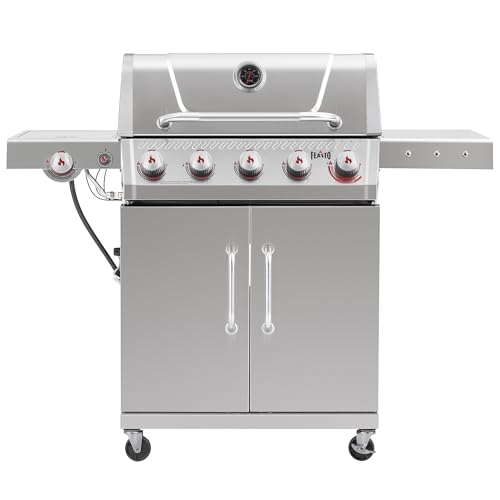
Feasto 5-Burner Propane Gas Grill with Built-In Sear Burner — Best Complete Station
The Feasto five-burner combines a listed 686 sq in of cooking space with a built-in sear burner, a side burner, a storage cabinet and a side prep table in stainless steel. It suits cooks who want the full station — sear, grill, hold, prep — in one purchase and who entertain often enough to use the space. It is not suited to buyers who prefer an established legacy brand’s parts network; Feasto competes on specification and completeness at its tier.
Strengths
- 686 sq in cooking space (per Amazon listing title) with a built-in sear burner
- Storage cabinet plus side prep table make a complete outdoor station
- Side burner included alongside the sear burner — both extras in one unit
Trade-offs
- 58,000 BTU total is moderate for a grill of this size
- Newer brand; wear parts come through the maker’s channels
- Large station footprint needs a dedicated patio position
| Cooking space | 686 sq in (per Amazon listing title) |
| Total output | 58,000 BTU (per Amazon listing title) |
| Extras | Built-in sear burner and side burner (per Amazon listing title) |
| Storage | Storage cabinet and side prep table (per Amazon listing title) |
| Fuel | Propane |
Feasto’s design reads like a buyer’s checklist answered in full: big stainless box, sear burner for the steaks, side burner for the sauce, cabinet for the tank and tools, prep table for the trays. The 686 sq in of cooking space is the substantive figure — enough to run a party load with zones to spare — and the sear burner means the big-grate compromise (plenty of room, not enough peak heat) does not apply here. The 58,000 BTU total is adequate rather than extravagant for the size, which in practice means slightly calmer preheats and a premium on zone planning for very large cooks. As with every specification-led brand in this guide, ownership means keeping the model details and sourcing wear parts from the maker, plus the usual cover discipline for stainless at this tier. If you want one purchase that ends the accessory hunt, this is the five-burner built around that idea.
Best for: buyers who want sear, storage and prep space in a single purchase / Not suited for: buyers who prefer a legacy brand’s parts network
Check the current price on Amazon for the Feasto 5-Burner Propane Gas Grill with Built-In Sear Burner.

Bestfire 5-Burner Propane Gas Grill, 647 Sq In — Best Grates and Output
The Bestfire five-burner pairs a listed 68,000 BTU with 647 sq in of cooking space and porcelain cast iron grates in a stainless steel patio cart design. It suits buyers who prioritise grate material and total output together at a value tier — the two specs that most directly change the food. It is not suited to buyers who want a cabinet’s enclosed storage; the cart design keeps the unit lighter and simpler, with the tank visible and accessible.
Strengths
- Porcelain cast iron grates combine searing mass with easier cleanup
- 68,000 BTU (per Amazon listing title) is strong output for the five-burner class
- 647 sq in cooking space (per Amazon listing title) covers crowd cooking
Trade-offs
- Open cart design offers less enclosed storage than cabinet models
- Value brand with maker-channel parts support
- Porcelain coating on grates can chip if struck with metal tools — use care
| Total output | 68,000 BTU (per Amazon listing title) |
| Cooking space | 647 sq in (per Amazon listing title) |
| Grates | Porcelain cast iron (per Amazon listing title) |
| Design | Stainless steel patio cart (per Amazon listing title) |
| Fuel | Propane |
Bestfire spends its budget where the food touches the grill. Porcelain cast iron is the grate material experienced cooks ask for — cast iron’s heat storage for marks and crust, with a porcelain surface that releases food more easily and slows rust — and pairing it with 68,000 BTU of output means the grates actually get the heat they are built to hold. The 647 sq in of space puts it squarely in crowd territory, and the cart format keeps the whole unit more manoeuvrable than a full cabinet when you need to move it for cleaning or winter storage. The trade-offs are storage and support: an open cart shows its tank, and a value brand’s parts come through its own channels. Neither affects a single cook. For buyers ranking grills by what happens at the grate rather than by the badge on the lid, this is one of the most persuasive five-burner specifications in the guide.
Best for: buyers ranking grills by what happens at the grate / Not suited for: buyers wanting enclosed cabinet storage
Check the current price on Amazon for the Bestfire 5-Burner Propane Gas Grill, 647 Sq In.
Comparison Table
| Pick | Badge | Key spec | Best for |
|---|---|---|---|
| Kenmore 5-Burner Propane Gas Grill with Searing Zone, Silver, 644 Sq In | Best Overall | 644 sq in, searing zone, silver finish | hosts cooking for eight to twelve who want the full system in a low-fuss finish |
| Royal Gourmet GA5403B 5-Burner Propane Gas Grill with Rear Burner | Best with Rear Burner — Rotisserie Ready | 74,000 BTUs, rear rotisserie burner | cooks who will actually rotisserie chickens and roasts |
| Royal Gourmet GA5401T 5-Burner BBQ Propane Gas Grill | Best Stainless Value | 61,000 BTU, stainless steel, side burner | buyers who want five-burner capacity and a stainless look without extras they will not use |
| Megamaster 5-Burner Propane Gas Grill, 753 Sq In | Largest Cooking Space | 753 sq in cooking space, cast iron grate | hosts whose bottleneck is pure square inches |
| Feasto 5-Burner Propane Gas Grill with Built-In Sear Burner | Best Complete Station | 686 sq in, built-in sear burner, storage cabinet | buyers who want sear, storage and prep space in a single purchase |
| Bestfire 5-Burner Propane Gas Grill, 647 Sq In | Best Grates and Output | Porcelain cast iron grates, 68,000 BTU, 647 sq in | buyers ranking grills by what happens at the grate |
Read the table by system, not by size — all six are five-burners, so the decision is which arrangement of extras (sear zone, rear burner, cabinet, grates) matches your menu and your maintenance style.
How to Choose the Best 5 Burner Gas Grills for Your Menu
Match the extras to the menu first. Rotisserie households should shortlist the rear-burner platform and ignore everything else until that box is ticked — no accessory fully substitutes for a built-in rear burner. Steak-led households should prioritise a sear zone or the strongest grate-and-output combination. Mixed family cooking — burgers, chicken, vegetables, the occasional party — is served by every pick here, and the decision then moves to finish, storage and support.
Grate material divides the class more honestly than price does. Porcelain cast iron (Bestfire) and matte cast iron (Megamaster) store the heat that makes big-batch food come off the grill marked rather than steamed; porcelain-coated steel is easier to keep and less impressive at the surface. At five-burner scale you are cooking for crowds, and crowd food punishes weak grates — twenty burgers on a thin grate is where the difference shows. Weight the grate accordingly.
Then decide your ownership style. Maintainers — people who brush, oil, cover and order a burner in year five — can buy any platform here happily. Replacers — people who will not — should weight the support trail and simpler specification, because a complex grill neglected ages faster than a simple grill neglected. The five-burner is a five-to-ten-year purchase; buy the one whose upkeep matches the owner you actually are.
Five Burners, Arranged Four Ways: Sear Zones, Rear Burners and Plain Gradients
The plain gradient — five uniform burners — is the original five-burner idea, and it works because the cook creates the zones: high at one end, low at the other. Its virtue is simplicity and its demand is attention. The GA5401T in this guide is its cleanest expression, and cooks who learned on uniform grills often prefer the control of building their own map.
A sear zone (Kenmore, Feasto) dedicates part of the box to concentrated heat. The advantage is real: the rest of the grate can run at cooking temperature while one corner finishes steaks properly, which is how restaurants plate mixed orders. The cost is complexity and a section of grate that runs hot by design. A rear burner (GA5403B) is a different axis entirely — it does not change grate cooking at all; it adds rotisserie as a parallel mode, and its value is binary: essential if you spin food, invisible if you do not.
Side burners, fitted to every pick here, are the least glamorous and most used extra: the sauce, the beans, the onions that would otherwise occupy grate corners or the kitchen stove. When you compare five-burners, count the extras you will use weekly, not the ones that photograph well — the honest spec sheet is your own menu, written out.
Sizing a Five-Burner: Area, Footprint and the Party Test
Five-burner cooking areas in this guide run from the mid-600s to the mid-700s of listed square inches, with the caveat that some figures include warming racks. The working test is the party load: a dozen burgers occupy roughly a third of a typical five-burner grate, leaving a vegetable zone and a holding zone — which is exactly the margin that makes hosting calm. If your regular load is half that, a four-burner serves you better; if it is double, read the six-burner guides before buying down.
Footprint is the constraint buyers discover late. A five-burner with a side burner is a wide appliance; add the cook’s standing room, a prep surface and the lid’s swing, and the honest space claim is a patio corner, not a slot. Measure with the lid open. Also plan the cover at purchase time — five-burner covers are large, and a grill this size left uncovered ages in dog years.
Propane logistics complete the sizing picture. Five burners at full light drink fuel at a rate that makes the spare tank a system rather than a tip, and zone discipline — lighting three burners for a family dinner — is what keeps the big grill economical on ordinary nights. Buy the size for your hosting life, run it for your daily life, and the arithmetic works at both ends.
The Five-Burner Maintenance Calendar: Small Jobs on a Schedule
Big grills fail by accumulation, not by event, so their care works best as a calendar rather than as a response. Per cook, the jobs are two: brush the grates while they are warm, and glance at the grease tray — a ten-second check that tells you whether this cook’s close-down includes emptying it. Per month in season, add the baffle scrape: heat tents and flavouriser bars collect the grease that becomes next month’s flare-ups, and a putty-knife pass while the grill is warm keeps them honest. None of this exceeds fifteen minutes, and all of it is cheaper than the deep clean it prevents.
Per season, the calendar deepens. Burners come out or get brushed in place, ports cleared with a soft brush so flames run even and blue again; the firebox gets scraped and vacuumed; connections get a soapy-water leak check whether or not the tank changed; cast iron grates get a re-seasoning if the surface has gone patchy. On stainless models, this is also the polish appointment — an hour that resets the finish for the season. Owners who keep this appointment describe their grills as reliable; owners who skip it describe the same grills as disappointing, which is the calendar’s whole argument.
Per years, expect the wear items in order: igniters first (cheap, quick), heat tents and baffles next, burners and grates on the longer arc. This is where the shortlist’s support differences become money — a platform whose parts are listed by model number and stocked widely turns each of those into a small errand, while an orphaned platform turns the first one into a replacement decision. Buy the calendar along with the grill: put the seasonal jobs in an actual diary, and a five-burner stops being a depreciating purchase and becomes what it was bought to be — infrastructure.
One more calendar entry belongs at the five-year mark: a planned refresh rather than a reactive repair. Grates re-seasoned or replaced, burners inspected against the light for thinning and port damage, the igniter renewed before it fails at a party. A five-burner refreshed on schedule at year five is, functionally, a new grill for the price of its wear parts — which is the entire economic argument for buying a supported platform in the first place, stated as a diary entry.
How to Set Up a Five-Burner Grill and Cook a Full Party Load
A five-burner’s first party is where its system proves itself. Set the grill up properly once, then run the load with the zone method and the hardware you bought will do the rest.
- Assemble, level and leak-check before anything else. Build the grill in its patio position, confirm it sits level and firm, connect the tank and brush soapy water over every gas connection with the burners off. Bubbles mean a leak — close the valve, reseat, retest. Light each burner and confirm even, mostly blue flames along every tube, including the sear zone, side burner and rear burner if fitted.
- Burn off and season the grates. Run all burners on high, lid closed, for 20–30 minutes to clear factory residues. Cool to warm, wipe the grates with a thin film of high-smoke-point oil on a tong-held towel, and heat on medium for 15 minutes. Cast iron and porcelain cast iron grates especially repay this first seasoning.
- Assign the zones before the guests arrive. Decide the map in advance: sear zone hot, middle burners medium for cooking through, far end low for holding, warming rack for buns and resting. Write the cooking order — thickest and longest items first — and prep everything that can be prepped. Party grilling is logistics wearing an apron.
- Preheat fully and load in waves. A full preheat stores heat in the grates; loading in waves — one zone at a time — keeps temperatures from crashing. Resist the photograph moment of a completely full, raw grate: it steams, it sticks and it recovers slowly.
- Work the extras as scheduled tools. Sear in batches and move finished pieces to the holding zone. Put the sauce and sides on the side burner from the start. If you are rotisserie cooking, the spit is the centrepiece — start it first, and let the grate work around its timetable, not the reverse.
- Close down completely. Burn off on high for ten minutes, brush the grates warm, and when cool, empty the grease tray, close the tank valve and fit the cover. A party load makes party quantities of grease; the close-down is part of the cook, not an optional epilogue.
Run two parties this way and the system becomes habit: zones assigned, waves loaded, everything landing hot together. That calm — not the burner count — is what you actually bought.
Common Buying Mistakes
Treating all five burners as one temperature. The class exists for gradients. One heat setting across five burners wastes the platform and guarantees the mixed-load juggle of finished food going cold while the rest catches up. Assign zones and move food between them.
Ignoring whether the area figure includes the warming rack. A 750 sq in grill whose headline counts the rack has a smaller main grate than the number suggests. It is still useful space — but compare main grates when the decision is close, as this guide’s reviews make explicit.
Buying a rear burner you will never use. Rotisserie hardware you do not use is storage, cleaning and cost. Buy the GA5403B’s rear burner because you spin chickens, or buy a simpler platform and spend the difference on the cover and a probe thermometer.
Letting the grease tray ride through party season. Five-burner parties produce five-burner grease. A tray emptied after every big cook is maintenance; the same tray discovered by a flare-up is a fire drill. Schedule it with the close-down, every time.
Running the full box for a two-person dinner. Light two burners and cook in the corner. The big grill’s flexibility is only economical if you use it, and a habit of full-light cooking is the fastest route to propane bills that make you resent the grill.
Skipping the cover because the grill is stainless. Stainless at value tiers is a finish as much as a structure, and it streaks, spots and eventually pits without protection. The cover is part of the purchase price of any five-burner — budget it on day one.
Final Recommendation
For most hosts, the Kenmore five-burner in silver is the complete answer: a sear zone inside the box, a side burner beside it, 644 sq in to work with and a finish that forgives an outdoor life. Rotisserie cooks should take the Royal Gourmet GA5403B and its rear burner without a second thought, and stainless-value buyers the GA5401T from the same maker.
If space is your bottleneck, the Megamaster’s listed 753 sq in is the class ceiling; if you want the whole station in one purchase, the Feasto; if you judge grills at the grate, the Bestfire. Add the sibling guide’s Char-Broil FlavorMax if long-term parts support tops your list, run whichever you choose with zones and a grease schedule, and a five-burner will host your summers for years.
- Kenmore 5-Burner Propane Gas Grill with Searing Zone, Silver, 644 Sq In — best overall pick.
- Royal Gourmet GA5403B 5-Burner Propane Gas Grill with Rear Burner — best with rear burner — rotisserie ready pick.
- Royal Gourmet GA5401T 5-Burner BBQ Propane Gas Grill — best stainless value pick.
Keep exploring the cluster: Best 5 And 6 Burner Gas Grills Best 6 Burner Gas Grills Best 4 Burner Propane Grills Best 6 Burner Grills Best 5 Bbq Grills Best 4 Burner Lp Gas Grills Under 250.00
Frequently Asked Questions
How many burgers fit on a 5 burner grill?
As a working figure, the platforms in this guide hold a full party load — roughly two dozen burgers if you use the whole grate, though cooking that way leaves no holding zone. The practical number is lower and better: cook in waves across the gradient, hold finished burgers in the low zone or on the warming rack, and the grill serves a crowd continuously without a single cold plate.
Is a sear zone better than a separate sear burner?
They solve the same problem in different places. An in-box sear zone (Kenmore, Feasto) keeps searing on the main grate, which suits batch workflow; a side sear station (the Napoleon in our four-burner guide) frees the whole grate. For five-burner buyers, the in-box zone is the common and convenient form — what matters is that concentrated heat exists somewhere.
What does a rear burner actually do?
It heats a rotisserie spit from behind, so a turning chicken or roast cooks evenly and bastes itself without dripping onto main burners. It does nothing for ordinary grate cooking. Buy it if rotisserie is on your menu — owners who use it consider it the best feature on the grill — and skip it without regret if it is not.
How long will a tank last on a 5 burner grill?
At full light, noticeably fewer cooks than a four-burner; with zone discipline, comparable per meal. The two-tank rotation — one in service, one full spare — is the standard system at this size and removes the question from party day entirely.
Are value-brand 5 burner grills durable?
The cooking hardware on the verified platforms here is honestly specified — the weak points across the class are the usual ones: burners, heat tents and grates as wear items, and finishes that need a cover. A maintainer gets many years from any pick in this guide; a neglectful owner can age a premium grill just as fast. Buy the support model that matches your habits.
Should I choose 5 burners or step up to 6?
Choose five for crowds of eight to fourteen and six when fourteen-plus is routine — the six-burner guides in this cluster make that case in detail. The five is not a compromise size; it is the size whose gradient most hosts can actually use fully, on a footprint most patios can actually hold.


