Disclosure: airfryerkitchensupply.com is reader-supported. When you buy through links on our site, we may earn an affiliate commission at no extra cost to you.
Where to Buy
Gas grills ship in big, damage-prone boxes, so order from a seller whose returns process you trust and inspect the firebox and lid for shipping dents before you assemble anything. All six picks below are sold on Amazon; configurations differ by fuel type and bundled accessories, so confirm propane versus natural gas on the listing before checkout.
- Weber Genesis E-415 Gas Grill (Propane) (Best Overall): Check the current price on Amazon.
- Napoleon Prestige 500 RSIB Propane Gas Grill (Best Premium): Check the current price on Amazon.
- Broil King Baron 490 Pro Shadow 4-Burner Propane Gas Grill (Best Heavy-Duty Build): Check the current price on Amazon.
- Weber Spirit E-310 Gas Grill (Best Compact): Check the current price on Amazon.
- Monument Grills 77352 6+1 Burner Stainless Steel Cabinet Grill (Best for Entertaining): Check the current price on Amazon.
- Broil King Crown S 440 4-Burner Propane Gas Grill (Best Mid-Range Stainless): Check the current price on Amazon.
The best durable gas grills share a pattern you can verify from the listing alone: stainless steel or cast aluminum fireboxes, burners made from thick stainless tube or cast metal rather than thin stamped steel, porcelain-coated cast iron grates, and an ignition system that does not depend on a single fragile module. A gas grill has more ways to die than a charcoal grill — burners rot out, igniters quit, valves stiffen, and grease quietly corrodes the cook box from inside — so durability here means every one of those systems was built to be serviced, not just to shine.
This roundup ranks gas grills by construction and serviceability. We looked first at the firebox and burner materials, then at grate quality, then at the grease path, because a grill that channels drippings into a removable tray ages far better than one that lets grease pool and bake onto the burner shields. Warranty structure counted too: makers who guarantee burners for a decade are telling you what the metal actually is.
The honest market note: the cheapest gas grills are built to a two-to-four-season life, with burners thin enough to flex in your hand. Nothing in that tier appears here. The list starts at the level where burners, grates and fireboxes are specified like equipment, and each step up buys measurably heavier metal or a better service network.
How to use this guide: find the pick whose badge matches your household, read its review fully, and then read the ownership sections at the end before you buy. With gas grills more than any other kind, the purchase is the beginning of a maintenance relationship — and the grills below were chosen because that relationship stays cheap, simple and well-supported for a very long time.
In this guide
Quick Picks
Six gas grills built for a decade of service, from a four-burner Weber with a serious parts pipeline to a Canadian-built Broil King and a stainless Napoleon flagship. Badges match the full reviews below.
- Best Overall: Weber Genesis E-415 Gas Grill (Propane) — four PureBlu burners, porcelain-enameled cast iron grates and the deepest spare-parts support in the business. — Check price on Amazon
- Best Premium: Napoleon Prestige 500 RSIB Propane Gas Grill — stainless construction, infrared side and rear burners, and wave-shaped stainless grates that shrug off seasons of weather. — Check price on Amazon
- Best Heavy-Duty Build: Broil King Baron 490 Pro Shadow 4-Burner Propane Gas Grill — a North American-built grill with a cast cook box, dual-tube burners and a rear rotisserie burner — substance over styling. — Check price on Amazon
- Best Compact: Weber Spirit E-310 Gas Grill — three burners and Weber build quality in a footprint that fits real patios, with Snap-Jet ignition and cast iron grates. — Check price on Amazon
- Best for Entertaining: Monument Grills 77352 6+1 Burner Stainless Steel Cabinet Grill — six main burners plus a side burner in a stainless cabinet — the big-grill option whose maker actually stocks burners and parts. — Check price on Amazon
- Best Mid-Range Stainless: Broil King Crown S 440 4-Burner Propane Gas Grill — stainless construction and a side burner at a mid-range tier, from the same heavy-build school as the Baron. — Check price on Amazon
How These Picks Were Chosen
Each model was verified against its current Amazon listing, so burner counts, fuel types and included features match what ships today. We required stainless or cast-metal burners, a firebox in cast aluminum or heavy stainless, and a manufacturer parts catalog that lists burners, grates, igniters and heat tents as orderable spares — a grill you cannot buy a burner for is a grill with an expiration date.
We also weighted the grease management design. Removable front-access trays, sloped cook boxes and protected burners all extend life because they keep hot grease and salt off the parts that corrode. Cabinet construction mattered at the larger sizes: doors and frames that stay square keep the whole grill feeling solid years in.
The six picks cover distinct jobs — the all-round family grill, the premium sear machine, the heavy North American build, the compact patio option, the big entertaining cabinet, and the infrared mid-ranger — so the recommendation turns on how you cook, not on which brand spent most on styling.
We also gave weight to how a grill behaves at year five, not just year one: does the lid still close true, do the knobs still turn without play, does the ignition still fire on the first click? Those qualities trace back to frame rigidity and component grades chosen at the factory, and they are why two grills with identical burner counts can age a decade apart.
The 6 Best Durable Gas Grills
Each review covers who the grill suits, the construction details that justify its durability claim, and its honest weaknesses. Specs are drawn from the verified listings; where a figure is not published, the box stays short rather than speculative.

Weber Genesis E-415 Gas Grill (Propane) — Best Overall
The Genesis line is where Weber’s build quality steps from good to equipment-grade, and the E-415 is the size most households actually need: four burners, a wide cook box, and room to run a serious two-zone fire. The PureBlu burner design uses tapered tubes intended to deliver even pressure along the whole burner, and the porcelain-enameled cast iron grates are heavy enough to hold searing heat through a full batch of steaks.
Strengths
- PureBlu stainless burners designed for even flame and long service, with replacements readily available
- Porcelain-enameled cast iron grates are heavy, durable and excellent for sear marks
- Weber’s parts and support network is the strongest in gas grilling — burners, grates, igniters all orderable
Trade-offs
- Premium pricing against similarly sized rivals with more headline features
- No side burner on this configuration; the counter space is prep-only
- Assembly is substantial — budget a couple of hours and a second pair of hands
| Burners | 4 PureBlu burners |
| Fuel | Liquid propane |
| Grates | Porcelain-enameled cast iron |
| Extras | Weber Works side rails for prep accessories |
Durability on a gas grill is mostly a story about the firebox environment: heat, grease vapor and salt. The Genesis cook box is built to shed grease toward the tray rather than pool it, and the burner tubes sit protected under flavorizer bars that themselves are replaceable wear items — exactly the right design philosophy, because the cheap sacrificial parts take the abuse and the expensive structure stays clean.
In daily use it behaves like a tool rather than an appliance: ignition is consistent, the four zones let you park a finished roast while vegetables char, and the whole grill still feels tight after seasons of use because the frame and cart were engineered to the same standard as the cook box. If you want the gas equivalent of buying once, this is it.
One ownership detail worth knowing: the Genesis platform’s popularity means its wear parts are stocked not only by the maker but by every grill-parts retailer, often with pattern alternatives for grates and deflectors. That aftermarket depth is a durability feature in itself — you will never face the discontinued-part dead end that retires otherwise sound grills from smaller brands.
If you are choosing between this and the stainless Genesis in our general durability guide, the honest difference is grates and finish, not bones — buy the S-415 for stainless grates, this one for value within the same platform.
Best for: families who grill weekly and intend to keep the same grill for a decade / Not suited for: buyers who need a side burner or the lowest possible price per burner
Check on Amazon to see the current configuration and delivery options for the Genesis E-415.

Napoleon Prestige 500 RSIB Propane Gas Grill — Best Premium
The Prestige 500 RSIB is the grill for buyers who want stainless steel everywhere it matters and infrared heat for steakhouse sears. The RSIB package adds an infrared side burner for crusting steaks and an infrared rear burner for rotisserie work, and Napoleon’s wave-shaped stainless cooking grids are more than a styling cue — the shape keeps small food from slipping through and the stainless material simply does not rust the way coated grates eventually do.
Strengths
- Stainless steel cooking grids and heavy construction throughout the cook box
- Infrared side burner delivers genuine high-heat searing; rear burner set up for rotisserie
- Strong manufacturer warranty culture and a real dealer/parts network behind it
Trade-offs
- Firmly premium tier — the most expensive route to four burners in this list
- Stainless exterior shows fingerprints and needs a wipe to stay pretty
- Infrared burners are powerful enough to scorch sauces and sugary rubs if you walk away
| Burners | 4 main burners plus infrared side and rear burners |
| Fuel | Propane |
| Grates | Stainless steel wave cooking grids |
| Body | Stainless steel construction |
What separates the Prestige from cheaper stainless grills is gauge and completeness: the stainless is not a thin skin over mild steel at the points that matter, and the burner and firebox hardware is specified to match. Infrared components are the parts skeptics question, and Napoleon supports them with the same parts pipeline as the main burners, which is the correct answer to that concern.
As a cooker it is the most versatile in this roundup — gentle enough for fish on the main grates with burners low, violent enough on the infrared side burner to crust a thick ribeye properly. For the buyer who keeps a grill a long time and cooks ambitiously, the Prestige earns its premium in both metal and capability.
The infrared side burner deserves a practical note: it is at its best with a screaming-hot, short cook — steaks, tuna, charred peppers — and it will incinerate delicate items while you blink. Use it as the specialist tool it is, keep its ceramic surface brushed clean per the manual, and it will deliver restaurant crusts for the life of the grill rather than becoming the part you stop using.
The Prestige rewards a cover and a monthly exterior wipe more than most, simply because stainless shows the environment it lives in. The metal underneath does not care; the mirror finish is for you, and two minutes keeps it.
Best for: enthusiasts who sear seriously and want stainless throughout / Not suited for: budget buyers or anyone who finds infrared heat more than they need
Check on Amazon to see the current configuration and delivery options for the Prestige 500 RSIB.
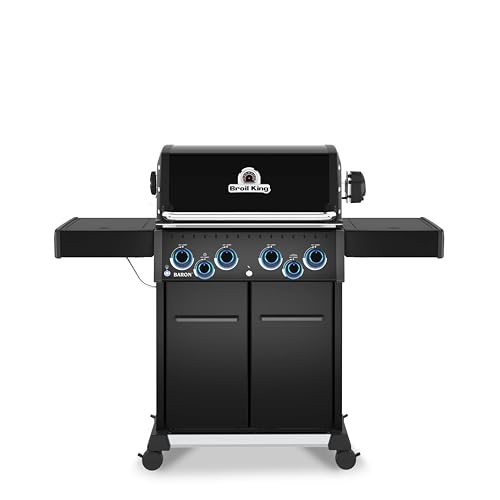
Broil King Baron 490 Pro Shadow 4-Burner Propane Gas Grill — Best Heavy-Duty Build
Broil King builds its Baron line around a heavy cast cook box — the component cheap grills make from thin folded steel — and dual-tube burners designed to maintain even heat front to back. The 490 Pro adds a side burner and a rear rotisserie burner to the four main burners, and the Shadow finish keeps the exterior understated while the hardware underneath does the talking.
Strengths
- Heavy cast aluminum cook box holds heat and cannot rust through like folded steel
- Dual-tube burners engineered for even front-to-back temperatures
- Rear rotisserie burner and side burner included for full cooking range
Trade-offs
- Styling is utilitarian next to the Napoleon and Weber flagships
- Parts are well supported but the retail footprint is smaller than Weber’s
- Cast cook box makes the grill head genuinely heavy to move during setup
| Model | Baron 490 Pro Shadow (674144) |
| Burners | 4 main + side burner + rear rotisserie burner |
| Fuel | Propane |
| Cook box | Cast construction |
The cast cook box deserves emphasis because it changes two things at once: heat retention and lifespan. A cast box does not flex with heat cycles the way folded sheet does, so seams and burner mounts stay true, and its mass smooths the temperature swings when you open the lid in cold weather. Combined with burners that are replaceable standard parts, the Baron is built on the same maintainable philosophy as our top pick, executed with a Canadian accent.
Cooking performance is quietly excellent — even heat across the grate is the Baron’s party trick, which makes it a forgiving grill for full loads of chicken or mixed grills where hot spots would normally scorch the food over the burners. Buyers who value engineering over badge will find this the most satisfying grill on the list.
Rotisserie cooking is where the Baron’s build quietly shines: the rear burner and the cook box’s heat retention produce the slow, even browning that makes rotisserie chicken worth the setup, and the heavy lid holds that environment steady in cool weather. Owners who rotisserie monthly tend to become the most loyal in this lineup — the grill rewards the habit with results cheaper grills genuinely cannot match.
Buyers comparing the Baron with the Genesis should cook their decision down to one question: evenness or ecosystem? The Baron’s heat evenness is its glory; Weber’s parts depth is the Genesis’s. Both are decade decisions made correctly.
Best for: cooks who value even heat and heavy construction over brand flash / Not suited for: small patios — it is a full-size four-burner cabinet grill
Check on Amazon to see the current configuration and delivery options for the Baron 490 Pro.

Weber Spirit E-310 Gas Grill — Best Compact
Not every durable grill needs four burners. The Spirit E-310 puts Weber’s current build standard — porcelain-enameled cast iron grates, a well-sealed cook box, individual Snap-Jet ignition per burner — into a three-burner cart that fits balconies and smaller patios without feeling like a toy. It is the grill we point to when someone says they want to buy once but only cook for two to five people.
Strengths
- Porcelain-enameled cast iron grates deliver real searing in a compact grill
- Snap-Jet ignition lights each burner individually — no single module to fail the whole grill
- Same Weber parts ecosystem as the Genesis, sized and priced for smaller households
Trade-offs
- Three burners limit true two-zone cooking for large mixed loads
- Side shelves are modest; plan on a separate prep surface for big cooks
- Costs more than larger grills from budget brands — you are paying for build, not size
| Burners | 3 burners |
| Fuel | Liquid propane |
| Grates | Porcelain-enameled cast iron |
| Ignition | Snap-Jet, one per burner |
The per-burner ignition is a small detail with a long shadow: on many grills a single electronic module serves every burner, and when it dies the whole grill goes to match-lighting. The Spirit’s arrangement means one igniter problem affects one burner, and the part is cheap and user-replaceable. That is what designing for a decade of ownership looks like at the component level.
Cooking is straightforward and honest — enough grate for a family dinner, enough heat for a proper sear, and a grease tray that slides out from the front for the weekly empty that keeps the firebox healthy. For apartments, townhouses and smaller families, this is the durable gas grill that fits both the space and the brief.
For small households, the E-310’s running costs are part of its durability case: three burners sip propane compared with five-burner cabinets, the smaller grate set is cheaper to replace when its decade eventually comes, and the whole grill fits under a standard cover without wrestling. Longevity you can afford to maintain is longevity you will actually get.
The E-310 is also the easiest recommendation in this guide to gift: it assembles without drama, lights without instruction, and its size suits almost any patio a recipient might have.
Best for: small households and patios that still want buy-it-for-years quality / Not suited for: regular cooking for eight or more
Check on Amazon to see the current configuration and delivery options for the Spirit E-310.

Monument Grills 77352 6+1 Burner Stainless Steel Cabinet Grill — Best for Entertaining
Big grills are where durability claims usually collapse, because the price pressure at six burners is brutal. The Monument 77352 earns its place by keeping the fundamentals respectable at scale: stainless cabinet construction, a full set of six main burners plus a side burner, and a rotisserie-capable setup for the cooks who host. It is the entertaining pick for buyers who need the area and refuse to buy a disposable party grill.
Strengths
- Six main burners give genuine multi-zone cooking for crowds
- Stainless cabinet build with enclosed storage keeps the cart rigid
- Side burner and rotisserie support cover the full party menu
Trade-offs
- More burners means more burners to maintain — budget time for annual deep cleaning
- Consumes propane at a party pace; keep a spare tank if you host often
- At this size, verify your patio door and gate widths before ordering
| Model | 77352 |
| Burners | 6 main + 1 side burner |
| Body | Stainless steel cabinet style |
| Fuel | Propane |
The maintenance math of a big grill is simple: everything scales. Six burners, six heat tents, and a lot of grate to keep seasoned. Monument’s advantage is that its wear parts are standard, orderable items rather than proprietary orphans, so the annual burner check and the occasional grate refresh stay cheap. Keep the grease tray emptied — on a grill this size it fills fast during parties — and the cabinet structure will stay sound.
For the host, the layout is the point: a whole zone can stay low for holding while two zones sear and the side burner handles sauce or corn. If your grilling life is measured in guests rather than weeknights, this is the durable way to buy the big grill.
A practical hosting tip that also protects the grill: cook in waves by zone and keep one zone off entirely as a clean holding area. It reduces the grease load across the whole cook box, keeps finished food unstained by fresh flare-ups, and means the post-party clean is a tray empty and a brush rather than a full excavation of six burners’ worth of drippings.
At six burners, buy the cover at the same time as the grill and store a spare set of heat tents from day one — on a grill this size, having the wear parts on the shelf turns maintenance from a project into a pause.
Best for: hosts who regularly cook for ten or more / Not suited for: weeknight cooking for two — it is far more grill than the job needs
Check on Amazon to see the current configuration and delivery options for the Monument 77352.

Broil King Crown S 440 4-Burner Propane Gas Grill — Best Mid-Range Stainless
The Crown S 440 is the step into Broil King’s stainless line: four burners, a side burner, and stainless construction at a price that undercuts the flagship stainless grills while keeping the fundamentals — a solid cook box, quality burners and proper grates — intact. It is aimed at the buyer who wants the stainless look and lifespan without paying for infrared extras.
Strengths
- Stainless steel construction at a mid-range price point
- Four burners plus side burner covers family cooking and sauces alike
- Broil King’s even-heat burner design carries down from the premium lines
Trade-offs
- Fewer convenience extras than the Baron 490 Pro — no rear rotisserie burner
- Stainless needs regular wiping to keep its finish in hard-water or coastal areas
- Assembly and heft are full-size; not a grill to reposition often
| Model | Crown S 440 (865364) |
| Burners | 4 main + side burner |
| Fuel | Propane |
| Body | Stainless steel |
Mid-range is where gas grills are won and lost, because it is where makers quietly swap materials. The Crown S 440 keeps the important ones: the cook box and burner system come from the same engineering family as the Baron, and the stainless exterior is a lifespan feature as much as a cosmetic one, since it removes exterior rust from the maintenance list entirely.
In use it is a calm, even grill — the kind that makes chicken skin render instead of flare, and that holds a steady low zone for ribs while the side burner minds the beans. For buyers cross-shopping the big-box stainless crowd, this is the one built by a grill company rather than assembled around a price tag.
The Crown S 440 is also a sensible natural-gas candidate for buyers with a patio gas line, since its burner system converts within the maker’s supported configurations — confirm the exact kit on the listing. A plumbed grill removes the empty-tank failure mode from entertaining entirely, which is its own kind of reliability, and the stainless build suits the permanent installation that a gas line implies.
The Crown S 440 and Baron 490 Pro are stablemates, not rivals: choose the Crown for stainless simplicity, the Baron for the cast box and rotisserie. Either way you are buying from the heavy-build school.
Best for: buyers who want stainless durability at a mid-range budget / Not suited for: rotisserie fans — choose the Baron 490 Pro instead
Check on Amazon to see the current configuration and delivery options for the Crown S 440.
Comparison Table
Side by side, the pattern to notice is how each maker spends money: burners and fireboxes first, or features first. The durable picks spend on metal and parts support.
| Pick | Badge | Key Spec | Best For |
|---|---|---|---|
| Weber Genesis E-415 Gas Grill (Propane) | Best Overall | 4 PureBlu burners, cast iron grates, propane | families who grill weekly and intend to keep the same grill for a decade |
| Napoleon Prestige 500 RSIB Propane Gas Grill | Best Premium | 4 burners + infrared side/rear, stainless wave grates | enthusiasts who sear seriously and want stainless throughout |
| Broil King Baron 490 Pro Shadow 4-Burner Propane Gas Grill | Best Heavy-Duty Build | Cast cook box, 4 burners + rotisserie burner | cooks who value even heat and heavy construction over brand flash |
| Weber Spirit E-310 Gas Grill | Best Compact | 3 burners, Snap-Jet ignition, cast iron grates | small households and patios that still want buy-it-for-years quality |
| Monument Grills 77352 6+1 Burner Stainless Steel Cabinet Grill | Best for Entertaining | 6+1 burners, stainless cabinet, rotisserie-ready | hosts who regularly cook for ten or more |
| Broil King Crown S 440 4-Burner Propane Gas Grill | Best Mid-Range Stainless | 4 burners + side burner, stainless body | buyers who want stainless durability at a mid-range budget |
How to Choose the Best Durable Gas Grills for a Decade of Use
Read listings like an engineer. The three specifications that predict lifespan are burner material, firebox material and grate material — in that order. Stainless tube burners and cast burners outlast thin stamped steel by years; cast aluminum and heavy stainless fireboxes outlast folded painted steel; porcelain-coated cast iron and solid stainless grates outlast thin wire and painted steel. A listing that hides these materials behind lifestyle language is telling you something.
Ignition deserves more attention than it gets. Per-burner piezo or Snap-Jet style igniters fail one at a time and cost little to replace. Single electronic modules are convenient until the day the whole grill will not light. Neither is a deal-breaker — match-lighting a durable grill beats replacing a flimsy one — but serviceable ignition is a genuine durability feature.
Size the grill to the household, not the holiday
Two burners serve one to three people, three burners cover most families, and four or more earn their keep when you regularly cook mixed loads or host. Oversized grills cost more to buy, more to feed with propane, and more to maintain — six burners is six burners to clean. The durable choice is the smallest grill that honestly covers your biggest regular cook, bought at the highest build quality the budget allows.
Budget tiers, honestly framed
Budget gas grills are engineered to a short life: thin burners, painted fireboxes, minimal parts support. The mid-range tier is where stainless burners, cast boxes and real parts catalogs begin — most of this list lives there. The premium tier adds stainless grates, infrared systems and the heaviest construction. Paying premium money should always buy visible metal, not just a longer feature list.
Burners, Heat Tents and Grease: The Systems That Decide Lifespan
Burners die from below: grease and salt drip, vapor rises, and the underside of a thin burner corrodes until the flame pattern goes ragged. Heat tents (flavorizer bars, flame tamers) exist to take that abuse sacrificially, which is why they are made replaceable. A grill whose heat tents are cheap standard parts is a grill designed to be maintained; check their price and availability before you buy, and plan to replace them on a cycle of a few seasons in heavy use.
Grease routing is the other half. A sloped cook box feeding a front-access removable tray keeps hot fat away from the burners and makes the weekly empty a ten-second job. Grills that pool grease in the bottom of the firebox cook fine when new and corrode from the inside as the baked-on layer holds moisture against the metal. When you inspect a grill in person, pull the tray and look at the slope — it tells you more about year five than the chrome does.
Reading a Warranty Like an Engineer
Warranty documents are unusually honest spec sheets if you read them by component. Makers warrant longest the parts they expect to last: a decade on burners and cook boxes signals real metal; a short warranty on burners with a long one on the lid tells you the lid is the strong part. Compare warranties component by component across your shortlist and you will learn more about construction than any product page admits.
Also note what warranties exclude — usually rust-through caused by neglected grease and ash environments, and consumables like heat tents and igniters beyond a short term. That is not fine-print trickery; it is the maker telling you the maintenance contract plainly. The grills in this guide pair their long component warranties with designs that make the required maintenance easy, which is the combination that actually produces fifteen-year grills.
What Ten Years of Gas Grill Ownership Actually Looks Like
Year one is all cooking. Somewhere in years two to four, the heat tents thin and are replaced — the first scheduled expense, and a cheap one. Around years five to seven, an igniter may quit and be swapped in minutes. In the back half of the decade, the first burner set may be due on a heavily used grill, and the grates get their deep assessment. That is the whole curve for a well-built grill on the maintenance routine in this guide.
Contrast the disposable curve: burner trouble in year two with no part available, a rusted firebox by year three, and a replacement grill in year four — twice. Durability is not a mystical property; it is the presence of that first curve instead of the second, and it is visible at purchase time in the materials and the parts catalog, which is why this guide keeps sending you back to those two checks.
Propane vs Natural Gas: The Ownership Angle
Fuel choice does not change a grill’s lifespan, but it changes its maintenance life. A propane grill is portable and self-contained, with one recurring chore — the tank — and one recurring inspection: the hose and regulator, which age in sunlight and should be replaced at the first sign of cracking. A natural gas grill removes the tank entirely and with it the mid-cook empty-tank failure, at the cost of fixing the grill’s home forever and adding a hose run to inspect instead.
For durability planning, plumbed natural gas suits the big permanent picks — the Genesis, the Prestige, the Baron’s natural gas siblings — because a grill that never moves also never gets dropped, dragged or stored badly. Propane suits the Spirit’s flexibility. Either way, the burner and firebox do not care which gas arrives; choose by patio, and keep the flexible connector — the one part common to both — on your annual inspection list.
How to Set Up and Maintain a Gas Grill for Long Service
A gas grill’s lifespan is decided in the first hour of setup and in a fifteen-minute monthly routine. Here is the sequence that keeps the picks above in service:
- After assembly, run a full leak test: brush soapy water on every gas connection, open the tank valve, and watch for bubbles before the first ignition.
- Season cast iron grates before the first cook — heat the grill, apply a thin coat of high-heat oil, and let it polymerize; repeat twice for a base layer.
- Burn off residue after each cook by running the grill on high for ten minutes with the lid closed, then brush the grates while hot.
- Empty the grease tray weekly in the season and never let it overflow — tray fires and corrosion both start there.
- Once a month, with the tank off, lift out the grates and heat tents and scrape the cook box down into the tray; check burner ports for blockages and clear them with a soft brush, never a drill bit.
- Once a season, inspect burners for rust-through or uneven flame, check igniter clicks on every burner, and replace heat tents that have thinned or holed.
- Cover the grill only when it is clean and cool, and in winter either store it sheltered or check monthly that no water is standing in the tray or firebox.
None of this is glamorous, and that is the point: durable gas grills are not maintenance-free, they are maintenance-friendly. Every pick on this list was chosen because its wear parts come out with simple tools and go back in the same way, so the routine above stays a routine instead of becoming a repair bill.
Common Buying Mistakes
Gas grills rarely die all at once. They are usually finished off by one of these five mistakes:
Counting burners instead of weighing metal
Eight thin burners are worse than three good ones. Burner count is marketing; burner material is lifespan. Lift a grate in the store and look at the burner itself before you credit any headline number.
Never emptying the grease tray
An overflowing tray is both a fire risk and a corrosion source, and it is the single most skipped maintenance item in gas grilling. If the tray is hard to reach, you bought the wrong grill — front-access trays exist precisely because this job matters.
Scrubbing stainless with steel wool
Steel wool embeds iron particles in stainless surfaces, which then rust and stain the finish. Use a nylon pad or a stainless-specific cleaner, wipe with the grain, and the exterior will stay clean for years.
Ignoring a ragged flame pattern
Yellow, lazy or patchy flames mean blocked ports or a dying burner. Catching it early is a brush-out or a modest parts order; ignoring it cooks unevenly for a season and then becomes a firebox problem.
Storing the tank connected and the grill dirty all winter
A dirty firebox holds moisture against every metal surface for months. Clean it, empty it, disconnect or close off the fuel per the manual, and the spring startup is a pleasure instead of a project.
Final Recommendation
For most buyers the Weber Genesis E-415 is the answer: the strongest combination of burner quality, grate quality and parts support in the class, sized for real family cooking. Step up to the Napoleon Prestige 500 RSIB if infrared searing and full stainless construction are worth a premium to you, or take the Broil King Baron 490 Pro if you value a cast cook box and dead-even heat.
On a smaller patio the Spirit E-310 buys the same ownership philosophy in three burners. The Monument 77352 is the entertainer’s big cabinet done responsibly, and the Crown S 440 is the mid-range stainless buy. Whichever you choose, the maintenance routine in this guide — not the badge — is what turns a good grill into a fifteen-year grill.
One last piece of arithmetic for the road: price the grill you want over the years you will keep it, not over the sticker. The picks above ask more on day one and far less across the decade — in parts, in propane wasted on uneven burners, and in replacement grills never bought. That is the whole case for durable, stated in the only currency that matters.
Ready to check today’s configurations? Start with the top three: Weber Genesis E-415 Gas Grill (Propane), Napoleon Prestige 500 RSIB Propane Gas Grill, Broil King Baron 490 Pro Shadow 4-Burner Propane Gas Grill — each listing shows the current setup and delivery options.
Keep exploring the cluster before you decide: Best Durable Grills Best Durable Charcoal Grills Best Easy Clean Bbq Grills Best Easy To Use Grills Best Gas Grills Best Grills For Beginners.
Frequently Asked Questions
How many years should a quality gas grill last?
A well-built gas grill with stainless burners and a cast or heavy stainless firebox should give ten to fifteen years with routine care and occasional wear-part replacement — heat tents, an igniter, perhaps a burner set late in life. Budget grills with thin stamped burners typically last two to four seasons.
Are stainless steel burners really better than cast iron burners?
Both can be excellent. Stainless tube burners resist corrosion and are light and replaceable; cast burners are massive, even-heating and very long-lived but can rust if neglected. The material to avoid is thin stamped steel, which corrodes through quickly in the grease-and-heat environment under the grates.
How often should heat tents or flavorizer bars be replaced?
Inspect them each season. In heavy weekly use, expect a few seasons from a set before they thin, hole or flake badly; lighter use stretches that considerably. They are sacrificial parts by design, and replacing them on time protects the burners underneath, which are far more expensive.
Is a natural gas grill more durable than propane?
The grill itself is identical in construction; the difference is convenience. Natural gas removes tank swaps and never runs out mid-cook, while propane keeps the grill movable. Burner and firebox lifespan are the same either way, so choose on your patio setup, not durability.
What is the most common cause of gas grill failure?
Neglected grease and corrosion inside the firebox. Grease holds moisture and salt against burners and the cook box floor, and the damage accumulates invisibly until a burner crumbles or the box rusts through. The weekly grease tray empty and monthly scrape-down prevent most of it.
Should I repair an old gas grill or replace it?
Repair it if the firebox and frame are sound and the maker still sells burners and grates — a burner set and heat tents cost a fraction of a new quality grill. Replace it if the cook box itself is rusted through, the frame is wobbling at the welds, or parts support has ended.
Are extended warranties worth it on a gas grill?
Usually not on a well-built grill whose wear parts are cheap and user-replaceable — the math favors banking the premium and buying a burner set in year nine. Extended coverage makes more sense on feature-heavy grills with electronics you cannot service yourself, which is itself a reason this guide favors mechanical simplicity.
Should I keep a spare set of heat tents from day one?
It is a genuinely good idea on a grill you plan to keep: heat tents are cheap, small and the first wear item to go, and having a set on the shelf turns a mid-season discovery into a ten-minute swap instead of a week of flaring while parts ship. Buy the exact part number for your model and store it dry.
Why do my burners light unevenly after a few seasons?
Usually blocked ports from grease and corrosion debris, or a burner beginning to thin at its underside. Clean the ports with a soft brush per the manual, inspect the tube for crumbling, and replace any burner that has holed — it is a standard wear item on every pick in this guide, priced accordingly.


