Disclosure: airfryerkitchensupply.com is reader-supported. When you buy through links on our site, we may earn an affiliate commission at no extra cost to you.
Where to Buy
Because a durable grill is a long-term purchase, buy it where the returns window covers your first several cooks and where the exact configuration — fuel type, color, bundle — is spelled out on the listing. All six picks below are sold on Amazon in the configurations described; check the current listing for the version that matches your fuel supply and space.
- Weber Genesis S-415 Gas Grill, Stainless Steel (Best Overall): Check the current price on Amazon.
- PK Grills PK360 Cast Aluminum Charcoal Grill (Graphite) (Best Charcoal for Longevity): Check the current price on Amazon.
- Kamado Joe Classic Joe I 18-Inch Ceramic Charcoal Grill (Best Ceramic): Check the current price on Amazon.
- Weber Performer 22-Inch Charcoal Grill (Best Kettle With a Cart): Check the current price on Amazon.
- Napoleon Rogue PRO 625 5-Burner Propane Grill with Infrared Side Burner (Best Big Stainless Gas Grill): Check the current price on Amazon.
- Broil King Signet 320 Shadow 3-Burner Propane Gas Grill (Best Mid-Size Value): Check the current price on Amazon.
Choosing among the best durable grills means ignoring fuel tribalism for a moment and asking a simpler question: what is this grill made of, and can I still buy its wear parts in eight years? Charcoal kettles, ceramic kamados, cast-aluminum capsules and stainless gas grills all earn a place on a durability list — they just fail in different ways, on different schedules, and at different maintenance costs. This guide compares the best of each family head to head.
Our ranking weighs the fire container first, because that is the part you cannot economically replace: porcelain-enameled steel, cast aluminum, refractory ceramic and heavy stainless all pass; thin painted steel does not, whatever fuel it burns. After the container we scored grate material, the quality of the moving parts — dampers, hinges, igniters, valves — and the depth of each maker’s spare-parts catalog.
One market reality to accept up front: durability and cheap do not overlap in grills. The budget tier is engineered to a short service life in every fuel type. The picks below start where construction gets serious, and for each one we explain what its lifespan actually depends on, so you can match the grill to the maintenance you will honestly do.
One promise about what follows: every pick is the durability champion of its own category rather than a runner-up padded in for length. If your fuel preference is already settled, you can read just your champion’s review and the shared care sections — but the comparison table is worth a glance, because the cross-fuel view occasionally changes minds for good reasons.
In this guide
Quick Picks
Six long-life grills across gas, charcoal and ceramic, picked so that each one is the durability champion of its own category. Badges match the detailed reviews that follow.
- Best Overall: Weber Genesis S-415 Gas Grill, Stainless Steel — the stainless Genesis — four PureBlu burners and stainless grates in the best-supported grill platform in the category. — Check price on Amazon
- Best Charcoal for Longevity: PK Grills PK360 Cast Aluminum Charcoal Grill (Graphite) — a cast-aluminum capsule with no rust failure mode at all — the charcoal grill most likely to be handed down. — Check price on Amazon
- Best Ceramic: Kamado Joe Classic Joe I 18-Inch Ceramic Charcoal Grill — the original Classic Joe — a refractory ceramic body that will outlast every metal grill here if you treat it gently. — Check price on Amazon
- Best Kettle With a Cart: Weber Performer 22-Inch Charcoal Grill — the porcelain-enameled 22-inch kettle mounted in a work cart — kettle longevity with a real prep surface and storage. — Check price on Amazon
- Best Big Stainless Gas Grill: Napoleon Rogue PRO 625 5-Burner Propane Grill with Infrared Side Burner — five burners, 74,000 BTUs and an infrared side burner in stainless — the large-format pick with real parts behind it. — Check price on Amazon
- Best Mid-Size Value: Broil King Signet 320 Shadow 3-Burner Propane Gas Grill — a cast cook box and dual-tube burners in a three-burner footprint — heavy-build thinking at a mid-range tier. — Check price on Amazon
How These Picks Were Chosen
Every pick was verified against its current Amazon listing. We required a fire container in a proven long-life material, cooking grates in cast iron, stainless or porcelain-coated cast iron, and a manufacturer that sells the wear parts — grates, burners, dampers, gaskets — as standard spares. Grills that failed any of those three tests were cut regardless of features or price.
We deliberately mixed fuel types because ‘durable’ means different things to different households. A gas grill’s lifespan is governed by burners and grease management; a charcoal grill’s by ash and enamel; a kamado’s by gaskets and gentle handling. Each pick below is the one we would buy if the goal is a single grill that is still cooking well a decade from now.
Within each fuel family we chose one representative rather than stacking the list, so the comparison table reads as a genuine cross-category decision aid: six grills, six ownership philosophies, one winner per kind of cook.
A final selection note: we did not require any pick to be the newest model. In durability terms, a design with a ten-year production history and a deep parts bin is a safer recommendation than a freshly launched flagship, however impressive its launch materials are. Every pick here has the ownership record to audit, and that record is the credential that matters for this brief.
The 6 Best Durable Grills
Read these as six different answers to the same question. Each review names the grill’s durability mechanism — the specific material or design that keeps it alive — and the habit its owner needs to keep it that way.

Weber Genesis S-415 Gas Grill, Stainless Steel — Best Overall
If one grill has to do everything for a decade, make it this one. The S-415 takes the Genesis platform — PureBlu burners, a grease-shedding cook box, Weber’s unmatched parts network — and finishes it in stainless with stainless steel cooking grates, removing grate coating wear from the maintenance list entirely. It is a gas grill, so it lights in seconds on a Tuesday, and it is built like equipment, so it will still be doing that in year ten.
Strengths
- Stainless steel cooking grates cannot lose a coating and resist rust season after season
- PureBlu burners and a well-drained cook box address the two main gas-grill failure points
- Deepest spare-parts and support ecosystem of any grill maker
Trade-offs
- Premium tier pricing; the enamel-finished Genesis models cost less for the same platform
- Stainless exterior rewards a regular wipe-down to look its best
- No charcoal flavor — the eternal gas trade-off, whatever the build quality
| Burners | 4 PureBlu burners |
| Fuel | Propane |
| Grates | Stainless steel |
| Body | Stainless steel finish |
The reason a Genesis anchors a durability list is not any single component; it is that every component was designed to be replaced by its owner with ordinary tools, and every one of those parts is stocked. Burners at year nine, an igniter at year six, heat deflectors whenever they thin — the grill is a platform, not a sealed appliance, and platforms outlive appliances.
In the backyard it is equally un-dramatic: even heat, honest searing power, and zones that behave the same in year five as in week one because the burners have not corroded into a ragged pattern. Buyers who want gas convenience without the disposable-appliance lifecycle should start and probably finish here.
Think of the S-415’s stainless grates as the tiebreaker detail: on most gas grills the grate is the first major wear item, and porcelain coatings eventually chip wherever they live. Solid stainless rods simply polish with use. Combined with the platform’s burner support, the grate choice removes the two largest scheduled expenses from the grill’s second decade.
For buyers hesitating on price: this is the grill whose second decade is cheapest, because the wear parts are common, stocked and owner-installed. Premium here buys down future cost, not just present shine.
Best for: households wanting one premium gas grill for the long term / Not suited for: charcoal flavor devotees or tight budgets
Check on Amazon to see the current configuration and delivery options for the Genesis S-415.

PK Grills PK360 Cast Aluminum Charcoal Grill (Graphite) — Best Charcoal for Longevity
Every other grill on this list manages corrosion; the PK360 opts out of it. Its cooking capsule is a thick aluminum casting, so the fire container cannot rust, and the casting’s mass smooths temperature swings the way a cast iron pan smooths heat on a stove. The design has survived essentially unchanged since the 1950s because there was never much to fix.
Strengths
- Cast aluminum capsule is immune to rust — the only pick with no corrosion failure mode
- Four-vent control makes it the most precise charcoal cooker here, low-and-slow included
- Thick casting tolerates thermal shock that would craze enamel finishes
Trade-offs
- Cooking area suits two to six people, not parties
- Premium price for its size — you are buying material, not area
- Stand and accessory ecosystem is smaller than Weber’s
| Body | Cast aluminum capsule |
| Venting | Four adjustable vents |
| Use | Grill and smoker |
Durability is also about what the grill asks of you, and the PK asks little: no enamel to baby, no paint to touch up, just ash removal and an occasional grate scrub. The capsule shape sheds ash efficiently and the vents are simple mechanical parts that do not wear out in any realistic timeframe.
As a cooker it rewards the enthusiast — the vent control genuinely holds low temperatures for ribs and brisket, then opens up for a hard sear. It is the connoisseur’s answer to the durability question, and for coastal or uncovered storage it has no real rival on this list.
The PK360 also travels better than its weight suggests, because there is nothing on it to bend, crack or shake loose: no legs to fold, no enamel to chip, no ceramic to baby. Owners toss it in truck beds for hunting camps and beach houses, and that rough-service record is part of why a 1950s design still anchors a modern durability list.
If the PK’s price gives pause, price it against the grills it replaces: it is routinely the last charcoal grill its owners buy, and its resale value reflects that — cast aluminum does not age out of the used market.
Best for: charcoal purists and coastal owners who store grills outside / Not suited for: feeding crowds or buyers who want push-button convenience
Check on Amazon to see the current configuration and delivery options for the PK360.

Kamado Joe Classic Joe I 18-Inch Ceramic Charcoal Grill — Best Ceramic
The Classic Joe I is the value entry into Kamado Joe’s ceramic line: the same high-fire ceramic body, cart and side shelves as the range above it, with a simpler trim level. Ceramic is the longevity extremist’s material — it does not rust, does not burn out, and insulates so well that a modest load of lump charcoal runs a long cook. Its one enemy is impact, so this is a grill for a permanent patio spot.
Strengths
- Ceramic body has effectively unlimited heat-cycle life and zero rust risk
- Superb insulation means low fuel use and steady temperatures in cold weather
- Kamado Joe’s parts support covers gaskets, hinges and grates for the long haul
Trade-offs
- Heavy and fragile in transit — choose its home carefully the first day
- Gasket is a consumable that needs periodic replacement to seal properly
- 18-inch cooking surface is snug for more than four to six diners
| Size | 18-inch ceramic kamado |
| Body | High-fire ceramic, red finish, cart with side shelves |
| Grates | Stainless steel cooking grate |
| Extras | Grill gripper and ash tool included |
Owners measure kamado lifespans in decades because the body simply has no wear mechanism at cooking temperatures — the same refractory material lines industrial furnaces. The maintenance that does exist is honest and cheap: a gasket every few years, hinge bolts checked annually, and a high-heat burn-off to clean the interior instead of chemicals.
The cooking range is the widest of any single grill here, from cold-smoke-adjacent low temperatures up through pizza-oven heat that would destroy lesser lids’ finishes. If your patio has a permanent corner for it, the Classic Joe I is the closest thing to a forever grill that charcoal offers at this tier.
Budget honestly for kamado ownership: the grill, a cover if it lives in harsh sun, good lump charcoal, and a gasket every few years. That is the whole list. There is no burner fund, no igniter fund, no grate-coating countdown — which is why, spread over the decades a ceramic body can serve, the Classic Joe’s cost per year undercuts grills that looked cheaper on day one.
Choose the Classic Joe I over the Series II when the budget matters more than the hinge and gasket upgrades; the ceramic heart of the grill — the part that decides the decades — is the same.
Best for: low-and-slow devotees with a permanent grill spot / Not suited for: anyone who moves house or tailgates regularly
Check on Amazon to see the current configuration and delivery options for the Classic Joe I.

Weber Performer 22-Inch Charcoal Grill — Best Kettle With a Cart
The Performer takes the most proven fire container in grilling — Weber’s porcelain-enameled 22-inch kettle bowl — and fixes the kettle’s two ergonomic flaws by mounting it in a cart with a work table and charcoal storage. The bowl, lid, One-Touch ash system and dampers are the same hardware that gives kettles their twenty-year reputation; the cart simply makes the grill nicer to live with every single cook.
Strengths
- Porcelain-enameled bowl and lid with the kettle’s decades-long service record
- Cart adds a stable work surface, tool hooks and enclosed charcoal storage
- One-Touch ash sweeping keeps the corrosive ash out of the bowl
Trade-offs
- Cart frame adds parts to keep tightened and clean versus a tripod kettle
- Costs meaningfully more than the same kettle on legs
- Table surface is handy, not huge — big prep still wants a side station
| Size | 22-inch kettle in cart |
| Body | Porcelain-enameled steel bowl and lid |
| Ash system | One-Touch cleaning system |
| Extras | Work table, charcoal storage, tool hooks |
There is a subtle durability argument for the cart beyond comfort: a kettle that is pleasant to use gets used, and a kettle that gets used gets its ash swept. The Performer’s storage bin also keeps charcoal dry and at hand, which removes the damp-fuel, smoky, uneven fires that make owners neglect a grill. Longevity is partly metallurgy and partly behavior, and this design wins on both.
Cooking is classic kettle — two-zone fires, lid-on roasting, a quick sear over a chimney’s worth of coals — with the lid resting in its holder instead of on the grass. For buyers who already know they love kettle cooking and want the grown-up version, the Performer is the durable default.
The Performer’s charcoal storage bin deserves more credit than it gets: charcoal that lives dry lights faster, burns cleaner and produces less of the acrid smoke that makes neighbors and cooks alike miserable. Dry fuel is also gentler on the bowl — a damp charge smolders and steams against the enamel. Storage, in other words, is a durability feature, and this cart builds it in.
The Performer is the pick most likely to be underestimated from photos: in person, the cart’s stability and the table’s usefulness convert skeptics within one cook. It is furniture-grade kettle ownership.
Best for: kettle fans who want a permanent, comfortable cooking station / Not suited for: portability — this is a patio fixture, not a travel grill
Check on Amazon to see the current configuration and delivery options for the Performer.
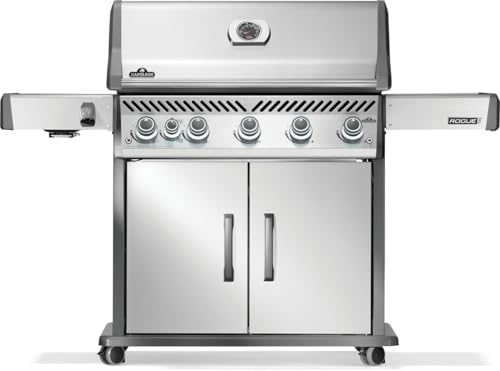
Napoleon Rogue PRO 625 5-Burner Propane Grill with Infrared Side Burner — Best Big Stainless Gas Grill
The Rogue PRO 625 is the big-grill entry for buyers who cook for a crowd but think like engineers: five main burners for true multi-zone cooking, an infrared side burner for searing, stainless construction, and a total output figure — 74,000 BTUs across a 988 square inch total area per the listing — that matches its size instead of inflating it. Folding side shelves let it tuck against a wall between parties, which matters for a grill this size.
Strengths
- Five burners create genuine independent zones for mixed large loads
- Infrared side burner handles searing without heating the whole cook box
- Stainless construction and folding shelves suit permanent patio placement
Trade-offs
- Large appetite for propane during full-load cooks
- Five burners means five burners worth of annual inspection and cleaning
- Premium pricing that competes with smaller flagship grills
| Burners | 5 main burners + infrared side burner |
| Output | 74,000 BTUs (listing figure) |
| Total area | 988 sq. in. (listing figure) |
| Body | Stainless steel |
Big grills earn durability skepticism honestly — more burners, more seams, more to corrode. The Rogue PRO’s answer is material and support: stainless where the weather and grease land, and a manufacturer whose parts catalog treats burners and igniters as the service items they are. Kept on the annual inspection rhythm in our care section, a grill like this is a ten-year appliance, not a three-summer one.
For the host, the zone flexibility is transformative: a low zone holding finished chicken, a medium zone for vegetables, a hot zone still searing, and the infrared burner free for the steaks that go on last. If your grill is the center of a dozen gatherings a year, this is the durable way to buy that capacity.
For hosts, the Rogue PRO’s folding shelves are a storage kindness: the grill presents a smaller target to wind, covers fit better, and the patio footprint shrinks between events. Large grills die of exposure as much as use, and a design that acknowledges its own off-duty life — shelves down, cover on, tucked to the wall — is thinking about year ten correctly.
Hosts should confirm one mundane detail before ordering: the path from delivery point to patio. A five-burner stainless grill is a two-person, measure-the-gate purchase, and planning it is part of buying well.
Best for: frequent hosts cooking varied menus at once / Not suited for: small households — most of its capability would sit idle
Check on Amazon to see the current configuration and delivery options for the Rogue PRO 625.

Broil King Signet 320 Shadow 3-Burner Propane Gas Grill — Best Mid-Size Value
The Signet 320 is the quiet achiever of this list: a three-burner grill built around the same cast cook box philosophy as Broil King’s premium lines, in a footprint and price bracket aimed at ordinary families. It does not chase features. It offers even heat, a firebox that will not flex or rust through on schedule, and burners designed to be replaced when they eventually need it.
Strengths
- Cast cook box delivers heat retention and structural life beyond folded-steel rivals
- Dual-tube burners are known for even front-to-back heat
- Three-burner size keeps purchase and maintenance costs proportionate
Trade-offs
- No side burner on this configuration
- Shadow finish is handsome but shows dust and pollen between cleans
- Brand retail presence is thinner than Weber’s in some regions
| Model | Signet 320 Shadow (844154) |
| Burners | 3 burners |
| Fuel | Propane |
| Cook box | Cast construction |
The Signet demonstrates why this guide keeps returning to the firebox: at mid-range prices, most grills spend their budget on stainless-look panels and extra knobs while the box itself stays thin. Broil King spends it on the box and burners, which is why a Signet still cooks evenly when same-age feature grills are flaring and sagging.
For a family of three to six that grills a few times a week, it is arguably the most rational purchase on the page — full-size cooking manners, a maintainable design, and no money wasted on capacity or gadgets that will not be used. Durability, in the end, is mostly rationality about materials.
The Signet is the pick we would hand a first-time gas buyer who asked for the ten-year version of the decision. Its controls are conventional, its parts are standard, and its cook box will not punish the learning years. Many owners will never need another grill; those who upgrade will do so for capacity, not because this one gave up.
The Signet’s Shadow finish photographs dark and handsome and hides a season of dust better than bright stainless — a small, real kindness for a grill that lives outdoors full-time.
Best for: families who want heavy-build quality without flagship pricing / Not suited for: side-burner users or regular crowds above eight
Check on Amazon to see the current configuration and delivery options for the Signet 320.
Comparison Table
Six grills, six materials strategies. Use the Key Spec column to see each pick’s durability mechanism at a glance, then read the matching review for the maintenance it expects from you.
| Pick | Badge | Key Spec | Best For |
|---|---|---|---|
| Weber Genesis S-415 Gas Grill, Stainless Steel | Best Overall | 4 PureBlu burners, stainless grates and body | households wanting one premium gas grill for the long term |
| PK Grills PK360 Cast Aluminum Charcoal Grill (Graphite) | Best Charcoal for Longevity | Cast aluminum capsule, four-vent control | charcoal purists and coastal owners who store grills outside |
| Kamado Joe Classic Joe I 18-Inch Ceramic Charcoal Grill | Best Ceramic | 18-inch ceramic kamado with cart | low-and-slow devotees with a permanent grill spot |
| Weber Performer 22-Inch Charcoal Grill | Best Kettle With a Cart | 22-inch enameled kettle in a work cart | kettle fans who want a permanent, comfortable cooking station |
| Napoleon Rogue PRO 625 5-Burner Propane Grill with Infrared Side Burner | Best Big Stainless Gas Grill | 5 burners + infrared side burner, 988 sq. in. total | frequent hosts cooking varied menus at once |
| Broil King Signet 320 Shadow 3-Burner Propane Gas Grill | Best Mid-Size Value | 3 burners, cast cook box, Shadow finish | families who want heavy-build quality without flagship pricing |
How to Choose Among the Best Durable Grills, Whatever the Fuel
Decide your maintenance personality before your fuel. Gas grills ask for grease discipline and an annual burner check. Charcoal grills ask for ash removal after every cook — sixty seconds that doubles bowl life. Kamados ask for gentleness: no drops, no thermal shock with cold water, a gasket every few years. The most durable grill for you is the one whose routine you will actually keep; an ignored premium grill dies younger than a tended mid-range one.
Then interrogate the fire container. Ask what the bowl, box or body is made of and how thick it is, and be suspicious of any listing that will not say. Porcelain enamel over steel, cast aluminum, ceramic and heavy stainless are the four honest answers. Painted steel, however thick the paint is marketed, is a countdown.
The spare-parts test
Before buying, find the maker’s parts page and price three items: the cooking grate, the main burner or damper hardware, and one cosmetic part like a handle. If all three are listed, in stock and reasonably priced, you are looking at a maintainable grill. This two-minute test predicts ten-year ownership better than any review score, because it reveals whether the manufacturer expects the grill to still exist in ten years.
Budget tiers, honestly framed
Across all fuels, the tiers rhyme. Budget buys thin metal and short support. Mid-range buys real materials — enamel, cast boxes, stainless burners — and is where durability per dollar peaks. Premium buys the exotic materials (cast aluminum, ceramic, full stainless) and the deepest support. Our list is drawn from the top two tiers because the brief is durability; a budget grill bought knowingly for light use is a fine purchase, but it is a different purchase.
Gas vs Charcoal vs Ceramic: Lifespan, Honestly Compared
A quality gas grill’s structure lasts ten to fifteen years, with burners and heat tents replaced along the way — its lifespan is a maintenance curve, not a cliff. A quality charcoal kettle’s bowl can pass twenty years because there is almost nothing to break, provided ash never sits in it. A ceramic kamado’s body has no practical lifespan limit at all, but its gaskets, bands and hinges make it the most part-dependent of the three.
Cost of ownership follows the same pattern. Gas is the most expensive to keep perfect, charcoal the cheapest, ceramic in between with occasional gasket and hardware spend. None of this should override how you like to cook — but if two grills cook equally well for you, the one with the simpler failure list is the more durable choice in practice.
The Resale and Hand-Me-Down Test
A useful durability shortcut: search the used market for the model you are considering. Grills that appear frequently in good working order at ten-plus years old — kettles, kamados, cast-aluminum capsules, the big-name gas platforms — are demonstrating their lifespan in public. Grills that are abundant at two years old and absent at eight are telling the opposite story with equal clarity.
Durable grills also hold value and get handed down, which changes the purchase math: a grill your household uses for a decade and then passes to a sibling, a kid’s first apartment or a cabin has a cost per cook that disposable grills cannot approach. Buying for that trajectory is why this guide keeps returning to parts support — a hand-me-down only works if the next owner can still buy a grate.
The One-Question Durability Audit
If you remember nothing else from this guide, run this audit on any grill you are considering, in the store or on the listing: find the fire container, name its material, and find one spare part for it. Container, material, part. A grill that passes all three in under two minutes is a maintainable object; a grill that hides any of the three is asking you to trust styling instead.
Apply it ruthlessly and the grill market sorts itself: the honest products identify their bowls, boxes and burners proudly and stock their wear parts visibly, because their makers expect the grills to still be cooking when those parts are needed. That expectation, designed in at the factory, is what the word durable actually means — everything else in this guide is commentary on it.
How Climate Changes the Durability Ranking
The ranking in this guide assumes a generic backyard, but climate shuffles it honestly. In coastal salt air, the PK360 and the ceramic kamado pull further ahead, because their bodies ignore chlorides that freckle even good stainless; the gas picks remain excellent but want the rinse habit from our outdoor guide. In wet, freeze-thaw country, enamel kettles and cast boxes shine, and any grill’s enemy becomes standing water in trays and bowls — drainage discipline matters more than material.
In hot, dry, high-UV climates, the ranking compresses: sun, not water, is the aging force, and it attacks covers, knobs and finishes while leaving fire containers alone. There, even mid-range construction lasts impressively, and the premium materials buy cooking quality more than survival. The practical takeaway is not to re-rank the list but to weight your own climate’s enemy — salt, water or sun — and read each review’s trade-offs with that enemy in mind. The grill that beats your weather is your most durable grill.
How to Do a Once-a-Year Durability Inspection on Any Grill
Whatever fuel your grill burns, one structured inspection each spring catches the small failures while they are still cheap. Work through it in order:
- Cold and disconnected: for gas, close and disconnect the tank; for charcoal, remove all ash and old fuel. Inspect in daylight, not by porch light.
- Fire container first: look for rust-through, pitting or flaking at the lowest points of the bowl or box, around damper rivets and burner mounts. Surface discoloration is fine; scale and holes are decisions.
- Grate check: flex and scrape the cooking grate. Coating coming off in flakes, or rods thinning at the welds, means replacement this season.
- Gas only: remove heat tents and inspect burners for crumbling, cracked tubes or ports eaten wide. Test-fire and look for a mostly blue, even flame pattern.
- Charcoal only: work every damper through its full travel, sweep the ash system, and check the bowl for enamel chips to touch up before they spread.
- Kamado only: inspect the gasket for compression and leaks, check band and hinge bolts for tightness, and look over the ceramic for hairline cracks after winter.
- Frame and hardware: rock the grill gently, tighten leg, cart and shelf fasteners, spin the wheels, and oil hinge pins.
- Order parts now, not in June: grates, gaskets, heat tents and igniters are all cheaper and easier to find before the season peaks.
Write the date and any parts replaced on a note kept with the grill manual. A five-line service history doubles the resale value of a good grill and, more importantly, reminds you which wear items are due next spring.
Common Buying Mistakes
Cross-category buying errors we see again and again:
Comparing grills by features instead of materials
A rotisserie kit and Bluetooth thermometer on a thin painted firebox is a two-year grill with gadgets. Judge the container, grates and burners first; features are only worth pricing after the structure passes.
Assuming stainless means rust-proof everywhere
Stainless comes in grades, and thin stainless over mild steel is common at the low end. On good grills the stainless is structural; on cheap ones it is wallpaper. The parts test — can you buy the burner, and what is it made of — separates them.
Buying capacity for the biggest day of the year
A grill sized for the annual party is oversized, over-maintained and under-used the other fifty weeks. Rent or borrow for the one huge day; buy for your real routine and the grill will stay clean, used and alive.
Skipping the cover-versus-garage decision
Where the grill sleeps is a durability spec. Uncovered in a wet climate, even good enamel needs vigilance; garaged or under a breathable cover, mid-range grills last like premium ones. Decide storage before you decide how much metal to buy.
Forgetting that every grill has a consumable
Gaskets, heat tents, grates, igniters — every design burns something slowly. The mistake is not the consumable; it is buying a grill whose consumables are discontinued. Check the parts page first.
Final Recommendation
If the decision must be one grill, the Weber Genesis S-415 is the most complete answer — gas convenience, stainless grates, and a parts ecosystem that makes fifteen-year ownership a plan rather than a hope. Charcoal loyalists should choose between the PK360’s rust-proof capsule and the Classic Joe I’s ceramic body based on whether the grill will ever move again.
The Performer is the kettle perfected as furniture, the Rogue PRO 625 is the crowd machine with real support behind it, and the Signet 320 is the rational family’s heavy-build buy. All six will outlast the typical grill aisle by years. The inspection routine above is what turns that potential into an actual decade.
Whichever champion you choose, write the purchase date inside the lid with a paint pen and keep the parts list with the manual. Future you — standing in a parts aisle in year seven, grateful the grate is a stock item — will understand exactly what present you bought: not a grill, but a system for still grilling in a decade.
And if you are buying for a household that will grill for the next twenty years — through kids, moves, and at least one patio rebuild — let that horizon make the decision for you. The grills on this page are the ones still standing at the far end of it, in the used listings, in the hand-me-downs, and in the backyards of people who bought once and never thought about grill shopping again. Join them deliberately: pick the champion of your fuel, run the spring inspection, and let the years accumulate in your favor instead of against a firebox that was never built to see them.
Ready to check today’s configurations? Start with the top three: Weber Genesis S-415 Gas Grill, Stainless Steel, PK Grills PK360 Cast Aluminum Charcoal Grill (Graphite), Kamado Joe Classic Joe I 18-Inch Ceramic Charcoal Grill — each listing shows the current setup and delivery options.
Keep exploring the cluster before you decide: Best Durable Charcoal Grills Best Durable Gas Grills Best Durable Out Door Grills Best Easy To Use Grills Best Kamado Grills Best Stainless Steel Grills.
Frequently Asked Questions
Which type of grill lasts the longest overall?
A ceramic kamado body has the longest theoretical life, followed by cast aluminum charcoal grills, then porcelain-enameled kettles and quality gas grills at roughly a decade to fifteen years. In practice, maintenance decides more than material: a swept kettle outlives a neglected kamado with a failed gasket and seized hinge.
Is it worth paying more for a durable grill?
If you grill weekly, yes — the arithmetic is hard to escape. A mid-range durable grill kept twelve years costs less per season than three budget grills, cooks better the whole time, and produces far less waste. If you grill six times a year, the math flips and a simpler grill is the honest buy.
What is the single best predictor of grill lifespan?
Whether the manufacturer still sells the wear parts. A live parts catalog for grates, burners, dampers and gaskets signals a grill designed to be maintained — and makes that maintenance possible. It is a better predictor than weight, warranty slogans or feature counts.
Can a gas grill really last as long as a charcoal grill?
The structure can; the difference is that a gas grill needs its burners, heat tents and igniter refreshed along the way, while a kettle mostly needs ash discipline. Total cost of ownership ends up similar over fifteen years — gas parts versus charcoal simplicity — so choose by cooking style.
How do I know when a grill is truly worn out?
When the fire container itself fails: a rusted-through bowl or cook box, a cracked ceramic body, or a frame whose mounts have torn. Everything else — grates, burners, gaskets, igniters, handles — is a replaceable wear item on a well-supported grill and is not, by itself, a reason to replace the whole thing.
Does a longer warranty mean a more durable grill?
It is a useful signal, not a guarantee. Makers price warranty risk into the product, so long burner and firebox warranties usually reflect real material quality. But warranty terms vary in what they cover and how claims are handled; treat the warranty as supporting evidence alongside materials and parts availability, never as the whole case.
Which durable grill is best if I can only have one?
For most households, the Weber Genesis S-415: gas convenience for weeknights, enough size for guests, stainless grates, and the parts support to make a fifteen-year plan realistic. Charcoal devotees should take the PK360 or a kamado instead and accept the lighting ritual as the price of flavor.
Is a heavier grill always a more durable grill?
No — weight only counts where it lives. Mass in the fire container, grates and lid is durability; mass in side shelves, cabinets and decorative panels is just freight. Press the bowl, lift the grate, and read the materials list before crediting a heavy shipping weight.
Can I make a cheap grill last like a durable one?
You can extend it — ash and grease discipline, a cover, prompt part swaps — but you cannot change its fire container material or conjure a parts catalog that does not exist. Good habits might double a budget grill’s life; they will not give it a durable grill’s decade, which is why the container check comes first in this guide.


