Disclosure: airfryerkitchensupply.com is reader-supported. When you buy through links on our site, we may earn an affiliate commission at no extra cost to you.
Where to Buy
Durability is the one thing you cannot judge from a showroom floor, so buy from a seller with a painless returns window and keep the box until after your first few cooks. Every grill below is sold on Amazon; use the links to check the current configuration, because kettle colors and kamado bundle contents change by season while the underlying build stays the same.
- Weber Original Kettle Premium Charcoal Grill, 22-Inch (Best Overall): Check the current price on Amazon.
- PK Grills PK360 Cast Aluminum Charcoal Grill (Best Rust-Proof Pick): Check the current price on Amazon.
- Kamado Joe Classic Joe Series II 18-Inch Ceramic Charcoal Grill (Best Ceramic): Check the current price on Amazon.
- Weber Master-Touch Charcoal Grill, 26-Inch (Best for Big Cooks): Check the current price on Amazon.
- Char-Griller AKORN 20-Inch Kamado Charcoal Grill and Smoker (Best Budget Kamado): Check the current price on Amazon.
- Dyna-Glo X-Large Premium Dual Chamber Charcoal Grill (DGN576SNC-D) (Best for Bulk Cooking): Check the current price on Amazon.
If you are shopping for the best durable charcoal grills, you are really shopping for materials: porcelain enamel that does not chip, cast aluminum that cannot rust, ceramic that shrugs off decades of heat cycles, and steel thick enough that the firebox does not oil-can after two summers. Most cheap charcoal grills fail the same way — the ash eats through a thin painted fire bowl, a leg socket tears out, or the grate coating flakes into the food — and none of those failures show up in the first month.
This guide ranks charcoal grills by how they are built rather than how they look in a product photo. We weighted bowl and lid construction first, then grate material, then the parts that actually wear out: dampers, hinges, ash systems, wheels and leg mounts. A grill that costs more but keeps its original fire bowl for fifteen years is cheaper per season than a bargain barrel you replace three times, and that math drives every pick below.
One honest note about the market: genuinely durable charcoal grills cluster in the mid-range and premium tiers. The rock-bottom tier is built from thin painted steel that is honest value for a season or two of tailgating, but nothing at that level earns a durability recommendation, so this list starts where the metal gets serious and explains what each step up buys you.
A word on how to read the picks: they are ordered by how most buyers should consider them, not by price. The badges name the job each grill does best, and the verdict line at the end of every review states plainly who should skip it. A durable grill bought for the wrong job still disappoints, so match the job first and the material second.
In this guide
Quick Picks
Six charcoal grills built to survive a decade or more of real use, from the porcelain-enameled kettle that defined the category to a cast-aluminum capsule that is effectively rust-proof. Badges match the detailed reviews further down.
- Best Overall: Weber Original Kettle Premium Charcoal Grill, 22-Inch — the porcelain-enameled kettle benchmark — a bowl and lid that routinely outlast twenty seasons, with every wear part still sold. — Check price on Amazon
- Best Rust-Proof Pick: PK Grills PK360 Cast Aluminum Charcoal Grill — a cast-aluminum capsule that physically cannot rust, with four-point venting for unusually precise charcoal control. — Check price on Amazon
- Best Ceramic: Kamado Joe Classic Joe Series II 18-Inch Ceramic Charcoal Grill — refractory ceramic body, air-lift hinge and a two-tier cooking system — the kamado that holds low heat for hours and sears at steakhouse temperatures. — Check price on Amazon
- Best for Big Cooks: Weber Master-Touch Charcoal Grill, 26-Inch — the kettle formula scaled up — a 26-inch porcelain-enameled bowl with room for whole packer briskets and party-size batches. — Check price on Amazon
- Best Budget Kamado: Char-Griller AKORN 20-Inch Kamado Charcoal Grill and Smoker — triple-wall insulated steel delivers kamado-style efficiency without ceramic weight or ceramic pricing. — Check price on Amazon
- Best for Bulk Cooking: Dyna-Glo X-Large Premium Dual Chamber Charcoal Grill (DGN576SNC-D) — a dual-chamber barrel with two separate charcoal zones and a big total firebox — built for feeding events, not weeknights. — Check price on Amazon
How These Picks Were Chosen
Every pick was checked against the manufacturer’s current listing, so the model names, sizes and configurations in this article match what is actually sold today. We only recommend grills whose core fire container — bowl, capsule or ceramic body — is made from a material with a proven long service life: porcelain-enameled steel, cast aluminum, refractory ceramic or heavy-gauge steel with a real powder-coat or enamel finish.
We also looked hard at replaceable wear parts. A durable grill is not one that never wears; it is one whose worn parts can be swapped in minutes with parts the maker still sells. Grates, dampers, ash sweepers, gaskets and igniter-free hardware all counted. Grills whose makers have effectively orphaned them — no grates, no gaskets, no support — were cut even when the original build was decent.
Finally, we matched each pick to a distinct job: everyday family grilling, rust-proof ownership near the coast, low-and-slow smoking, feeding a crowd, kamado cooking on a budget, and bulk charcoal cooking for events. If two grills did the same job, the one with the better wear-part support won.
One more filter deserves stating plainly: we excluded grills with known safety recalls and grills whose fire bowls depend on a painted finish as their only corrosion defense. A painted bowl can be a fine budget product, but it cannot be the foundation of a durability recommendation, and no amount of feature trim changes that.
The 6 Best Durable Charcoal Grills
Each review explains who the grill suits, where its construction earns the durability claim, and where it honestly falls short. Specs in the mini boxes come from the verified product listings; where a maker does not publish a figure, we leave the box shorter rather than guess.

Weber Original Kettle Premium Charcoal Grill, 22-Inch — Best Overall
This is the grill to buy if you want one charcoal grill that simply keeps working. The bowl and lid are steel wrapped in porcelain enamel inside and out, a finish that resists rust far better than paint because it is glass fused to the metal rather than a coating sitting on top of it. The 22-inch size feeds a family without eating the whole patio, and the design has been in continuous production long enough that every screw, damper and grate on it can be replaced from stock.
Strengths
- Porcelain-enameled bowl and lid resist rust and heat damage far longer than painted steel
- One-Touch ash sweeping system keeps corrosive ash from sitting in the bowl between cooks
- Decades of parts support — grates, dampers, handles and leg kits remain available and cheap
Trade-offs
- Plated steel cooking grate is the wear item; expect to replace it every few seasons
- Two-wheel tripod stance is stable on flat patios but awkward to drag across lawns
- No factory side table, so you will want a small prep stand next to it
| Size | 22-inch kettle |
| Body | Porcelain-enameled steel bowl and lid |
| Ash system | One-Touch cleaning system with enclosed ash catcher |
| Extras | Built-in lid thermometer, all-weather wheels |
The durability story here is mostly about ash discipline. Wet ash is alkaline and corrosive, and it is what kills most kettles from the inside. The One-Touch system sweeps ash into an enclosed catcher with three lever strokes, which means the bowl spends its life dry and empty instead of holding a damp, salty residue. Owners who use the sweeper after every cook are the ones reporting bowls that still shine inside after a decade.
Temperature control is damper-based and honest: the lid damper and the sweeping vents give you a workable range from low smoking heat up to a hard sear, and the built-in thermometer is close enough for kettle work once you learn its offset from grate level. It is not a set-and-forget smoker, but as a durable all-rounder that also smokes creditably with a two-zone fire, nothing at its tier touches the ownership record.
Ownership costs over a decade are refreshingly boring: a replacement grate every few seasons, a handle or thermometer eventually, and charcoal. There is no igniter, no electronics and no proprietary anything, which is precisely why this design accumulates twenty-year owners while smarter grills cycle through landfills. If you keep one receipt in the box, make it the one for the grate size — it is the only number you will ever need.
Final check before buying: the 22-inch size is the sweet spot for a reason, but measure your typical cook honestly — if two whole chickens side by side is a monthly event rather than an annual one, the 26-inch Master-Touch below is the better decade-long decision.
Best for: most households that want one charcoal grill for ten-plus years / Not suited for: cooking for crowds of twelve or more on a regular basis
Check on Amazon to see the current configuration and delivery options for the Original Kettle Premium.

PK Grills PK360 Cast Aluminum Charcoal Grill — Best Rust-Proof Pick
The PK360 attacks durability from a completely different direction: its cooking capsule is cast aluminum, so there is no steel in the fire container to rust at all. The design descends from a 1950s original, and the thick casting also works as a thermal flywheel — it soaks up heat and evens out the temperature swings that make thin-steel grills frustrating. If you live near salt air or simply refuse to store a grill indoors, this is the charcoal grill that will still be sound when everything painted has peeled.
Strengths
- Cast aluminum capsule cannot rust and shrugs off coastal salt air
- Thick casting holds heat evenly and recovers fast after the lid opens
- Four adjustable vents (two in, two out) give precise two-zone and low-and-slow control
Trade-offs
- Premium tier pricing for a cooking area smaller than a 22-inch kettle
- Heavy capsule makes it portable in name more than in practice for long carries
- Hinged design cooks best closed; open-lid griddling space is limited
| Body | Cast aluminum capsule |
| Venting | Four-point adjustable air control |
| Use | Grill and smoker, portable-capable with stand options |
Aluminum’s other quiet advantage is that it does not care about the thermal shock that cracks enamel. You can run the PK360 hard on a cold night, bank coals against one wall for indirect cooking, and never worry about the finish crazing. The capsule’s rounded shape also sheds ash toward the bottom vents instead of trapping it in corners, which makes the post-cook sweep genuinely quick.
As a cooker, it is the most controllable charcoal grill in this roundup. The dual intake and exhaust vents let you set a steady low fire for ribs and then open everything for a steak sear without rebuilding the fire. The trade is capacity: this is a grill for two to six people cooked in waves, not a party machine, and its price puts it in deliberate-buyer territory. What you are paying for is a fire container with essentially no corrosion failure mode.
A word about the stand options, because they affect longevity too: the capsule can sit in a cart, on a stand or be carried to a table, and the mounting hardware is as overbuilt as the capsule itself. Owners who travel with it should still pad the capsule in transit — cast aluminum is tough but the graphite and silver finishes can mark — and once home, a hose-down is genuinely all the cleaning the exterior ever asks for.
If rust has killed your last two grills, stop reading the rest of this list and buy this one — the capsule removes the failure mode entirely, and no cover discipline is required to protect a material that cannot corrode.
Best for: coastal owners and anyone who stores a grill outdoors year-round / Not suited for: large gatherings or buyers who need maximum grate area per dollar
Check on Amazon to see the current configuration and delivery options for the PK360.

Kamado Joe Classic Joe Series II 18-Inch Ceramic Charcoal Grill — Best Ceramic
Ceramic is the oldest durable grill material there is: a refractory clay body that tolerates extreme heat, insulates like an oven wall, and never rusts. The Classic Joe Series II pairs that body with the hardware that makes kamados livable — an air-lift hinge that makes the heavy lid feel light, a fiberglass mesh gasket that seals properly, and a multi-piece firebox designed to flex with heat instead of cracking in one piece.
Strengths
- Ceramic body cannot rust and insulates for exceptionally fuel-efficient long cooks
- Air-lift hinge removes most of the lid weight, the classic kamado annoyance
- Divide and Conquer two-tier grates cook at two heights and temperatures at once
Trade-offs
- Very heavy — this is a place-it-once grill, not a portable
- Ceramic survives heat but not drops or hard impacts during a move
- 18-inch grate needs the tier system to feed more than four to six people
| Size | 18-inch ceramic kamado |
| Body | High-fire ceramic with cart and side shelves |
| Hinge | Air-lift hinge |
| Grates | Stainless steel, two-tier Divide and Conquer system |
The durability question with kamados is never the ceramic itself — archaeological pottery outlasts empires — it is the fittings. Kamado Joe’s multi-panel firebox is the key detail: instead of one rigid ring that can crack from thermal stress, the firebox is segmented so each piece can expand. The gasket is a replaceable wear item, as on any kamado, and the brand’s parts pipeline for gaskets, hinges and grates is among the strongest in the category.
In use, the insulation changes what charcoal cooking feels like. A single load of lump can hold a low smoking temperature through a long cook with the vents barely open, and the same grill will run far hotter than a kettle for pizza and steaks. If your definition of durable includes a grill that will still be cooking when your kids inherit it, and you have a permanent spot for it, this is the pick.
Fuel choice quietly affects a kamado’s lifespan: quality lump charcoal burns cleaner and leaves less ash and residue than cheap briquettes full of fillers, which means fewer clean-outs and less moisture held in the ash drawer. Run good lump, keep the drawer emptied, and the Classic Joe’s interior stays in the seasoned, self-maintaining state that makes ceramic ownership feel almost unfair compared with steel.
Buyers torn between this and the kettle should ask one question: will you smoke monthly? If yes, the kamado’s efficiency and stability repay its price quickly; if no, the kettle’s simplicity wins.
Best for: serious low-and-slow cooks who want one grill for decades / Not suited for: renters, tailgaters, or anyone who must move their grill often
Check on Amazon to see the current configuration and delivery options for the Classic Joe Series II.

Weber Master-Touch Charcoal Grill, 26-Inch — Best for Big Cooks
Everything that makes the 22-inch kettle durable applies here, scaled to a 26-inch bowl that changes what you can cook: whole briskets lie flat, two chickens sit side by side with an indirect zone to spare, and a full chimney of coals still leaves a genuine cool zone. The Master-Touch trim adds the Tuck-Away lid holder, a better handle arrangement and a hinged grate for adding coals mid-cook.
Strengths
- Same porcelain-enamel durability as the 22-inch, with far more cooking room
- Hinged plated-steel grate lets you add charcoal without lifting food off
- Tuck-Away lid holder keeps the hot lid secure and off the ground
Trade-offs
- Uses noticeably more charcoal per cook than a 22-inch for small meals
- Large lid is a two-hand lift and catches wind on exposed patios
- Footprint and price both step up well beyond the standard kettle
| Size | 26-inch kettle |
| Body | Porcelain-enameled steel bowl and lid |
| Ash system | One-Touch cleaning system |
| Extras | Tuck-Away lid holder, hinged cooking grate |
Big kettles fail differently from small ones: the larger bowl flexes more, and cheap large kettles develop wobble at the leg sockets within a few seasons. The Master-Touch’s bowl gauge and socket design are the same proven hardware as the smaller grill, and the enamel finish matters even more at this size because a 26-inch bowl holds a lot of ash — the One-Touch sweep keeps that ash from becoming a corrosion bath after rainy weeks.
For the cook, the extra diameter is really extra zones. You can bank a serious fire on one side, run a drip pan under a pork shoulder on the other, and still have grate space for vegetables at the edge. If your household regularly cooks for eight or more, the 26-inch is the durable kettle that fits the job without stepping into offset-smoker complexity.
The 26-inch size also changes fuel economics in your favor for crowds: one large fire cooks everything at once instead of two sequential fires in a smaller kettle, so charcoal per diner actually drops at party scale. The hinged grate earns its keep here more than anywhere — a brisket at hour six will need coals, and lifting a corner beats unloading a hot brisket onto a tray while guests watch.
One caution: at this diameter, wind matters. A 26-inch lid is a sail in a gust, so give the grill a sheltered corner and the size becomes all advantage and no drama.
Best for: families and hosts who regularly cook for eight-plus people / Not suited for: couples cooking two burgers at a time
Check on Amazon to see the current configuration and delivery options for the Master-Touch 26.

Char-Griller AKORN 20-Inch Kamado Charcoal Grill and Smoker — Best Budget Kamado
The AKORN takes the kamado idea and rebuilds it in triple-wall insulated steel with a porcelain-coated interior, which solves ceramic’s two problems: weight and fragility. It is light enough to roll around a patio easily, it will not crack if it gets knocked, and the insulation still gives you the kamado party tricks — long low cooks on modest charcoal and genuinely hot sears.
Strengths
- Triple-wall insulated steel body is far lighter than ceramic and impact-tolerant
- Porcelain-coated interior and cast iron grates stand up to regular high-heat use
- Efficient insulation stretches a load of charcoal across long smoking sessions
Trade-offs
- Steel body can rust at chips and scratches if left uncovered outdoors
- Temperature can overshoot quickly if vents are opened too far when lighting
- Cart and side shelves feel lighter-duty than the cooking body itself
| Size | 20-inch kamado-style |
| Body | Triple-wall insulated steel, porcelain-coated interior |
| Grates | Cast iron cooking grates |
Honesty about lifespan: an AKORN will not match a ceramic kamado’s theoretical decades, because its body is steel and steel eventually loses to weather if the finish is breached. What it offers instead is a very durable decade for buyers who keep it covered — the insulated walls mean the outer skin never sees fire temperatures, so the finish lives an easy life, and the parts that do wear, like the cast iron grate and gasket, are replaceable.
As a cooker it is forgiving in the way that matters most: once the vents are set, the insulated body holds a temperature with little fiddling, and it sips charcoal compared with a barrel grill. For a first kamado-style grill — or a second grill dedicated to smoking beside a gas grill — it is the durability-per-dollar sweet spot in this lineup.
Temperature discipline is the AKORN’s one learning curve: because the body is insulated, it heats fast and overshoots if you light it like a thin barrel. Light a modest fire, catch the temperature on the way up with the vents, and it will sit steady for hours. That same insulation means winter smoking is realistic in a way thin steel never allows, which extends its useful season — another form of durability.
Treat the AKORN as a ten-year grill with a cover and it will behave like one; treat it as invincible and the steel will eventually correct you. The cover is the whole contract.
Best for: buyers who want kamado efficiency without ceramic cost or weight / Not suited for: uncovered outdoor storage in wet climates
Check on Amazon to see the current configuration and delivery options for the AKORN.
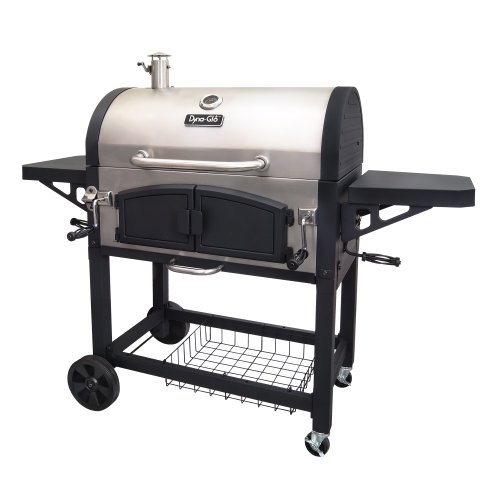
Dyna-Glo X-Large Premium Dual Chamber Charcoal Grill (DGN576SNC-D) — Best for Bulk Cooking
Some households do not need a grill that lasts twenty years of Tuesday burgers; they need one that survives ten years of graduation parties, church picnics and holiday crowds. The Dyna-Glo dual chamber design splits the firebox into two independently controlled charcoal zones, so you can run one side hot for searing and the other gentle for holding, or light only one side for a smaller cook and save the wear on the other.
Strengths
- Two separate charcoal chambers let you run two temperatures or rest one side entirely
- Large total cooking area handles event-scale batches in a single session
- Adjustable charcoal trays raise and lower the fire for heat control without moving food
Trade-offs
- Painted steel barrel needs a cover and ash discipline to reach its full lifespan
- Big footprint — measure your patio before ordering
- Assembly is a real project with many panels and fasteners
| Model | DGN576SNC-D |
| Design | Dual chamber charcoal grill |
| Heat control | Adjustable charcoal trays and dampers |
The dual-chamber layout is also a quiet durability feature: alternating which chamber you light for small cooks spreads heat cycles across the whole firebox instead of concentrating them in one spot, and the adjustable trays keep coals from sitting directly against the bowl floor, which is where barrel grills usually burn through first.
Set expectations correctly and this grill delivers: keep it covered, empty the ash trays after each event, and the heavy panels will give you years of high-volume service. Leave it uncovered full of wet ash and no barrel at any price survives. For buyers whose real requirement is capacity with honest construction, it earns its place here.
For event cooking, plan the fire by chamber: light the chamber under the food that needs the most heat and use the second as a finishing and holding zone, rotating trays as the event flows. The dual layout also forgives the classic party mistake — one giant fire for everything — by giving delicate items somewhere cooler to live while the searing side does its work at full tilt.
Event cooks should budget for a second ash container and a stiff brush kept with the grill — at this scale, the cleaning kit is part of the machine, and having it at hand keeps the barrel’s interior in the condition its lifespan depends on.
Best for: event cooks and big families who grill in volume / Not suited for: small patios or low-frequency grillers
Check on Amazon to see the current configuration and delivery options for the Dyna-Glo Dual Chamber.
Comparison Table
The six picks side by side. Note how the durability mechanism differs by row — enamel, cast aluminum, ceramic, insulated steel and chamber design are five different answers to the same question.
| Pick | Badge | Key Spec | Best For |
|---|---|---|---|
| Weber Original Kettle Premium Charcoal Grill, 22-Inch | Best Overall | 22-inch porcelain-enameled kettle, One-Touch ash system | most households that want one charcoal grill for ten-plus years |
| PK Grills PK360 Cast Aluminum Charcoal Grill | Best Rust-Proof Pick | Cast aluminum capsule, four-vent control | coastal owners and anyone who stores a grill outdoors year-round |
| Kamado Joe Classic Joe Series II 18-Inch Ceramic Charcoal Grill | Best Ceramic | 18-inch ceramic kamado, air-lift hinge, two-tier grates | serious low-and-slow cooks who want one grill for decades |
| Weber Master-Touch Charcoal Grill, 26-Inch | Best for Big Cooks | 26-inch porcelain-enameled kettle, hinged grate | families and hosts who regularly cook for eight-plus people |
| Char-Griller AKORN 20-Inch Kamado Charcoal Grill and Smoker | Best Budget Kamado | 20-inch triple-wall insulated steel kamado | buyers who want kamado efficiency without ceramic cost or weight |
| Dyna-Glo X-Large Premium Dual Chamber Charcoal Grill (DGN576SNC-D) | Best for Bulk Cooking | Dual-chamber barrel, adjustable charcoal trays | event cooks and big families who grill in volume |
How to Choose the Best Durable Charcoal Grills for Your Yard
Start with the fire container, because everything else on a charcoal grill is a bolt-on. Rank the materials honestly: cast aluminum cannot rust at all; refractory ceramic cannot rust and tolerates any temperature a charcoal fire can make; porcelain-enameled steel is excellent as long as the enamel stays intact; heavy powder-coated steel is good with a cover; thin painted steel is a consumable. When a listing leads with chrome trim and bottle openers instead of bowl material, that tells you where the money went.
Next, look at the grate. Porcelain-coated cast iron and stainless steel grates last for many seasons; thin chrome-plated steel grates are annual purchases. A hinged grate matters more than it sounds, because a grill you can refuel without removing the food is a grill you will actually use for long cooks — and a grill that gets used gets maintained, while a frustrating one sits full of ash and rusts.
Match the size to your real headcount
A 22-inch kettle cooks comfortably for four to six. The 26-inch size is for regular crowds or whole large cuts. Kamados cook smaller than their diameter suggests because so much of the grate is prime real estate only in the center; the tiered grate systems fix that by adding a second level. Oversizing has a durability cost too: big thin bowls flex, and every flex works the finish. Buy the smallest grill that honestly fits your biggest regular cook.
Budget tiers, honestly framed
In the budget tier you are buying painted steel and accepting a shorter life — fine for occasional use, wrong for a durability brief. The mid-range tier is where porcelain enamel, real ash systems and parts support begin, and it is where most of this list lives. The premium tier buys you materials with no corrosion failure mode at all — cast aluminum and ceramic — plus heavier hardware throughout. None of these tiers is a mistake; the mistake is paying premium money for budget materials with premium styling.
The Parts That Actually Wear Out on a Charcoal Grill
In rough order of failure: cooking grates rust or lose their coating; dampers seize or bend; ash corrodes the bowl from inside; leg sockets and wheel axles loosen; handles and lid hangers crack from heat cycling. Notice that the bowl — the expensive part — usually dies from ash neglect, not from fire. That is why ash management systems rank so high in our picks: a sweeper or a removable ash pan is a lifespan feature, not a convenience feature.
Before buying any charcoal grill, spend two minutes checking that the maker sells the grate, the damper hardware and (for kamados) the gasket as spare parts. If those three are listed and in stock, the grill is maintainable for a decade. If the support page is a dead end, the grill is disposable regardless of how solid it feels on day one.
What a Decade of Ownership Actually Costs
Run the honest arithmetic. A durable mid-range charcoal grill kept for twelve years will consume, beyond charcoal itself, perhaps three cooking grates, one set of damper or handle hardware, and a cover or two. A premium ceramic or cast-aluminum grill adds a gasket or two and almost nothing else. Against that, a budget grill replaced every three seasons costs its purchase price four times over the same period — plus the assembly Saturdays, which nobody counts and everybody remembers.
The other hidden cost is performance decay. A grill does not usually die in a single season; it fades — the grate roughens, the dampers stiffen, the bowl pits — and each fade makes the food slightly worse and the cook slightly less willing. Durable grills hold their cooking quality flat for years, which is a benefit no per-season cost table captures and the real reason owners of the picks above sound so satisfied.
Porcelain Enamel: Why the Kettle Finish Keeps Winning
Porcelain enamel deserves its own paragraph in any durability guide, because it is the finish that built the category’s longest service records. It is powdered glass fused to steel at high temperature, which makes it harder than paint, immune to the heat cycling that blisters coatings, and smooth enough that carbon releases with a brush. Its weakness is impact: a hard knock can chip it, and a chip exposes steel that then needs a dab of high-heat paint to stay sealed.
That failure profile — immune to time, vulnerable only to accidents — is exactly what you want in a grill finish, because accidents are within your control and time is not. It is also why enamel care is so simple: no special cleaners, no polishing, just ash discipline and the occasional chip touch-up. When a listing says porcelain-enameled bowl and lid, that phrase is doing more durability work than every other feature on the page combined.
How to Season and Care for a Charcoal Grill So It Lasts
The first cook and a five-minute routine after every cook do more for a charcoal grill’s lifespan than any feature on the spec sheet. Here is the routine that keeps the picks above alive:
- On a new grill, wash the cooking grate with hot soapy water, dry it fully, then run a medium charcoal fire for about an hour with the lid on to burn off manufacturing residues.
- While the grate is hot, wipe it with a thin film of high-heat cooking oil on a folded paper towel held in tongs; repeat twice as the grill cools to start the seasoning layer on iron or steel grates.
- After every cook, close the vents to choke the fire, and once the ash is fully cold — wait at least a day — sweep or dump all of it. Never store a grill with ash inside.
- Brush the grate while it is still warm from the next preheat, not after cooking; carbonized residue releases far more easily on reheating.
- Once a month during the season, scrape the inside of the bowl and lid, check dampers move freely, and touch up any enamel chips on steel grills with high-heat paint to seal the metal.
- Store under a breathable cover or indoors. A cover that traps condensation against the grill is worse than no cover on a well-drained patio.
- Once a year, tighten leg and cart fasteners, oil hinge pins on kamados, and replace the gasket if smoke leaks visibly at the lid seam.
Follow that routine and the failure mode of a good charcoal grill shifts from years to decades. The single highest-value habit is ash removal: ash plus rainwater makes a mildly caustic paste that eats enamel and steel alike, and it is entirely preventable with sixty seconds of sweeping.
Common Buying Mistakes
Most charcoal grills are not killed by cooking. They are killed by these five habits and buying errors:
Judging durability by weight alone
Heavy is good only when the weight is in the bowl and grates. Plenty of flimsy grills are heavy because of thick side shelves and decorative panels while the firebox itself is foil-thin. Press the bowl wall and check the listing for the fire container material before you credit the shipping weight.
Leaving ash in the grill between cooks
The number one lifespan mistake. Ash absorbs moisture from the air, holds it against the metal, and corrodes bowls, dampers and ash pans from the inside out. A grill swept after every cook can outlast an identical neglected grill by a decade.
Buying a bigger grill than the patio routine supports
Oversized barrels and 26-inch kettles use more charcoal, take longer to clean, and get skipped on busy weeknights — and skipped grills sit dirty. The most durable grill is the one that fits your actual cooking pattern well enough to stay in use and stay maintained.
Ignoring the spare-parts check
A grill with no available replacement grate or gasket is a countdown timer. Two minutes on the manufacturer support page before buying tells you whether you are purchasing a maintainable tool or a disposable appliance.
Using lighter fluid and blaming the grill
Fluid-soaked fires burn unevenly, spike temperatures at the bowl wall, and leave residue that accelerates grate corrosion — besides the taste. A chimney starter is faster, cleaner and kinder to the grill.
Final Recommendation
If you buy one grill from this list, make it the Weber Original Kettle Premium 22-inch: it is the proven balance of enamel durability, parts support and price, and it cooks everything a household reasonably asks of charcoal. Choose the PK360 if rust is your specific enemy — coastal air, outdoor storage, no garage — because its cast aluminum capsule removes rust from the equation entirely.
Go ceramic with the Kamado Joe Classic Joe Series II if low-and-slow cooking is the main event and the grill will live in one spot, or step up to the 26-inch Master-Touch if your regular crowd is eight or more. The AKORN is the smart budget route into kamado-style cooking, and the Dyna-Glo dual chamber is the event machine. Every one of them will outlast a cheap painted barrel by years — provided you sweep the ash.
Ready to check today’s configurations? Start with the top three: Weber Original Kettle Premium Charcoal Grill, 22-Inch, PK Grills PK360 Cast Aluminum Charcoal Grill, Kamado Joe Classic Joe Series II 18-Inch Ceramic Charcoal Grill — each listing shows the current setup and delivery options.
Keep exploring the cluster before you decide: Best Durable Grills Best Durable Gas Grills Best Easy Clean Bbq Grills Best Easy To Use Grills Best Charcoal Grills Best Kamado Grills.
Frequently Asked Questions
How long should a durable charcoal grill actually last?
With ash removed after every cook and a cover in wet weather, a porcelain-enameled kettle should give ten to twenty years, a cast aluminum grill longer still, and a ceramic kamado several decades with gasket replacements along the way. Painted thin-steel grills typically last two to four seasons under the same conditions.
Is cast iron or stainless steel better for cooking grates?
Both are durable; they fail differently. Cast iron holds heat and sears beautifully but needs seasoning and rusts if left wet. Stainless is lower maintenance and shrugs off weather, but thinner stainless rods can warp under extreme heat. Porcelain-coated cast iron splits the difference and is what most of our picks use.
Does a cover really extend a charcoal grill’s life?
Yes, provided the grill goes under it clean and dry. A cover keeps rain out of the bowl and vents, which keeps ash dry and metal dry. Covering a grill that is still holding damp ash traps the moisture against the steel and can make corrosion worse, not better.
Are kamado grills really more durable than kettles?
The ceramic body itself outlasts any metal grill, but a kamado has more wear parts — gaskets, hinges, bands — that need periodic attention, and the body can crack from impact in a move. A kettle is simpler and more forgiving of rough handling. Pick based on how you cook and whether the grill will ever move.
What is the first thing to check on an old charcoal grill?
The inside of the bowl, at the lowest point where ash collects. Surface rust on the outside is cosmetic; pitting or flaking at the bowl floor, especially around damper rivets, means the fire container is near the end. Also check that dampers still move — a seized damper makes the grill nearly unusable.
Can I leave a charcoal grill outside all winter?
An enameled kettle, cast aluminum grill or ceramic kamado can winter outside if it is cleaned, the ash is out, the vents are closed and it is covered. Painted steel grills fare much better in a garage or shed. In all cases, a mid-winter check for standing water in the ash catcher is worth the minute it takes.
Should I buy a used durable charcoal grill?
Often, yes — this category rewards it. A used enameled kettle, cast-aluminum grill or kamado with a sound fire container is most of the way to a new grill’s remaining life at a fraction of the cost. Inspect the bowl or ceramic for cracks and rust-through, work every damper and hinge, and budget for a new grate and gasket. Avoid used grills whose fire container is already compromised; that part is the grill.


