Disclosure: airfryerkitchensupply.com is reader-supported. When you buy through links on our site, we may earn an affiliate commission at no extra cost to you.
Where to buy
Every linked pick in this guide to the best food processors for making pesto was verified against Amazon’s catalog data for this site before writing, so capacities, wattages, and included bowls match real current listings. Use the links in this box, in Quick Picks, and under each review to check price on Amazon on the day you buy. Pesto is a sizing game before it is a power game — the batch must fit the bowl’s working zone — so each pick below is matched to the batch size it genuinely serves.
- Cuisinart Mini-Prep Plus 4-Cup Food Processor DLC-4CHB (Best Overall for Pesto) — check price on Amazon
- KitchenAid 5 Cup Food Chopper KFC0516 (Best for Small Batches with Extras) — check price on Amazon
- Cuisinart 14-Cup Food Processor DFP-14BCNY (Best for Harvest Batches and Freezing) — check price on Amazon
- Ninja Professional Plus Food Processor BN601 (Best Power for Dense Variations) — check price on Amazon
- KitchenAid 7-Cup Food Processor KFP0718 (Best Mid-Size for Weekly Pesto) — check price on Amazon
- Hamilton Beach Stack & Snap 14-Cup Food Processor 70585 (Best Two-Size Flexibility) — check price on Amazon
The best food processors for making pesto are not the biggest or the most powerful — they are the ones whose bowls fit the batch. Pesto is a small, wet, delicate sauce: a standard recipe is two cups of basil, a small handful of nuts, cheese, garlic, and oil. Put that in an oversized bowl and the leaves plaster to the walls, bruised and darkening, while the blade spins uselessly beneath them. Put it in a right-sized bowl and the same ingredients become a vivid, emulsified sauce in a minute. This guide is organized around that single insight, with picks for every batch size from a weekly jar to a harvest-day freezing session.
Pesto also punishes rough handling in a specific way: basil oxidizes. Over-processing warms and bruises the leaves, and the sauce turns from bright green toward olive drab. Short processing in a well-fitted bowl is therefore a quality feature, not a convenience. The picks below were chosen for bowl fit first, then for the control — pulses, low speeds, drizzle-friendly lids — that lets you stop at the exact texture pesto wants: integrated, but with a whisper of granularity left in the cheese and nuts.
Finally, a note on scope. Pesto is a family: Genovese basil, walnut-parsley, kale, arugula, sun-dried tomato, pistachio. The gentle picks serve the classic; the powerful pick serves the fibrous, dense variations. Read the badges as menu directions, and choose for the pesto you actually make.
There is also a freshness argument unique to pesto among processor jobs. The sauce is raw, its aromatics are volatile, and its best self exists for a short window after making. A machine that turns basil into pesto in five minutes, at the moment the pasta water boils, delivers a version of the dish that no make-ahead routine matches. Right-sized machines are what make that just-in-time habit practical on a weeknight, which is why this guide weights small-bowl excellence as heavily as it does.
One more honesty note before the picks: no processor makes pesto from poor basil into great pesto. Leaves should be fresh, dry on the surface — wet leaves water the sauce and dull the emulsion — and used promptly. The machines below differ in how faithfully they handle good ingredients; the ingredient standard itself is the cook’s contribution, and it is the larger half of the result.
In this guide
Quick Picks
Cuisinart Mini-Prep Plus 4-Cup Food Processor DLC-4CHB — Best Overall for Pesto. Pesto is a small-batch sauce, and this is the small machine that matches it: a 4-cup bowl where two packed cups of basil actually meet the blade, and an auto-reversing blade that chops in one direction and grinds in the other — the two motions a good pesto needs. Check price on Amazon.
KitchenAid 5 Cup Food Chopper KFC0516 — Best for Small Batches with Extras. A cup more room than the Mini-Prep and a control scheme — two speeds plus pulse — that gives pesto makers a gentle low gear for leaves and a stronger gear for nuts, plus a whisk accessory that earns its keep on the rest of the menu. Check price on Amazon.
Cuisinart 14-Cup Food Processor DFP-14BCNY — Best for Harvest Batches and Freezing. When the basil plants peak all at once, pesto becomes a preservation project: batch after batch, frozen in trays and jars for winter. That is a full-size machine’s day, and the 720-watt, 14-cup Cuisinart is the classic tool for it. Check price on Amazon.
Ninja Professional Plus Food Processor BN601 — Best Power for Dense Variations. Classic basil pesto is gentle work; the wider pesto family is not. Kale stems, sun-dried tomatoes, raw walnuts, and thick nut-heavy spreads ask for real power, and the 1000-watt BN601 is the strongest full processor in this guide. Check price on Amazon.
KitchenAid 7-Cup Food Processor KFP0718 — Best Mid-Size for Weekly Pesto. The middle path: a true processor with discs and a feed tube, in a 7-cup size that still treats a standard pesto batch properly — plus in-bowl storage that keeps the whole kit together between sauce days. Check price on Amazon.
Hamilton Beach Stack & Snap 14-Cup Food Processor 70585 — Best Two-Size Flexibility. The two-bowls-in-one-box answer to this guide’s central tension: the included 4-cup mini bowl makes proper small-batch pesto, and the 14-cup bowl stands ready for harvest day — one motor base, both pesto lives. Check price on Amazon.
How These Picks Were Chosen
We filtered first on verified bowl capacity, because for pesto the capacity is the review. Listings that did not confirm bowl size were excluded. Within verified options we deliberately covered the full size ladder — 4, 5, 7, 9, and 14 cups, plus one dual-bowl machine — because the correct answer to ‘which processor for pesto’ is genuinely ‘which batch size.’
Control style came second. Pesto rewards feathered pulses and a usable low speed far more than program menus, so picks with honest pulse control and multi-speed layouts scored ahead of preset-driven designs of similar size. Drizzle access — lid openings that admit a stream of oil while running — was treated as a real feature, because emulsification is built during that pour.
We also considered the rest of each machine’s life. A mini chopper that only makes pesto must be very good at it; a full processor earns its place across the week. Both logics appear in the picks, labeled honestly, so you can choose the ownership style that fits your kitchen rather than a spec sheet’s idea of best.
We deliberately included one dual-bowl machine, because pesto exposes the weakness of single-size thinking more than any other sauce: the same household makes one jar in June and twenty jars in September. A guide that forced a single-size answer would be tidier and less truthful. Where a pick serves only one scale, its review says so plainly, so the limitation is a known term of the purchase rather than a discovery.
Every pick was also sanity-checked against a simple question: would a cook who owns this machine make pesto more often, or less? Machines that answer ‘more’ — through size, storage, washing ease, or sheer speed — are the ones that appear below.
The 6 Best Food Processors for Making Pesto

Cuisinart Mini-Prep Plus 4-Cup Food Processor DLC-4CHB — Best Overall for Pesto
Most pesto failures are size failures. A standard batch — a couple of cups of basil leaves, a handful of nuts, cheese, garlic, oil — disappears into the bottom of a 14-cup bowl, where the blade spins beneath it and the leaves plaster themselves to the walls, bruised and barely cut. In the Mini-Prep’s 4-cup bowl, the same batch fills the working zone: every leaf passes through the blade path repeatedly, the nuts grind evenly, and the emulsion comes together in under a minute of total processing. The 250-watt motor is modest on paper and entirely sufficient here, because pesto is a light, wet mixture — this job rewards fit, not force.
Strengths
- Right-sized 4-cup bowl keeps a standard pesto batch in the blade’s working zone instead of lost in a big bowl
- Auto-reversing blade handles both motions pesto needs: chopping leaves, then grinding nuts and cheese
- Dishwasher-safe bowl and lid per the verified listing — pesto is oily, and easy washing keeps the habit alive
Trade-offs
- 250 watts is for light mixtures; do not ask it to grind meat or knead dough
- 4-cup ceiling means garden-glut batches must be made in sequence, not all at once
- No slicing or shredding discs — this is a chopper-grinder specialist
| Specification | Verified detail |
|---|---|
| Capacity | 4-cup bowl (from Amazon title) |
| Motor | 250-watt (from Amazon title) |
| Blade | Auto-reversing stainless steel blade (from Amazon title) |
The technique this machine rewards is the classic sequence. Nuts and garlic first, pulsed to a coarse meal so they will not turn the sauce greasy-smooth. Cheese next, a few pulses. Then the basil, packed in, with the machine run in short bursts and the oil drizzled through the lid openings while it runs, so the sauce emulsifies around the leaves instead of separating into oil and pulp. Because the bowl is small, two scrape-downs are quick and total, and the whole batch — start to jar — takes about five minutes including the washing up.
Color deserves a sentence of its own. Pesto darkens when basil is over-processed, overheated by friction, or left exposed to air. A right-sized bowl shortens processing dramatically, which protects the green; working quickly, covering the finished sauce with a thin film of oil, and refrigerating promptly protects it the rest of the way. Cooks who blanch their basil briefly before processing get the most vivid color of all, and in this little machine the blanched leaves break down almost instantly.
A final practical virtue: storage. A mini chopper lives in a drawer or a small cupboard corner and comes out for pesto, salsa, chimichurri, and spice grinding without the ceremony of hauling a full-size processor onto the counter. For a sauce made weekly through basil season, that low ceremony is the difference between homemade pesto as a habit and as an occasion.
Best for: weekly pesto makers doing standard one-jar batches, and small kitchens generally / Not suited for: gardeners processing a whole basil harvest at once, who need the big-bowl picks below
Check on Amazon — check price on Amazon before you buy, because included accessories and bundle contents vary between listings.

KitchenAid 5 Cup Food Chopper KFC0516 — Best for Small Batches with Extras
The 5-cup size is the connoisseur’s pesto bowl: large enough for a generous batch with headroom for the oil, small enough that the leaves stay in the blade’s path. KitchenAid’s two-speed-plus-pulse layout maps neatly onto pesto’s two phases — pulse and low speed for the basil, so it cuts cleanly instead of being beaten into dark pulp, and the higher speed for the initial nut-and-cheese grind. The stainless multipurpose blade is the only blade you need for this sauce, and it is a good one.
Strengths
- Two speeds plus pulse lets you treat leaves gently and nuts firmly in the same batch
- 5-cup bowl is arguably the ideal single-batch pesto size
- Whisk accessory extends the machine into dressings, whipped toppings, and emulsified sauces beyond pesto
Trade-offs
- Like all choppers, no discs — slicing and shredding live elsewhere in your kitchen
- Capacity still caps at generous-single-batch; harvest day needs a bigger bowl or sequential batches
- Contour Silver finish shows oily fingerprints; wipe-downs are part of ownership
| Specification | Verified detail |
|---|---|
| Capacity | 5-cup bowl (from Amazon title) |
| Controls | Two speeds plus pulse (from Amazon title) |
| Included | Whisk accessory (from Amazon title) |
Where this chopper quietly excels is variation. Pesto is a family, not a recipe: sun-dried tomato, walnut and parsley, arugula, kale with lemon, cilantro for a different cuisine entirely. Small, fast batches invite experimentation — a cup of sauce for tonight’s pasta, made from whatever green is abundant — and the KitchenAid’s size and speed control make those experiments consistently successful rather than occasionally soupy. The drizzle-friendly lid design on this class of chopper also helps the oil go in gradually, which is the emulsification detail that separates silky pesto from an oily puddle with green bits in it.
For the classic Genovese, use the low speed more than instinct suggests. Basil wants cutting, not pulverizing; a slightly textured pesto, where the cheese and nuts keep a whisper of granularity, eats better on pasta than a baby-food-smooth one. This machine’s pulse control makes that texture easy to land and easy to repeat, batch after batch.
Best for: experimenters and small households making varied, single batches of pesto and similar sauces / Not suited for: anyone needing disc work or harvest-scale capacity from the same machine
Check on Amazon — check price on Amazon before you buy, because included accessories and bundle contents vary between listings.

Cuisinart 14-Cup Food Processor DFP-14BCNY — Best for Harvest Batches and Freezing
Harvest pesto inverts the usual advice. Instead of one small batch in a small bowl, you want the largest sensible batch in a large bowl — quadruple quantities, processed in one continuous session while the leaves are fresh — because the washing-up and setup happen once. The DFP-14BCNY’s 720-watt motor keeps a big, wet load moving evenly, and its simple controls suit a production rhythm: load, pulse, drizzle, scrape, jar, repeat. For a single small batch it is admittedly too much machine; for the two weekends a year when the garden demands it, nothing smaller will do.
Strengths
- 14-cup bowl and 720 watts handle quadruple pesto batches for freezing in one session
- Proven, simple controls suit repetitive production work
- Full disc set covers the rest of harvest season — shredding, slicing, and dough — beyond pesto day
Trade-offs
- Oversized for a standard single batch; leaves get lost in the bowl and bruise before they cut
- Big bowl and parts make for a big wash after an oily sauce
- Footprint and weight demand real storage
| Specification | Verified detail |
|---|---|
| Capacity | 14-cup work bowl (from Amazon title) |
| Motor | 720-watt (from Amazon title) |
Production technique differs from single-batch technique in one important way: cheese and nuts can go in with the first portion of basil rather than separately, because the volume keeps everything circulating, and the oil should be added in a steady stream while the machine runs to build the emulsion at scale. Freeze the finished pesto in ice-cube trays or small jars, leaving the cheese out of the freeze batch if you follow the traditional advice — cheese added fresh at serving keeps the thawed sauce brighter — though many home cooks freeze complete pesto happily and notice little difference.
The honest framing: this pick and the Mini-Prep at the top of this guide are a pair. Many serious pesto households own both sizes — the mini for Tuesday’s jar, the 14-cup for harvest weekend. If you must choose one, choose by which of those days happens more often in your kitchen.
Best for: gardeners and bulk makers freezing pesto for the year, and households that cook at scale generally / Not suited for: single-batch weeknight makers, for whom this bowl is counterproductive
Check on Amazon — check price on Amazon before you buy, because included accessories and bundle contents vary between listings.

Ninja Professional Plus Food Processor BN601 — Best Power for Dense Variations
Judge this pick by the hard end of the repertoire. A kale pesto where the leaves are fibrous, a walnut pesto where the nuts are dense, a romesco-style sauce with roasted peppers and almonds — these mixtures resist the blade, and underpowered machines leave them coarse and separated. The Ninja’s 1000 watts and stacked blade arrangement cut dense loads quickly, and speed is a quality feature in pesto: the faster the sauce comes together, the less the greens oxidize and darken.
Strengths
- 1000-watt motor powers through fibrous greens and dense nut mixtures that stall lighter machines
- Fast processing protects color and freshness in green sauces
- 9-cup bowl splits the difference — big enough for double batches, workable for standard ones
Trade-offs
- Power must be governed: on delicate basil, use short pulses or you will puree past pesto into soup
- Stacked blades demand careful handling when washing oily parts
- Presets are aimed at other jobs; pesto here is a manual pulse craft
| Specification | Verified detail |
|---|---|
| Capacity | 9-cup bowl (from Amazon title) |
| Motor | 1000W (from Amazon title) |
| Programs | Auto-iQ presets (from Amazon title) |
The discipline this machine requires is restraint. Load basil last, pulse in one-second bursts, and stop while the texture is still a touch coarse — carryover in the jar and the toss with hot pasta will finish the integration. Where the Ninja earns its premium over the choppers is the variations: a thick, almost spreadable walnut-parsley pesto for crostini, or a pistachio pesto — a luxury worth making at home, where the nut quality is yours to choose — processed to exactly the granularity you want.
If your pesto ambitions stop at classic basil in summer, the smaller picks serve you better and cost less of your counter. If your ambitions roam the whole family of green and nut sauces year-round, this is the machine that never meets a mixture it cannot civilize.
Best for: adventurous sauce makers working with kale, walnuts, pistachios, and other dense variations / Not suited for: purists making only small classic basil batches, who are better served by the choppers
Check on Amazon — check price on Amazon before you buy, because included accessories and bundle contents vary between listings.
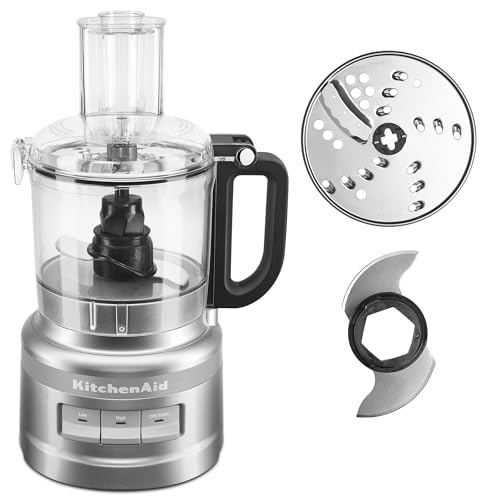
KitchenAid 7-Cup Food Processor KFP0718 — Best Mid-Size for Weekly Pesto
Seven cups is the largest bowl that still handles a standard pesto batch gracefully, and that makes the KFP0718 the pick for cooks who want one real processor — slicing, shredding, dough — without giving up good pesto. The three-speed control gives you a genuinely gentle low for leaves, and the easy-clean bowl design matters more than it sounds when the sauce in question is an oil emulsion that films every surface it touches.
Strengths
- 7-cup bowl is the biggest size that still processes a standard pesto batch in the blade’s working zone
- Three speeds include a gentle low suited to basil and other delicate greens
- All-in-one storage and easy-clean bowl reduce the friction of a weekly sauce routine
Trade-offs
- Standard batches sit at the bowl’s lower comfort limit — do not go smaller than a full batch
- Wattage is not stated in the verified title, so we claim steady mid-size performance, not power leadership
- Less suited than the 14-cup pick to harvest-scale freezing sessions
| Specification | Verified detail |
|---|---|
| Capacity | 7-cup work bowl (from Amazon title) |
| Controls | Three speed control (from Amazon title) |
| Storage | All-in-one storage for blades and discs (from Amazon title) |
In a weekly rhythm this machine makes sense as the household’s only processor. Pesto on Sunday — a full standard batch, emulsified properly with the oil drizzled in on low — then the discs come out for the week’s slicing and shredding, and everything stores inside the bowl in one cupboard spot. The pesto itself benefits from the bowl’s proportions: enough room for the leaves to tumble and cut rather than pack, not so much room that they hide from the blade.
One technique note for mid-size bowls: add the basil in two handfuls rather than one packed mass. The first handful chops down and makes room; the second integrates without the cook having to force the lid’s contents down with excessive scraping. It adds twenty seconds and noticeably improves the evenness of the cut — the kind of small craft that separates a good pesto routine from a frustrating one.
Best for: households wanting one mid-size processor for everything, with weekly pesto in the rotation / Not suited for: mini-batch minimalists and harvest-scale preservers at either extreme
Check on Amazon — check price on Amazon before you buy, because included accessories and bundle contents vary between listings.

Hamilton Beach Stack & Snap 14-Cup Food Processor 70585 — Best Two-Size Flexibility
Read the verified listing again: this machine includes a 4-cup mini food processor bowl alongside its 14-cup main bowl. For pesto, that is not a bonus accessory; it is the whole argument. The mini bowl replicates the Mini-Prep’s right-sized advantage for weekly jars, and when the garden peaks, the big bowl takes over for freezing batches. The Stack & Snap assembly — no twist-lock wrestling — is a genuine comfort when your hands are oily, and the 500-watt motor is adequate for both jobs, since even big pesto batches are wet and forgiving loads.
Strengths
- Two bowls included: 4-cup mini for correct small-batch pesto, 14-cup for harvest and family cooking
- Stack & Snap design assembles without twist-lock struggle, even with oily hands
- One purchase covers both ends of the pesto size spectrum covered separately by other picks
Trade-offs
- 500-watt motor is adequate, not swift, on dense nut-heavy variations
- Two bowls and their parts add up to a real storage commitment
- Plastic-forward build at a value-leaning tier
| Specification | Verified detail |
|---|---|
| Capacity | 14-cup bowl plus included 4-cup mini bowl (from Amazon title) |
| Motor | 500-watt, 3 speeds (from Amazon title) |
The workflow writes itself. Through the season, the mini bowl lives on the base: a jar of pesto here, a chimichurri there, small sauces in minutes with a small wash. Twice a year the big bowl comes out and the freezer gets stocked. Compare that with owning the Cuisinart mini and the Cuisinart 14-cup as separate machines — the Hamilton Beach concedes some refinement to each specialist, and wins on total cost, total storage, and having one base to maintain.
Pesto quality from the mini bowl is genuinely comparable to the dedicated choppers for standard batches: pulse the nuts and cheese, add leaves in handfuls, drizzle oil, scrape once. If your household’s pesto life spans both scales and your budget or cupboard spans only one machine, this is the rational compromise — and ‘compromise’ here means giving up very little.
Best for: households whose pesto making spans weekly jars and harvest freezing, wanting one machine / Not suited for: specialists who prefer a dedicated premium machine for either end of the scale
Check on Amazon — check price on Amazon before you buy, because included accessories and bundle contents vary between listings.
Comparison Table
| Pick | Badge | Key spec | Best for |
|---|---|---|---|
| Cuisinart Mini-Prep Plus 4-Cup Food Processor DLC-4CHB | Best Overall for Pesto | 4-cup bowl, 250W, auto-reversing blade | weekly pesto makers doing standard one-jar batches, and small kitchens generally |
| KitchenAid 5 Cup Food Chopper KFC0516 | Best for Small Batches with Extras | 5-cup bowl, 2 speeds + pulse, whisk included | experimenters and small households making varied, single batches of pesto and similar sauces |
| Cuisinart 14-Cup Food Processor DFP-14BCNY | Best for Harvest Batches and Freezing | 14-cup bowl, 720W motor | gardeners and bulk makers freezing pesto for the year, and households that cook at scale generally |
| Ninja Professional Plus Food Processor BN601 | Best Power for Dense Variations | 9-cup bowl, 1000W, Auto-iQ | adventurous sauce makers working with kale, walnuts, pistachios, and other dense variations |
| KitchenAid 7-Cup Food Processor KFP0718 | Best Mid-Size for Weekly Pesto | 7-cup bowl, 3 speeds, in-bowl storage | households wanting one mid-size processor for everything, with weekly pesto in the rotation |
| Hamilton Beach Stack & Snap 14-Cup Food Processor 70585 | Best Two-Size Flexibility | 14-cup + 4-cup mini bowl, 500W | households whose pesto making spans weekly jars and harvest freezing, wanting one machine |
How to Choose a Food Processor for Pesto
Match the bowl to the batch — this is the whole decision, so make it first. A standard batch (about two cups of leaves) wants a 4- to 7-cup bowl. A double batch for guests wants 7 to 9 cups. Harvest batches for freezing want 14 cups, or a dual-bowl machine that covers both ends. If you regularly make two sizes, the dual-bowl pick or owning a mini plus a full-size machine beats compromising on a single mid-size bowl that serves neither perfectly.
Power is a secondary spec for classic pesto — the mixture is light and wet — but becomes primary for the wider family. Kale, walnuts, and sun-dried tomatoes justify stepping up to a high-wattage machine; basil and pine nuts do not. Be honest about which repertoire is yours, because paying for power you only use on basil is paying for noise.
Budget framing, in tiers: mini choppers are the budget tier and, for classic pesto, arguably the best tools outright — a rare case where the cheapest suitable tool is also the correct one. Mid-range buys full-processor versatility; premium buys capacity and power for variations and volume. Spend according to your repertoire, not according to a hierarchy that assumes bigger is better. For pesto, it usually is not.
Technique: The Order, the Oil, and the Color
Build pesto in the order that protects texture. Nuts and garlic first, pulsed to a coarse meal — they need the head start, and processing them later would force you to over-work the leaves. Cheese second, briefly. Leaves third, in handfuls, pulsed rather than run. Oil last and gradually, drizzled in while the machine runs in short bursts, so the sauce emulsifies into a cohesive, glossy whole instead of separating into green pulp floating on oil.
Color is managed by time, temperature, and air. Work quickly once the leaves are cut; keep total processing short; consider blanching the basil for a few seconds and shocking it in cold water before processing if the most vivid green matters — the flavor cost is small and the color gain is dramatic. Cover finished pesto with a thin film of oil before refrigerating, and press wrap directly onto the surface of a part-used jar.
Salt and acid are finishing judgments. Salt the sauce as you would a finished dish, tasting on a piece of bread or a strand of pasta rather than from the spoon, because the cheese contributes salt of its own. A few drops of lemon juice brighten flavor and help the color; add them at the end, sparingly. These are cook’s decisions no machine makes for you — the processor’s job is to deliver the texture that lets them shine.
Freezing and Storing Pesto Like You Mean It
Pesto freezes exceptionally well, which is why harvest batches exist. The two proven vessels are ice-cube trays — cubes drop straight into a pan of pasta — and small jars filled to minimize headspace, topped with an oil film. Traditional advice freezes the base without cheese and adds cheese at serving; the practical difference is modest, and many cooks freeze complete pesto with no complaints. Choose the method you will actually follow consistently.
Refrigerated pesto keeps its best quality for about a week, always with that oil film renewed after serving from the jar. Darkening at the surface is oxidation, not spoilage — stir the brighter sauce up from below. If a jar smells sharp or off, discard it; fresh herbs and oil deserve respect on storage timelines.
Label frozen pesto with the variation and date. A freezer holding basil, walnut, and kale cubes in identical trays is a small chaos that labeling prevents. Come winter, those cubes are the difference between a sauce with a point of view and whatever the store had — the entire return on harvest day’s work.
Beyond Basil: A Short Field Guide to the Variations
Walnut-parsley pesto is the workhorse variation — earthier, cheaper to make in quantity, and excellent with roasted vegetables and grains. It tolerates a slightly coarser texture and rewards a squeeze of lemon at the end. Kale pesto wants the kale blanched or massaged with salt first if raw kale’s toughness is to be avoided, and it benefits from the powerful pick’s ability to break down fibrous leaves completely. Arugula pesto is peppery and assertive; blend it half-and-half with basil or spinach if it will be served to cautious eaters.
Sun-dried tomato pesto — really a different sauce wearing the family name — is dense, sweet, and forgiving: the tomatoes’ oil joins the emulsion, the mixture is thick, and mid-power machines handle it happily. Pistachio pesto is the luxury entry, worth making when the nuts are excellent, because the processor cannot improve mediocre nuts into greatness; it can only preserve what the ingredients bring. Herb stems deserve a word too: tender parsley and cilantro stems carry real flavor and process fine, while woody basil stems should be left out for texture.
The practical lesson across all variations is that pesto is a method, not a formula: something green, something nutty, something sharp and salty, garlic, and good oil, processed in the order this guide teaches. A cook who internalizes the method stops needing recipes, and the right processor — fitted to the batch, gentle or powerful as the ingredients demand — becomes a standing invitation to improvise with whatever the garden and pantry offer.
How to Make Pesto in a Food Processor
This sequence works in every pick in this guide; only the batch size changes. Have all ingredients ready before the leaves are cut — pesto rewards a cook who moves without pauses once the machine starts.
- Pulse the nuts and a garlic clove to a coarse, sandy meal — five to eight short pulses, no further.
- Add the grated cheese and pulse three or four times to combine.
- Add the basil leaves in two handfuls, pulsing briefly after each, just until the leaves are chopped and beginning to gather.
- With the machine running in short bursts, drizzle in the olive oil gradually until the sauce turns glossy and cohesive.
- Stop, scrape the bowl once completely, and pulse two or three final times. Taste and adjust salt and a drop of lemon if you use it.
- Serve immediately, or jar with an oil film on the surface and refrigerate; freeze in trays or small jars for longer storage.
Tossing matters as much as making. Pesto should meet pasta off the heat, loosened with a spoonful or two of the pasta’s hot cooking water, which helps the sauce coat every strand and turns the emulsion silky. Sauce slapped onto pasta straight from the jar, undiluted, clumps and oils off — a serving error often blamed on the pesto itself. Make the sauce well, then finish it properly, and the processor’s work shows at its best.
Serve the sauce the day it is made whenever you can; pesto’s aromatics are at their peak within hours, and even careful storage is a graceful decline from that first bright hour.
A note on nuts and toasting: pine nuts and walnuts both gain depth from a brief, careful toast in a dry pan, but they scorch quickly and bitter nuts make bitter pesto. Toast to pale gold, cool completely before processing — warm nuts turn the cheese greasy — and taste one before committing the batch. Thirty seconds of attention at this stage protects everything that follows.
Keep the finished jar out of direct light and reach for it with a clean spoon every time; pesto’s two enemies after making are oxidation and contamination, and both are defeated by habits that cost nothing. A jar treated that way rewards you with bright flavor to the last spoonful.
Common Buying Mistakes
Using a bowl far too big for the batch. The classic pesto failure. Leaves plaster to the walls, the blade idles beneath them, and the cook processes longer and longer, bruising the basil dark. Fit the bowl to the batch, or make a double batch in the big bowl and freeze the surplus.
Adding all the oil at once. Dumped oil separates; drizzled oil emulsifies. The gradual pour while the machine runs is the difference between a cohesive sauce and green bits in an oil slick.
Processing the leaves to a puree. Pesto wants texture — a fine chop with granularity from the nuts and cheese. Running the machine until the sauce is baby-smooth flattens flavor and color alike. Stop early; you can always pulse twice more.
Skipping the scrape-down. In small bowls especially, one complete scrape midway equalizes the batch more than extra processing does. Build it into your sequence between the leaves and the oil.
Storing pesto without an oil film. Exposed surface oxidizes and darkens within hours. A thin film of oil and prompt refrigeration keep a jar bright for days; skipping it wastes a good batch slowly.
Toasting the nuts until dark and processing them warm. Scorched nuts turn the whole batch bitter, and warm nuts melt the cheese into grease instead of letting it stay granular. Toast pale, cool fully, and taste a nut before it goes in — the cheapest quality control in the entire recipe.
Final Recommendation
For the classic weekly jar, the Cuisinart Mini-Prep Plus is the pesto buy — the right bowl, the right motions, the least ceremony. The KitchenAid 5 Cup suits experimenters; the Cuisinart 14-Cup owns harvest day; the Ninja BN601 owns the dense variations; the KitchenAid 7-Cup serves one-processor households; and the Hamilton Beach 70585 covers both scales in one box. Whichever you choose, fit the batch to the bowl, drizzle the oil, and stop while the texture still has life. Keep exploring the cluster: Best Food Processors For Making Nut Butter Best Food Processors For Making Smoothies Best Food Processors For Making Hamburger Best Food Processors For Meat Best Food Processors For Chopping
Frequently Asked Questions
What size food processor is best for pesto?
For a standard batch built on about two cups of basil leaves, a 4- to 7-cup bowl is ideal — large enough for the ingredients and oil, small enough that everything stays in the blade’s path. Bigger bowls suit double and harvest batches; smaller loads in big bowls are the most common cause of bruised, uneven pesto.
Why does my pesto turn dark or brown?
Oxidation, accelerated by over-processing, friction heat, and air exposure. Shorten the processing, work quickly, consider blanching the basil briefly before processing, and store the sauce under a thin film of oil. A few drops of lemon juice also help hold the color.
Should I add the cheese before freezing pesto?
Traditional advice freezes the base without cheese and stirs cheese in at serving for the brightest result. In practice, complete pesto freezes well too. If you freeze in cubes for pasta, either method works; choose based on whether you value tradition or convenience more.
Can I make pesto without pine nuts?
Absolutely — walnuts are the classic substitute, and almonds, pistachios, cashews, and even sunflower seeds all make good pesto with their own character. The method is unchanged: grind the nuts first to a coarse meal, then proceed. Adjust salt at the end, since nuttiness and sweetness vary.
How long does homemade pesto keep?
About a week in the refrigerator under an oil film, at its best in the first few days. Frozen in trays or small jars, it keeps its quality for months. Always refrigerate promptly and discard any jar that smells sharp or off.
Why is my pesto oily and separated instead of creamy?
The oil went in too fast or all at once. Emulsification needs a gradual drizzle while the machine runs in bursts. A separated batch can often be rescued by whisking in a spoonful of hot pasta water when tossing, which pulls the emulsion back together.
Can I make pesto in a food processor without a drizzle opening in the lid?
Yes, with a small adjustment: stop the machine twice during the oil stage, pour in a portion of the oil each time, and pulse briefly to incorporate. The emulsion forms slightly less elegantly than with a continuous drizzle, but the finished sauce is effectively the same. What matters is gradual addition, not the specific hardware that enables it.

