Disclosure: airfryerkitchensupply.com is reader-supported. When you buy through links on our site, we may earn an affiliate commission at no extra cost to you.
Where to buy
This guide to the best food processors chopped potatoes links only to models we verified against the manufacturer’s own listing, so the shortlist below is the right place to start comparing.
Food processors that genuinely handle potatoes well are sold through Amazon and kitchen retailers, and Amazon is where we verified every pick in this guide against the manufacturer’s own listing. That verification matters in this category more than most: feed tube design and disc sets change between model years with near-identical names, and the listing is the only reliable way to confirm the machine in the box is the machine we reviewed. Check dimensions too — the best potato processors are full-size machines.
Buy the disc set question into your order. Some processors include the dicing or adjustable slicing discs that make potato work fast; on others they are accessories. The listings below note what each machine is, and it is worth adding any disc you know you will use to the same order rather than discovering its absence on the day you planned a gratin. Check the current price on Amazon for each pick.
- Breville Sous Chef 16 Cup Food Processor (BFP810) — Check the current price on Amazon
- Cuisinart 14-Cup Food Processor (DFP-14BCNY) — Check the current price on Amazon
- Breville Sous Chef 12 Cup Food Processor (BFP710) — Check the current price on Amazon
- KitchenAid 9-Cup Food Processor (KFP0921) — Check the current price on Amazon
- Ninja Professional Plus Food Processor (BN601) — Check the current price on Amazon
- Hamilton Beach Stack & Snap 14-Cup Food Processor (70585) — Check the current price on Amazon
Searching for the best food processors chopped potatoes style — machines that can turn a bag of potatoes into even slices, shreds and cubes without reducing half of them to mush — leads to a specific set of requirements that general food processor guides gloss over. Potatoes are dense, starchy and unforgiving: a weak motor stalls on them, a narrow feed tube forces you to pre-cut every spud into slivers, and a blunt slicing disc tears instead of cutting, leaving wedges that cook unevenly and weep starch everywhere.
So this guide judges processors the way a potato judges them. Feed tube width comes first, because a tube that swallows a halved potato doubles your speed. Disc quality comes second: a sharp, adjustable slicing disc and a sturdy shredding disc are the tools potatoes actually meet. Motor torque and bowl capacity follow, because a processor that handles two potatoes but chokes on a family-size batch of scalloped potatoes has solved nothing. Every pick below was verified by brand and model against the manufacturer’s Amazon listing before we linked it.
One honest expectation to set: a standard processor slices and shreds potatoes beautifully, but true uniform dice needs either a dedicated dicing kit (available for some models below) or a knife. We flag which picks dice natively, which slice-and-shred only, and how to get cube-like results from the rest — because for soups, hash and breakfast potatoes, technique plus the right machine gets you nearly all the way there.
It is worth pausing on why this job matters enough to deserve its own guide. Potatoes are the most-processed vegetable in most kitchens — the weekly gratin, the weekend hash, the soup base, the roast tray — and they are also the ingredient where hand-prep time concentrates. Twenty minutes of knife work per potato dish, several dishes a week, is hours a month that a suitable processor returns to you. That arithmetic, not gadget enthusiasm, is the case for the machines below, and it is why we judged them on the unglamorous metrics — tube width, disc rigidity, bowl size — that decide whether those hours are actually saved or merely promised.
In this guide
Quick Picks
Six verified full-size processors chosen for potato work specifically: wide feed tubes, strong discs and bowls big enough for family batches. Badges repeat in the full reviews below.
- Breville Sous Chef 16 Cup Food Processor (BFP810) — Best Overall. The potato benchmark: a 16-cup bowl, a feed chute that takes potatoes nearly whole, an adjustable slicing disc with fine increments, and the motor to run it all without complaint. Check price on Amazon.
- Cuisinart 14-Cup Food Processor (DFP-14BCNY) — Best for Big Batches. The classic workhorse: 14-cup capacity, a famously durable motor, and a wide feed tube — the machine generations of cooks have used for holiday-scale potato dishes. Check price on Amazon.
- Breville Sous Chef 12 Cup Food Processor (BFP710) — Best for Smaller Kitchens. The Sous Chef formula at 12 cups: same design intelligence, wide chute and disc quality in a body that fits ordinary kitchens more easily. Check price on Amazon.
- KitchenAid 9-Cup Food Processor (KFP0921) — Best Mid-Size All-Rounder. A well-mannered 9-cup machine with a 2-in-1 feed tube and all-in-one storage — sized for weeknight potato jobs rather than feasts. Check price on Amazon.
- Ninja Professional Plus Food Processor (BN601) — Best Budget Power. Serious wattage and a 9-cup bowl at a mid-market price, with auto programs that make potato shredding and chopping nearly push-button. Check price on Amazon.
- Hamilton Beach Stack & Snap 14-Cup Food Processor (70585) — Best Value for Large Batches. Fourteen cups, a big-mouth feed tube and the simplest assembly in the class, at the lowest price of any large processor here. Check price on Amazon.
How These Picks Were Chosen
Verification followed this site’s standard method: each processor was searched by brand and model connected to this site, and the returned manufacturer listing title had to match the exact model before we attached a link. Food processors are notorious for silent revisions — same name, new disc set — so where a listing title confirmed capacity and key features, we used only those confirmed details in the spec boxes.
The judging criteria were potato-specific. Feed tube: how much pre-cutting does a medium potato need? Discs: is slicing adjustable, is the shredding disc reversible, and does a dicing option exist? Power delivery: does the motor hold speed under a full bowl of dense potato, or does it bog and heat? Bowl: can it take a family batch in one load? And cleanup: potato starch turns to glue, so bowls and discs that rinse clean without a archaeological dig scored higher.
We deliberately excluded mini choppers and small-capacity processors from this guide, however good they are at herbs and nuts. Chopped potatoes for real meals means volume, and a 4-cup chopper that needs six batches to fill a roasting tray is the wrong tool. Every pick here is a full-size machine that treats a bag of potatoes as a single job.
One exclusion deserves explaining: several processors advertise dicing kits prominently, and we checked those claims against the verified listings rather than the marketing. Where a dicing function was confirmed as part of the platform we said so in general terms, but because kit availability changes by region and model year, no pick in this guide depends on a dicing kit for its recommendation — each earns its place on slicing, shredding and chopping performance that the base machine demonstrably delivers. Buyers set on true dicing should confirm the kit for their exact model before ordering.
The 6 Best Food Processors Chopped Potatoes, Reviewed
Each review leads with the potato verdict — tube, discs, batch size — then covers the machine’s wider character for the rest of your cooking. If dice is your priority, read the Breville and Cuisinart reviews first.

Breville Sous Chef 16 Cup Food Processor (BFP810) — Best Overall
The Sous Chef 16 is what happens when a manufacturer designs a food processor around ingredients instead of around a price point. Its feed chute accepts potatoes with minimal trimming, the slicing disc adjusts in fine steps so your scalloped potatoes come out uniformly thick, and the 16-cup bowl swallows a family batch in one load. For chopped potatoes in every form — sliced, shredded, roughly cubed via slice-and-stack — this is the most capable machine in the guide.
- 16-cup capacity (confirmed in the manufacturer’s listing title)
- Model: BFP810 (Sous Chef 16)
- Adjustable slicing disc and multi-size feed chute
- Heavy-duty induction-style motor design
Strengths
- Feed chute minimises pre-cutting, the single biggest time saver with potatoes
- Adjustable slicer produces even slices that cook at the same rate
- Large bowl and strong motor handle dense, full loads without bogging
Trade-offs
- Premium price and a large, heavy body that needs permanent counter or cupboard space
- Many parts to wash after a big session
- Overkill for households that process small amounts occasionally
Potato work exposes weak processors in seconds, and the Sous Chef simply never looks exposed. Slices emerge clean rather than torn, the shredding disc turns out hash-brown shreds that are dry and separate rather than a starchy mat, and the machine’s weight keeps it planted on the counter instead of walking under load. The variable slicing is the feature you will praise most: gratins and scalloped dishes live or die on slice uniformity, and this machine makes uniformity the default.
Beyond potatoes it is a complete, serious processor — dough, grating, emulsifying — with the accessory storage to keep its many discs organised. The honest costs are money, size and washing up. If potatoes and batch cooking are weekly events in your kitchen, it earns all three. Check the current price on Amazon; it is the most expensive pick here and worth comparing against its 12-cup sibling below before deciding.
Ownership is where the flagship earns its keep back: the accessory case keeps a dozen discs from becoming a drawer hazard, the parts are heavy enough to feel like equipment, and the motor’s warranty backing reflects Breville’s confidence in it. The one habit to build is batch planning — its capacity tempts owners to fill it, and a full 16 cups of potato is a commitment to a lot of gratin. For big households and holiday cooks, that temptation is the point. Everyone else should read the 12-cup review again before paying the flagship premium.
Best for: serious home cooks who process potatoes and big batches weekly / Not suited for: small kitchens or occasional users
Check the current price on Amazon

Cuisinart 14-Cup Food Processor (DFP-14BCNY) — Best for Big Batches
The DFP-14BCNY is the food processor equivalent of a cast-iron skillet: a design that has been in kitchens for decades because it simply does the work. Fourteen cups of capacity, a feed tube wide enough to keep potato pre-cutting to a minimum, and a motor with a reputation for outliving its owners’ interest in cooking trends. For chopped potatoes at family and holiday scale, it remains the value-conscious way to get serious capacity.
- 14-cup capacity (confirmed in the manufacturer’s listing title)
- Model: DFP-14BCNY
- Wide-mouth feed tube
- Includes slicing and shredding discs
Strengths
- Huge bowl handles a whole bag of potatoes in one or two loads
- Simple, durable design with an excellent long-term reliability record
- Wide feed tube reduces the pre-cutting that slows potato prep
Trade-offs
- Controls are basic — no adjustable slicing finesse of the Breville
- Heavy base and a tall profile for storage
- Accessory ecosystem is functional rather than expansive
Where the Breville wins on refinement, the Cuisinart wins on trust. Owners keep these machines for ten and twenty years, and for potato work the fundamentals are all present: slices come out even, shreds come out clean, and the machine does not flinch at a full bowl. The slicing disc is fixed-thickness rather than adjustable, so scalloped-potato perfectionists should note the difference — but for hash, soups, latkes and roasting prep, the output is exactly right.
It is also the easiest big processor to recommend to someone who dislikes gadgetry: a lever, a pulse, and done. If your potato cooking is about volume and reliability rather than precision slicing, this is the machine to buy, and its long production run means parts and discs stay available. Check price on Amazon before ordering.
This is the processor owners describe with the word ‘still’: still sharp, still strong, still on the counter after a decade. Its simplicity is the mechanism of that longevity — few electronics, a motor built like a bench tool, and discs that are standard, replaceable and widely stocked. Potato-specific ownership is equally plain: rinse the bowl and discs immediately, because dried potato starch is the only enemy this machine cannot outmuscle, and dry the slicing disc’s edge before storage to keep it keen for the next gratin season.
Best for: big families and batch cooks who value durability over finesse / Not suited for: cooks who want adjustable slicing thickness
Check the current price on Amazon

Breville Sous Chef 12 Cup Food Processor (BFP710) — Best for Smaller Kitchens
The Sous Chef 12 answers the obvious question about its bigger sibling: how much of that performance fits a normal kitchen? Most of it. The 12-cup bowl still takes a generous batch of potatoes, the feed chute still minimises pre-cutting, and the adjustable slicing disc — the feature potato cooks actually use weekly — is present and correct. What you surrender is only the largest-batch headroom.
- 12-cup capacity (confirmed in the manufacturer’s listing title)
- Model: BFP710 (Sous Chef 12)
- Multi-size feed chute
- Adjustable slicing disc
Strengths
- Adjustable slicing for even potato slices, like the 16-cup model
- Friendlier size and price than the flagship
- Strong motor for its class; dense loads are not a problem
Trade-offs
- Holiday-scale batches need two loads instead of one
- Still a substantial appliance to store
- Accessory set is generous but adds washing up
For households of two to four, this is arguably the sweet spot of the whole guide. Scalloped potatoes for a family dinner fit comfortably, hash browns for a weekend breakfast are a two-minute job, and the machine stores without the furniture rearrangement the 16-cup model can demand. Slice quality is the same story as the flagship: clean, even, predictable.
Choose the 16 only if you regularly cook for crowds or meal-prep in bulk. Everyone else gets the same potato performance here with money and cupboard space left over. It is the pick we would buy for a keen cook in an ordinary-sized kitchen.
In practice the 12-cup Sous Chef is the one owners leave out on the counter, and that single fact predicts more use than any feature list. Its accessory set covers the potato repertoire completely — slice, shred, chop — and its bowl size hits the zone where a family dinner’s worth of potatoes is one load while a Tuesday’s worth still processes evenly. If the flagship is the machine for the cook who hosts twenty, this is the machine for the cook who feeds four brilliantly and often.
Best for: households of two to four who cook potatoes weekly / Not suited for: bulk meal preppers and very large families
Check the current price on Amazon
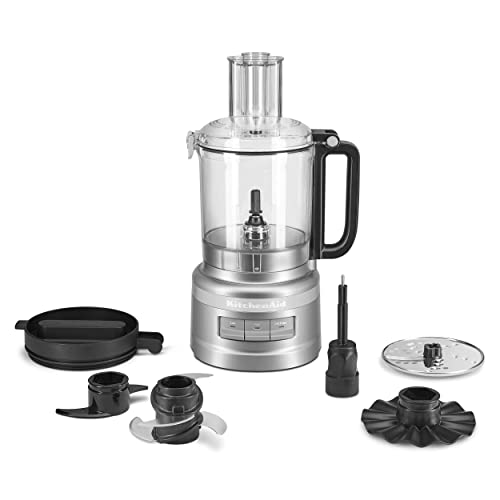
KitchenAid 9-Cup Food Processor (KFP0921) — Best Mid-Size All-Rounder
The KitchenAid 9-Cup is the right size for how most households actually cook potatoes: a gratin for four, a pan of breakfast potatoes, a soup base. Its 2-in-1 feed tube handles halved potatoes through the main chute and slimmer pieces through the small pusher, and its clever in-bowl storage means the slicing and shredding discs live inside the machine instead of colonising a drawer.
- 9-cup capacity (confirmed in the manufacturer’s listing title)
- Model: KFP0921
- 2-in-1 feed tube with small pusher for narrow items
- All-in-one accessory storage in the bowl
Strengths
- Size matches weeknight cooking without dominating the counter
- Discs and blades store inside the bowl — nothing gets lost
- Easy-clean bowl design suits starchy potato residue
Trade-offs
- Big batches need splitting into two loads
- Feed tube still asks for quartering large baking potatoes
- Less raw power than the Breville and Cuisinart flagships
KitchenAid’s design team clearly watched people use food processors: the storage, the snap-on lid and the easy-clean bowl all attack the friction that makes owners leave machines in cupboards. For potatoes, the slicing and shredding performance is clean and consistent at this capacity, and the machine’s manners — it is comparatively tidy and controlled — suit weeknight cooking.
Its ceiling is capacity and brute force. A full 9 cups of dense potato is its comfort limit, not its party trick. Within that limit it is one of the most liveable processors in this guide, and the one least likely to be resented on a Tuesday evening. Check the current price on Amazon.
KitchenAid’s in-bowl storage turns out to be an ownership feature owners mention years later: every disc present, every edge protected, nothing rattling in a drawer. The machine’s lighter weight also changes behaviour — it gets carried to the food rather than the food being carried to it, which suits smaller kitchens with one good work surface. Its potato ceiling is honest: a family gratin yes, a church supper no. Buy it for the cooking you do weekly and it will feel perfectly sized every single time.
Best for: weeknight cooks in households of two to four / Not suited for: bulk preppers or cooks who regularly process whole bags at once
Check the current price on Amazon

Ninja Professional Plus Food Processor (BN601) — Best Budget Power
The Ninja BN601 brings the brand’s blender-bred horsepower to the processor bowl. Its timed Auto-iQ programs pulse and run in patterns that suit chopping, which makes it unusually forgiving for rough-chopped potatoes destined for hash, soups and stews: press the button and the machine produces an even rough chop instead of the puree-at-the-bottom, chunks-at-the-top gradient weaker machines deliver.
- Model: BN601 (Professional Plus)
- High-power motor with Auto-iQ programs
- Precision processor bowl with slicing/shredding disc
- Chopping and dough blades included
Strengths
- Motor power per dollar is the best in this guide
- Auto programs make even rough chops easy for beginners
- Disc handles slicing and shredding duties for gratins and hash
Trade-offs
- Slicing finesse trails the adjustable Breville discs
- Louder and more aggressive in character than the premium picks
- Feed tube size means more pre-cutting of large potatoes
Judge the Ninja by the potato dishes most people actually make weekly — hash, home fries, soups, casseroles — and it is excellent: fast, even, unfussy. Judge it by a perfect scalloped-potato slice and the Breville machines pull ahead. That is the honest shape of its value, and for many kitchens the value wins.
It is also the easiest recommendation here for a first full-size processor, because the programs forgive inexperience. If your potato ambitions grow toward precision slicing later, you will know exactly which upgrade to buy — and this machine will still have earned its keep. Check price on Amazon, where Ninja discounts often.
The BN601’s ownership personality is pure Ninja: powerful, a little loud, and forgiving of beginners because the programs do the pulsing discipline for you. For potatoes specifically, owners learn one trick quickly — the chop program’s timed pulses are the difference between even hash and accidental mash, so resist the urge to hold the button down ‘just to finish’. Parts are dishwasher-friendly in the ways that matter after a starchy session, and the whole machine asks so little money for its power that a second, finer machine later is a luxury, not a rescue.
Best for: first-time processor buyers and hash-and-soup households / Not suited for: precision slicing perfectionists
Check the current price on Amazon

Hamilton Beach Stack & Snap 14-Cup Food Processor (70585) — Best Value for Large Batches
Hamilton Beach built its reputation on removing the annoyances other brands keep, and the Stack & Snap 14-Cup is that philosophy in a food processor. The bowl stacks and snaps instead of twisting into alignment, the Big Mouth tube takes potatoes with minimal trimming, and the capacity matches machines costing far more. For chopped potatoes in quantity on a budget, nothing else in this guide is close.
- 14-cup capacity (confirmed in the manufacturer’s listing title)
- Model: 70585 (Stack & Snap)
- Big Mouth feed tube
- Stack-and-snap assembly with no twist locking
Strengths
- Lowest price for a true 14-cup potato-capable processor
- Assembly is genuinely foolproof — no alignment wrestling
- Wide feed tube keeps pre-cutting to a minimum
Trade-offs
- Fit and finish are workmanlike rather than premium
- Disc performance is good, not Breville-clean
- Motor is adequate for big loads but less refined under strain
This is the processor for the cook who processes potatoes because dinner requires it, not because equipment is a hobby. Slices and shreds come out entirely serviceable, batches are big, and the machine never makes you feel foolish trying to lock a lid. In a church kitchen, a big-family home or a meal-prep routine, those virtues compound daily.
The compromises are the expected ones at this price: plastics feel utilitarian, the motor’s voice rises under a full dense load, and slice uniformity is a notch below the premium discs. None of them stop dinner. If the budget is the binding constraint, this is where the smart money in this guide goes — check the current price on Amazon.
The Stack & Snap’s ownership story is written by people who hate assembling things: scout groups, church kitchens, grandparents, holiday rentals. Nothing twists, nothing aligns, nothing needs the manual after the first use — and a processor that assembles without friction is a processor that gets used for a single potato job instead of defaulting to the knife. Its discs and bowl rinse clean without ceremony. It will not be the most refined machine you ever own; it may well be the one that teaches a whole household that the processor is worth reaching for.
Best for: budget-conscious big-batch cooks and shared kitchens / Not suited for: buyers who prioritise premium finish and the finest slicing
Check the current price on Amazon
Comparison Table
For potato work, read the table’s key-spec column as a workflow column: bowl size decides your batch count, tube and disc design decide your prep minutes. The two Breville machines win on slicing, the Cuisinart and Hamilton Beach on raw capacity per dollar.
| Pick | Badge | Key spec | Best for |
|---|---|---|---|
| Breville Sous Chef 16 Cup Food Processor (BFP810) | Best Overall | 16-cup bowl, adjustable slicer, wide chute | serious home cooks who process potatoes and big batches weekly |
| Cuisinart 14-Cup Food Processor (DFP-14BCNY) | Best for Big Batches | 14-cup bowl, wide tube, proven motor | big families and batch cooks who value durability over finesse |
| Breville Sous Chef 12 Cup Food Processor (BFP710) | Best for Smaller Kitchens | 12-cup bowl, adjustable slicer | households of two to four who cook potatoes weekly |
| KitchenAid 9-Cup Food Processor (KFP0921) | Best Mid-Size All-Rounder | 9-cup bowl, 2-in-1 feed tube | weeknight cooks in households of two to four |
| Ninja Professional Plus Food Processor (BN601) | Best Budget Power | Powerful motor, Auto-iQ programs | first-time processor buyers and hash-and-soup households |
| Hamilton Beach Stack & Snap 14-Cup Food Processor (70585) | Best Value for Large Batches | 14-cup bowl, Big Mouth tube, easy assembly | budget-conscious big-batch cooks and shared kitchens |
What Makes a Food Processor Good at Potatoes, Specifically?
Three things, in order. First, the feed tube: potatoes are wide, and every cut you must make before the potato enters the machine is time the processor was supposed to save. The best designs here accept halved or even whole medium potatoes. Second, the discs: a slicing disc should be rigid, sharp and ideally adjustable, because wobbly thin discs produce wedges; a shredding disc should have clean-cut holes that produce separate shreds rather than a starchy mat. Third, torque: potatoes are dense, and a motor that slows dramatically under load tears food instead of cutting it.
Notice what is not on the list: the S-blade. The chopping blade is the tool buyers imagine using, but for potatoes it is the least controlled option — it produces an uneven rough chop that suits hash and soups and ruins everything else. Slices and shreds from discs are what make processor potatoes look and cook like knife work, only faster and more uniform.
How to Choose the Right Size and Disc Set?
Match the bowl to your largest regular job, not your largest imaginable one. Households of two to four live happily at 9 to 12 cups; families and meal preppers should start at 14. Oversizing has a real cost beyond money: big bowls chop small amounts badly, because ingredients hide under the blade’s sweep, and big machines get left in cupboards.
- For slicing (gratins, scalloped, chips): prioritise an adjustable or well-made fixed slicing disc and a wide tube.
- For shredding (hash browns, latkes, rosti): prioritise a sturdy reversible shredding disc and the power to run it continuously.
- For dicing (soups, breakfast potatoes): look for a dedicated dicing kit — available on select platforms — or use the slice-and-stack method described in the how-to below.
- For dough and general work: any pick here handles it, but the flagship Breville and Cuisinart are the most complete all-rounders.
Also check the accessory storage story before buying. A processor with five discs and no storage plan donates those discs to the back of a drawer, where their edges — and your fingers — suffer. In-bowl and caddy storage, offered by several picks here, quietly determines whether you still use the discs in year three.
Sliced, Shredded or Diced: Which Cut Does Your Dish Need?
Slicing is the processor’s finest potato trick: uniform rounds cook evenly, which is why gratins and scalloped potatoes are better from a good processor than from most home knife work. Shredding is the speed trick — hash browns and latkes for a crowd in minutes, with one caveat: shreds weep starch and moisture, so rinse, spin or squeeze them dry before the pan, or they steam instead of crisping.
Dicing is the honest limitation. A standard processor cannot dice; it slices, and cubes happen when you stack and cross-cut slices by hand, or when a model offers a true dicing attachment. For soups and breakfast potatoes, the slice-stack-cross-cut method takes an extra minute and produces cubes uniform enough that no diner will ever know. Buyers who dice daily in volume should confirm dicing-kit availability for their chosen platform before ordering.
How to Store and Care for Discs So They Stay Sharp?
A food processor is only as good as its discs’ edges, and discs live or die by storage. Loose in a cutlery drawer, a slicing disc dulls itself against everything it touches and eventually touches a hand. Use the storage the machine offers — Breville’s caddy, KitchenAid’s in-bowl system — or give the discs a dedicated container with the cutting edges guarded. It is the cheapest performance preservation available in this category.
Care is equally simple: rinse potato starch off immediately, wash in warm soapy water, and dry discs fully before storing, because a disc put away wet dulls and spots. Never use the discs as scrapers or pry tools, and when a slicing disc finally dulls after years, replace the disc rather than the machine — every pick in this guide has a parts channel, and a fresh disc restores a processor to as-new cutting for a fraction of a new machine’s price.
Which Potatoes Process Best — and Which Fight Back?
Variety changes the processing experience more than most guides admit. Waxy potatoes — reds, new potatoes, most fingerlings — hold their structure under the disc and produce the cleanest slices and shreds, which is why they are the choice for gratins and salads. Floury baking potatoes process adequately but are more prone to tearing and to breaking down at the blade, suiting them to rough chops for soups and stews where tenderness is the goal anyway. All-rounders sit happily between the two and are the sensible default buy for a processor household.
Condition matters as much as variety. Cold, firm, recently bought potatoes cut cleanly; potatoes that have sat warm for weeks, begun to sprout or gone slightly soft will smear and tear in any machine in this guide. If a batch processes badly, check the potatoes before blaming the disc — and route tired potatoes to mash and soup, where their weaknesses stop mattering.
How to Prep Potatoes in a Food Processor Without Turning Them to Mush
Technique is the difference between processor potatoes that look machine-made in the good way and a bowl of starchy rubble. The routine below works on every machine in this guide.
- Choose even, firm potatoes. Similar sizes feed evenly and slice uniformly. Very old, sprouting or soft potatoes tear under any disc — save those for mash, where the processor should not be used anyway.
- Cut to the tube, not to the recipe. Halve or quarter potatoes so each piece sits snugly in the feed tube. A piece that fits with light pressure feeds straight; a loose, rattling piece wobbles and produces tapered slices.
- Chill for cleaner cuts. Thirty minutes in the fridge firms potatoes noticeably. Cold, firm flesh slices and shreds cleanly; warm, soft flesh smears and weeps starch onto everything.
- Use the pusher as a metronome, not a hammer. Steady, moderate pressure gives even slices. Forcing the pusher flexes discs and wedges the cut; letting go entirely lets the piece bounce and shred unevenly.
- For dice: slice, stack, cross-cut. Slice the potatoes thickly with the disc, stack the slices, then cut the stacks into sticks and cubes with a knife. It is the fastest honest route to processor-assisted dice.
- Manage the starch. For frying and roasting, rinse slices or shreds until the water runs clearer, then dry thoroughly. Surface starch is what makes processor potatoes glue themselves together in the pan.
- Rinse the machine immediately. Potato starch dries into cement. A thirty-second rinse of bowl, disc and lid right after use saves a twenty-minute soak later — the single best ownership habit for this category.
Follow those steps and the processor stops being a blunt instrument. The cuts come out as even as patient knife work at five times the speed — which is the entire promise of the machine.
Common Buying Mistakes
Using the chopping blade for everything. The S-blade rough-chops; it does not slice or dice. Buyers who judge a processor by blade-chopped potatoes conclude processors are bad at potatoes, when they simply used the wrong tool in the box.
Overfilling the bowl with potato pieces. A bowl packed to the lid chops unevenly — mush at the blade, boulders at the top. Work in two honest batches and the total time is shorter, not longer.
Skipping the rinse and dry for fried dishes. Starch-laden, wet shreds steam in the pan and never crisp. The rinse-and-dry step is not fussiness; it is the difference between hash browns and potato porridge.
Buying a mini chopper for a family potato habit. Small choppers are excellent tools asked to do the wrong job here. Chopped potatoes for real meals need a full-size bowl and discs, as every pick in this guide provides.
Forcing oversized potatoes through a narrow tube. Jamming the pusher bends discs, stalls motors and produces dangerous kickback habits. Two seconds with a knife to halve a potato is always the cheaper cut.
Final Recommendation
If you want the best potato processor outright, buy the Breville Sous Chef 16: its chute, adjustable slicer and capacity make every potato task easier. The Cuisinart DFP-14BCNY is the durability-first alternative for big batches, the Sous Chef 12 trims the same idea for smaller kitchens, and the KitchenAid 9-Cup suits weeknight scale. The Ninja BN601 brings the most power per dollar for hash-and-soup cooking, and the Hamilton Beach 70585 is the budget champion for volume.
Whichever you choose, work the discs, chill the potatoes, rinse the starch and rinse the machine — technique plus any of these six will out-cook an expensive machine used carelessly. The related guides below cover the wider processor category in more depth.
A closing thought on value, because the price spread in this guide is wide: the cheapest pick here will chop a potato about as fast as the flagship. What the flagship buys is not speed but ceiling — finer slices, bigger batches, quieter confidence under load, and a decade of parts. Decide which of those your cooking actually uses. A household that gratins monthly and hashes weekly will feel the flagship’s advantages every single week; a household that processes potatoes at holidays will not, and should keep its money for the potatoes themselves.
- Breville Sous Chef 16 Cup Food Processor (BFP810) — Check price on Amazon
- Cuisinart 14-Cup Food Processor (DFP-14BCNY) — Check price on Amazon
- Breville Sous Chef 12 Cup Food Processor (BFP710) — Check price on Amazon
Best Food Processors Best Cuisinart Food Processors Best Food Processors For Dough Best Food Processors For Slicing Vegetables Best Mini Food Processors
Frequently Asked Questions
Can a food processor dice potatoes evenly?
Only with help. A standard processor slices and shreds; true dice requires either a model-specific dicing attachment or the slice-stack-cross-cut method: slice thickly with the disc, stack the slices, then knife-cut them into cubes. For soups, hash and breakfast potatoes that method is fast and produces cubes even enough to cook uniformly.
Why do my processor potato slices come out uneven?
Three usual causes: pieces that fit loosely in the feed tube and wobble, inconsistent pusher pressure, or warm, soft potatoes that deform under the disc. Chill the potatoes, cut them to fit the tube snugly, and use steady moderate pressure — the combination fixes most uneven slicing.
Should you peel potatoes before processing?
For slicing and shredding, peeling first is cleaner: peels feed unevenly and shred into tough ribbons. For rough chopping into soups, well-scrubbed unpeeled potatoes are fine and keep the nutrients in the skin. Either way, remove eyes and green patches before the potatoes meet the machine.
How do you stop shredded potatoes turning grey or brown?
Work quickly and hold shreds in cold water until cooking — exposure to air oxidises cut potato fast. The same cold-water soak pulls surface starch, so drain and dry them thoroughly before frying and you solve browning and sogginess in one step.
Can a food processor mash potatoes?
It can, and it should not. The blade’s speed works the starch into glue, producing the infamous wallpaper-paste mash. Use a ricer, masher or mill for mashed potatoes, and keep the processor for the slicing, shredding and chopping work it is genuinely best at.
What size food processor do I need for a family of four?
A 9 to 12-cup machine covers most family potato jobs in one load — a gratin, a pan of breakfast potatoes, a soup base. If you regularly cook for more, meal-prep in bulk or host holidays, step up to the 14 to 16-cup models in this guide so big jobs stay single-batch.
Can I use a food processor for French fries?
Yes, with the right approach: several platforms offer a dedicated French-fry disc, and without one, the slice-and-stack method from our how-to — slice thickly, stack, then cut into batons by hand — produces even fries that cook uniformly. Soak the cut fries in cold water to remove surface starch, dry them thoroughly, and they will crisp properly in the oven or fryer.
Why do my shredded potatoes turn into a wet mat?
Usually a combination of a dull or fine shredding disc, soft warm potatoes, and no starch management. Chill the potatoes, use the coarser shredding side, and rinse and squeeze the shreds dry before cooking. The shreds should fall as separate strands; if they clump in the bowl, the potatoes were too warm or the disc is past its best.
Do I need to dry potatoes before slicing them for a gratin?
For slicing, surface moisture matters less than for frying — the slices go into liquid anyway. Pat them dry if they are dripping from a rinse, mainly so they feed through the tube without slipping. For shredding destined for the frying pan, drying is essential: rinse, spin or towel the shreds thoroughly, or they will steam in their own starch instead of crisping.

