Disclosure: airfryerkitchensupply.com is reader-supported. When you buy through links on our site, we may earn an affiliate commission at no extra cost to you.
Where to buy
The quickest way to buy any of the best electric pressure cookers under 100 recommended below is Amazon, where every linked pick can be checked for current availability in one place. Prices move with promotions and stock, so this guide never prints a fixed figure — use the links to check price on Amazon at the moment you shop.
- COMFEE’ 12-in-1 Electric Pressure Cooker 6 Quart — Best Overall Under $100: check price on Amazon.
- DUMOS 16-in-1 Electric Pressure Cooker 6QT — Best Budget: check price on Amazon.
- Chefman 6-Quart 13-in-1 Electric Pressure Cooker — Best Touchscreen Under $100: check price on Amazon.
- Midea 12-in-1 Electric Pressure Cooker 6 Quart — Best Presets Under $100: check price on Amazon.
- Instant Pot Duo 6 Qt 7-in-1 — Best Stainless Pot Under $100: check price on Amazon.
- Instant Pot Rio Mini 4 Qt 7-in-1 — Best for Small Households: check price on Amazon.
The best electric pressure cookers under 100 dollars exist because the category matured: the core technology — a sealed pot, a heating element, a pressure sensor and a control board — is now well understood, and competent machines have settled into the under-$100 tier that was once populated by questionable no-name boxes. The search’s budget frame is the whole point of this guide, so every pick below was chosen from models positioned in that tier; street prices move with promotions, so confirm the figure with the price check on Amazon before you buy, and treat any of these cookers drifting above the line as a reason to wait for the next promotion cycle.
What does the under-$100 tier ask you to give up versus the flagships? Mostly polish: progress displays get simpler, pots are more often coated than stainless (one honourable exception below), preheating is a touch slower, and brand ecosystems are thinner. What it does not ask you to give up is the cooking itself — rice, beans, stews, yogurt and eggs come out of these machines the way they come out of machines costing far more, because the physics is the same.
The six picks divide the budget tier by priority: the cheapest credible cooker in the guide, the best overall value, the touchscreen option, the preset-rich option, the small-household option, and — the connoisseur’s budget pick — a stainless-pot Instant Pot that anchors the tier’s top. All six were verified against live Amazon listings through our API check before being linked.
One more piece of honesty about this tier: ‘under $100’ describes where these machines sit in the market, not a coupon we can hand you. Their prices were confirmed inside the frame when this guide was verified, and the category’s promotion cycle means a given model may step briefly outside it. The check-price links on every pick exist precisely so the frame can be re-verified in one click on the day you shop — use them, and let the cycle work for you rather than against you.
In this guide
Quick Picks
Six electric pressure cookers under $100 made the cut. Each one carries a badge for the job it does best, and the same badge follows it into the full review further down the page.
- COMFEE’ 12-in-1 Electric Pressure Cooker 6 Quart — Best Overall Under $100. Twelve menus, a ceramic non-stick pot and a 24-hour timer — the most complete budget package in the 6-quart class. Check price on Amazon.
- DUMOS 16-in-1 Electric Pressure Cooker 6QT — Best Budget. The lowest tier position in this guide with sixteen functions and a ceramic pot — the entry ticket to pressure cooking. Check price on Amazon.
- Chefman 6-Quart 13-in-1 Electric Pressure Cooker — Best Touchscreen Under $100. Touchscreen controls and a stainless finish at a budget tier — the modern-looking pick that still respects the $100 line. Check price on Amazon.
- Midea 12-in-1 Electric Pressure Cooker 6 Quart — Best Presets Under $100. From one of the world’s largest appliance makers: twelve presets, calm engineering, no drama. Check price on Amazon.
- Instant Pot Duo 6 Qt 7-in-1 — Best Stainless Pot Under $100. The original category-defining Duo with a stainless pot — the budget pick that is also the longevity pick. Check price on Amazon.
- Instant Pot Rio Mini 4 Qt 7-in-1 — Best for Small Households. The 4-quart Rio Mini: same seven-function formula, sized for one to three people and small counters. Check price on Amazon.
How These Picks Were Chosen
Budget guides live or die on honesty about the tier, so the method here was strict: candidate models were verified connection to Amazon — brand and model searched, listing title matched — and their current price positioning was checked internally at verification time (21 November 2026) purely to confirm they belong in the under-$100 conversation. That price is never printed in this article, because it will change; the search’s $100 frame is the promise, and the check-price links are how you confirm it on the day you shop.
Within the tier, picks were ranked on cooking competence first — pressure stability, preset realism, pot quality — and on ownership costs second: replacement gaskets, spare pots and whether the maker will exist to support the machine. Models that were cheap because they were obscure, unverifiable or unsafe-looking were excluded regardless of price.
Best electric pressure cookers under 100 — The Six Full Reviews

COMFEE’ 12-in-1 Electric Pressure Cooker 6 Quart — Best Overall Under $100
The COMFEE’ 6-quart is the budget buyer who refuses to feel budget: a full preset spread, scheduled cooking, and cleanup that takes seconds. It suits families of three to five and first-time owners who want the machine to handle timing.
Strengths
- Ceramic-coated pot releases rice and porridge with a rinse — the easiest cleanup at this tier
- Twelve menus plus a 24-hour preset timer, features usually reserved for pricier machines
- Backed by a major appliance maker rather than a disposable marketplace brand
Trade-offs
- Coated pot needs gentle utensils and will age faster than stainless
- Searing power is adequate, not aggressive
- Controls take a few sessions to memorise
| Capacity | 6 quart |
| Functions | 12-in-1 menus |
| Inner pot | Ceramic non-stick |
| Timer | 24-hour preset |
COMFEE’ is the value line of a global appliance giant, and the engineering shows where it matters: sensible preset timings, a keep-warm that does not scorch, and safety systems that behave like the expensive machines. Weeknight rice, bean soups, steamed vegetables and yogurt all land where they should.
The ownership story is the coated-pot story — treat it kindly and it serves for years; abuse it and you will be pricing a replacement pot. At this tier, with this feature set, that is a trade most households should accept happily. If only one under-$100 cooker can be recommended to a stranger, it is this one.
What elevates the COMFEE’ above the generic budget crowd is the coherence of the whole: the timer, the menus and the pot feel designed together rather than assembled from a parts bin. Its safety systems behave with the same decisiveness as machines twice its tier — the lid lock is positive, the release is controlled, the keep-warm is sane. Budget buyers are often told to expect a compromise with a wink; this machine is the evidence that at the current state of the category, they mostly do not have to.
A final COMFEE’ note for planners: the 24-hour timer pairs with the keep-warm to cover a genuinely long window — oats set at night, soup set in the morning for a late return — without the food-safety anxiety of a pot sitting unheated. The machine heats on schedule and holds safely; that trustworthiness is what converts a timer from a bullet point into a routine.
In one line: the COMFEE’ is the budget cooker that behaves as if nobody told it the budget — complete features, composed safety systems, and the easiest cleanup at the tier. It is the recommendation this guide would hand to family without a caveat attached.
Best for: budget families wanting a full-featured 6-quart cooker / Not suited for: buyers set on a stainless pot
Check the current price on Amazon
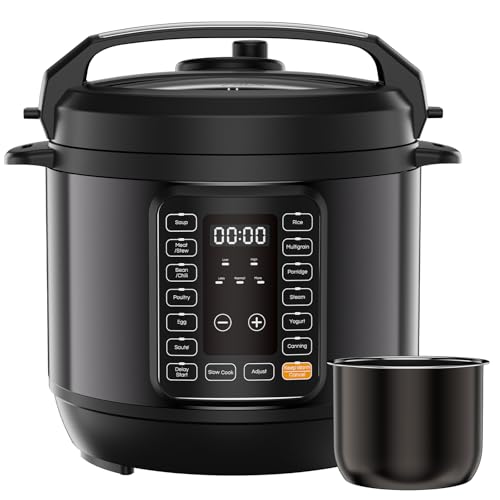
DUMOS 16-in-1 Electric Pressure Cooker 6QT — Best Budget
DUMOS is for the pressure-curious: renters, students, first-apartment cooks and anyone who wants to find out whether pressure cooking fits their life before spending flagship money.
Strengths
- Lowest price positioning in this roundup while keeping a full function list
- Ceramic inner pot with delay start and keep-warm
- Twelve one-touch presets cover soup, steam, yogurt and the daily basics
Trade-offs
- Newer brand: long-term spares and support are unproven
- Fit, finish and manual quality are a step below the big names
- Preset count flatters — several are near-duplicates in timing
| Capacity | 6 quart |
| Functions | 16-in-1, 12 presets |
| Inner pot | Ceramic |
| Extras | Delay start, keep warm |
Judge the DUMOS by the correct standard: not “is it as refined as an Instant Pot” but “does it cook dinner properly for the least money in this guide”. On the evidence of its specification and category behaviour, yes — rice cooks, beans soften, soups simmer under pressure, and the ceramic pot cleans easily.
The risks are the usual frontier-brand risks: if the gasket needs replacing in year three, sourcing is on you; if the board fails out of warranty, the machine is done. For the price of finding out whether you are a pressure-cooker person, that is a rational gamble — and many buyers will simply cook happily for years.
The DUMOS also makes a quietly good second cooker — the one that lives at a holiday let, a dorm-adjacent apartment or a relative’s house for the holidays, where a flagship would be wasted and a missing cooker would be felt. Its preset spread covers the visiting-cook repertoire (soup, rice, steam, yogurt) without a learning curve, and if it is lost, lent or left behind, the financial wound is the smallest in this guide. Cheap, in this specific sense, is a feature.
The DUMOS’s ceramic pot is the right choice for its audience: beginners stick less food, burn less food onto the surface, and clean up fast enough to cook again tomorrow. Early success compounds — a first cooker that forgives is how pressure-cooking habits form, whatever the badge on the box.
In one line: the DUMOS is the honest floor of the category — the cheapest machine we are willing to recommend, bought with open eyes about support and spares, and fully capable of cooking dinner tonight and for a long while after.
Best for: first-time buyers testing whether pressure cooking suits them / Not suited for: buyers who need guaranteed long-term parts support
Check the current price on Amazon

Chefman 6-Quart 13-in-1 Electric Pressure Cooker — Best Touchscreen Under $100
The Chefman suits buyers whose kitchens are on display and whose patience for dial-and-button interfaces is gone. It is the budget pick for people who schedule dinner with delay start as a matter of routine.
Strengths
- Flat touchscreen panel: legible, modern and easy to wipe clean
- Delay start and keep-warm turn it into a meal scheduler
- Stainless exterior finish looks a tier above its price
Trade-offs
- Touch controls need dry hands mid-cooking
- No first-party recipe app ecosystem
- Inner pot is coated, not stainless, despite the stainless exterior
| Capacity | 6 quart |
| Functions | 13-in-1 |
| Controls | Touchscreen |
| Extras | Delay start, keep warm |
Chefman’s budget play is design: the panel looks like a current appliance rather than a 2015 closeout, and the food-labelled presets (soup, chili, steam) are genuinely faster to use than coded programs. Cooking performance is squarely in the competent budget band — proper pressure, even rice, a sauté that browns respectably.
It shares the tier’s standard cautions — coated pot care, thinner spares — but adds the scheduling features budget rivals often cut. For a modern kitchen on a strict budget, it is the easiest cooker here to live with daily.
Chefman’s panel design shows an understanding the flagships sometimes miss: presets labelled by food — soup, chili — are faster to use than presets labelled by method, because nobody thinks ‘I shall now pressure-cook’ at 6 p.m.; they think ‘chili’. That small human-factors decision, plus delay start, makes the Chefman the budget machine most likely to be used by every member of a household rather than mastered by one and feared by the rest.
Chefman’s stainless exterior finish earns its keep in open kitchens: it resists the greying and staining that painted budget finishes develop near a stove, so the machine keeps looking like the modern appliance it is. Vanity is a legitimate specification when the appliance never leaves the counter.
In one line: the Chefman proves a budget machine can look current and schedule like a flagship’s assistant — touchscreen, delay start, food-labelled presets — while its cooking stays squarely, competently in the tier’s honest middle.
Best for: design-conscious budget buyers who use delay start / Not suited for: wet-handed touchscreen sceptics
Check the current price on Amazon

Midea 12-in-1 Electric Pressure Cooker 6 Quart — Best Presets Under $100
The Midea is for the buyer who trusts manufacturing scale: a global giant’s cooker with a complete preset list and none of the frontier-brand uncertainty, at a budget-tier position.
Strengths
- Made by Midea — one of the largest appliance manufacturers on earth
- Twelve presets spanning rice, steam, sauté, yogurt and slow cook
- Sensible, conservative timings that suit beginners
Trade-offs
- Design is plain beside the Chefman
- Pot is coated; stainless requires the 8-quart sibling line
- Brand storytelling in this category is minimal — support is functional, not fancy
| Capacity | 6 quart |
| Functions | 12-in-1, 12 presets |
| Roles | Pressure cooker, rice cooker, steamer, sauté pan, yogurt maker |
| Maker | Midea |
There is a particular comfort in buying the budget product of an enormous manufacturer: the safety systems are engineered, the manual is coherent, and the company will exist next year. The Midea cooks like it — unspectacular in every good way, with rice and grains a quiet highlight given the maker’s rice-cooker heritage.
If the COMFEE’ (its corporate cousin) wins on cleanup and timer, the Midea wins on preset breadth and maker scale. Households choosing between them should flip a coin weighted by which control panel they prefer looking at.
Midea’s rice-cooker heritage shows in a place spec sheets never mention: the grain programs’ water behaviour. Rice emerges with distinct, intact grains rather than the porridge-adjacent softness budget machines often produce, and the keep-warm does not dry the top layer into a crust over an hour. For the many households whose pressure cooker is, in practice, a rice cooker that also does stew, that quiet competence is the deciding factor — and it costs nothing extra.
Midea’s global service footprint is the quiet insurance here: a maker selling on every continent maintains documentation, parts channels and recall infrastructure as a matter of course. Budget buyers rarely price that infrastructure until they need it; with Midea, it is simply included.
In one line: the Midea is manufacturing scale made edible — no drama, no novelty, just twelve presets executed by the largest appliance operation on earth, at a price that makes the absence of drama feel like the luxury it is.
Best for: buyers who want big-maker reliability at a budget tier / Not suited for: design-first shoppers
Check the current price on Amazon

Instant Pot Duo 6 Qt 7-in-1 — Best Stainless Pot Under $100
The Duo is for the budget buyer who plans to own one cooker for many years: stainless pot, the largest recipe ecosystem in the category, and replacement parts available everywhere.
Strengths
- Stainless steel inner pot — the only one at this tier, and the longest-lived surface here
- Every pressure-cooker recipe on the internet is written for this platform
- Gaskets, pots and lids are stocked everywhere, cheaply
Trade-offs
- Seven functions is the shortest list in this guide
- Its street price hovers near the top of the tier and can drift over the line between promotions — check before buying
- Controls are the oldest design here
| Capacity | 6 quart |
| Functions | 7-in-1 |
| Inner pot | Stainless steel |
| Ecosystem | Largest recipe and accessory base in the category |
The Duo is the cooker that created the category’s habits, and its budget-tier presence is a gift: the stainless pot alone justifies it for longevity-minded buyers, because the pot is the part that decides when a cooker dies. Everything else — the app recipes, the accessory market, the universal familiarity — compounds the value.
The one discipline this pick demands is price-watching: it lives at the tier’s ceiling and promotions move it in and out of the under-$100 frame. Inside the frame, it is arguably the smartest money in this entire guide; outside it, wait a week.
The Duo’s second-hand and spare economy deserves emphasis for budget thinkers: because millions were sold, spare pots, rings and lids circulate cheaply everywhere, and a Duo with a worn ring is a small purchase away from new. Total cost of ownership across a decade — the only honest budget metric — is where this machine quietly beats every rival in the guide, including the ones with lower stickers. Cheap to buy is good; cheap to keep is better.
One Duo habit worth copying from its millions of owners: keep the manual’s timing chart on the inside of a cupboard door. The Duo’s presets are few enough that the chart, plus experience, replaces recipe-searching entirely within a month — the machine becomes reflex, which is the final form of every easy appliance.
In one line: the Duo is the budget pick for people who think in decades — stainless pot, universal spares, the world’s recipe library — provided its price is inside the frame on the day you shop. Check, and if it is, stop deliberating.
Best for: longevity-first buyers who want stainless and the biggest ecosystem / Not suited for: buyers who need the price guaranteed under the line today
Check the current price on Amazon

Instant Pot Rio Mini 4 Qt 7-in-1 — Best for Small Households
The Rio Mini is for singles, couples, dorm-adjacent kitchens and RV cooks — anyone for whom a 6-quart’s minimum liquid and footprint are the actual problem.
Strengths
- 4-quart size pressurizes fast and suits small batches honestly
- Seven-function Instant Pot formula with the full recipe ecosystem
- Compact footprint that earns permanent counter space
Trade-offs
- Too small for whole chickens or family batch cooking
- Per-quart value is worse than the 6-quart models
- Couples who entertain will outgrow it
| Capacity | 4 quart |
| Functions | 7-in-1 |
| Inner pot | Stainless steel |
| Footprint | Compact / small-kitchen class |
Small cookers are not just shrunken big ones; they change the cooking maths. Less minimum liquid means small portions cook properly instead of swimming, pressurizing is quicker, and the pot fits the sink. The Rio Mini keeps the stainless pot and the platform’s recipe wealth while shedding the bulk.
Be honest about trajectory: a single who starts hosting, or a couple planning a family, will replace this within a few years. For the household it fits, though, it is the most liveable budget cooker here — the one that stays out, gets used nightly, and never intimidates.
Small households should also weigh the Rio Mini’s energy and time profile: a 4-quart pot pressurises noticeably faster than a 6-quart and uses less power per meal, which compounds across a year of nightly cooking for one or two. It is also the only pick here that fits comfortably in a caravan, a studio kitchenette or a work locker-room kitchen — contexts where the best cooker is definitionally the one that is present.
The Rio Mini also suits a use its size suggests: the dedicated side-dish station. Households with a main cooker already can run the Mini for rice, grains or steamed vegetables in parallel — two pressure cookers sound extravagant until a holiday meal makes the logic obvious, and at this tier and size, the second machine is a modest purchase.
In one line: the Rio Mini is the right size pretending to be a compromise — for one- and two-person households it is faster, thriftier and more present than any 6-quart, and presence is what makes a cooker earn its category’s promises.
Best for: singles, couples and small kitchens / Not suited for: families or batch cookers
Check the current price on Amazon
Comparison Table
| Pick | Badge | Key spec | Best for |
|---|---|---|---|
| COMFEE’ 12-in-1 Electric Pressure Cooker 6 Quart | Best Overall Under $100 | 6 qt, 12-in-1, ceramic pot | budget families wanting a full-featured 6-quart cooker |
| DUMOS 16-in-1 Electric Pressure Cooker 6QT | Best Budget | 6 qt, 16-in-1, lowest tier | first-time buyers testing whether pressure cooking suits them |
| Chefman 6-Quart 13-in-1 Electric Pressure Cooker | Best Touchscreen Under $100 | 6 qt, 13-in-1, touchscreen | design-conscious budget buyers who use delay start |
| Midea 12-in-1 Electric Pressure Cooker 6 Quart | Best Presets Under $100 | 6 qt, 12 presets, Midea | buyers who want big-maker reliability at a budget tier |
| Instant Pot Duo 6 Qt 7-in-1 | Best Stainless Pot Under $100 | 6 qt, 7-in-1, stainless pot | longevity-first buyers who want stainless and the biggest ecosystem |
| Instant Pot Rio Mini 4 Qt 7-in-1 | Best for Small Households | 4 qt, 7-in-1, compact | singles, couples and small kitchens |
What you give up under $100 — and what you do not
You do not give up dinner. Pressure is pressure: at the same PSI, beans soften and stews tenderize identically in a budget pot and a flagship. Rice texture, yogurt setting and egg peeling do not know what the control panel cost. If your goal is the food, the under-$100 tier fully delivers it.
You give up refinement and insurance. Refinement: progress displays, quiet steam release, fast preheating, app ecosystems. Insurance: deep spare-parts networks, long warranties serviced by big companies, stainless pots that outlive the electronics. The picks above are chosen to minimise those losses — one even keeps the stainless pot — but a buyer who cooks daily for a decade should know the flagship tier exists for a reason.
How to shop a moving price line honestly
The under-$100 frame collides with reality: prices in this category move weekly with promotions, coupons and stock. A model can sit inside the frame for a month, step out for a fortnight and return. Treat the frame as a discipline, not a snapshot — shortlist from this guide, then use the check-price links, and if your chosen cooker is a few dollars over the line today, either wait for the cycle or consciously decide the overage is worth it.
Watch for the quiet budget traps while you compare: a cheap cooker bundled with no spare ring, a listing whose pot is uncoated aluminium-thin, or a too-good price on a marketplace brand with no support address. The six picks here were screened against those traps; anything you consider outside this list should be screened the same way.
Budget sizing: 4 quarts or 6?
At this tier the price gap between 4- and 6-quart models is small, so size by household, not by savings. One to two people cooking fresh: the 4-quart Rio Mini pressurizes faster, stores easier and wastes less. Three to five people, or anyone who freezes portions: 6 quarts, every time — the extra capacity costs almost nothing and prevents the most common budget-cooker regret, which is outgrowing the pot within a year.
Skip 8-quart models in this budget frame entirely. Credible 8-quart machines occasionally dip toward the line on promotion, but at this tier the large budget boxes are where quality control gets thinnest. A good 6-quart beats a dubious 8-quart on every weeknight that matters.
Where the budget tier’s money actually goes
Understanding a budget cooker’s bill of materials tells you what you are really buying. The pressure vessel, heating element and safety systems are mature, commoditised engineering — genuinely similar across tiers, which is why budget machines cook as well as they do. The money saved comes from displays (segment panels instead of graphics), finishes (coated pots instead of stainless), sound insulation around the release, and the invisible infrastructure of apps, recipe development and support staffing.
That breakdown is reassuring: the savings are concentrated in polish and ecosystem, not in the pressure boundary. It also tells you where to inspect a budget machine on arrival — the pot’s coating evenness, the lid’s locking feel, the ring’s fit — because those tactile details are where an individual unit, rather than the design, can let the tier down.
New budget cooker vs second-hand flagship
A fair question at this price: the used market offers yesterday’s flagships at budget-tier money. The flagship brings a stainless pot, a deeper ecosystem and proven design; it also brings an unknown history, a ring at an unknown age, no warranty, and a previous owner’s seasoning habits baked into the seals. For a confident buyer who will replace the ring on day one and inspect the vessel carefully, used can be excellent value.
For everyone else, the new budget machines in this guide offer something the used flagship cannot: a warranty, a known history and current safety documentation. First-time pressure-cooker owners especially should start new — the category’s learning curve is easier without wondering whether a quirk is the machine’s past or the technology’s nature.
The total-cost view: what a budget cooker costs over five years
Sticker price is the first payment, not the whole bill. Add a spare ring in year one, possibly a replacement coated pot in year three or four for the coated models, and the electricity of nightly use — modest for all pressure cookers, which are among the most efficient cooking appliances made. Run that arithmetic and the guide’s ranking sharpens: the Duo’s stainless pot deletes the largest mid-life cost in the category, which is why a machine at the tier’s ceiling can be its best value.
The same arithmetic acquits the coated picks for lighter users: a household cooking twice a week will take a decade to wear a coating that a daily cook wears in three years. Match the machine to your frequency, honestly counted, and the budget tier contains a correct answer at every level of use — which is more than can be said for most appliance categories.
Reading a budget listing like a sceptic: five checks
First, find the pot material named explicitly — if the listing will not say, assume the cheapest possibility. Second, look for the standard safety set (lid lock, pressure release valve, overheat protection) described in words, not implied by icons. Third, check that replacement rings are actually sold for the model. Fourth, read the manual’s minimum-liquid and fill guidance; its presence signals real engineering documentation. Fifth, confirm the seller and warranty channel exist beyond a marketplace storefront.
Every pick in this guide passes those five checks, which is precisely why the guide contains six machines and not sixteen. The budget tier’s long tail fails them in instructive ways — unnamed pot materials, unsourceable rings, manuals that are pamphlets. Cheap is a price; value is a checklist.
Gift-giving and second-cooker duty: the budget tier’s second life
Budget cookers are the category’s natural gift and second machine, and the picks here divide that duty sensibly. For a student or first-apartment gift, the DUMOS or COMFEE’ — forgiving pots, labelled presets, no intimidation. For a parent or grandparent, the Duo or Rio Mini, whose ecosystems guarantee that any question they ever have is answerable by a neighbour, a video or a phone call to you. For a holiday home or a caravan, the Rio Mini again, on size alone.
The gift-giver’s discipline is to include the unglamorous extras: a spare ring, a note with three starter recipes in your own handwriting, and the manual’s water test done together on first visit. A budget cooker given that way outperforms a flagship given bare — the machine is the same price, but the ownership starts three weeks ahead.
How to Get Flagship Results from a Budget Pressure Cooker
Technique closes most of the gap between tiers. These five habits will make a budget cooker cook like it cost more.
Step 1: Preheat the pot while you prep
Budget models preheat a little slower. Start the sauté function while you chop, and the pot is hot when the ingredients land — browning improves and total time drops to flagship territory.
Step 2: Deglaze like you mean it
After sautéing, pour in your liquid and scrape every browned speck off the base. This prevents the burn warning that budget sensors trigger eagerly, and it dissolves pure flavour into the dish. Thirty seconds, huge payoff.
Step 3: Respect the minimum liquid and the fill lines
A cup of thin liquid minimum in a 6-quart, two-thirds full at most, half for beans and grains. Budget cookers forgive many things; physics is not one of them.
Step 4: Use natural release for meats, always
Quick-releasing a stew toughens meat and can spray starchy liquid. Ten to fifteen minutes of patience — which costs you nothing — is the single biggest quality upgrade available at any price.
Step 5: Keep the ring clean and the pot unscratched
Wash the sealing ring promptly, store the lid upside down so the ring airs, and use silicone or wooden tools in coated pots. Budget machines reward gentle owners with flagship-length service lives.
Step 6: Calibrate once with the water test and a cup of rice
Before the first real meal, run the water test to verify the seal, then cook plain rice at the manual’s ratio and taste it critically. That single bowl calibrates your expectations of your specific unit — its pressurising time, its rice behaviour, its release character — better than any review, including this one. Budget models vary slightly unit to unit; knowing yours is the whole game.
Keep a small notebook — physical or phone — of your machine’s personal timings: your rice ratio, your bean minutes, your egg setting. Every cooker has slight individual character; three weeks of notes turns a budget box into a calibrated tool.
Making a budget cooker last like a flagship
Longevity at this tier is a behaviour, not a purchase. Coated pots last years with silicone tools and prompt washing, or months with metal spoons and dishwasher abrasion. Rings last when they are washed and aired; they perish when left sealed in a damp pot absorbing last week’s stew. The float valve stays reliable when the anti-block shield gets a monthly rinse. None of this costs money — it costs ninety seconds of routine, which is the true price difference between tiers.
Register the warranty, keep the receipt somewhere findable, and learn the maker’s support channel before you need it. Budget brands honour warranties at very different rates of grace, and the owners who fare best are the ones whose paperwork is boringly in order. A budget cooker treated this way routinely outlives a neglected flagship — the tiers are closer than the stickers suggest.
Common Buying Mistakes
Assuming the cheapest listing is the best budget buy. Below the credible tier sit cookers with thin pots, vague safety documentation and no spares. The DUMOS in this guide is the floor we are willing to recommend; go lower and you are gambling, not saving.
Ignoring the pot material to save a few dollars. The pot decides the cooker’s lifespan. A coated pot treated gently is fine; a stainless pot is finer. A mystery-metal pot is a short lease, whatever the discount.
Forgetting that the $100 line moves. Prices cycle. A pick drifting slightly over the line during a non-promotion week is not a broken promise — check again, use coupons where offered, and buy inside the cycle.
Buying 8-quart size at this tier for “value”. Oversized budget cookers are the category’s weakest products. The credible money at under $100 is in the 4- and 6-quart classes.
Skipping the water test because the machine was cheap. The first-run water test verifies the seal and teaches the controls on water instead of dinner. It matters more, not less, on a budget model.
Final Recommendation
The COMFEE’ 12-in-1 is the budget cooker to buy if you buy one: complete features, easy cleanup, big-maker backing. The DUMOS undercuts everything for the truly price-first, the Chefman adds touchscreen polish, and the Midea adds manufacturing scale. Longevity hunters should stretch to the Duo while it sits inside the frame for its stainless pot, and small households should take the Rio Mini and never look back.
Under $100, pressure cooking is no longer a compromise category — it is simply the category, minus the chrome. Pick by pot material and household size, verify the day’s price with the check links, and cook.
Start here: COMFEE’ 12-in-1 Electric Pressure Cooker 6 Quart (best overall under $100), DUMOS 16-in-1 Electric Pressure Cooker 6QT (best budget), Chefman 6-Quart 13-in-1 Electric Pressure Cooker (best touchscreen under $100).
Keep exploring the cluster: Best Electric Pressure Cookers For Easy Meals, Best Electric Pressure Cookers 8qt, Best 6 Quart Pressure Cookers, Best Affordable Pressure Cookers, Best Electric Pressure Cookers With A Stainless Steel Pot.
Frequently Asked Questions
Are pressure cookers under $100 safe?
The credible ones are: look for the standard safety set — lid lock, pressure regulator, overheat protection — from a maker with a real support presence. Every pick in this guide clears that bar; unknown marketplace boxes are where caution belongs.
Will a budget pressure cooker cook as well as an expensive one?
The food, yes — pressure physics does not check price tags. What you lose is speed of preheating, display polish, quiet release and long-term parts depth, not dinner quality.
Which under-$100 cooker lasts longest?
The Instant Pot Duo, because its stainless pot outlasts coated alternatives and its spares are everywhere. Coated-pot models serve well for years with gentle utensils and prompt washing.
Why do prices in this guide’s tier keep changing?
Promotions, coupons and stock cycles move this category weekly. The guide verifies tier positioning at writing time; your check-price click verifies it at buying time. If a pick is just over the line, waiting for the next cycle usually works.
Is 6 quarts the right budget size?
For most households, yes — it is the largest size with consistently credible machines under the line, and it covers family dinners plus modest batch cooking. Only small households should step down to 4 quarts.
Can a budget cooker replace a slow cooker and rice cooker too?
Functionally, yes: slow-cook and rice programs are standard across these picks, and results are comparable for everyday use. Dedicated appliances still win narrow contests — rice texture for purists, all-day slow cooking for traditionalists.
Is it worth waiting for a promotion on these models?
Usually, yes — this category promotes aggressively and cyclically, and the picks here move in and out of the frame by small margins. If your chosen cooker sits just above the line, a short wait is the rational play; if it sits inside the line today, buy with confidence.
What accessories should a budget buyer add first?
A spare sealing ring, before anything decorative — it is the cheapest insurance in the category. After that, a steamer basket and a set of silicone tools to protect the pot. Everything else can wait until your cooking habits prove they need it.
Should I buy an extended warranty on a budget cooker?
Generally the money serves better as a spare-parts fund: a ring and, for coated models, a budgeted replacement pot in a few years. Budget machines fail cheaply or not at all, and the picks here come from makers with real support channels if a genuine defect appears early.
What is the first meal I should cook in a budget pressure cooker?
The water test, then a simple stew or a pot of dried beans. Both are forgiving, both teach the machine’s pressurising and release character, and both taste like a victory. Save the cheesecake and the perfect risotto for week two, when the machine is a known quantity rather than a stranger.


