Disclosure: airfryerkitchensupply.com is reader-supported. When you buy through links on our site, we may earn an affiliate commission at no extra cost to you.
Where to buy
Five of the six picks below for the best dual thermometer for smokers were verified against their own Amazon listings before earning a link. The sixth — the classic wired dual-probe — is included unlinked, with the reason stated in its review, because this programme links only what it can verify with certainty. That discipline is the difference between a buying guide and a list of guesses, and it applies to thermometers exactly as it applies to smokers.
- MEATER Pro Duo WiFi & Bluetooth Thermometer — 2-Probe — check price on Amazon; choose the listing sold or shipped by Amazon or the brand’s own store, and confirm the exact model name before you order.
- TempPro TempSync Bluetooth Meat Thermometer — 2 Probes — check price on Amazon; choose the listing sold or shipped by Amazon or the brand’s own store, and confirm the exact model name before you order.
- CHEF iQ Sense Smart Wireless Meat Thermometer — 2 Probes (Gen 3) — check price on Amazon; choose the listing sold or shipped by Amazon or the brand’s own store, and confirm the exact model name before you order.
- ThermoWorks Signals BBQ Alarm Thermometer — check price on Amazon; choose the listing sold or shipped by Amazon or the brand’s own store, and confirm the exact model name before you order.
- INKBIRD IBT-4XS Bluetooth Meat Thermometer — 4 Probes — check price on Amazon; choose the listing sold or shipped by Amazon or the brand’s own store, and confirm the exact model name before you order.
- ThermoPro TP20 Wireless Dual-Probe Meat Thermometer — unlinked pick (see its review): buy from the maker’s own store or a major retailer, and confirm the exact TP20 model name before ordering.
The best dual thermometer for smokers is not really a thermometer purchase; it is the purchase of the second temperature. A single probe tells you about the meat. A dual thermometer tells you about the meat and the fire at the same time — one probe in the thickest part of the brisket, one clipped at grate level reading the air your food actually cooks in — and that pair of numbers, watched together, is the entire difference between smoking by folklore and smoking by knowledge. The six picks below are the verified ways to own that pair, from wire-free flagships to the wired classic.
Here is why the pit probe matters as much as the meat probe, stated once and plainly: your smoker’s lid gauge reads the air at the lid, which is not where your food is. Offsets, cabinets and kettles all run grate temperatures meaningfully different from their lid readings, and the difference changes with weather, fuel and load. Cooks who blame their smoker for inconsistency are usually cooking on a fictional temperature. A dual thermometer ends the fiction — which is why experienced pitmasters treat the second probe not as an accessory but as the instrument, and why this guide exists separately from single-probe thermometer round-ups.
The formats divide by philosophy. Wireless probes (MEATER, CHEF iQ) delete the cables and live in apps. Wired duals with phone links (TempPro) deliver the technique at value tiers. Professional instruments (ThermoWorks) prioritise accuracy and alarms. A four-probe step-up (INKBIRD) serves the full-smoker cook. And the classic wired dual with its own receiver (ThermoPro TP20, unlinked here) serves the phone-free. Read the verdicts against your own cooking — frequency, batch size, tolerance for apps — and your pick will be obvious by the comparison table.
In this guide
Quick Picks
Two true dual-probe systems, a smart dual, a professional instrument, a four-probe step-up and the wired classic — badged by cooking style. Read the verdicts first if your smoker is already lit; read the method sections before your next cook either way, because the instrument only pays when the technique comes with it.
- Best Overall: MEATER Pro Duo WiFi & Bluetooth Thermometer — 2-Probe — two truly wireless probes with WiFi and Bluetooth, heat resistance to 1000°F and six sensors per the verified listing — the dual-probe system that removes every wire from the smoker for good.
- Best Value Dual Probe: TempPro TempSync Bluetooth Meat Thermometer — 2 Probes — the straightforward dual-probe Bluetooth answer — two probes, phone alerts, and the pit-plus-meat monitoring this category exists for, at an honest value tier.
- Best Smart Dual Probe: CHEF iQ Sense Smart Wireless Meat Thermometer — 2 Probes (Gen 3) — two wireless probes in their third generation, built around guided cooking and smart alerts for cooks who want the app to think alongside them.
- Best for Serious Pitmasters: ThermoWorks Signals BBQ Alarm Thermometer — the professional’s alarm thermometer with Wi-Fi and Bluetooth — run it as a dual-probe pit-and-meat system today, with professional accuracy and channels in reserve.
- Best for Multi-Meat Cooks: INKBIRD IBT-4XS Bluetooth Meat Thermometer — 4 Probes — four probes and Bluetooth across a 150-foot class link, rechargeable — the step beyond dual for cooks running several meats at different targets.
- Best Classic Wired Dual Probe: ThermoPro TP20 Wireless Dual-Probe Meat Thermometer — the classic wired dual-probe with a remote receiver — pit probe and meat probe, no phone required. Written unlinked in this guide: see the review for why, and buy it from the maker’s own store or a verified listing.
How These Picks Were Chosen
Picks were chosen for genuine dual-channel monitoring: every linked system watches at least two temperatures simultaneously, with alarms or alerts, from probes suited to smoker work. Instant-read thermometers — however excellent — were excluded, because they answer a different question at a different moment; dial lid gauges were excluded as the very fiction this category exists to replace. Survivors were judged on probe format, connectivity, alarm quality and the honesty of their fit for low-and-slow cooking.
Verification used Amazon listing data on this site’s own Amazon connection, cache-first: the MEATER Pro Duo, TempPro TempSync, CHEF iQ Sense, ThermoWorks Signals and INKBIRD IBT-4XS were all matched by brand and model to their returned listing titles before linking, and the specifications in the mini boxes come only from those listings.
Badges are cooking-style labels. Best Overall is the most complete modern dual system; the value, smart and professional badges crown the instruments that beat it for their cooks; the four-probe pick is badged honestly as a step beyond dual; and the classic is badged as what it is — the archetype, included on merit, linked on evidence, and the evidence was not there. That sentence is this guide’s methodology in miniature.
The 6 Best Dual Thermometers for Smokers

MEATER Pro Duo WiFi & Bluetooth Thermometer — 2-Probe — Best Overall
The MEATER Pro Duo is what the dual thermometer idea looks like when the wires are deleted entirely: two independent wireless probes, each monitoring its own meat — or one monitoring meat and one, via its ambient sensor, the pit — reporting over WiFi and Bluetooth to your phone. The verified listing’s specification is serious: heat resistance to 1000°F and six sensors in the system. For smoker work, where doors stay shut and cables get trapped, pinched and melted, the wire-free format is not a luxury; it is the removal of the category’s oldest failure mode.
Strengths
- Two fully wireless probes: no cables through the door seal, no transmitter box balanced on a hot shelf
- WiFi plus Bluetooth gives both local and whole-property range — monitor the brisket from the sofa, the shop or the school run
- 1000°F-class heat resistance per the listing means the probes survive flare-ups and searing that destroy lesser probes
Trade-offs
- Premium tier — the most expensive way in this guide to watch two temperatures, justified by format rather than accuracy alone
- Wireless probes are thicker than wired ones; in thin cuts and small items the probe itself is a presence
- The system lives in an app: if you want a receiver on the counter and no phone at the pit, the wired classic below is your pick
Key specs (from the verified listing):
- Probes: 2 wireless probes (per verified listing)
- Connectivity: WiFi & Bluetooth (per verified listing)
- Heat resistance: 1000°F (per verified listing)
- Sensors: Six sensors (per verified listing)
In a long smoke, the Duo’s workflow is the calmest in this guide: probes in at the start, door shut, and the next ten hours happen on a phone screen — current temperatures, trends, alerts you set around your target rather than the maker’s. The ambient reading at the probe tip deserves the experienced user’s respect: it reads the air where the meat actually sits, which is the temperature that cooks your food, as opposed to the lid gauge’s optimistic fiction. Two meats at two targets, or meat plus pit, are equally natural configurations — the duality is in the probes, not in a menu.
Battery and charging discipline is the ownership note: wireless probes live in their charger between cooks, and the habit of returning them there is the difference between a system that is always ready and one that is dead at brisket o’clock. Keep that habit, and the Pro Duo is the dual thermometer most owners in this category would choose again — the complete modern answer, at the modern price.
Best for: low-and-slow cooks who want wire-free, phone-monitored dual probing with premium build. / Not suited for: thin-cut grilling, app-averse cooks, or value-first buyers.
Check the current price on Amazon — MEATER Pro Duo WiFi & Bluetooth Thermometer — 2-Probe: choose the listing sold or shipped by Amazon or the brand’s own store, and confirm the exact model name before you order.

TempPro TempSync Bluetooth Meat Thermometer — 2 Probes — Best Value Dual Probe
The TempPro TempSync is the dual-probe idea without the ceremony: two wired probes — one for the pit, one for the meat, or two meats — reporting over Bluetooth to your phone, at the value end of the verified range. It takes the value badge because dual probing is a technique before it is a product category, and this is the least expensive verified way to practise the technique properly: grate-level pit temperature and internal meat temperature, simultaneously, with alerts.
Strengths
- True dual-probe monitoring — pit plus meat — at the guide’s most accessible tier
- Bluetooth phone alerts free you from standing over the smoker without WiFi money being spent
- Wired probes are slim: they suit smaller cuts and tighter smoker racks better than thick wireless probes
Trade-offs
- Bluetooth range is a same-property technology: thick walls and distance will test it where WiFi would not
- Wires through the door are the classic compromise — route them through the gasket line with care
- Value-tier build and app polish sit below the MEATER and ThermoWorks ecosystems
Key specs (from the verified listing):
- Probes: 2 probes (per verified listing)
- Connectivity: Bluetooth (per verified listing)
- Brand line: TempPro TempSync series
What you give up against the premium picks is range and refinement; what you keep is the information that matters. A smoker cook is decided by two numbers and their trends, and the TempSync shows both, alerts on both, and costs the household its step into serious smoking rather than a commitment to it. For the reader whose smoker is new — or whose smoking is monthly rather than weekly — this proportionality is exactly right, and this guide recommends it without the usual value-pick condescension.
Practical notes from the format: keep the transmitter out of direct heat and weather, coil spare cable loosely rather than kinking it, and verify the probes occasionally in iced and boiling water against known points. Do those small things and the TempSync will teach you more about your smoker in three cooks than a season of lid-gauge guessing — which is, in the end, what any thermometer in this guide is really selling.
Best for: new and occasional smokers wanting proper dual-probe technique at a value tier. / Not suited for: long-range monitoring across large properties, or daily heavy users.
Check the current price on Amazon — TempPro TempSync Bluetooth Meat Thermometer — 2 Probes: choose the listing sold or shipped by Amazon or the brand’s own store, and confirm the exact model name before you order.

CHEF iQ Sense Smart Wireless Meat Thermometer — 2 Probes (Gen 3) — Best Smart Dual Probe
The CHEF iQ Sense, in its third generation with two wireless probes, is the dual thermometer for cooks who want the system to participate: smart alerts, guided logic and an app experience designed around the cook rather than around the hardware. Where the MEATER Pro Duo leads on specification and range, the Sense leads on hand-holding — it is the pick for the smoker owner who is still building confidence and wants the thermometer to double as a quiet instructor.
Strengths
- Two wireless probes with third-generation refinement — the format’s convenience with the rough edges iterated away
- Smart, guided app experience suits learners: targets, alerts and doneness logic presented as coaching
- Wire-free probes keep smoker doors sealing properly, as with the MEATER — no cable compromises
Trade-offs
- Guidance is only valuable while you need it; expert cooks may find the coaching layer surplus to their own system
- Premium-smart tier positioning — you pay for the intelligence as well as the probes
- App-centred ownership, with the usual dependency on phones, updates and accounts
Key specs (from the verified listing):
- Probes: 2 wireless probes, Gen 3 (per verified listing)
- Type: Smart wireless meat thermometer system (per verified listing)
- Maker’s line: CHEF iQ Sense series
On the pit, the Sense’s virtues compound for the cooks it targets. A brisket is an intimidating first long cook largely because the information is ambiguous — is this stall normal, is this temperature drift a problem, when do I wrap? A system that frames alerts around the cook’s progress rather than raw numbers alone converts ambiguity into a sequence of small, calm decisions. The dual probes carry the classic configuration — pit awareness plus meat, or two meats — and the wire-free format keeps the smoker sealed while it all happens.
Experienced pitmasters should read the badge literally: this is the best smart dual probe, and if ‘smart’ is not an adjective you want near your fire, the ThermoWorks below is your instrument. For the large and growing class of cooks who learned smoking from apps and videos, the Sense speaks their language fluently, and fluency is a feature. Buy it from the verified listing — the generation matters, and Gen 3 is the one reviewed here.
Best for: learners and app-fluent cooks wanting guided dual-probe smoking. / Not suited for: purists who want raw instruments without coaching.
Check the current price on Amazon — CHEF iQ Sense Smart Wireless Meat Thermometer — 2 Probes (Gen 3): choose the listing sold or shipped by Amazon or the brand’s own store, and confirm the exact model name before you order.

ThermoWorks Signals BBQ Alarm Thermometer — Best for Serious Pitmasters
ThermoWorks is the name professionals say first, and the Signals is its BBQ alarm thermometer: a Wi-Fi and Bluetooth instrument built to monitor a pit with laboratory seriousness. Run with two probes it is a dual thermometer of the highest accuracy class in this guide — pit probe on its clip at grate level, meat probe in the thickest muscle — and its additional channel capacity waits in reserve for the day a second meat or a second pit joins the cook. It takes the pitmaster badge because accuracy, alarm quality and build are the currencies serious cooks trade in.
Strengths
- ThermoWorks measurement pedigree — the accuracy and probe quality the rest of the category is benchmarked against
- Wi-Fi plus Bluetooth monitoring with proper alarm behaviour for overnight and unattended-phase cooks
- Dual-probe today, expandable tomorrow: the instrument grows with your cooking instead of being replaced by it
Trade-offs
- Professional tier pricing follows professional specification — the most instrument-like spend in this guide
- Wired probes, with the door-routing care that format asks for
- No coaching, no hand-holding: the Signals reports; the pitmaster decides. Beginners may prefer the Sense above
Key specs (from the verified listing):
- Connectivity: Wi-Fi and Bluetooth wireless technology (per verified listing)
- Type: BBQ alarm thermometer (per verified listing)
- Maker: ThermoWorks Signals line
The overnight brisket is this instrument’s home fixture. Alarms that wake you for a falling pit at 3 a.m. — and only for a falling pit, not for noise — are the difference between a hobby that fits a life and one that consumes it. The Signals’ alarm logic, probe durability and temperature fidelity are built for exactly that trust, and its readings become the reference against which a pitmaster calibrates everything else: the lid gauge’s error, the smoker’s hot spots, the stall’s true duration. Instruments like this do not merely monitor cooks; they teach the cooker.
Buy it if your smoking is weekly, your cooks are long, and your standard is repeatability. The dual-probe brief is met with headroom to spare, and headroom — in channels, in accuracy, in build — is what separates an instrument from a gadget over five seasons of fires. This is the guide’s recommendation to the reader who intends to still be smoking, seriously, years from now.
Best for: serious, frequent pitmasters running long and overnight cooks. / Not suited for: beginners wanting guidance, or occasional smokers watching spend.
Check the current price on Amazon — ThermoWorks Signals BBQ Alarm Thermometer: choose the listing sold or shipped by Amazon or the brand’s own store, and confirm the exact model name before you order.
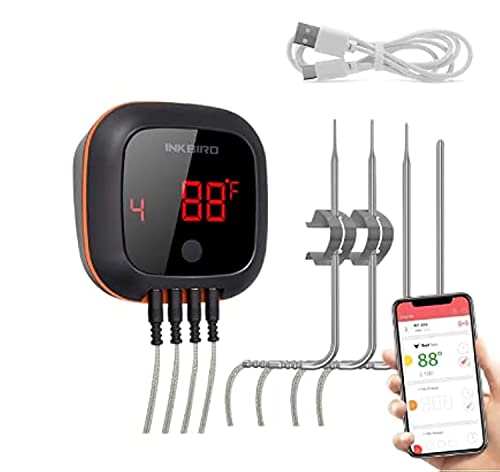
INKBIRD IBT-4XS Bluetooth Meat Thermometer — 4 Probes — Best for Multi-Meat Cooks
Strictly, the INKBIRD IBT-4XS is a quad-probe thermometer — and it belongs in a dual-thermometer guide because it is where dual buyers graduate to. Four probes across a Bluetooth link of the 150-foot class, in a rechargeable unit: pit, brisket, pork shoulder, chicken — each at its own target, each with its own alert. Cooks who host, who batch, who run the smoker full, outgrow two probes within a season; this is the verified instrument waiting for them, badged honestly as the step beyond dual rather than disguised as one.
Strengths
- Four probes cover the full-smoker cook: one pit sentinel plus three meats at three targets
- Rechargeable unit with Bluetooth monitoring — no battery drawer archaeology before a cook
- INKBIRD’s value-for-specification positioning makes four probes cost what rivals charge for two
Trade-offs
- Four wired probes are a cable-management exercise: label them, route them, or spend the cook untangling identities
- Bluetooth range limits apply as with the TempSync — a same-property technology
- If you truly never cook more than one meat, this is capacity you will not use — buy the dual picks above
Key specs (from the verified listing):
- Probes: 4 probes (per verified listing)
- Connectivity: Bluetooth, 150 ft class (per verified listing)
- Power: Rechargeable (per verified listing)
- Model: IBT-4XS (per verified listing)
The multi-meat cook is a logistics problem disguised as a barbecue: different masses, different targets, different finishing times, one fire. Probes are how the problem becomes a schedule — the chicken’s alert, the shoulder’s stall, the brisket’s long plateau, all visible at once, all plannable around. The IBT-4XS’s contribution is making that visibility affordable and rechargeable, with INKBIRD’s enthusiast following as informal evidence of durability in the wild. Label the probes with coloured tape on day one; every four-probe owner wishes they had.
For competition practice, holiday cooks and freezer-filling batch sessions, this is the guide’s instrument. For the single-brisket Sunday, it is honest overkill — and this guide would rather sell you the right dual pick than a badge-inflated quad. Judge by your fullest smoker, not your emptiest: if the racks fill even monthly, the four-probe case is made.
Best for: hosts, batch cooks and full-smoker sessions with several meats at once. / Not suited for: single-meat cooks, who should buy a true dual pick above.
Check the current price on Amazon — INKBIRD IBT-4XS Bluetooth Meat Thermometer — 4 Probes: choose the listing sold or shipped by Amazon or the brand’s own store, and confirm the exact model name before you order.
ThermoPro TP20 Wireless Dual-Probe Meat Thermometer — Best Classic Wired Dual Probe
Every category has a classic, and in dual-probe thermometers it is the ThermoPro TP20 pattern: two wired probes — one tipped for the pit, one for the meat — a transmitter at the smoker and a wireless remote receiver you carry, with preset and custom alarms and no phone anywhere in the system. It is included as this guide’s sixth pick in unlinked form, for a reason stated plainly: at the time of writing, this batch could not match the TP20 to a stable Amazon listing with the certainty this programme requires for a purchase link, so it is recommended as a product and deliberately not linked. Buy it from ThermoPro’s own store or a major retailer where the model is certain.
Strengths
- The phone-free system: a dedicated receiver with real range, alarms and presets — nothing to pair, update or charge a subscription against
- The dual-probe archetype itself: pit probe and meat probe, the configuration every other pick in this guide elaborates on
- Wired slim probes suit every cut, and replacement probes for this pattern are widely available
Trade-offs
- Unlinked in this guide, as explained — you will buy it through the maker’s channel rather than a link here
- A remote receiver is one more object to keep track of, where phone systems ride in your pocket already
- No logging, graphs or smart guidance: it reports two temperatures superbly and does nothing else
Why does the classic endure? Because its failure modes are empty. No app update breaks it on brisket morning; no account, no Bluetooth pairing ritual, no WiFi password changed since last season. The receiver sits on the kitchen counter showing two numbers, beeps when a number crosses your line, and otherwise leaves you alone — a design philosophy that a meaningful minority of cooks prefers on principle, and that this guide respects enough to include without a link rather than exclude for lacking one.
If that philosophy is yours, the TP20 pattern is your pick, and the unlinked status should be read as this programme’s verification discipline working as intended — the same discipline that verified the other five picks protects you here by refusing to guess. Check the model name carefully wherever you buy; the dual-probe classic has imitators, and the genuine article is the one with the maker’s name and support behind it.
Best for: phone-free cooks who want the classic dual-probe system with a dedicated receiver. / Not suited for: cooks wanting app logging, wireless probes or whole-property WiFi range.
Comparison Table
| Pick | Badge | Key spec | Best for |
|---|---|---|---|
| MEATER Pro Duo WiFi & Bluetooth Thermometer — 2-Probe | Best Overall | 2 wireless probes; WiFi + Bluetooth; 1000°F class | Wire-free low-and-slow cooks |
| TempPro TempSync Bluetooth Meat Thermometer — 2 Probes | Best Value Dual Probe | 2 probes; Bluetooth; value tier | New and occasional smokers |
| CHEF iQ Sense Smart Wireless Meat Thermometer — 2 Probes (Gen 3) | Best Smart Dual Probe | 2 wireless probes; Gen 3 smart system | Learners who want guidance |
| ThermoWorks Signals BBQ Alarm Thermometer | Best for Serious Pitmasters | BBQ alarm thermometer; Wi-Fi + Bluetooth | Serious and overnight pitmasters |
| INKBIRD IBT-4XS Bluetooth Meat Thermometer — 4 Probes | Best for Multi-Meat Cooks | 4 probes; Bluetooth 150 ft class; rechargeable | Full-smoker multi-meat cooks |
| ThermoPro TP20 Wireless Dual-Probe Meat Thermometer | Best Classic Wired Dual Probe | 2 wired probes; dedicated receiver; unlinked | Phone-free traditionalists |
How to Choose the Best Dual Thermometer for Smokers
Choose by cook frequency first. Weekly and overnight cooks justify the professional and premium tiers — the ThermoWorks Signals and MEATER Pro Duo — because their cost divides by hundreds of cooks and their alarms and accuracy repay trust when you are asleep. Monthly cooks belong with the TempPro TempSync or the classic wired pattern: full dual technique at a proportionate spend. The most common error in this category is a first smoker paired with a flagship thermometer, or a fifth-year pitmaster still squinting at a value unit’s fading display; match the instrument to the practice you actually have.
Choose by format second. Wireless probes maximise convenience and door seal, and minimise what can melt — at premium prices and with thicker probes. Wired probes are slim, cheap to replace and honest, at the cost of cable routing through the door line. Phone-linked systems put the display in your pocket; dedicated-receiver systems keep a display on the counter and the phone out of the fire’s business. None of these is the correct format — but one of them is correct for your kitchen geography, your phone habits and your smoker’s door design, and ten honest seconds on those three facts settles it.
Choose by range last, and measure it in your own property. Bluetooth is a same-area technology — pit to patio to kitchen, through ordinary walls, usually. WiFi is a whole-property and beyond technology, for the school run and the sofa alike. Manufacturers’ range figures are open-field numbers; your walls are the truth. If your smoker sits far from the house or behind masonry, WiFi picks earn their premium on this fact alone. If your pit is six steps from the kitchen door, save the money with a clear conscience.
The Dual-Probe Method: Pit Probe, Meat Probe, and the Stall
Set the pit probe correctly and half the method is done: clipped to the grate, at the same level as the food, a few inches from the meat — close enough to share its climate, far enough not to read the meat’s cold mass in the early hours. That reading, not the lid gauge, is your cooking temperature; drive the fire to hold it where your recipe intends, and let the lid gauge become what it always secretly was — a decoration with a needle.
Set the meat probe in the thickest part of the muscle, away from bone and fat seams, and then practise the method’s discipline: do not chase it. Meat temperature in a smoker is a story with a famous middle chapter — the stall, where evaporative cooling holds the reading nearly still for hours while the cook is, in fact, progressing. Dual monitoring earns its keep precisely here: the pit probe proves the fire never faltered, which converts the stall from a panic (‘something is wrong’) into a schedule (‘this is the stall; we wrap, or we wait’). More briskets are ruined by stall panic than by any defect of fire or meat.
Use alarms as boundaries, not as entertainment. Set the pit alarm a sensible band around your target — tight enough to catch a dying fire, loose enough to ignore a gust — and the meat alarm at your wrapping point and your target. Then let the system do the watching while you do the living: that division of labour is the entire product. When the cook ends, note the two curves’ story in whatever log you keep; pitmasters who review their dual traces improve faster than those who rely on memory, because the traces do not flatter and do not forget.
Match the method to the instrument you chose and the system coheres. On the MEATER Pro Duo the ambient sensor at the probe tip is your pit reading, so placement of the meat probe does double duty — deep in the muscle for the meat, with its tip’s ambient zone reading the grate air honestly. On the ThermoWorks Signals the pit probe is a separate instrument on its clip, and its alarms are the ones to trust with the overnight hours. On the TempPro TempSync the method is identical at a gentler tier — which is the quiet thesis of this whole guide: the dual-probe method matters more than the badge on the transmitter, and every pick here performs the method completely. Buy the instrument your frequency justifies, then run the method without shortcuts, and your smoker becomes a known quantity within three cooks.
How to Run Your First Dual-Probe Smoke, Step by Step
Before the fire: verify both probes. Ice water and boiling water give you two known points at home altitude’s approximation; a probe that reads sensibly at both can be trusted in between. Charge or battery-check the system, pair it if it pairs, and run the cables or seat the wireless probes so the cook starts calm. Seasoned cooks do this the night before a long smoke, because brisket morning is no time to discover a dead transmitter.
At the start: pit probe clipped at grate level before the meat goes on, so you stabilise the fire against a true reading from the first minute. Meat probe in once the meat is placed — thickest point, centred, not touching bone. Set your alarm bands, start your log if you keep one, and close the door with the cook’s new mantra: the probes are watching, so you do not have to hover. Check the trend at the first hour mark to confirm the fire’s character, then let the intervals stretch.
Through the stall and the finish: trust the pit trace. If the pit held and the meat is stalling, you are watching barbecue happen, not fail. Wrap or ride it out per your method, probe for tenderness at the end rather than worshipping a final number — temperature proposes, tenderness disposes — and rest the meat properly while the probes, still in place, confirm the gentle fall. Clean probes promptly, coil cables loosely, return wireless probes to their charger. The system that is cared for between cooks is the system that is ready at 4 a.m. when the next brisket calls.
A word on records, because the first dual-probe cook deserves one. Write down — in a notebook, a phone note, anywhere durable — the pit temperature you held, the stall’s start and end, the wrapping decision and the result at the table. Three cooks of such notes constitute a personal manual for your smoker that no book can sell you, because it describes your fire, your fuel and your weather. Dual thermometers generate the data; the pitmaster who keeps it compounds it. This, more than any feature in any review above, is what separates the cooks who improve yearly from those who repeat their first year ten times.
Common Buying Mistakes
- Setting alarms so tight they cry wolf. A pit alarm that fires on every gust teaches you to ignore alarms — the one habit a dual system cannot survive. Bands wide enough for weather, narrow enough for a dying fire, are the calibration that matters.
- Cooking by the lid gauge while owning a dual thermometer. The pit probe at grate level is the temperature. Demote the lid gauge to decoration the day the dual arrives.
- Placing the pit probe against the meat or the wall. It must read the food’s air: grate-clipped, inches from the meat, clear of walls and drips.
- Stall panic. A flat meat trace with a steady pit trace is the stall, not a failure. Wrapping is a choice; opening the door every twenty minutes is an error.
- Buying flagship range for a patio pit. Bluetooth serves a six-step smoker perfectly. Match connectivity to your property, not to the brochure.
- Neglecting probe care. Probes are consumables with long lives if cleaned, dried and loosely coiled — and short ones if left baked, soaked or kinked.
- Judging doneness by number alone. Temperature is the map; tenderness is the territory. Probe-tender is the finish line temperature can only announce.
Final Recommendation
For most smokers, the modern default is the MEATER Pro Duo: wire-free, dual, ranged for real properties, and built to survive the fire’s worst moods. Value and first-smoker households should start with the TempPro TempSync and learn the dual method at a gentle price; learners who want coaching should take the CHEF iQ Sense. Serious and overnight pitmasters belong with the ThermoWorks Signals, full stop. Hosts who fill the smoker should step up to the INKBIRD four-probe, and phone-free traditionalists should buy the ThermoPro TP20 pattern through the maker’s own channel, with this guide’s respect and its explanation in the review above.
Whichever system you choose, the upgrade that matters is already decided: two temperatures, honestly read, from this cook forward. Buy through the verified listings where they exist, check current prices there, verify your probes before the first long cook — and expect your smoking to change character within a month, from hoping the fire behaved to knowing that it did.
Pair the thermometer with the smoker it will serve and the programme completes itself: the dual-fuel combos in this batch’s companion guide are exactly the machines whose two fires reward dual probing most, since a charcoal chamber’s true grate temperature is the one number their lids cannot tell you. Instrument the fire you own, learn its traces across three honest cooks, and the combination — a known smoker, honestly monitored — is the whole of barbecue competence. Everything after that is practice, and practice, unlike temperature, was never the problem. Give the practice an honest instrument and a season of Sundays, and the pitmaster this guide’s badges keep addressing — the serious one, the learning one, the hosting one — turns out to have been you all along.
Keep exploring the same category with these companion guides from this programme: Best Dual Fuel Smokers Best Digital Thermometer For Smokers Best Digital Meat Thermometer For Smokers Best Digital Smokers Best Digital Grill Smokers Best 3 Inch Thermometer For Offset Smokers.
Frequently Asked Questions
Why do I need two probes for smoking?
Because smoking is controlled by two temperatures: the pit’s air at grate level, which cooks the meat, and the meat’s internal temperature, which reports its progress. Your smoker’s lid gauge reads neither accurately. A dual thermometer reads both, simultaneously, and that pair is the difference between guessing and knowing.
Where exactly should the pit probe go?
Clipped to the cooking grate, at the food’s level, a few inches from the meat — near enough to share its climate, clear of the meat itself, the walls and dripping fat. That position reads the temperature your food actually experiences.
Wireless or wired probes — which is better for a smoker?
Wireless probes keep the door seal perfect and remove meltable cables, at premium prices and with thicker probes. Wired probes are slimmer, cheaper to replace and suit every cut, at the cost of routing cables through the door line. Both are legitimate; this guide’s badges separate them by household rather than declaring a winner.
What is the stall, and how does a dual thermometer help?
The stall is the plateau where evaporative cooling holds meat temperature nearly steady for hours mid-cook. A dual thermometer helps by proving, via the pit probe, that the fire never faltered — converting panic into patience, and making wrap-or-wait a decision instead of a guess.
Can I use a dual thermometer for grilling too?
Yes — pit probe becomes grill-zone probe, meat probe stays meat probe, and the same alarms apply at higher temperatures. Check your probes’ heat rating for direct-flame work; the MEATER Pro Duo’s listing specifies a 1000°F class, while value wired probes prefer indirect zones.
How do I know my probes are still accurate?
Test them in ice water and in boiling water — two known points. A probe reading sensibly at both ends can be trusted between them. Test before long cooks and after any probe has been dropped, kinked or baked beyond its rating.
Do I need a separate instant-read thermometer as well?
Eventually, most serious cooks own both, for different moments: the dual system monitors the cook continuously, while an instant-read checks specific spots at the end — the flat versus the point of a brisket, the thin end of a rack. The dual thermometer is the first purchase because it governs hours; the instant-read is the second because it governs seconds. This guide’s category is the hours, and the hours are where smoking is won.


