Disclosure: airfryerkitchensupply.com is reader-supported. When you buy through links on our site, we may earn an affiliate commission at no extra cost to you.
Where to buy
The best digital meat thermometer for smokers is the instrument that tells you the one number a smoker cannot guess: the temperature inside the meat, right now, without opening the lid. The verified field splits into leave-in probes that ride the whole cook — wireless pucks, cabled multi-probe systems — and the instant-read you stab in at the end to verify. The six picks below cover both halves, led by MEATER’s WiFi Pro Duo and a one-second TempPro instant-read that every smoker in this guide deserves as a partner.
- MEATER Pro Duo Smart Meat Thermometer — check price on Amazon; choose the listing sold or shipped by Amazon or the brand’s own store, and confirm the exact model name before you order.
- TempPro TempSwift TP19H Instant Read Meat Thermometer — check price on Amazon; choose the listing sold or shipped by Amazon or the brand’s own store, and confirm the exact model name before you order.
- CHEF iQ Sense Smart Wireless Meat Thermometer, 2 Probes — check price on Amazon; choose the listing sold or shipped by Amazon or the brand’s own store, and confirm the exact model name before you order.
- TempPro TempSync 1000FT Wireless Meat Thermometer, 4 Probes — check price on Amazon; choose the listing sold or shipped by Amazon or the brand’s own store, and confirm the exact model name before you order.
- MEATER Plus Smart Meat Thermometer — check price on Amazon; choose the listing sold or shipped by Amazon or the brand’s own store, and confirm the exact model name before you order.
- INKBIRD IBT-4XS Bluetooth Meat Thermometer — check price on Amazon; choose the listing sold or shipped by Amazon or the brand’s own store, and confirm the exact model name before you order.
The best digital meat thermometer for smokers earns its place in the first hour of the first cook. A smoker’s chamber temperature is a rumour; the meat’s internal temperature is the fact — the difference between a brisket pulled at rendering tenderness and one pulled at a number on a chart, between chicken served juicy and chicken served safe-but-sorry. Digital meat thermometers close the gap between rumour and fact in two ways: leave-in probes that report continuously while the lid stays shut, and instant-reads that verify in a second wherever you point them. Serious smokers own one of each, and this guide is organised to help you choose both halves well.
A clarification this cluster of guides insists on: this article is about instruments for the meat. Its sibling — the digital thermometer guide — covers pit monitoring: ambient probes, high-low alarms and the systems that watch the cooker itself. The two overlap in the shops and differ in the hand, and conflating them is how buyers end up with a beautiful pit monitor and no idea what their brisket is doing. Here, every pick is judged on meat duty: probe design, sensor placement, heat tolerance at the meat, and the speed and honesty of the number it reports.
Where a listing states a range or a heat rating, the review quotes it; where it does not, the review stays silent rather than borrowing numbers from a brand’s wider reputation.
In this guide
Quick Picks
Six verified meat thermometers for smoking — two MEATER wireless systems, CHEF iQ’s ultra-thin probes, TempPro’s long-range RF set and one-second instant-read, and Inkbird’s four-probe value standard.
- Best Overall: MEATER Pro Duo Smart Meat Thermometer — two fully wireless probes with WiFi and Bluetooth, six sensors each and 1000°F heat resistance — the leave-in system to beat for smoking.
- Best Instant-Read: TempPro TempSwift TP19H Instant Read Meat Thermometer — the one-second verifier — an instant-read with auto-rotating backlit display and waterproof body, for checking any spot on any cut without opening your cook to the weather.
- Best Ultra-Thin Probes: CHEF iQ Sense Smart Wireless Meat Thermometer, 2 Probes — the slim-probe alternative — two ultra-thin wireless probes with five sensors, 1000°F heat safety and WiFi’s unlimited range.
- Best Long-Range RF System: TempPro TempSync 1000FT Wireless Meat Thermometer, 4 Probes — the base-station workhorse — four colour-coded cabled probes reporting over 1000FT RF to a backlit receiver with alarms, no phone or WiFi required.
- Best Single Wireless Probe: MEATER Plus Smart Meat Thermometer — the original wireless probe, perfected as a single — a walnut-block Bluetooth probe with 165ft range for the one-cut cook.
- Best Value Multi-Probe: INKBIRD IBT-4XS Bluetooth Meat Thermometer — four probes, honest Bluetooth and a magnetic back — the rechargeable Inkbird that put multi-probe monitoring within everyone’s reach.
How These Picks Were Chosen
Instruments that could not be confirmed were excluded, including some famous names sold mainly direct.
Judging weighted meat-duty criteria: sensor honesty and placement, probe survivability at smoker temperatures, the usefulness of the monitoring architecture (wireless, RF, Bluetooth, cabled), and the verification role of the instant-read. Range figures are quoted as the listings state them, with the standing caveat — repeated in the reviews — that all wireless ranges are clear-air numbers taxed by walls and weather.
One boundary of this guide deserves stating: dedicated pit-monitoring systems — the instruments that watch the cooker rather than the cook — are reviewed in the sibling thermometer guide, and only the TempSync’s spare-probe capability is mentioned here in passing. Keeping the two briefs separate is deliberate; a buyer who arrives asking about meat should leave knowing about meat, with a clear signpost to the pit side rather than a muddle of both.
No prices or ratings appear, by policy. Thermometer pricing is volatile and promotion-driven; check price on Amazon for the exact model, and decide by architecture — how many probes, which link, whose display — using the buying guide below.
The 6 Best Digital Meat Thermometer For Smokers

MEATER Pro Duo Smart Meat Thermometer — Best Overall
The MEATER Pro Duo is what the leave-in meat thermometer becomes when every compromise is engineered out: two completely wireless probes — no cables across the grate, no transmitter box on the shelf — each carrying six sensors, rated to 1000°F, reporting over WiFi and Bluetooth from a bamboo charging block that doubles as the system’s home. In a smoker, the wirelessness is transformative in a specific way: meat can be turned, wrapped, moved and spritzed without a cable negotiation, and a rotisserie or a crowded rack stops being a wiring problem. For brisket-and-ribs programmes, two probes is the working number, and this is the two-probe system to beat.
Strengths
- Truly wireless probes: nothing to route, melt or tangle at the grate
- Six sensors per probe and 1000°F rating cover smoker and sear alike
- WiFi plus Bluetooth with app guidance, resting and carryover estimates
Trade-offs
- Premium positioning: this is the considered purchase of the category
- Probe diameter, while slimmed across generations, still leaves a real hole in delicate cuts
- The system lives in its app; cooks who want a standalone display should look at the RF pick below
| Probes | 2 wireless probes (from listing) |
| Sensors | 6 per probe (from listing) |
| Heat rating | 1000°F (from listing) |
| Connectivity | WiFi and Bluetooth (from listing) |
Sensor count sounds like marketing until you cook with it. A probe carrying multiple sensors along its length reads the meat at several depths and the ambient air at its tip’s other end, letting the system estimate the meat’s true thermal centre rather than trusting wherever the tip happened to stop. In a brisket — a cut whose point and flat cook like different animals — that estimation is the difference between a number and knowledge. The app’s guided cooks and rest predictions build on the same data, and while no algorithm replaces a cook’s squeeze test, this one earns its place beside it.
The 1000°F rating quietly widens the brief beyond smoking: the same probes survive the sear at the end of a reverse-sear, the oven, the fryer — one instrument for the whole kitchen rather than a smoker-only accessory. Ownership is correspondingly simple: probes live in their bamboo block, charge between cooks, and ask only to be kept clean and dry. For smokers who cook several proteins at once and hate cables with a principled hatred, this is the answer, and it is not close.
Best for: multi-protein smokers who want wireless freedom and the deepest data / Not suited for: single-cut cooks on a budget — the MEATER Plus or Inkbird below serve you for less commitment

TempPro TempSwift TP19H Instant Read Meat Thermometer — Best Instant-Read
Every leave-in probe in this guide shares one limitation: it measures where it sits. The TP19H is the corrective — a one-second instant-read thermometer you touch to the brisket’s thick end, the chicken’s thigh joint, the rib’s middle, and know. Its display rotates automatically for whichever hand and angle you approach from, lights itself, wakes on motion, and the body is waterproof against the spritz bottle and the sink. In a smoker’s kit this is not the alternative to a probe system; it is the referee every probe system answers to, and the single highest-value thermometer purchase a new smoker can make.
Strengths
- One-second readings: verify anywhere, instantly, lid open for moments only
- Auto-rotating backlit display reads from any angle, in smoke and dusk alike
- Waterproof, motion-activated body built for the wet end of barbecue work
Trade-offs
- It verifies; it does not monitor — long cooks still want a leave-in for the hours between checks
- A folding probe is one more thing to keep clean at the hinge
- No app, no alarms, no graph: this is an instrument, not a system
| Read time | 1 second (from listing) |
| Display | Auto-rotating, backlit (from listing) |
| Body | Waterproof (from listing) |
| Activation | Motion-activated (from listing) |
The case for an instant-read in a smoker’s hand is the case against single-point faith. A brisket is not one temperature; it is a landscape — the flat’s far end, the point’s heart, the seam between them — and doneness lives in the coldest relevant valley. A one-second read lets you map that landscape in a single lid opening: four stabs, four numbers, a decision. The same logic serves ribs (between the bones), chicken (thigh, not breast, for safety’s truth), and the wrapped phase of any cook, when the leave-in probe’s cable becomes a foil-tearing liability and the instant-read simply goes where it is told.
Details decide whether an instant-read gets used or drawer-bound, and the TP19H’s are the right ones: the rotating display because briskets are approached from odd angles, the backlight because smoking happens at dusk and dawn, the waterproofing because a thermometer that fears the sink gets cleaned reluctantly and late. Buy one before you buy any system in this guide; it will still be working, and still be right, when the systems have been replaced twice.
Best for: absolutely every smoker, as the always-carried verifier / Not suited for: cooks wanting unattended monitoring — pair it with a leave-in from this list

CHEF iQ Sense Smart Wireless Meat Thermometer, 2 Probes — Best Ultra-Thin Probes
CHEF iQ’s Sense answers the wireless probe’s oldest criticism — the hole — with the thinnest probes in this guide: two ultra-thin wireless probes, five sensors apiece, heat-safe to 1000°F, reporting over WiFi with the unlimited range a home network grants. Thin probes matter most where the meat is precious or delicate: a competition chicken, a fish fillet’s thick end, a steak you intend to photograph. The Gen3 system wraps the hardware in an app experience built around guided cooking, and for cooks who found earlier wireless probes too blunt an instrument, this is the refinement to try.
Strengths
- Ultra-thin probes leave the smallest mark in delicate and premium cuts
- WiFi unlimited range: monitor from anywhere the internet reaches
- Five sensors per probe with 1000°F heat safety
Trade-offs
- App-centred ownership: the experience assumes a phone at the cook
- Two probes is the set; larger programmes need a second system or a wired sibling
- A younger platform than MEATER’s: ecosystem and longevity still being proven
| Probes | 2 ultra-thin wireless probes (from listing) |
| Sensors | 5 per probe (from listing) |
| Heat rating | 1000°F (from listing) |
| Connectivity | WiFi, unlimited range (from listing) |
Probe diameter is a real culinary variable, not an aesthetic one. Every probe displaces meat and leaves a channel; in a thick brisket the channel is trivia, in a chicken breast or a prized steak it is a visible wound that leaks juice on the slice. The Sense’s slim probes reduce that cost to near the vanishing point while keeping the multi-sensor estimation that makes wireless probes trustworthy — five sensors is a serious array in a shaft that thin, and it signals where the engineering budget went.
The unlimited-range WiFi framing deserves its plain translation: the probes talk to your network, your phone talks to the internet, and the cook becomes location-independent — the school run, the office, the neighbour’s porch are all within monitoring range. Cooks whose smoking day is genuinely mobile will feel the difference between this and Bluetooth’s honest tether immediately. Cooks who smoke within sight of the patio will not, and should weigh the MEATER Plus below or the Inkbird’s value accordingly.
Best for: mobile cooks and delicate-cut specialists wanting wireless without the wound / Not suited for: cooks who prefer a base-station display to a phone-centred system

TempPro TempSync 1000FT Wireless Meat Thermometer, 4 Probes — Best Long-Range RF System
The TempSync 1000FT represents the other great architecture of meat monitoring: cabled probes into a transmitter at the smoker, a dedicated receiver in your hand, and a radio link rated to 1000 feet that owes nothing to WiFi, phones or accounts. Four colour-coded probes cover a full programme — brisket point, brisket flat, ribs, and the pit itself if you dedicate one — with alarms set per probe on a backlit display you can read across a dark yard. For cooks who distrust app-dependence, farm and acreage cooks whose distances laugh at Bluetooth, and anyone whose smoker lives beyond the home network’s reach, this is the system architecture that simply works.
Strengths
- 1000FT RF range: works where WiFi and Bluetooth give up
- Four colour-coded probes with per-probe alarms on a standalone receiver
- No phone, app or account anywhere in the chain
Trade-offs
- Cables return: routing four leads through a smoker door is a learned tidiness
- The receiver is one more device to charge, carry and not drop in the beans
- Range is a line-of-sight rating; buildings and terrain tax it honestly
| Range | 1000FT RF (from listing) |
| Probes | 4 color-coded probes (from listing) |
| Display | Backlit receiver with alarms (from listing) |
| Technology | RF, phone-free (from listing) |
There is a philosophy in this box: a thermometer should be a thermometer. The receiver wakes instantly, shows four numbers, and alarms when told to — at 6am, in gloves, without an update, a login or a permissions dialogue. Owners who cook on land, at camps, at competition sites with congested networks, or simply past the patience for app stewardship, describe the same relief. The RF link’s thousand-foot rating is a fair-weather figure, but even taxed by walls and weather it outranges Bluetooth several times over, and it never once asks about your router.
Four probes is the other half of the argument, and smokers should think in fours: two in the brisket’s two muscles, one in the ribs, one spare or on the grate. Colour-coding sounds trivial until four identical cables emerge from one door at midnight; then it is the feature you would not trade. Paired with the instant-read above for spot verification, the TempSync is the most complete phone-free meat-monitoring station this guide can assemble.
Best for: app-free cooks, big properties and four-probe programmes / Not suited for: minimalists who want two wireless probes and a phone, nothing more

MEATER Plus Smart Meat Thermometer — Best Single Wireless Probe
Most smokes, most days, involve one hero cut — and for that cook, the MEATER Plus remains the category’s most elegant answer: a single wireless probe in a walnut charging block, Bluetooth-linked to 165 feet, with the guided-cook app that taught the market what a smart thermometer could be. No cables, no receiver, no second probe you will not use. It rides a pork shoulder from fridge to rest, estimates the finish, calls you when to wrap and when to pull, and returns to its block to charge. If the Pro Duo is the programme system, the Plus is the daily driver, and daily drivers are where categories are truly won.
Strengths
- Single-probe simplicity: the cleanest possible leave-in setup
- Walnut block charger is genuinely handsome kit that lives on the counter
- Guided cooks, estimates and alerts in the mature MEATER app
Trade-offs
- Bluetooth range is honest but finite — walls between you and the smoker tax it
- One probe means one cut monitored; multi-protein cooks outgrow it
- Wireless probes share the category’s diameter consideration in delicate meat
| Probes | 1 wireless probe (from listing) |
| Range | 165ft Bluetooth (from listing) |
| Charger | Walnut block (from listing) |
| Use | Grill and oven rated (from listing) |
The Plus’s longevity in the market is itself the review: this is the product that defined wireless meat thermometry, refined across years of ownership feedback into a tool whose behaviours are all known quantities. The app experience — set the cut, set the target, watch the ambient and internal curves converge on an estimated finish — converts beginners fastest, because it makes the invisible visible in the most literal way. In a smoker, where the cook’s whole problem is not being able to see inside the meat, that visibility is the product.
Choose it with clear eyes about its two honest limits. Bluetooth’s 165 feet is a clear-air figure; a smoker outside and a cook inside through two walls will test it, and the Pro Duo’s WiFi exists for exactly that house. And one probe monitors one thermal story — the shoulder is covered, the ribs ride on faith and the instant-read. For the enormous population of one-cut cooks, neither limit binds, and the Plus remains the recommendation this guide gives most casually and most often.
Best for: one-cut households wanting the wireless habit without system weight / Not suited for: multi-protein programmes and houses where Bluetooth cannot reach the kitchen
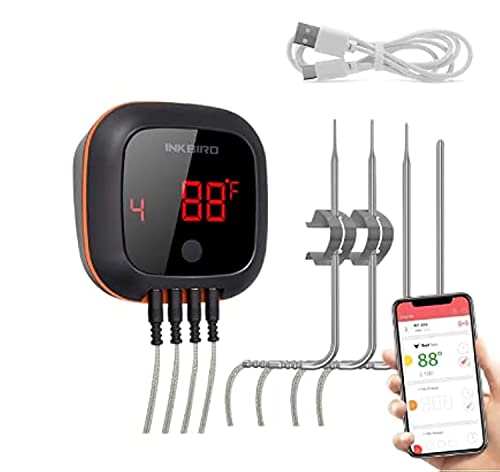
INKBIRD IBT-4XS Bluetooth Meat Thermometer — Best Value Multi-Probe
The IBT-4XS is the thermometer that democratised the four-probe cook: four cabled probes into a rechargeable Bluetooth base with a backlit LED display, timer and alarm functions, and a magnetic back that parks it on the smoker’s shelf or the fridge door. It reports to an app across a 150-foot Bluetooth range, and it has done so, reliably, for a generation of smokers who learned multi-probe discipline on it. Inkbird’s wider reputation in temperature control — the company also makes the fan controllers in this programme’s other guides — shows in the details: sensible alarms, honest range claims, and a price position (check Amazon) that makes ‘one probe per protein’ a normal household decision.
Strengths
- Four probes at the accessible end of the market
- Rechargeable base with backlit display, timer and alarms — works phone-free at the smoker
- Magnetic mounting and a mature, simple app
Trade-offs
- 150FT Bluetooth is the shortest tether in this guide — plan your monitoring distance
- Cabled probes: the routing ritual returns, fourfold
- Display and app are functional rather than beautiful
| Probes | 4 probes (from listing) |
| Range | 150FT Bluetooth (from listing) |
| Power | Rechargeable (from listing) |
| Display | LED backlit with timer and alarm (from listing) |
Value picks earn their slot by deciding real cooks’ real programmes, and the IBT-4XS’s four probes do exactly that at the price tier where households actually shop. The pattern it enables — brisket point, brisket flat, one grate-level ambient check, one protein of the day — is the pattern the expensive systems also enable; the differences are range, polish and probe wirelessness, not the cooking. For a smoker building skills, those are the right differences to defer paying for.
The base unit’s standalone competence deserves emphasis: with its own display, timer and alarms, the Inkbird monitors perfectly well with the phone in another room or out of battery — a resilience the app-only systems cannot claim. Mount it magnetically where you can see it from the door, route the cables once with care, and the IBT-4XS becomes the kind of tool that disappears into the routine, which is the highest praise working thermometers ever get.
Best for: budget-conscious programmes wanting four probes and standalone backup / Not suited for: cooks who need monitoring range beyond Bluetooth or hate cables entirely
Comparison Table
Two architectures and one referee: wireless probes, cabled systems, and the instant-read that verifies them all. Match the row to your programme size and your house’s distances.
| Pick | Badge | Key spec | Best for |
|---|---|---|---|
| MEATER Pro Duo Smart Meat Thermometer | Best Overall | 2 wireless probes, 6 sensors, 1000°F, WiFi | Most smokers wanting the best leave-in meat system |
| TempPro TempSwift TP19H Instant Read Meat Thermometer | Best Instant-Read | 1-sec instant read, rotating backlit display | Every smoker, as the verification half of the kit |
| CHEF iQ Sense Smart Wireless Meat Thermometer, 2 Probes | Best Ultra-Thin Probes | 2 ultra-thin probes, 5 sensors, WiFi, 1000°F | Delicate cuts and presentation-conscious cooks |
| TempPro TempSync 1000FT Wireless Meat Thermometer, 4 Probes | Best Long-Range RF System | 4 probes, 1000FT RF, standalone receiver | Large properties, app-sceptics and full-programme cooks |
| MEATER Plus Smart Meat Thermometer | Best Single Wireless Probe | 1 wireless probe, 165ft Bluetooth, walnut block | One-cut cooks wanting wireless simplicity |
| INKBIRD IBT-4XS Bluetooth Meat Thermometer | Best Value Multi-Probe | 4 probes, 150FT Bluetooth, rechargeable, magnetic | Value-first cooks wanting four-probe coverage |
How to Choose a Digital Meat Thermometer for Smoking
Decide the architecture first, because it decides your cooking posture. Wireless probes free the meat entirely — turn it, wrap it, move it — and report through an app; they suit cooks who value freedom and cook one or two proteins. Cabled multi-probe systems monitor a whole programme from a base station, at the cost of routing cables; they suit brisket-plus-ribs Saturdays and cooks who want a display that is not a phone. RF systems like the TempSync are the cabled idea with the leash cut at the receiver instead of the probe. There is no wrong architecture here — there is only the one that matches your cooks, your distances and your patience for apps.
How many probes do you actually need?
Count proteins at your largest regular cook, then add the brisket rule: a whole packer wants two probes, one in the flat and one in the point, because the two muscles finish at different times and the flat’s verdict governs the pull. Most households land at two probes for life and four for programmes; one-probe cooks are the honest single-cut majority the MEATER Plus serves. Buying four when you cook one wastes little money but adds cable clutter; buying one when you cook programmes costs you the ribs’ data every single Saturday.
The instant-read is not optional
Whichever system you choose, budget for the instant-read as its partner. Leave-in probes measure a point; cooks are decided by landscapes. The one-second verification pass — thick end, thin end, the seam, the second chicken — is how experienced smokers reconcile a probe’s confidence with a cut’s reality, and it is also the fastest doneness check for everything that never carried a probe: ribs, burnt ends, the sausage that went on late. The TP19H in this guide exists because no system pick, at any price, makes it redundant.
Wireless, RF or Cabled: Living With Each Architecture
A season with each architecture teaches what the spec sheets cannot. Wireless probes make the cook physically careless in the best way — meat moves freely, the smoker’s door never negotiates with a cable, and the app’s estimates become a background confidence — at the price of charging discipline and the occasional range negotiation with your own house’s walls. Cabled systems are the opposite temperament: a small ritual at loading, absolute indifference to walls thereafter, and a base station that works in gloves, in rain, in the dark, forever. RF splits the difference with a receiver that behaves like a tool rather than a platform.
House geometry is the hidden specification in every one of these decisions. A ranch house with the smoker outside the kitchen window forgives Bluetooth anything; a brick house with the smoker at the garden’s end forgives nothing but WiFi and RF. Before choosing, stand at your smoker with your phone and read its signals honestly — WiFi strength for the connected picks, and your own sense of distance for the Bluetooth ones. The best thermometer in this guide is the one whose link survives your actual geography, and the reviews flag each architecture’s honest reach so the match can be made with open eyes.
Probe Craft: Placement, Sensors and the Numbers That Matter
A thermometer is only as truthful as its placement. The probe’s sensing zone must sit in the meat’s thermal centre — the thickest part, away from bone (bone conducts heat and flatters the reading) and away from fat seams (which read their own story). Multi-sensor probes like the MEATER Pro Duo and CHEF iQ Sense forgive imperfect placement by sampling along the shaft; single-sensor probes demand the cook’s care. When a reading surprises you — too fast, too slow, impossibly even — suspect placement before you suspect the meat, and verify with the instant-read an inch away. Disagreement between instruments is information, not malfunction.
Heat ratings decide where a probe may live. Smoking temperatures are gentle, but the same probe may be asked to survive a sear, a hot oven or a flare-up at the smoker’s edge; the 1000°F ratings on the wireless picks here buy that freedom, while cabled probes ask respect for their cables’ limits at the door seam — the classic failure point, where a slammed lid or a sharp grate edge ends a probe’s career. Route cables once, route them kindly, and every system in this guide will outlast several smokers’ worth of cooks.
Finally, learn your instruments’ language of doneness. A number is a proxy; the meat’s tenderness — the probe sliding in like butter, in the brisket cook’s phrase — is the fact the number approximates. Digital thermometers at their best do not replace that judgement; they tell you when to start exercising it, which is why the finest cooks in this craft carry both a system and an instant-read, and consult each against the other.
How to Use a Meat Thermometer Across a Full Smoke
One brisket, start to finish, as the worked example — the same rhythm serves shoulders, ribs and chicken with adjusted targets. The instruments change; the discipline does not.
- Charge and check before the meat is seasoned. Wireless probes out of their blocks and confirmed in the app, cables inspected at the door-seam wear points, instant-read battery alive. Thermometer problems found now are errands; found at hour six, they are crises.
- Probe at loading, not later. Insert leave-in probes into the cold, seasoned meat before it enters the smoker — flat and point on a brisket — so the whole cook is recorded and the meat is never opened up mid-run for instrumentation.
- Set alarms with intent. A wrap alert at the bark’s readiness zone, a target alert near the finish, and a low-temperature guard on the pit probe if you run one. Alarms you set thoughtfully wake you for decisions; alarms left at defaults wake you for nothing.
- Monitor the curve, not the moment. Check the app or receiver on a rhythm — hourly is plenty for most of a brisket — and read the trend: the stall will announce itself as a flattening long before it becomes a worry.
- Verify at the wrap. When you open to wrap, spend twenty seconds with the instant-read mapping the cut — thick end, thin end, seam — and reconcile it with the leave-in’s story before the foil closes.
- Judge the finish by probe and by feel. Near target, the instant-read becomes a tenderness probe: sliding resistance tells you what the number cannot. Pull on the combined verdict, never the number alone.
- Track the rest. Leave a probe in during the rest and watch carryover do its work; the rest curve teaches you more about your smoker’s timing than any single cook’s climax.
- Clean probes like cutlery. Wash probes and cables’ food ends promptly, dry them fully, and return wireless probes to their chargers. Instruments stored clean are instruments that survive to be accurate.
After three cooks run this way, a pattern emerges that no specification sheet can give you: your smoker’s personality expressed through your instruments — where its readings run optimistic, how its stalls behave, when its finishes truly land. That personal calibration, cook over cook, is the actual product a good meat thermometer sells. The systems above are the ones this guide trusts to teach it.
Accuracy, Calibration and Trusting Your Instruments
Digital thermometers earn trust by surviving verification. The classic check costs nothing: an ice-water slurry reads at freezing, boiling water at boiling (adjusted for altitude), and any instrument in this guide should sit close to both marks. Run the check when a thermometer is new, after any drop or door-slam incident, and at the season’s start; a probe that fails it gets retired from brisket duty to candy duty, or replaced. Multi-sensor wireless systems self-report more of their health through their apps, but the ice bath remains the court of final appeal — physics does not have a firmware version.
Battery honesty belongs in the same conversation. Wireless probes live or die by their charging ritual — a probe that enters a twelve-hour brisket half-charged is a monitoring gap scheduled in advance — and the bamboo and block chargers in this guide exist to make the ritual effortless by giving the probes a home that is also a charger. Cabled bases ask less often but ask eventually; the Inkbird’s rechargeable design and its standalone display mean a low battery degrades the system gracefully to a wired readout rather than to silence. Whichever architecture you choose, the night-before check — probes charged, base charged, instant-read alive — is the cheapest insurance in all of barbecue.
Carryover and rest behaviour are the last accuracy lesson. Meat’s internal temperature coasts upward after pulling, then falls through the rest; a thermometer left in place turns that invisible arc into knowledge you can plan slicing around. It is a small example of the guide’s whole thesis: these instruments do not cook the meat — they make the cook’s decisions timely, and timely decisions are what separate the brisket you boast about from the one you apologise for.
Common Buying Mistakes
Probing next to the bone. Bone conducts the smoker’s heat into the sensor and reports the meat done before it is. Always place the sensing zone in pure muscle, and verify suspiciously fast cooks with the instant-read an inch away.
Trusting a single point in a two-muscle cut. A brisket’s flat and point finish on different schedules; one probe forces you to guess the other half. Two probes — or an instant-read map at the finish — is the minimum honest instrumentation.
Leaving cables to be slammed in the door. More probes die at the door seam than in any fire. Route leads through the intended path, close the lid like you mean to keep them, and inspect the wear points each season.
Cooking to the number and skipping the feel. Temperature proposes; tenderness disposes. The smoker who pulls a brisket at the target while it still probes tight has obeyed the instrument and betrayed the meat.
Storing probes dirty or discharged. Wireless probes left flat in a drawer and cables stored with last month’s brisket on them are next season’s error messages. Clean, dry, charged, in their blocks — a thirty-second ritual.
Final Recommendation
Build the kit in this order: the TempPro TP19H instant-read first, because it verifies everything including your own judgement; then the leave-in that matches your life — the MEATER Pro Duo for wireless programme cooking, the CHEF iQ Sense for delicate cuts and true remote range, the TempSync 1000FT for phone-free distance, the MEATER Plus for one-cut simplicity, or the INKBIRD IBT-4XS for four probes at the sensible end of the market. Any of these pairings outperforms any single instrument in this guide used alone.
Check price on Amazon for the exact models — thermometer names repeat across generations — and read the cluster’s other half before deciding your whole setup: Best Digital Thermometer For Smokers covers pit monitoring and alarms, Best Bluetooth Meat Thermometer For Smokers narrows the wireless field further, and Best Dual Thermometer For Smokers examines the two-probe pit-and-meat instruments. If your smoker itself is the next upgrade, Best Digital Smokers surveys the digitally controlled machines these thermometers serve, and Best Bluetooth Thermometer For Smokers rounds out the connected-instrument picture.
To act on this guide: start with MEATER Pro Duo Smart Meat Thermometer, then compare TempPro TempSwift TP19H Instant Read Meat Thermometer, and finally CHEF iQ Sense Smart Wireless Meat Thermometer, 2 Probes — check price on Amazon on each listing, confirm the exact model name and size, and choose by the design logic above rather than by the headline discount.
Frequently Asked Questions
Do I need both a leave-in probe and an instant-read?
For smoking, yes — they do different jobs. The leave-in watches one point continuously so the lid stays shut; the instant-read maps the whole cut in seconds when a decision is due. Each covers the other’s blind spot, and the pair costs less than most single mistakes they prevent.
Are wireless probes accurate enough for brisket?
The multi-sensor wireless picks here — MEATER Pro Duo, CHEF iQ Sense — estimate the meat’s thermal centre from several sensors and are trusted by serious cooks for exactly this job. Verify occasionally with an instant-read, as you should with any instrument, and their convenience costs you nothing in truth.
How many probes should a beginner buy?
Two is the sweet spot for most: a brisket wants two by itself, and two proteins are the normal family cook. One-probe cooks are well served by the MEATER Plus; four-probe systems earn their cables when programmes — brisket plus ribs plus a third — become your normal Saturday.
What temperature rating do smoker probes need?
Smoking itself is gentle, but probes migrate — to the grill, the oven, the sear. The 1000°F ratings on this guide’s wireless picks buy that freedom. Cabled probes should be kept within their makers’ stated limits, with special care for cables at the smoker’s door seam.
Why does my thermometer disagree with my smoker’s display?
They measure different places: the smoker reads its sensor’s air; your probe reads the meat’s interior or the grate’s air. Disagreement is geography, not error. The meat probe’s number governs doneness; the smoker’s governs the fire; your job is knowing which witness to ask which question.
Can I leave a wireless probe in during the rest?
Yes, and you should: the rest curve — carryover rise, then the fall toward slicing temperature — is some of the most useful data a cook collects, and it costs nothing but leaving the probe where it already is.


