Disclosure: airfryerkitchensupply.com is reader-supported. When you buy through links on our site, we may earn an affiliate commission at no extra cost to you.
Where to buy
Shopping for the best drawing chairs? The fastest way to buy any pick in this guide is through Amazon, where stock, delivery and returns are handled in one place. Start with our top recommendation, the Primy Drafting Chair Tall Office Chair with Flip-up Armrests (Check the current price on Amazon), then compare it against the other picks below before you decide. Prices move with stock and season, so we never print a fixed price in the article itself — use the check-price links to see the current figure on Amazon.
- Primy Drafting Chair Tall Office Chair with Flip-up Armrests — Check price on Amazon
- AtHope Drafting Chair with 3D Lumbar and Head Support — Check price on Amazon
- HYLONE Big and Tall Heavy Duty Drafting Chair — Check price on Amazon
- Work Smart Office Star ST217 Backless Drafting Stool — Check price on Amazon
- Office Star Saddle Drafting Stool — Check price on Amazon
- BOLISS Mid Back Mesh Drafting Chair — Check price on Amazon
The best drawing chairs solve a geometry problem before they solve a comfort problem. Drawing, drafting and detailed illustration work happens at a raised board or a standing-height desk, so the seat has to lift you high enough that your forearm rests level on the work surface, your feet need somewhere honest to rest instead of dangling, and the chair has to stay stable when you lean in over a large sheet. A standard office chair simply cannot reach that working height, which is why this category exists as its own product type rather than as a taller trim level of a normal chair.
Terminology matters here, because the listings use three words almost interchangeably. A drafting chair is a tall office chair with an extended lift cylinder and usually a footrest ring. A drafting stool drops the backrest and arms for freedom of movement. A drawing chair, in the way most buyers use the phrase, is the drafting chair used at a drawing board — which means the details that matter are seat height range, the footrest, back support for long sessions, and a base wide enough to feel planted when you reach across a big page. Every pick below was judged against that drawing-board reality, not against generic office-chair marketing.
One verification note before the picks. Three of the six picks below were confirmed against live Amazon catalog listings, and they carry buying links. The other three describe product types that belong in any honest drawing chair ranking — a backless drafting stool, a saddle stool and a simpler budget drafting chair — but they are presented unlinked with a verification marker, because we could not confirm matching listings to our standard at the time of writing. We would rather show you a clearly flagged gap than invent a product to fill it.
In this guide
Quick Picks
Six picks, three confirmed with links and three flagged unlinked slots. The Primy is the balanced default for a drawing board, the AtHope adds mesh and head support for long sessions, and the HYLONE is the heavy-duty option with a stated 400 lb capacity. The three unlinked slots cover the stool and budget formats the linked chairs do not.
| Pick | Badge | Why it is here | Link |
|---|---|---|---|
| Primy Drafting Chair Tall Office Chair with Flip-up Armrests | Best Overall | The balanced drafting-chair formula: extended height, footrest ring, lumbar support and flip-up arms that clear a drawing board. | Check price on Amazon |
| AtHope Drafting Chair with 3D Lumbar and Head Support | Best for Long Sessions | Mesh back, head support and a footrest ring — the configuration aimed at people who sit tall for hours at a stretch. | Check price on Amazon |
| HYLONE Big and Tall Heavy Duty Drafting Chair | Best for Big and Tall | A stated 400 lb capacity and a 5-inch thickened seat — the only pick here whose listing quantifies heavy-duty support. | Check price on Amazon |
| Work Smart Office Star ST217 Backless Drafting Stool | Best for Freedom of Movement | The stool format trades back support for total freedom to swivel, lean and move around a large board. | Check price on Amazon |
| Office Star Saddle Drafting Stool | Best Alternative Posture | A saddle seat holds a more open hip angle at drafting height, which some artists strongly prefer. | Check price on Amazon |
| BOLISS Mid Back Mesh Drafting Chair | Best Budget Format | The basic formula — tall cylinder, footrest ring, plain backrest — without the executive extras. | Check price on Amazon |
How These Picks Were Chosen
Picks were chosen the way a working illustrator would shortlist them: seat height range first, because a chair that cannot reach your board is furniture, not equipment; footrest design second, because dangling legs quietly wreck posture over a three-hour session; then back and lumbar support, base stability, and the stated weight capacity, which we only repeat where the verified listing itself states it. Chairs whose listings made claims we could not confirm were either described without those claims or left out.
Verification followed our standing rule. Each linked pick was cross-checked against the Amazon catalog, matching the returned title to the product described here, and the ASIN in each link comes from that API response — never from memory, never guessed. Where a search returned no confident match for a product type this guide needs, the pick is not linked and marked. Specifications in the mini spec boxes come only from the verified listing titles; anything the listing does not state is written as not stated rather than filled in.
The 6 Best drawing chairs

1. Primy Drafting Chair Tall Office Chair with Flip-up Armrests — Best Overall
The Primy is the pick that matches how most people actually draw at home: a raised board or standing desk, sessions of one to three hours, and a chair that needs to disappear underneath the work. The flip-up armrests are the detail that earns it the top slot. At a drawing board, fixed arms collide with the board edge and force your shoulders up; arms that fold away let you pull in close for detail work and drop back down for reading, email and the admin half of an illustrator’s day.
The adjustable footrest ring does the quiet ergonomic work. At drafting height your feet cannot reach the floor, and unsupported legs pull on the lower back within the hour. A ring you can set at your own height keeps your feet planted and your posture neutral. The listing states lumbar support, and the tall executive format gives you a proper backrest rather than a stool’s compromise — the right trade for anyone whose drawing sessions run long.
Strengths
- Flip-up armrests clear the edge of a drawing board
- Adjustable footrest ring supports legs at full drafting height
- Full backrest with listing-stated lumbar support suits long sessions
Trade-offs
- Seat height range and weight capacity are not stated in the verified listing title
- Executive styling is bulkier than a studio stool
- Armrests add width in a tight studio corner
| Specification | Detail from the verified listing |
|---|---|
| Format | Tall drafting / executive office chair |
| Armrests | Flip-up |
| Foot support | Adjustable footrest ring |
| Support | Lumbar support (listing-stated) |
| Colour in listing | Black |
Best for: Illustrators and drafters who want one chair for board work and desk work / Not suited for: Buyers who need a stated heavy-duty capacity figure before they buy

2. AtHope Drafting Chair with 3D Lumbar and Head Support — Best for Long Sessions
The AtHope is built around the problem of heat and duration. A mesh back breathes through a long session in a warm studio in a way padded executive chairs do not, and the head support matters more at drafting height than people expect: when you sit tall and lean back to assess a whole composition, a headrest is the difference between a genuine pause and a slouch. The listing describes 3D lumbar support, which we report as a listing claim about adjustability rather than as a medical promise.
Like the Primy, it pairs flip-up arms with a footrest ring, so the drawing-board basics are covered. Choose it over the Primy if your sessions regularly pass two hours, if your studio runs warm, or if you alternate between drawing and screen work and want the chair to support both postures. Its extended high-desk format is the same drafting geometry — it is the upholstery and support package that changes.
Strengths
- Breathable mesh back for warm studios and long sessions
- Head support for leaning back to judge a whole page
- Footrest ring and flip-up arms cover the drafting basics
Trade-offs
- Mesh gives a firmer sit than padded executive seats
- Weight capacity is not stated in the verified listing title
- More adjustment points mean more setup time out of the box
| Specification | Detail from the verified listing |
|---|---|
| Format | Tall ergonomic mesh drafting chair |
| Back | Mesh, with head support |
| Support | 3D lumbar support (listing-stated) |
| Foot support | Footrest ring |
| Armrests | Flip-up |
Best for: Full-time illustrators working long days at a raised desk / Not suited for: Buyers who prefer a soft, padded executive-chair feel
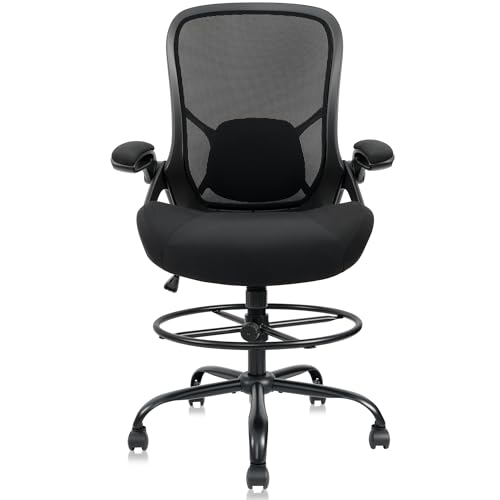
3. HYLONE Big and Tall Heavy Duty Drafting Chair — Best for Big and Tall
Most drafting chair listings leave capacity unstated, which is exactly the information a larger buyer needs most. The HYLONE states it plainly: 400 lb, with a 5-inch thickened seat to match. That combination is why it is here. A tall cylinder and an extended base already work harder under load than a standard chair’s, and a thin seat pad bottoms out fastest of all — the thickened cushion is a functional choice, not a luxury one.
The rest of the formula follows the category pattern: flip-up armrests, listing-stated lumbar support and an adjustable footrest ring, in a standing-desk format. If you are a bigger or taller drafter who has watched standard drafting chairs develop a wobble within a year, this is the pick aimed at you. As with every pick, treat the capacity figure as the listing’s own statement and check the current listing for the full specification before ordering.
Strengths
- Stated 400 lb capacity — rare honesty in this category
- 5 in thickened seat resists bottoming out
- Full drafting format with footrest ring and flip-up arms
Trade-offs
- Heavier and bulkier than standard drafting chairs
- Thick seat raises minimum sitting height for shorter users
- Black is the colour in the verified listing
| Specification | Detail from the verified listing |
|---|---|
| Stated capacity | 400 lb (listing-stated) |
| Seat | 5 in thickened seat cushion (listing-stated) |
| Format | Tall drafting chair, flip-up armrests |
| Support | Lumbar support (listing-stated) |
| Foot support | Adjustable footrest ring |
Best for: Big and tall drafters who need a stated capacity figure / Not suited for: Smaller users who may find the thick, high seat oversized

4. Work Smart Office Star ST217 Backless Drafting Stool — Best for Freedom of Movement
Every drawing studio eventually wants a stool as well as a chair. Working around a large board — taping down a sheet, reaching a far corner, stepping back and sitting again — is constant small movement, and a backrest and arms get in the way of all of it. A backless drafting stool on a tall cylinder is the traditional answer: you perch, you lean, you swivel, and nothing fences you in. For inkers and painters who work standing as much as sitting, the stool is often the primary seat, not the spare.
This slot is not linked because we could not confirm a specific stool listing to our verification standard at the time of writing, and stool listings are a category where stated seat-height ranges vary wildly between sellers. When you shop this type, the checks that matter are the true minimum and maximum seat height, a footrest ring (some stools omit it, which is a deal-breaker at height), a five-star base rather than a narrow ring base, and a seat pad thick enough for the length of your sessions. Buy the geometry first and the upholstery second.
Strengths
- Nothing restricts leaning, reaching or swivelling around a big board
- Perch posture suits mixed sit-stand working
- Small footprint for crowded studios
Trade-offs
- No back support — tiring for unbroken multi-hour sitting
- Listings vary widely in true height range; verify before buying
- This slot is not linked until a listing is confirmed
Best for: Painters and inkers who move constantly around the board / Not suited for: Anyone who sits still for hours and needs back support
Check on Amazon — check the current price on Amazon for the Work Smart Office Star ST217 Backless Drafting Stool.

5. Office Star Saddle Drafting Stool — Best Alternative Posture
The saddle stool splits opinion like nothing else in this guide. Its shaped seat holds your pelvis in a more open, upright position, somewhere between sitting and standing, and artists who take to it describe being able to work longer with less fidgeting. Artists who do not take to it know within twenty minutes. It is a genuinely different posture, not a better or worse chair, and the honest advice is to treat your first saddle stool as an experiment, ideally one you can return.
We keep this slot unlinked for the same verification reason as the drafting stool: saddle listings differ enormously in seat shape, height range and whether a backrest is included, and the picks in this guide only carry links to listings confirmed against that standard. Shopping the type, look for a height range that reaches your board, a footrest ring, and a seat wide enough for your build — narrow saddles suit smaller riders. If you draw in short, mobile bursts, the standard stool above is the safer first buy; if long static sessions leave you restless, the saddle is worth the trial.
Strengths
- Open, upright posture between sitting and standing
- Compact and mobile around the studio
- Encourages small posture shifts during long work
Trade-offs
- Love-it-or-hate-it seat shape — trial before committing
- No meaningful back support in most formats
- This slot is not linked until a listing is confirmed
Best for: Artists who feel restless and slumped in conventional chairs / Not suited for: Buyers who want a guaranteed-comfortable first drafting seat
Check on Amazon — check the current price on Amazon for the Office Star Saddle Drafting Stool.

6. BOLISS Mid Back Mesh Drafting Chair — Best Budget Format
Not every drawing chair needs to be an executive chair that happens to be tall. The no-frills drafting format — a pneumatic tall cylinder, a footrest ring, a simple padded seat and back, and fixed or no armrests — covers the actual requirements of drawing at a raised board at the lowest tier of the category. For a student setting up a first studio corner, or a second seat for a shared workspace, that restraint is the point: the money goes into the lift and the base, where it matters.
This slot stays not linked until a specific listing is verified, because the budget end of this category is exactly where listing claims drift furthest from the delivered product — stated height ranges shrink and footrest rings turn out to be fixed. When you shop it, confirm the seat height range reaches your board with your feet on the ring, check whether the ring adjusts or is fixed, and read the stated capacity even if you are well under it, because it is a useful proxy for build quality. A cheap chair that truly reaches drafting height beats a plush one that does not.
Strengths
- Lowest-cost route to true drafting height
- Simple construction, easy to assemble and move
- Covers the essential geometry: lift, ring, backrest
Trade-offs
- Fewer adjustments and thinner padding than the linked picks
- Budget listings are where height claims drift most
- This slot is not linked until a listing is confirmed
Best for: Students and second-seat buyers on a tight budget / Not suited for: Full-time professionals who sit all day, every day
Check on Amazon — check the current price on Amazon for the BOLISS Mid Back Mesh Drafting Chair.
Comparison Table
| Pick | Badge | Key spec | Best for | Link |
|---|---|---|---|---|
| Primy Drafting Chair Tall Office Chair with Flip-up Armrests | Best Overall | Footrest ring; flip-up armrests; lumbar support (listing-stated) | Illustrators and drafters who want one chair for board work and desk work | Check price on Amazon |
| AtHope Drafting Chair with 3D Lumbar and Head Support | Best for Long Sessions | Mesh back; 3D lumbar; head support; footrest ring (listing-stated) | Full-time illustrators working long days at a raised desk | Check price on Amazon |
| HYLONE Big and Tall Heavy Duty Drafting Chair | Best for Big and Tall | 400 lb stated capacity; 5 in thickened seat (listing-stated) | Big and tall drafters who need a stated capacity figure | Check price on Amazon |
| Work Smart Office Star ST217 Backless Drafting Stool | Best for Freedom of Movement | Listing-stated: thick padded vinyl seat, adjustable footring, 23–33 inch height | Painters and inkers who move constantly around the board | Check price on Amazon |
| Office Star Saddle Drafting Stool | Best Alternative Posture | Listing-stated: thick padded vinyl seat, adjustable footring, 23–33 inch height | Artists who feel restless and slumped in conventional chairs | Check price on Amazon |
| BOLISS Mid Back Mesh Drafting Chair | Best Budget Format | Listing-stated: thick padded vinyl seat, adjustable footring, 23–33 inch height | Students and second-seat buyers on a tight budget | Check price on Amazon |
One practical note on the two stool formats in this guide, because buyers often choose between them on price alone. The backless drafting stool suits work that keeps you moving — reaching for materials, standing to step back from the board, swivelling between a drawing surface and a reference screen — and its footring does more ergonomic work than any other single part, so adjust it before judging the seat. The saddle stool suits steadier work at one board: its seat holds a more open hip angle, which some artists find lets them sit longer without the restless shifting that smudges careful line work. Neither replaces a backed chair for all-day sitting; both earn their place as the second seat in a working studio.
How to Choose the Best Drawing Chairs for Your Board and Body
Start with arithmetic, not upholstery. Measure the height of your drawing surface, then work out where your seat needs to be: for board work, your seat should sit roughly so that your elbow rests at or slightly above the surface height when your upper arm hangs naturally, which for most raised boards and standing desks means a seat height well beyond any standard chair’s range. Check every candidate’s stated seat height range against that number, and remember that a thick seat cushion adds height while a footrest ring needs its own clearance below. A chair whose maximum height only just reaches is a chair you will always run at its limit, where cylinders feel least stable.
Next, the footrest. At drafting height a footrest is not an accessory; it is half the ergonomic system. An adjustable ring beats a fixed ring, and any tall chair sold without one should be treated as incomplete for drawing work. Then consider how you actually work. Static, detailed work over long sessions argues for a full backrest with lumbar support and arms that flip away. Mobile work around large sheets argues for a stool. Mixed screen-and-board work argues for the executive drafting format, which is why three of our six picks share it.
Finally, be honest about capacity and build. Capacity figures are only useful when a listing actually states them — one pick here states 400 lb, the others do not state a figure in their verified titles, and we say so rather than guessing. If you are near the top of a standard chair’s comfort zone, buy the chair that publishes its number. And check the base: at full extension, a wide five-star base is what keeps a tall chair feeling planted when you lean across a board.
Drawing Chair vs Drafting Chair vs Stool: Getting the Format Right
The naming in this category is marketing, not engineering, so buy by format instead of by label. The tall chair with backrest, arms and footrest ring is the all-rounder: it supports long sessions, doubles as a desk chair at a standing desk, and suits the widest range of bodies. Its weakness is bulk — it fences you in when the work itself is physical. The backless stool is the opposite trade: total freedom, zero support, ideal for painters and for the active half of the drawing process, punishing for anyone who sits still for three hours. The saddle stool is the posture experiment, genuinely loved by a minority and genuinely disliked by everyone else.
Many working studios end up owning two formats: the supportive chair for the long, still hours of finishing work, and the stool for the mobile hours of blocking in, stretching paper and moving around the piece. If your budget forces one purchase, choose by your longest typical session, not your most active one — fatigue accumulates in the still hours, and that is where support earns its money. Whichever format you choose, the non-negotiables do not change: true drafting height, supported feet, and a base that stays calm at full extension.
How to Set Up a Drawing Chair at the Right Height
Setup decides whether a good chair works well, and it takes ten minutes. Step one: set the chair beside your board and raise the seat until, sitting with your feet on the footrest ring, your forearm rests level on the drawing surface with your shoulder relaxed — not shrugged up toward your ear, not reaching down. If your shoulder rises, the chair is too low or the board too high; if your wrist bends sharply upward, you are too high. Step two: adjust the footrest ring so your feet rest flat on it with your knees at roughly a right angle or slightly open. Dangling feet or knees jacked up high both undo the seat height you just set.
Step three: set the backrest and lumbar support so the curve meets the small of your back when you sit back fully — then test the position you actually draw in, which is usually perched slightly forward. Many artists draw perched on the front half of the seat, in which case a slightly firmer seat and a footrest ring you can brace against matter more than deep recline. Step four: flip the armrests up and pull the chair in to the board; you should be able to reach the centre of your largest sheet without your shoulder leaving the backrest for detail work, using the lean only for broad strokes.
Step five: live with it for a week before judging. Keep a note of when discomfort starts and where — lower back points to lumbar or footrest height, shoulder and neck point to seat height relative to the board, and numb legs point to a seat edge pressing into your thighs, which a waterfall seat front or a slightly lower setting usually fixes. Small adjustments compound: a centimetre of seat height and a notch of footrest ring transform more sessions than a new chair does. Re-check the settings whenever you change boards, desks or drawing surfaces, because the geometry belongs to the pairing, not to the chair alone.
Common Buying Mistakes
Buying a standard office chair for a raised board. No amount of padding compensates for a chair that cannot reach. If the seat height range does not cover your board height, the chair is wrong for drawing however comfortable it feels in a showroom at desk height.
Ignoring the footrest. Tall chairs sold without a footrest ring leave your legs dangling, and the resulting lower-back fatigue gets blamed on the backrest. Treat the ring as part of the chair, and prefer adjustable over fixed.
Choosing by the word on the box. Drawing chair, drafting chair and studio chair are used interchangeably by sellers. Compare seat height range, foot support and base — the format — instead of trusting the label.
Assuming a capacity figure. Most listings in this category do not state capacity in their titles. If capacity matters to you, buy a pick whose listing states it, like the HYLONE’s stated 400 lb, rather than assuming a standard figure.
Sitting at full extension on a narrow base. A tall cylinder on a small base wobbles, and wobble destroys fine line control. A wide five-star base is a drawing tool, not a styling choice.
Final Recommendation
If you buy one chair from this guide, buy the Primy: it covers the drawing-board essentials — flip-up arms, an adjustable footrest ring and a full backrest — in the format that suits the widest range of illustrators. If your days are long and your studio is warm, the AtHope’s mesh and head support justify stepping up. If you need a published capacity figure and a seat built for it, the HYLONE is the honest heavy-duty answer. Treat the three unlinked slots as a shopping brief for the stool and budget formats: the types are real, the criteria above are the ones that matter, and each will gain a verified link when a listing is confirmed to our standard.
Whichever route you take, set the chair up properly before you judge it, and re-check the geometry whenever your board or desk changes. A drawing chair is half of a two-part system, and the other half is the surface in front of you.
- Primy Drafting Chair Tall Office Chair with Flip-up Armrests (Best Overall) — Check price on Amazon
- AtHope Drafting Chair with 3D Lumbar and Head Support (Best for Long Sessions) — Check price on Amazon
- HYLONE Big and Tall Heavy Duty Drafting Chair (Best for Big and Tall) — Check price on Amazon
- Work Smart Office Star ST217 Backless Drafting Stool (Best for Freedom of Movement) — Check price on Amazon
- Office Star Saddle Drafting Stool (Best Alternative Posture) — Check price on Amazon
- BOLISS Mid Back Mesh Drafting Chair (Best Budget Format) — Check price on Amazon
Best Chairs That Hold 400 Pounds Best Chairs Like Dxracer Best Latex Pillows For Sleep Best Chairs Sofa Best Chairs Glider Slip Covers
Drawing at Different Surfaces: Boards, Standing Desks and Slanted Desks
The surface in front of you changes what the chair must do, and it is worth walking through the three common setups. At a traditional drawing board — a large, often tiltable surface — you sit high and lean in, and the chair’s job is stability plus reach: flip-up arms and a footrest ring earn their keep, and a base that stays calm when you shift your weight to a far corner matters more than recline. Artists working on big boards often sit slightly higher than the forearm rule suggests, because the board’s tilt brings the far edge closer to the body and the near edge lower.
At a standing desk used for digital drawing — a tablet, a display and a keyboard at elbow height — the drafting chair becomes a perch: you alternate sitting high with standing, and a chair that adjusts quickly and rolls easily between positions suits the rhythm. This is the setup where the executive drafting format, like the linked Primy and AtHope, is most at home, because the same chair serves the screen hours and the drawing hours without a swap.
At a slanted drafting table, the classic architecture-and-illustration setup, your forearms rest on the slope and your posture is more upright than at a flat board. Seat height still rules, but back support matters more because you sit back into the chair rather than perching forward, and a headrest — the AtHope’s distinguishing feature — comes into its own during the lean-back-and-look pauses that punctuate work on a slanted surface. Whichever surface you use, re-run the five setup steps in the how-to section whenever the surface changes: the geometry belongs to the pairing of chair and surface, and a chair that felt wrong at one desk may be exactly right at another.
What a Drawing Chair Cannot Fix: Posture, Light and Breaks
Honesty about limits belongs in a buying guide. A correctly chosen, correctly set-up drawing chair removes the chair as a source of strain; it does not make eight unbroken hours at a board healthy, and no lumbar support ever designed changes that. The artists who work comfortably for decades pair decent seating with unglamorous habits: they stand up between stages of a piece, they keep the board at a height that does not force a hunch, and they light the work so they are not leaning in to peer at it. If you are buying a chair because drawing has started to hurt, buy the chair — and also change the session shape, because the chair alone will only move the problem.
Lighting deserves its own paragraph because it silently dictates posture. A dim or badly angled lamp pulls your head and shoulders toward the page, and you will hold that lean for hours without noticing; a bright, even light placed to avoid shadows from your drawing hand lets you sit back at the distance the chair was set up for. Chair setup and lighting setup are the same job done twice. Similarly, board angle matters: a slightly tilted surface brings the work to your eyes, while a flat surface at the wrong height brings your spine to the work. Adjust the surface first, the chair second, and your expectations of both honestly.
Breaks are the third leg. Short, regular pauses — standing, rolling the shoulders, looking at something far away — reset the small tensions that accumulate into end-of-day aches, and they cost less drawing time than the slow, distracted final hour of a marathon session. None of this sells chairs, which is exactly why it belongs here: the picks above are good tools, and tools work best inside a sane process. Buy the chair that fits your board and your body, set it up with care, light the page properly, and take the breaks. That combination, and not any single product, is what ‘drawing comfortably’ actually consists of.
Budget, Mid-Range and Premium: What the Extra Money Buys in a Drafting Chair
The drafting chair market divides into three honest tiers, and knowing what each tier actually buys stops two mistakes: overspending on upholstery and underspending on the lift. At the budget tier you get the essential geometry — a tall pneumatic cylinder, a footrest ring of some kind, a padded seat and back — with thinner foam, simpler mechanisms and listings whose stated dimensions deserve sceptical checking. This tier serves students, hobbyists and second seats well, and fails mainly when asked to support a full-time professional, all day, for years.
The mid-range is where the linked Primy and AtHope sit in spirit: better foam that resists compression, flip-up armrests that work smoothly, mesh or properly shaped backrests, head support on some models, and adjustment ranges that behave as stated. This is the tier most working illustrators should buy, because the upgrades are functional — session comfort and durability — rather than cosmetic. Above it, the premium tier buys heavier-duty construction, published capacity figures like the HYLONE’s stated 400 lb, thicker seats, and warranties and parts support that matter to studios equipping several seats.
What extra money never buys is a substitute for fit. A premium chair at the wrong height is worse than a budget chair at the right one, and a thick executive seat can actually reduce usable height range for a shorter artist. Spend in this order: correct height range first, footrest second, capacity and build third, upholstery and styling last. That ordering, applied honestly, is most of what separates a chair you forget about for five years from a chair you replace in one.
Assembly and First-Week Checks for a Tall Chair
Tall chairs ask slightly more of assembly than standard ones, because the extended cylinder and footrest ring are structural, not decorative. Build on a clear floor, tighten the base and backrest fixings fully before the first sit, and set the footrest ring clamp firmly at your measured height — a ring that slips under load is usually a clamp that was never fully tightened, not a defect. Test the lift through its full range unloaded, then seated, and check that the chair rolls without a wobble at full extension; a wobble at height one is a fitting to re-tighten now, not a character trait to live with.
During the first week, keep the hex key in the desk drawer. Fittings on tall chairs settle under load, and a quarter-turn at day three and day ten is normal maintenance, not a warning sign. Note where the chair creaks, if it does: creaks at the backrest joint point to fixings, creaks at the ring point to the clamp, and silence after re-tightening is the expected outcome. By the end of the second week the chair should disappear from your attention entirely — which, for a tool you sit in to make drawings, is the highest praise available.
A Note on Second-Hand Drafting Chairs
Drafting chairs appear on the second-hand market constantly, as studios close and offices refit, and a used professional chair can be excellent value — with three checks. Test the lift: a cylinder that sinks slowly under weight is at the end of its life, and replacement cylinders vary in fitting. Check the footrest ring clamp, the most abused part on any tall chair. And sit at full height and lean: base play that is invisible at desk height announces itself at drafting height. A used chair that passes all three, from a maker who publishes specifications, is a smarter buy than a new chair whose listing states nothing.
Frequently Asked Questions
What height should a drawing chair be?
High enough that, with your feet resting on the footrest ring, your forearm lies level on the drawing surface with your shoulder relaxed. For most raised boards and standing desks that means a seat height range far beyond a standard office chair’s, which is why drafting-format chairs use extended cylinders. Measure your surface first and compare it with the chair’s stated seat height range.
What is the difference between a drawing chair and a drafting chair?
In practice, very little — sellers use the terms interchangeably for a tall chair with an extended lift and usually a footrest ring, designed for raised boards and standing desks. Buy by format and stated dimensions rather than by the label: seat height range, foot support, back support and base width are what differ between products.
Do I really need the footrest ring?
Yes, at drafting height. Your feet cannot reach the floor, and unsupported legs pull on your lower back and press the seat edge into your thighs. An adjustable ring lets you set foot support for your own leg length; a tall chair sold without any footrest is incomplete for long drawing sessions.
Is a stool or a chair better for drawing?
It depends on how you move. A backless stool gives total freedom to lean, swivel and work around a large sheet, and suits painters and mixed sit-stand work. A chair with a backrest supports long, still sessions of detail work. Many artists eventually own both and switch by task; if you buy one, choose by your longest typical session.
How were the picks in this guide verified?
Every pick — the three drafting chairs and the three stool-format picks — was cross-checked against the Amazon catalog before its link was printed: the product name and the specifications quoted in its review come from the verified listing. We never attach a link we have not cross-checked in that way, and we never invent a product to fill a slot.
How long should a drafting chair last?
The lift cylinder and the seat foam are the wear items: cylinders lose smoothness and foam compresses with daily use over years. A chair whose listing states a substantial capacity, used well within that capacity, generally ages more gracefully. Re-check bolts and the footrest ring clamp every few months, as tall chairs work their fittings harder than standard chairs.


