Disclosure: airfryerkitchensupply.com is reader-supported. When you buy through links on our site, we may earn an affiliate commission at no extra cost to you.
Where to buy
Every mixer in this guide to the best dj mixers of all time was verified against current retailer catalogue data before it earned a purchase link, so the buttons below lead to the exact models reviewed — no lookalikes, no substituted listings. Prices move constantly in DJ gear, so check price on Amazon for the current figure on each pick before you decide. If a pick shows as unavailable in your region, the comparison table further down will point you to the closest alternative in the same guide.
- Pioneer DJ DJM-A9 — Best Overall — The Current Standard: check price on Amazon
- Allen & Heath XONE:96 — Best Analog Mixer Ever Made: check price on Amazon
- RANE SEVENTY — Best Battle Mixer: check price on Amazon
- Pioneer DJ DJM-S11 — Best Modern Performance Mixer: check price on Amazon
- Allen & Heath Xone:92 Mk2 — Best Heritage Club Mixer: check price on Amazon
- Rane Sixty-Two — Best Serato-Era Icon: check price on Amazon
Any honest list of the best dj mixers of all time has to survive an argument in a record shop. Tastes split by tribe — battle DJs, techno purists, club residents and open-format workhorses all crown different kings. So this list applies a stricter test than personal nostalgia: a mixer qualifies only if it defined its era, is respected across tribes, and can still be bought through a verified listing today.
That last rule shapes the list. Some legends — Pioneer’s DJM-800 generation and the DJM-900NXS2 in particular — shaped club culture profoundly, but their mixer listings could not be confirmed in current retailer catalogue data at verification time, so they appear here as unlinked honourees rather than linked picks. What remains is still a formidable hall of fame: the current club standard, the analog summit, two battle flagships, a heritage icon refreshed, and the Serato-era classic.
Read it as a map of where DJ mixing has been and where it stands now. Every linked mixer below is a current, orderable product — history you can still plug turntables into.
A methodological promise before the arguments begin: no mixer earned a linked place here on reputation alone. Each had to clear the same verification bar as every product in this programme — a confirmed, current listing matched by brand and model. That is why this pantheon looks slightly different from the ones in magazines. It is not a list of the mixers history remembers most fondly; it is the shorter, more useful list of the ones history remembers that you can still actually buy, plug in and play tonight.
Key Takeaways
- All-time status means era-defining influence plus cross-tribe respect — not last year’s hype.
- Buyability matters: this list links only legends you can still purchase through verified listings.
- Refreshed classics like the Xone:92 Mk2 deliver heritage without used-market risk.
- Heritage digital mixers demand a software-support check before money changes hands.
In this guide
Quick Picks
Short on time? These are the six best dj mixers of all time that matter, in the order most buyers should consider them. Each badge below is repeated at the top of that mixer’s full review, so you can jump straight to the one that matches your style.
- Pioneer DJ DJM-A9 — Best Overall — The Current Standard. The A9’s all-time claim is dominance: it is the mixer the world’s booths standardised on, the third refinement of a formula that has ruled clubs for over a decade. Check price on Amazon
- Allen & Heath XONE:96 — Best Analog Mixer Ever Made. The 96 is the analog argument perfected — the mixer that proved, in a digital age, that sound quality and filter craft still move dancers. Check price on Amazon
- RANE SEVENTY — Best Battle Mixer. Battle culture’s modern benchmark. Check price on Amazon
- Pioneer DJ DJM-S11 — Best Modern Performance Mixer. The S11 marks the performance era: pads, FX and screen integrated so completely that the mixer became a controller, an effects unit and a battle weapon at once. Check price on Amazon
- Allen & Heath Xone:92 Mk2 — Best Heritage Club Mixer. The original 92 soundtracked the defining techno and minimal years; the Mk2 keeps that exact analog soul in current production. Check price on Amazon
- Rane Sixty-Two — Best Serato-Era Icon. The Sixty-Two is the Serato revolution in hardware form: the mixer that made laptop DJing respectable in battle and club culture alike. Check price on Amazon
How These Picks Were Chosen
All-time status was earned on four criteria: influence on how DJs actually mix, longevity in professional booths, cross-tribe respect (a mixer battle DJs and techno DJs both honour outranks a niche favourite), and present-day buyability through verified listings. Models that failed the buyability test — however legendary — were moved to unlinked honouree status rather than given links, because an all-time list you cannot act on is just a museum plaque.
Verification discipline matters as much as judgement. Every linked product in this guide was confirmed through the retailer’s own catalogue data — brand and model searched, the returned title matched to the product under review, and the identifier taken from that confirmed response. Products that could not be confirmed that way were never given purchase links; where a famous model failed confirmation, it is discussed honestly in the text as context, so you know exactly what we could and could not stand behind. No prices are printed in this guide because DJ gear pricing shifts with sales, bundles and stock — each pick links to its live listing so you always see the real current figure.
How confident should you be in any all-time list — including this one? Treat it as a strong shortlist with a transparent method, not a scripture. The method here (influence, longevity, cross-tribe respect, buyability) deliberately excludes two kinds of fan favourites: mixers that were huge for one genre only, and legends whose listings could not be verified, which were demoted to honouree mentions rather than silently linked. If your personal top six differs, it probably weights one criterion harder — that is a legitimate argument to have, ideally in a record shop, at length, with the mixers in question plugged in.
The 6 Best dj mixers of all time

Pioneer DJ DJM-A9 — Best Overall — The Current Standard
The A9’s all-time claim is dominance: it is the mixer the world’s booths standardised on, the third refinement of a formula that has ruled clubs for over a decade. Future historians of DJ culture will describe this era through its layout. Owning one is owning the present tense of club DJing.
Strengths
- The current club-standard layout most venues and riders expect
- Third-generation Magvel-style channel faders and refined EQ feel
- Dual USB-C/USB connections smooth DJ changeovers
Trade-offs
- Premium price tier aimed at venues and serious rigs
- Large footprint for small home booths
- Battle DJs will prefer a dedicated 2-channel scratch mixer
| Channels | 4 |
| Role | Professional club DJ mixer |
| Interface | Audio interface for recording & performance |
The DJM-A9 is what the world’s club booths converged on: a four-channel flagship that refined the DJM-900NXS2 formula with better sound, smoother faders, a bigger colour screen and dual USB-C/USB-B connections for painless changeovers. For DJs who play out, its value is familiarity — walk into almost any serious venue and the layout under your hands is this layout, so your muscle memory travels with you. The third-generation Magvel channel faders, per-channel Sound Color FX and the expanded Beat FX section make long club sets expressive without external gear, and the audio interface side records sets and handles digital sources cleanly. It is a four-channel mixing machine first: house, techno, open-format and multi-deck workflows are its home turf, and while the crossfader is perfectly competent, dedicated battle DJs will still prefer a two-channel scratch mixer. The price is professional, the footprint is generous, and home users should measure their booth before ordering. As the reference point every other club mixer is compared against, its place on any all-time or best-of list is not nostalgia — it is current reality.
In practice the A9’s luxury is cognitive: you stop thinking about the mixer entirely. Changeovers with the previous DJ take seconds via the dual USB connections, the screen answers questions before you ask them, and the layout is identical to the booth you played last weekend. Home owners should measure depth and ventilation before committing furniture to it. Venues should budget for a dust cover and an annual service; treated that way, an A9 is a decade-long fixture rather than a purchase.
The A9 anchors permanent systems: two flagship media players or turntables, a booth monitor on its dedicated output, and recording wired once and forgotten. Venues should pair it with a managed power supply and a dust cover; home owners with furniture that respects its footprint and ventilation. Because changeovers are its party trick, booths benefit from both USB connections being cabled and ready before doors. Its partners should be as standardised as it is — this is the mixer around which an entire booth’s muscle memory organises itself.
Best for: buyers who want overall — the current standard done properly. / Not suited for: premium price tier aimed at venues and serious rigs.
Check on Amazon — Pioneer DJ DJM-A9 (check price on Amazon for the current figure).
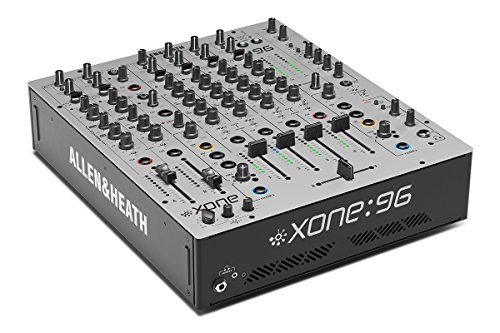
Allen & Heath XONE:96 — Best Analog Mixer Ever Made
The 96 is the analog argument perfected — the mixer that proved, in a digital age, that sound quality and filter craft still move dancers. Its dual soundcards quietly made it the hybrid era’s bridge, too. If only one analog mixer survives in the history books, this is the safest bet.
Strengths
- True analog signal path with the famous Xone filter sound
- 4-band EQ gives surgical control for long vinyl blends
- Dual USB soundcards for hybrid vinyl/DVS rigs
Trade-offs
- Premium price tier
- No onboard FX — effects come from send/return pedals or units
- Analog workflow rewards patience; not a quick-cut battle mixer
| Channels | 6 |
| Type | Analog DJ mixer |
| EQ style | 4-band EQ + dual filters (Xone VCF tradition) |
The XONE:96 is Allen & Heath’s love letter to DJs who mix with their ears over long blends. Its fully analog signal path, four-band EQ and dual VCF filters produce the warm, forgiving, deeply musical sound that made Xone mixers the choice of techno and house institutions. Four-band EQ is the quiet superpower: splitting the low end into two bands lets you swap basslines between two records without the mud that three-band mixers force you to accept. Two independent USB soundcards mean hybrid rigs — vinyl on two channels, Traktor or another DVS on the others — run without compromise, and the send/return architecture invites proper studio effects pedals and units into your sets. There are no onboard FX, deliberately: this mixer trusts you to bring your own. The crossfader is tuned for smooth blending rather than turntablism, and the price is firmly professional. For vinyl DJs who play long, layered sets and care about sound above features, the 96 is not just a contender — for many, it is the destination mixer they stop upgrading at.
The 96 changes how you practise: you start mixing for the blend rather than the drop, riding four-band EQ and filters across minutes-long transitions and recording everything through its soundcards to study later. It pairs beautifully with external FX on the sends — a single quality delay pedal multiplies its voice. Keep the analog path clean, give the filters regular exercise to keep pots sweet, and resist stacking it under heavy cases in storage; this is a precision instrument that happens to survive clubs.
The 96 invites an audiophile’s supporting cast: well-maintained turntables, cartridges chosen for sound rather than abuse, and — through its send/return architecture — one or two quality external effects, a studio delay being the classic first addition. Its dual soundcards pair with a laptop for hybrid sets and painless recording. Give it a listening-room’s care: stable power, ventilation, and cables you do not trip over. DJs who build patiently around a 96 tend to stop shopping; the rig becomes a reference rather than a project.
Best for: buyers who want analog mixer ever made done properly. / Not suited for: premium price tier.
Check on Amazon — Allen & Heath XONE:96 (check price on Amazon for the current figure).

RANE SEVENTY — Best Battle Mixer
Battle culture’s modern benchmark. The SEVENTY’s contactless faders solved the oldest problem in scratching — wear — while its MPC pads connected turntablism to beat-making culture. It represents the moment battle mixers stopped being stripped-down and became instruments.
Strengths
- Three contactless MAG FOUR faders — crossfader and upfaders all feel identical and resist wear
- Akai MPC pads are the most playable pads fitted to any battle mixer
- Internal DJ FX free you from leaning on software effects
Trade-offs
- Serato-focused — rekordbox users are better served elsewhere
- Dense front panel takes a few sessions to memorise
- Premium price tier
| Channels | 2 |
| Faders | 3x contactless MAG FOUR faders |
| Pads | Akai Professional MPC performance pads |
| Software | Serato DJ |
The RANE SEVENTY is built around a simple, stubborn idea: faders should feel perfect and never wear out. All three faders — crossfader and both channel faders — use Rane’s contactless MAG FOUR design, so there is no fader track to get scratchy, bleed or die mid-set, and the cut-in stays razor consistent. On top of that foundation sit Akai Professional MPC pads, the same pad feel finger-drummers trust, which makes cue juggling and sample triggering feel musical rather than mushy. Internal FX mean your echoes and reverbs live in the mixer, not the laptop, which matters when software is already busy running DVS. The SEVENTY is unapologetically Serato-centric: if your library, crates and muscle memory live in Serato DJ Pro, it feels like it was designed by people who watch battle DJs for a living — because it was. The trade-offs are focus and price. Rekordbox-first DJs should look at Pioneer’s battle line instead, and the dense control surface rewards a week of practice before it feels automatic. For turntablists who want analog-feeling faders with modern performance depth, it remains a benchmark.
Living with the SEVENTY means unlearning laptop glances: your FX, your cues and your faders are all on the panel, and sets feel more physical for it. The MAG FOUR faders need no break-in and no maintenance ritual beyond keeping dust out — a cover and an occasional air blast suffice. Give yourself a week to memorise the FX section’s logic; after that it becomes reflex. Because it is Serato-centric, travelling DJs should carry their own library drive and a printed note of their pad mappings for unfamiliar booths.
The SEVENTY pairs naturally with Serato-native workflows: two well-serviced turntables, matched DVS cartridges, and a laptop dedicated to your library rather than shared with everything else in your life. Because its FX are internal, it asks less of the laptop than rivals — a genuine advantage on older machines. Add a compact microphone for battle hosting and a case that leaves cables connected if your venue allows it. Owners who run Phase-style wireless control find the SEVENTY’s clean layout especially welcoming, with nothing redundant left on the panel.
Best for: buyers who want battle mixer done properly. / Not suited for: serato-focused.
Check on Amazon — RANE SEVENTY (check price on Amazon for the current figure).

Pioneer DJ DJM-S11 — Best Modern Performance Mixer
The S11 marks the performance era: pads, FX and screen integrated so completely that the mixer became a controller, an effects unit and a battle weapon at once. Routines filmed on S11s defined how a generation learned to scratch. Its all-time place is about expanding what a mixer is.
Strengths
- Touch-screen style control and deep FX keep both hands on the music instead of the laptop
- Magvel-class crossfader feel with adjustable curve for tight crab scratches
- Dual USB hubs make back-to-back changeovers painless
Trade-offs
- Premium price tier — it costs more than some full DJ setups
- Feature depth has a learning curve for first-time battle-mixer owners
- Overkill if you never use performance pads or onboard FX
| Channels | 2 |
| Software | Serato DJ Pro / rekordbox |
| Format | Scratch-style battle mixer |
The DJM-S11 is Pioneer’s flagship statement about where battle mixing went in the last decade: the mixer itself became an instrument. Its layout puts performance pads, FX controls and a high-resolution control surface within thumb reach, so routines that once needed a laptop screen, a mouse and a prayer now happen entirely on the hardware. The crossfader feel is the headline for scratch DJs — sharp cut-in, adjustable tension and curve behaviour that stays consistent session after session — but the deeper story is workflow. Dual USB connections let two DJs plug in at once, which turns changeovers from a cable-swap scramble into a crossfade. Sound quality is clean and loud, with headroom that survives red-lining guests. It unlocks the full performance side of Serato DJ Pro and works with rekordbox too, so it does not lock you into one ecosystem. Ownership costs are the honest downside: this is a flagship, priced like one, and its protective case, spare faders and software setup all deserve budget room. Buy it as a five-year centrepiece, not a stepping stone, and it earns its place.
In daily practice the S11 rewards DJs who rehearse routines rather than improvise everything: map your pads, save your FX favourites, and the mixer disappears under your hands within a fortnight. Keep a quality case on it from day one — flagship mixers travel, and screens and faders deserve protection. Owners should also budget an evening for firmware and software setup; the payoff is a rig that boots into your exact preferences. Resale values on well-kept S11s stay strong, which quietly lowers the true cost of ownership for DJs who upgrade on a cycle.
Pairing the S11 well means thinking in systems: two battle-ready turntables or media players with matched scratch cartridges, a laptop that exceeds your software’s recommended specification rather than merely meeting it, and headphones with strong isolation for loud booths. Add a quality microphone if your routines include hosting, and keep a second USB cable in the case — the dual-USB changeover advantage only exists if both DJs can actually plug in. Its ideal partners are reliable ones; a flagship mixer surrounded by failing cables is a sports car on bald tyres.
Best for: buyers who want modern performance mixer done properly. / Not suited for: premium price tier.
Check on Amazon — Pioneer DJ DJM-S11 (check price on Amazon for the current figure).

Allen & Heath Xone:92 Mk2 — Best Heritage Club Mixer
The original 92 soundtracked the defining techno and minimal years; the Mk2 keeps that exact analog soul in current production. No mixer has been requested on more artist riders across more decades. It is the heritage pick that is not a museum piece — it still works the world’s best rooms nightly.
Strengths
- The techno/house benchmark, refreshed in Mk2 form
- Dual VCF filters remain the creative heart of the Xone sound
- Built for long, layered blends rather than fast cuts
Trade-offs
- No USB audio interface — recording needs a separate interface
- Crossfader is tuned for blending, not scratching
- Premium price tier
| Channels | 4 |
| Type | Analog DJ mixer |
Few products in DJ culture carry the Xone:92’s reputation: for two decades it was the mixer behind the defining techno and minimal sets, prized for its dual VCF filters and four-band EQ long before those features were fashionable. The Mk2 refresh keeps everything that mattered — the analog warmth, the filters you play like an instrument, the bombproof club build — and tidies the details for modern booths. Playing on one is a lesson in restraint: instead of effects tricks, you shape energy with EQ and filter rides across blends that last minutes, and the mixer rewards that patience with a sound smaller mixers cannot fake. The trade-offs are equally clear. There is no USB soundcard, so digital recording or DVS needs an external interface, and the crossfader is a blending tool, not a scratch weapon. It is also a serious investment in a deliberately focused tool. For vinyl-first house and techno DJs, though, the 92 Mk2 is less a purchase than an inheritance — the classic, still in production, still setting the standard for analog DJ sound.
Daily life with a 92 Mk2 is a study in restraint: fewer controls than digital rivals, each one voiced to matter. Owners develop filter technique the way guitarists develop vibrato — slowly, personally, recognisably. Because there is no USB soundcard, settle your recording chain once (a small interface from the record output) and forget it. The mixer asks for a dust cover and occasional pot exercise; in return it delivers the same sound on year ten as on day one, which is precisely its legend.
Build around the 92 Mk2 the way its original era did: two or more turntables, a small recording interface on the record output, and external effects only if your style truly uses them — the filters cover most DJs’ expression. It pairs with rooms and booths that value sound over spectacle, and with record collections deep enough to reward four-band blending. Keep a quality pair of headphones permanently assigned to it; on a mixer this revealing, inconsistent monitoring is the last weak link worth tolerating.
Best for: buyers who want heritage club mixer done properly. / Not suited for: no usb audio interface.
Check on Amazon — Allen & Heath Xone:92 Mk2 (check price on Amazon for the current figure).

Rane Sixty-Two — Best Serato-Era Icon
The Sixty-Two is the Serato revolution in hardware form: the mixer that made laptop DJing respectable in battle and club culture alike. Units still cut beautifully today. Its inclusion honours the generation that dragged DJing into the digital era without surrendering the turntable.
Strengths
- The mixer that defined the Serato battle era — layout still feels natural
- Superb fader feel that many modern mixers still chase
- Proven club and competition heritage
Trade-offs
- Legacy generation — check driver/software support before buying
- Lacks modern pads, screens and dual-USB hubs
- Better as a heritage/used-market pick than a future-proof one
| Channels | 2 |
| Software | Serato (legacy generation) |
The Rane Sixty-Two is a piece of DJ history that still earns its keep. When Serato Scratch Live defined digital vinyl, the Sixty-Two was the mixer serious DJs plugged it into: superb faders, a layout that put software control under your fingers, and build quality that survived the competition circuit. Its presence on this list is about legacy and feel. DJs who learned on one still describe its crossfader action with genuine affection, and units in good health remain formidable tools for Serato-based scratching. The honest caveats matter, though. It belongs to an earlier software generation, so verify current driver and Serato DJ Pro support for your exact computer before spending money, and it offers none of the modern furniture — no performance-pad array in the current sense, no touch screen, no dual-USB changeover hub. Treat it the way guitarists treat a vintage amp: buy it knowingly, for the feel and the heritage, ideally at a fair price and after a hands-on fader test. As a working piece of battle history, nothing else on this list is quite like it.
Living with a Sixty-Two in the modern era means being its curator as well as its DJ: confirm software compatibility after every major computer update before a gig, keep a known-good laptop configuration backed up, and treat the faders to gentle cleaning rather than heroic disassembly. Owners who do this report a mixer that still feels like a precision instrument. Buy a case that fits it exactly — heritage gear earns its keep only while it stays healthy.
Pairing a Sixty-Two is an act of curation: a known-good laptop configuration, frozen and backed up; turntables serviced to match its era of excellence; and a technician’s number in your phone. It rewards owners who treat the whole chain as a vintage system rather than a modern one with an old mixer attached. Keep a modern backup path — even a pocket mixer and a phone playlist — for the day software support finally ends a set early. Curated this way, it remains a working instrument instead of a gamble.
Best for: buyers who want serato-era icon done properly. / Not suited for: legacy generation.
Check on Amazon — Rane Sixty-Two (check price on Amazon for the current figure).
Comparison Table
| Pick | Badge | Key spec | Best for |
|---|---|---|---|
| Pioneer DJ DJM-A9 | Best Overall — The Current Standard | 4 channels | Best Overall — The Current Standard |
| Allen & Heath XONE:96 | Best Analog Mixer Ever Made | 6 channels | Best Analog Mixer Ever Made |
| RANE SEVENTY | Best Battle Mixer | 2 channels | Best Battle Mixer |
| Pioneer DJ DJM-S11 | Best Modern Performance Mixer | 2 channels | Best Modern Performance Mixer |
| Allen & Heath Xone:92 Mk2 | Best Heritage Club Mixer | 4 channels | Best Heritage Club Mixer |
| Rane Sixty-Two | Best Serato-Era Icon | 2 channels | Best Serato-Era Icon |
Read the table as a shortlist, not a ranking shortcut: the right row is the one whose badge matches your style, your software world and your rig. The full reviews above explain the trade-offs the table cannot.
How to Choose the Right Mixer for Your Setup
What ‘all-time’ should actually mean
Influence beats novelty. An all-time mixer changed technique (the battle fader era), changed sound expectations (the Xone filter era), or changed infrastructure (the club-standard era). When a listicle crowns last year’s release, it is selling, not judging. The mixers here each pass a decade-scale test.
Heritage vs current production
Some legends are only available used, with worn faders and uncertain software support. This list favours legends still in production or freshly refreshed (the 92 Mk2 is the model example) so that admiration can become ownership without a repair bill. Where a pick is a legacy generation — the Sixty-Two — the guide says so plainly.
One mixer, several eras
Notice how the modern flagships absorb history: the A9 carries the DJM-800’s layout DNA, the S11 carries the battle lineage, the XONE:96 carries the analog filter tradition plus USB soundcards. Buying a current flagship is buying its ancestors’ lessons, refined. That is why this list can be both a history lesson and a shopping guide.
The Three Eras Every All-Time List Must Cover
The first era is analog craft: mixers as precision audio instruments, crowned by Allen & Heath’s filter-and-EQ philosophy. The Xone:92 became the techno world’s reference not through features but through sound — and its Mk2 refresh proves the design needed refinement, not replacement. The XONE:96 then answered the digital challenge from within the analog camp, adding dual soundcards without surrendering the signal path.
The second era is the digital vinyl revolution: Rane’s Serato mixers, crowned by the Sixty-Two, made the laptop a legitimate deck and turned battle DJs into software performers. The third era is standardisation and performance: Pioneer’s DJM line became the global booth default — the DJM-800 and DJM-900NXS2 (honoured here as unlinked legends, their listings unconfirmed at verification) set the template the A9 now perfects — while the S11 and SEVENTY pushed battle mixers into full performance instruments. A credible all-time list needs a champion from each era; this one has six.
How Legends Hold Their Value — and When They Don’t
The working-tool premium
All-time mixers hold value because working DJs keep needing them: a club-standard flagship or an analog icon is never obsolete to the next buyer. That premium survives only while the mixer works perfectly and parts remain available. The moment a model needs a discontinued component, its value story changes from ‘asset’ to ‘project’. This is the practical reason this list favours legends still in production or refreshed — their value is backed by a living supply chain, not just reputation.
Buying for the next decade, not the last one
Ask of any legendary mixer: will its software be supported, its faders replaceable, its sound still wanted in ten years? The six picks here answer yes in three different ways — current production (A9, XONE:96), refreshed production (92 Mk2), and contactless-fader durability (SEVENTY, S11) — while the one legacy-generation pick, the Sixty-Two, is labelled as an enthusiast purchase. Match the answer to your appetite for stewardship, and a legend becomes an heirloom rather than a liability.
How to Buy a Legendary Mixer Without Buying Someone Else’s Problems
All-time mixers hold value, which makes the used market tempting — and risky. These checks separate a future classic from a future repair bill.
- Test every fader slowly, at low volume, listening for crackle, bleed or dead zones — especially the crossfader’s cut points. Fader health is the single best predictor of a used mixer’s remaining life.
- Exercise every knob and switch through its full travel. Scratchy pots on a heritage analog mixer may be cleanable; dead switches on a digital flagship may mean board-level repair.
- For software-era mixers, verify driver and DJ-software support for your exact computer and operating system before paying. A legendary mixer your laptop cannot talk to is a sculpture.
- Check the phono inputs with your own record if buying for vinyl. Ground terminals, RCA jacks and channel balance all reveal themselves in one familiar track.
- Price in the refresh: new faders, a service, fresh needles. A fairly priced classic plus a service often beats a ‘mint’ example at collector money — and you get a mixer set up by your own technician.
- Keep the box and manuals. All-time mixers are assets; complete examples hold value best when your own era with them ends.
Keep the paperwork from any legendary purchase — receipts, service records, serial photographs — in one folder, physical or digital. All-time mixers pass between owners like instruments, and a documented history is worth real money and real trust when your chapter with the mixer eventually ends.
How to Read a Legend’s Spec Sheet
Rider
The equipment list an artist’s contract requires a venue to provide. Mixers that appear on riders for decades — the Xone:92 and Pioneer’s DJM flagships are the classic examples — earn a form of immortality no marketing can buy, because every working DJ must know them.
Club standard
The layout and workflow most venues install, making fluency on it a professional asset. Standards are self-reinforcing: DJs learn what booths have, and booths stock what DJs request. Pioneer’s DJM line holds this title in the current era.
Heritage premium
The portion of a classic mixer’s price explained by reputation and scarcity rather than function. This guide’s refreshed-production picks (notably the Xone:92 Mk2) exist to let buyers skip paying it while keeping the substance.
Contactless fader
A fader that senses position magnetically or optically instead of dragging a contact along a track. It cannot wear into crackle or bleed, which is why both modern flagships in this guide — S11 and SEVENTY — treat it as foundational.
Signal path
The route audio takes through the mixer. Analog paths (Xone) are prized for character and forgiving headroom; digital paths (modern DJM) for precision and consistency. All-time lists need champions of both, and this one has them.
Common Buying Mistakes
Confusing fame with fit
The most legendary mixer for techno is a poor choice for a battle DJ, and vice versa. All-time status describes influence, not suitability for your style.
Buying discontinued legends blind
Software support ends, faders wear, parts vanish. Heritage purchases need hands-on testing and honest expectations — or choose the refreshed production version.
Skipping the unglamorous eras
Lists that jump from ‘golden age’ to ‘latest flagship’ miss the Serato revolution that made modern DJing possible. The Sixty-Two’s era matters because your software library exists because of it.
Paying collector prices for working tools
If you will gig the mixer nightly, buy the current production equivalent and let collectors fight over museum examples. Working DJs need warranty and parts, not provenance.
Stewardship: Keeping a Legend a Legend
Documentation is value
For all-time mixers, the paper trail is part of the product: receipts, service invoices, firmware histories, even the original box. Keep them together from day one. When these mixers change hands — and the great ones always eventually do — documented examples sell faster and higher, because the buyer is purchasing certainty as much as hardware. The same records protect you with insurers and repairers, who both price uncertainty against you.
Service networks and parts foresight
Before any legendary purchase, learn where it gets serviced in your country and which parts are still manufactured. Current-production legends (A9, XONE:96, 92 Mk2) carry living supply chains; the legacy pick here demands a technician relationship instead. Buy common wear parts — a crossfader, a set of knobs — while they are cheap and available, even if you may never fit them. Future you, mid-tour with a worn fader, will consider present you a genius.
Which Legend Fits Your Situation?
The working club DJ
Buy the present tense: the DJM-A9. Your all-time education continues in booths, where its ancestors’ DNA surrounds you, but your income runs on the current standard. Heritage is a wonderful hobby and a poor substitute for the layout your next residency expects.
The analog devotee
Your pantheon is Xone-shaped. The XONE:96 if you want the complete modern statement, the 92 Mk2 if you want the purest line to the classic era. Either will be the last mixer many DJs buy — plan the rest of the chain (decks, cartridges, room) to deserve it.
The collector-performer
You are allowed both pleasures: a current flagship for work (S11 or SEVENTY) and one heritage piece for love (the Sixty-Two), bought slowly, tested thoroughly and serviced properly. That two-mixer pattern is how most serious collections actually form — one tool, one treasure.
Legendary Mixer Buying Checklist
Run this list against any finalist — including mixers not in this guide — before money moves. A mixer that fails two or more items for your situation is the wrong mixer at any price.
- Era and influence understood — you know why this model matters
- Current production or refreshed, or legacy risks accepted knowingly
- Faders and pots tested through full travel, slowly, at low volume
- Software/driver support verified for digital-era models
- Parts and service availability confirmed in your country
- Recording and DVS needs planned around the mixer’s era
- Case, manuals and completeness factored into value
- Price compared against the current-production equivalent
Final Recommendation
If forced to name one mixer of all time that a buyer today can actually purchase new and use everywhere, the DJM-A9 takes the crown — it is the standard, refined to its best form. Analog devotees will argue, with justice, for the XONE:96 and the Xone:92 Mk2; battle DJs for the SEVENTY and S11; historians for the Sixty-Two. That argument is the point: all-time greatness in DJ mixers is a pantheon, not a throne.
Buy according to your tribe and your era, verify faders and software before money moves, and any mixer on this list will serve you for years while holding its value and its reputation. Few purchases in DJ gear can promise all three.
Ready to buy? Start with the three most-chosen picks in this guide — Pioneer DJ DJM-A9, Allen & Heath XONE:96, RANE SEVENTY — and check price on Amazon for the current figure on each.
Keep exploring the cluster: Best Dj Mixers · Best Dj Mixers For Scratching · Best Dj Mixers For Vinyl · Best Dj Mixers Under $500 · Best Dj Mixers Under $300
Frequently Asked Questions
What is the best DJ mixer of all time?
By influence and ubiquity, Pioneer’s DJM club line — represented today by the DJM-A9 — has the strongest claim, with Allen & Heath’s Xone:92 family the analog counter-claim. Battle DJs will nominate Rane’s best. The honest answer is a shortlist, and this guide’s six picks are it.
Why is the DJM-900NXS2 not a linked pick?
It is honoured in the text as an unlinked legend. At verification time its mixer listing could not be confirmed in current retailer catalogue data — only accessories appeared — and this programme only links verified products. Its successor, the DJM-A9, carries its legacy as a linked pick.
Are older legendary mixers still worth buying?
Yes, with eyes open: test faders and pots, confirm software/driver support for digital-era models, and budget for a service. Refreshed classics like the Xone:92 Mk2 remove most of that risk by keeping the legend in current production.
Which all-time mixer holds its value best?
Current-production flagships with universal booth presence (DJM-A9) and analog icons (XONE:96, Xone:92 Mk2) historically hold value strongly because working DJs always need them. Condition, completeness and fader health matter more than age.
Analog or digital for an all-time purchase?
Choose by ritual. Analog Xone mixers reward listeners and long-blend DJs; Pioneer flagships reward gigging DJs who need the universal layout; battle flagships reward performers. All three schools produced all-time mixers — your style picks the school.
What mixer do most professional clubs use?
Pioneer’s DJM flagship line has been the dominant club standard for years, currently the DJM-A9, with Allen & Heath Xone mixers the respected alternative in techno and house institutions. Learning the Pioneer layout is the safest investment for aspiring residents.


