Disclosure: airfryerkitchensupply.com is reader-supported. When you buy through links on our site, we may earn an affiliate commission at no extra cost to you.
Where to buy
Every verified pick in this guide to the best digital thermometer for pellet grills is sold through Amazon, where you can check price on Amazon, confirm the exact configuration, and read the current listing details before you order. Listings change, bundles change, and model years roll over, so treat the links below as the fastest route to the live listing rather than a fixed offer. If a pick is marked as unlinked, it means we could not confirm a matching listing through our verification process, so search the product name on Amazon directly and compare the title word for word before buying.
- ThermoWorks Signals BBQ Alarm Thermometer (Best Overall) — check price on Amazon
- MEATER Pro Smart Meat Thermometer (Best Truly Wireless) — check price on Amazon
- MEATER Pro Duo WiFi & Bluetooth Thermometer, 2-Probe (Best Two-Probe Wireless) — check price on Amazon
- MEATER Block WiFi Smart Meat Thermometer, 4-Probe (Best for Big Cooks) — check price on Amazon
- INKBIRD IBT-4XS Bluetooth Meat Thermometer, 4 Probes (Best Value Multi-Probe) — check price on Amazon
- MEATER Plus Smart Meat Thermometer (Best Simple Wireless Starter) — check price on Amazon
Finding the best digital thermometer for pellet grills starts with admitting an uncomfortable truth about pellet grills: the temperature on the controller is the temperature of one sensor, in one spot, measuring air — not the temperature of your brisket, and not even the average temperature of the cooking chamber. Pellet grills swing as the auger feeds, run hotter near the fire pot, and cooler at the stack end. A good digital thermometer closes that gap with probes where the food actually is, and that is the difference between guessing a fourteen-hour cook and managing one.
This guide covers the two jobs separately, because they need different tools. Job one is food temperature: wireless or wired probes that track internal temperature and alert you at your target. Job two is pit temperature: an ambient probe clipped at grate level that tells you what your food is experiencing, which is often meaningfully different from the controller display. The best setups here do both, with enough probes to run a brisket, a grate sensor, and a second protein at once.
Every pick was verified against its live listing, including the probe counts and connectivity in its title. We favored systems built for long, unattended cooks — WiFi that reaches the house, alarms that wake you, probes rated for smoker heat — over kitchen thermometers that happen to survive a grill. If you cook low and slow more than twice a month, one of these will pay for itself in saved brisket alone.
In this guide
Quick Picks
Short on time? These are the six best digital thermometer for pellet grills we would buy with our own money, each chosen for a different job, space, or cooking style. The badge next to each name is the same badge used in its full review further down, so you can jump straight to the pick that matches your situation.
ThermoWorks Signals BBQ Alarm Thermometer — Best Overall. A WiFi and Bluetooth alarm thermometer built for serious barbecue — the reference-grade monitoring base for pellet cooks who want alerts anywhere and probes that survive years of smoke.
MEATER Pro Smart Meat Thermometer — Best Truly Wireless. A single truly wireless probe with very high heat resistance and long range — no cables to route, nothing to melt, and the cleanest possible setup for pellet grills and rotisseries alike.
MEATER Pro Duo WiFi & Bluetooth Thermometer, 2-Probe — Best Two-Probe Wireless. Two truly wireless probes with WiFi and Bluetooth and six sensors across the pair — the pellet setup for a brisket plus a second cook, with no cables anywhere.
MEATER Block WiFi Smart Meat Thermometer, 4-Probe — Best for Big Cooks. Four wireless probes in a bamboo charging block with WiFi and a standalone mode that works without your phone — the holiday and party pellet system.
INKBIRD IBT-4XS Bluetooth Meat Thermometer, 4 Probes — Best Value Multi-Probe. Four wired probes, Bluetooth monitoring, a rechargeable base with a backlit display and a magnet for the pellet hopper — the most monitoring per dollar in this guide.
MEATER Plus Smart Meat Thermometer — Best Simple Wireless Starter. The original single wireless probe with a walnut charger and Bluetooth range for patio-scale monitoring — the simplest way into cable-free pellet cooking.
How These Picks Were Chosen
We screened for pellet-grill reality: cooks that run eight to sixteen hours, often overnight, with the cook indoors, asleep, or at work. That demands wireless range that survives walls, alarms that can be set per probe, and probes and cables rated for sustained smoker temperatures. Instant-read pens are wonderful tools but they are not this category — opening the lid every hour to spot-check defeats the purpose of a leave-in monitoring system.
Each candidate was verified through Amazon listing, matching the exact model — probe count, connectivity, and generation — because thermometer lines reuse names across versions with different radios and ranges. Only confirmed matches carry buy links. We then weighed the things owners actually live with: app reliability, probe durability, charging or battery routine, and whether the system works without a phone for cooks who prefer a base-station display.
Badges follow use cases. There is a best overall for most pellet owners, a best truly-wireless option for rotisserie and clean setups, a best multi-probe system for big cooks, and a best value wired system for cooks who stay near the pit. Read the badge that matches your cooking style first.
The 6 Best Digital Thermometers for Pellet Grills

ThermoWorks Signals BBQ Alarm Thermometer — Best Overall
Signals is the choice when the cook matters and the budget allows the best tool. It anchors a pellet setup with wired probes, WiFi plus Bluetooth connectivity, and loud, configurable alarms. Competition-minded and brisket-serious home cooks, this is your pick.
Strengths
- WiFi and Bluetooth together — monitor from the couch or across town
- Built as a dedicated BBQ alarm, with per-probe high and low alarms for pit and food
- Pro-grade probe ecosystem with replacements readily available
Trade-offs
- Premium tier pricing, especially as you add probes
- Wired probes mean cable management through the lid or door gasket
- Base-station design is a tool, not a lifestyle gadget — the app is functional, not flashy
| Specification | Detail |
|---|---|
| Connectivity | WiFi and Bluetooth |
| Type | BBQ alarm thermometer, wired probes |
| Color noted | Nautical Blue listing |
The reason experienced pellet cooks graduate to a Signals-style system is trust at 3 a.m. Low alarms catch a pellet hopper bridging or a flame-out while there is still time to save the cook; high alarms catch a grease flare or a controller overshoot. WiFi means those alarms reach your phone anywhere with signal, and the base station keeps working — and keeps alarming — even if your phone dies, which is exactly the redundancy an overnight brisket deserves.
For pellet grills specifically, run one probe clipped at grate level beside the meat and treat that number, not the controller display, as your pit temperature. You will likely find a consistent offset; once you know it, you can set the controller to compensate and cook to the temperature your recipe actually means. That single habit improves consistency more than any rub or wrap trick.
Best for: Serious low-and-slow cooks wanting reference-grade monitoring / Not suited for: Casual grillers who only need a quick burger check

MEATER Pro Smart Meat Thermometer — Best Truly Wireless
Choose MEATER Pro when you hate cables: cooks that spin, cooks in tight pellet chambers, and cooks where a wire through the lid seal is one more thing to manage. One probe lives in the meat and reports both internal and ambient temperature. It is the minimalist’s monitoring system.
Strengths
- Truly wireless — nothing to route through the lid, nothing to snag
- Very high heat resistance suits searing as well as smoking
- Dual sensing reports food and ambient temperature from one probe
Trade-offs
- One probe means one protein monitored at a time
- Range depends on the charger relay position and your phone or network setup
- Premium price for a single-probe system
| Specification | Detail |
|---|---|
| Connectivity | Bluetooth with long-range relay via charger |
| Heat resistance | Rated to 1000°F per listing |
| Sensors | Internal plus ambient in one probe |
On a pellet grill, a wireless probe’s ambient sensor is quietly transformative: it sits at meat level, so the temperature it reports is the temperature field your food is actually cooking in — not the controller’s sensor near the wall. Comparing the two numbers across a few cooks teaches you your grill’s personality: where it runs hot, how much it swings during pellet feeds, and where the calm spot for a brisket really is.
The limits are real and worth stating. A single probe cannot watch a brisket and a pork butt at once, and Bluetooth ecosystems reward careful placement of the charging block near the grill. For cooks built around one hero protein — a brisket, a prime rib, a rotisserie chicken — the simplicity is unbeatable, and the probe’s heat rating means the same tool sears on steak night without a swap.
Best for: Single-protein cooks and anyone who hates probe cables / Not suited for: Multi-protein cooks needing three or four channels at once

MEATER Pro Duo WiFi & Bluetooth Thermometer, 2-Probe — Best Two-Probe Wireless
Most real pellet cooks are two-item cooks: brisket and beans, butt and ribs, turkey and a ham. The Pro Duo covers two proteins wirelessly, with WiFi for house-wide range. If the single MEATER Pro tempts you but your cooks come in pairs, this is the version to buy.
Strengths
- Two wireless probes cover the classic two-protein pellet cook
- WiFi plus Bluetooth gives range beyond the patio
- Six sensors across the probes for detailed internal and ambient readings
Trade-offs
- Still capped at two proteins — big multi-meat cooks need a wired multi-probe system
- Two probes to keep charged and paired
- Premium tier, priced as a system rather than an accessory
| Specification | Detail |
|---|---|
| Probes | 2 truly wireless probes |
| Connectivity | WiFi and Bluetooth |
| Heat resistance | Rated to 1000°F per listing |
| Charger | Bamboo charger |
The second probe changes the ambient game as well as the protein game. Put one probe in the brisket at the cool end of the chamber and one in the butt at the warm end, and you have a live map of your pellet grill’s gradient — the knowledge that lets you rotate food intelligently instead of by the clock. Over a season, that map is worth more than any single feature on the grill itself.
WiFi is the other half of the upgrade. Bluetooth alone tethers you to the patio’s edge; WiFi puts the cook on your phone anywhere in the house and beyond, which is what overnight and workday cooks actually need. If your pellet grill cooks while you live your life, the Duo’s connectivity matches that reality better than any Bluetooth-only setup.
Best for: Two-protein pellet cooks wanting wireless plus WiFi / Not suited for: Competition-style cooks running four or more proteins

MEATER Block WiFi Smart Meat Thermometer, 4-Probe — Best for Big Cooks
When the pellet grill carries the whole event — two briskets, a turkey, and a ham — four probes stop being a luxury. The Block’s standalone display mode also suits cooks who want monitoring at the grill without a phone in a greasy hand. Big-cook households, start here.
Strengths
- Four wireless probes cover the largest home pellet cooks
- Standalone mode monitors at the block without a phone
- WiFi range plus watch and voice-assistant compatibility
Trade-offs
- Highest investment in this guide
- Four probes means four charging and pairing routines to maintain
- Block needs a sheltered spot near the grill, out of weather
| Specification | Detail |
|---|---|
| Probes | 4 truly wireless probes |
| Connectivity | WiFi, standalone mode |
| Charger | Bamboo charging block with display |
The Block’s standalone mode is its most underrated design decision. Apps fail, phones die, and guests borrow chargers — but a holiday cook cannot pause. A display on the block itself keeps temperatures visible at the grill, while WiFi still pushes alerts to your phone when you step away. That belt-and-braces approach is what separates event-grade gear from gadget-grade gear.
Four probes also unlock proper gradient management on a loaded grill: proteins at different positions finish at different times, and knowing which one is actually done — rather than opening the lid to poke each one — keeps heat in and bark intact. For the cook who hosts Thanksgiving on a pellet grill, the Block is not an extravagance; it is the control system the meal deserves.
Best for: Holiday and party cooks running three or four proteins / Not suited for: Single-probe households or tight budgets
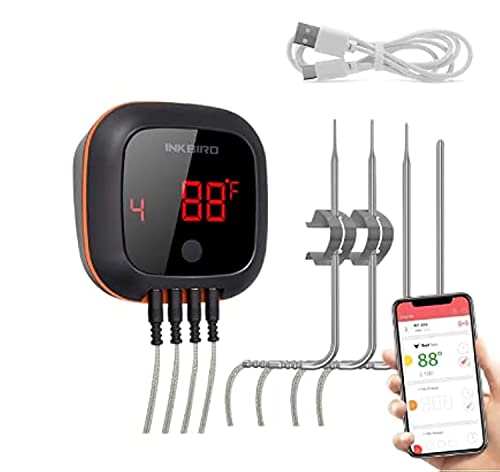
INKBIRD IBT-4XS Bluetooth Meat Thermometer, 4 Probes — Best Value Multi-Probe
Choose the IBT-4XS if you cook near the grill — patio, garage, kitchen window — and want four channels without premium pricing. The magnetic base sticks to the pellet hopper or grill side, the display reads at a glance, and the phone app covers the couch. It is the practical workhorse pick.
Strengths
- Four probes at a value-tier price — full pit-plus-proteins coverage
- Rechargeable base with backlit display works without the phone
- Magnetic base mounts neatly on the hopper or grill body
Trade-offs
- Bluetooth range is patio-scale, not whole-house like WiFi systems
- Wired probes need careful routing and gentle handling to last
- App experience is functional rather than polished
| Specification | Detail |
|---|---|
| Probes | 4 wired probes |
| Connectivity | Bluetooth (150 ft class per listing) |
| Power | Rechargeable, LED backlit display, magnetic base |
Four wired probes at this tier change what a budget cook can control: one ambient probe at grate level, one in the brisket flat, one in the point, and one spare for the beans or the second protein. That is the exact channel map a Signals owner runs, delivered at a fraction of the system cost — the honest trade is range and app polish, not capability.
Probe care decides how long the value lasts. Route cables through the lid’s edge without pinching, keep connectors dry when washing, and never submerge a probe past its cable joint. Treated that way, wired probes serve for years; treated carelessly, any brand’s probes fail early. For cooks who stay within Bluetooth range of their pellet grill, this is the smart-money pick of the guide.
Best for: Value-focused cooks who stay near the pit / Not suited for: Anyone needing alerts from across town

MEATER Plus Smart Meat Thermometer — Best Simple Wireless Starter
If your pellet cooks are one protein at a time and you stay within the patio or the next room, the MEATER Plus covers the job with the least possible fuss. It suits beginners who want guided, cable-free cooking without committing to a multi-probe system.
Strengths
- Dead-simple single-probe wireless setup
- Guided app cooking helps beginners land target temperatures
- Walnut charger looks at home in a kitchen, not just a garage
Trade-offs
- Bluetooth range is the shortest in this guide — plan charger placement
- Single probe only, with no expansion path
- Lower heat ceiling than the Pro line for hard searing
| Specification | Detail |
|---|---|
| Probes | 1 truly wireless probe |
| Connectivity | Bluetooth (165 ft class per listing) |
| Charger | Walnut charging block |
The Plus is where many pellet owners learn the core lesson of this category: the meat’s temperature curve tells you more than any timer. Watching a brisket climb, stall, and push through — live, on your phone, without opening the lid — changes a cook from anxious to informed in a single session. The guided cook features, which estimate finishing times, are genuinely useful training wheels for that first year.
Know its ceiling before you buy. Bluetooth range shrinks through walls and a metal grill lid, so the charger block needs to live near the grill with a clear path to your phone. And when your cooks grow to two proteins or overnight WiFi monitoring, you will replace rather than expand it. As a first wireless probe for single-protein cooks, though, it remains an easy, satisfying tool.
Best for: Beginners and single-protein cooks near the patio / Not suited for: Overnight cooks needing WiFi alerts
Comparison Table
| Pick | Badge | Key spec | Best for |
|---|---|---|---|
| ThermoWorks Signals BBQ Alarm Thermometer | Best Overall | WiFi and Bluetooth | Serious low-and-slow cooks wanting reference-grade monitoring |
| MEATER Pro Smart Meat Thermometer | Best Truly Wireless | Bluetooth with long-range relay via charger | Single-protein cooks and anyone who hates probe cables |
| MEATER Pro Duo WiFi & Bluetooth Thermometer, 2-Probe | Best Two-Probe Wireless | 2 truly wireless probes | Two-protein pellet cooks wanting wireless plus WiFi |
| MEATER Block WiFi Smart Meat Thermometer, 4-Probe | Best for Big Cooks | 4 truly wireless probes | Holiday and party cooks running three or four proteins |
| INKBIRD IBT-4XS Bluetooth Meat Thermometer, 4 Probes | Best Value Multi-Probe | 4 wired probes | Value-focused cooks who stay near the pit |
| MEATER Plus Smart Meat Thermometer | Best Simple Wireless Starter | 1 truly wireless probe | Beginners and single-protein cooks near the patio |
Choose by channels and range. One protein, no cables: MEATER Pro, or the MEATER Plus if you stay close and want the gentlest price of entry. Two proteins wirelessly with WiFi: MEATER Pro Duo. A grill full of food: MEATER Block for wireless, or the INKBIRD IBT-4XS for four wired channels at value pricing. And for the most dependable alarm system with WiFi and a dedicated base, the ThermoWorks Signals remains the reference pick. Every system here beats the controller display, because every one measures where the food is.
How to Choose the Best Digital Thermometer for Pellet Grills
Count your channels honestly. A serious pellet setup needs, at minimum, one food probe and one ambient probe at grate level. A brisket cook with a second protein wants three or four channels. Systems cannot usually be expanded later — a single wireless probe stays single — so buy for the biggest cook you do twice a year, not the smallest you do weekly.
Match connectivity to your life. Bluetooth is fine if the grill lives outside your kitchen window and you stay home. WiFi earns its premium the first time a brisket cooks while you are at work, asleep with the phone on loud, or across the house with guests. For overnight cooks, also insist on a low-temperature alarm: a pellet flame-out at 4 a.m. is recoverable at 4 a.m. and a total loss at 8 a.m.
Check heat ratings where they matter. Probes and cables that live in a smoker need ratings for sustained heat, and any probe you might also use for searing needs a higher ceiling still — the wireless Pro-class probes in this guide are rated far beyond smoker temperatures, which is why they double as steak tools. Keep wired probe cables out of direct flame paths regardless of rating.
Finally, weigh the ecosystem: replacement probes, app updates, and whether the system works when the phone is busy elsewhere. A base-station display or standalone mode sounds old-fashioned until the day your phone dies mid-cook. The best system is the one still alarming when everything else fails.
Grate-Level Truth: Using an Ambient Probe on a Pellet Grill
Your pellet controller regulates to its own sensor, which usually sits at one end of the chamber, away from the food. The temperature at grate level beside a cold brisket can differ from that reading by a meaningful margin, and the difference changes across the cook as the meat warms and the weather shifts. An ambient probe clipped to the grate, an inch or two from the meat and not touching it, measures the air your food actually experiences.
Run both numbers for three cooks and write them down. Most owners find a consistent offset — the grate runs cooler than the display by a fairly stable amount at smoking temperatures. From then on, set the controller with the offset in mind and cook to the grate number your recipes assume. This one calibration habit explains — and fixes — most ‘my brisket took four hours longer than the recipe’ stories.
Placement discipline matters: keep the ambient probe out of the direct path of the fan’s hottest airflow, off the metal of the grate itself (use the clip), and away from dripping fat. Recheck its position when you wrap or rotate food. Treat the ambient probe as a permanent member of the cook, not an accessory you add when something already looks wrong.
Probe Placement Masterclass: Where Temperatures Are Won and Lost
A thermometer system is only as truthful as its probe placement, and placement is a learnable craft. For food probes, the target is the thermal center of the thickest part — on a brisket flat, that means entering from the side, horizontally, until the probe’s sensing section sits in the middle of the meat, not near the surface and never touching the board beneath. A probe resting against bone reads the bone’s story; a probe in a fat seam reads the fat’s; both will lie to you with complete confidence, which is why experienced cooks verify with a second spot-check before pulling anything expensive.
Brisket deserves its own paragraph because it is really two muscles. The flat cooks lean and finishes earlier; the point, marbled and thick, runs later and more forgiving. One probe in each — the setup this guide’s multi-channel picks exist for — lets you separate the muscles at the right moment, wrap the flat while the point finishes, and stop treating a two-muscle animal as a single temperature. Pork butt is simpler: one probe, deep in the thickest part away from the blade bone, tells the whole story.
Ambient probes have their own discipline. Clip the probe to the grate so its tip floats in the air an inch or two from the food — not touching meat, not touching metal, not parked over the fire pot’s direct blast or under a dripping brisket. When you open the lid to wrap or spritz, glance at the clip before you close: probes migrate during a long cook more often than any manual admits, and a migrated ambient probe quietly corrupts hours of otherwise perfect data.
Alarms, Logs, and Learning Your Grill: The System Beyond the Hardware
The hardware in this guide earns its keep through two habits: alarms set with intent, and a simple cook log. Intentional alarms are specific. The food alarm sits a few degrees below your pull temperature so the alert means ‘come and verify’, not ‘already over’. The pit low alarm sits far enough below your cooking temperature to ignore normal pellet-feed swings, but high enough to catch a flame-out while the meat is still safe and the cook is still saveable. The pit high alarm catches the grease fire and the controller failure. Three numbers, set before every long cook, convert monitoring from watching into insurance.
The log is the second habit, and it takes ninety seconds: date, protein and weight, controller setting, grate-level temperature observed, weather, and finish time. Within five cooks, patterns emerge that no forum can give you — your grill’s offset in wind, your hopper’s real burn rate, the stall’s timing on your briskets specifically. Pellet grills are consistent machines, and a log turns that consistency into prediction: the cook who knows their brisket finishes two hours after the wrap, in their grill, stops guessing and starts planning dinner.
Together, alarms and logs are why a digital thermometer is best understood as a learning system rather than a gadget. The probes report, the alarms protect, and the log remembers — and after a season, the cook holding the phone knows their pellet grill the way a pilot knows an aircraft: by instruments, verified by experience.
Troubleshooting the Cook: What Your Thermometer Is Telling You
Problem: the grate temperature swings far more than the controller display suggests. → That is your pellet grill’s feed cycle made visible: the auger delivers pellets in pulses, the fire breathes with them, and a fast-responding probe reports the breathing honestly. Moderate swings at smoking temperatures are normal and average out in the meat. The fix is rarely the grill — it is expectation, plus keeping the lid closed so the system can stabilize instead of chasing your curiosity.
Problem: the food probe reads done, but the meat is not tender. → Temperature and tenderness are cousins, not twins. Brisket and pork butt are done when connective tissue has rendered, which happens across a range and announces itself by probe tenderness — the probe sliding in with almost no resistance — more reliably than by any single number. Use the thermometer to know when to start checking tenderness, then let the meat, not the display, make the final call.
Problem: two probes in the same protein disagree. → One of them is placed badly: touching bone, sitting in a fat seam, or not inserted to its sensing depth. Reposition both to the thickest part, entering from the side, and trust the one whose reading moves sensibly when you adjust it slightly. Persistent disagreement after careful placement means a failing probe — swap channels to confirm, and replace the probe, not the whole system.
Problem: alerts arrive late or the connection drops mid-cook. → Range and relays, almost always. Wireless systems depend on the charger or base sitting within honest reach of both the grill and your network; metal lids, brick walls, and distance all tax the link. Move the relay point, keep the base station in range as the always-on witness, and treat a dropped phone connection as an inconvenience — the cook itself should never depend on a single radio path. That redundancy is designed into the better systems in this guide; set your cook up to use it.
From First Brisket to Tenth: How Thermometer Habits Mature
The first brisket with a real thermometer system is an anxious education. The new cook checks the app constantly, learns the stall by living through it — that long plateau where the temperature refuses to climb while collagen and patience do their work — and discovers at hour ten that the numbers were trustworthy all along. The main lesson is not technical; it is that the meat was never in danger, only the cook’s imagination was, and the instrument’s calm outlasted it.
By the third or fourth cook, behavior changes. Alarms replace checking; the phone stays in a pocket; the grate-offset of the home grill is known and compensated without thought. The cook starts using the second channel deliberately — point versus flat, the second protein, the beans’ ambient corner — and the log, if one is being kept, begins to predict finish times within the hour. This is the stage where a thermometer stops being a purchase and becomes a practice.
By the tenth cook, the system has quietly rearranged the cook’s whole relationship with the pellet grill. Overnight cooks are scheduled rather than feared. New proteins are approached with a probe plan instead of a prayer. Guests are given a serving time that actually happens. None of that came from the hardware alone — it came from ten cooks of verified feedback, which is what every pick in this guide really sells. The brisket was the tuition; the calm is the degree.
Instant-Read Partners and Backup Plans: Completing the System
Every leave-in system in this guide has a silent partner: the instant-read thermometer you verify with before pulling. Leave-in probes monitor; instant-reads adjudicate. A probe that sat in a fat seam all night will report a beautiful, false doneness, and the ten-second cross-check in two fresh spots is what catches it before the brisket is sliced in front of witnesses. Budget for the pair from the start — the monitoring system for the cook, the instant-read for the verdict — and your thermometer setup is genuinely complete.
Backup thinking extends further. Probes are consumables on a long enough timeline: cables fatigue, seals age, and a probe will eventually choose the morning of a big cook to retire. Owners of multi-probe systems already own their backup — channels can be reassigned — while single-probe wireless owners should know their fallback: the instant-read, used sparingly with the lid opened briefly and purposefully, plus the tenderness tests that barbecue used before electronics existed. A cook with a plan B cooks calmly; the thermometer system’s job is confidence, and redundancy is confidence’s foundation.
Finally, keep the unglamorous supplies with the system: spare batteries or a charged power bank where relevant, the grate clip that wanders off between cooks, and a small case so probes travel to a friend’s grill or a competition without tangling into modern art. Systems fail at their edges, in the accessories nobody organized. Organize them, and the setup in this guide will run for years of Saturdays.
A Note on Accuracy Claims and Calibration
Thermometer listings love accuracy claims, and a pellet cook should know how to hold them honestly. Any leave-in probe can be checked in ice water and in boiling water — two known temperatures available in every kitchen — and a probe that reads both correctly can be trusted in between. Run that check when a system arrives and once a season after; it takes five minutes and converts a marketing claim into your own verified fact. Probes that drift at the extremes should be retired to ambient duty or replaced, because a thermometer you cannot trust is worse than none: it manufactures confidence while the meat tells a different story. The systems in this guide come from makers with serious measurement pedigrees, but verification is a habit, not a brand — keep it.
One Last Word Before Your First Monitored Cook
Set the system up on a forgiving cook first — a pork butt, the most patient protein in barbecue — and let it teach you the interface, the alarms, and your grill’s offset without a brisket’s stakes. By the second cook the habits in this guide will feel less like instructions and more like reflexes, and by the fifth you will be the person at the barbecue explaining, calmly and correctly, exactly when dinner will be ready. That calm, purchased once and practiced briefly, is the real product every pick in this guide is selling.
How to Set Up a Thermometer System for an Overnight Pellet Cook
An overnight brisket is where a thermometer system proves itself. Set it up in this order, before the meat goes on, and the night runs itself.
- Charge or battery-check every probe and the base station in the afternoon — never discover a flat probe at midnight.
- Place the ambient probe on its grate clip beside where the meat will sit, then preheat the pellet grill and compare grate temperature to the controller display; note the offset.
- Insert food probes into the thickest part of each protein, avoiding bone and fat pockets; for a brisket, one in the flat and, if you have the channel, one in the point.
- Route wired cables through the lid edge or gasket without sharp bends or pinches; position wireless chargers or relays with a clear path into the house.
- Set alarms per channel: food target a few degrees below your pull temperature, pit low alarm well below cooking temperature to catch a flame-out, and pit high alarm above it to catch a runaway.
- Test the alert path — trigger a test alarm and confirm your phone is loud, charged, and not in a do-not-disturb mode that silences it.
- Do a final hopper check: pellets topped up, lid closed, and the cook logged with start time and target temperatures.
- In the morning, verify with a second method before pulling — a quick instant-read check in a second spot confirms the leave-in probe’s story.
That routine takes ten minutes and converts the riskiest cook in barbecue into the calmest. After two or three overnight cooks with full alarm coverage, you will wonder how anyone sleeps next to an unmonitored smoker.
Common Buying Mistakes
Trusting the controller display as the cooking temperature. It measures one sensor in one place. A grate-level ambient probe is the only number your food experiences.
Buying a single probe for multi-protein cooks. Channels cannot be added later to most systems. Count your biggest regular cook and buy for it.
Choosing Bluetooth for an overnight, across-the-house cook. Range through walls and a steel lid is shorter than the box suggests. WiFi exists for exactly this cook.
Pinching probe cables in the lid. Crushed cables are the number-one probe killer. Route gently, avoid sharp edges, and never slam the lid on a cable.
Setting only a food alarm. The pit low alarm — the flame-out catcher — is the one that saves briskets. Set both, every time.
Final Recommendation
Most pellet owners should start with the ThermoWorks Signals for its WiFi, alarms, and base-station dependability — or the MEATER Pro Duo if cables offend you and two proteins define your cooks. Single-protein cooks will love the MEATER Pro; beginners, the MEATER Plus. Big-cook households should go straight to the MEATER Block, and value hunters to the four-probe INKBIRD IBT-4XS.
Whichever system you choose, run an ambient probe at grate level from the first cook and keep a simple log of offsets and finish times. A digital thermometer does not just prevent disasters — it turns your pellet grill from an appliance you hope behaves into an instrument you actually understand.
Check the ThermoWorks Signals BBQ Alarm Thermometer on Amazon. Check the MEATER Pro Smart Meat Thermometer on Amazon. Check the MEATER Pro Duo WiFi & Bluetooth Thermometer, 2-Probe on Amazon.
Keep exploring the cluster: Best Durable Grills Best Easy To Use Grills Best Compact Outdoor Grills Best Cookout Grills Best Consumer Grills
Frequently Asked Questions
Why not just trust my pellet grill’s built-in temperature?
The built-in sensor measures air at one fixed point, usually near the chamber wall, and the controller averages its readings to run the auger. Your food sits somewhere else, in a temperature field that varies by position and shifts as the meat warms. A probe at grate level beside the food measures what the food experiences — the number recipes are written for.
How many probes do I need for a brisket?
Two at minimum: one in the brisket and one ambient probe at grate level. Three is better — flat and point of the brisket cook at different rates, and separate probes let you pull or wrap each at the right moment. A fourth channel usually goes to a second protein.
WiFi or Bluetooth — which matters more for pellet grills?
For short, attended cooks, Bluetooth is enough. For overnight or away-from-home cooks, WiFi is the meaningful upgrade: alerts reach you anywhere, and you can check a cook from work. Many cooks start with Bluetooth and upgrade after their first anxious overnight brisket.
Can wireless probes handle pellet grill temperatures?
Easily at smoking temperatures — pellet grills cook low and slow, well within any leave-in probe’s rating. The high heat ratings on Pro-class wireless probes matter for the other jobs those probes do, like searing steaks. Always respect the rating printed for your specific probe, and keep any probe’s minimum insertion depth in mind so its electronics stay out of the hottest zone.
Where exactly should the ambient probe go?
Clipped to the cooking grate, one to two inches from the food, not touching the meat or the grate metal itself, and out of the direct blast of the hottest airflow. Its job is to sample the air around the food. Reposition it when you move or wrap the meat.
Do I still need an instant-read thermometer?
Yes — as a verifier. Leave-in probes monitor the cook; an instant-read confirms doneness in several spots before you pull, catches a probe that was sitting in a fat pocket, and handles quick cooks where leave-in probes never get deployed. The two tools complement rather than replace each other.


