Disclosure: airfryerkitchensupply.com is reader-supported. When you buy through links on our site, we may earn an affiliate commission at no extra cost to you.
Where to buy
There is no custom trailer BBQ smoker for sale on Amazon, at any price: searches in Amazon’s product data return hinges, parts and rubs — never a trailer pit. Custom trailer smokers are fabricated to order and sold direct. The Amazon products below are backyard offsets, labelled as alternatives only; they are not trailer pits and they do not tow.
The best custom trailer bbq smokers are the cathedrals of the barbecue world: a serious pit — offset, reverse-flow or cabinet — welded onto a road trailer, with wood storage, work surfaces and sometimes sinks and burners, built to be towed to competitions, weddings, fundraisers and family land. They are also, without exception, fabricator products. A trailer pit is a vehicle as much as a cooker: it has an axle, a tongue weight, lights and a title in many jurisdictions, and no marketplace ships that in a box.
So this guide does the two honest things available. First, it profiles the trailer programmes of three proven custom builders — Lang’s trailer-mounted reverse-flow pits, Shirley Fabrication’s bespoke trailer builds, and Meadow Creek’s working trailer cookers — in prose, with ordering guidance and the practical questions (axle, storage, towing, registration) that trailer buyers must ask and patio buyers never do. Second, it reviews three verified Amazon backyard offsets as explicitly labelled non-trailer alternatives, for the many readers who discover, on reflection, that their cooks happen in one place.
If you finish this page and still want the trailer — many do, and for competitions and events nothing else substitutes — you will know which builders to call and what to ask them. If you finish it realising the dream was capacity rather than wheels, the alternatives will feed your crowd this month. Either outcome is a win; the only failure this category offers is paying trailer money for something that is not a trailer pit.
Shop the verified picks here: Oklahoma Joe’s Laredo Series 1100 Offset — Backyard Alternative (Not a Trailer Pit), VEVOR Charcoal Offset Smoker with Side Firebox — Backyard Alternative (Not a Trailer Pit), Realcook Charcoal Grill with Offset Smoker, 800 Sq. In. — Backyard Alternative (Not a Trailer Pit). Every link in that list was confirmed against live Amazon product data for this guide; check price on Amazon on the exact model named before you order.
In this guide
Quick Picks
Three custom trailer programmes (fabricator-direct only — no Amazon listing exists) and three verified backyard alternatives that are NOT trailer pits, labelled as such in every badge.
- Lang Smoker Cookers Trailer Models (Reverse-Flow on Wheels) — Best Custom Trailer Route — Reverse Flow: The established trailer programme: Lang’s reverse-flow pits mounted on trailers in several sizes, built to order for events, competitions and family land. — sold direct by the maker (see the review below)
- Shirley Fabrication Trailer Builds (Bespoke Rigs) — Best Custom Trailer Route — Bespoke: The commissioned trailer rig: pit style, cabinets, warmers and trailer layout specified by you and engineered by one of the most sought-after shops in custom barbecue. — sold direct by the maker (see the review below)
- Meadow Creek Trailer Cookers (Working Event Rigs) — Best Custom Trailer Route — Working Events: The working trailer fleet: chicken cookers, pig roasters and smokers on trailers, built for fundraisers, fairs and caterers who cook by the hundredweight. — sold direct by the maker (see the review below)
- Oklahoma Joe’s Laredo Series 1100 Offset — Backyard Alternative (Not a Trailer Pit) — Best Backyard Alternative — NOT a Trailer Pit: NOT a trailer pit and does not tow — the largest verified backyard offset (1,100 square inches) for readers whose events all happen at home. — Check price on Amazon
- VEVOR Charcoal Offset Smoker with Side Firebox — Backyard Alternative (Not a Trailer Pit) — Best Backyard Alternative — Wheeled and Movable (Still Not a Trailer): NOT a trailer pit — a wheeled backyard offset (its listing calls it movable) that rolls around your own property, and no further. — Check price on Amazon
- Realcook Charcoal Grill with Offset Smoker, 800 Sq. In. — Backyard Alternative (Not a Trailer Pit) — Best Backyard Alternative — Budget (Not a Trailer Pit): NOT a trailer pit — a budget 800-square-inch barrel combo for backyard parties, for readers testing whether big offset cooking suits them at all. — Check price on Amazon
How These Picks Were Chosen
Builders were chosen for genuine trailer programmes, not one-off favours: Lang builds its reverse-flow pits on trailers as a standard offering; Shirley Fabrication commissions bespoke trailer rigs as a core part of its work; Meadow Creek builds working trailer cookers for the event and catering world. Together they cover the three reasons people buy trailer pits — competition and family events, fully personal specification, and commercial-scale outdoor cooking.
The alternatives were selected under protest from the category itself: since no trailer pit is buyable on Amazon — a fact our fresh API search demonstrated almost comically, returning hinges and rub as the top results — we chose the strongest verified backyard offsets for the readers whose underlying need is capacity. Each carries an explicit not-a-trailer label in its badge, its spec box and its first paragraph.
The governing rule is the site’s standing empty-category standard, identical to Best Custom Bbq Smokers and Best Custom Built Smokers: prose and ordering guidance where no listing exists; verified links only where a real product exists; and labels that never let an alternative impersonate the category.
Custom Trailer Pit Builders — and Honest Alternatives That Are Not Trailer Pits
Lang Smoker Cookers Trailer Models (Reverse-Flow on Wheels) — Best Custom Trailer Route — Reverse Flow
Lang’s trailer line is the default answer when a cook outgrows the patio: the same reverse-flow cookers that made the Georgia shop’s name, mounted on road trailers in a ladder of sizes from family-event rigs to serious catering capacity. The proposition is coherence — a pit whose cooking geometry is proven, on a trailer engineered for it, from one builder responsible for both. For competitions, reunions, church cooks and the family place with no permanent pit site, it is the trailer programme most buyers should price first.
Strengths
- Proven reverse-flow pits on purpose-built trailers
- Size ladder lets you match the rig to your events honestly
- One builder accountable for pit and trailer as a system
Trade-offs
- Fabricator pricing plus the trailer premium on top
- Build lead time, then registration and storage to arrange
- Towing a pit is a skill and a responsibility, not an accessory
Specify a Lang trailer the way the shop’s experienced buyers do: by the largest event you genuinely serve, not the largest you can imagine; with wood storage and work surface options weighed against tongue weight; and with your tow vehicle’s real capacity checked against the loaded rig, not the empty one. Ask about axle rating, spare wheel and lighting as part of the build conversation. Delivered and seasoned, it becomes the centre of every gathering it attends — which is precisely the point of the category.
Best for: event and competition cooks who want proven reverse flow, mobile / Not suited for: patio cooks — a trailer pit is a vehicle, with a vehicle’s overheads
Ordering note: this pick is not sold as a finished product on Amazon, so there is no Amazon link here on purpose. Order it through the maker named above, and treat any marketplace listing that claims otherwise with suspicion.
Shirley Fabrication Trailer Builds (Bespoke Rigs) — Best Custom Trailer Route — Bespoke
A Shirley trailer build is the category without a catalogue: you commission a rig, and the shop engineers your specification — offset or cabinet pit, warmer and storage boxes, prep surfaces, trailer layout — into a single rolling system. Competition teams and serious caterers queue for these builds because a rig designed around one cook’s workflow is a genuine competitive asset: everything in reach, nothing improvised, the pit’s manners known to the millimetre.
Strengths
- Fully bespoke: the rig is designed around your workflow
- Craft standard at the very top of the custom world
- Competition and catering layouts from one accountable builder
Trade-offs
- The waitlist is measured in seasons; plan campaigns accordingly
- Bespoke pricing across pit and trailer both
- Your specification errors become your permanent rig — brief carefully
Approach Shirley with a workflow, not a wishlist: walk your current event cook hour by hour, note every walk back to the truck, every surface you lacked, every time the pit’s layout fought you. That list is the commission. The shop will handle steel and geometry; you must supply the truth about how you cook. For teams whose results justify it, this is the endgame rig — and for home cooks, it is the clearest possible illustration of what custom trailer money buys, and why it cannot be clicked into a cart.
Best for: competition teams and caterers commissioning a workflow-built rig / Not suited for: anyone in a hurry, or still discovering how they cook at events
Ordering note: this pick is not sold as a finished product on Amazon, so there is no Amazon link here on purpose. Order it through the maker named above, and treat any marketplace listing that claims otherwise with suspicion.
Meadow Creek Trailer Cookers (Working Event Rigs) — Best Custom Trailer Route — Working Events
Meadow Creek’s trailer cookers are the ones actually feeding your county: chicken rigs that turn out fundraiser dinners in waves, pig roasters for the annual whole-hog weekend, and trailer smokers sized by servings rather than by square inches. This is the practical end of the custom trailer world — less heirloom, more workhorse — and for organisations it is usually the right end. The builds prioritise throughput, serviceability and towing manners, because their owners cook on schedules with queues of hungry people attached.
Strengths
- Formats engineered for volume: chicken, whole hog, event smoking
- Working-grade builds that tolerate hard, frequent use
- Dealer network makes inspection and service more practical
Trade-offs
- Event scale is absurd overkill for family patio cooking
- Utilitarian finish — these are tools, not showpieces
- Still a fabricator purchase: order, wait, register, store
Organisations should start the Meadow Creek conversation with servings and service pattern: how many, how often, how far towed, who maintains it. The shop’s formats map to those answers directly, which is why fire companies and church groups keep buying them. If your trailer dream is really a business or a community institution, this profile — not the competition rigs — is your template, and a season of cooking on one will teach you more about event barbecue than any book.
Best for: fundraisers, caterers and organisations cooking for crowds / Not suited for: households — see the backyard alternatives below instead
Ordering note: this pick is not sold as a finished product on Amazon, so there is no Amazon link here on purpose. Order it through the maker named above, and treat any marketplace listing that claims otherwise with suspicion.

Oklahoma Joe’s Laredo Series 1100 Offset — Backyard Alternative (Not a Trailer Pit) — Best Backyard Alternative — NOT a Trailer Pit
Label, in the first line where it belongs: this cooker is stationary. It has no trailer, no axle and no hitch, and it will never follow you to a competition. It is reviewed here because a large share of trailer-pit shoppers, when they list their actual cooks, describe events in their own garden. For them the Laredo 1100 — the largest verified backyard offset in our guides at 1,100 square inches — delivers the capacity that was the real object of desire, at a factory price, this week.
Strengths
- Maximum verified backyard capacity in this guide
- No towing, registration, insurance or trailer storage overheads
- Mainstream brand support, covers and spares
Trade-offs
- It cooks where it stands: your events come to it, or nowhere
- Factory steel and traditional-draw hot spot, as with its class
- Will not satisfy a genuine mobility need — be honest about yours
| Status | Stationary factory offset — NOT trailer-mounted, cannot tow |
| Layout | Traditional offset smoker and grill |
| Cooking area | 1,100 sq. in. (verified listing) |
| Fuel | Charcoal and wood splits |
If the honest summary of your last two years is ‘the big cooks all happened here’, buy the capacity and skip the vehicle. Put the money saved towards wood, a great thermometer and the celebratory first brisket. Our class review in Best Consumer Smokers Offset covers its cooking manners in full, where it earned Best Large-Capacity Value.
Best for: hosts whose big events happen at home / Not suited for: anyone who cooks at sites other than their own yard
Check on Amazon — check price on Amazon before you decide, because commercial listings change configuration often.
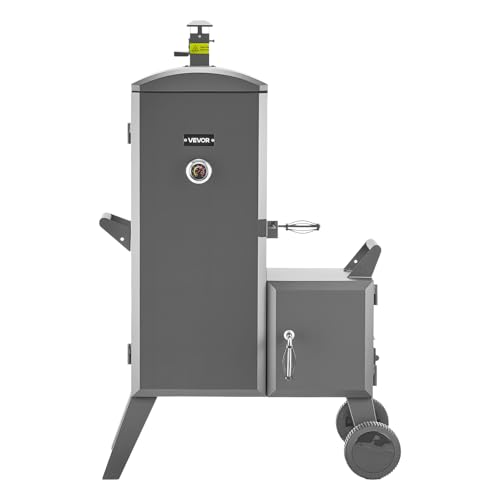
VEVOR Charcoal Offset Smoker with Side Firebox — Backyard Alternative (Not a Trailer Pit) — Best Backyard Alternative — Wheeled and Movable (Still Not a Trailer)
Label, plainly: ‘movable’ in this listing means wheels across your patio, not a trailer on the road. The VEVOR offset is here for the middle-case reader: your cooks move around your own property — out of the garage for summer, across the yard for the party, back under cover for winter — and a cooker on proper wheels serves that life well. The verified listing describes a heavy-duty steel offset with side firebox, six adjustable grates, thermometer and air vents: a complete, flexible backyard smoker.
Strengths
- Genuine around-the-property mobility on its wheels
- Adjustable grates give flexible loading for mixed cooks
- Complete offset setup at a factory price, available now
Trade-offs
- Not towable, not registrable, not a trailer in any sense
- Factory construction and finish, with upkeep to match
- Wheels serve a yard, not a highway — know which you need
| Status | Wheeled factory offset — patio-movable, NOT road-towable |
| Layout | Offset with side firebox |
| Features | 6 adjustable grates, thermometer, air vents (verified listing) |
| Fuel | Charcoal and wood |
Judge it as the flexible home cooker it is and it makes a strong case: reposition for wind, chase shade in summer, store it tight in winter. If your mobility map is your own land, this is the honest fulfilment of it. If your map has postcodes on it, scroll back up to the builders — no factory wheel turns a patio smoker into a road rig, and any listing implying otherwise deserves your suspicion.
Best for: property cooks who reposition their smoker around home ground / Not suited for: road use of any kind — it is not built or legal for towing
Check on Amazon — check price on Amazon before you decide, because commercial listings change configuration often.

Realcook Charcoal Grill with Offset Smoker, 800 Sq. In. — Backyard Alternative (Not a Trailer Pit) — Best Backyard Alternative — Budget (Not a Trailer Pit)
Label, plainly: a stationary budget combo with no trailer and no towing in its future. The Realcook’s role in this guide is the trailer-dream reality check at the lowest price: its verified listing offers 800 square inches of barrel grill and offset smoker aimed squarely at backyard parties and gatherings. Cook a season of gatherings on it and you will know — with evidence, not imagination — whether your future is a bigger backyard cooker, a factory upgrade, or a fabricator’s order book.
Strengths
- Cheapest route to real gathering-size offset cooking
- Grill and smoker in one footprint for party menus
- A season on it writes your future brief, whatever you buy next
Trade-offs
- Budget construction: light steel, lively temperatures, finite life
- Stationary — the party must be at your place
- Small firebox, frequent feeding, as with its class
| Status | Stationary factory combo — NOT trailer-mounted |
| Layout | Barrel grill with offset smoker |
| Cooking area | 800 sq. in. (verified listing) |
| Positioning | Backyard parties and gatherings (per listing) |
There is no shame in this being the end of the journey rather than the start: for many households a budget barrel that feeds twenty happily for years is the correct purchase, and the trailer was a screensaver fantasy. For others it is the inexpensive season that turns a vague trailer dream into a precise commission. Both outcomes start with honest cooking, which this cooker provides at the lowest cost in the guide.
Best for: households testing gathering-size offset cooking on a budget / Not suited for: mobile cooking of any description
Check on Amazon — check price on Amazon before you decide, because commercial listings change configuration often.
Comparison Table
The Status column decides everything on this page: the first three rows are fabricator programmes with no Amazon listing; the last three are stationary backyard cookers that do not tow.
| Pick | Badge | Key spec | Best for |
|---|---|---|---|
| Lang Smoker Cookers Trailer Models (Reverse-Flow on Wheels) | Best Custom Trailer Route — Reverse Flow | Trailer-mounted reverse-flow pit — built to order, direct only | event and competition cooks who want proven reverse flow, mobile |
| Shirley Fabrication Trailer Builds (Bespoke Rigs) | Best Custom Trailer Route — Bespoke | One-off bespoke trailer rig — direct commission, waitlist | competition teams and caterers commissioning a workflow-built rig |
| Meadow Creek Trailer Cookers (Working Event Rigs) | Best Custom Trailer Route — Working Events | Working trailer cookers and roasters — direct/dealer only | fundraisers, caterers and organisations cooking for crowds |
| Oklahoma Joe’s Laredo Series 1100 Offset — Backyard Alternative (Not a Trailer Pit) | Best Backyard Alternative — NOT a Trailer Pit | 1,100 sq. in. stationary backyard offset (verified listing) | hosts whose big events happen at home |
| VEVOR Charcoal Offset Smoker with Side Firebox — Backyard Alternative (Not a Trailer Pit) | Best Backyard Alternative — Wheeled and Movable (Still Not a Trailer) | Wheeled backyard offset, 6 adjustable grates (verified listing) | property cooks who reposition their smoker around home ground |
| Realcook Charcoal Grill with Offset Smoker, 800 Sq. In. — Backyard Alternative (Not a Trailer Pit) | Best Backyard Alternative — Budget (Not a Trailer Pit) | 800 sq. in. barrel grill-offset combo (verified listing) | households testing gathering-size offset cooking on a budget |
How to Choose the Best Custom Trailer BBQ Smokers: Pit First, Trailer Second
Choose the pit before the trailer, because you will cook on the pit for decades and the trailer’s job is simply to carry it well. Decide your cooking layout first — reverse-flow like Lang’s programme, bespoke like Shirley’s, or working formats like Meadow Creek’s — using the same reasoning as any custom purchase in Best Custom Built Smokers. Then interrogate the trailer as a vehicle: axle rating against the loaded rig’s real weight, tongue weight against your tow vehicle, tyre quality, lighting, spare wheel, and the storage and work-surface layout that decides whether event day flows or frustrates.
Ask each builder the vehicle questions explicitly. What does the rig weigh loaded with wood and water? What hitch and electrics does it need? Is a title or registration paperwork provided for your jurisdiction? Fabricators who build trailers weekly answer instantly; hesitation here is information.
The True Cost of a Trailer Pit: Tow Vehicle, Registration, Storage
Budget the system, not the smoker. The rig itself is the first line; then the tow vehicle — its rated capacity, a suitable hitch, and the fuel reality of towing a steel pit; then registration, plates and insurance as your jurisdiction requires for a trailer of its weight; then storage, because a trailer pit lives somewhere between events and ‘somewhere’ needs to fit a vehicle-sized object with a smokestack. Add security: a trailer pit is, by design, easy to tow away, and coupler locks and storage choices are part of ownership.
None of this argues against buying one — competition teams and event cooks pay these costs gladly because the rig earns them back in capability. It argues for paying them knowingly, with the total compared honestly against the stationary alternative that serves the same menu at home.
Do You Actually Need the Trailer? A Five-Cook Test
List your last five big cooks and mark each one’s location. Five at home: buy capacity, not wheels — the alternatives above exist for you. Three or more away — competitions, family land, organisational events — the trailer case is real and the builders above are your shortlist. The mixed case, one or two away per year, is the hardest: price renting, borrowing a team’s spare rig, or cooking on a host’s equipment for those outings before committing vehicle money to a twice-a-year need.
Be equally honest about trajectory. A cook entering their first competition season has a growing away-list; a cook whose club just folded has a shrinking one. Buy for the list you are actually building, and the right answer — trailer or backyard — usually announces itself.
Anatomy of a Trailer Rig: More Than a Pit on Wheels
A serious trailer rig is three systems engineered as one. The pit you know: chamber, firebox, stack, baffles — built heavy, because a trailer pit cannot be babied. The trailer beneath it: frame, axle and suspension rated for the loaded weight with margin, tyres chosen for real roads, a coupler and safety chains that match your vehicle, lights and wiring that survive weather, and balance — tongue weight in the safe band when the rig is loaded with wood and water exactly as it will travel. The working layer on top: wood storage that keeps fuel dry, prep and landing surfaces, storage boxes for tools and thermometers, sometimes sinks, burners and generators on catering builds.
Judge builders by how they talk about the second and third systems. A pit builder dabbling in trailers speaks only about the smoker; a trailer-rig builder like the three profiled here speaks fluently about axles, balance and workflow, because their customers’ livelihoods and competition seasons ride on all of it — literally. When you inspect a rig, new or used, inspect it as a vehicle first and a cooker second: the cooker can be seasoned in an afternoon, but a bad trailer is bad at seventy kilometres an hour.
Towing and Travelling With a Competition Rig
Towing a pit is a discipline with its own craft. Before the first trip: weigh the loaded rig if you can, confirm tongue weight, check tyre pressures and dates — trailer tyres age out on the wall of the garage more often than they wear out on the road — and practise reversing in an empty lot until the rig’s manners are boring. On the road: longer stopping distances, wider turns, a walk-around at every fuel stop covering coupler, chains, lights, tyres and the pit’s own doors and latches, because a firebox door swinging open at speed is a story nobody wants to star in.
At the event, the rig’s design repays its cost: level it properly before cooking — a pit out of level drains grease wrongly and drafts oddly — chock the wheels, and set your workflow out of the storage you specified. After the event, hot ash is the traveller’s hazard: a pit must be fully cold and its ash managed before towing, a rule with no exceptions and no shortcuts. Teams build checklists for all of this; steal that habit from your first trip, not your first incident.
Storing, Securing and Insuring a Trailer Pit
Between events, a trailer rig is a large, valuable, inherently mobile asset, and it should be stored like one. Best case is under cover on a hard surface, tyres protected from long sun exposure, the pit itself cleaned and oiled against the damp months. Security is layered: a quality coupler lock, a wheel clamp, and where possible storage that is itself secured or overlooked — because the feature that makes the rig useful, its towability, makes it stealable by anyone with a hitch.
Insurance deserves a direct conversation with your provider rather than an assumption: clarify whether the rig is covered as a trailer, as equipment, at home and in transit and at events, and what its agreed value is. Registration records, the builder’s documentation and photographs of the rig and its markings support both insurance and recovery if the worst happens. None of this is the romantic part of trailer ownership, and all of it is what separates owners who keep their rigs for decades from cautionary tales told at competitions.
Competition Day With a Trailer Rig: How the Workflow Actually Runs
Watch an experienced team work a trailer rig and the custom premium explains itself in motion. The rig arrives levelled and lit within minutes because every tool lives in its assigned box. The pit comes to temperature while prep happens on surfaces that are part of the trailer, at working height, in the cook’s preferred sequence. Wood moves three steps, not thirty. When turn-in boxes are built, they are built on the rig’s own counter, under its own light, by a cook whose feet have worn a familiar path around a familiar machine.
None of that is available to the team cooking out of a pickup bed and a folding table, however good their smoker is — which is why the bespoke end of this category sells workflow, not merely steel. If you are commissioning, specify from this picture backwards: attend a competition as a spectator, watch three teams’ setups, and write down every reach, bend and walk you would design out of your own rig. That list, priced by a builder like Shirley, is the true content of a custom trailer commission.
The Borrowed-Rig Season: Learning Trailer Life Before Buying It
Before the deposit, buy the experience cheaply. Rent a trailer pit for one real event, as the FAQ suggests. Volunteer with a competition team for a weekend and work their rig — loading wood at 3 a.m. teaches more than a season of brochures. Borrow or hire capacity for your organisation’s big annual cook and observe what the format demands of your volunteers, your site and your tow vehicle. Each of these is a full-scale rehearsal that costs a fraction of a build slot.
Pay attention to the unglamorous data: how the rig towed behind your actual vehicle, where it slept at night, how long setup and teardown truly took, and whether the cooking itself — the part everyone imagines — was helped or merely transported. Buyers who arrive at a builder with that data commission rigs that fit their lives. Buyers who arrive with only enthusiasm commission rigs that fit their dreams, and the second owner of many a fine trailer pit thanks them for the discount.
Events That Justify a Trailer Pit (and Events That Do Not)
The trailer earns its keep at a recognisable class of events: competitions, where your pit is your instrument and its familiarity is competitive advantage; recurring organisational cooks — fundraisers, church dinners, team feeds — where volume and mobility are the whole job; catering and vending, where the rig is a business asset that also advertises itself; and family land, reunions and festivals where the gathering happens far from anyone’s kitchen. At each, the trailer is not transporting a smoker. It is delivering a kitchen.
The honest counter-list matters as much: the annual backyard party (buy capacity), the tailgate that a portable grill serves better, the single wedding you will cater once as a favour. Trailer money spent for those buys a vehicle that spends its life as expensive storage. Read your calendar, not your imagination — the builders in this guide will respect you for it, because their order books are full of people whose calendars told the truth.
Used Trailer Pits: The Inspector’s Checklist
The secondhand market is the one place a trailer pit changes hands without a build queue, and it rewards inspectors over enthusiasts. Start with the trailer as a vehicle: frame rails for rust and cracks, especially around the pit’s mounting points; axle, springs and hangers; tyre age as well as tread; coupler wear; lights and wiring function; and the paperwork — title or registration history clean enough to transfer in your jurisdiction. Then the pit as a cooker: firebox floor and door seals, chamber seams, baffle condition on reverse-flow models, grate integrity, stack and damper movement, and evidence of grease fires or chronic neglect in the cooking chamber.
Price what you find against the new-build total for the same builder and size, subtracting honestly for tyres, bearings, paint and any steel work. Ask the seller for the builder’s name and the build year, and where possible confirm with the shop, which often knows the rig. A sound used rig from a known builder is the fastest legitimate route into this category; a neglected one is a restoration project wearing a bargain’s clothes. Inspect, verify, then decide.
The First Tow: A Short Ceremony Worth Performing
When the rig is finally yours, resist the urge to debut it at a paying event or a family milestone. Give it a ceremony instead: a short, empty tow around familiar roads to learn its manners behind your vehicle, then a home cook — levelled in your own yard, fired, seasoned and run through a full menu with nobody waiting on the results. Note the clearances it needs, the surfaces you reach for, the way its doors and latches behave after a road’s vibration. That unglamorous day converts a delivered object into your rig, and it is the cheapest insurance in this category: every surprise it contains will happen in your driveway, where surprises are free, instead of at the event, where they are not.
How to Buy a Custom Trailer Smoker, Step by Step
Step 1 — Prove the need. Run the five-cook location test in the guide above. If the away-cooks are real and recurring, proceed; if not, buy backyard capacity and revisit in a season.
Step 2 — Fix the pit specification first. Layout, chamber size, firebox and options, from your cooking — the same discipline as any commission in Best Custom Bbq Smokers. The trailer serves the pit, never the reverse.
Step 3 — Interrogate the trailer engineering. Loaded weight, axle and tyre ratings, tongue weight, hitch and electrics, spare, lighting, storage layout. Confirm your tow vehicle’s ratings against the loaded figures in writing.
Step 4 — Paper the whole purchase. Pit specification, trailer specification, total price, deposit terms, completion estimate, and what title or registration documentation the builder supplies — all written, before the deposit.
Step 5 — Arrange the unglamorous logistics. Registration and insurance in your jurisdiction, a storage home that fits the rig, coupler lock and security, and a collection or delivery plan that accounts for towing an unfamiliar trailer home.
Step 6 — Season, practise, then perform. Season the pit as with any custom build, run two full practice cooks at home, and tow it empty or lightly loaded before its first event. Event day is the wrong classroom for both a new pit and a new trailer.
Common Buying Mistakes
Buying a ‘trailer style’ cooker that cannot tow. Wheels on a patio smoker are for your yard. A road rig needs an axle, rated tyres, lights and paperwork — if a listing lacks all four, it is not a trailer pit.
Matching the rig to your imagination instead of your tow vehicle. Loaded weight and tongue weight are physics, not preferences. Exceeding your vehicle’s ratings is dangerous and, in many places, illegal.
Forgetting registration, insurance and storage until delivery day. A trailer pit is a vehicle in the eyes of most jurisdictions and a large object in the eyes of your driveway. Arrange its legal and physical home in advance.
Sizing for the biggest imaginable event. An oversized rig tows worse, stores worse and cooks small loads inefficiently. Size for your real calendar, as with every cooker in this programme.
Skipping security. You have built a valuable asset designed to be hitched and driven away. Coupler locks, wheel clamps and thoughtful storage are not paranoia; they are ownership.
Final Recommendation
For the genuine trailer life: Lang for a proven reverse-flow programme on wheels, Shirley for a rig commissioned around your workflow, Meadow Creek for working event cookers that feed hundreds. All direct, all worth their waits for the cooks they fit. For everyone whose big cooks happen at home — which the five-cook test reveals for most of us — the labelled alternatives are the honest buy: Laredo capacity, VEVOR flexibility around your property, or the Realcook as a budget season of discovery. What this category will not give you, from us or from anyone honest, is a custom trailer pit in a marketplace box. It does not exist, and your money deserves that sentence in writing.
Start your shortlist here: Oklahoma Joe’s Laredo Series 1100 Offset — Backyard Alternative (Not a Trailer Pit), VEVOR Charcoal Offset Smoker with Side Firebox — Backyard Alternative (Not a Trailer Pit), Realcook Charcoal Grill with Offset Smoker, 800 Sq. In. — Backyard Alternative (Not a Trailer Pit). Check price on Amazon for each, in that order, against the needs described above.
Related guides
Frequently Asked Questions
Can I buy a custom trailer BBQ smoker on Amazon?
No. We checked Amazon’s product data directly for this guide: trailer smoker searches return hinges, parts and rubs — the ingredients of trailer pits, not the pits. Custom trailer smokers are fabricated to order and sold direct by builders.
How much does a custom trailer smoker weigh, and what can tow it?
Weights vary enormously with pit size and options, from manageable rigs to genuinely heavy ones. The only safe method is to get the loaded weight and tongue weight from your builder in writing and match them against your specific vehicle’s ratings.
Do trailer smokers need registration or a title?
In many jurisdictions, yes — a road trailer of typical pit-rig weight falls under trailer registration rules, and builders usually supply the paperwork needed. Confirm your local requirements before the build completes, not after.
What is the advantage of a trailer pit over a big backyard offset?
Location. A trailer pit cooks at competitions, events, family land and customer sites; a backyard offset, however large, cooks at home. If your big cooks are all at home, the trailer buys you nothing but overheads.
Can a patio smoker on wheels be towed short distances?
No. Patio wheels are not road equipment: no rated axle, no road tyres, no lights, no legal standing. Towing one on public roads is unsafe. Mobility between properties means a trailer pit or transporting a cooker as cargo, properly secured.
Which builder is best for a first trailer pit?
For most buyers, an established programme like Lang’s — proven pit designs on purpose-built trailers — is the safest first rig. Bespoke commissions reward experience; working event rigs from Meadow Creek suit organisations from day one.
Can I rent a trailer smoker before buying one?
In many regions, yes — event rental companies and some barbecue shops hire out trailer pits by the weekend. Renting for a real event is the single best research a prospective buyer can do: you will learn your true capacity needs, your towing comfort and your workflow gaps in one weekend.
What licence or endorsements do I need to tow a smoker trailer?
Requirements depend on your jurisdiction and the loaded weight of the rig; lighter rigs fall under ordinary car licences in many places, while heavier combinations can trigger additional categories or rules. Check your local authority’s towing guidance against your builder’s stated loaded weight before you buy.
How do I transport wood and supplies with a trailer pit?
Most rigs are specified with wood storage as part of the build — dry, ventilated space near the firebox — plus storage boxes for tools, thermometers and consumables. When you commission, list everything you currently carry in your vehicle and have the builder design its home on the rig; anything without a home ends up back in the truck.
Can a trailer pit be stored outdoors year-round?
It can, with discipline: the pit cleaned and oiled, the trailer’s tyres and bearings maintained, electrics checked, and a cover or shelter keeping the worst weather off. Most owners who store outdoors successfully treat the off-season inspection as a fixed appointment rather than a spring surprise.


