Disclosure: airfryerkitchensupply.com is reader-supported. When you buy through links on our site, we may earn an affiliate commission at no extra cost to you.
Where to buy
Genuine custom BBQ smokers are not sold on Amazon — they are built to order by fabrication shops, sold direct and usually wait-listed, and Amazon’s product data confirms it. This page profiles the builders worth your deposit and reviews verified Amazon alternatives, each labelled as a factory cooker, not a custom build.
The search for the best custom bbq smokers starts with a fact most roundups are too polite to state: the best custom bbq smokers cannot be added to a cart. A custom smoker is a one-off or small-batch steel pit built by a fabricator — thick plate steel, welded seams, a firebox sized and tuned to the chamber by someone who cooks on their own product. Lang, Shirley Fabrication, Jambo and their peers sell through their own order books, often with lead times measured in months, because every pit is cut, welded and seasoned by a small crew.
That model is the opposite of Amazon’s, which is why no verified listing exists for any of them and why this guide contains no buy links for the builders themselves. Anyone who shows you a ‘custom’ pit with a one-click buy button is showing you a factory cooker wearing a costume. What we can do — and what this page does — is give you the real shortlist of builders competition cooks actually order from, explain how the custom buying process works and what it costs in time and money, and then offer the strongest factory alternatives for readers who want to be cooking this month.
Three builders are profiled as a pick without a link, because prose is the only honest format for products Amazon does not sell. Three Amazon alternatives follow, each verified, each clearly labelled. After the reviews: how to choose between builders, how the custom ordering process actually works step by step, the mistakes that cost custom buyers real money, and straight answers about deposits, lead times and shipping.
Shop the verified picks here: Oklahoma Joe’s Highland Reverse Flow Offset Smoker — Amazon Alternative, Oklahoma Joe’s Longhorn Combo Offset Smoker and Grill — Amazon Alternative, Dyna-Glo Wide Body Vertical Offset Charcoal Smoker — Amazon Alternative. Every link in that list was confirmed against live Amazon product data for this guide; check price on Amazon on the exact model named before you order.
In this guide
Quick Picks
Three custom routes (ordered direct from the fabricator, no Amazon listing exists) and three verified Amazon alternatives (factory cookers, labelled as such). The badge tells you which kind each pick is.
- Lang Smoker Cookers (Custom Reverse-Flow Offsets) — Best Custom Route — Reverse Flow: The most approachable custom route: a long-established Georgia fabricator building reverse-flow offsets to order, in a range of sizes, sold direct. — sold direct by the maker (see the review below)
- Shirley Fabrication (Fully Bespoke Pits) — Best Custom Route — Fully Bespoke: The true bespoke route: an Alabama shop building one-off pits to the buyer’s specification — cabinet, offset or hybrid — through a famously patient waitlist. — sold direct by the maker (see the review below)
- Jambo Pits (Competition-Bred Offsets) — Best Custom Route — Competition: The contest-circuit custom: Texas-built offsets with a championship pedigree, insulated fireboxes and a following among cooks who compete. — sold direct by the maker (see the review below)
- Oklahoma Joe’s Highland Reverse Flow Offset Smoker — Amazon Alternative — Best Amazon Alternative — Reverse Flow: NOT a custom pit — the factory reverse-flow that gets you Lang-style heat flow this week, with 1,093 square inches in its verified listing. — Check price on Amazon
- Oklahoma Joe’s Longhorn Combo Offset Smoker and Grill — Amazon Alternative — Best Amazon Alternative — Size and Versatility: NOT a custom pit — a large factory offset-and-grill combo (1,060 square inches verified) for households that want one big cooker for everything. — Check price on Amazon
- Dyna-Glo Wide Body Vertical Offset Charcoal Smoker — Amazon Alternative — Best Amazon Alternative — Small Footprint: NOT a custom pit — a vertical factory offset that delivers offset flavour where a custom horizontal pit would never fit. — Check price on Amazon
How These Picks Were Chosen
For the builders, we used the reputation test that matters in this world: which fabricators’ pits show up on competition circuits, in respected barbecue shops’ yards, and in the driveways of cooks who have owned factory cookers and upgraded. Lang Smoker Cookers, Shirley Fabrication and Jambo Pits pass that test across decades, regions and cooking styles, and each represents a distinct custom philosophy — reverse-flow production customs, fully bespoke one-offs, and competition-bred offsets respectively.
For the alternatives, the standard was strict: a current, buyable Amazon listing confirmed through Amazon data, in the offset family a custom buyer is cross-shopping, and good enough that recommending it is honest rather than apologetic. Our fresh API searches during this guide’s preparation confirmed the situation in writing: ‘custom offset smoker’ returned factory offsets only, and a brand search for the best-known custom maker returned no listing for that maker at all.
One rule governed everything: no invented listings, no borrowed links, no pretending a factory cooker is custom. Where a pick has no Amazon link, the review says why and tells you how ordering actually works. That honesty is the entire point of this page, and it follows the same empty-category standard we apply across this site — see Best Custom Built Smokers and Best Custom Trailer Bbq Smokers for the sibling categories with the same reality.
The Custom Builders to Know — and the Best Amazon Alternatives
Lang Smoker Cookers (Custom Reverse-Flow Offsets) — Best Custom Route — Reverse Flow
Lang is where many cooks start their custom journey, because it is custom with the training wheels of a catalogue: a defined range of reverse-flow offset models, built to order in Georgia from heavy steel, with options chosen at ordering rather than a blank-sheet design process. The reverse-flow layout — Lang’s signature — routes heat under a baffle first, giving the even chamber temperatures that make these pits beloved for brisket, and the build quality is the factory-offset owner’s classic upgrade: thick steel that holds heat through weather, welds instead of bolts, and a firebox that takes full splits.
Strengths
- Established reverse-flow designs with decades of owner history
- Heavy steel construction that transforms temperature stability
- Defined model range makes ordering simpler than full bespoke
Trade-offs
- Sold direct only — lead times and freight are part of the deal
- Costs several times a factory offset of similar size
- Heavy: plan its home before it arrives, because it will not move casually
Order a Lang the way owners recommend: choose the size by your biggest realistic cook, talk to the shop about the options you will actually use, and budget for freight or a collection trip as part of the purchase, not an afterthought. Expect a wait, and use it — the owners’ community for these pits is deep, and a season of reading while your pit is built will have you cooking well on delivery day. This is the custom route for the cook who knows they want reverse flow and heavy steel, and wants a proven pattern rather than a one-off experiment.
Best for: offset cooks upgrading to heavy steel and reverse-flow evenness / Not suited for: anyone who needs to be cooking this month or on a factory budget
Ordering note: this pick is not sold as a finished product on Amazon, so there is no Amazon link here on purpose. Order it through the maker named above, and treat any marketplace listing that claims otherwise with suspicion.
Shirley Fabrication (Fully Bespoke Pits) — Best Custom Route — Fully Bespoke
Shirley Fabrication is what ‘custom’ means when the word is used precisely: you do not pick a model, you commission a pit. The Alabama shop builds offsets, vertical cabinets and hybrids to the customer’s specification — chamber dimensions, firebox design, warmer boxes, finishes — and its order book is famously long, because the barbecue world has decided the results are worth queuing for. Owners speak about their Shirley the way people speak about instruments: an object made for them, that they will keep for decades.
Strengths
- True one-off builds matched to your cooking, not a catalogue
- Craftsmanship regarded at the very top of the custom world
- Design flexibility: offsets, cabinets and hybrids in one shop
Trade-offs
- The waitlist is the price of admission — think in seasons, not weeks
- Full custom pricing, with a deposit to hold your place
- Specification is on you: vague briefs make vague pits
The Shirley route rewards buyers who do their homework before joining the queue: cook on other pits, learn whether you are an offset or cabinet cook, list the features you have genuinely missed, and arrive with a brief. The shop will guide the engineering; your job is knowing your cooking. For the right buyer this is the endgame purchase — the last smoker they buy. For everyone else it is the benchmark that explains what custom money buys, and why the factory alternatives below, good as they are, are a different product category entirely.
Best for: experienced cooks commissioning a lifetime, one-off pit / Not suited for: first-time smoker buyers — commission after you know your style
Ordering note: this pick is not sold as a finished product on Amazon, so there is no Amazon link here on purpose. Order it through the maker named above, and treat any marketplace listing that claims otherwise with suspicion.
Jambo Pits (Competition-Bred Offsets) — Best Custom Route — Competition
Jambo Pits built its name where reputations cannot be faked: the competition circuit, where the same cooks win year after year on the same equipment. These Texas-built offsets are known for insulated fireboxes that sip fuel and hold a clean fire, precise draft control, and the kind of fit and finish that comes from a shop building for professionals who notice everything. If your custom ambition is pointed at contests — or at cooking as if it were — Jambo is the name that recurs.
Strengths
- Championship pedigree earned in open competition
- Insulated firebox design for fuel efficiency and clean fires
- Built for cooks who run long, precise, repeatable sessions
Trade-offs
- Competition specification means competition pricing
- Direct order with build lead time, like all true customs
- Over-specified for a household that smokes twice a year
Be honest about the Jambo proposition: you are buying capability headroom. A home cook will not outgrow a Jambo; the question is whether the cook will use what it offers — the fine draft control, the efficiency across a fourteen-hour brisket, the consistency that lets a recipe be repeated exactly. If you compete, or plan to, the case makes itself. If you cook for family, read the profile as education, then look hard at the reverse-flow alternative below before spending custom money on a contest tool.
Best for: competition cooks and aspirants who want circuit-proven equipment / Not suited for: occasional family smokers — the capability far exceeds the need
Ordering note: this pick is not sold as a finished product on Amazon, so there is no Amazon link here on purpose. Order it through the maker named above, and treat any marketplace listing that claims otherwise with suspicion.

Oklahoma Joe’s Highland Reverse Flow Offset Smoker — Amazon Alternative — Best Amazon Alternative — Reverse Flow
Label, plainly: this is a factory cooker, not a custom smoker. It is here because it delivers the defining feature of the most popular custom route — reverse-flow heat management — in a box you can order today. The baffle plate forces heat under the grates before it draws back across the food, evening out the chamber the way a Lang does in principle, and the verified listing credits 1,093 square inches of cooking area. The steel is thinner and the seams are factory seams; the cooking geometry is genuinely the same idea.
Strengths
- Reverse-flow evenness without the custom wait or price
- Available now, with mainstream parts and cover support
- The best test of whether reverse flow suits your cooking
Trade-offs
- It is not custom: thinner steel, bolted assembly, factory tolerances
- Will not hold heat in weather like a heavy fabricated pit
- Resale and lifetime expectations are factory-grade, not heirloom
| Status | Factory cooker — alternative to custom, NOT custom-built |
| Layout | Reverse-flow offset with baffle plate |
| Cooking area | 1,093 sq. in. (verified listing) |
| Fuel | Charcoal and wood splits |
Buy this as either of two sensible things: your long-term cooker, if factory reverse flow proves to be all the pit you need — for many households it honestly is — or your research instrument, the season of cooking that tells you exactly what to commission from a builder later. Either way it beats guessing. Full details sit in our Best Consumer Smokers Offset review, where it earned Best for Even Temperatures against its own class.
Best for: cooks who want reverse-flow cooking now, custom or not / Not suited for: buyers set on heavy steel and a built-to-order pit
Check on Amazon — check price on Amazon before you decide, because commercial listings change configuration often.

Oklahoma Joe’s Longhorn Combo Offset Smoker and Grill — Amazon Alternative — Best Amazon Alternative — Size and Versatility
Label, plainly: factory-made, not custom. The Longhorn Combo answers a different question from the builders above — not ‘what is my dream pit?’ but ‘what one cooker smokes a brisket on Saturday and grills for twenty on Sunday?’ Its verified listing puts total cooking area at 1,060 square inches split between the offset chamber and grill duties, which makes it the versatility alternative: the household that would commission a big custom pit partly for sheer presence may find this covers the actual cooking at a fraction of the commitment.
Strengths
- Big total capacity across smoking and grilling in one unit
- Orderable today at a factory price
- A realistic stand-in for households whose custom dream is mostly about size
Trade-offs
- Combo design compromises dedicated-smoker purity
- Factory steel and seals, with the usual gasket upgrade advised
- Large footprint to store for a non-custom cooker
| Status | Factory cooker — alternative to custom, NOT custom-built |
| Layout | Offset smoker plus grill combination |
| Cooking area | 1,060 sq. in. (verified listing) |
| Fuel | Charcoal and wood |
Run it as two cookers sharing a firebox: offset mode for low-and-slow with the chamber loaded sensibly, grill mode for direct heat when the crowd arrives. A gasket kit transforms its smoking manners, as with most factory offsets. If your custom research keeps circling back to ‘big, impressive, does everything’, cook a season on the Longhorn first — you will either be satisfied, which saves a fortune, or specific, which makes a later commission far better briefed.
Best for: households wanting one large smoker-grill without the custom commitment / Not suited for: purists — a combo is a compromise by design
Check on Amazon — check price on Amazon before you decide, because commercial listings change configuration often.
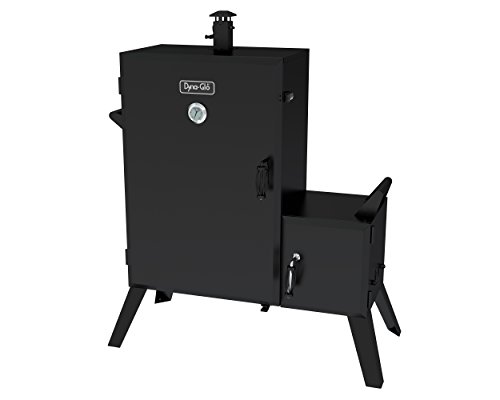
Dyna-Glo Wide Body Vertical Offset Charcoal Smoker — Amazon Alternative — Best Amazon Alternative — Small Footprint
Label, plainly: a factory vertical offset, not a custom build. Its place here is practical: many custom dreams die at the patio door, because a fabricated horizontal pit needs width, clearance and a permanent home. The Dyna-Glo stands the offset layout upright — firebox low beside a wide cabinet of stacked racks — so the flavour profile of offset cooking fits a corner. For renters, small yards and anyone whose custom pit would be a planning dispute, this is the alternative that actually fits their life.
Strengths
- Offset flavour on a fraction of a custom pit’s footprint
- Stacked racks handle mixed loads efficiently
- Buyable now, movable later — no permanent siting decision
Trade-offs
- Vertical format cooks differently: heat rises, top racks run hotter
- Not a grill, and not custom steel or capacity
- Door seals need watching, as on all tall cabinets
| Status | Factory cooker — alternative to custom, NOT custom-built |
| Layout | Vertical offset, side firebox at base |
| Format | Wide-body cabinet, stacked racks |
| Fuel | Charcoal and wood |
Cook it as a cabinet: forgiving cuts high, delicate items low, rotation between racks rather than across a grate. It will not scratch the bespoke itch, and it does not pretend to. What it does is put real offset flavour into spaces and budgets where the custom answer is ‘not yet’ — which, honestly assessed, is most spaces and most budgets. Our full review sits in Best Consumer Smokers Offset, where it took Best Vertical Footprint.
Best for: small spaces that still want genuine offset flavour / Not suited for: buyers whose priority is a horizontal pit’s grill-and-smoke format
Check on Amazon — check price on Amazon before you decide, because commercial listings change configuration often.
Comparison Table
Read the ‘Status’ column first. Three of these cannot be bought on Amazon at all; three can, and are labelled as the factory alternatives they are.
| Pick | Badge | Key spec | Best for |
|---|---|---|---|
| Lang Smoker Cookers (Custom Reverse-Flow Offsets) | Best Custom Route — Reverse Flow | Built-to-order reverse-flow offset — sold direct only | offset cooks upgrading to heavy steel and reverse-flow evenness |
| Shirley Fabrication (Fully Bespoke Pits) | Best Custom Route — Fully Bespoke | One-off bespoke fabrication — sold direct, waitlist | experienced cooks commissioning a lifetime, one-off pit |
| Jambo Pits (Competition-Bred Offsets) | Best Custom Route — Competition | Competition offset, built to order — sold direct only | competition cooks and aspirants who want circuit-proven equipment |
| Oklahoma Joe’s Highland Reverse Flow Offset Smoker — Amazon Alternative | Best Amazon Alternative — Reverse Flow | 1,093 sq. in., reverse-flow baffle (verified listing) | cooks who want reverse-flow cooking now, custom or not |
| Oklahoma Joe’s Longhorn Combo Offset Smoker and Grill — Amazon Alternative | Best Amazon Alternative — Size and Versatility | 1,060 sq. in. offset smoker and grill combo (verified listing) | households wanting one large smoker-grill without the custom commitment |
| Dyna-Glo Wide Body Vertical Offset Charcoal Smoker — Amazon Alternative | Best Amazon Alternative — Small Footprint | Vertical offset cabinet, wide-body racks (verified listing) | small spaces that still want genuine offset flavour |
How to Choose the Best Custom BBQ Smokers: Match the Shop to Your Cooking
Custom builders are not interchangeable. Lang sells perfected patterns — choose a size, choose options, receive a pit whose design has been refined over decades. Shirley sells interpretation — your brief, engineered into a one-off. Jambo sells specialisation — competition offsets refined where results are public. The right choice follows from a question only you can answer: do you want a proven design, your design, or a contest design?
Then interrogate the practicalities before the romance. Ask about current lead time in writing, deposit terms, what the deposit secures if the shop’s circumstances change, freight method and cost to your address, and what is included — thermometers, covers, ash tools — versus extra. Reputable builders answer all of it plainly; the custom world runs on reputation and the good shops protect theirs. If a ‘custom’ seller cannot discuss steel thickness, firebox sizing or lead time concretely, you are not talking to a fabricator.
What Custom Money Actually Buys (and What It Does Not)
It buys steel: plate thick enough to hold temperature through wind and winter, welded into a single rigid body that does not leak at bolted seams. It buys geometry: a firebox correctly sized to the chamber, a stack placed and sized for clean draft, doors that fit. And it buys time — the pit’s working life is measured in decades, and its cooking manners on a bad-weather day are where factory owners feel the difference most.
It does not buy skill, and it does not buy convenience. A custom offset still needs its fire tended every half hour; it will not make a careless cook’s brisket tender. Price the whole commitment honestly: pit, freight, a permanent site, a wood supply of proper splits, and the seasons of practice. That total — not the headline price — is the real comparison against the alternatives above and the factory class in Best Consumer Smokers.
The Factory Alternative Test: When ‘Good Enough’ Is Actually Right
Run this test before paying any deposit. List your last ten cooks: sizes, cuts, weather, guests. If a factory reverse-flow or combo covers nine of them, the custom premium buys you one cook a year and better manners in bad weather — which may still be worth it to you, but now it is a decision, not a dream. If your list shows regular large cooks, winter smoking and a genuine love of fire craft, the custom case strengthens with every line.
Many respected pit cooks did it in stages: factory offset first, custom second, with the factory cooker teaching them the brief for the commission. There is no shame in that sequence — it is how the best-specified custom pits get ordered.
Inside a Custom Build: The Anatomy Worth Paying For
To judge a builder, learn to see a pit the way they do. Start at the firebox: its volume is proportioned to the chamber, its door seals against a machined-flat flange, and its grate holds a coal bed at the height the draft design assumes. Move to the chamber: plate steel you can hear when you knock it, a door that closes with a latch’s authority rather than a prayer, hinges that will not sag in a decade. Follow the heat’s path — in a reverse-flow pit, under a baffle plate welded as structure, not dropped in as an accessory; in a traditional pit, through a throat sized to the stack. End at the stack itself: diameter and height are draft engineering, and a builder who chooses them by eye is telling you something.
None of this anatomy is visible in a photograph, which is why custom buying runs on conversation and reputation rather than listings. Ask a builder to walk you through their firebox sizing for the chamber you want. The ones worth your deposit will talk for ten minutes and teach you something. That conversation — unbuyable, unshippable, unlistable — is the real product page of the custom world, and it is why this guide sends you to telephones instead of carts.
Reverse Flow vs Traditional in Custom Pits: Settling the Argument Properly
In factory cookers the reverse-flow debate is partly marketing; in custom pits it is a genuine engineering fork, and your builder choice may settle it for you — Lang’s identity is reverse flow, Klose-style traditionalists defend the classic draw, and bespoke shops like Shirley will build either and argue their corner. The honest physics: reverse flow spends some heat warming its baffle plate in exchange for an even chamber and a distinctive sizzle-driven flavour; traditional draw keeps the fire’s full energy in the airstream, rewards rotation skills, and gives the cook a deliberate hot zone to exploit.
Choose by cooking style, not by forum loyalty. Cooks who load a chamber fully with uniform product — ribs for a crowd, a catering row of chickens — benefit most from reverse flow’s evenness. Cooks who run mixed loads and enjoy using gradient as a tool often prefer traditional, especially in smaller pits where the gradient is gentle anyway. A bespoke builder will ask which you are; a pattern builder has already answered for their range. Either answer, executed in heavy steel, cooks superbly — the fork matters less than the metal it is executed in.
Living With a Custom Pit: The Decade View
Custom ownership has a rhythm factory owners never meet. The first season is calibration: your pit’s draft personality, its fuel appetite by season, the grate map of its chamber. The following years are a long, pleasant plateau in which the cooker stops being a variable at all — it does the same thing every time, in any weather, and all improvement comes from the cook. Maintenance shrinks to the honourable minimum: ash out, grates oiled, firebox watched for the rust that even great steel invites where heat is fiercest, a cover or shelter overhead.
There is also a social fact worth naming: a custom pit becomes a landmark. Neighbours navigate by its smoke; family events organise around it; the builder’s name becomes part of your own barbecue story. Owners consistently report that this — not the tenth of a degree of temperature stability — is what the money bought. Plan for it as you would any landmark: site it where it will be loved for decades, because moving it is nobody’s idea of a Saturday.
Questions to Ask Any Builder Before a Deposit Changes Hands
Carry this list into every builder conversation and score the answers, not the brochures. What steel thickness do you use in the chamber and the firebox, and why? How do you size the firebox and stack to the chamber? What is your current lead time, honestly, and what has it averaged this year? What does the deposit secure, and what happens to it if timelines slip badly? How is the pit delivered — freight, liftgate, collection — and what does each route cost to my address? What is included in the price, and what do owners most often add later? Who do I call in year five if a hinge or damper needs attention?
Notice what the list never asks: it never asks for a discount in the first conversation, and it never asks the builder to match another shop’s design. Custom buying is a relationship measured in decades, and these questions start it as one — technically curious, practically serious, respectful of the craft. The builders profiled in this guide answer every one of them fluently. Anyone who cannot is not selling you a custom smoker, whatever their page says.
The Staged Path: How Most Custom Owners Actually Got There
Talk to custom owners at competitions and a pattern repeats so reliably it deserves to be called the normal road. Stage one is a factory cooker — often a combo like the alternatives in this guide — bought with enthusiasm and cooked on weekly. Stage two is modification and mastery: gaskets, baffles, thermometers, a notebook filling with the cooker’s habits and limits. Stage three is the itch made specific: the owner can now name, in engineering terms, exactly what their next pit must fix. Only then, stage four, comes the commission — and it is a good one, because it was written by three seasons of evidence.
The staged path costs less than it appears to, because the factory cooker keeps working — as a second pit, a grill, a loaner — long after the custom arrives, and because it prevents the one truly expensive outcome in this category: a bespoke pit specified by guesswork. If you are at stage one today, you are not behind the custom owners. You are where they started.
Resale, Inheritance and the Long Arc of a Custom Pit
A custom pit is one of the few consumer purchases that behaves like a durable asset. The secondhand market for respected builders is active precisely because the product’s useful life dwarfs its first owner’s plans: pits change hands when cooks upsize, downsize or leave the circuit, and a well-kept example of a known builder’s work finds buyers quickly. Documentation helps — the original specification, the builder’s name and markings, a photographic record of condition — so keep the paperwork the way this guide keeps telling you to write it down.
There is a longer arc still. Custom pits get inherited, genuinely and affectionately: the grandfather’s Lang, the team’s retired Shirley, still cooking at family gatherings decades after the deposit was paid. No purchasing framework prices that, and this guide will not pretend to. But it explains the otherwise puzzling calm of custom buyers about the money: they are not buying a smoker for this season. They are buying the last smoker, and amortising it across a lifetime of Saturdays.
A Word on Patience: Lead Times as a Feature, Not a Bug
Every buyer’s first instinct is to negotiate the wait away, and every experienced owner advises the opposite: the queue is information. A builder with no wait is a builder the market has not tested; a builder booked out for seasons is carrying the verdict of hundreds of cooks who ate the food and told their friends. The lead time also does quiet work for you — it is the cooling-off period in which impulse becomes intention, briefs improve, sites get prepared and wood gets seasoned. More than one owner in the custom world will tell you the pit they received was better than the pit they ordered, because the wait gave them time to change two options and a dimension, in writing, before steel was cut.
So plan the calendar instead of fighting it: order in the quiet season, cook the interval on the best factory alternative you can justify, and let anticipation do what it does for every other craft purchase worth making. The pit is coming. It will outlast the wait by decades.
How to Order a Custom Smoker, Step by Step
Step 1 — Define your cooking brief. Write down your typical and maximum cooks, your fuel, your site and its dimensions, and the features you have genuinely missed on previous cookers. Builders build to briefs; vague wishes produce vague pits.
Step 2 — Shortlist two or three shops. Use the profiles above as the pattern: pattern builders, bespoke builders, competition builders. Read owner forums for the specific model or style you are considering, and note real lead times people experienced, not just quoted ones.
Step 3 — Talk before you pay. A proper conversation about steel, firebox sizing, options and freight is the industry’s handshake. Ask what the builder would change about your brief — good fabricators push back where experience disagrees with you, and that pushback is part of what you are buying.
Step 4 — Secure your place properly. Expect a deposit. Get the specification, price, deposit terms and estimated completion in writing. Confirm what happens to the deposit if timelines slip significantly.
Step 5 — Plan the pit’s home while you wait. A fabricated pit is heavy and effectively permanent. Prepare a level, non-flammable base with working room around the firebox and doors, and plan the delivery route — gates, slopes and steps included.
Step 6 — Season and learn it. On arrival, season the steel with oil and a clean fire, then cook forgiving cuts while you learn your pit’s draft personality. Even a perfect custom pit has one; learning it is the first season’s real work. For the theory underneath, Best Cookbook For Smokers — Franklin above all — is the custom owner’s home library.
Common Buying Mistakes
Believing a factory cooker marketed as ‘custom’. If it ships in a box from a marketplace, it is a production cooker. Good ones exist — three are reviewed above — but buy them as what they are.
Paying a deposit without a written specification. Size, steel, options, price, freight and timeline belong on paper. Reputable builders expect this; anyone who resists it has told you something.
Commissioning before you know your style. A one-off pit built around a guess is an expensive way to learn you prefer cabinets. Cook a season on a factory cooker first if you have never owned an offset.
Forgetting freight and siting in the budget. Heavy steel travels at heavy prices, and a pit that cannot reach its base is a sculpture. Price the whole journey, gate to first fire.
Ordering size for the party you throw once a year. Oversized chambers cost fuel and patience on every ordinary cook. Size for your real life, as with any cooker in Best Custom Built Smokers.
Final Recommendation
If you are ready for the real thing: Lang for a perfected reverse-flow pattern, Shirley for a true one-off commission, Jambo for competition-bred offsets — all ordered direct, all worth the wait for the right cook. If you are not ready, or not sure, the labelled alternatives are the honest path: the Highland Reverse Flow to test reverse-flow cooking now, the Longhorn Combo for size and versatility, the Dyna-Glo Wide Body where space rules. Every one of those decisions is respectable. The only wrong move in this category is paying custom money — or custom trust — to a listing that was never custom at all. The sibling categories follow the same rule: see Best Custom Built Smokers for built-to-order variations and Best Custom Trailer Bbq Smokers for towable pits.
Start your shortlist here: Oklahoma Joe’s Highland Reverse Flow Offset Smoker — Amazon Alternative, Oklahoma Joe’s Longhorn Combo Offset Smoker and Grill — Amazon Alternative, Dyna-Glo Wide Body Vertical Offset Charcoal Smoker — Amazon Alternative. Check price on Amazon for each, in that order, against the needs described above.
Frequently Asked Questions
Can I buy a genuine custom smoker on Amazon?
No — and that is the honest headline of this guide. Custom pits are built to order and sold direct by fabricators. Amazon sells factory offsets, some of them excellent, but a one-click listing is by definition not a custom build.
How long does a custom smoker take to arrive?
Lead times vary by builder and season and are measured in months rather than weeks; bespoke shops with waitlists can run considerably longer. Get the current estimate in writing when you place your deposit.
Why are custom smokers so much more expensive than factory offsets?
Thick plate steel, welded one-off construction, hand fitting, and a small crew’s labour across days of fabrication. You are buying material, geometry and decades of service life, not a brand premium.
Do custom smokers cook better than factory ones?
They cook more steadily — thick steel and sealed construction hold temperature through weather and recover faster — and their draft geometry is usually better tuned. They do not tend their own fires; the cook’s skill still decides the brisket.
What deposit should I expect to pay?
Practices vary by shop; a deposit to secure a build slot is standard. What matters is that the amount, the specification it secures and the terms are recorded in writing before money moves.
Should I buy a factory offset before commissioning a custom pit?
If you have never owned an offset, yes. A season on a factory cooker teaches you your size, layout and feature preferences, and that knowledge makes a later commission dramatically better specified.
Do custom smokers hold their value?
Well-regarded builders’ pits have an active secondhand market and typically retain value far better than factory cookers, because the product does not wear out on a consumer timescale. Condition, builder reputation and region all move the actual number, so treat it as durability rather than as an investment promise.
Can a custom builder copy a pit I have seen?
Bespoke shops will discuss design influences and adapt ideas to your brief; pattern builders will point you to the closest model in their range. What reputable builders will not do is clone another shop’s signature design wholesale — and a shop that offers to should prompt questions about its other ethics too.
Is a custom smoker a good first smoker for a keen beginner?
Keen is not the same as calibrated. Without a season of cooks, a beginner cannot specify size, layout or options from evidence, and a one-off pit frozen around guesses teaches expensively. The staged path in this guide — factory season first, commission second — exists because it produces both better cooks and better pits.
Are there custom-style options between factory and full custom?
Yes, in spirit: the premium factory end — heavy-for-the-class offsets like the reverse-flow alternative in this guide, fitted with gaskets and tuning by their owners — is where most cooks actually live. It is not custom, and this guide will not call it that, but it is a legitimate destination rather than merely a waiting room.


