Disclosure: airfryerkitchensupply.com is reader-supported. When you buy through links on our site, we may earn an affiliate commission at no extra cost to you.
Where to buy
Cuisinart sells the same mixer platforms in several finishes and two control styles, so the listing details matter: buy on Amazon, where each listing names the exact model — SM-50, SMD-50BC, HM-90S, HM-50 — and its finish. Use this guide’s links to check price on Amazon; we do not print static prices because finish and promotion change them constantly. Confirm the model code in the title before checkout.
- Cuisinart Stand Mixer SM-50, 5.5 Quart, White Linen — Best Overall Cuisinart: check price on Amazon
- Cuisinart Precision Pro Digital Stand Mixer SMD-50BC, 5.5 Quart — Best Digital Cuisinart: check price on Amazon
- Cuisinart Stand Mixer SM-50, 5.5 Quart, Onyx — Best for Modern Kitchens: check price on Amazon
- Cuisinart Stand Mixer SM-50, 5.5 Quart, Ruby Red — Best Statement Finish: check price on Amazon
- Cuisinart Power Advantage Plus 9-Speed Hand Mixer HM-90S — Best Cuisinart Hand Mixer: check price on Amazon
- Cuisinart Power Advantage 5-Speed Hand Mixer HM-50, White — Best Budget Cuisinart: check price on Amazon
Shoppers looking for the best Cuisinart mixers usually arrive with a sensible instinct: Cuisinart’s stand mixers deliver the flagship formula — big stainless bowl, double-digit speeds, full attachment set — at a friendlier position than the category’s prestige brands, and its hand mixers are category staples. This guide covers the whole Cuisinart mixing range: the SM-50 stand mixer in its key finishes, the digital Precision Pro step-up, and the two hand mixers that round out the line.
An honest framing first: Cuisinart’s stand mixer line is one platform with variations, not six different machines. The SM-50’s 5.5-quart, 12-speed tilt-head design is the core; finishes change the look, and the SMD-50BC changes the controls to digital with preprogrammed settings. The hand mixers are genuinely different tools for a different job. This guide treats them that way — no invented distinctions, just clear guidance on which configuration fits which kitchen.
Every model was verified, so model codes, capacities, speeds and included attachments below match the live listings behind the links.
In this guide
Quick Picks
The Cuisinart range in six picks: the SM-50 in White Linen as the overall choice, the digital SMD-50BC for program-led bakers, the SM-50 in Onyx and Ruby Red for finish-led kitchens, and the HM-90S and HM-50 hand mixers for drawer-stored mixing.
- Cuisinart Stand Mixer SM-50, 5.5 Quart, White Linen — Best Overall Cuisinart. The core Cuisinart: 12 speeds, 5.5-quart stainless bowl, whisk, paddle, dough hook and a splash guard with pour spout — the complete package in a bright, kitchen-friendly finish. Check price on Amazon.
- Cuisinart Precision Pro Digital Stand Mixer SMD-50BC, 5.5 Quart — Best Digital Cuisinart. The digital evolution of the platform: 12 speeds, 3 preprogrammed food-prep settings and the full attachment set for bakers who want repeatable, program-led mixing. Check price on Amazon.
- Cuisinart Stand Mixer SM-50, 5.5 Quart, Onyx — Best for Modern Kitchens. The same complete SM-50 platform in Onyx — the finish that hides daily baking evidence and matches black and stainless appliance suites. Check price on Amazon.
- Cuisinart Stand Mixer SM-50, 5.5 Quart, Ruby Red — Best Statement Finish. The SM-50 as the kitchen’s focal point: Ruby Red finish over the same 12-speed, 5.5-quart platform with the full attachment set. Check price on Amazon.
- Cuisinart Power Advantage Plus 9-Speed Hand Mixer HM-90S — Best Cuisinart Hand Mixer. Cuisinart’s premium hand mixer: 9 speeds, SmoothStart to prevent splatters, and a snap-on storage case that keeps beaters, whisk and hooks together. Check price on Amazon.
- Cuisinart Power Advantage 5-Speed Hand Mixer HM-50, White — Best Budget Cuisinart. The entry Cuisinart: a 220W, 5-speed hand mixer with extra-long beaters — simple, light and sufficient for the standard home mixing repertoire. Check price on Amazon.
How These Picks Were Chosen
This guide covers the Cuisinart mixing line as it actually exists, verified model by model: the SM-50 stand platform, the SMD-50BC digital variant, and the HM-series hand mixers. Each listing’s model code, capacity, speed count and included attachments were confirmed against Amazon’s catalog data before inclusion.
We refused to manufacture differences. The three SM-50 finishes are presented as finishes — the choice between them is aesthetic and practical, and the reviews say so. The genuine decisions in the line are platform decisions: analog versus digital controls, stand versus hand, and those are the comparisons the guide develops in depth.
Competing brands appear only as context. Buyers who land on this search have usually already chosen Cuisinart’s value proposition; the guide’s job is to land them on the right Cuisinart, not to relitigate the brand choice.
The 6 Best Cuisinart Mixers

Cuisinart Stand Mixer SM-50, 5.5 Quart, White Linen — Best Overall Cuisinart
Badge: Best Overall Cuisinart. The SM-50 in White Linen is the Cuisinart mixer in its definitive form. Twelve speeds, a 5.5-quart stainless steel bowl, and the full working set — chef’s whisk, mixing paddle, dough hook and a splash guard with a pour spout — in a light finish that suits the bright kitchens where stand mixers most often live. Check the current price on Amazon.
Strengths
- Complete attachment set including splash guard in the box
- 12 speeds with smooth low-speed control
- White Linen finish brightens rather than dominates a counter
Trade-offs
- Tilt-head design flexes more than bowl-lift under very stiff dough
- Light finish shows turmeric and tomato splashes until wiped
- Accessory ecosystem is smaller than KitchenAid’s
| Spec | Detail |
|---|---|
| Capacity | 5.5 qt bowl |
| Design | Tilt-head |
| Speeds | 12 |
| Included | Chef’s whisk, mixing paddle, dough hook, splash guard with pour spout |
The SM-50’s case is completeness per dollar. Rival platforms charge extra for the splash guard; Cuisinart includes it, along with the three attachments that do nearly all home mixing. The tilt-head workflow — tilt, add, scrape, tilt back — is the friendliest in the category for cake-led baking, which is most baking.
White Linen is the finish to choose if the mixer will sit in a light kitchen or you simply prefer appliances that recede. It asks for prompt wiping after colored batters, a fair trade for a counter that does not gain a visual boulder.
A word on sizing within the Cuisinart line: the 5.5-quart bowl is the platform’s only stand size, and that simplicity is a feature — every Cuisinart stand attachment, bowl and accessory conversation starts from the same dimensions. Owners upgrading within the brand, or buying a second bowl, never face a compatibility matrix.
Best for: most buyers choosing a Cuisinart stand mixer / Not suited for: weekly stiff-dough bread specialists
Check on Amazon if this pick matches your kitchen and the way you actually cook.
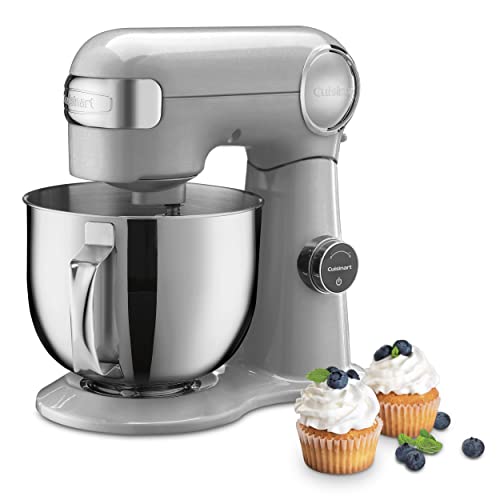
Cuisinart Precision Pro Digital Stand Mixer SMD-50BC, 5.5 Quart — Best Digital Cuisinart
Badge: Best Digital Cuisinart. The SMD-50BC Precision Pro takes the SM-50’s bowl and brief and adds a digital control system with three preprogrammed food-prep settings. The point is not novelty — it is repeatability. Programs ramp speeds the same way every time, so the meringue you nailed last month is reproducible this month. Check the current price on Amazon.
Strengths
- Preprogrammed settings standardize common jobs
- Digital speed selection is precise and repeatable
- Same generous in-box attachment set as the SM-50
Trade-offs
- Digital premium over the SM-50 buys control, not capacity
- One more interface to learn
- Tilt-head ceiling on stiff dough remains
| Spec | Detail |
|---|---|
| Capacity | 5.5 qt bowl |
| Design | Tilt-head, digital |
| Speeds | 12 |
| Programs | 3 preprogrammed food prep settings |
| Included | Whisk, flat mixing paddle, dough hook, splash guard |
Who benefits from programs? Bakers who repeat recipes — the weekly bread, the signature cake, the holiday marathon — and newer bakers who have not yet internalized pacing. The machine’s memory substitutes for both. If your baking is improvisational, the analog SM-50’s knob is equally good and simpler.
In Silver Lining finish the SMD-50BC also splits the aesthetic difference between the white and black SM-50s, suiting stainless-led kitchens. It is the Cuisinart to buy when you know you will keep it a decade and want the controls to feel current throughout.
The digital model’s preprogrammed settings are also a teaching tool: run a program and watch its pacing — where it pauses, how it ramps — and you learn the rhythm an experienced baker applies manually. Owners report ‘graduating’ to manual control with better instincts after a season of programs, which is a benefit no spec sheet lists.
Best for: repeat-recipe bakers and digital-interface fans / Not suited for: buyers who prefer knobs or the lowest Cuisinart stand-mixer spend
Check on Amazon if this pick matches your kitchen and the way you actually cook.
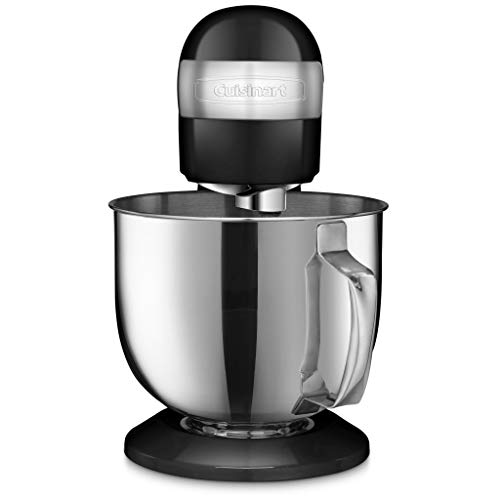
Cuisinart Stand Mixer SM-50, 5.5 Quart, Onyx — Best for Modern Kitchens
Badge: Best for Modern Kitchens. Onyx is the SM-50 for the modern kitchen: black appliance suites, dark counters, and cooks who would rather wipe a mixer weekly than daily. Mechanically it is identical to the White Linen pick — 12 speeds, 5.5-quart bowl, whisk, paddle, hook and splash guard — which is precisely the point: choose this one with your eyes, guilt-free. Check the current price on Amazon.
Strengths
- Dark finish conceals the film of daily baking
- Identical complete platform to the Best Overall pick
- Matches black and stainless suites effortlessly
Trade-offs
- Dark die-cast shows flour dust prominently
- Same tilt-head dough ceiling as all SM-50s
- Finish choice only — no mechanical upgrade
| Spec | Detail |
|---|---|
| Capacity | 5.5 qt bowl |
| Design | Tilt-head |
| Speeds | 12 |
| Finish | Onyx |
| Included | Chef’s whisk, mixing paddle, dough hook, splash guard with pour spout |
Finish is a legitimate deciding factor for an appliance that lives in view for a decade, and Onyx’s case is practical: butter smears and batter specks that shout on white merely whisper on black. Flour dust reverses the equation, but flour wipes off dry in seconds.
Buyers torn between this and White Linen should decide by their kitchen’s palette and their wiping temperament, not by imagined performance differences — there are none, and this guide will not invent any.
Onyx also travels well between kitchen styles: the same machine suits a farmhouse kitchen’s black accents and a loft’s industrial palette. If your home’s style is still evolving — a rental now, a renovation later — Onyx is the finish least likely to be stranded by the next design decision.
Best for: modern, dark or stainless-led kitchens / Not suited for: buyers wanting a mechanically distinct upgrade
Check on Amazon if this pick matches your kitchen and the way you actually cook.
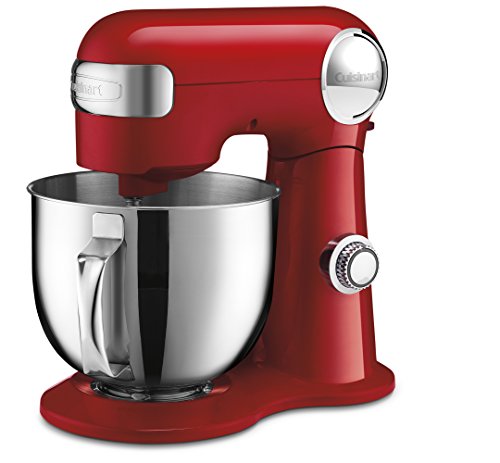
Cuisinart Stand Mixer SM-50, 5.5 Quart, Ruby Red — Best Statement Finish
Badge: Best Statement Finish. Some kitchens are built around a color, and the Ruby Red SM-50 is for them. It is the complete Cuisinart platform — 12 speeds, 5.5-quart stainless bowl, whisk, paddle, dough hook, splash guard — wearing the finish that turns a workhorse into the room’s signature. Check the current price on Amazon.
Strengths
- Statement red finish with the full platform underneath
- Complete attachment set included
- Red appliances hold their look well over years
Trade-offs
- A decade-long color commitment on a central counter
- No mechanical difference from other SM-50 finishes
- May clash with future kitchen refreshes
| Spec | Detail |
|---|---|
| Capacity | 5.5 qt bowl |
| Design | Tilt-head |
| Speeds | 12 |
| Finish | Ruby Red |
| Included | Chef’s whisk, mixing paddle, dough hook, splash guard with pour spout |
Red stand mixers are a tradition in American kitchens, and the logic is sound: an appliance you love looking at is an appliance you use. The Ruby Red SM-50 gives that tradition Cuisinart’s value platform instead of the prestige brands’ pricing.
The only real caution is temporal. Kitchens get refreshed more often than stand mixers get replaced, so choose red because red is your kitchen’s constant — not its current phase. If it is, this is the most joyful pick in the Cuisinart line.
Red has one more practical virtue: visibility. A Ruby Red mixer is never visually lost in a busy kitchen, which matters in shared households — everyone knows where the mixer is, what it is, and (after one demonstration) what it can do. Appliances that invite use get used; the red SM-50 invites.
Best for: color-led kitchens and red-appliance collectors / Not suited for: kitchens likely to change palette soon
Check on Amazon if this pick matches your kitchen and the way you actually cook.

Cuisinart Power Advantage Plus 9-Speed Hand Mixer HM-90S — Best Cuisinart Hand Mixer
Badge: Best Cuisinart Hand Mixer. The HM-90S is Cuisinart’s answer for kitchens that mix often but store small. Nine speeds with a SmoothStart feature that begins gently — no flour cloud, no batter splash — plus a snap-on storage case holding the beaters, chef’s whisk and dough hooks, make it the most complete hand mixer in the brand’s line. Check the current price on Amazon.
Strengths
- SmoothStart eliminates the classic hand-mixer splatter
- 9 speeds including a true gentle low
- Snap-on case ends the lost-beater drawer hunt
Trade-offs
- Hand mixing is still arm-powered for long jobs
- Dough hooks handle soft doughs only
- Premium position among hand mixers
| Spec | Detail |
|---|---|
| Type | Hand mixer |
| Speeds | 9 |
| Feature | SmoothStart |
| Included | Beaters, chef’s whisk, dough hooks, snap-on storage case |
SmoothStart sounds like a brochure word until you have worn a cake batter. The HM-90S ramps into each speed, so dry ingredients incorporate instead of erupting — the single most-loved feature in owner feedback for this class, and the reason this hand mixer converts stand-mixer skeptics.
The storage case is the second practical win: hand mixers fail organizationally, not mechanically, and a case that keeps the full set together means the whisk is findable the day you need it. For small kitchens, this is the Cuisinart to buy first.
The HM-90S’s whisk deserves its own mention: hand mixers live or die on whether they can whip cream and egg whites quickly, and the chef’s whisk plus the 9-speed range’s honest top end do it properly. Meringue from a hand mixer used to be a compromise; with this tool it is merely a choice.
Best for: small kitchens and frequent batter-and-cream mixing / Not suited for: serious dough work or large batches
Check on Amazon if this pick matches your kitchen and the way you actually cook.
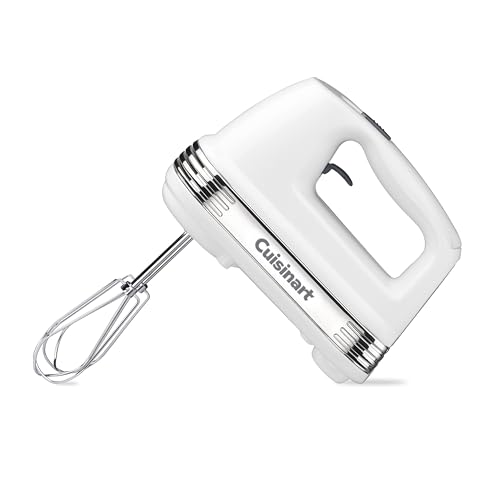
Cuisinart Power Advantage 5-Speed Hand Mixer HM-50, White — Best Budget Cuisinart
Badge: Best Budget Cuisinart. The HM-50 is where the Cuisinart range begins: five speeds, a 220-watt motor and extra-long beaters that reach into deep bowls. It lacks the HM-90S’s SmoothStart and case, but for batters, frostings and whipped cream — the hand-mixer core repertoire — it covers the ground at the brand’s friendliest position. Check the current price on Amazon.
Strengths
- Light, simple and easy to store
- Extra-long beaters suit deep bowls and pots
- The budget way into the Cuisinart line
Trade-offs
- No SmoothStart — mind the first seconds with flour
- 5 speeds give coarser control than the HM-90S
- No storage case included
| Spec | Detail |
|---|---|
| Type | Hand mixer |
| Speeds | 5 |
| Motor | 220W |
| Included | Extra-long beaters |
The HM-50’s buyers are households that mix monthly, not weekly: birthday cakes, holiday frostings, the occasional whipped cream. For that rhythm, nine speeds and a case are luxuries, and the HM-50’s simplicity — plug in, choose a speed, mix — is the feature.
It also serves as the sensible second mixer in a stand-mixer household, for the small jobs not worth hauling out the big bowl. Bought for either job, it is the Cuisinart line’s easiest yes.
The HM-50’s white finish and light body make it the Cuisinart most often found in vacation homes, spare kitchens and first apartments — contexts where a mixer should be obvious to operate and painless to replace. Its longevity in the catalog is the market agreeing with that positioning, year after year.
Best for: occasional mixers and second-mixer duty / Not suited for: frequent bakers who will miss SmoothStart and finer speeds
Check on Amazon if this pick matches your kitchen and the way you actually cook.
Comparison Table
The Cuisinart range is one stand platform in three finishes, one digital evolution, and two hand mixers. This table keeps the distinctions honest and the choice simple.
| Pick | Badge | Key spec | Best for |
|---|---|---|---|
| Cuisinart Stand Mixer SM-50, 5.5 Quart, White Linen | Best Overall Cuisinart | 5.5 qt tilt-head, 12 speeds | most buyers choosing a Cuisinart stand mixer |
| Cuisinart Precision Pro Digital Stand Mixer SMD-50BC, 5.5 Quart | Best Digital Cuisinart | 5.5 qt digital, 12 speeds, 3 programs | repeat-recipe bakers and digital-interface fans |
| Cuisinart Stand Mixer SM-50, 5.5 Quart, Onyx | Best for Modern Kitchens | 5.5 qt tilt-head, 12 speeds, Onyx | modern, dark or stainless-led kitchens |
| Cuisinart Stand Mixer SM-50, 5.5 Quart, Ruby Red | Best Statement Finish | 5.5 qt tilt-head, 12 speeds, Ruby Red | color-led kitchens and red-appliance collectors |
| Cuisinart Power Advantage Plus 9-Speed Hand Mixer HM-90S | Best Cuisinart Hand Mixer | 9-speed hand mixer, SmoothStart, case | small kitchens and frequent batter-and-cream mixing |
| Cuisinart Power Advantage 5-Speed Hand Mixer HM-50, White | Best Budget Cuisinart | 5-speed hand mixer, 220W | occasional mixers and second-mixer duty |
How to Choose Among the Best Cuisinart Mixers
Decide stand versus hand first. If you knead dough, bake in batches or want hands-free mixing, the stand platform is your answer and the hand mixers are future second tools. If your mixing is batters, frostings and cream at standard scale — and especially if storage is tight — the HM-90S will serve you better than a stand mixer you dread retrieving.
Within the stand line, decide controls: the SM-50’s knob is immediate and proven; the SMD-50BC’s digital programs add repeatability for recipe-repeaters. Then, and only then, choose the finish — White Linen for bright kitchens, Onyx for modern suites, Ruby Red for color-led rooms. That order prevents the classic error of buying a color and discovering you wanted different controls.
- Stand for dough, batches and hands-free work
- Hand for storage-tight kitchens and batter-led mixing
- Digital if you repeat recipes and value programmed pacing
- Analog if you want the simplest, proven interface
- Finish last — by palette and wiping habits
Cuisinart SM-50 vs SMD-50BC: What the Digital Upgrade Buys
The two stand mixers share the platform essentials: 5.5-quart bowl, tilt-head access, the core attachment set. The SMD-50BC’s premium buys a digital interface and three preprogrammed food-prep settings that standardize ramping and timing. In mixing output — the cake that results — the machines are peers when operated by an experienced baker.
The upgrade therefore pays in consistency and learning curve, not in capability. Newer bakers get pacing they have not yet learned; repeat bakers get identical runs. If neither describes you, the SM-50 remains the value center of the line, and the money saved buys ingredients for a season of baking.
Getting the Most from a Cuisinart Mixer
Cuisinart’s tilt-heads reward correct technique: start low, add dry ingredients in stages, and let the paddle — not the whisk — do creaming and batter work. The splash guard with its pour spout is not packaging filler; fitted during flour additions, it keeps the counter and the cook clean and lets liquids join mid-mix.
For the hand mixers, SmoothStart on the HM-90S should be your default beginning, and even on the HM-50 a slow first speed prevents the splatter that gives hand mixing a bad name. Register whichever model you buy and keep the attachment set together — with the case on the HM-90S, that discipline is built in.
Cuisinart Mixer Attachments and Accessories: What Fits, What Is Worth It
Within the stand line, the platform’s accessories revolve around the bowl and the beater shaft: spare bowls for batch work, replacement beaters, whisks and hooks, and the splash guard most owners already own because Cuisinart includes it. The highest-value first addition is a second 5.5-quart bowl — it converts batch baking from a wash-and-repeat relay into a smooth sequence, especially at holidays.
Cuisinart also offers optional attachments for its stand mixers through its own catalog; check model compatibility on the listing before buying, because fit is platform-specific. For the hand mixers, the accessory story is the set itself — keep beaters, whisk and hooks together (the HM-90S case exists precisely for this) and the tool stays complete for its whole life.
Cuisinart vs the Category: An Honest Positioning
Cuisinart’s stand mixers compete by offering the flagship formula — capacity, speeds, attachments — at a position below the prestige brands, and by including in the box what rivals sell separately. The prestige brands counter with deeper accessory ecosystems, bowl-lift flagships and longer flagship pedigrees. Neither story is false; they are different allocations of the same money.
The hand mixer line plays a similar game one tier down: the HM-90S’s SmoothStart and storage case are features rivals reserve for their own premium models. Buyers who choose Cuisinart are typically choosing completeness-per-dollar, and the brand’s mixer line is engineered to reward exactly that priority. If your priority is instead the largest possible attachment catalog, the honest advice is to compare ecosystems before committing — a point this guide makes rather than hides.
Care and Troubleshooting for Cuisinart Mixers
Most Cuisinart mixer complaints trace to three fixable causes. Unmixed flour at the bowl’s bottom usually means the beater clearance needs a small adjustment or the mix needed one scrape-down — normal for tilt-head platforms. Flour clouds mean the guard was off or the speed started high; both are technique, not defects. A motor that sounds strained on dough is telling you the batch exceeds comfortable capacity — split it, and the machine returns to its easy rhythm.
Care itself is minimal: wash attachments promptly, wipe the head and base after use, keep the hand mixers’ vents clear, and store cords loosely. Register the product, keep the manual’s speed chart — Cuisinart’s recommended speeds per task are genuinely well calibrated — and the mixer will repay the small attention for years.
Cuisinart Mixers for Holidays and Batch Season
The test of any mixer line is December. The SM-50 platform handles the season’s shape well: a 5.5-quart bowl takes double cookie batches, the paddle creams the season’s butter by the kilo, and the splash guard earns its place when flour additions multiply. The discipline is sequencing — doughs that need chilling go first, frostings last — and a second bowl, the line’s best accessory investment, removes the washing bottleneck entirely.
For households whose holidays include gift baking at volume, the honest ceiling appears: tilt-head platforms manage the season in batches rather than in single heroic runs. Plan the batches and the Cuisinart keeps pace indefinitely; demand one-run scale and you are shopping the bowl-lift flagships in the cluster guides — a boundary this brand guide states rather than strains against.
Cuisinart Mixer Myths, Corrected
Myth one: more speeds means better mixing. The SM-50’s twelve speeds matter because its lowest gears are genuinely gentle, not because twelve exceeds ten — a violent first speed in a 15-speed machine is worse than a calm one in a 9-speed. Myth two: wattage decides dough ability. Drive design and bowl geometry decide it; wattage is the supporting actor. Myth three: a stand mixer replaces technique. It amplifies technique — creaming times, flour staging and hook speeds still belong to the baker.
Myth four, specific to this line: that the finishes differ mechanically. They do not, and any source claiming the Onyx ‘performs better’ is selling, not informing. The Cuisinart range is refreshingly legible once the myths are cleared: one stand platform, two control philosophies, three finishes, two hand mixers. Choose on that map and you cannot go far wrong.
Registering, Warranties and Getting Support for Your Cuisinart
A practical closing note for the line: register whichever model you buy, keep the manual — its speed-by-task chart is calibrated to these machines and outperforms generic internet advice — and keep the box through the first month in case the unit must travel. Cuisinart’s support channels handle the mixer line routinely, and model codes (SM-50, SMD-50BC, HM-90S, HM-50) are the language that makes any support conversation short.
Replacement beaters, bowls and guards for these platforms are standard catalog items, which is part of buying an established line: the machine’s ecosystem persists as long as the machine does. That persistence, as much as any single feature, is the Cuisinart proposition this guide keeps returning to.
Cuisinart Mixers in the Hands of Real Bakers: Three Household Profiles
Profile one: the weekend cake baker. Her SM-50 lives on the counter beside the flour canisters, creams butter on Saturdays, and has converted a boxed-mix habit into a scratch repertoire because the machine removed the labor barrier. The tilt-head’s easy scraping suits her layered cakes; the splash guard keeps her white kitchen white. She has never once wished for a bowl-lift, because her doughs are batters and her batches are birthdays.
Profile two: the bread-curious couple. Their SM-50 kneads a Sunday loaf at low speed while they learn hydration by feel; the machine’s honesty about its ceiling taught them batch discipline — one loaf, mixed well, beats two loaves mixed hard. If the habit deepens into a multi-loaf routine, they will graduate within the cluster guides; for now the Cuisinart is exactly the teacher they needed. Profile three: the small-apartment cook whose HM-90S lives in its case in a drawer, whipping, creaming and mixing in a kitchen where a stand mixer would have to sleep in the oven. Her baking output embarrasses kitchens three times her size.
The profiles share a moral: Cuisinart’s line is sized to real households rather than to aspirational ones. The brand’s value is not that it beats flagships at flagship games; it is that its machines fit the lives most bakers actually lead, at prices that leave budget for the ingredients those lives are baked from.
The Cuisinart Kitchen: Pairing Your Mixer With the Rest of the Brand’s Bench
Buyers often ask whether a Cuisinart mixer ‘goes with’ a Cuisinart food processor or coffee maker, and the honest answer is that ecosystems matter within a product, not across a counter. A mixer’s attachments fit its own platform; its relationship to your processor is purely visual. Choose the mixer on mixer merits — this guide’s entire argument — and let the counter’s palette be a tiebreaker, never a criterion.
Where pairing does matter is within the mixing bench itself: the stand mixer plus the brand’s hand mixer is a genuinely complementary pair, sharing a design language and a support channel, covering dough-to-drawer with no gap. Households building a bench from zero can rationally choose that pair on purpose. Everyone else should feel free to mix brands across the counter without a flicker of guilt — the cakes cannot tell.
Cuisinart Mixers for Specific Bakes: Matching the Line to Your Signature Recipes
Every baker has signatures, and the Cuisinart line maps onto them cleanly. The layer-cake baker lives on the paddle and the splash guard: the SM-50’s creaming at mid speeds, its gentle folding at the bottom of the dial. The meringue and pavlova baker lives on the whisk — the stand line’s whisk at full speed for volume, or the HM-90S for the small, precise batches a hand tool handles better. The cookie baker at volume wants the 5.5-quart bowl and a second bowl waiting, because December is a relay race.
The bread beginner — one loaf, learning — is served by the SM-50’s hook at low speed with flour staged in; the bread obsessive is this guide’s honest redirect to bowl-lift and bottom-drive designs in the cluster. The frosting-and-fillings cook, the one whose mixing is ninety percent creaming and whipping, is the HM-90S’s natural owner and may never need the stand at all. Name your signatures before you shop and the Cuisinart choice stops being a comparison and becomes a recognition.
That recognition is the brand’s quiet strength: the line is small enough to know completely. Six picks, one platform logic, no maze. In a category that often monetizes confusion, Cuisinart’s legibility is a feature this guide is happy to reward with its clearest possible verdicts.
What to Do in the First Month With a New Cuisinart Mixer
Week one: bake what you already know. Your familiar recipes are the calibration set — you know how the batter should look, so the machine’s speeds and action can be learned against a known result. Register the product, read the speed chart, and fit the splash guard before the first flour, not after the first cloud. Week two: attempt the machine’s party pieces — a whisked sponge for the stand, a SmoothStart batter for the hand mixer — and note the speeds that worked in the recipe margins.
By week four the mixer should feel like furniture: placed, understood, unremarkable. If a friction persists — clearance, a beater that misses the bowl’s edge, a speed that throws flour — it is adjustment or technique, both fixable, and Cuisinart’s support and documentation cover each by name. The first month is an investment whose return is the following decade of unconsidered competence, and it is the same month every pick in this guide asks of its owner.
Cuisinart Mixers: The Verdict in One Page
Strip this guide to its skeleton and the Cuisinart line is a decision tree with four questions. Do you knead or batch? Then stand; otherwise consider the hand line seriously. Do you repeat recipes and value programmed pacing? Then the SMD-50BC; otherwise the SM-50’s dial. Which finish survives your kitchen’s palette and your wiping temperament? White Linen, Onyx or Ruby Red — a free choice, honestly labeled. And if hand: do you mix weekly? Then the HM-90S’s SmoothStart and case; monthly, the HM-50 suffices.
Four questions, six products, no wrong answers — only mismatches, each named in the reviews above. That is the Cuisinart proposition at its best: a line small enough to understand completely and complete enough to serve almost every home baker. Choose on the tree, register the product, keep the speed chart, and bake. The machine will handle the rest for years.
A Note on Finishes, Photography and Real Kitchens
One last piece of buying hygiene for this line: product photography flatters finishes. White Linen photographs brighter than it lives, Onyx photographs moodier, Ruby Red photographs richer. In your kitchen’s light, all three will read slightly differently — which is an argument for choosing by palette family rather than by the exact photographed shade, and for remembering that the finish you see most is the one covered in the evidence of baking. All three finishes forgive that evidence at different rates, and the reviews have told you which is which.
One More Consideration: Cuisinart Mixers as Gifts
Cuisinart’s mixers occupy the giftable sweet spot of the category: substantial enough to mark an occasion, priced so the giver is not performing, and legible enough that the recipient needs no expertise to choose well — this guide’s decision tree fits on the gift card. The HM-90S is the line’s safest gift (every kitchen can use it, every drawer can hold it), the SM-50 in the recipient’s kitchen colors is the confident one, and the SMD-50BC suits the baker whose recipe notebook is already a system.
Include the receipt, register nothing on their behalf, and add the one line that makes appliance gifts succeed: an offer to bake the first recipe together. A mixer given with a first bake scheduled becomes a household institution; a mixer given alone becomes a box in a closet with surprising frequency. The difference is not the machine — it never was.
Closing Note: The Line’s Quiet Virtue
If this guide has a single sentence for the Cuisinart range, it is this: the line respects the buyer’s intelligence. One platform, honest variations, complete boxes, and prices that leave room for flour and butter. In a category that often sells fog, that clarity is the feature above features — and it is why these six picks can be recommended without a single asterisk.
How to Use a Cuisinart Stand Mixer for Cakes, Dough and Whipping
Fit the bowl, choose the attachment by task — paddle for batters and creaming, whisk for aeration, hook for dough — and check that the head locks down fully before starting. Begin every job at the lowest speed and step up in stages; the SM-50’s twelve speeds reward patience at the bottom of the dial.
- Cream butter and sugar with the paddle for several minutes until pale — this is your cake’s lift
- Add eggs one at a time, then alternate dry and wet ingredients at low speed
- For dough, use the hook at low speed and add flour gradually until the dough clears the bowl
- Whip cream and egg whites with the whisk, watching closely at the end — seconds separate peaks from butter
- Use the splash guard during flour additions and pour liquids through its spout
- Scrape the bowl once mid-mix for even results
After baking, wash attachments promptly and wipe the head and base while splashes are fresh. Store the bowl on the machine. A Cuisinart maintained this way is a decade-plus appliance.
Common Buying Mistakes
The common Cuisinart mistake is buying the finish first and the platform second. The second is expecting tilt-head rigidity from any brand’s tilt-head under a very stiff dough — technique and hydration management matter more than the logo.
- Choosing a finish before deciding analog versus digital
- Running the dough hook at high speed
- Skipping the splash guard and blaming the mixer for flour clouds
- Overfilling the 5.5 qt bowl with a double stiff dough
- Losing hand-mixer attachments by skipping the case habit
- Assuming hand-mixer dough hooks replace a stand mixer for bread
Final Recommendation
The Cuisinart line resolves to a few clear answers. Most buyers: the SM-50 in whichever finish suits the kitchen — White Linen by default. Repeat-recipe bakers: the SMD-50BC’s digital programs. Small or storage-tight kitchens: the HM-90S, whose SmoothStart and case make it the best hand mixer Cuisinart sells. Occasional mixers: the HM-50, simple and sufficient.
Decide platform, then controls, then color — and the Cuisinart range stops looking like six options and becomes one obvious choice.
Ready to decide? Start with the shortlist: Cuisinart Stand Mixer SM-50, 5.5 Quart, White Linen, Cuisinart Precision Pro Digital Stand Mixer SMD-50BC, 5.5 Quart, Cuisinart Stand Mixer SM-50, 5.5 Quart, Onyx.
Keep exploring the cluster: Best Counter Mixers Best Counter Top Mixers Best Deluxe Mixers Best Affordable Stand Mixers Best Afforable Hand Mixers
Frequently Asked Questions
Are Cuisinart stand mixers as good as KitchenAid?
They compete on the same formula — capacity, speeds, attachments — with different strengths. Cuisinart’s SM-50 typically offers more speeds and a more complete in-box set at its position; KitchenAid offers a deeper attachment ecosystem and bowl-lift models. For cake-led home baking, the Cuisinart is a fully credible alternative, which is why it anchors this guide.
What is the difference between the SM-50 and SMD-50BC?
Controls. The SM-50 uses an analog dial for its 12 speeds; the SMD-50BC is digital and adds three preprogrammed food-prep settings for repeatable pacing. Bowl, platform and attachments are essentially shared. Buy digital for consistency, analog for simplicity and value.
Can the Cuisinart SM-50 knead bread dough?
Yes, with the dough hook at low speed and flour added in stages. It handles standard home loaves well. Very stiff, low-hydration doughs in double batches are where tilt-head designs work hardest — occasional bread is fine, a weekly multi-loaf routine argues for a bowl-lift or bottom-drive design.
Does the HM-90S hand mixer really prevent splattering?
Its SmoothStart feature begins each speed gently, which prevents the burst that throws flour and batter — the main cause of hand-mixer mess. Technique still helps: start with beaters submerged and add dry ingredients gradually.
Which Cuisinart mixer is best for a small kitchen?
The HM-90S hand mixer: it stores in a drawer, its case keeps attachments together, and its 9 speeds cover the batter-and-cream repertoire completely. If you bake bread or big batches, the SM-50 is the smallest stand option in the line worth considering.
Are Cuisinart mixer attachments interchangeable across models?
Within the stand line, the core attachments are designed for the platform; hand mixer beaters and hooks are model-family specific. Check the model code when buying replacements — the listings name compatibility explicitly.


