Disclosure: airfryerkitchensupply.com is reader-supported. When you buy through links on our site, we may earn an affiliate commission at no extra cost to you.
Where to buy
Shopping for the best cookware sets for beginners? Start here. Every linked set below was verified in this site’s Amazon catalog data before earning a link. Beginner buying has one rule that outranks all others: the set should forgive your first year of mistakes while teaching you to cook. Each pick here was chosen for that forgiveness, at a different tier and in a different material. Jump to a listing, or read the reviews to find your match.
- T-fal Initiatives Ceramic 14-Piece Cookware Set — check price on Amazon
- Farberware EcoAdvantage 13-Piece Cookware Set — check price on Amazon
- GreenLife 16 Piece Ceramic Nonstick Cookware Set, Black — check price on Amazon
- KitchenAid Hard-Anodized Nonstick 10-Piece Set — check price on Amazon
- Rachael Ray Cucina 12-Piece Nonstick Cookware Set — check price on Amazon
- Cuisinart Chef’s Classic Stainless Steel 10-Piece Set (77-10P1) — check price on Amazon
The best cookware sets for beginners are not the best cookware sets, full stop — and confusing the two is how new cooks end up with a demanding stainless fleet they hate, or a fragile budget set that dies by Christmas. A beginner set has a specific job: survive imperfect heat, imperfect timing and imperfect washing-up while still turning out dinners that encourage the cook to try again tomorrow. Forgiveness is the feature. Everything else — material, count, tier — is a way of delivering it.
Forgiveness comes in three forms in this guide. Nonstick and ceramic sets forgive technique: food releases even when your heat judgement is still developing. Hard-anodized and mid-tier sets forgive carelessness: thicker metal resists warping when a pan is left empty a minute too long. And complete, well-composed sets forgive inexperience itself, by including the pan each job actually needs, so a beginner is never trying to boil pasta in a skillet and concluding they cannot cook.
All six picks passed the same verification gate as every guide in this programme: the exact set confirmed in this site’s Amazon catalog data before a link was written. The reviews are blunt about lifespans and learning curves, because a beginner deserves the truth in plain language — including the truth that one of these sets is deliberately a first set, meant to be learned on and eventually outgrown.
In this guide
Quick Picks
Short on time? These are the best cookware sets for beginners worth your money, in the order most shoppers should consider them. Every pick below gets a full review further down the page, with its badge carried through so you can match the summary to the detail.
- Best Overall for Beginners: T-fal Initiatives Ceramic 14-Piece Cookware Set — a 14-piece ceramic set at the budget tier — maximum forgiveness and complete coverage for the lowest stakes, from a brand big enough to support a new cook. — Check on Amazon
- Best Budget Alternative: Farberware EcoAdvantage 13-Piece Cookware Set — a 13-piece set from one of America’s oldest cookware names — an alternative budget doorway with an eco-positioned line and a complete beginner composition. — Check on Amazon
- Best Ceramic for Beginners: GreenLife 16 Piece Ceramic Nonstick Cookware Set, Black — 16 pieces of verified ceramic nonstick from the category’s best-known name — the step up from the budget doorway for beginners who know they want ceramic. — Check on Amazon
- Best Mid-Range for Beginners: KitchenAid Hard-Anodized Nonstick 10-Piece Set — a 10-piece hard-anodized nonstick set, induction-ready per its verified listing — the beginner set for cooks who want substance under the convenience. — Check on Amazon
- Best Friendly First Set: Rachael Ray Cucina 12-Piece Nonstick Cookware Set — a 12-piece aluminium nonstick set in the Cucina line’s warm styling — an approachable, colourful first fleet for beginners who cook socially. — Check on Amazon
- Best Grow-Into-It Set: Cuisinart Chef’s Classic Stainless Steel 10-Piece Set (77-10P1) — the stainless alternative — no coating to manage ever, a complete 10-piece composition, and a steeper first month in exchange for a set that can serve for decades. — Check on Amazon
How These Picks Were Chosen
Beginner suitability was scored on four axes. Forgiveness: does the surface release food for a cook whose heat control is still forming? Resilience: does the construction tolerate the classic beginner accidents — the empty pan on a lit burner, the metal spoon, the dishwasher-everything phase? Completeness: does the composition cover the beginner repertoire — eggs, pasta, sauces, one-pot meals, reheats — without gaps or silly duplicates? And guidance value: does the set teach transferable skills, or does it hide cooking entirely behind a coating?
No single set wins all four axes, which is why this guide spans materials and tiers and says plainly which axis each pick serves. A beginner who knows they will cook eggs daily needs a different first set from a beginner who dreams of sauces and searing — and both are right.
The 6 Best Cookware Sets for Beginners
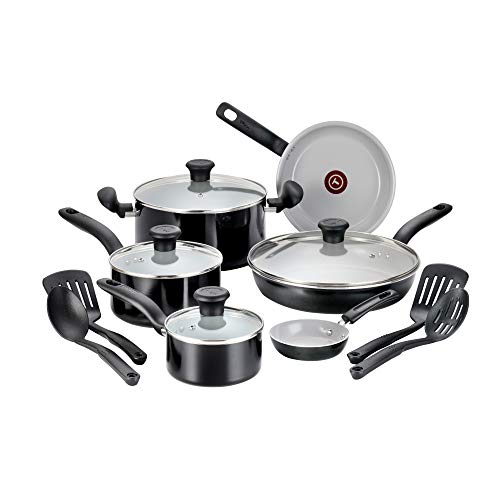
T-fal Initiatives Ceramic 14-Piece Cookware Set — Best Overall for Beginners
The first set most beginners should buy is the one that makes the first year easy and the mistakes cheap, and that is this set. Fourteen pieces cover the whole beginner repertoire, the ceramic surface — confirmed in the verified listing title — releases food for cooks whose heat judgement is still forming, and the budget tier means a scorched pan is a lesson, not a financial event. It suits true beginners, students and first-flat cooks. It does not suit anyone who already cooks confidently — the mid-tier picks will serve you better — or cooks planning heavy searing from day one.
Strengths
- Ceramic nonstick forgiveness: eggs, fish and reheats release while technique develops
- 14 pieces means the right pan exists for every beginner job — no skillet-pasta improvisations
- Budget-tier stakes turn the inevitable early mistakes into cheap lessons, backed by a major brand’s support
Trade-offs
- Thinner construction rewards medium heat; it is not the set for unattended high burners
- Coating lifespan at this tier is the shortest in the guide — plan on it as a first set, not a final one
- It teaches convenience more than craft; cooks who fall in love with cooking will outgrow it, happily
| Pieces | 14 |
| Surface (verified from listing) | Ceramic |
Judge this set as a teaching tool and it is superb. The beginner repertoire — breakfast eggs, pasta and jarred sauce becoming real sauce, stir-fries, soups, reheated everything — cooks successfully in it from the first week, and early success is what turns a beginner into a cook. The pans are light, the cleanup is trivial, and nothing about the set intimidates.
Set the expectation on day one: this is a two-to-three-year first set whose real product is a confident cook. When that cook emerges, they will know exactly what to buy next — and several of those next sets are the other picks in this guide.
Best for: true beginners who want easy wins and low stakes / Not suited for: confident cooks or heavy searing
Check on Amazon — check the current price on Amazon before you decide, because set configurations and included pieces change between listings.

Farberware EcoAdvantage 13-Piece Cookware Set — Best Budget Alternative
Farberware has been equipping first kitchens for generations, and the EcoAdvantage 13-piece set is its current beginner proposition: a complete composition at the accessible tier, from a line positioned around more considered materials. It suits beginners who want the budget doorway but prefer a heritage brand’s ecosystem, and households furnishing a first kitchen in one box. It does not suit cooks who want the ceramic surface specifically — take the T-fal above — or anyone chasing premium heft.
Strengths
- Complete 13-piece beginner composition — the daily core plus the extras a first kitchen actually uses
- A heritage brand with deep retail and support presence; replacement pieces are easy to source
- Accessible tier keeps first-year mistakes inexpensive while skills form
Trade-offs
- Budget construction across the category means medium-heat discipline is part of the deal
- Like all entry sets, it is a first set by design — keen cooks will upgrade within a few years
- Check the listing for your hob type before ordering, as with every set in this guide
| Pieces | 13 |
| Line | EcoAdvantage |
The choice between this and the T-fal Initiatives set is mostly about surface and brand preference; both deliver the same beginner bargain — completeness and forgiveness at low stakes. Farberware’s long presence in American kitchens means its pieces feel familiar to anyone who grew up cooking at a parent’s or grandparent’s stove, which is its own kind of beginner comfort.
Whichever doorway you choose, walk through it with the same plan: cook everything, learn your hob, notice which two pans you use daily. That knowledge, bought cheaply, is what makes the second set a triumph instead of another guess.
Best for: beginners wanting a heritage-brand budget set / Not suited for: ceramic-specific shoppers or premium seekers
Check on Amazon — check the current price on Amazon before you decide, because set configurations and included pieces change between listings.

GreenLife 16 Piece Ceramic Nonstick Cookware Set, Black — Best Ceramic for Beginners
Beginners who have done their reading often arrive with a decision already made — ceramic, for its PFAS-free coating story — and this is the set that honours it properly: 16 pieces, ceramic nonstick confirmed in the verified listing title, from the brand that built its identity on exactly this surface. It suits beginners equipping a kitchen completely in ceramic, and households that cook gently and often. It does not suit high-heat searing ambitions or anyone who has not confirmed their hob against the listing.
Strengths
- The fullest ceramic composition in this guide — a whole beginner kitchen in one box
- Ceramic release is at its best in the beginner repertoire: eggs, pancakes, fish, grains, reheats
- A brand whose entire focus is this surface, with the open-stock ecosystem to refresh worn pieces later
Trade-offs
- Ceramic ownership rules are real homework: medium heat, gentle tools, no aerosol sprays
- Coating lifespan is years, not decades — a renewable-surface commitment
- Bigger box means more storage than the compact picks; measure your cabinets
| Pieces | 16 |
| Surface (verified from listing) | Ceramic nonstick |
| Colour | Black |
What this set offers a beginner is completeness without intimidation. Every early cooking question — which pan for this? — has an answer in the box, and every answer releases its food and rinses clean. That frictionless first year is worth a great deal, and it is why ceramic sets are so often the correct first purchase despite their finite surface life.
The upgrade path is built in: when the frypans eventually tire — they will, years in, if cared for — GreenLife’s open-stock range replaces them while the pots serve on. A beginner who starts here and follows the care rules in this guide may never need another full set at all.
Best for: beginners committed to ceramic with a complete kitchen to equip / Not suited for: high-heat cooks or unconfirmed-induction buyers
Check on Amazon — check the current price on Amazon before you decide, because set configurations and included pieces change between listings.

KitchenAid Hard-Anodized Nonstick 10-Piece Set — Best Mid-Range for Beginners
Some beginners know themselves: they will cook daily, they will be a bit rough on equipment while learning, and they want pans with real substance from the start. KitchenAid’s hard-anodized 10-piece set is built for them — thicker, sturdier bodies than the budget doorways, nonstick forgiveness on top, and induction readiness stated in the verified listing. It suits committed beginners and first households with induction hobs. It does not suit the lowest budgets, or purists avoiding coatings entirely.
Strengths
- Hard-anodized bodies resist the warping and hot spots that punish beginner heat mistakes in thin pans
- Induction readiness is confirmed in the verified listing — critical for modern first flats
- 10-piece composition is the beginner sweet spot: complete without padding
Trade-offs
- Mid-tier money for a coated product still buys a finite surface life
- Heavier than budget sets — a genuine consideration for smaller cooks and full pans
- Nonstick forgiveness can delay learning heat skills that stainless would teach faster
| Pieces | 10 |
| Construction (verified from listing) | Hard-anodized, induction |
| Oven (per listing title) | Oven safe to 500°F |
| Colour | Matte black |
The case for spending mid-tier money as a beginner is durability against your own learning curve. The classic beginner accidents — preheating too long, heat too high, a pan left to cool on a hot burner — are exactly what hard-anodized construction shrugs off and thin budget metal does not. If you can afford the step up, the set survives your education intact.
It also future-proofs the hob question, which matters more than beginners expect: first flats increasingly mean induction, and a set that works on it from day one never becomes the reason a new home’s kitchen feels broken.
Best for: committed beginners wanting substance and induction readiness / Not suited for: tight budgets or coating-free purists
Check on Amazon — check the current price on Amazon before you decide, because set configurations and included pieces change between listings.

Rachael Ray Cucina 12-Piece Nonstick Cookware Set — Best Friendly First Set
Cooking confidence is partly emotional, and the Cucina set understands that: friendly colours, comfortable grips and a 12-piece aluminium nonstick composition that makes a first kitchen feel welcoming rather than clinical. The verified listing confirms the set in Agave Blue, with other colourways on the same listing family. It suits beginners who cook for friends, enjoy their kitchen’s look and want zero intimidation from their tools. It does not suit minimalists, induction owners without a listing check, or searing specialists.
Strengths
- Approachable design that genuinely encourages nervous beginners to cook more often
- 12-piece composition covers the social beginner repertoire — pasta nights, brunches, one-pot dinners
- Aluminium bodies heat quickly and forgive the timing errors of a cook still learning their hob
Trade-offs
- Aluminium nonstick at this positioning is a few-years surface, like all its peers
- Colour-forward styling will not suit every kitchen or every taste
- Enamel-style exteriors ask for reasonable care to stay looking their best
| Pieces | 12 |
| Material | Aluminium nonstick |
| Colour | Agave Blue (per listing) |
Never underestimate the equipment that makes a beginner want to cook. A set that looks friendly gets used; a set that looks like a chemistry lab gets avoided, and avoided pans teach nothing. The Cucina line’s warmth is a functional feature for exactly the audience of this guide.
Under the styling sits a sensible fleet: the pans a social beginner actually reaches for, in quick-heating aluminium with easy-release surfaces. Treat it as the few-years first set it is, cook joyfully in it, and graduate informed.
Best for: social beginners who want a welcoming, colourful first set / Not suited for: minimalists or high-heat specialists
Check on Amazon — check the current price on Amazon before you decide, because set configurations and included pieces change between listings.

Cuisinart Chef’s Classic Stainless Steel 10-Piece Set (77-10P1) — Best Grow-Into-It Set
One beginner strategy deserves its own pick: skip the training-wheels set and learn on the real thing. Cuisinart’s Chef’s Classic stainless 10-piece set is the most accessible honest version of that strategy — complete composition, no coating to baby or replace, and a tier that forgives the purchase if cooking does not stick. It suits beginners who are patient, who cook with people who can teach them, or who simply refuse to buy anything twice. It does not suit egg-for-breakfast daily cooks without a supplementary skillet, or anyone whose patience for a learning curve is honestly low.
Strengths
- No coating means no surface lifespan at all — the set cannot wear out in the way every coated pick eventually does
- Complete 10-piece composition teaches real technique: preheating, deglazing, heat control — skills that transfer to all cooking
- Stainless tolerates every beginner accident except dropping it: metal tools, high heat, dishwasher, oven — all fine
Trade-offs
- The first month is genuinely harder: eggs and fish will stick until heat technique clicks
- Food sticks, so cleanup in the learning phase is soaking and scrubbing, not wiping
- Success depends on the cook’s patience — an impatient beginner in stainless is an ex-cook in the making
| Pieces | 10 |
| Line | Chef’s Classic Stainless, 77-10P1 |
The honest pitch: month one will include stuck eggs and a pan that looks like a crime scene. Month three, if you persist, brings the quiet mastery of a cook who can sear, sauce and deglaze in the same pan — and a set that will still be doing it in twenty years. Cooking media has romanticised this path for good reason; it is simply not for everyone.
Our advice is specific: take this set if you have a teacher, a temperament for practice, or a small nonstick skillet budget alongside it for breakfast duty. Take a coated pick if dinner must simply work tonight. Both decisions are respectable; only the mismatch is a mistake.
Best for: patient beginners who want to learn real technique once / Not suited for: daily egg cooks without a backup skillet, or the impatient
Check on Amazon — check the current price on Amazon before you decide, because set configurations and included pieces change between listings.
Comparison Table
| Pick | Badge | Key spec | Best for |
|---|---|---|---|
| T-fal Initiatives Ceramic 14-Piece Cookware Set | Best Overall for Beginners | 14 pc ceramic set, budget tier | true beginners who want easy wins and low stakes |
| Farberware EcoAdvantage 13-Piece Cookware Set | Best Budget Alternative | 13 pc set, budget tier | beginners wanting a heritage-brand budget set |
| GreenLife 16 Piece Ceramic Nonstick Cookware Set, Black | Best Ceramic for Beginners | 16 pc ceramic nonstick set | beginners committed to ceramic with a complete kitchen to equip |
| KitchenAid Hard-Anodized Nonstick 10-Piece Set | Best Mid-Range for Beginners | 10 pc hard-anodized nonstick, induction | committed beginners wanting substance and induction readiness |
| Rachael Ray Cucina 12-Piece Nonstick Cookware Set | Best Friendly First Set | 12 pc aluminium nonstick set | social beginners who want a welcoming, colourful first set |
| Cuisinart Chef’s Classic Stainless Steel 10-Piece Set (77-10P1) | Best Grow-Into-It Set | 10 pc stainless set | patient beginners who want to learn real technique once |
How to Choose the Best Cookware Sets for Beginners
Begin by being honest about your first year, not your fantasy year. You will burn something, leave a pan heating too long, use the wrong utensil and wash everything in the dishwasher at least once. The right first set is the one whose material and tier absorb that year gracefully. Coated sets absorb it by forgiving technique; stainless absorbs it by being nearly indestructible; budget tiers absorb it by making every lesson cheap. Choose which absorption you need most.
Composition second: the beginner repertoire needs a small and a medium frypan, a 1-to-2-quart saucepan, a 3-quart saucepan or sauté pan, and a pot that boils pasta. Verify those five vessels exist in any set you consider, in sizes that match your household. Ignore headline counts — a 21-piece set can hide a missing saucepan behind six utensils, and a focused 10-piece set can cover everything.
Third, the hob check, which beginners skip and regret: confirm the set works on your stove type from the listing itself. Induction in particular excludes plain aluminium. This guide only repeats compatibility a verified listing states; where a title is silent, the review says so. Thirty seconds of checking beats a set that cannot heat up.
Nonstick, Ceramic or Stainless: A Beginner’s Material Guide
Nonstick (PTFE-based) is the most forgiving surface ever made: food releases at any skill level, cleanup is trivial, and the pans are light and cheap. Its costs are a finite surface life, a dislike of high heat and metal tools, and the need to replace frypans every few years. For a beginner whose priority is cooking dinner successfully tonight, it remains the rational default.
Ceramic nonstick offers similar forgiveness with a PFAS-free coating story, at the price of a somewhat shorter release lifespan and stricter heat discipline. It suits beginners whose reason for shopping includes coating chemistry. Stainless is the opposite bargain: zero forgiveness at first, zero surface lifespan forever. It teaches real skills and never needs replacing, and it punishes the impatient. None of these is the correct material — the correct material is the one matched to your patience, your recipes and your reasons.
The Beginner’s First Five Skills (Your Set Will Teach Them)
Heat management: pans cook food, burners just supply energy — learning to preheat, then moderate, is 80 percent of cooking. Sequencing: starting long-cooking items first and fast items last, so dinner lands together. Moisture control: drying proteins before the pan and not crowding it, which is the difference between searing and steaming. Deglazing: using liquid to lift the browned bits into a sauce, the first real ‘chef’ move and an easy one. And mise en place: everything chopped and ready before heat, because a beginner’s disasters are usually timing disasters in disguise.
Notice that none of these require expensive equipment — they require a set that lets you practise without punishment. That is the entire theory of this guide, and it is why the budget doorway picks are not compromises. They are the correct tools for the learning phase, and the skills they teach transfer intact to whatever you buy next.
Your First Five Recipes in a New Set (and What Each Teaches)
Recipe one, eggs any style, teaches heat: the pan tells you within a minute whether your burner runs hot, and eggs forgive nothing except low heat — which is the lesson. Recipe two, pasta with a simple tomato sauce, teaches sequencing and water management: sauce first, pasta timed to meet it, a mug of pasta water to marry them. Recipe three, a stir-fry, teaches preparation — everything cut before the heat goes on — and the cost of crowding a pan, visible in real time as vegetables steam instead of sear.
Recipe four, chicken thighs with a pan sauce, teaches the core protein skill set: dry surface, patient crust, deglaze, reduce. It is the meal that converts beginners, because it tastes like a restaurant and uses one pan. Recipe five, a one-pot grain dish — a simple pilaf or a lentil soup — teaches absorption and patience, and it is the weeknight template you will repeat for years. Cook these five in your first fortnight and your set has taught you the foundations; every cuisine afterwards is variation, not new territory.
Notice that none of the five requires a specialty pan, a gadget or a second set. That is deliberate: a beginner set proves itself by covering the foundations completely, and a beginner proves the set by cooking them. If a recipe you love needs a vessel your set lacks, that is your first informed supplement purchase — the system working as designed.
Care Habits That Double a First Set’s Life
Habit one: heat the pan, then add fat, then food — in that order, at medium. It prevents scorching, sticking and most coating wear in a single routine. Habit two: soak while you eat. A pan filled with warm water at serving time washes in seconds afterwards; the same pan at midnight needs a scouring pad and a grudge. Habit three: the right tool lives at the hob — a wooden spoon and a silicone spatula in a crock within reach, so the metal fork is never the nearest option.
Habit four: dry and store with protection. A cloth between stacked pans, a hook or a rack if space allows, and never a wet pan put away to rust its rivets or spot its steel. Habit five: read one page of the maker’s care notes — genuinely one page — because each surface has a single specific enemy (sprays for ceramic, thermal shock for enamel, salt pitting for stainless) and knowing yours is most of care.
None of these habits costs money or meaningful time, and together they are worth more than a tier of price. Beginners routinely double a set’s service life by adopting them in the first month, while the habits are still conscious choices. By month three they are simply how you cook — which is the point of every good routine.
When to Add, When to Upgrade: A Beginner’s Timeline
Months one to six: add nothing. Cook the repertoire, notice the gaps, write them down instead of buying them — half the gaps turn out to be one-off recipes, not needs. The first justified addition is usually a specialist the set cannot fake: a cast-iron skillet for searing, a wok if stir-frying becomes weekly, a larger pot if entertaining becomes real. Each addition should answer a repeated pattern, not a single craving.
Years one to three: the upgrade question arrives when your first set’s limits are specific and nameable — the frypan’s release is fading, the thin base scorches sauces, the composition lacks the workhorse your cooking has become centred on. Upgrade the pieces in the order you use them, not the whole fleet at once: most cooks discover that two excellent pans transform their cooking more than a second full set would.
And keep the first set’s survivors in service. The stockpot and saucepans of a budget first set often serve for many extra years as utility players — pasta water, reheats, camping — long after the frypans retire. A beginner set’s final gift is becoming the backup fleet, which is why even the budget picks in this guide come from brands whose pieces deserve that second career.
Troubleshooting: Six Beginner Problems and Their Real Causes
Problem: food sticks in a coated pan → the pan was too hot, too dry, or the coating is being sanded by metal tools and sprays. Fix the heat first — medium, with fat — and audit the utensils. Problem: food sticks in stainless → the pan was not preheated, or the food was moved too early; proteins release themselves when the crust forms, so patience is the technique. Problem: sauces scorch in one corner → a hot spot from a thin base or a burner larger than the pan; stir the corners, match pan to burner, and consider it evidence at upgrade time.
Problem: pans warp or wobble → thermal shock or sustained empty high heat. Never run cold water into a hot pan, and never leave an empty pan on a lit burner while you chop. Problem: rice and grains burn at the bottom of a saucepan → too much heat for too long; grains want a lid, low heat and rest time off the burner. Problem: everything tastes bland → almost never the pan. Salt earlier, brown properly, and finish with acid — a squeeze of lemon or a splash of vinegar — before blaming equipment.
Keep this list on the fridge for the first month. Nearly every beginner frustration maps to heat, timing or moisture rather than to the set itself — which is quietly good news, because those three variables are free to fix, and fixing them is precisely what learning to cook means.
Cooking for Others: The Beginner’s Confidence Ladder
Cooking for yourself teaches technique; cooking for others teaches cooking. The ladder is forgiving if climbed in order: first a partner or a close friend, with a meal you have already cooked twice alone. Then a small group, with a one-pot dish that waits patiently — a braise, a curry, a baked pasta — so timing pressure disappears. Only then the multi-part meal with guests, by which point it is simply your repertoire performed once more.
Your set supports every rung: the big pot and the deep pan are the dinner-party tools, and the beginner repertoire in this guide — pan-sauce chicken, one-pot grains, a proper tomato sauce — is genuinely guest-worthy food. Most beginners discover their cooking was ready before their confidence was. The ladder exists to close that gap one successful meal at a time.
A Beginner’s Pantry to Match the Set
Equipment is half the system; the other half is a small pantry that makes the beginner repertoire effortless. Keep these and the five foundation recipes in this guide are always available: eggs, rice and one other grain, dried pasta, tinned tomatoes, onions and garlic, a stock cube or carton you like, soy sauce, vinegar or lemons, chilli flakes, and one hard cheese. Twenty items, one shelf, dozens of dinners.
Buy fresh proteins and vegetables against that backbone two or three times a week, in quantities for the meals you have actually planned. The beginner who shops with a list cooks; the beginner who shops with optimism composts. Your new set, a stocked shelf and a short list are the entire infrastructure of a cooking life — everything else is refinement.
Keeping a Tiny Cooking Log (It Works)
For the first month, keep a one-line log on the fridge: date, dish, one thing learned. ‘Eggs stuck — heat too high.’ ‘Sauce scorched in the corner — stir corners.’ ‘Chicken perfect — dried it properly this time.’ Thirty seconds per meal, and within weeks the patterns become visible: your hob’s hot side, your habitual heat setting, the dish you have quietly mastered. Cooks improve fastest when feedback is written rather than remembered, because memory edits and paper does not.
The log also settles equipment questions with evidence. If the same complaint appears five times against the same pan, that is a supplement or upgrade decision made rationally. If the complaints scatter across heat and timing, the set is innocent and the cook is levelling up. Either way, a beginner with a log stops guessing — about their pans, and about themselves.
Reading Recipes With Your Set in Mind
Recipes assume a kitchen; yours is specific. Learn to translate: ‘a large skillet’ means your medium-large frypan, and for two servings you can often drop a size. ‘A Dutch oven’ in a beginner recipe usually means any heavy lidded pot — your stockpot qualifies for nearly every weeknight use. ‘Medium-high heat’ means the setting where a drop of water dances but the fat does not smoke, and your hob’s number for that is yours to discover in week one, because no two stoves agree.
Build a small translation habit and cookbooks stop being intimidating: before cooking, read the recipe once for its vessels and once for its timeline, then set out exactly the pans it needs. Beginners who do this discover that most recipes ask for two pans and a pot — precisely what every set in this guide provides. The recipe was never the hard part; the unread recipe was.
How to Use Your First Cookware Set: The First Two Weeks
A structured first fortnight turns a new set from an object into a skill base. Cook in roughly this order, whatever pick you chose.
Step 1: Days 1–2: Boil and steam
Start with water: pasta in the big pot, vegetables steamed or boiled in the saucepan. You are learning your hob’s power and each pan’s heating speed with zero risk. Note how long your largest pot takes to boil — that number plans every future pasta night.
Step 2: Days 3–5: Master the frypan gently
Eggs, pancakes and grilled sandwiches in the frypan on medium heat. If your set is coated, this is its home ground and confidence comes fast. If you chose stainless, practise the water-bead preheat test and accept the first stuck egg as tuition — then read the pan, adjust, and watch it click.
Step 3: Days 6–9: Sauces and one-pot meals
A tomato sauce in the deep saucepan, a one-pot pasta, a simple curry. These teach sequencing and moisture control, and they are forgiving dishes that taste like competence. Use the lids; notice how much less water pasta needs when it simmers covered at low heat.
Step 4: Days 10–12: Protein and pan sauce
Chicken thighs or salmon in the sauté pan or largest frypan: dry the surface, do not crowd, let the crust form, then deglaze with stock or wine and mount a quick sauce. This is the meal that makes beginners feel like cooks, because it is the real technique, done once, successfully.
Step 5: Days 13–14: Clean, inspect and organise
Wash everything properly, inspect surfaces for early damage from any bad habit, and reorganise storage by what you actually used — the two hero pans at the front. You now know your set, your hob and your repertoire’s shape. Everything after this is refinement.
Two weeks, five skill blocks, one confident cook. The set was never the point — it was the practice field. Choose the field that forgives your practice, and the cooking takes care of itself.
Common Buying Mistakes
Buying the aspirational set first
The clad stainless fleet of your dreams is a wonderful second set. As a first set it teaches slowly and punishes daily. Buy for the cook you are this year; the cook you become will choose their own upgrade, knowledgeably.
Starting on high heat
Beginners equate high heat with fast cooking; mostly it means burnt outsides and raw middles, plus damaged coatings. Medium heat, patiently applied, cooks nearly everything in this guide’s repertoire better.
Using metal tools in coated pans ‘just this once’
Coating damage is cumulative and invisible until release fails. Keep wood and silicone tools by the hob from day one — the habit is the protection.
Washing up later, always
Dried, baked-on food is what turns easy-clean pans into scrubbing projects and tempts people into abrasive pads. A two-minute soak while you eat makes every set in this guide easy to own.
Judging yourself by the pan’s first month
Stuck food in week one is data, not verdict. Every cook alive has burned the same meals you are burning. Adjust one variable — heat, timing, dryness — and cook it again. That loop is literally what cooking skill is.
Final Recommendation
Most beginners should start with the T-fal Initiatives Ceramic 14-piece: complete, forgiving and inexpensive to learn on, with the Farberware EcoAdvantage as its heritage-brand alternative. Beginners set on ceramic should take the GreenLife 16-piece; those wanting substance and induction readiness, the KitchenAid hard-anodized set; social cooks, the friendly Rachael Ray Cucina. And the patient beginner with a teacher or a skillet budget should seriously consider the Cuisinart stainless set and skip the training-wheels phase entirely.
Whichever doorway you choose, choose it for your first year, not your fantasy decade. The best beginner set is the one still making you dinner — happily — six months from now.
The shortlist, with direct links for final checking:
- Best Overall for Beginners: T-fal Initiatives Ceramic 14-Piece Cookware Set
- Best Budget Alternative: Farberware EcoAdvantage 13-Piece Cookware Set
- Best Ceramic for Beginners: GreenLife 16 Piece Ceramic Nonstick Cookware Set, Black
- Best Mid-Range for Beginners: KitchenAid Hard-Anodized Nonstick 10-Piece Set
- Best Friendly First Set: Rachael Ray Cucina 12-Piece Nonstick Cookware Set
- Best Grow-Into-It Set: Cuisinart Chef’s Classic Stainless Steel 10-Piece Set (77-10P1)
Keep researching within this cluster: Best Cookware Sets Ceramic Best Cookware Sets For A Small Apartment Best Cookware Sets For 2 Person Family Best Beginner Cookware Sets Best Cookware Sets For College Students Best Affordable Nonstick Cookware Sets
Frequently Asked Questions
What is the easiest cookware material for a beginner?
Nonstick and ceramic-coated pans are the most forgiving: food releases even while your heat judgement develops, and cleanup takes seconds. Stainless steel is the hardest to start on and the longest-lasting. Most beginners do best starting coated and adding skills — and possibly a stainless pan — later.
How much should a beginner spend on a first set?
Think in tiers rather than totals: a budget-tier complete set is a rational first purchase because it converts your learning mistakes into cheap lessons, and a mid-tier set makes sense if you know you will cook daily and want construction that survives your learning curve. Premium clad fleets are best bought as a second set, chosen with experience.
Do beginners need a big set?
No — five vessels cover the beginner repertoire: two frypans, two saucepans and a pasta-capable pot. Sets in the 10-to-16-piece range (counting lids and utensils) typically contain exactly that core. Judge by the vessel list, not the headline number.
Can a beginner start with stainless steel?
Yes, with patience or a teacher. Stainless teaches real technique and never wears out, but the first month involves stuck eggs and scrubbing. A common compromise is a stainless set plus one small nonstick skillet for breakfast — the strategy this guide’s stainless pick recommends openly.
What is the most common beginner cookware mistake?
Heat. Too high, for too long, in an empty pan. It burns food, warps thin pans and ages coatings prematurely — three failures from one habit. Medium heat and a minute of patience fix most beginner cooking problems before any equipment upgrade does.
When should a beginner upgrade their set?
When you can name what you need and why: the frypan size you always reach for, the material your cooking has outgrown, the piece your repertoire is missing. That moment usually arrives one to three years in — and a cook who can articulate it will choose a superb second set.

