Disclosure: airfryerkitchensupply.com is reader-supported. When you buy through links on our site, we may earn an affiliate commission at no extra cost to you.
Where to buy
Shopping for the best cookware sets ceramic? Start here. Every linked set below earned its link the same way: its Amazon catalog title, checked for this site, explicitly confirms a ceramic nonstick coating — no set is here on reputation or on a brand’s general marketing. One pick is deliberately unlinked, and its review explains why. Jump to a listing from the list, or read on to understand the two very different products that both call themselves “ceramic.”
- GreenLife 16 Piece Ceramic Nonstick Cookware Set, Black — check price on Amazon
- T-fal Initiatives Ceramic 14-Piece Cookware Set — check price on Amazon
- T-fal Fresh Gourmet Ceramic 12-Piece Set — check price on Amazon
- GreenLife 12-Piece Ceramic Nonstick Set, Pink — check price on Amazon
- T-fal Preserve Ceramic 13-Piece Set, Blue — check price on Amazon
- Solid Ceramic Cookware (Xtrema Class) — sold through specialty retailers; see the review below for how to source it
Before the picks, one distinction decides whether the best cookware sets ceramic search ends well or badly: “ceramic cookware” names two different things. The first — and almost everything sold as a set — is metal cookware, usually aluminium, finished with a ceramic-derived sol-gel nonstick coating. The second is cookware made of ceramic material all the way through, the solid-ceramic class sold by makers such as Xtrema. They cook differently, age differently and fail differently, and this guide keeps them visibly separate: five verified ceramic-coated sets with links, and the solid-ceramic route covered honestly in prose.
Ceramic-coated sets earn their popularity fairly. The coating is made without PFAS chemistry, releases eggs and fish beautifully when new, needs little cooking fat, and wipes clean in seconds. The trade is lifespan: sol-gel coatings are a wear surface, and even careful owners should expect strong release for a few years rather than a decade. Solid ceramic inverts the bargain — no coating to wear out and total indifference to high heat, in exchange for weight, fragility and a price per piece that makes full sets rare.
Every linked pick below was verified against Amazon’s catalog data for this site, and in each case the listing title itself states the ceramic coating — we did not infer it from a brand name. Where a famous name’s listing title does not confirm the coating, the set is not linked, however well known it is. That discipline is the difference between a guide and an advertisement.
In this guide
Quick Picks
Short on time? These are the best cookware sets ceramic worth your money, in the order most shoppers should consider them. Every pick below gets a full review further down the page, with its badge carried through so you can match the summary to the detail.
- Best Overall: GreenLife 16 Piece Ceramic Nonstick Cookware Set, Black — the most complete verified ceramic-coated set in this guide — 16 pieces in black, from the brand that built its name on PFAS-free ceramic nonstick. — Check on Amazon
- Best Budget: T-fal Initiatives Ceramic 14-Piece Cookware Set — a 14-piece ceramic set from one of the biggest names in nonstick, positioned at the budget tier — the lowest-risk way to try ceramic cooking. — Check on Amazon
- Best Mid-Range Upgrade: T-fal Fresh Gourmet Ceramic 12-Piece Set — T-fal’s step-up ceramic line — 12 pieces with the brand’s gourmet positioning, for cooks who liked the budget set’s idea and want more substance. — Check on Amazon
- Best for Small Households: GreenLife 12-Piece Ceramic Nonstick Set, Pink — the 12-piece GreenLife configuration in pink — the right-sized ceramic set for one-to-three-person households that do not need a 16-piece box. — Check on Amazon
- Best for Easy Storage: T-fal Preserve Ceramic 13-Piece Set, Blue — a 13-piece ceramic set in blue from T-fal’s Preserve line — a newer ceramic entry whose composition suits kitchens where storage and everyday ease come first. — Check on Amazon
- Best Coating-Free Alternative: Solid Ceramic Cookware (Xtrema Class) — cookware made of ceramic material throughout rather than coated metal — no coating to wear out, total heat tolerance, at a premium per piece. Covered without a link, for the reason stated in its review. — unlinked pick, explained in its review
How These Picks Were Chosen
Selection started with a verification gate: a set could only be linked if its catalog title explicitly confirmed a ceramic nonstick surface. That single rule removed several famous names from the linked list — not because their coatings are not ceramic-derived in the maker’s own literature, but because a buyer following our link deserves a listing that says what it is. Unverifiable sets are discussed in prose where they matter, with the reason stated.
Beyond the gate, sets were judged on the things that decide ceramic ownership: piece composition (does the set include the pans you will actually use weekly?), lid material, handle design, oven limits stated by the maker, and whether the brand sells open-stock replacements — because with a wear coating, the ability to replace one tired skillet without replacing the set is a genuine feature. We also spread the picks across household sizes and budgets so the guide answers the search at several depths of commitment.
The 6 Best Cookware Sets Ceramic

GreenLife 16 Piece Ceramic Nonstick Cookware Set, Black — Best Overall
GreenLife is the name most shoppers mean when they say ceramic cookware, and this 16-piece set is its fullest expression: a broad spread of pots, pans and utensils in a ceramic nonstick finish, at a mid-tier position that undercuts the designer brands. It suits households equipping a kitchen from scratch who want the ceramic route without designer pricing. It does not suit induction owners — confirm your hob type against the listing before ordering, because this set’s base is built for gas and electric coil/glass cooking — nor buyers who want a ten-year pan.
Strengths
- Ceramic nonstick confirmed in the verified listing title, from a brand whose entire identity is PFAS-free ceramic coatings
- 16-piece composition covers the daily core — frypans, saucepans, a stockpot and utensils — in one purchase
- Soft-grip style handles and a wipe-clean surface make it one of the lowest-effort sets to live with day to day
Trade-offs
- Like all sol-gel coatings, release performance is a few-years proposition, not a lifetime one
- Not the set for high-heat searing; ceramic coatings age fastest when routinely overheated
- Buyers must confirm hob compatibility on the listing — do not assume induction readiness
| Pieces | 16 |
| Surface (verified from listing) | Ceramic nonstick |
| Colour | Black |
What makes this the overall pick is completeness per unit of money. Most households need exactly what is in this box: two frypans, saucepans with lids, a stockpot for pasta and soup, and the basic utensils to serve them. The ceramic surface is at its best in precisely these daily jobs — eggs, pancakes, fish, reheated sauces — where its release is genuinely excellent and its cleanup is a single wipe.
Own it the ceramic way and it will serve well: medium heat, a little fat even though the coating tempts you to use none, silicone or wood tools, and handwashing when you can. Own it like cast iron — dry-heated to smoking and scrubbed with steel — and you will be shopping again within the year. The set is honest; the habits decide the lifespan.
Best for: households equipping a kitchen with ceramic nonstick in one box / Not suited for: induction owners who have not confirmed base compatibility, or high-heat searing cooks
Check on Amazon — check the current price on Amazon before you decide, because set configurations and included pieces change between listings.
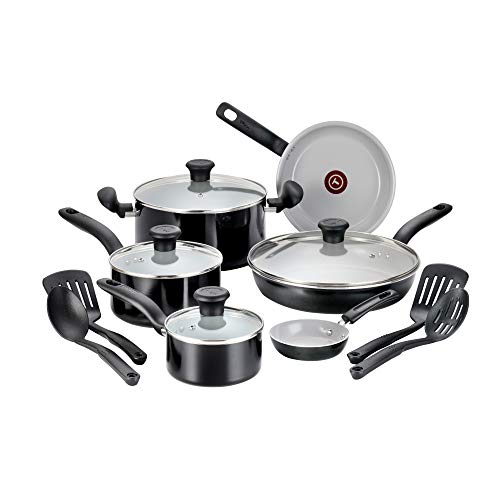
T-fal Initiatives Ceramic 14-Piece Cookware Set — Best Budget
T-fal’s Initiatives line is the budget doorway into ceramic cookware: 14 pieces, a ceramic interior confirmed in the verified listing title, and the backing of a brand with real distribution and support. It suits first apartments, rental kitchens, students and the ceramic-curious who want to learn whether the surface suits their cooking before spending more. It does not suit heavy daily family cooking at high volume — the mid-tier picks above and below are built for that — or anyone expecting heirloom weight and feel.
Strengths
- Ceramic surface confirmed in the verified listing title, at the most accessible tier in this guide
- 14 pieces is a genuinely usable spread for a first kitchen, not a padded count of lids and spoons
- T-fal’s scale means replacement pieces and support are easy to find years later
Trade-offs
- Budget construction means thinner gauges that reward medium heat and punish scorching
- Coating lifespan at this tier is the shortest in the guide — treat the set as a few-years purchase
- Handles and fittings are functional rather than premium, and feel it next to mid-tier rivals
| Pieces | 14 |
| Surface (verified from listing) | Ceramic |
The right way to judge this set is as tuition. For the price of one premium frypan, a new cook gets a full ceramic kitchen and two or three years to learn the surface’s rules: heat discipline, gentle tools, no aerosol sprays. If ceramic suits them, they upgrade with knowledge; if it does not, the lesson was cheap. That is a rational purchase, and it is why the budget badge exists.
Set expectations correctly and satisfaction follows: this is light, easy, forgiving cookware for everyday meals, not a searing station or a lifetime investment. Within those honest limits, it is one of the strongest value propositions in the ceramic aisle.
Best for: first kitchens and ceramic first-timers on a budget / Not suited for: high-volume family cooking or lifetime-buy expectations
Check on Amazon — check the current price on Amazon before you decide, because set configurations and included pieces change between listings.

T-fal Fresh Gourmet Ceramic 12-Piece Set — Best Mid-Range Upgrade
Fresh Gourmet is where T-fal’s ceramic range grows up: a 12-piece set with the line’s more substantial build and presentation, aimed at cooks who cook daily and want ceramic’s release with a bit more pan under it. It suits established households replacing a tired nonstick set and cooks who found budget ceramic too light. It does not suit induction buyers without a listing check, or shoppers who simply want the largest piece count — the 16- and 23-piece GreenLife sets win that contest.
Strengths
- Ceramic surface confirmed in the verified listing title, in T-fal’s step-up line rather than its entry line
- 12 well-chosen pieces rather than an inflated count — the composition favours pans over padding
- Brand support and open-stock availability make replacing a single worn pan straightforward
Trade-offs
- Mid-tier money buys better feel, not a different coating lifespan — sol-gel wear rules still apply
- Piece count is smaller than the big GreenLife boxes, which matters to from-scratch buyers
- As with all sets here, hob compatibility must be confirmed on the listing before purchase
| Pieces | 12 |
| Surface (verified from listing) | Ceramic |
| Line | Fresh Gourmet |
This is the set for the second-time ceramic buyer — the cook who learned the surface on a budget set, liked it, and now wants the same release with better balance, better lids and a pan that sits flatter and heats more evenly. The upgrade is in the metal and the details, and daily cooks feel it immediately even though the coating chemistry is a cousin of the cheaper line’s.
If you are choosing between this and the 16-piece GreenLife, decide by kitchen state: empty kitchen, take the bigger box; equipped kitchen replacing worn pans, take this one’s substance. Both are defensible, and the comparison table below lays the trade out plainly.
Best for: daily cooks upgrading from entry-level ceramic / Not suited for: piece-count maximisers or unverified-induction assumptions
Check on Amazon — check the current price on Amazon before you decide, because set configurations and included pieces change between listings.

GreenLife 12-Piece Ceramic Nonstick Set, Pink — Best for Small Households
Not every kitchen needs sixteen pieces, and this 12-piece GreenLife set is the same ceramic proposition trimmed to a smaller household’s reality — in a pink finish that has made it a favourite for first flats and smaller kitchens. It suits singles, couples and small families who cook real meals at modest scale. It does not suit large-batch cooks or anyone whose colour preferences run conservative — though the same line offers other finishes in other configurations.
Strengths
- Ceramic nonstick confirmed in the verified listing title, in a right-sized 12-piece composition
- Smaller sets mean less storage and fewer duplicate pieces gathering dust
- The colour finish is a genuine differentiator for buyers furnishing a first kitchen they want to enjoy looking at
Trade-offs
- A 12-piece ceiling shows quickly if you start cooking for five or six
- Light colours show exterior staining more readily than black — a cosmetic, not functional, cost
- Same ceramic ownership rules as every coated pick here: medium heat, gentle tools, no sprays
| Pieces | 12 |
| Surface (verified from listing) | Ceramic nonstick |
| Colour | Pink |
Right-sizing is an underrated virtue in cookware. A 16-piece set in a two-person kitchen means four pieces in daily rotation and twelve in the way; this set’s composition matches small-household cooking almost piece for piece. The ceramic surface handles the small-kitchen repertoire — eggs, grains, vegetables, fish, reheats — with the easy release and cleanup that make ceramic worth choosing at all.
The pink finish deserves a straight word: it is not a gimmick tax. The set sits in the same value band as its plainer siblings, and a kitchen you like looking at is a kitchen you cook in more. If the colour makes you smile and the size fits your household, this is the pick.
Best for: singles, couples and small households wanting right-sized ceramic / Not suited for: large families or big-batch cooking
Check on Amazon — check the current price on Amazon before you decide, because set configurations and included pieces change between listings.

T-fal Preserve Ceramic 13-Piece Set, Blue — Best for Easy Storage
The Preserve line is T-fal’s newer ceramic direction, and this 13-piece blue set is its representative here: a mid-size composition, ceramic surface confirmed in the verified listing title, and a design brief aimed at everyday cooking and tidier storage. It suits households replacing an ageing nonstick set who want current-generation ceramic without designer money. It does not suit shoppers who want the longest track record — this line is newer than the Initiatives and GreenLife ranges — or maximum piece counts.
Strengths
- Ceramic surface confirmed in the verified listing title, in a current-generation T-fal line
- 13-piece composition balances coverage and cupboard footprint for average kitchens
- Backed by one of the largest cookware makers in the world, with the support network that implies
Trade-offs
- Newer line means a shorter public track record than the guide’s established picks
- Mid-size composition will feel light to from-scratch buyers feeding a family
- Standard ceramic care rules apply in full — the coating rewards gentle handling
| Pieces | 13 |
| Surface (verified from listing) | Ceramic |
| Colour | Blue |
Newer ceramic lines are worth attention because coating formulations genuinely improve between generations — release durability is the industry’s known battleground, and each new line claims ground on it. We make no lifespan promises a listing cannot support; what can be said is that this set pairs a confirmed ceramic surface with a sensible composition and the industry’s deepest support bench.
Choose it if you value buying the current version of a technology from a maker who will still exist at replacement time. Choose the GreenLife 16-piece if you value maximum coverage today, and the Initiatives set if you value the lowest possible entry cost.
Best for: households wanting a current-generation ceramic set from a major maker / Not suited for: buyers who prioritise the longest-established lines only
Check on Amazon — check the current price on Amazon before you decide, because set configurations and included pieces change between listings.
Solid Ceramic Cookware (Xtrema Class) — Best Coating-Free Alternative
This final pick is a category, not a linked product, and the reason is verification discipline: the solid-ceramic makers — Xtrema is the best-known name — sell primarily through their own channels, and we could not confirm a set listing for them in this site’s Amazon catalog data to the standard this guide requires for a buying link. Rather than link you somewhere unverified, we cover the class in prose, because for some buyers it is genuinely the right answer to the ceramic question.
Strengths
- No coating exists to wear, chip or lose release — the cooking surface is the material itself, so the pan’s tenth year behaves like its first
- Full high-heat tolerance, including searing and broiler use that would age a sol-gel coating quickly
- Nothing to leach or degrade from a surface layer, which is the entire reason many buyers seek this class out
Trade-offs
- Genuinely expensive per piece, and full sets are rare — most owners build a small collection piece by piece
- Ceramic material can crack or chip if dropped or thermally shocked; it demands the handling respect you would give a ceramic dish
- Heavier and slower to respond than aluminium-core coated pans, with a learning curve on preheating
Understand what solid ceramic is and is not. It is not a tougher version of the coated sets above; it is a different material philosophy, closer to cooking in a ceramic vessel than in a metal pan. Food release is a matter of preheating and fat, not of a slick surface, and cooks raised on nonstick should expect a real adjustment period. In exchange, the cookware is essentially permanent if handled with care — no re-buying skillets every few years, no coating anxiety at all.
Who should take this route? Buyers whose objection to coated ceramic is the wear itself, cooks who keep pans for decades, and anyone furnishing a small kitchen where three permanent pieces beat sixteen temporary ones. Source it from the maker’s own store, verify the exact piece composition there, and treat the absence of a link here as what it is: this guide links only what it can verify.
Best for: coating-averse buyers who keep cookware for decades / Not suited for: budget buyers or anyone who drops pans
This pick is covered without a link: no set listing for the solid-ceramic makers could be confirmed in this site’s Amazon catalog data to this guide’s verification standard, so the class is covered in prose and should be sourced from the maker’s own store.
Comparison Table
| Pick | Badge | Key spec | Best for |
|---|---|---|---|
| GreenLife 16 Piece Ceramic Nonstick Cookware Set, Black | Best Overall | 16-piece ceramic nonstick set | households equipping a kitchen with ceramic nonstick in one box |
| T-fal Initiatives Ceramic 14-Piece Cookware Set | Best Budget | 14-piece ceramic set, budget tier | first kitchens and ceramic first-timers on a budget |
| T-fal Fresh Gourmet Ceramic 12-Piece Set | Best Mid-Range Upgrade | 12-piece ceramic set, mid tier | daily cooks upgrading from entry-level ceramic |
| GreenLife 12-Piece Ceramic Nonstick Set, Pink | Best for Small Households | 12-piece ceramic nonstick set | singles, couples and small households wanting right-sized ceramic |
| T-fal Preserve Ceramic 13-Piece Set, Blue | Best for Easy Storage | 13-piece ceramic set | households wanting a current-generation ceramic set from a major maker |
| Solid Ceramic Cookware (Xtrema Class) | Best Coating-Free Alternative | Solid ceramic material throughout | coating-averse buyers who keep cookware for decades |
Ceramic-Coated vs Solid Ceramic: The Difference That Decides Everything
Coated ceramic — five of this guide’s six picks — is aluminium wearing a ceramic-derived sol-gel skin a fraction of a millimetre thick. The metal gives fast, even, responsive heat; the skin gives PFAS-free release and easy cleanup. The skin is the wear part. Everything about owning these sets well flows from that sentence: protect the skin and the pan performs; abuse it and the pan is done, because the pan effectively is its skin.
Solid ceramic is ceramic all the way through — no metal core, no skin. It tolerates any heat a home kitchen can produce, cannot lose a coating it does not have, and will outlive its owner if it is not dropped. It is also heavier, slower to heat, breakable, and priced per piece like the permanent object it is. Neither class is “the real ceramic.” They are different tools that share a word, and choosing between them is choosing between convenience now and permanence later.
A practical middle path many households land on: a coated set for daily nonstick jobs, plus one or two permanent pieces — cast iron, stainless or solid ceramic — for searing and high-heat work. That division of labour lets each material do what it is good at, and it is the setup most experienced cooks quietly end up with.
How to Choose the Best Cookware Sets Ceramic Shoppers Will Still Like in Year Two
Count your real pieces first. A household’s daily core is usually two frypans, two saucepans, a stockpot or Dutch oven and a sauté pan. Sets that cover that core with lids earn their money; sets padded with utensils and novelty pieces inflate the count without feeding you. Compare compositions, not headline numbers — a focused 12-piece set often out-covers a padded 21-piece one.
Confirm the base against your hob from the listing itself. Ceramic sets are commonly aluminium, and aluminium alone does not work on induction. Some lines add a bonded magnetic base and say so; many do not. The listing is the authority — if it does not claim induction, assume it is not there, which is why this guide never prints an induction claim a title does not support.
Finally, price the replacement path. Coated ceramic is a renewable surface, so a brand that sells open-stock skillets lets you refresh the two pans that wear while the pots — which barely wear at all — serve on. That ecosystem check turns a three-year set into a ten-year system with two mid-life skillet swaps, and it is the smartest money move in this entire category.
Making a Ceramic Coating Last: The Four Rules
Heat discipline first: preheat on medium, cook on medium, and reserve high heat for boiling water. Sol-gel coatings age by thermal stress, and a pan preheated gently with a little fat will release food as well as a scorched one — without spending its lifespan. Fat second: a thin film of oil or butter protects the surface and improves browning; cooking sprays are the exception, because their additives bake into a gummy film that ruins release and is nearly impossible to remove.
Tools third: wood, silicone and nylon only. Metal utensils rarely cut a coating in one use — they sand it across a hundred. Storage fourth: a cloth or paper liner between stacked pans costs nothing and prevents the rim chips that start coating failure. Follow those four rules and the sets in this guide deliver their full service life; break them and no brand at any price will save you.
Ceramic Cookware and Your Hob: What Works Where
Gas is ceramic’s easiest home: any coated set works, heat is visible and responsive, and the main discipline is keeping flames at the pan’s base rather than licking up its sides, which stains exteriors and overheats edges. Radiant electric and glass-top hobs also suit ceramic sets well, provided bases are flat — a warped pan on glass rocks, spins and hotspots, which is one more argument for the mid-tier sets whose bases hold their shape.
Induction is the exception that decides purchases. Plain aluminium is invisible to an induction hob, so a ceramic set works there only when the maker bonds a magnetic base into the design and says so in the listing. That is why this guide is almost stubborn on the point: no listing claim, no induction promise. If you own induction, filter by that claim first and choose among the sets that make it — in the wider market, not by hoping a favourite brand’s other line transfers the feature.
Portable and specialty hobs follow the same logic. Butane camp stoves behave like small gas burners and suit ceramic fine for gentle cooking; halogen behaves like radiant. The hob does not care about the coating’s marketing — it cares about the base’s material and flatness, and so should you.
What to Cook (and Avoid) in Ceramic-Coated Pans
Ceramic’s home repertoire deserves naming, because cooking to a surface’s strengths is how it lasts. Eggs in every form, pancakes and crêpes, fish fillets, grilled sandwiches, vegetables sautéed at moderate heat, reheated grains and sauces — these are the jobs where the coating’s release is a daily pleasure and its lifespan is spent slowly. Acidic sauces are no problem at all; unlike reactive metals, the coating is inert to tomatoes and wine.
The avoid list is short and specific. Sustained dry high-heat searing spends the coating fastest — use cast iron or stainless for steakhouse crusts. Broiler finishing is hard on coatings and handles alike unless the maker explicitly rates the piece for it. Metal utensils and abrasive pads sand the surface down meal by meal. And aerosol sprays, as this guide repeats deliberately, deposit the one film that ruins release permanently. Cook the home repertoire, route the exceptions to a permanent pan, and a ceramic set stops being a consumable and starts being a system.
Ceramic Sets vs Buying Open Stock: The Smarter Money Path
A set is the right first purchase because it guarantees a coherent fleet at a per-piece price open stock rarely matches. But ceramic’s wear pattern — frypans age, lidded pots barely do — means the smart long-term money is set first, open stock forever after. When the small frypan’s release fades in year three, replacing that one pan costs a fraction of a new set, and the stockpot from the original box may serve a decade untouched.
This is why brand ecosystem appears in this guide’s selection criteria alongside coatings and counts. GreenLife, GreenPan and T-fal all sell individual pieces broadly; a no-name set with no open-stock presence forces a full repurchase at first wear. Price that difference honestly when comparing a cheap unknown box against a known brand at a higher tier — over a ten-year horizon, the brand is frequently the cheaper purchase.
Solid ceramic inverts the maths once more: no set discount worth chasing, no replacements to plan, just permanent pieces bought one at a time. Households that cook in three vessels can rationally skip sets altogether and assemble those three pieces in permanent materials — an option this guide raises because the best advice sometimes points away from the product category in the title.
Reading a Ceramic Listing Like an Inspector
Listings reward careful readers. The title and specification table are where verifiable claims live — surface type, piece composition, base construction, oven limits — and they are exactly what this guide used to admit picks. Marketing prose lower on the page is where vague language gathers: ‘ceramic-infused’, ‘ceramic-look’ and ‘inspired by ceramic’ are not the claim ‘ceramic nonstick’, and a buyer who learns to spot the difference will never be mis-sold a set again.
Piece composition deserves the same forensic eye. Count vessels, not pieces: lids, utensils and handle accessories inflate totals across the whole category. Then check which vessels they are — a set missing a small saucepan but rich in novelty shapes is composed for the photograph, not the kitchen. The sets in this guide passed that audit; apply it to any set you consider elsewhere and it will serve you equally well.
Finally, read the care section before the feature list. A maker’s own instructions reveal the product’s true nature: the stated heat limits, utensil rules and washing guidance tell you how the coating expects to live. A brand that publishes honest, specific care guidance is telling you it expects its pans to be owned for years — and that signal, across this category, has proven more predictive than any headline claim.
Ceramic Cookware: A Short, Honest History
Ceramic coatings arrived in the late 2000s as the industry’s answer to a fair question: could nonstick release be had without fluoropolymer chemistry? The sol-gel process — a liquid ceramic-derived solution sprayed and cured onto metal — was the answer, and early versions were fragile enough to earn scepticism. The formulations in current sets from the major makers are meaningfully tougher descendants of those first coatings, which is why a modern GreenLife or T-fal ceramic pan outlives the category’s early reputation.
Solid ceramic is older by millennia — clay vessels are humanity’s first cookware — and its modern makers simply engineer that ancient material to contemporary tolerances. The two products sharing one word is a historical accident, and understanding it dissolves most of the confusion in this market: you are not choosing between grades of one thing, but between a modern coated technology and an ancient material, each with a coherent case. This guide’s structure — linked coated sets, prose-covered solid class — simply mirrors that reality.
A Note on Colours, Finishes and Matching Your Kitchen
It is not frivolous to care how a set looks: cookware in a small or open-plan kitchen is on display permanently, and several picks here — the pink and turquoise GreenLife sets, the blue T-fal Preserve — treat colour as a feature rather than an accident. Light finishes brighten small spaces and show exterior staining sooner; dark finishes hide the evidence of gas cooking and suit busier stoves. Choose with your kitchen and your temperament in view, because you will look at the set daily for years, and a set you enjoy seeing is a set you reach for. The performance differences between colourways of the same line are nil — this is the one decision in the guide you are allowed to make purely by eye.
How to Use Ceramic Cookware for the First Time
A ceramic set’s first week sets its lifespan. This short routine applies to every coated pick in this guide; solid ceramic owners should preheat more gradually, as the material dislikes thermal shock.
Step 1: Wash and condition the surface
Hand-wash each piece in warm soapy water to remove packing residues, dry it fully, then rub a few drops of neutral oil over the cooking surface and warm the pan gently for a minute. Let it cool and wipe away the excess. This light seasoning-style start is recommended by several ceramic makers and gives the coating its best first impression of food.
Step 2: Preheat low and slow
Set the pan over medium-low heat for a minute before adding food. Ceramic-coated aluminium heats fast; a gentle ramp prevents the hot-spot scorching that stains coatings early. Add your fat once the pan is warm, then the food once the fat shimmers.
Step 3: Cook the first meals kindly
Spend the first week on the jobs ceramic loves — eggs, pancakes, fish, vegetables, reheats — before attempting anything aggressive. You will learn the surface’s release behaviour and your hob’s hot spots at zero risk to either dinner or pan.
Step 4: Clean while warm, never shocked
Let the pan cool until it is warm, not hot, then wash with a soft sponge. Never plunge a hot ceramic pan into cold water: the thermal shock stresses both coating and base. Stubborn spots yield to a baking-soda paste and patience, not to steel wool.
Step 5: Store with protection from day one
Stack with a liner between pieces or hang them. The habits that keep a coating alive are cheapest to build when the set is new and you are still paying attention — by month three they are simply how you cook.
None of this is burdensome once habitual, and it is the entire difference between a ceramic set that delights for years and one that disappoints by spring. The coating is a partnership: it gives you effortless release, you give it moderate heat and gentle tools.
Common Buying Mistakes
Believing “ceramic” means one thing
Coated and solid ceramic are different products sharing a word. Buyers who expect a coated set to be permanent — or a solid piece to be nonstick — are disappointed by a misunderstanding, not a defect. Decide which product you actually want before you shop.
Dry-heating on high
The fastest way to kill a sol-gel coating is an empty pan on a high burner. Preheat gently, with fat, on medium — the food will cook just as fast and the coating will live years longer.
Using cooking spray
Aerosol sprays leave an additive film that bakes onto ceramic and destroys release, and it does not wash off. Use bottled oil or butter applied with a brush or cloth instead.
Assuming induction compatibility
Aluminium ceramic sets do not work on induction unless the listing says a magnetic base is fitted. Check the listing for your exact set — never infer it from the brand’s other lines.
Judging sets by piece count
Utensils, lids and novelty pieces pad counts cheaply. Compare the pans themselves: two frypans, two saucepans and a stockpot that you will use daily beat a padded count you will store forever.
Final Recommendation
For most shoppers, the GreenLife 16-piece set is the answer: verified ceramic, complete composition, sane tier. Budget buyers should start with the T-fal Initiatives 14-piece and treat it as inexpensive tuition in ceramic cooking; daily cooks who already know they like the surface should step up to the T-fal Fresh Gourmet 12-piece. Small households fit the GreenLife 12-piece best, and the T-fal Preserve 13-piece suits anyone who wants the current generation from a major maker. And if your real objection is coatings themselves, the solid-ceramic route — bought direct from its makers — is the permanent, premium answer.
Whichever you choose, buy the class honestly: coated ceramic for effortless daily cooking with a renewable surface, solid ceramic for permanence. Confusing the two is the only true mistake in this category.
The shortlist, with direct links for final checking:
- Best Overall: GreenLife 16 Piece Ceramic Nonstick Cookware Set, Black
- Best Budget: T-fal Initiatives Ceramic 14-Piece Cookware Set
- Best Mid-Range Upgrade: T-fal Fresh Gourmet Ceramic 12-Piece Set
- Best for Small Households: GreenLife 12-Piece Ceramic Nonstick Set, Pink
- Best for Easy Storage: T-fal Preserve Ceramic 13-Piece Set, Blue
Keep researching within this cluster: Best Cookware Sets Copper Best Cookware Sets For Beginners Best Cookware Sets For A Small Apartment Best Cookware Ceramic Sets Best Cookware Sets Non Toxic Best Cast Iron Cookware Sets
Frequently Asked Questions
Is ceramic cookware really nonstick?
Ceramic-coated cookware is genuinely nonstick when new — eggs and fish release with little or no fat. The honest caveat is durability: the sol-gel surface is a wear layer, and release declines gradually over years of use, faster with high heat and metal tools. Solid ceramic is not nonstick in the same sense; its release comes from preheating and fat.
Is ceramic cookware free of PFAS and PTFE?
The ceramic coatings in this guide are marketed by their makers as PFAS-free, and ceramic sol-gel is a different chemistry from PTFE-based nonstick. If avoiding those chemistries is your reason for shopping, ceramic-coated and solid ceramic are the two main routes — which is exactly the split this guide is organised around.
Can ceramic cookware go on an induction hob?
Only if the specific set has a magnetic base, and many aluminium ceramic sets do not. The listing for the exact set is the only authority — this guide deliberately makes no induction claim for any pick whose verified title does not state one. Check before you buy; a magnet test on delivery confirms it in seconds.
How long should a ceramic-coated set last?
With the care rules in this guide — medium heat, gentle tools, no sprays, protected storage — expect strong performance for a few years, with frypans wearing first and lidded pots lasting far longer. Brands that sell open-stock replacements let you refresh the worn pieces instead of replacing the whole set.
Can ceramic pans go in the oven and dishwasher?
Many ceramic-coated sets carry maker-stated oven limits and dishwasher tolerance, but limits vary by line and handle material, so the listing for your exact set governs. Handwashing is always the kinder choice for a coating. Solid ceramic tolerates high oven heat readily but should never be thermally shocked.
What is the difference between GreenLife/GreenPan-style sets and Xtrema?
The first group are metal pans with a ceramic-derived coating — light, responsive, nonstick, and finite-lived. Xtrema is the best-known solid-ceramic maker: cookware made of ceramic throughout, with no coating to wear, high heat tolerance, and premium per-piece pricing. This guide links the verified coated sets and covers the solid class in prose, because its makers sell mainly direct.

