Disclosure: airfryerkitchensupply.com is reader-supported. When you buy through links on our site, we may earn an affiliate commission at no extra cost to you.
Where to buy
Shoppers comparing the best cast iron cookware sets should know one thing first: cast iron sets are heavy, and shipping damage on a badly packed box is the most common complaint in this category, so buy through a listing with straightforward returns. Amazon sells every set in this guide: start with the Lodge 5-Piece Set for the classic pre-seasoned route, the STAUB 4-piece Stackable Set if you want enamel and stackable storage, or the Le Creuset Signature 5-piece Set for the heirloom end of the category.
Check the current price on Amazon for the exact colour and configuration you want — enamel colours in particular move between listings — and confirm what the box actually contains, because cast iron ‘sets’ range from three skillets to full kitchen batteries.
Introduction
The best cast iron cookware sets share one trait that no other cookware category can match: they get better the longer you own them. A pre-seasoned skillet builds its own nonstick surface meal by meal, an enameled Dutch oven braises for decades without a thought, and both shrug off heat, metal utensils and campfire coals that would destroy lesser pans. Buying cast iron as a set makes sense because the pieces share care routines and storage logic, and because a set covers the three jobs cast iron does best — searing, baking and slow braising — in one purchase.
This guide covers both branches of the family. Pre-seasoned bare cast iron, led by Lodge, is the affordable, indestructible route that asks for a little seasoning care. Enameled cast iron from STAUB and Le Creuset costs far more, needs no seasoning, and brings colour and easy cleaning. Every set below was verified against Amazon’s catalogue data before earning a link, and the guide explains honestly where each branch earns its money — and where a set is the wrong format and individual pieces serve you better.
In this guide
Quick Picks
1. Lodge Cast Iron 5-Piece Set — Best Overall. Skillets, a griddle and a Dutch oven from America’s cast iron foundry — the complete bare-iron starter battery in one box.
2. Lodge Cast Iron 4-Piece Set — Best Budget. The same Lodge formula — skillets, griddle and Dutch oven — trimmed to four pieces for the tightest budgets and smallest kitchens.
3. STAUB Cast Iron 4-Piece Stackable Set — Best Premium Enameled. A Dutch oven, skillet and grill pan that stack into one footprint with a single universal lid — French enamel engineering for small kitchens.
4. Le Creuset Enameled Cast Iron Signature 5-Piece Set — Best Heirloom Set. Built around the 5.5 qt Signature Dutch oven, in the colours Le Creuset is famous for — the set people buy once and hand down.
5. Lodge Pre-Seasoned Cast Iron Skillet 3-Piece Set — Best Skillet-Focused Set. The three skillet sizes every kitchen actually uses — 8, 10.25 and 12 inch — with no filler pieces at all.
6. Lodge Cast Iron Baker’s Favorite 6-Piece Set — Best for Bakers. Pie pan, muffin pan and casserole in cast iron — the set that turns an ordinary oven into a bakery.
How These Picks Were Chosen
We built this list around coverage of cast iron’s core jobs. A worthwhile set needs a primary skillet in the 10- to 12-inch range, a way to braise or bake with a lid — a Dutch oven or covered casserole — and at least one specialty shape such as a griddle, grill pan or bakeware piece. Sets that were merely three sizes of the same skillet scored lower unless, like the Lodge skillet trio here, that focus is the entire point and the price reflects it.
Each set was verified, with piece lists and materials taken from the manufacturer’s own listing. We excluded unbranded cast iron sets with no verifiable foundry behind them — bare cast iron quality is about casting smoothness and seasoning, and no-name sets are where rough castings and flaky factory seasoning hide. We also checked for recall or safety issues; none of the six sets here carries one.
The 6 Best Cast Iron Cookware Sets

1. Lodge Cast Iron 5-Piece Set — Best Overall
Lodge has poured cast iron in Tennessee since 1896, and this five-piece set is the modern expression of that heritage: pre-seasoned skillets, a griddle and a Dutch oven that together cover searing, frying, baking and braising. It arrives seasoned with vegetable oil baked on at the foundry, so it cooks from day one and improves with every meal.
This is the set for buyers who want the full cast iron experience at a sane price. You will learn seasoning, you will occasionally re-season, and in exchange you get cookware that your grandchildren can argue over. No other pick in this guide delivers this much capability per dollar.
Strengths
- Complete coverage: skillets, griddle and Dutch oven in one set
- Foundry pre-seasoning that genuinely improves with use
- Indestructible — oven, broiler, grill and campfire safe
Trade-offs
- Bare iron needs drying discipline and occasional re-seasoning
- Heavy: the full set is a serious shelf load
- Factory seasoning is good, not great — expect a few weeks of building
| Pieces | 5 |
| Material | Pre-seasoned cast iron, PFAS-free |
| Includes | Skillets, griddle and Dutch oven |
The Dutch oven is the quiet star. With its lid on, it bakes no-knead bread with a crust enameled ovens envy, braises short ribs, and deep-fries with the thermal stability only mass provides. The griddle earns its place on pancake mornings and burger nights, and the skillets handle everything between. Cooking across the set for a month teaches you cast iron’s central lesson: heat management is gentle and patient — preheat on medium, let the mass do the work, and food releases when it’s ready.
Against enameled rivals, bare Lodge asks more and costs a fraction as much. Against no-name sets, the casting is smoother, the seasoning more even, and the company answerable. For most buyers type this query, this is the answer.
Best for: most buyers — full cast iron capability at the fairest price / Not suited for: anyone who refuses all seasoning and drying discipline
Check the current price on Amazon

2. Lodge Cast Iron 4-Piece Set — Best Budget
The four-piece Lodge set keeps the architecture of its bigger sibling — skillets, a griddle and a Dutch oven, all pre-seasoned at the foundry — and trims the piece count to hit a lower tier. For a single cook, a couple, or a cabin kitchen, the missing piece is one you may never miss.
Budget cast iron is where buyers get burned by no-name foundries, so the value here is not just the count: it is Lodge’s casting quality, seasoning and century-deep track record at the price point where rivals cut corners. If the five-piece set is the recommendation, this is the recommendation for everyone watching the budget line.
Strengths
- Same Lodge foundry quality and pre-seasoning for less
- Still includes the all-important lidded Dutch oven
- Ideal size for singles, couples and second kitchens
Trade-offs
- One fewer piece than the five-piece set for batch cooking
- Same bare-iron care requirements as all Lodge sets
- Skillet sizes skew smaller — check they fit your cooking
| Pieces | 4 |
| Material | Pre-seasoned cast iron, PFAS-free |
| Includes | Skillets, griddle and Dutch oven |
Think of this set as the five-piece’s argument with the fat trimmed. You lose redundancy, not capability: you can still sear, griddle, bake and braise on day one. Households that cook two portions at a time will never feel the difference, and the shelf space saved is real — cast iron sets are furniture as much as cookware.
The seasoning journey is identical to the bigger set: a few weeks of fatty cooking — cornbread, fried potatoes, burgers — builds the surface from good to glassy. Start here if money or space is tight; add individual Lodge pieces later, since every piece in the line shares the same care routine and aesthetic.
Best for: budget buyers and small households wanting real Lodge iron / Not suited for: large families who run two big skillets simultaneously
Check the current price on Amazon

3. STAUB Cast Iron 4-Piece Stackable Set — Best Premium Enameled
STAUB’s stackable set is the cleverest storage design in cast iron: a Dutch oven (cocotte), a skillet and a grill pan engineered to nest into a single vertical stack, sharing one universal lid. Each piece is enameled inside and out — STAUB’s matte black interior enamel browns like bare iron while resisting staining and needing no seasoning at all.
It suits cooks who want premium enameled performance but store pans in a cupboard, not a showroom. The French-made quality is evident in the casting and enamel finish, and the stackable format makes this the only premium set here that a small kitchen can adopt without a storage plan.
Strengths
- Stackable design stores three vessels in one footprint
- Matte enamel interior browns beautifully and never needs seasoning
- Universal lid fits all three pieces — fewer lids to store and wash
Trade-offs
- Premium price for a four-piece count
- Enamel can chip if banged against other iron — store the stack as designed
- Grill pan ridges are the hardest shape here to clean
| Pieces | 4 |
| Material | Enameled cast iron, made in France |
| Includes | Dutch oven, skillet, grill pan, universal lid |
STAUB’s interior enamel deserves its reputation: the matte black finish is slightly textured, which helps browning and fond development in a way glossy enamels don’t, and it hides the patina of use gracefully. The cocotte’s lid design, with its self-basting spikes, keeps braises moist in long cooks. These are the details that separate STAUB from budget enamel, and they show up in the food, not just the photos.
The stackable format is not a gimmick. Three cast iron vessels normally colonise an entire cupboard shelf; this set takes the vertical space of the cocotte alone. For apartment cooks who thought enameled cast iron was a suburban luxury, this set is the rebuttal.
Best for: small kitchens wanting premium enamel without the storage penalty / Not suited for: buyers wanting maximum piece count for the money
Check the current price on Amazon

4. Le Creuset Enameled Cast Iron Signature 5-Piece Set — Best Heirloom Set
Le Creuset is the name most buyers picture when they picture enameled cast iron, and the Signature five-piece set is built around the piece that made the brand: the 5.5-quart round Dutch oven, sized for family braises, soups and bread. The surrounding pieces extend the system across the stovetop, all in the gradient enamel colours that make these sets kitchen furniture as much as tools.
This is the heirloom purchase in the guide. The enamel is light-coloured inside, so you can watch fond develop and judge browning precisely; the lids seal tightly; the handles are the most comfortable in cast iron. Bought for a wedding, a first house, or a lifetime of Sunday cooking, it is priced like the last set you will buy — because it usually is.
Strengths
- Signature Dutch oven is the benchmark braiser in the category
- Light interior enamel makes browning easy to judge
- Enamel needs no seasoning and cleans easily
Trade-offs
- The most expensive route in this guide by a wide margin
- Light enamel shows staining over years of use (cosmetic, but real)
- Heavy pieces demand two-hand respect, especially full
| Pieces | 5 |
| Material | Enameled cast iron |
| Centrepiece | 5.5 qt Signature round Dutch oven |
What the premium buys, beyond the name, is consistency: casting thickness is even, enamel is smooth and chip-resistant, and the Dutch oven’s heat distribution across a long braise is the reference standard other brands chase. The 5.5-quart size is the sweet spot — big enough for a whole chicken or a double soup batch, small enough to lift full without drama.
If your cooking centres on braises, stews, sauces and bread, and your budget allows one splurge, this set is the splurge with the longest track record in the category. Choose a colour you still want to see in twenty years; you will be seeing it.
Best for: braise-and-bread cooks buying a once-in-a-lifetime set / Not suited for: budget buyers or anyone indifferent to enamel’s easy care
Check the current price on Amazon

5. Lodge Pre-Seasoned Cast Iron Skillet 3-Piece Set — Best Skillet-Focused Set
Some buyers don’t need a ‘set’ so much as the right skillets, and this trio is exactly that: Lodge’s 8-inch for eggs and single servings, the classic 10.25-inch daily driver, and the 12-inch for family sears and pizzas, all pre-seasoned and ready to cook. If you already own a stockpot and a Dutch oven, this is the set-shaped purchase that completes your iron.
Skillets are where cast iron’s value is most obvious — searing, frying, baking, broiling — and owning the graduated trio means the right mass for every job: the little pan heats fast for one egg, the big pan holds heat when four burgers land at once.
Strengths
- The three genuinely useful skillet sizes, nothing else
- Pre-seasoned and compatible with oven, stovetop and grill
- Lowest-friction way to build a cast iron skillet rotation
Trade-offs
- No lidded vessel — braising needs a separate Dutch oven
- Three skillets is a lot of iron if you rarely fry
- Same seasoning care as all bare Lodge iron
| Pieces | 3 skillets |
| Sizes | 8, 10.25 and 12 inch |
| Material | Pre-seasoned cast iron |
Rotation is the underappreciated benefit: with three skillets, one can live in the oven as a permanent pizza and roast pan, one on the stove for daily work, and the small one for eggs and reheating. Each builds seasoning through its own specialty, and none is ever ‘the pan that’s dirty.’ For cast iron devotees, this trio plus any lidded pot is a complete system.
It is also the natural upgrade path from the Lodge sets above: buyers who start with the four- or five-piece set and fall for iron often add exactly these sizes next. Buying them as a trio simply skips the piecemeal stage at a better per-pan price.
Best for: skillet-first cooks who already own a lidded pot / Not suited for: first-time buyers needing a complete, self-sufficient set
Check the current price on Amazon
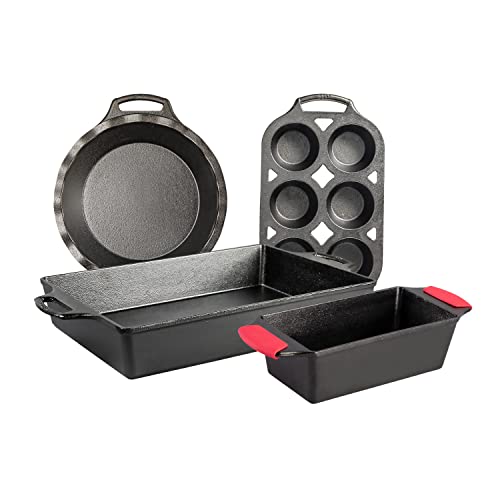
6. Lodge Cast Iron Baker’s Favorite 6-Piece Set — Best for Bakers
Cast iron bakeware is the category’s open secret: nothing browns a pie crust, crisps a muffin top or bakes cornbread with a shattering edge like preheated iron. Lodge’s Baker’s Favorite bundles the shapes bakers reach for — pie pan, muffin pan and casserole among its six pieces — all cast and seasoned in the USA.
It suits the cook whose cast iron ambitions run through the oven rather than the stovetop: pies with bottom crusts that actually crisp, muffins with real colour, casseroles that go from oven to table still bubbling. As a companion to a stovetop set, or a gift for the family baker, it occupies a niche nothing else in this guide touches.
Strengths
- Cast iron browning for pies, muffins and casseroles
- Preheated iron gives crusts glass and ceramic can’t match
- Made in the USA with Lodge’s standard pre-seasoning
Trade-offs
- Bakeware only — no stovetop skillets or Dutch oven
- Muffin wells need careful greasing while seasoning builds
- Heavy bakeware demands confident oven handling
| Pieces | 6 |
| Material | Pre-seasoned cast iron, made in the USA |
| Includes | Pie pan, muffin pan, casserole pan |
The technique that unlocks this set is preheating: put the empty pan in the oven as it heats, add batter or dough to hot iron, and the crust sets on contact. Cornbread pours in with a sizzle and emerges with the deep golden edge that defines the dish; pie crusts lose their sogginess; muffins dome and colour evenly because the mass holds temperature when the door opens.
Care mirrors stovetop iron — wash, dry thoroughly, light oil — with extra attention to muffin wells and corners where moisture hides. Bakers who maintain that small discipline get bakeware that outlasts every nonstick muffin tin ever made.
Best for: bakers wanting cast iron crusts and oven performance / Not suited for: buyers shopping for a primary stovetop set
Check the current price on Amazon
Comparison Table
| Pick | Badge | Key spec | Best for |
|---|---|---|---|
| Lodge Cast Iron 5-Piece Set | Best Overall | 5-piece pre-seasoned: skillets, griddle, Dutch oven | Overall value and coverage |
| Lodge Cast Iron 4-Piece Set | Best Budget | 4-piece pre-seasoned: skillets, griddle, Dutch oven | Tight budgets, small kitchens |
| STAUB Cast Iron 4-Piece Stackable Set | Best Premium Enameled | 4-piece enameled, stackable, universal lid | Premium enamel, tiny footprint |
| Le Creuset Enameled Cast Iron Signature 5-Piece Set | Best Heirloom Set | 5-piece enameled, 5.5 qt Signature Dutch oven | Heirloom quality and colour choice |
| Lodge Pre-Seasoned Cast Iron Skillet 3-Piece Set | Best Skillet-Focused Set | 3 pre-seasoned skillets: 8 / 10.25 / 12 inch | Skillet coverage |
| Lodge Cast Iron Baker’s Favorite 6-Piece Set | Best for Bakers | 6-piece cast iron bakeware set | Baking and roasting |
How to Choose a Cast Iron Cookware Set
The first decision is bare versus enameled, and it is really a decision about care. Bare pre-seasoned iron (the Lodge sets) costs far less, tolerates any heat and any utensil, and asks you to dry it promptly and re-season occasionally. Enameled iron (STAUB, Le Creuset) costs more, never needs seasoning, handles tomato sauces and dishwasher-adjacent lifestyles gracefully, and asks you not to chip it. Cooks who enjoy a little ritual choose bare; cooks who want iron’s cooking with a modern appliance’s manners choose enamel.
The second decision is set composition. Audit any set against cast iron’s three core jobs: a 10- to 12-inch skillet for searing, a lidded Dutch oven or cocotte for braising and bread, and a flat surface — griddle or grill pan — for pancakes, burgers and vegetables. The Lodge five-piece and the STAUB stackable cover all three; the skillet trio and baker’s set deliberately specialise, and should be bought as specialists, not as complete kitchens.
- Choose bare iron for value and indestructibility, enamel for zero seasoning
- Confirm the set includes a lidded vessel — it unlocks braising and bread
- Check skillet diameter against your largest burner
- Plan storage: a full iron set can weigh as much as a small child
- Buy from a foundry with a name — casting quality is the product
Bare vs Enameled Cast Iron: An Honest Comparison
Bare iron’s cooking surface is polymerised oil that you build and maintain. It becomes impressively nonstick, it self-repairs with cooking, and it laughs at metal spatulas and 600-degree ovens. Its enemies are soaking, neglect and long simmers of acidic sauce, which strip seasoning. Enameled iron replaces that living surface with glass: inert, non-reactive, and indifferent to tomatoes, wine and dishwashers, but vulnerable to chips from impacts and thermal shock, and once chipped it cannot be re-seasoned back to new.
In the pan, both sear beautifully because the mass is the same. Enamel’s edge is braising and sauce work — no seasoning to protect, easy cleanup, flavours that don’t carry between dishes. Bare iron’s edge is abuse tolerance and price: a Lodge skillet costs a fraction of an enameled one and can be restored from almost any neglect with steel wool and oil. Many serious kitchens end up owning both: bare skillets for searing, one enameled Dutch oven for braises. The sets in this guide let you start at either pole.
Cast Iron Set Sizes and Weights: What Fits Your Kitchen
Cast iron is the heaviest cookware you will own, and set buying forces the storage question early. A five-piece Lodge set needs a sturdy shelf or a stove-adjacent cupboard; stacking bare iron is fine, while enameled pieces should be stacked with protectors or not at all. The STAUB stackable set exists precisely because this is the category’s pain point, storing three vessels in one footprint. Before ordering any set, weigh your reality: lower cabinets beat overhead storage for iron, always — lifting a Dutch oven down from a high shelf, full or empty, is how accidents happen.
Size-wise, match the skillet to your burner and your household. A 12-inch skillet overhanging a small burner heats unevenly; a 10.25-inch is the universal daily size; Dutch ovens in the 5- to 5.5-quart range — the Le Creuset’s centrepiece — braise for four to six people without the lift-weight of the 7-quart class. Bigger is not better in cast iron; right-sized is better, because you will actually use it on a weeknight.
Seasoning Myths and What Actually Matters
Seasoning inspires more anxiety than any topic in cooking, so here is the calm version. Seasoning is simply oil polymerised onto iron by heat, forming a hard, slick layer. Factory pre-seasoning gives you a working start; cooking fatty foods builds it further; an occasional oven seasoning session — a whisper-thin coat of oil, baked upside down above the oil’s smoke point — repairs thin spots. That’s all. You do not need flaxseed rituals, six-coat weekends, or fear of soap: modern dish soap does not strip seasoning, whatever the folklore says.
What actually damages seasoning is soaking, long acidic simmers in a young pan, and scrubbing with oven cleaner. What damages the pan itself is essentially nothing short of a drop onto concrete or heating it empty to extreme temperatures and quenching it. Buy the set, cook fatty things first, wash and dry it like you mean it, and seasoning becomes a non-topic within a month.
What a Cast Iron Set Costs Over a Lifetime
Cast iron inverts normal cookware economics. The Lodge sets in this guide cost less than a single premium nonstick skillet and have no replacement horizon — the per-year cost approaches zero, and the resale market for used Lodge is famously lively because the product survives. Enameled sets cost several times more up front and also last decades; their cost-per-year beats any coated cookware while trailing bare iron. The genuinely expensive option is the cheap no-name set: rough castings and bad seasoning sour buyers on cast iron entirely, and the money is simply lost.
Budget honestly for the accessories that make iron pleasant: a chainmail scrubber, a couple of handle holders for hot skillet grips, and shelf space. Those small additions, plus any set in this guide, assemble a cooking system that will outlast your stove, your kitchen renovation, and possibly your house.
Cast Iron on Every Heat Source: Gas, Induction, Grill and Campfire
No other cookware material is as indifferent to where its heat comes from. Bare cast iron moves from a gas burner to an induction hob to a charcoal grill to open campfire coals without a single caution in the manual, because there is nothing in the pan that heat can damage — no coating to blister, no bonded base to delaminate, no handle material with a ceiling. That versatility is why the Lodge sets anchor camping kits and off-grid cabins as happily as suburban kitchens: the same skillet that sears a steak on Tuesday fries trout over a fire on Saturday.
Enameled iron is nearly as flexible, with two sensible limits: avoid direct flame licking up the sides on very high heat, which can stress enamel over time, and never heat an enameled piece empty on maximum power. On induction, both types heat fast — faster than new owners expect — so the standing rule is to start every preheat at medium and let the mass climb. Glass-top owners of either type should lift rather than slide, since iron’s weight plus any grit on the base can scratch the surface. Respect those small rules and a cast iron set is the one purchase that survives every stove you will ever own, including the ones that don’t exist yet.
What to Cook First in Each Piece of Your Set
First meals matter because they build seasoning and confidence simultaneously. In the skillets, start with cornbread — the batter releases from a preheated, greased skillet with a crisp bottom crust, and the bake lays down a beautiful layer of seasoning. Follow with roasted potato wedges and smash burgers over the first fortnight. In the Dutch oven, bake a no-knead loaf: the lidded, preheated pot is a home bread oven, and the loaf that emerges convinces most owners the set has already paid for itself. Follow with a beef stew or braised chicken thighs, which teach the pot’s gentle, even simmer.
On the griddle, pancakes and grilled cheese show off the flat surface’s even heat, while the STAUB grill pan wants vegetables and chicken breasts whose char lines make weeknight food look deliberate. The baker’s set should start with a fruit pie — nothing demonstrates cast iron bakeware like a bottom crust that comes out crisp instead of pale. Cook in that order and every piece in the set has both seasoning and a success story within the first month, which is exactly how a set becomes a habit instead of a shelf ornament.
Vintage and Second-Hand Cast Iron: Should a Set Buyer Consider It?
New set buyers often hear that vintage iron — old Griswold and Wagner pans — is smoother and lighter than modern castings. It is true that vintage pans were machined smooth and that their thinner castings suit some cooks. But vintage buying is a hobby in itself: prices for desirable pieces rival new Le Creuset, condition is a lottery of rust, warps and unknown history, and assembling a matched ‘set’ takes months of hunting. For a buyer who wants to cook this weekend with a warranty and a known seasoning starting point, the new sets in this guide are the rational purchase.
The honest middle path: buy a new core set now — Lodge for value, STAUB or Le Creuset for enamel — and let vintage pieces become later, joyful additions once you know what you love. A vintage skillet slides into a Lodge-based rotation without friction because the care routine is identical. What you should not do is delay a working kitchen for a perfect antique, or pay collector prices for a first pan. Cast iron’s promise is cooking, not collecting — though owners of these sets often end up doing a little of both.
Enameled Cast Iron Care: Keeping STAUB and Le Creuset Beautiful
Enamel asks for a different discipline than bare iron: protection from impact and thermal shock rather than seasoning. Let a hot cocotte rest on a trivet and cool before washing; fill a hot pan with warm, not cold, water; and use wooden or silicone tools even though the surface is hard, because metal utensils leave grey marks that look like damage. Stains on light interiors yield to a simmer of water with a little baking soda, and the occasional specialised enamel cleaner restores the showroom look for owners who care — cooking performance is unaffected either way.
Chips are the one irreversible event, and they happen at rims and handles where pieces knock together. Store enameled pieces with protectors, don’t stack them bare, and never use a chipped-edge piece as a hammer substitute for a stuck lid. A small chip on the exterior is cosmetic; a chip on the cooking surface means retiring that piece from acidic cooking, though it can live on as a bread baker lined with parchment. Bought with this care in mind, enameled sets routinely serve for thirty years and more.
Building a Full Cast Iron Kitchen Around Your Set
A set is the core; a few deliberate additions complete the system. The most useful companion for the Lodge sets is a large enameled Dutch oven for acidic braises — or, if you bought the Le Creuset set first, a bare Lodge skillet for maximum-heat searing without enamel anxiety. A lid for the 10.25-inch skillet (glass or iron) turns it into a small braiser and splatter-controlled fryer, and a trivet plus two silicone handle holders make the whole collection safer to live with daily.
Beyond that, let your cooking argue for each addition: a waffle press for the brunch household, a wok for the stir-fry devotee, a bigger griddle for the pancake-for-six family. Cast iron’s freedom is that every addition is permanent and cross-compatible in care, so a collection assembled over a decade still behaves like one system. Start with any set in this guide and you have made the only irreversible decision correctly — the foundry and the branch, bare or enameled, that fit your habits.
How Cast Iron Sets Are Made — and Why Foundry Quality Shows
Every piece in this guide began as molten iron poured into a sand mould, and the foundry’s discipline at that moment determines the pan you live with. Good castings are even in thickness, free of pitting, and finished so the cooking surface is smooth enough for seasoning to grip evenly. Lodge’s century of production in Tennessee, and STAUB’s and Le Creuset’s French foundries, represent three variations on that discipline — which is why this guide insists on named foundries. The failures of no-name cast iron are born in the mould: rough, pebbly surfaces that food clings to, uneven bases that spin on glass tops, and seasoning that flakes because the surface beneath it was never sound.
Enameling adds a second craft: powdered glass fused to the iron in layers, each fired and inspected. STAUB applies multiple coats for depth and chip resistance; Le Creuset’s gradient colours are a finishing signature as much as a look. When you pay the enameled premium, this is literally what you are paying for — skilled labour at a furnace, repeated over hours per piece. Understanding the process reframes the prices in this guide: bare Lodge is one of manufacturing’s great bargains, and French enamel is priced like the craft object it is.
How to Season and Care for a New Cast Iron Set
New bare cast iron needs no ceremony — it arrives pre-seasoned — but this routine sets every piece up for a fast start:
- Wash each piece in hot water with a small amount of soap, dry it on a warm burner until every drop evaporates, and wipe on the thinnest possible coat of neutral oil
- Cook fatty, forgiving foods for the first two weeks: cornbread, roasted potatoes, burgers, bacon, fried eggs in butter — each meal lays down seasoning
- After cooking, wash with hot water and a brush or chainmail scrubber, dry on the burner again, and finish with a light oil wipe while warm
- Once a month (or whenever a spot looks dull), run a maintenance seasoning: oil-whisper coat, oven upside down at a high temperature for an hour, cool in the oven
- For enameled pieces, skip seasoning entirely: wash, cook, and avoid thermal shock by letting a hot cocotte cool before it meets cold water
Storage completes the system: stack bare iron freely, separate enameled pieces with cloth or felt protectors, and store lids slightly ajar so no moisture is trapped against the iron. Follow this and a set bought this year will cook better next year — a claim no other cookware category can honestly make.
Common Buying Mistakes
Buying a no-name set to save money. Rough castings and flaky seasoning are where cheap cast iron fails. The Lodge sets prove named foundry iron is already affordable.
Soaking bare iron in the sink. Water plus time equals rust. Wash promptly, dry on heat, and rust never gets a foothold.
Fearing soap. Modern dish soap does not strip polymerised seasoning. The myth survives from lye-soap days; wash your pans properly.
Cranking the heat to maximum immediately. Cast iron heats slowly and holds heat fiercely. Preheat gently on medium to avoid hot spots and stressed enamel.
Stacking enameled pieces bare. Enamel chips at contact points. Use the protectors, or store pieces separately — a chipped rim is forever.
Final Recommendation
For most buyers, the Lodge 5-Piece Set is the answer: complete coverage of searing, griddling and braising, from the foundry that defined American cast iron, at a price that makes the enameled sets look like luxury goods — because they are. The 4-Piece Set delivers the same quality to tighter budgets and smaller kitchens. At the premium end, choose the STAUB Stackable if storage is your constraint and the Le Creuset Signature if you are buying the heirloom Dutch-oven-centred set. Specialists are served honestly too: the Lodge skillet trio for skillet-first cooks, and the Baker’s Favorite for the oven-driven kitchen.
Check the current price on Amazon through the links above, confirm the piece list in the box, weigh the total shipping weight, and plan exactly where the iron will live before it arrives. Then cook something fatty, wash it, dry it on the burner — and start the decades-long process of owning a set that improves every single year.
Keep exploring: Best Beginner Cookware Sets Best Cast Iron Skillets Best Dutch Ovens Best Anodized Cookware Sets
Frequently Asked Questions
Is cast iron really nonstick?
Well-seasoned bare cast iron is impressively slick — eggs slide with a little fat and a properly preheated pan — but it is earned nonstick, built over weeks of cooking, not the instant release of a coating. Enameled cast iron is not nonstick at all; it is a browning surface that releases fond beautifully when deglazed. Set expectations accordingly and both delight.
Can cast iron sets be used on induction?
Yes — cast iron is magnetic, so both bare and enameled pieces work on induction. Use flat-bottomed pieces, lift rather than drag them to protect the glass, and let the pan preheat gently since induction heats iron fast.
How do I remove rust from cast iron?
Scrub the spot with steel wool or a vinegar soak for stubborn cases, wash, dry thoroughly on heat, and re-season the piece. Rust on bare iron is a maintenance event, not a death sentence — one of the category’s great virtues. Enamel with rust at a chip can be cleaned and sealed with oil for continued use.
Are cast iron sets too heavy for everyday cooking?
They are heavy, and that mass is the point: it is what holds heat through a sear. Most cooks adapt within weeks, using two hands and helper handles for the big pieces. If wrist strength is a real concern, choose the smaller Lodge set or the STAUB stackable’s compact pieces rather than abandoning iron entirely.
Can I cook tomato sauce in bare cast iron?
Short sauces, yes, especially in a well-seasoned pan. Long, slow acidic simmers can strip young seasoning and pick up a metallic note; that is the job enameled Dutch ovens exist for. Many households keep bare skillets for searing and one enameled pot for sauces — the sets here support either strategy.
What is the difference between a Dutch oven and a cocotte?
Functionally, almost nothing: cocotte is simply the French term STAUB and Le Creuset use for their enameled Dutch ovens. Both are heavy, lidded, oven-safe pots for braising, soups and bread. Buy on size, enamel quality and lid fit rather than the name.
Should I buy pre-seasoned cast iron or season it myself?
Buy pre-seasoned — every set in this guide arrives ready to cook, and factory seasoning from Lodge, applied in multiple baked-on layers, is a better starting surface than most home first attempts. You will still build seasoning through cooking, and an occasional oven session keeps it strong, but there is no bare-metal starting phase to endure. Truly unseasoned new cast iron is now rare outside specialty imports, and offers no advantage to a set buyer.
How many cast iron pieces does a household really need?
Three working pieces cover the overwhelming majority of cast iron cooking: a 10- to 12-inch skillet, a lidded Dutch oven, and one flat or specialty piece such as a griddle or grill pan. That is exactly the architecture of the Lodge and STAUB sets here. Additional pieces earn their shelf by specialty — baking, a second skillet size — rather than by necessity, which is why we rank focused sets above sprawling ones in this category.

