Disclosure: airfryerkitchensupply.com is reader-supported. When you buy through links on our site, we may earn an affiliate commission at no extra cost to you.
Where to buy
For the best convection ovens with electric range and lip, the mainstream answer is the Frigidaire 5.3 cu. ft. freestanding convection range — freestanding format is what guarantees the rear lip this search is about — with the Cosmo COS-RES304SS as the value alternative. Every linked model was confirmed against a live Amazon listing for the exact range named; check price on Amazon for the current configuration, and confirm the backguard profile in the listing photos for the specific finish you order.
First, the word that makes this search different: in range terminology, the “lip” is the raised backguard — the lipped ledge that rises at the rear of a freestanding range, behind the cooktop. It carries the controls on many models, shields the wall from splashes and pan handles, and gives pots a backstop. So best convection ovens with electric range and lip means, precisely: electric ranges with a convection oven and a freestanding backguard design, as opposed to slide-in ranges, whose flat, front-control format deletes the lip entirely. This guide is written to that reading, states it openly so you can judge whether it matches your intent, and compares the verified freestanding convection ranges that deliver it.
Why would a buyer specify the lip? Three practical reasons recur. The backguard protects a wall that is painted, papered or otherwise not finished for direct cooktop exposure — the exact situation in most kitchens that have always had a freestanding range. Rear controls on the backguard sit out of small children’s reach and out of the steam path of front burners. And the ledge itself is useful: a rest for utensils and lids, a visual backstop that keeps pan handles from swinging over the rear edge, and the traditional look many kitchens are simply built around. Against that, the lip is also what slide-in buyers are paying to remove — this guide serves the other side of that preference, deliberately.
Four linked picks and two unlinked entries make the list. The linked four are verified freestanding convection ranges across mainstream, value, black-finish and compact positions. The two unlinked entries name the legacy backguard strongholds — the classic freestanding lines where the lip is most pronounced — which we describe without links because we could not confirm a current listing for the exact configuration at the standard this programme requires. That honesty, plus a buying guide on measuring and living with a backguard, is the shape of the article. One more preliminary: if your kitchen currently has a slide-in and a finished backsplash you love, read the vocabulary section before the picks — it separates the backguard from the rear filler strips sold for slide-ins, a distinction that has cost more buyers money than any other in this corner of the market.
In this guide
Quick Picks
Freestanding convection ranges only — the format that carries the rear lip — with slide-ins excluded on purpose and the reason stated in every review. Two entries are not linked classes rather than linked products, and they are labelled as such here and in their reviews, so the quick list never promises a link the guide does not deliver.
- Frigidaire Electric Convection Range with Steam Cleaning & Air Fry, 5.3 Cu. Ft. — Best Overall with Lip: A 5.3 cu. ft. freestanding electric range with convection, air fry and steam cleaning — and the freestanding backguard format this search specifies. — Check the current price on Amazon
- Cosmo COS-RES304SS 30 in. Electric Range with Convection and Air Fry — Best Value with Lip: A 4.8 cu. ft. freestanding range with convection, air fry, steam clean and a dual element burner — the backguard format at a value tier. — Check the current price on Amazon
- Cosmo COS-ERD304K-BK 30 in. Electric Range with Convection, Black — Best Black Finish with Lip: The black-finished freestanding option: 4.9 cu. ft. convection oven, glass cooktop with dual element burners, digital display — and the backguard, in black. — Check the current price on Amazon
- Avanti ELITE 24 Inch Electric Range — Best Compact with Lip: A 24-inch freestanding range with four coil burners, a 2.3 cu. ft. oven, broiler and storage drawer — the compact backguard option, with the standing convection note. — Check the current price on Amazon
- Classic Freestanding Convection Ranges from the Legacy Brands (GE, Hotpoint class) — Best Traditional Tall Backguard — no link: The legacy freestanding lines are where the tallest, most pronounced backguards live — described here in prose, because no exact current configuration met this programme’s verification standard for a link.
- Slide-In Look Without Losing the Wall: Freestanding Front-Control Hybrids — Unlinked — The Middle Path — no link: A small class of freestanding ranges puts controls at the front yet keeps a low rear lip — described in prose as the compromise option, without a verified link.
How These Picks Were Chosen
The method began with the interpretation stated in the introduction: “lip” read as the raised rear backguard of a freestanding range, the only reading under which the search describes a real, shoppable distinction. That reading set the screen — freestanding ranges in, slide-ins out — and it is declared openly so a reader who meant something else by the word can stop early and lose nothing.
Within freestanding electric ranges with convection ovens, every linked pick was confirmed against a live Amazon listing for the exact model, and spec boxes state only what those listings support, with the backguard recorded as a format characteristic of the freestanding design rather than as a per-listing dimension — which is why the guide advises confirming the backguard profile in listing photographs for the specific configuration ordered, since ledge height varies by model and finish.
Two entries are not linked by design. The legacy tall-backguard class and the low-lip hybrid class are real parts of this market that a complete guide must describe, but no exact current configuration for either met the verification standard for a product link when this guide was prepared. Rather than invent links or quietly drop the classes, the guide covers them in prose, says why, and tells the reader exactly how to verify a candidate at retail.
A last methodological note concerns dimensions. Backguard heights, cooktop heights and cavity figures in this guide are discussed as planning categories rather than quoted to the millimetre, because they vary by configuration and finish in ways a roundup cannot freeze. The dimensioned drawing of the exact model you order is the authoritative source, and the buying guide’s measurement routine is built around checking it — a small discipline that prevents the one genuinely common failure of this search, which is a beautiful range whose lip meets the microwave above it.
The 6 Best Convection Ovens With Electric Range And Lip

Frigidaire Electric Convection Range with Steam Cleaning & Air Fry, 5.3 Cu. Ft. — Best Overall with Lip
As the mainstream freestanding range in this programme’s verified set, this Frigidaire is the natural lead for the lip-specific search: the backguard format is its architecture, not an accessory. The ledge rises behind the smoothtop, the wall behind it is shielded from the everyday splashes of a working cooktop, and the whole arrangement drops into the standard opening that freestanding ranges have defined for decades. Buyers replacing an older backguard range will find the sightlines of their kitchen unchanged, which is precisely what most of them want.
The oven beneath is the complete modern formula already detailed in the general guide: 5.3 cu. ft. of convection cavity, air fry mode using that convection system, and steam cleaning for light soil. Two-rack baking is even, roasts brown properly, and the capacity takes holiday loads without negotiation. Nothing about choosing the lip costs you oven performance in this model — the backguard is a format decision, and the appliance inside it is fully current.
Strengths
- Freestanding backguard format protects the wall and anchors the traditional layout
- Complete convection feature set: convection, air fry and steam clean, covering modern cooking end to end
- 5.3 cu. ft. capacity for two-rack baking and full holiday cooking without rearrangement
Trade-offs
- Backguard interrupts a continuous backsplash line, for kitchens that have one
- Radiant smoothtop response is leisurely next to induction
- Steam clean is for light soil; heavy soil needs the full cycle
| Format | Freestanding electric range — rear backguard (lip) format |
| Oven capacity | 5.3 cu. ft. |
| Oven features | Convection, air fry, steam cleaning (per listing) |
Living with the lip is mostly advantages that compound quietly: splashes land on an enamelled ledge designed to be wiped, not on paint; the spoon rest lives on the backguard instead of the counter; and a pan pushed back stops at the ledge rather than at the wall. The one discipline the format asks is a wipe of the backguard itself, which at least is a surface built for exactly that.
Buy this range if your kitchen has always had a backguard and works because of it. It is the default answer to this search for the same reason it leads the general guide: completeness, capacity and a service network, now in the format the search specifies.
Best for: Kitchens built around a freestanding backguard range needing a modern convection replacement with full features / Not suited for: Slide-in styling, induction seekers, or continuous-backsplash designs that a backguard would interrupt
Check on Amazon — check price on Amazon before you buy, because vehicle and appliance listings change configurations often.
Cosmo COS-RES304SS 30 in. Electric Range with Convection and Air Fry — Best Value with Lip
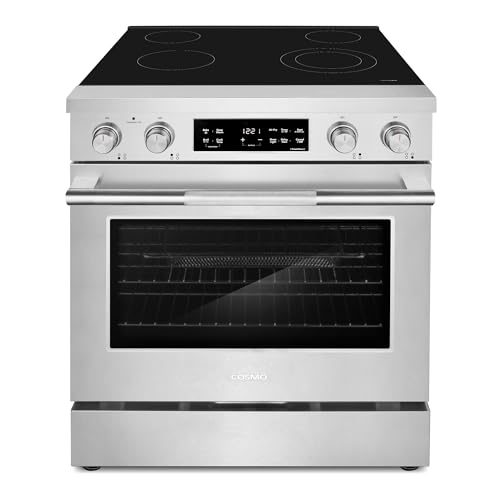
The value route to this search keeps every element of the formula: freestanding format with its backguard, a convection oven with air fry, steam cleaning, and a ceramic glass cooktop whose dual element burner adapts to pan size. The Cosmo’s 4.8 cu. ft. cavity is the compromise that buys the price — a half-step below the Frigidaire that most households will only notice when a very large bird meets a very full oven.
For rental properties and budget remodels, this combination has a specific logic: the backguard protects the landlord’s wall, the feature list satisfies a modern tenant or buyer, and the value-brand price leaves money for the rest of the kitchen. The trade, as with the general guide’s assessment, is service-network depth rather than cooking ability.
Strengths
- Full backguard format with convection and air fry at a value position
- Dual element burner is a genuinely useful cooktop feature
- Steam clean supports a light-and-often maintenance habit
Trade-offs
- 4.8 cu. ft. cavity is the smallest full-size oven here
- Value-brand service network is thinner than legacy brands
- Radiant cooktop, with the usual smoothtop care
| Format | Freestanding electric range, 30 in. — rear backguard (lip) format |
| Oven capacity | 4.8 cu. ft. |
| Cooktop | Ceramic glass, dual element burner (per listing) |
| Oven features | Convection, air fry, steam clean function (per listing) |
The backguard on a value range deserves one practical check at delivery: confirm its height and profile suit your wall and any shelf or rail above the range, because backguard heights vary by model and a tall ledge can meet a low-mounted microwave or shelf sooner than expected. The buying guide below gives the measurements to take before the truck arrives.
Choose the Cosmo when the budget leads and the format is non-negotiable. It is the cheapest complete answer to this exact keyword in the verified set.
One more consideration belongs to this pick specifically, because value-tier freestanding ranges are so often bought for properties the buyer does not cook in daily: tenants and family members will use the backguard exactly as intended without being taught, because the format teaches itself — controls up high, splashes on the ledge, pans stopped at the rear. Appliances that instruct their users by shape are worth a premium in rental and multi-user settings, and this one charges the opposite of a premium for the privilege.
Best for: Budget remodels and rentals needing the backguard format with modern oven features / Not suited for: Maximum cavity size or the deepest service networks
Check on Amazon — check price on Amazon before you buy, because vehicle and appliance listings change configurations often.

Cosmo COS-ERD304K-BK 30 in. Electric Range with Convection, Black — Best Black Finish with Lip
Finish is a legitimate specification in a kitchen, and this Cosmo is the pick where finish and format coincide: a black freestanding range whose backguard rises in the same black, keeping the ledge visually part of the appliance rather than an interruption. In dark-cabinet or black-appliance kitchens, that continuity is the difference between a range that looks chosen and one that looks substituted.
The cooking specification mirrors its value-tier siblings: a 4.9 cu. ft. convection oven with six functions, a glass smoothtop with dual element burners for pan-size flexibility, and a digital display with timer. It does not headline air fry the way the stainless Cosmo does, so cross-shoppers between the two should decide whether that mode or this finish matters more to the household.
Strengths
- Black backguard format is genuinely scarce in convection ranges
- Dual element smoothtop and a full convection oven
- Slightly larger cavity than its stainless sibling
Trade-offs
- No air fry headline feature
- Black glass shows dust readily between cleans
- Value-brand support depth, as with the other Cosmo
| Format | Freestanding electric range, 30 in., black — rear backguard (lip) format |
| Oven capacity | 4.9 cu. ft. |
| Cooktop | Glass cooktop, dual element burners (per listing) |
| Oven features | Convection, 6 oven functions, digital display with timer (per listing) |
A black backguard changes the wall equation slightly in the owner’s favour: splashes and steam marks show less against black enamel than against a light wall, and the ledge reads as a deliberate design element with dark cabinetry. Pair it with at least one other black appliance or a black hood so the scheme reads as intention.
This is the pick when the kitchen’s design language is set and the lip is part of it. Function follows the value tier; the finish is the reason.
Best for: Black-appliance kitchens wanting a backguard convection range at a value tier / Not suited for: Air fry prioritists or stainless-matched kitchens
Check on Amazon — check price on Amazon before you buy, because vehicle and appliance listings change configurations often.

Avanti ELITE 24 Inch Electric Range — Best Compact with Lip
Compact kitchens get the lip almost by default: 24-inch ranges are freestanding designs, and the Avanti ELITE’s backguard protects the wall of a small kitchen where the range often sits closer to everything, including the cook. In apartments, cabins and in-law units, that little ledge earns its place daily — splashes contained, utensils rested, and a visual finish to a cooktop that would otherwise end abruptly at the wall.
The standing honesty note from the general guide applies unchanged: this model’s listing does not claim a convection oven, so we do not claim one for it. In a 2.3 cu. ft. cavity the practical difference convection makes is smaller than at full size, and for the compact buyer the format, the coil burners’ universal compatibility and the broiler may well outrank the fan. If verified convection in 24 inches is the hard requirement, confirm any alternative’s claim in its listing before ordering — and treat this Avanti as the honest benchmark of what the size class otherwise offers.
Strengths
- True 24-inch freestanding format with wall-protecting backguard
- Coil burners accept every pan and are cheap to replace
- Broiler with pan and storage drawer in a small footprint
Trade-offs
- Convection not claimed in its listing — verify if essential
- Small oven limits pan sizes and batch cooking
- Coil cooktop needs more cleaning effort than a smoothtop
| Format | Freestanding electric range, 24 in. — rear backguard (lip) format |
| Oven capacity | 2.3 cu. ft. |
| Cooktop | 4 coil burners (per listing) |
| Included | Storage drawer, broiler with pan (per listing) |
In a compact kitchen the backguard has one more job: it is often the only splash protection the wall gets, because small kitchens rarely have tiled backsplashes fitted behind a range that was “temporary” a decade ago. The Avanti’s ledge, wiped weekly, quietly preserves that wall.
Choose it when the opening is 24 inches and the lip is part of the requirement. Nothing else verified fits the space.
Best for: Apartments, cabins and compact kitchens with a 24-inch opening and a wall to protect / Not suited for: Buyers for whom a verified convection fan is non-negotiable
Check on Amazon — check price on Amazon before you buy, because vehicle and appliance listings change configurations often.
Classic Freestanding Convection Ranges from the Legacy Brands (GE, Hotpoint class) — Best Traditional Tall Backguard — no link
This entry is deliberately unlinked. The legacy American brands built the backguard format — tall ledges carrying the clock and controls, sized to anchor a kitchen — and their freestanding convection ranges remain the reference point for buyers who want the lip at its most pronounced. We could not confirm a current listing for an exact configuration to the standard this programme requires for a product link, so no link is offered and no specific model is ranked. What can be said usefully is how to shop this class wherever you buy it.
Look for three things. A backguard tall enough to carry the controls puts them at eye level and out of children’s reach — the classic layout this search’s most traditional buyers are picturing. A convection claim stated as a fan system in the oven specification, not implied by a badge. And a smoothtop or coil cooktop matched to your pans: this class still offers both, and the coil versions remain the repairability champions of the entire range market.
Strengths
- Tallest backguards and the classic rear-control layout
- Deep parts and service ecosystems for the legacy brands
- Coil and smoothtop variants across wide price tiers
Trade-offs
- No verified current listing to link at this programme’s standard — shop the class, not a link
- Feature sets vary widely by model year and retailer configuration
- Tall backguards can conflict with low over-range microwaves — measure first
If this class is your answer, buy it the old way: choose the exact model at a retailer whose listing states the convection system and shows the backguard profile in photographs, confirm the electrical requirements against your kitchen, and keep the model number recorded for parts. The format’s longevity is its charm; a well-chosen legacy freestanding range is a twenty-year appliance in many homes.
We include the class because a guide to this search that ignored it would be describing the market with its centre missing — and we label it unlinked because that is what honest verification requires.
Best for: Traditionalists wanting the tallest backguard and rear controls from a legacy brand / Not suited for: Buyers who want a one-click verified listing from this page
This pick is covered without a link: we could not confirm a current, matching Amazon listing for the exact configuration, so compare it at specialty retailers and check price on Amazon if a listing appears.
Slide-In Look Without Losing the Wall: Freestanding Front-Control Hybrids — Unlinked — The Middle Path — no link
Some buyers want this search and its opposite at once: front controls and a cleaner line, but a wall that still gets some protection. A minority of freestanding ranges answer with a low-profile rear lip — a short raised edge rather than a full backguard — keeping a splash ledge and a pan backstop while surrendering the tall control panel. We describe the class without a link: configurations change quickly, and no exact current model met this programme’s verification standard for a link at the time of writing.
Judge any candidate in this class by the lip’s actual height in the listing’s dimensioned drawings, not by photographs, which flatter. A low lip stops splashes at cooktop level and catches a sliding pan; it does not shield the wall from a tall pot’s steam or a vigorous frying session the way a full backguard does, and it places controls at the front, with the child-access consideration that implies. It is a real compromise, in both directions.
Strengths
- Front-control ergonomics with some wall protection retained
- Cleaner sightline than a tall backguard
- Freestanding finished sides keep installation simple
Trade-offs
- Low lip protects less than a full backguard
- Front controls are reachable by small children
- No verified link offered here; exact models must be confirmed at retail
The buyer for this class usually has a finished backsplash they like, a wall that still takes splashes at the rear burners, and a preference for front knobs. If that is you, shop the class with a tape measure and the dimension sheets, and weigh the two linked full-backguard Cosmos and the Frigidaire first — for many kitchens the classic format turns out to be the honest answer once the compromise’s limits are priced in.
As with the legacy entry above, the unlinked label is the verification standard working as intended: the class is real, the guidance is usable, and the link waits for a listing that can be confirmed.
Best for: Buyers wanting front controls who still need some rear splash protection / Not suited for: Anyone needing maximum wall shielding or rear controls for child safety
This pick is covered without a link: we could not confirm a current, matching Amazon listing for the exact configuration, so compare it at specialty retailers and check price on Amazon if a listing appears.
Comparison Table
| Pick | Badge | Key spec | Best for |
|---|---|---|---|
| Frigidaire Electric Convection Range with Steam Cleaning & Air Fry, 5.3 Cu. Ft. | Best Overall with Lip | Freestanding with backguard; 5.3 cu. ft. convection oven; air fry; steam clean | Kitchens built around a freestanding backguard range needing a modern convection replacement with full features |
| Cosmo COS-RES304SS 30 in. Electric Range with Convection and Air Fry | Best Value with Lip | Freestanding with backguard; 4.8 cu. ft.; ceramic glass cooktop; convection and air fry; steam clean | Budget remodels and rentals needing the backguard format with modern oven features |
| Cosmo COS-ERD304K-BK 30 in. Electric Range with Convection, Black | Best Black Finish with Lip | Freestanding with backguard, black; 4.9 cu. ft.; glass cooktop; convection; 6 oven functions | Black-appliance kitchens wanting a backguard convection range at a value tier |
| Avanti ELITE 24 Inch Electric Range | Best Compact with Lip | 24 in. freestanding with backguard; 2.3 cu. ft. oven; 4 coil burners; broiler and storage drawer | Apartments, cabins and compact kitchens with a 24-inch opening and a wall to protect |
| Classic Freestanding Convection Ranges from the Legacy Brands (GE, Hotpoint class) | Best Traditional Tall Backguard — no link | Freestanding; tall backguard with rear controls; convection oven (model-dependent) | Traditionalists wanting the tallest backguard and rear controls from a legacy brand |
| Slide-In Look Without Losing the Wall: Freestanding Front-Control Hybrids — no link | The Middle Path — no link | Freestanding; front controls; low-profile rear lip (model-dependent) | Buyers wanting front controls who still need some rear splash protection |
How to Choose a Convection Range with a Backguard (Lip)
Confirm the format before the features. The lip exists only on freestanding ranges; the moment a listing says slide-in or front-control built-in styling, the backguard is gone or reduced to a trim strip. Product photographs can mislead — a freestanding range photographed against a tiled wall hides its ledge — so verify format in the specification and the dimensioned drawing, where the backguard’s height is a stated number you can plan around.
Measure three heights before ordering: the backguard’s top against any over-range microwave, shelf or cabinet above the range; the cooktop against your counters, so the range levels flush; and the ledge against your tallest stockpot, since a backguard that crowds a tall pot’s lid is a daily annoyance. These are five-minute measurements that decide five-year satisfaction, and they are the measurements this search’s buyers most often skip because the lip felt like a styling word rather than a physical object.
Rear controls versus front controls
A full backguard usually carries the controls, and that placement has a household logic: unreachable by small children, unspattered by front burners, and readable at eye level. Its cost is reaching over rear burners’ steam to adjust the oven — a minor reach for most cooks, a real consideration for shorter cooks and for anyone who lifts heavy pans across that space. Low-lip hybrids move controls forward and trade the child-safety margin for ergonomics. Decide by who lives in the house and who cooks, not by showroom habit.
Wall protection, honestly assessed
A backguard shields the wall band immediately behind the cooktop — the zone that takes spits, splashes and pan-handle knocks. It does not protect the wall above its own height from steam and grease aerosol, which is a ventilation question answered by the hood, not the range. Kitchens with delicate finishes behind and above the range may still want a washable panel above the ledge; kitchens with ordinary paint will find the backguard sufficient, as several generations of cooks did.
The oven still decides the cooking
It is easy, in a format-led search, to let the lip choose the range and forget the oven. Resist it: convection class (fan versus true convection), capacity against your largest pan, cleaning system and cooktop type will shape more meals than the ledge will. The linked picks were chosen so that no reader has to trade oven quality for format — each is a complete modern convection range that happens to wear the backguard this search requires.
Backguard, Slide-In Trim and Rear Filler: Sorting the Vocabulary
Three different objects get confused in this corner of the market, and separating them prevents expensive mistakes. The backguard is part of the range: a raised rear panel, often carrying controls, integral to freestanding models. A rear filler or trim kit is an accessory for slide-in ranges: a metal strip that bridges the gap between a slide-in’s rear edge and the wall, giving a finished look and stopping crumbs falling behind the appliance. It is not a lip in this search’s sense — it carries no controls, rises barely above the cooktop, and protects against crumbs rather than splashes. Owners sometimes add one to a slide-in and believe they have bought the backguard format; they have bought a tidier gap.
The third object is the backsplash itself: tile, stone, glass or metal fitted to the wall. A slide-in kitchen relies on it entirely; a backguard kitchen uses the ledge as the first line and the wall finish above it as the second. When planning a swap in either direction, price the wall work with the range: removing a backguard range exposes whatever the ledge used to hide, and adding one to a kitchen designed for a slide-in can collide with a backsplash that runs down to cooktop level. The range and the wall are one system, and this search, properly understood, is about that system. Buyers who keep that system view make this purchase once; buyers who shop the appliance alone sometimes make it twice, and the second purchase is always the one that fits the wall.
Households That Should Insist on the Lip — and Those That Should Not
Families with children under about seven are the backguard’s clearest constituency. Rear controls sit beyond a child’s reach and sightline, and the ledge itself interrupts the visual invitation of the cooktop’s rear burners. No format makes a range childproof — front burners and oven doors remain — but the control placement removes one entire category of accident, and parents consistently rank it above styling when the two conflict. If your household is in those years now or expects to be, weight the lip heavily.
Rentals and multi-generational homes form the second constituency, for the wall. A backguard range can be installed in a kitchen with ordinary painted walls and no tiled backsplash and leave that wall essentially unmarked after years of cooking; a slide-in in the same kitchen writes its history on the paint within a year. Landlords replacing ranges in older housing stock choose freestanding backguard models for this reason almost by reflex, and children cooking in a parent’s long-owned kitchen inherit the same benefit: the wall behind the range is the one surface in the house the appliance itself maintains.
The households that should skip the lip are equally definable. Kitchens designed around a statement backsplash lose its lowest band to a backguard. Cooks who use very tall stockpots on rear burners daily will fight a tall ledge. And households whose cooking is front-burner, small-pan and design-led will simply never collect the lip’s benefits, while paying its one cost — a busier rear sightline — every day. For them the format-neutral guide’s slide-in picks are the honest recommendation, and this guide says so without reluctance: the lip is a tool, and like every tool in this programme it has a job description rather than a universal claim.
How to Install a Freestanding Convection Range and Settle the Backguard
The installation sequence for a freestanding range is the standard electric one, with two lip-specific checks added:
- Confirm the dedicated 240-volt circuit and receptacle configuration before delivery day, and plan the anti-tip bracket position.
- Before the old range leaves, photograph the wall behind it: the new backguard’s height will cover a specific band, and you want to know what it must hide or match.
- Fit the cord, connect at the terminal block as diagrammed, and fit the anti-tip bracket exactly as specified.
- Slide the range in and level it front-to-back and side-to-side; a range that rocks will rattle pans against the backguard at every boil.
- Check the backguard against the wall and any over-range fixture: confirm clearance, confirm the ledge sits close enough to the wall to stop splashes reaching it, and confirm tall pots sit on the rear burners without their lids fouling the ledge.
- Restore power, test every element and the convection fan, and run the empty burn-off cycle with ventilation before the first meal.
As with any range work, circuit questions belong to a licensed electrician when they exceed your confidence. The backguard checks, by contrast, are pure tape-measure work — and they are the difference between a lip that serves the kitchen and one that merely decorates it.
Common Buying Mistakes
- Ordering a slide-in for a backguard kitchen and discovering the exposed, unfinished wall band behind it.
- Assuming a rear filler trim kit gives a slide-in the protection of a true backguard — it closes a gap; it does not shield a wall.
- Skipping the height check between a tall backguard and a low over-range microwave or shelf.
- Judging the backguard from photographs instead of the dimensioned drawing’s stated height.
- Letting the format search eclipse the oven: convection class, capacity and cleaning system still decide the cooking.
- Forgetting that rear controls mean reaching across rear-burner steam to set the oven.
- Replacing a backguard range without photographing and measuring the wall the ledge used to cover.
Final Recommendation
The Frigidaire is the complete answer for most kitchens making this search: freestanding backguard format, a 5.3 cu. ft. convection oven with air fry, steam cleaning, and the deepest service network in this guide standing behind a ten-year appliance. The stainless Cosmo delivers the same format and most of the features at a value tier, its black sibling serves dark kitchens, and the Avanti covers 24-inch openings with its convection caveat understood. The two unlinked classes — legacy tall backguards and low-lip hybrids — are worth shopping at retail with this guide’s checks in hand, and are labelled unlinked because their exact current configurations could not be verified to this programme’s linking standard.
The wider family of guides sits nearby: the format-neutral comparison is Best Convection Ovens With Electric Range, countertop models are in Best Countertop Toaster Convection Ovens, drawer models in Best Convection Ovens With Baking Drawer, and the coating-focused search is answered in Best Convection Ovens Without Non Stick Coating. Combination oven-microwaves are compared in Best Convection Ovens With Microwaves.
The shortlist, one more time:
- Frigidaire Electric Convection Range with Steam Cleaning & Air Fry, 5.3 Cu. Ft. — Best Overall with Lip: Kitchens built around a freestanding backguard range needing a modern convection replacement with full features
- Cosmo COS-RES304SS 30 in. Electric Range with Convection and Air Fry — Best Value with Lip: Budget remodels and rentals needing the backguard format with modern oven features
- Cosmo COS-ERD304K-BK 30 in. Electric Range with Convection, Black — Best Black Finish with Lip: Black-appliance kitchens wanting a backguard convection range at a value tier
- Avanti ELITE 24 Inch Electric Range — Best Compact with Lip: Apartments, cabins and compact kitchens with a 24-inch opening and a wall to protect
- Classic Freestanding Convection Ranges from the Legacy Brands (GE, Hotpoint class) — Best Traditional Tall Backguard — Unlinked: Traditionalists wanting the tallest backguard and rear controls from a legacy brand (unlinked pick, no confirmed listing)
- Slide-In Look Without Losing the Wall: Freestanding Front-Control Hybrids — Unlinked — The Middle Path — Unlinked: Buyers wanting front controls who still need some rear splash protection (unlinked pick, no confirmed listing)
Frequently Asked Questions
What does “lip” mean on a range?
In this context, the raised rear ledge of a freestanding range — the backguard. It rises behind the cooktop, often carries the controls, shields the wall from splashes and acts as a backstop for pans. That is the reading this guide is written to, stated openly in its introduction. A slide-in range has no lip in this sense; its rear edge is flat, with at most an accessory filler strip.
Can I add a backguard to a slide-in range?
Not a true one. Slide-ins accept rear filler trim that closes the gap to the wall and stops crumbs, but it does not rise like a backguard, carry controls or shield the wall from splashes. If the lip matters — for wall protection, rear controls or the traditional format — the answer is a freestanding range, which is why every linked pick in this guide is one.
Are backguard ranges out of date?
They are the older format, and they remain in production across every major brand because the format solves real problems: wall protection, child-safe rear controls and drop-in replacement for the millions of kitchens built around them. Slide-ins won the styling conversation; freestanding ranges kept the practical one. Choose by your kitchen and household, not by fashion.
How tall is a typical backguard?
It varies by model from a low ledge of a few inches to a tall control-carrying panel, which is why this guide insists on the dimensioned drawing rather than a typical figure. Measure yours against the space above the range — over-range microwaves and shelves set the ceiling — before ordering, and against your tallest pot’s lid for daily comfort.
I am replacing a slide-in with a backguard range. What changes?
Three things. The new range has finished sides, so it can sit at the end of a run as well as between cabinets. Its backguard will cover the lower band of your backsplash — check that the tile or finish behind the old slide-in extends sensibly and that no unfinished strip sits exactly where the ledge will not cover it. And the controls move to the rear, which changes cooking ergonomics and improves child safety. Electrically and dimensionally, the swap is standard; the wall and the workflow are what actually change.
Why are two entries in this guide unlinked?
Because no exact current configuration for those classes — legacy tall-backguard models and low-lip front-control hybrids — could be confirmed to the verification standard this programme requires for a product link. Rather than invent a link or omit real parts of the market, the guide describes the classes, explains how to shop them, and labels them clearly. The four linked picks are the verified, orderable answers.