Disclosure: airfryerkitchensupply.com is reader-supported. When you buy through links on our site, we may earn an affiliate commission at no extra cost to you.
Where to buy
Under $2000 is built-in territory: every pick below is a verified wall oven from Amazon’s catalog data. The GE 30-Inch Smart Convection Oven is the complete mainstream answer, the ZLINE WAS-30 brings professional true convection, and the Samsung NV51K6650SG adds steam. The Frigidaire Gallery Combination solves oven-plus-microwave in one cutout, while the Cosmo COS-30ESWC and the Empava 30-Inch hold the value end. Check the current price on Amazon for each — and before anything else, measure your cabinet cutout and confirm your electrical supply, because a wall oven is an installation, not a delivery.
Introduction
The best convection ovens under 2000 dollars are built-in wall ovens, and the character of the category changes completely at this level: no more countertop compromises, but installation projects, cutout dimensions and decade-long commitments. That is a fair trade. A wall oven is the kitchen’s anchor appliance, and this budget buys the genuine article in the standard 30-inch format — smart convection from GE, professional true convection from ZLINE, steam-assisted baking from Samsung, a convection oven-and-microwave combination from Frigidaire for tight kitchens, and true-convection value from Cosmo and Empava at the frame’s accessible end. Every pick was verified in Amazon’s catalog data, with convection systems, capacities and features taken from the manufacturers’ own listings.
Two disciplines govern this tier, and this guide observes both. The first is measurement: a wall oven must fit the cutout you have or the cabinetry you are building, and its electrical requirements must match your supply — the reviews and the buying guide return to this because it is where wall-oven purchases actually fail. The second is honesty about features: at this level every brand offers a long list, and the differences that matter are the convection configuration, the presence or absence of steam and air fry, and the service network standing behind a ten-year appliance. Prices are not printed, as throughout this series; the frame is the search’s own, and the links in each review take you to the current tag on Amazon on the day you shop.
In this guide
Quick Picks
- Best Overall: GE 30 Inch Single Smart Convection Wall Oven with No-Preheat Air Fry — the complete modern wall oven — smart convection, a no-preheat air fry mode, and GE’s mainstream service network, in the standard 30-inch single-oven format most kitchens are built around.
- Best Professional Style: ZLINE WAS-30 30 Inch Professional True Convection Wall Oven — the professional statement — a 30-inch true convection wall oven with air fry and self-clean, from the brand that sells restaurant presence for home kitchens.
- Best Smart and Steam: Samsung NV51K6650SG 30 Inch Smart Wall Oven with Steam Cook — the technologist’s oven — a 30-inch smart wall oven with Steam Cook, Wi-Fi control and a large capacity, in fingerprint-resistant black stainless.
- Best Combination Unit: Frigidaire Gallery 27 Inch Wall Oven and Microwave Combination with Total Convection — the two-in-one — a 27-inch built-in combination pairing a Total Convection oven below with a microwave above, in smudge-proof stainless, for kitchens where one cutout must do two jobs.
- Best Value 30-Inch: Cosmo COS-30ESWC 30 Inch Electric Wall Oven, True Convection — the value flagship — a full 30-inch, 5 cu ft wall oven with true convection and self-cleaning, bringing the tier’s essential specification in well inside the frame.
- Best Budget 30-Inch: Empava 30 Inch Electric Single Wall Oven with Convection and Air Fry — the budget doorway into 30-inch built-ins — a convection wall oven with air fry, 10 cooking functions and an LED digital display, at the accessible end of the frame.
How These Picks Were Chosen
We selected these six by verifying each model — convection type, capacity, signature features and finish from the manufacturers’ own listings — and then requiring an established position within the under-$2000 frame. Built-ins above the frame, however excellent, were left to no guide at all rather than borrowed on a discount story; the 24-inch class was left to the under-$1000 guide where it belongs; and countertop models were excluded entirely, because a reader shopping this search at this budget is furnishing a kitchen, not a counter. The six that remain divide by genuine buying case: mainstream flagship, professional, steam-and-smart, combination, value and budget.
One evidence note applies to the whole article and is repeated where it bites: listings vary in how completely they publish specifications, and where a listing is spare — the Samsung’s emphasis on steam over convection detail is the example here — the review says so and rests its claims on what is verified. A wall oven is the most expensive purchase in this series and the longest-lived; it deserves the most careful reading, and this guide would rather flag a gap than fill it with a guess.
The 6 Best Convection Ovens Under 2000 Dollars
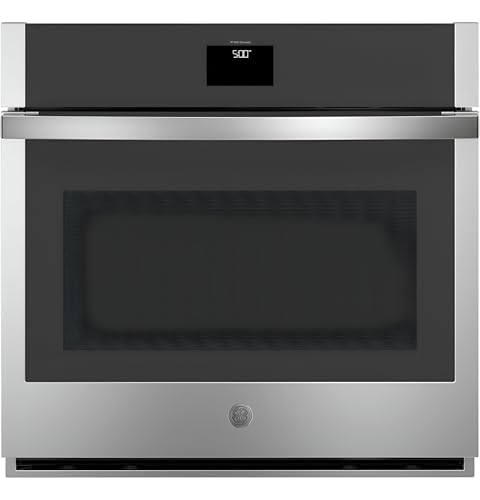
GE 30 Inch Single Smart Convection Wall Oven with No-Preheat Air Fry — Best Overall
At the top of the under-$2000 frame, a wall oven should do three things supremely well: bake with true evenness, roast with authority, and disappear into the kitchen’s daily life. GE’s 30-inch smart convection oven is built to that brief. The headline features in its listing are the two that define the current generation of wall ovens: smart convection, which manages the fan and elements as one system rather than as separate parts, and a no-preheat air fry mode that brings the countertop’s favorite trick into the big cavity — crisping at family scale without a separate appliance and without the wait. GE is the mainstream choice in American wall ovens for reasons that compound over a decade: parts everywhere, service everywhere, and controls that a generation of cooks already knows. In stainless, in the standard 30-inch single format, this is the oven against which the rest of this guide is measured.
Strengths
- Smart convection plus no-preheat air fry in one full-size cavity
- GE’s service and parts network — the safest long-term ownership bet in the class
- Standard 30-inch format fits the cutouts most kitchens already have
Trade-offs
- Smart features assume a household that will actually connect and use them
- Single oven — simultaneous two-temperature cooking needs a second cavity or a countertop helper
- Sits at the top of the frame; sale timing matters
| Type | Built-in single wall oven, 30 inch |
| Convection | Smart convection (per manufacturer listing) |
| Air fry | No-preheat air fry (per manufacturer listing) |
| Finish | Stainless steel |
The no-preheat air fry deserves a paragraph of its own, because it changes the arithmetic of weeknight cooking. A countertop air fryer crisps brilliantly for two; this oven crisps for the whole family in one load, on a sheet pan, with no preheat penalty — wings, vegetables, reheated anything, at a scale the pod appliances cannot approach. Paired with convection roasting that handles the Sunday bird without rotation rituals, the oven covers both ends of the modern repertoire. The smart layer is best understood as insurance rather than entertainment: remote monitoring, precise temperature management and an appliance that can be updated rather than merely aging. Owners who cook seriously and often will feel this oven’s quality daily; owners who bake twice a year are overspending here, and the Cosmo below exists for them. For the kitchen being built or rebuilt around one great oven, this is the guide’s answer.
Best for: serious home cooks building a kitchen around one excellent oven / Not suited for: occasional bakers, for whom the Cosmo delivers the essentials for less
Check the current price on Amazon for the GE 30 Inch Single Smart Convection Wall Oven with No-Preheat Air Fry.
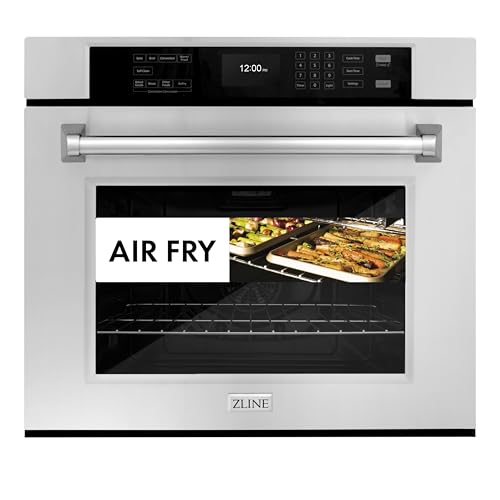
ZLINE WAS-30 30 Inch Professional True Convection Wall Oven — Best Professional Style
ZLINE built its name on a proposition the legacy brands underserve: professional aesthetics and cooking hardware without the professional-brand pricing structure, and the WAS-30 is that proposition in wall-oven form. The listing confirms the serious hardware — true convection, the configuration with a heating element at the fan that delivers the flattest temperature map in the category — plus air fry and a self-cleaning cycle, the two modern conveniences that matter most in daily and monthly life respectively. The design language is the other half of the purchase: this is an oven meant to be looked at, with the substantial, restaurant-inflected presence that anchors a kitchen renovation’s photographs as well as its cooking. Under the frame’s ceiling, it is the pick for buyers who want the professional look and true convection engineering in the same box.
Strengths
- True convection — the evenness configuration bakers ask for by name
- Air fry and self-clean cover the modern convenience pair
- Professional design presence that anchors a renovation
Trade-offs
- A younger brand than the legacy names — support networks are still growing
- Professional styling is a commitment; it dominates a kitchen’s look
- Top-of-frame positioning alongside the GE
| Type | Built-in single wall oven, 30 inch |
| Convection | True convection (per manufacturer listing) |
| Features | Air fry, self clean (per manufacturer listing) |
| Finish | Stainless steel |
Choosing between the ZLINE and the GE above is this guide’s most interesting fork. The GE argues ecosystem: the deepest service network in the business and smart features that integrate the oven into a connected kitchen. The ZLINE argues the oven itself: true convection hardware and a design presence the mainstream brands reserve for their luxury lines. Both arguments are honest, and the right one depends on whether your kitchen values the network or the object more. Bakers, specifically, should weigh the true convection heavily — multi-rack evenness is the thing itself for their work, not a feature bullet. Renovators should weigh the look with equal seriousness, because a wall oven is the largest single visual object in most kitchens and you will see it ten thousand times. Either way, this tier’s lesson holds: at under $2000 you are no longer choosing what you can afford, you are choosing what you prefer — a much better problem.
Best for: bakers and renovators who want true convection with professional presence / Not suited for: buyers who prioritize the deepest service network and smart-home integration
Check the current price on Amazon for the ZLINE WAS-30 30 Inch Professional True Convection Wall Oven.

Samsung NV51K6650SG 30 Inch Smart Wall Oven with Steam Cook — Best Smart and Steam
Samsung approaches the wall oven the way it approaches every appliance category: as a technology product that cooks. The NV51K6650SG’s listing leads with Steam Cook — the ability to introduce steam into the cavity, which is the professional baker’s secret for crusty bread with a shattering crust and the roast cook’s secret for meat that stays moist — alongside Wi-Fi connectivity and a large oven capacity in the 30-inch format. The finish is fingerprint-resistant black stainless, the darker register of modern kitchen design. Steam is the feature to take seriously here: it is genuinely difficult to retrofit, impossible to fake with a pan of water at the level an integrated system delivers, and transformative for the specific foods — artisan loaves, roasted poultry, reheated leftovers that should taste fresh — that steam serves. For the cook whose ambitions run artisanal, this is the oven in the frame built around them.
Strengths
- Steam Cook — the one capability in this guide that cannot be improvised
- Wi-Fi smart control for monitoring and preheating from anywhere in the house
- Large capacity in the standard 30-inch format
Trade-offs
- Technology-forward design means more systems to learn and, eventually, to service
- Black stainless is a specific aesthetic commitment
- Steam benefits specific foods most; plain roasting gains less
| Type | Built-in smart wall oven, 30 inch |
| Signature feature | Steam Cook (per manufacturer listing) |
| Connectivity | Wi-Fi (per manufacturer listing) |
| Finish | Fingerprint-resistant black stainless (per manufacturer listing) |
A note on evidence, in keeping with this guide’s practice: Samsung’s listing emphasizes steam, Wi-Fi and capacity, and this review rests its claims on those verified features; the model sits in the convection class this search covers, and buyers comparing convection configurations should confirm the exact specification on the listing at purchase. What is not in doubt is the cooking case. Steam-assisted baking is the difference between home bread and bakery bread — the steam keeps the crust supple while the loaf expands, then lets it crisp — and steam-assisted roasting and reheating are quieter miracles of the same kind. If your cooking runs toward bread, poultry and leftovers treated with respect, the Samsung is not the tech-gadget pick; it is the specialist pick, and its Wi-Fi layer is simply how a modern specialist is controlled. Kitchens that cook plainly and prize service networks above features should take the GE; kitchens that bake should take a long look here.
Best for: bread bakers and technology-comfortable cooks who will use steam weekly / Not suited for: plain-cooking households that value service networks over features
Check the current price on Amazon for the Samsung NV51K6650SG 30 Inch Smart Wall Oven with Steam Cook.

Frigidaire Gallery 27 Inch Wall Oven and Microwave Combination with Total Convection — Best Combination Unit
Some kitchens do not have room for an oven and a microwave in separate places, and for them the combination unit is not a compromise but the design. Frigidaire’s Gallery combination stacks a microwave over a wall oven in a single 27-inch built-in footprint, and the oven below carries the brand’s Total Convection system — its name for a convection configuration aimed at even, multi-rack results. The smudge-proof stainless finish is the practical luxury families feel daily: a surface that does not record every fingerprint in a kitchen where the microwave handle is touched twenty times a day. Gallery is Frigidaire’s premium line, and the combination format is its most space-rational product: one cutout, one electrical project, two appliances, and a counter freed of the microwave that would otherwise live on it.
Strengths
- Oven plus microwave in one 27-inch built-in footprint
- Total Convection in the oven cavity for even baking
- Smudge-proof finish suits high-touch family kitchens
Trade-offs
- 27-inch class is narrower than the 30-inch standard — check pan fit
- A combination unit means a failure in one half implicates the whole appliance
- Microwave height in a stack suits most, but not all, households’ reach
| Type | Built-in wall oven + microwave combination, 27 inch |
| Convection | Total Convection (per manufacturer listing) |
| Finish | Smudge-proof stainless steel |
The combination unit asks to be judged as a system. Separately, a 27-inch oven is a size class down from the 30-inch picks around it, and a built-in microwave is a luxury next to a countertop model. Together, in a kitchen short on wall space — a galley, a condo, an in-law suite, a remodel that cannot move walls — they solve the whole cooking wall in one decision, at a combined cost inside this frame that separate premium units would exceed. The honest cautions are the format’s own: the shared-fate problem if one half fails, and the ergonomics of a microwave at stack height, which households with shorter cooks or mobility concerns should test in a showroom before committing. For the right kitchen, though, this is the most space-intelligent purchase in the guide, and Frigidaire’s convection system ensures the oven half is a real oven, not an afterthought under a microwave.
Best for: space-constrained kitchens needing oven and microwave in one cutout / Not suited for: kitchens with room for separate 30-inch units and cooks who prefer them
Check the current price on Amazon for the Frigidaire Gallery 27 Inch Wall Oven and Microwave Combination with Total Convection.

Cosmo COS-30ESWC 30 Inch Electric Wall Oven, True Convection — Best Value 30-Inch
Cosmo’s proposition is the mirror of the premium brands’: the essential wall-oven specification — full 30-inch width, a generous 5 cu ft cavity, true convection, self-cleaning — delivered without the smart layers and brand premiums that pad the top of this tier. The listing confirms each element: true convection for even multi-rack baking, a self-clean function for the monthly reality, and a blue porcelain interior, the traditional premium-oven finish that resists staining and makes the cavity’s state easy to see. For the renovator whose budget is being pulled by cabinets, counters and everything else a kitchen project demands, this is the oven that lets the appliance line come in under the frame while conceding nothing on the cooking fundamentals. It is the same brand whose 24-inch model anchors our under-$1000 guide, playing the same role one size up.
Strengths
- True convection and 5 cu ft at a value position in the tier
- Self-clean function included — not reserved for premium trims
- Blue porcelain interior, the classic premium-oven finish
Trade-offs
- No smart features or air fry modes — the fundamentals only
- Smaller brand; verify local service options before purchase
- Controls and refinement trail the legacy flagships
| Type | Built-in electric wall oven, 30 inch |
| Capacity | 5 cu ft |
| Convection | True convection (per manufacturer listing) |
| Cleaning | Self clean (per manufacturer listing) |
| Interior | Blue porcelain |
The Cosmo is the pick this guide most enjoys making, because it tests whether the reader has been paying attention to the right things. Strip the category to what cooks food — cavity, convection quality, cleaning, build — and this oven has all of it, in the full-size format, inside the frame with room to spare. What it lacks is everything that photographs well in a feature list: no Wi-Fi, no air fry branding, no steam. Households that will use those features should buy them, in the GE or Samsung above, with our blessing. Households that will not — and honest self-knowledge says they are the majority — should take the Cosmo’s deal and put the savings into the range hood, the pans or the pantry. The one diligence item is service: check that your area has support for the brand before purchase, as you should for any smaller name. Do that, and this is the value pick of the entire convection series.
Best for: renovators who want true convection fundamentals without feature premiums / Not suited for: buyers who will genuinely use smart, steam or air fry features weekly
Check the current price on Amazon for the Cosmo COS-30ESWC 30 Inch Electric Wall Oven, True Convection.

Empava 30 Inch Electric Single Wall Oven with Convection and Air Fry — Best Budget 30-Inch
Empava has built its business on the accessible end of the built-in market, and this 30-inch wall oven is its representative here: convection cooking with an air fry mode, 10 cooking functions and an LED digital display, in the full-size format, positioned at the budget end of the under-$2000 frame. The function count is the tell — where the Cosmo strips to fundamentals, the Empava competes on breadth, offering the modern mode list including the air fry that buyers now expect, behind a digital interface rather than knobs. For a rental property being upgraded, a first renovation on a disciplined budget, or a flip where a modern-looking, full-feature wall oven matters, this is the doorway into the 30-inch built-in class without approaching the frame’s ceiling.
Strengths
- Full 30-inch built-in format at the frame’s accessible end
- 10 functions including air fry, behind a digital display
- Modern look that lifts a budget renovation
Trade-offs
- Build refinement and insulation trail the legacy brands
- Smaller brand — confirm service and parts locally first
- Feature breadth over depth; serious bakers should step up to true convection picks
| Type | Built-in electric wall oven, 30 inch |
| Functions | 10 cooking functions (per manufacturer listing) |
| Features | Convection with air fry (per manufacturer listing) |
| Controls | LED digital display |
Budget built-ins deserve the same honest framing as budget anything: the question is not whether the Empava matches the GE — it does not, in refinement, insulation or network — but whether it delivers the format and the cooking credibly for its position in the frame. On the verified evidence of its listing, it delivers the checklist a modern buyer requires: full size, convection, air fry, digital control. The buyers it serves are real: landlords, first-time renovators, sellers preparing a kitchen, and households whose alternative is not a flagship but an aging oven kept alive another five years. Against that alternative the Empava wins easily. Against the Cosmo, the choice is philosophy — Empava’s features against Cosmo’s fundamentals — and this guide’s consistent advice applies: buy the fundamentals if you cook daily, the features if the kitchen’s job is broader than cooking. Either way, confirm local service before the install, because a built-in is a decade-long relationship with whoever can repair it.
Best for: budget renovations, rentals and first built-in upgrades / Not suited for: daily serious cooks who will feel the refinement gap for a decade
Check the current price on Amazon for the Empava 30 Inch Electric Single Wall Oven with Convection and Air Fry.
Comparison Table
| Pick | Badge | Key spec | Best for |
|---|---|---|---|
| GE 30 Inch Single Smart Convection Wall Oven with No-Preheat Air Fry | Best Overall | 30 in smart convection, no-preheat air fry | The main kitchen oven |
| ZLINE WAS-30 30 Inch Professional True Convection Wall Oven | Best Professional Style | 30 in true convection, self clean | Bakers and design-led renovations |
| Samsung NV51K6650SG 30 Inch Smart Wall Oven with Steam Cook | Best Smart and Steam | 30 in, Steam Cook, Wi-Fi | Artisan baking and smart kitchens |
| Frigidaire Gallery 27 Inch Wall Oven and Microwave Combination with Total Convection | Best Combination Unit | 27 in combo, Total Convection | Small kitchens, full function |
| Cosmo COS-30ESWC 30 Inch Electric Wall Oven, True Convection | Best Value 30-Inch | 30 in, 5 cu ft, true convection | Value renovations |
| Empava 30 Inch Electric Single Wall Oven with Convection and Air Fry | Best Budget 30-Inch | 30 in, 10 functions, air fry | Budget built-in upgrades |
How to Choose a Wall Oven Under $2000: Cutout, Convection, Then Features
Begin with the hole in your kitchen. Wall ovens are bought to a cutout — width class first (30 inch is the standard this guide’s picks serve, 27 inch for the combination), then the exact cutout height, width and depth in the manufacturer’s installation specification, measured on your cabinetry rather than assumed from the old oven’s badge. Electrical supply comes with it: wall ovens are hardwired appliances with real amperage requirements, and confirming your circuit before purchase is the difference between an installation day and a reschedule. Only when the physical facts close do features open. This ordering feels backwards to shoppers raised on feature lists, and it is the single most reliable predictor of a wall-oven purchase that ages well — because a decade of ownership is lived with the fit and the convection daily, and with the feature list mainly on the first weekend.
Convection configuration is the feature that matters most: true convection, with its element at the fan, for bakers and multi-rack cooking; a well-engineered fan convection for generalists. Then the signature capabilities, bought only if your cooking will use them weekly — air fry for the crisping household, steam for the bread baker, a combination microwave for the space-poor kitchen. Finally, weigh the service network with the seriousness a decade appliance deserves: the best oven in this guide is the one your town can repair in year seven. Follow that order — fit, convection, features, service — and the under-$2000 frame reliably produces a kitchen’s happiest purchase.
Single, Combination or Double: Choosing the Wall Oven Format
This guide’s picks are single ovens and one combination, and the format question deserves a direct answer. A single wall oven, paired with a separate cooktop, is the standard serious kitchen: one excellent cavity, all of this tier’s budget spent on its quality. It suits cooks who rarely need two temperatures at once and who use a countertop oven or the range’s second zone for overflow. A combination unit — the Frigidaire here — trades cavity size for the microwave’s integration, and wins outright in kitchens where wall space, not cooking ambition, is the constraint. Double ovens, the format this frame largely prices out, serve the simultaneous-two-temperature household: the holiday roaster, the baker with a proofing loaf and a roasting bird. If that is your kitchen, the honest advice is to know it before shopping, because no single oven — however smart, however steamy — cooks at two temperatures at once, and discovering that on a holiday is the most expensive way to learn it.
How to Plan a Wall Oven Installation Without Surprises
Wall oven installation rewards the owners who treat it as a small project rather than a delivery. Start weeks ahead: download the manufacturer’s installation specification for your exact model and measure your cutout against it — height, width, depth and the location of the electrical junction — because “30-inch oven” describes a class, not a guarantee, and classes vary by fractions that matter. Confirm the circuit: the specification states the amperage, and your panel and wiring must meet it; if they do not, the electrician comes before the oven does, not after. Arrange the install path too — doorways, turns, and a clear route from the truck to the kitchen — and plan the old oven’s removal and disposal in the same conversation.
On the day, insist on the unglamorous completions: the oven leveled and secured, the door aligned, a test bake with a thermometer to confirm the cavity heats honestly, and the anti-tip and trim details finished rather than promised. Then register the warranty while the paperwork is in your hand, photograph the model and serial plate for future service calls, and run the self-clean or burn-off cycle the manual prescribes before the first real food. A wall oven installed this way disappears into the kitchen for a decade. One installed casually announces itself at intervals forever — in uneven doors, mystery rattles and service calls that begin with “who put this in?” Be the first kind of owner; it costs one careful day.
Common Buying Mistakes
- Measuring the old oven instead of the cutout. The badge lies by omission; the cabinet opening is the truth. Measure the hole, match the new oven’s installation specification to it.
- Discovering the circuit on installation day. Wall ovens are hardwired with real requirements. Confirm amperage and wiring before the truck is booked.
- Buying features your cooking will never open. Steam, Wi-Fi and air fry are worth their cost only in weekly use. Honest self-knowledge is the best feature filter at this tier.
- Ignoring the service network. A wall oven is a ten-year appliance. The brand your town can repair beats the brand with the longer feature list.
- Choosing a single oven for a two-temperature household. No feature substitutes for a second cavity on the days you need one. Know your holiday cooking before you choose the format.
- Skipping the test bake. A thermometer and one tray of cookies on day one catch installation and calibration problems while everyone is still reachable.
Final Recommendation
For most kitchens the answer is the GE 30-Inch Smart Convection Oven — complete, mainstream and serviceable everywhere. Bakers and design-led renovators should take the ZLINE WAS-30, bread bakers the steam of the Samsung NV51K6650SG, and tight kitchens the Frigidaire Gallery Combination. Value belongs to the Cosmo COS-30ESWC and the budget doorway to the Empava 30-Inch. The rest of the series: Best Convection Ovens Under $1000, Best Convection Ovens Under $200, and the specialists in Best Convection Ovens With Baking Drawer.
The Ergonomics Dividend: Cooking at the Height You Chose
The least discussed and most daily-felt advantage of a wall oven is height. A range oven puts its floor near your ankles; every heavy roast, every full casserole, every holiday bird is a deadlift from knee height with hot liquid in it. A wall oven installs where your designer — or your existing cabinetry — puts it, which for most households means the rack at elbow height and the lifting done by arms at their strongest angle. Cooks with aging backs, cooks who are short, cooks who are tall, and cooks who simply produce heavy food in quantity all describe the same discovery: the oven stops being the physically hardest appliance in the kitchen. When you plan the installation in our how-to section, spend one of your careful minutes on this: stand in the kitchen, mime lifting a full roasting pan from the proposed height, and adjust the plan while adjusting is still free. A decade of comfortable lifting is bought in that minute.
Why Wall Ovens Outlive Every Other Appliance Decision
Countertop appliances are replaced on a whim’s schedule; a wall oven is replaced on a decade’s. That asymmetry should change how you shop. The features that matter in year eight are not the ones that demo well — they are the cavity’s evenness, which never stops mattering; the self-clean cycle, which you will run a hundred times; the door hinges and gaskets, which you will feel at every use; and the service network, which decides whether a year-seven fault is a repair or a replacement. This is why this guide ranks a mainstream flagship first despite strong cases for steam and style around it, and why it keeps returning to installation and service in a document nominally about convection. The oven is the kitchen’s longest relationship. Choose it like one: slowly, with measurements in hand, and with your actual cooking — not a holiday fantasy or a showroom mood — as the specification it has to meet.
Pairing the Cooktop: The Other Half of the Wall Oven Decision
A wall oven implies a cooktop, and the pairing deserves a thought before the oven is chosen, because the two appliances share a budget, an electrical plan and a kitchen’s visual field. Induction cooktops are the current default recommendation for most households — fast, precise, easy to clean, and cool to the touch in a way that suits the ergonomic, everything-at-reach-height logic that leads kitchens to wall ovens in the first place. Gas remains the choice of cooks who cook by flame sight and wok heat, and radiant electric serves the budget end honestly. The planning point is sequence: decide the cooktop’s fuel and circuit alongside the oven’s, because both may draw on the same panel capacity, and a surprise electrical upgrade discovered mid-renovation costs more than one planned from the start. Visually, matching finishes across the pair — or deliberately contrasting them, like the Samsung’s black stainless against a stainless cooktop — is a decision to make on paper rather than in the aisle. The wall oven is the anchor; the cooktop is its partner; kitchens that choose them together look and cook like it.
Renovation Economics: Where a Wall Oven Earns Its Frame
Kitchen renovations are exercises in allocating a finite budget across things that photograph well and things that cook well, and the wall oven sits at the intersection. It is one of the few renovation purchases that returns value on both ledgers: daily, in cooking quality and ergonomics, for a decade; and at resale, where a modern convection wall oven reads to buyers as a serious kitchen in a way that a builder-grade range does not. That dual return is the argument for spending at this tier rather than below it when a renovation is already underway — the marginal cost of the better oven, spread across the project and the decade, is among the smallest line items with the largest daily presence. The counterargument is equally real: in a kitchen not being renovated, a wall oven’s installation costs can exceed a range’s entire price, and the flagship countertop ovens in our under-$1000 guide deliver most of the cooking with none of the construction. Renovating kitchens belong in this guide. Settled kitchens belong in that one. Knowing which kitchen you have is the first specification of all.
Steam, Air Fry and the New Wall Oven Repertoire
The current generation of wall ovens has absorbed the countertop’s two best tricks, and the absorption changes kitchen planning. Air fry at wall-oven scale ends the batch tyranny of the pod fryer — a sheet pan of wings crisps at once, and the countertop appliance it replaces can leave the counter. Steam, where fitted, does the opposite journey: a professional bakery technique arriving in the home oven, turning out loaves with real crusts and roasts with real moisture. Kitchens designed around these capabilities look different — fewer single-purpose appliances, more sheet pans, a wall oven that is genuinely the center of cooking rather than its largest backup. None of this obliges any buyer to want either feature; plenty of great cooking predates both. But buyers choosing a decade appliance should choose with the repertoire in view, because the oven you install this year is the one your cooking will grow into — or chafe against — for years.
Frequently Asked Questions
Are wall ovens under $2000 worth it versus a range?
For kitchens designed around them, yes: a wall oven at comfortable height, paired with a separate cooktop, is the ergonomic and capacity equal of any range, and this frame buys true convection, air fry and even steam. The trade is installation — a wall oven is a project with a cutout and a circuit, where a range slides in. Choose by your kitchen’s design, not by a hierarchy.
What cutout size do I need for a 30-inch wall oven?
The class is standardized but not identical: each model’s installation specification gives exact cutout height, width and depth, and those numbers — measured on your cabinetry — govern. Never order from the class name alone; the guide’s installation section walks through the measurement discipline that prevents the classic failure.
What is true convection and do I need it?
True convection adds a heating element at the fan, so circulated air enters the cavity already heated and multi-rack baking stays even. Bakers and multi-rack cooks benefit most; single-dish roasters are well served by good fan convection. Two picks in this guide — the ZLINE and the Cosmo — offer true convection explicitly.
Can a wall oven air fry as well as a countertop air fryer?
At scale, better: the cavity takes a full sheet pan in one load, and no-preheat models like the GE here remove the countertop unit’s last advantage. A pod fryer still wins for a single small portion on speed and energy. Most households that gain a wall oven with air fry retire the pod within a season.
How long does a wall oven installation take?
The physical install is typically a few hours when the cutout and circuit are correct — which is why this guide insists on measuring and confirming both in advance. Cabinet modification or electrical work adds a separate visit. Budget a day, expect a morning, and run the test bake before the installers leave.
Should I match my wall oven brand to my other appliances?
For looks, matching finishes matter more than matching badges — stainless from different brands sits together comfortably, while black stainless shades vary enough to check in person. For service, there is a real argument for one brand across the kitchen: a single service relationship and, on smart appliances, a single app. Neither argument should override buying the right oven; they break ties between ovens that already fit.
What is the difference between a wall oven and a range oven?
Location and ergonomics. A wall oven is installed in cabinetry at a height you choose — no bending to the floor for heavy roasts — and pairs with a separate cooktop. A range combines oven and cooktop in one freestanding unit that slides into a gap. Cooking capability at this tier is equivalent; the choice is kitchen design, budget structure and how your back feels about low ovens.
Why no prices in an “under $2000” guide?
Built-in pricing moves with sales, bundles and installation promotions, and a printed figure would mislead quickly. The frame is the commitment: every pick is positioned within it as the market understands the tier. Check the current price on Amazon via the review links on the day you buy.

