Disclosure: airfryerkitchensupply.com is reader-supported. When you buy through links on our site, we may earn an affiliate commission at no extra cost to you.
Where to Buy
If you are shopping for the best competition bbq grills, start here. Competition barbecue is a specialist world: some of its defining equipment — drum smokers from small American makers, gravity-feed smokers, custom offsets — is sold direct or through dealers rather than Amazon. The picks below separate the two honestly: verified Amazon listings get links, and the one legendary direct-sale cooker in the lineup is covered in prose with no purchase link.
- PK Grills PK360 Cast Aluminum Charcoal Grill — Best Overall. Check the current price on Amazon before you order, and confirm the listing matches the exact model described in this guide.
- Oklahoma Joe’s Highland Reverse Flow Offset Smoker — Best Offset for Contests. Check the current price on Amazon before you order, and confirm the listing matches the exact model described in this guide.
- Kamado Joe Classic Joe Series II 18-Inch — Best Kamado for Competition. Check the current price on Amazon before you order, and confirm the listing matches the exact model described in this guide.
- Gateway Drum Smoker — Best Drum — Unlinked pick. This model is sold mainly through specialty dealers and direct channels rather than Amazon, so it is covered in prose below with no purchase link.
- Char-Griller AKORN 20-Inch Kamado Charcoal Grill and Smoker — Best Budget Competition Kamado. Check the current price on Amazon before you order, and confirm the listing matches the exact model described in this guide.
- Weber Smokey Mountain Cooker 14-Inch — Best Bullet for Small Teams. Check the current price on Amazon before you order, and confirm the listing matches the exact model described in this guide.
The best competition bbq grills are not chosen the way backyard grills are chosen. A competition cook is buying scorecard performance under contest conditions: a cooker that holds its temperature through a windy night in a fairground, produces four different meats on a strict turn-in schedule, travels in a trailer without breaking, and does it all identically on the cook’s worst day, because contests are won on the worst box, not the best bite. Every purchasing criterion flows from that reality — consistency beats peak performance, reliability beats features, and a cooker the team knows intimately beats a better cooker they met last month.
The competition world runs several distinct equipment games at once. Sanctioned barbecue contests (the KCBS-style circuit of brisket, pork, ribs and chicken) are fought on offsets, drum smokers, pellet cookers and kamados. Steak cookoffs are a different sport with different weapons — the cast-aluminum PK grill is its icon. And the backyard and tailgater divisions have their own economics, where a cooker that costs less than the entry fees for a season is the rational weapon. This guide covers the real contenders across those games.
One honesty note that shapes the whole list: the drum smoker most associated with competition success in the last decade is sold direct by its maker, not on Amazon, so it appears here as a pick without a link — covered in full, because a competition guide without it would be a lie, but with no buy link, because inventing one would be a worse one.
In this guide
Quick Picks
If you only read one section, make it this one. These are the best competition bbq grills worth serious consideration this season, each chosen for a different kind of buyer:
- PK Grills PK360 Cast Aluminum Charcoal Grill — Best Overall. The cast-aluminum capsule that owns steak cookoffs and doubles as a superb small smoker — the most competition-proven portable grill ever made. Check the current price on Amazon.
- Oklahoma Joe’s Highland Reverse Flow Offset Smoker — Best Offset for Contests. A 1,093 sq in reverse-flow offset whose even chamber removes the rotation variable from brisket and pork — the thinking team’s contest offset at a non-custom price. Check the current price on Amazon.
- Kamado Joe Classic Joe Series II 18-Inch — Best Kamado for Competition. The 18-inch ceramic kamado with the air-lift hinge and divide-and-conquer grates — the chicken and ribs weapon, and a backyard-division program in a single cooker. Check the current price on Amazon.
- Gateway Drum Smoker — Best Drum — Unlinked pick. The drum that redefined modern competition barbecue — hot-and-fast cooking, intense flavor, and a trophy record few cookers of any price can match. Sold direct; covered here in prose.
- Char-Griller AKORN 20-Inch Kamado Charcoal Grill and Smoker — Best Budget Competition Kamado. A 20-inch insulated-steel kamado with cast-iron grates — near-ceramic performance for backyard divisions and new teams, at a fraction of ceramic money. Check the current price on Amazon.
- Weber Smokey Mountain Cooker 14-Inch — Best Bullet for Small Teams. The bullet smoker in its most portable size — dual grates, porcelain enamel, and the water-pan steadiness that has started more competition careers than any other cooker. Check the current price on Amazon.
How These Picks Were Chosen
Picks were evaluated as contest equipment, not patio furniture: temperature stability over long cooks, recovery after door openings (turn-in schedules mean constant openings), capacity per competition category, transport durability, and how the cooker behaves at hour ten of an overnight brisket cook. Every linked model was verified against Amazon’s catalog data account, and specs in the boxes come from that verified data. The single unlinked pick is included on its competition record and is clearly marked.
The spread of formats is the story of modern competition. The offset remains the prestige brisket weapon. The drum — represented here in prose — owns a huge share of the circuit on simplicity and flavor. The kamado is the chicken-and-ribs assassin and the backyard division’s favorite. The PK is the steak game’s defining tool. And the value offsets and bullets fill the teams that are building toward the big rigs. A serious team eventually owns two of these categories; this guide is organized so you can see which two are yours.
The 6 Best Competition BBQ Grills

PK Grills PK360 Cast Aluminum Charcoal Grill — Best Overall
The PK360 is a legend with a serial number. Its cast-aluminum capsule — a design lineage running back to the 1950s — is the defining tool of competitive steak cooking, where its four-vent control system lets cooks run precise two-zone fires and produce the sear and doneness the judges score. It is also, not incidentally, an excellent small smoker and an everyday grill of remarkable durability, because cast aluminum does not rust. Ever.
Strengths
- Four-vent airflow system gives competition-grade fire control in a portable body
- Cast aluminum capsule: rust-proof, heat-retentive, and effectively a lifetime purchase
- The proven steak-cookoff weapon — and a capable two-zone smoker for ribs and chicken
Trade-offs
- Capacity is couples-and-categories scale — a full four-meat KCBS load needs a bigger partner cooker
- Premium price for its cooking area; you are buying control and material, not inches
- Aluminum is light for travel but the capsule shape packs its own way
| Specification | Detail |
|---|---|
| Body | Cast aluminum capsule (per verified listing) |
| Format | Portable charcoal grill and smoker |
| Vents | Four-point airflow control |
Steak competition is a game of millimeters — grill marks, crust, and a perfect medium-rare from edge to edge — and the PK360 wins it with control. The four vents (two intakes, two exhausts, arranged for cross-flow) let the cook build a fire that is violent on one side and gentle on the other, then steer it minute by minute. In barbecue categories the same capsule, run low with the vents nearly closed, holds smoking temperatures with a steadiness that embarrasses thin steel, and the aluminum’s heat retention smooths every adjustment. For a team, the PK is typically the steak and chicken weapon alongside a larger brisket cooker; for a backyard-division cook or a steak specialist, it can be the whole program. It is also the rare competition tool that moonlights beautifully — the same capsule grills weeknight dinners for decades without a spot of rust. Buy it as an instrument, learn its vents like a language, and it will repay you in the only currency contests print: consistency.
Best for: Steak cookoff competitors, backyard-division teams, and any cook who wants one precise charcoal instrument for a career / Not suited for: Full four-meat teams needing one cooker to do everything, or buyers shopping by square inches per dollar
Check on Amazon — check the current price on Amazon, since listings and configurations change through the season.

Oklahoma Joe’s Highland Reverse Flow Offset Smoker — Best Offset for Contests
Brisket is where contests are decided and where offsets earn their mystique. The Highland Reverse Flow attacks the offset’s one competitive weakness — the hot end by the firebox — with a baffle plate that routes heat the length of the chamber before releasing it, evening the cooking field across 1,093 square inches. For a team cooking two briskets and two butts to a turn-in clock, evenness is not comfort; it is the removal of a whole category of surprises.
Strengths
- Reverse-flow baffle delivers the most uniform brisket chamber in its class
- Capacity handles a realistic contest load: briskets, butts and ribs in sequence
- Even heat means fewer door openings for rotation — and every opening costs recovery time
Trade-offs
- Stick-burning through a contest night is skilled, sleepless work by design
- Prosumer steel gauge; a custom quarter-inch pit holds heat with less tending
- Reverse-flow design punishes dirty fires — clean-burning discipline is mandatory
| Specification | Detail |
|---|---|
| Cooking area | 1,093 sq in (per verified listing) |
| Design | Reverse-flow offset |
| Fuel | Charcoal and wood splits |
Contest brisket is a scheduling problem wearing a cooking costume. Two briskets go on at midnight, butts join at dawn, ribs at mid-morning, and everything converges on turn-in boxes in the early afternoon. The Highland’s contribution is that position in the chamber stops being a variable the cook must manage: the flat by the stack cooks like the flat by the firebox, so the rotation dance that costs heat, time and bark on a traditional offset mostly disappears. What does not disappear is the fire — this remains a stick-burner, demanding small clean fires fed on a rhythm through the night, and the reverse-flow path holds dirty smoke against the meat longer than an open offset does, so fire discipline is doubly rewarded and doubly punished. Teams stepping up from backyard cookers will find it the most forgiving route into serious offset competition; teams dreaming of a custom pit will find it the honest measuring stick for whether they actually enjoy the stick-burning life enough to pay for it in steel.
Best for: Competition teams cooking brisket and pork on an offset, and serious amateurs entering sanctioned contests / Not suited for: Teams that need sleep more than smoke character, or anyone expecting custom-pit thermal mass at this price
Check on Amazon — check the current price on Amazon, since listings and configurations change through the season.

Kamado Joe Classic Joe Series II 18-Inch — Best Kamado for Competition
If the offset is the brisket weapon, the kamado is the assassin for chicken and ribs — the categories where moisture, bite-through skin and precise finishing decide trophies. The Classic Joe Series II is the refined form of the 18-inch ceramic kamado: air-lift hinge that makes the heavy dome weightless, a divide-and-conquer two-level grate system, and the insulation that lets a kamado sip charcoal while holding any temperature from low smoking to searing.
Strengths
- Ceramic insulation holds contest temperatures for hours on minimal charcoal and attention
- Two-level grate system cooks categories at different heights and heats simultaneously
- Air-lift hinge and quality hardware survive the travel-and-cook contest cycle
Trade-offs
- 18 inches is one category at a time at contest volumes — plan its role
- Ceramic travels carefully; a cracked dome ends a season, not a weekend
- Premium pricing, and the accessory ecosystem invites further spending
| Specification | Detail |
|---|---|
| Size | 18-inch ceramic kamado (per verified listing) |
| Grates | Stainless steel, two-level system (per verified listing) |
| Format | Kamado grill and smoker with cart and side shelves |
Competition chicken is a notoriously technical cook — skin rendered bite-through, meat juicy, appearance lacquered — and it is won on precise, repeatable heat in the final hour. The kamado’s gift is repeatability: light it, set the vents, and the ceramic mass holds the number while the cook attends to sauces and boxes. Ribs benefit the same way, and the two-level system lets a team run ribs above and chicken below, or finish and hold at different heights, in one small footprint at the contest site. In the backyard and tailgater divisions, a Classic Joe can credibly be the entire program — brisket in miniature, butts, ribs and chicken across a long day. In pro divisions it is the specialist that handles the categories where finesse outranks volume. Either way, its contest value is the same as its backyard value, concentrated: the most controllable charcoal fire in this roundup.
Best for: Chicken and ribs specialists, backyard-division teams, and pro teams adding a precision cooker to a larger rig / Not suited for: High-volume brisket programs as a sole cooker, or rough-and-ready transport without protection
Check on Amazon — check the current price on Amazon, since listings and configurations change through the season.
Gateway Drum Smoker — Best Drum — Unlinked pick
No honest competition guide can omit the drum, and no honest guide can link you to an Amazon listing for the category’s defining product. Gateway Drum Smokers — the Missouri-built drums that popularized hot-and-fast competition cooking — are sold direct and through specialty dealers. What they offer is a philosophy as much as a cooker: meat suspended or gridded directly over a charcoal fire in a sealed drum, cooking hotter and faster than the low-and-slow orthodoxy, dripping onto the coals and returning as flavor.
Strengths
- Hot-and-fast method turns in brisket and pork on a contest-friendly schedule
- Direct-over-coals dripping creates the signature drum flavor judges reward
- Dead-simple, rugged design with almost nothing to fail in transport
Trade-offs
- Sold direct/dealer only — no Amazon listing to link, and freight is part of the purchase
- Hot-and-fast is a distinct technique with its own learning curve and timing
- Capacity per drum is category-scale; full programs often run two or more
The drum’s competitive argument is time and flavor. Where an offset brisket owns the cook’s night, a drum brisket cooks in a fraction of the hours at higher heat, with the fat rendering directly onto the fire and basting the meat in its own smoke — a flavor profile that has taken a remarkable share of top finishes in modern sanctioned contests. For a team, the economics compound: drums are comparatively affordable, nearly indestructible in a trailer, and light on fuel, so a two-drum program (one for brisket and pork, one for ribs and chicken) is a realistic pro setup at a fraction of a custom offset’s cost. The technique is its own discipline — fire building, vent settings and hanging versus gridding all differ from offset craft — and the community around these cookers is famously deep, which matters when you are learning. Buy it direct from the maker or an authorized dealer so sizing, accessories and support are right the first time; that channel is part of how the product is sold and supported, and this guide will not pretend otherwise.
Best for: Competition teams adopting the hot-and-fast method, and new teams wanting a proven, economical pro platform / Not suited for: Low-and-slow traditionalists, or buyers who need Amazon purchasing specifically
This pick is covered without a link: it is sold through specialty dealers and direct channels, so there is no verified Amazon listing to link here. Buy it through an authorized dealer so the warranty and commissioning support stay intact.

Char-Griller AKORN 20-Inch Kamado Charcoal Grill and Smoker — Best Budget Competition Kamado
Not every competition budget starts at ceramic. The AKORN takes the kamado formula — insulated body, tight seals, efficient charcoal burning — and builds it in triple-wall insulated steel with cast-iron grates at 20 inches, a size that swallows a contest chicken load or a pair of pork butts with room to work. For backyard divisions and first-year teams, it delivers most of the kamado’s competitive virtues at a price that leaves budget for entry fees.
Strengths
- Insulated steel holds kamado-style temperatures without ceramic cost or fragility
- 20-inch size is genuinely useful across chicken, ribs and butts
- Cast-iron grates sear and finish the way competition presentation demands
Trade-offs
- Steel gives back a little efficiency and stability versus true ceramic on the longest cooks
- Finish and seals need maintenance to stay contest-tight over seasons
- Heavier than it looks — insulated steel is still steel
| Specification | Detail |
|---|---|
| Size | 20-inch kamado (per verified listing) |
| Body | Triple-wall insulated steel (per verified listing) |
| Grates | Cast iron (per verified listing) |
The AKORN’s competition case is arithmetic: a new team has a season of entry fees, travel, meat and supplies ahead of it, and the cooker line item competes with all of them. The AKORN lets that team cook kamado-style — efficient, stable, versatile across all four categories at backyard volumes — while spending the savings on the reps that actually build skill. Experienced cooks consistently report that the gap between insulated steel and ceramic shows up mostly at the extremes: the very longest holds, the coldest nights. Within a contest day, the AKORN is a legitimate weapon, and its steel body forgives the trailer bumps that would end a ceramic’s season. Treat it as the platform for learning the kamado game at full seriousness; if the team graduates to ceramic later, the AKORN remains the perfect second cooker and travel unit — which is how most of them spend their long second lives.
Best for: Backyard-division teams, new competitors, and any cook wanting kamado performance on a working budget / Not suited for: Pro teams optimizing the final few percent of stability, or buyers who want set-and-forget pellet ease
Check on Amazon — check the current price on Amazon, since listings and configurations change through the season.
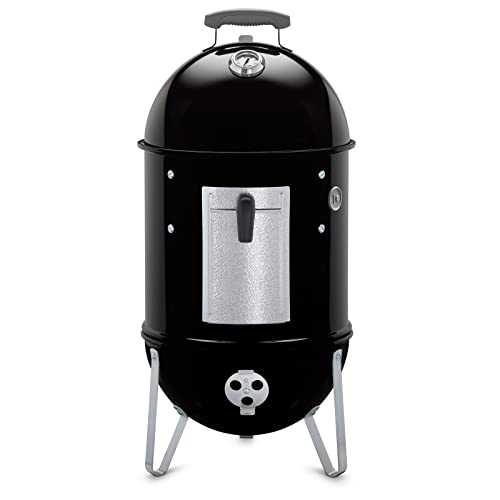
Weber Smokey Mountain Cooker 14-Inch — Best Bullet for Small Teams
The Smokey Mountain is the cooker that taught America to smoke, and the 14-inch is its most portable expression: a porcelain-enameled bullet with dual cooking grates and a water pan that steadies temperature and humidity. In competition terms it is a small-team and small-category instrument — ribs, chicken, or a single butt cooked with a bullet’s characteristic calm — and the finest training cooker in this entire roundup.
Strengths
- Water-pan design delivers exceptionally stable, humid smoking for its size
- Porcelain enamel and Weber support make it a decade-scale purchase
- Dual grates double the useful capacity of a tiny footprint
Trade-offs
- 14 inches is genuinely small — whole packer briskets need the larger siblings or another cooker
- Water pan management is a chore some cooks love and others abandon for sand or foil
- Charcoal-and-vents control is manual; no controller unless you add one
| Specification | Detail |
|---|---|
| Size | 14-inch bullet smoker (per verified listing) |
| Grates | Dual cooking grates (per verified listing) |
| Body | Porcelain-enameled (per verified listing) |
Bullets endure in competition because they remove variables. The water pan is a thermal flywheel and a humidity source in one, so a Smokey Mountain, once settled, ticks along for hours with the least vent-fiddling of any charcoal cooker here — which is why so many teams park one beside the big rig for ribs or chicken and trust it like an appliance. The 14-inch size is the honest limit: it is a category cooker and a small-team cooker, ideal for the backyard division, for steak-and-barbecue double events, and for learning the entire craft — fire, vents, wrapping, resting — at a scale where mistakes are cheap and lessons are fast. Its accessory ecosystem (controllers, gaskets, hinges, larger siblings when you graduate) is the deepest in charcoal smoking. If a young cook asked where to start a competition journey with one purchase, this little bullet, run weekly for a season, would teach more per dollar than anything else in this guide.
Best for: Small teams, backyard divisions, category specialists and anyone learning competition cooking properly / Not suited for: Full four-meat pro loads on a single cooker, or cooks who want to skip the manual-fire apprenticeship
Check on Amazon — check the current price on Amazon, since listings and configurations change through the season.
Comparison Table
| Pick | Badge | Key Spec | Best For |
|---|---|---|---|
| PK Grills PK360 Cast Aluminum Charcoal Grill | Best Overall | Cast aluminum, 4-vent control | Steak cookoff competitors, backyard-division teams, and any cook who wants one precise charcoal instrument for a career |
| Oklahoma Joe’s Highland Reverse Flow Offset Smoker | Best Offset for Contests | Reverse-flow offset, 1,093 sq in | Competition teams cooking brisket and pork on an offset, and serious amateurs entering sanctioned contests |
| Kamado Joe Classic Joe Series II 18-Inch | Best Kamado for Competition | 18 in ceramic kamado, 2-level | Chicken and ribs specialists, backyard-division teams, and pro teams adding a precision cooker to a larger rig |
| Gateway Drum Smoker | Best Drum — Unlinked pick | Drum smoker, hot-and-fast (direct sale) | Competition teams adopting the hot-and-fast method, and new teams wanting a proven, economical pro platform |
| Char-Griller AKORN 20-Inch Kamado Charcoal Grill and Smoker | Best Budget Competition Kamado | 20 in insulated steel kamado | Backyard-division teams, new competitors, and any cook wanting kamado performance on a working budget |
| Weber Smokey Mountain Cooker 14-Inch | Best Bullet for Small Teams | 14 in bullet, water pan | Small teams, backyard divisions, category specialists and anyone learning competition cooking properly |
Five of these picks link to Amazon; the Gateway Drum deliberately does not, because it is sold direct — its row in the table is there so you can compare the method honestly against the linked cookers. Most real teams end up as hybrids: an offset or drums for the big meats, a kamado or PK for chicken and steak, and a bullet quietly holding a category in the corner. Read the badges as role assignments rather than rankings — on a real contest team, the budget pick and the overall pick are not rivals but colleagues, and the scoresheet rewards the team that assigns each cooker the job it does best.
How to Choose Competition BBQ Grills
Choose by category, not by cooker. List the categories you will actually enter — brisket, pork, ribs, chicken, steak — and assign each a cooker before you buy anything. Brisket wants capacity and stability (offset, drum). Chicken wants precision (kamado, PK, bullet). Steak wants the PK’s four-vent fire. A team that buys one cooker to do everything has usually bought a compromise in every category; a team that buys two specialists owns two advantages.
Consistency is the whole sport. Judges score the box in front of them, and contests are decided by the worst category, so a cooker’s value is its floor, not its ceiling. Prefer the cooker whose temperature you can hold in wind, whose fire you can rebuild half-asleep at 3 a.m., and whose behavior you have logged across dozens of cooks. That is why experienced teams resist switching equipment mid-season, and why your practice cooks matter more than your purchase.
Budget for the system, not the smoker. The cooker is one line item in a season that includes entry fees, travel, meat (competition teams cook multiples of everything and turn in the best), fuel, sauces, boxes and a canopy that survives fairground weather. A rational first-year budget often spends less on the cooker than on the reps. The value picks in this guide exist precisely to fund those reps.
Transport is a design spec. Competition cookers live in trailers and truck beds. Ceramic needs protection, offsets need ramps and straps, drums and bullets and PKs travel like they were designed for it — because they were. Walk your loading routine before you buy: the cooker you can load alone at midnight after awards is the cooker you will still be competing on in five years.
The Competition Season: Turning Equipment Into Scores
Equipment becomes scores through a practice discipline that has little to do with shopping. Serious teams cook the full contest timeline at home — all categories, real turn-in times, boxes built and photographed — several times before the season, because the contest is a schedule executed under fatigue, and every cooker behaves differently inside that schedule. The offset’s recovery after the ribs go on, the kamado’s readiness for the chicken finish, the drum’s timing curve: these are learned in rehearsal or paid for in results.
Keep a contest log the way commercial kitchens keep batch logs: fires, vents, weather, times, and what the judges’ scoresheets said afterward. Over a season, that log is worth more than any single equipment upgrade, because it converts anecdotes into patterns — the category that fades in wind, the cooker that runs hot in August — and patterns are what a team actually improves. Buy the best cooker your budget allows from the list above, then spend the season becoming the team that cooker deserves.
How to Run a Competition Cook: The Turn-In Timeline
Sanctioned contests share a rhythm. This is the generic shape — always confirm your event’s official times:
- Night before: big meats on. Briskets and pork butts go onto the offset or drum late in the evening, after the fire has proven stable for a full hour. Settle the cooker, log the vents and weather, and rotate sleep in shifts if the cooker demands tending.
- Early morning: wrap and hold discipline. Big meats come off as they finish — by feel and probe tenderness, not the clock — and rest wrapped in a dry cooler or holding box. This is where contests are quietly won: rested meat, held safely, beats meat rushed off the fire.
- Mid-morning: ribs on. Ribs run their shorter cook to finish just before their turn-in window, with time budgeted for saucing, setting the glaze and selecting the best bones for the box.
- Late morning: chicken, the sprinter. Chicken cooks last and fastest, timed backward from its turn-in so the skin finish and sauce set land in the window, not after it.
- Build boxes like a stylist. Each box gets the best slices and pieces, arranged consistently, sauced evenly, checked for stray hairs and smudges. Appearance is a scored category; treat the box as plating, not packing.
- Walk it in early, calm, and once. Know the turn-in route, carry the box level, and arrive inside the window with margin. More contests are lost to logistics than to cooking.
Reading a Scoresheet: What Judges Actually Reward
New competitors often cook for an imaginary judge who wants the strongest smoke, the heaviest rub and the most dramatic bark. Real scoresheets reward something quieter: tenderness at the exact standard the sanctioning body teaches, moisture, a balanced flavor in which smoke, rub, sauce and meat support rather than shout over one another, and appearance that promises the bite delivers. The recurring lesson of the scoresheet is that championships are built on the absence of flaws — no dry slice, no bitter note, no sloppy box — more than on moments of brilliance.
That is why this guide keeps returning to consistency when it talks about equipment. A cooker that holds its temperature lets the cook reproduce the balanced box every time; a cooker with moods turns the same recipe into a lottery. When you review your own practice cooks, score them as a judge would — blind, in order, against the standard rather than against your hopes — and let those honest scores, not your enthusiasm, decide where the next practice session and the next equipment dollar go.
Building a Team Around the Cookers
Competition barbecue is a team sport wearing a solo sport’s clothes. The programs that endure assign roles as deliberately as they assign cookers: a pit lead who owns the fires and the log, a box builder with the eye for appearance, a runner who owns turn-in times and the route to the judges’ tent, and someone whose job at 6 a.m. is coffee, breakfast and morale — which is not a joke role, because contests are lost by tired, hungry teams making small mistakes at noon.
Equipment choices should follow those roles. The pit lead’s cooker preferences outrank everyone’s, because they will spend the night with it. The box builder needs a finishing surface and light they trust. The runner needs the site layout that keeps boxes level and unhurried. Buy and arrange for the humans you have, rehearse with the humans you have, and the scoresheets will reflect a program rather than a purchase. Teams that shop first and organize later usually end up reorganizing around the equipment anyway — at contest prices, in contest weather, the expensive way.
Off-Season: Maintenance and the Upgrade Decision
The off-season is when competition programs are actually built. Cookers get their deep maintenance: offsets scraped, seasoned and inspected for the rust that starts at the firebox floor; kamado gaskets replaced and bands checked; drums burned out and re-seasoned; every thermometer calibrated against a known reference, because a season of decisions was made on those numbers. It is also when the honest review happens — scoresheets spread on the table, the log beside them, and the question asked plainly: which category cost us the season, and was it the cooker, the technique or the schedule?
Upgrade only the answer to that question. If the brisket cooker ran out of capacity or stability, the off-season is when a reverse-flow offset or a direct-order drum gets bought, practiced on, and integrated — never mid-season, never on impulse after one bad result. If the scores say the cooking was fine and the boxes were sloppy, the upgrade is a class, a practice schedule and better lighting at the prep table. Programs that spend their off-seasons this way improve every year on roughly the same equipment budget as everyone else — which is, in the end, the most competitive skill of all.
Backyard and Tailgater Divisions: The Smart Way In
Not every competitor needs the pro circuit’s budget or its sleepless nights. Backyard and tailgater divisions exist precisely as the accessible doorway: fewer categories, one-day formats, smaller fields, and cookers like the AKORN, the Smokey Mountain and the PK doing the work at a fraction of pro-rig cost. For most cooks, this is not a lesser version of the sport — it is the sport, at the scale where it stays joyful, and many excellent competitors spend entire careers there by choice.
The smart way in is to pick one division, one or two categories, and one cooker from this guide, then cook a full local season without changing anything but technique. A season of backyard events teaches fire management, timing, box building and scoresheet reading — the entire competitive skill set — for less than a single pro weekend costs. Graduate when the logbook and the scoresheets say you have outgrown the division, not when the catalogs say you have outgrown the cooker. That patience is rare, and it is exactly what the teams on the big stages have in common.
Fuel and Flavor at Contest Level
Competition fuel is chosen like an ingredient, because it is one. Offset and drum teams standardize on a wood program — a base of oak or a charcoal base with wood splits for flavor — bought from one supplier, seasoned consistently, and logged like every other variable, because a change in fuel moisture or species shows up in the box as surely as a change in rub. Kamado and bullet cooks lean on lump charcoal for its clean burn and low ash, and they learn their brand’s size consistency the way bakers learn a flour.
The contest-level detail is smoke timing: meat takes smoke most readily early, while its surface is cool and moist, so the cleanest fire of the cook should coincide with the first hours — which is another argument for the rehearsed, stable fire over the heroic one. Dirty smoke at hour one cannot be undone at hour ten. Teams that treat fuel as a managed input, with a reserve supply at every event and a backup plan when a supplier’s load arrives wet, remove one more variable from a sport that is won by removing variables. It is unglamorous, like most of what wins.
Common Buying Mistakes
- Buying one cooker for every category. Specialists win categories; compromises place mid-pack in all of them.
- Changing equipment mid-season. A new cooker resets your knowledge to zero. Upgrade in the off-season, with practice cooks to pay for it.
- Practicing dishes instead of timelines. Contests are schedules. Rehearse the full turn-in day, not just the recipes.
- Ignoring the worst category. Totals are sunk by the weakest box. Spend practice where your scores are lowest.
- Under-budgeting meat. Teams cook multiples and turn in the best. One brisket is a hope, not a program.
- Neglecting the log. Unrecorded cooks teach nothing twice. Write it all down, especially the failures.
Final Recommendation
If you are building a competition program from zero, start with the cooker that matches your first category: steak cooks take the PK360 and never look back; brisket-led teams take the Highland Reverse Flow or go direct for the Gateway Drum and learn the hot-and-fast craft; chicken-and-ribs assassins take the Kamado Joe Classic II, or the AKORN when the budget must also fund a season of entries; and the smallest teams and newest cooks take the Smokey Mountain 14 and start logging practice cooks this weekend. Whatever you choose, choose it for the season — the cooker is the instrument, but the team that rehearses, logs and shows up consistent is the program.
Start your shortlist there: PK Grills PK360 Cast Aluminum Charcoal Grill, Oklahoma Joe’s Highland Reverse Flow Offset Smoker, Kamado Joe Classic Joe Series II 18-Inch — check the current price on Amazon for each and confirm the configuration matches your site before ordering.
Keep exploring the cluster before you decide:
- Best Commercial Wood Smoker Grills
- Best Commercial Smoker Grills
- Best Compact Outdoor Grills
- Best Commercial Outdoor Grills
Frequently Asked Questions
What is the best type of grill for a first competition?
The one matched to your first category and your budget for practice. Steak cookoffs point to the PK360; backyard barbecue divisions point to a kamado, bullet or value offset. The most common beginner error is buying a flagship cooker and having no budget left for the practice cooks that actually produce scores.
Why are drum smokers covered without a purchase link?
The category-defining competition drums, such as Gateway, are sold direct by their makers and through specialty dealers rather than Amazon. Under this site’s verification rules, only products confirmed in Amazon’s catalog data get purchase links — so the drum is reviewed in full, in prose, with its sales channel stated plainly.
Do pellet grills win barbecue competitions?
Yes — pellet cookers have won at the highest levels, and many teams value their consistency and sleep-friendly operation. This particular roundup concentrates on charcoal and wood platforms because they dominate the categories covered, but a pellet platform is a legitimate competition choice, especially for new teams.
How many cookers does a competition team need?
Most successful teams run two to three: a big-meat cooker (offset or drums), a precision cooker for chicken and ribs (kamado, bullet or PK), and often a dedicated steak grill. Backyard-division teams can and do run a full program on one versatile cooker like a kamado.
What is hot-and-fast cooking, and why do drums use it?
Hot-and-fast cooks brisket and pork at significantly higher temperatures than traditional low-and-slow, finishing in a fraction of the time. In a drum, drippings fall directly onto the coals and vaporize back onto the meat, creating the method’s signature flavor. It demands its own timing and fire skills, but it has a proven championship record.
How much does a competition season cost beyond the grill?
Entry fees, travel, lodging, meat multiples for selection, fuel, supplies and incidentals add up to several times the cost of a mid-range cooker across a season. Budget honestly for the whole program — the teams that last are the ones whose finances survive their enthusiasm.


