Disclosure: airfryerkitchensupply.com is reader-supported. When you buy through links on our site, we may earn an affiliate commission at no extra cost to you.
Where to Buy
If you are shopping for the best commercial wood smoker grills, start here. Wood-fired commercial cooking is a craft market: the heaviest custom pits are fabricated to order and sold direct, while a real working tier of offsets, vertical wood smokers and Santa Maria live-fire grills is listed on Amazon. Every linked pick below was verified against Amazon’s catalog data for this site. Custom fabricators are discussed honestly in the guide — in prose, with no invented listings.
- Oklahoma Joe’s Highland Reverse Flow Offset Smoker — Best Overall. Check the current price on Amazon before you order, and confirm the listing matches the exact model described in this guide.
- Oklahoma Joe’s Longhorn Offset Charcoal Smoker — Best Traditional Offset Value. Check the current price on Amazon before you order, and confirm the listing matches the exact model described in this guide.
- Backyard Discovery Argentine Santa Maria Heritage Grill — Best Santa Maria for Restaurants. Check the current price on Amazon before you order, and confirm the listing matches the exact model described in this guide.
- BIG HORN Santa Maria Grill (Large) — Best Santa Maria for Events. Check the current price on Amazon before you order, and confirm the listing matches the exact model described in this guide.
- Dyna-Glo Wide Body Vertical Offset Smoker (DGO1890BDC-D) — Best Vertical Wood Smoker. Check the current price on Amazon before you order, and confirm the listing matches the exact model described in this guide.
- Char-Griller Smokin Pro Charcoal Grill and Offset Smoker — Best Budget Offset. Check the current price on Amazon before you order, and confirm the listing matches the exact model described in this guide.
The best commercial wood smoker grills are bought by people who have already decided something important: that burning real wood splits — not pellets, not gas assist, not electricity — is the point of their program. That decision has consequences. A wood smoker grill trades convenience for character: deeper smoke, bark built by dry convective heat, the theater of a live fire in view of customers — and in exchange it demands seasoned fuel, skilled fire management, and more labor per pound of finished product than any other platform in commercial cooking. Buyers who accept that trade knowingly tend to build beloved businesses. Buyers who stumble into it tend to sell their pit within two seasons.
The market has three honest tiers. At the top, custom fabricators build quarter-inch-steel offsets and rotisseries to order, with lead times measured in months and prices to match; they sell direct and through dealers, and this guide covers them in prose because that is where they live. In the middle — and this is where Amazon genuinely participates — sit the production-grade consumer-commercial crossovers: reverse-flow and traditional offsets with real capacity, vertical offset cabinets, and the Santa Maria live-fire grills that restaurants use for open-flame grilling programs. Below that sit the thin-steel backyard units that wear out under commercial duty, and they are excluded here on purpose.
The six picks below are the wood-fired units a caterer, smokehouse, ranch venue or live-fire restaurant can actually buy, verify and put to work: two Oklahoma Joe’s offsets including the reverse-flow Highland, a Dyna-Glo vertical offset cabinet, a Char-Griller offset for tight budgets, and two Santa Maria grills — the open-fire format that has moved from Argentine steakhouses into mainstream commercial outdoor cooking. Read the guide sections before choosing: with wood, the cooker is only half the purchase, and the woodpile is the other half.
In this guide
Quick Picks
If you only read one section, make it this one. These are the best commercial wood smoker grills worth serious consideration this season, each chosen for a different kind of buyer:
- Oklahoma Joe’s Highland Reverse Flow Offset Smoker — Best Overall. A 1,093 sq in reverse-flow offset that routes smoke under and across the chamber for the most even heat in its class — the thinking buyer’s stick-burner. Check the current price on Amazon.
- Oklahoma Joe’s Longhorn Offset Charcoal Smoker — Best Traditional Offset Value. The classic horizontal offset — 1,060 sq in, honest construction, and a price that has made it the first real pit for a generation of caterers. Check the current price on Amazon.
- Backyard Discovery Argentine Santa Maria Heritage Grill — Best Santa Maria for Restaurants. A fire-brick-lined Santa Maria with adjustable grates — the live-fire station format that steakhouses and open-kitchen restaurants are building programs around. Check the current price on Amazon.
- BIG HORN Santa Maria Grill (Large) — Best Santa Maria for Events. A large-format Santa Maria parrilla with an adjustable-height grate, sized for event caterers cooking whole primals and big batches over open fire. Check the current price on Amazon.
- Dyna-Glo Wide Body Vertical Offset Smoker (DGO1890BDC-D) — Best Vertical Wood Smoker. A wide-body vertical offset cabinet — stacked cooking space on a small footprint, for operations that smoke in batches and cannot spare floor area. Check the current price on Amazon.
- Char-Griller Smokin Pro Charcoal Grill and Offset Smoker — Best Budget Offset. The starter offset for micro-caterers and pop-ups: a charcoal grill with a side firebox and dual damper control at the lowest cost of entry here. Check the current price on Amazon.
How These Picks Were Chosen
Selection for this category ran on the criteria that decide whether a wood cooker survives commercial life: cooking capacity in real proteins, firebox and cook-chamber construction, how the design manages airflow and heat distribution (traditional offset, reverse flow, vertical, or open-fire Santa Maria), grate quality, and verifiable Amazon availability through Amazon data. Specs quoted in the boxes come from that verified listing data.
Two formats dominate because they dominate real wood-fired commerce. The horizontal offset is the brisket-and-ribs machine: a firebox beside a long cook chamber, smoke and heat drawn across the meat, the format behind the Texas style that anchors so many menus. The Santa Maria grill is the opposite philosophy — no lid, no chamber, just a wood or charcoal fire under a height-adjustable grate, built for grilling over live flame rather than smoking under cover — and restaurants running open-fire programs have made it the fastest-growing format in commercial outdoor cooking. The vertical offset splits the difference for buyers short on floor space.
What we left out, deliberately: pellet grills (a different article and a different fuel discipline), thin entry-level offsets whose steel cannot hold heat or survive daily firing, and any custom-fabricator pit we could not verify as listed — the fabricators are named and discussed in the guide, because pretending they do not exist would make this guide useless to a serious buyer.
The 6 Best Commercial Wood Smoker Grills

Oklahoma Joe’s Highland Reverse Flow Offset Smoker — Best Overall
Reverse flow is the refinement that fixes the classic offset’s one flaw: the hot spot beside the firebox. The Highland Reverse Flow routes smoke and heat beneath a baffle plate the length of the chamber, releasing it at the far end so it draws back across the meat — and the result, across 1,093 square inches of cooking area, is the most even temperature map you can buy at this level of the market. For a caterer or smokehouse whose briskets must cook uniformly without constant rotation, that evenness is not a luxury; it is yield.
Strengths
- Reverse-flow baffle delivers the most even chamber temperatures in this class
- 1,093 sq in of cooking area handles a real catering load of briskets, butts and ribs
- Even heat means less product rotation, less door-opening, and more consistent bark
Trade-offs
- Still a stick-burner: a skilled fire hand is part of the purchase, every cook
- Baffle plate adds a cleaning surface that must be scraped and maintained
- Steel gauge is prosumer, not custom-fabricator quarter-inch — expect a working life measured in years of heavy use, not decades
| Specification | Detail |
|---|---|
| Cooking area | 1,093 sq in (per verified listing) |
| Fuel | Charcoal and wood splits |
| Design | Reverse-flow offset smoker and grill |
The working difference shows up in the product. On a traditional offset, the brisket nearest the firebox finishes first and the far one lags, so the pit hand rotates meat and loses heat with every door opening. On the Highland Reverse Flow, a full chamber of briskets finishes within a far narrower window, which simplifies the entire service: one doneness check rhythm, one resting schedule, one slicing time. For a wedding caterer cooking off-site, that predictability is worth more than raw capacity. Fire management remains the craft — small, hot, clean fires fed on schedule, splits pre-warmed on the firebox so they ignite cleanly — and the reverse-flow design is somewhat less forgiving of a smoldering, dirty fire than a wide-open traditional offset, because the baffle path holds that dirty smoke in the chamber longer. Run it clean and it is the best production offset here; run it lazy and it will tell on you.
Best for: Caterers and smokehouses that need even, repeatable offset cooking across a full chamber / Not suited for: Operators without a trained fire hand, or buyers expecting custom-fabricator steel thickness at this price
Check on Amazon — check the current price on Amazon, since listings and configurations change through the season.

Oklahoma Joe’s Longhorn Offset Charcoal Smoker — Best Traditional Offset Value
If the Highland is the refined offset, the Longhorn is the archetype: firebox on the side, long horizontal chamber, smoke drawn across 1,060 square inches of grate by a tall stack. It has been the entry point to serious stick-burning for years because it gets the fundamentals right — real capacity, workable airflow, a firebox big enough for splits — at a price a startup caterer or ranch venue can actually reach.
Strengths
- Classic offset layout with 1,060 sq in — proven, understood, easy to staff
- Functions as both smoker and a direct grill over the firebox for service flexibility
- The most affordable route into genuine split-burning at catering capacity
Trade-offs
- Traditional offsets run hotter near the firebox — rotation is part of the craft
- Thinner steel than professional pits means wider temperature swings in wind and cold
- Plan on gasket and tuning-plate tinkering to get the best from it
| Specification | Detail |
|---|---|
| Cooking area | 1,060 sq in (per verified listing) |
| Fuel | Charcoal and wood splits |
| Design | Traditional horizontal offset smoker and grill |
The Longhorn rewards the operator who treats it as an instrument to be learned. Its temperature map has a personality — hot at the firebox end, gentle at the stack end — and experienced hands use that map deliberately: ribs at the gentle end, butts in the middle, the brisket flat where the heat rolls strongest. That is not a defect to apologize for; it is how offsets have always cooked, and a pit hand who knows one chamber intimately will out-cook a novice on a fancier pit. Ownership at commercial tempo means maintenance: door seals checked, ash cleared before it chokes the firebox draw, the exterior oiled against rust through the wet season. Many working caterers run a Longhorn as the event pit — the one that travels, performs for the crowd, and produces the signature product — while a more automated cooker handles weekday volume. In that role, and as a first real pit, it remains the value benchmark of this category.
Best for: Startup caterers, ranch and event venues, and smokehouses wanting a traditional offset without custom-pit pricing / Not suited for: High-volume daily restaurants that need unattended consistency, or operators in very cold, windy sites without shelter for the pit
Check on Amazon — check the current price on Amazon, since listings and configurations change through the season.

Backyard Discovery Argentine Santa Maria Heritage Grill — Best Santa Maria for Restaurants
The Santa Maria format inverts everything about a smoker: no lid, no chamber, just a wood fire burning down to embers under a grate that cranks up and down to control heat. The Backyard Discovery Heritage brings the format to commercial buyers in a complete package — adjustable grill grates over a fire-brick-lined firebox that burns wood or charcoal, built as a permanent station rather than a portable toy.
Strengths
- Height-adjustable grate is the heat control — instant, intuitive, and visible to the cook
- Fire bricks line the firebox, holding ember heat and protecting the steel
- Open-fire format is theater: guests see, smell and photograph the cooking
Trade-offs
- It grills; it does not smoke low-and-slow — no lid means no chamber smoking
- Burns more wood per service than a closed cooker, and needs a tended fire
- Weather-exposed cooking: wind and rain are the cook’s problem to manage
| Specification | Detail |
|---|---|
| Fuel | Wood and charcoal (per verified listing) |
| Firebox | Fire-brick lined (per verified listing) |
| Grate | Height-adjustable (per verified listing) |
| Design | Argentine Santa Maria open-fire grill |
Restaurants adopt Santa Maria stations for two reasons, and both are commercial. The first is the product: proteins cooked over real wood embers, basted and turned in the open, develop a char and a depth that gas cannot imitate, and the crank-adjustable grate gives the cook a heat control as responsive as a burner knob — down for sear, up for gentle finishing, all by eye and instinct. The second reason is that the station sells the restaurant: an open fire on the patio or in view of the dining room is atmosphere no décor budget can buy. The operating discipline is ember management. The fire is built early, burned down to a working ember bed, and fed at the edges so fresh wood flames off to the side while the center stays at cooking heat. Staff that station with a cook who loves live fire, keep the wood dry and split small, and the Heritage becomes the hardest-working piece of marketing in the business. Buy it as a grill station alongside a smoker, not instead of one.
Best for: Steakhouses, live-fire restaurants and venues building an open-fire grilling station / Not suited for: Anyone needing low-and-slow smoking capacity — this is an open grill, not a chamber smoker
Check on Amazon — check the current price on Amazon, since listings and configurations change through the season.

BIG HORN Santa Maria Grill (Large) — Best Santa Maria for Events
Event cooking over open fire is a spectacle with a throughput problem: the crowd wants to watch, and the crowd also wants to eat on schedule. The large BIG HORN Santa Maria answers with scale — a big Argentine parrilla cooking surface over a wood and charcoal fire, with the height-adjustable grate that defines the format, sized for the whole muscles, whole birds and batch grilling that event menus run on.
Strengths
- Large cooking surface suits event volumes and whole-primal cooking
- Adjustable-height grate gives live-fire heat control across a big batch
- Open format doubles as the event’s visual centerpiece
Trade-offs
- Newer brand — inspect welds, crank mechanism and grate flatness on delivery
- Large open fires need generous clearance, a dedicated fire hand, and local fire-rule compliance
- No lid, no smoking chamber — grilling only
| Specification | Detail |
|---|---|
| Fuel | Wood and charcoal (per verified listing) |
| Grate | Adjustable height (per verified listing) |
| Design | Argentine parrilla / Santa Maria, large format |
The event use case rewards size in a specific way: not more burgers, but bigger pieces. A parrilla this size takes whole tri-tips in rows, spatchcocked chickens by the dozen, and the long vegetable and bread service that surrounds a live-fire menu, all visible to the guests who paid for the experience. The crank mechanism is the component to scrutinize — it carries the full loaded grate, it cycles constantly through a service, and its smoothness decides whether the cook adjusts heat willingly or fights the machine. Check it under load during your first burn, keep the mechanism cleaned of ash and lightly maintained, and it will serve. Fire planning scales with the grate: build the fire an hour ahead, in sections, so one end of the bed is always at searing heat while the other coasts at finishing temperature, and assign one person to the fire alone on big events. As with every Santa Maria, this is a grill station — pair it with a smoker for the low-and-slow menu and the program is complete.
Best for: Event caterers and venues cooking large-format live-fire menus for crowds / Not suited for: Small restaurants without the clearance, staffing or fire-rule room for a large open fire
Check on Amazon — check the current price on Amazon, since listings and configurations change through the season.
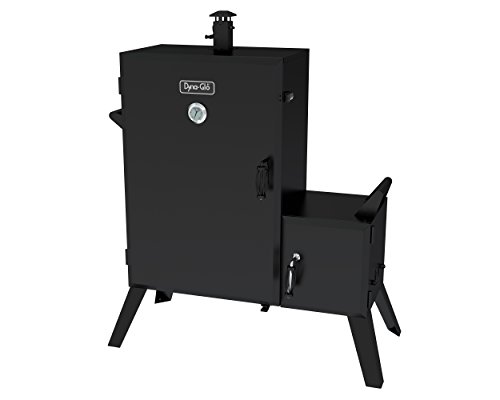
Dyna-Glo Wide Body Vertical Offset Smoker (DGO1890BDC-D) — Best Vertical Wood Smoker
Floor space is money in a commercial kitchen, and the vertical offset is the wood smoker that respects it. The Dyna-Glo Wide Body stacks its cooking chamber upward from an offset firebox, so a caterer, commissary or small smokehouse gains multi-rack smoking capacity on roughly the footprint of a single chair — while still burning real charcoal and wood with genuine offset smoke flow.
Strengths
- Vertical format delivers batch capacity per square foot that horizontal offsets cannot match
- Offset firebox gives true wood-smoke character, not cabinet-steamed flavor
- Wide-body cabinet fits larger cuts than most vertical designs
Trade-offs
- Vertical chambers stratify — top and bottom racks cook at different rates; rotation is routine
- Cabinet door seals are the wear point; keep them clean and expect to maintain them
- Not a grill: no direct-fire finishing on this unit
| Specification | Detail |
|---|---|
| Fuel | Charcoal and wood |
| Design | Wide-body vertical offset smoker |
| Model | DGO1890BDC-D (per verified listing) |
Vertical offsets suit a specific production rhythm: batch in, batch out. A commissary smoking a day’s worth of ribs, sausage and chicken in stacked loads, or a caterer prepping components ahead of events, uses the cabinet the way an oven is used — by the rack, on a schedule. The physics to respect is stratification: heat and smoke rise, so the top of the cabinet runs hotter and smokier than the bottom, and the operator’s craft is assigning products to racks by their tolerance and rotating on a timer. Put the forgiving cuts high, the delicate ones low, swap halfway, and the cabinet produces remarkably even batches. The firebox being offset rather than underneath matters for flavor — smoke is generated in a real fire and drawn through the chamber, so the product tastes smoked rather than steamed in its own drippings, which is the failure mode of cheap vertical cabinets. For a footprint-pressed operation that refuses to give up real wood flavor, this is the pragmatic answer.
Best for: Commissaries, caterers and small smokehouses that batch-smoke on a tight footprint / Not suited for: Programs centered on long whole briskets, or anyone who needs the cooker to grill as well
Check on Amazon — check the current price on Amazon, since listings and configurations change through the season.

Char-Griller Smokin Pro Charcoal Grill and Offset Smoker — Best Budget Offset
Every category needs an honest floor, and the Char-Griller Smokin Pro is this one: a barrel charcoal grill with a bolt-on side firebox that converts it into a small offset smoker, with dual damper control for managing the draw. For a pop-up operator, a micro-caterer testing whether smoked items sell, or a venue adding a weekend smoke special without committing real capital, it is the cheapest legitimate way to burn wood and learn the craft.
Strengths
- Lowest cost of entry into genuine offset smoking in this roundup
- Dual role: direct charcoal grill without the firebox, offset smoker with it
- Dual damper control gives the beginner real airflow management to learn on
Trade-offs
- Thin steel and modest seals — temperature management is hands-on and weather-sensitive
- Capacity suits pop-ups and specials, not a full barbecue menu
- Expect a shorter service life under daily commercial firing than the heavier picks
| Specification | Detail |
|---|---|
| Fuel | Charcoal and wood |
| Design | Barrel grill with side firebox offset |
| Controls | Dual damper control (per verified listing) |
Buy the Smokin Pro with clear eyes and it will not disappoint you. It is a learning instrument and a specials machine: hot-smoke a Saturday’s worth of ribs and chicken for a pop-up, run the grill side for burgers while the firebox side smokes, and discover — for very little money — whether your customers buy smoked food and whether your team enjoys producing it. Its limits are the honest physics of thin steel: heat leaks, wind pushes the temperature around, and the fire wants feeding more often than a heavy pit’s does. None of that prevents good barbecue; all of it prevents unattended barbecue. Treat it as the audition, not the career. If the smoked program proves itself, the Highland or Longhorn above is the graduation — and the Char-Griller retires gracefully to backup and event duty, which is a respectable second life for the money.
Best for: Pop-ups, micro-caterers and venues testing a smoked special before investing in a production pit / Not suited for: Daily commercial production or any operation needing stable, lightly attended long cooks
Check on Amazon — check the current price on Amazon, since listings and configurations change through the season.
Comparison Table
| Pick | Badge | Key Spec | Best For |
|---|---|---|---|
| Oklahoma Joe’s Highland Reverse Flow Offset Smoker | Best Overall | Reverse-flow offset, 1,093 sq in | Caterers and smokehouses that need even, repeatable offset cooking across a full chamber |
| Oklahoma Joe’s Longhorn Offset Charcoal Smoker | Best Traditional Offset Value | Offset, 1,060 sq in, wood/charcoal | Startup caterers, ranch and event venues, and smokehouses wanting a traditional offset without custom-pit pricing |
| Backyard Discovery Argentine Santa Maria Heritage Grill | Best Santa Maria for Restaurants | Santa Maria, adjustable grate, fire brick | Steakhouses, live-fire restaurants and venues building an open-fire grilling station |
| BIG HORN Santa Maria Grill (Large) | Best Santa Maria for Events | Large parrilla, adjustable grate | Event caterers and venues cooking large-format live-fire menus for crowds |
| Dyna-Glo Wide Body Vertical Offset Smoker (DGO1890BDC-D) | Best Vertical Wood Smoker | Vertical offset, wide body | Commissaries, caterers and small smokehouses that batch-smoke on a tight footprint |
| Char-Griller Smokin Pro Charcoal Grill and Offset Smoker | Best Budget Offset | Budget offset, side firebox | Pop-ups, micro-caterers and venues testing a smoked special before investing in a production pit |
The table hides the category’s real divide: three of these cookers smoke under a lid (the two offsets and the vertical), one is a budget version of the same idea, and two never smoke at all — the Santa Marias are open-fire grills. Programs usually need one of each kind, sequenced by budget: a chamber smoker for the low-and-slow menu, a live-fire station for the grilled menu and the theater. Buy whichever half your menu earns from first, run it until its limits show up in the logbook, and add the other half with the confidence of a program that has already proven its customers will pay for wood-fired cooking.
How to Choose Commercial Wood Smoker Grills
Decide what the fire is for. Low-and-slow smoking (brisket, pork shoulder, ribs) needs a closed chamber with controlled draw — an offset or vertical. Live-fire grilling (steaks, whole birds, vegetables over embers) needs an open Santa Maria. Confusing the two is the most expensive mistake in this category, because no accessory turns one into the other. Most serious programs eventually run both; sequence the purchase by which menu earns first.
Steel and seals decide the labor bill. Thick steel holds heat, smooths the temperature curve between fuel additions, and survives years of firing; thin steel leaks heat, swings with the weather, and works the fire hand twice as hard for the same product. You cannot inspect your way around this in a listing — but you can read the design honestly: baffle plates, gasketed doors and heavy grates are the marks of a cooker built to be run, and at commercial tempo they repay their cost in labor and fuel within a season.
Airflow design is flavor design. Traditional offsets concentrate heat near the firebox and demand rotation; reverse-flow designs spend a baffle plate to even the chamber; verticals stratify and reward rack discipline. All three produce excellent barbecue in practiced hands. Choose the airflow whose management style matches the staff you actually have — the best pit is the one your Tuesday cook can run as well as your Saturday pitmaster.
Budget the woodpile as equipment. A commercial wood program consumes seasoned splits by the cord. Before the cooker arrives, you need a supplier, a dry covered store, and a moisture meter. Price a season of wood alongside the cooker quotes; more than one program has bought a beautiful pit and then fed it green wood from a landscaper, and wondered why the brisket tasted like a campfire accident.
The Custom Fabricator Tier, in Honest Prose
Above the units in this guide sits the custom tier: fabricators who weld quarter-inch and thicker steel into offsets, rotisseries and trailer pits built to a buyer’s specification, sold direct or through dealers with lead times that can run many months. Names in this world are regional and reputation-driven, and the product is genuinely different — a custom pit holds heat like a masonry oven, cooks for decades, and becomes the physical identity of the business that owns it.
Shop that tier when volume and identity justify it: a smokehouse doing daily brisket service, a caterer whose trailer is the brand, a restaurant building its room around the pit. Shop it like a building project — visit the fabricator if you can, talk to owners running the same model at your volume, get the delivery and warranty terms in writing, and plan the site (pad, clearance, wood store) before the pit is welded, not after. The Amazon-listed cookers in this guide are how most programs start and many happily stay; the custom tier is where a proven program goes when the starter pit has earned its replacement.
How to Run a Clean Fire: Wood Smoker Technique for Commercial Cooks
Wood cooking quality is fire quality. This is the routine that separates clean smoke from dirty smoke on any offset or vertical in this guide:
- Start with a charcoal base. Light a chimney of charcoal and establish a glowing coal bed in the firebox before the first split goes on. Splits added to a strong coal bed ignite cleanly; splits asked to start a fire smolder.
- Feed small, feed on schedule. Add one split at a time, sized to the firebox, on a rhythm — typically every 30 to 45 minutes on pits of this class — rather than loading the box and walking away. Small hot fires burn clean; big smoldering fires make bitter smoke.
- Pre-warm the next split. Rest the next piece of wood on top of the firebox or at its edge so it is hot and dry when it goes in. A warmed split catches in seconds and barely dents the chamber temperature.
- Read the smoke, not just the thermometer. Clean smoke is thin and pale, almost blue, and smells sweet. Thick white or grey smoke means the fire is starved or the wood is wet — open the intake, check the coal bed, and fix the fire before you blame the cooker.
- Manage the chamber by the door discipline. Every opening dumps heat and resets the cook. Plan door openings — to wrap, spritz or rotate — in batches, work quickly, and let the pit recover fully between them.
- Rest in the pit’s afterglow only with a plan. As the fire dies, chamber temperature falls through the food-safety danger zone. Move finished product to proper holding on schedule; the pit is a cooker, not a warmer.
Building the Woodpile: Species, Seasoning and Storage
A commercial wood program should treat its woodpile with the same seriousness a kitchen treats its walk-in. Species first: build the pile around a dependable base wood — oak in most regions — that burns long, coals well and flavors neutrally, then hold smaller quantities of character woods (hickory, pecan, cherry, apple) to blend for specific proteins. Consistency matters more than connoisseurship: the brisket your regulars love was smoked over a particular fire, and wild swings in fuel are wild swings in product.
Seasoning is where programs succeed or fail quietly. Fresh-cut wood can hold half its weight in water; properly seasoned splits have dried to the point where they burn hot and clean. Buy from a supplier who splits and stacks ahead, verify deliveries with a moisture meter at the pile — not as an insult to the supplier, but as receiving inspection, the same as checking a meat delivery’s temperature — and reject or re-stack loads that arrive wet to dry further before they ever meet the firebox. Storage completes the discipline: off the ground on racks, top covered against rain, sides open to the wind, and the stack rotated so the driest wood is always the wood in reach. A pit hand who never has to fight wet wood is a pit hand whose barbecue tastes the same in March as in October, and that sameness is the entire commercial proposition.
Live-Fire Service: Running a Santa Maria Station Through a Rush
A Santa Maria station succeeds on ember logistics. The fire is not one fire but a rolling system: a generation zone where fresh splits burn down, a working bed of embers under the grate, and a reserve of coals banked at the edge. The cook’s craft is moving heat through that system so the grate never waits for fire and never sits over flame. Build the first fire at least an hour before service, deeper than you think you need — embers are the station’s inventory, and you cannot manufacture them at 7 p.m. when the tickets stack up.
During service, the grate height is the throttle and the cook’s eye is the gauge: proteins sear low over the hottest section, finish raised and toward the cooler edge, and rest furthest from the heat. Assign the fire to one person on any service beyond a handful of covers; the moment the grill cook is also the fire cook is the moment both jobs suffer. Between services, the bed is raked, ash is drawn down, and the ember bank is rebuilt rather than extinguished where the schedule allows — a station that restarts from cold every service burns twice the wood for the same menu. Run this way, a live-fire station is not a primitive ancestor of the gas line; it is a different, older technology with its own complete logic, and a restaurant that masters it owns a product and a room atmosphere its competitors cannot copy with equipment alone.
When to Graduate: Reading the Signs Your Program Needs a Bigger Pit
Starter and mid-tier pits like the ones in this guide announce their limits honestly, if you know how to listen. The first sign is scheduling: when the load plan regularly leaves proteins waiting for chamber space, or services get planned around the pit instead of the menu, capacity has become the constraint. The second sign is labor: when your best cook is spending their whole shift feeding a thin-steel fire that a heavier pit would let them check hourly, you are paying custom-pit money in wages, a month at a time. The third sign is variance — when the same recipe produces noticeably different product on windy days, cold days and humid days, the cooker’s thermal mass has become the ceiling on your consistency.
Graduation does not have to mean replacement. Many programs keep the proven starter pit for events, overflow and the theater of a visible fire, and add the heavier cooker as the production backbone. What matters is making the decision from the logbook — load plans, fuel records, labor hours — rather than from frustration after one bad service. The pits in this guide will tell you, in numbers, exactly when they have taken your program as far as they can. That is not their failure; that is their job description, completed.
Common Buying Mistakes
- Burning green or wet wood. The single most common cause of bitter commercial barbecue. Seasoned splits, verified with a moisture meter, stored dry.
- Buying a grill when the menu needs a smoker. Santa Maria grills and offset smokers are different tools; a lid is not an accessory.
- Overloading the chamber. Crowded meat steams, bark fails, and cook times stretch unpredictably. Air space is an ingredient.
- Chasing temperature with the stack. Control the fire with the intake and fuel size; a choked exhaust makes dirty smoke and soot.
- No wood supplier before the pit arrives. The cooker is half the purchase. The seasoned-wood supply chain is the other half.
- Skipping the fire hand in the budget. Wood cooking is skilled labor. If the roster cannot staff the fire, buy a different platform.
Final Recommendation
For a single wood-fired purchase that does the most commercial work, take the Oklahoma Joe’s Highland Reverse Flow — its even chamber is the closest thing to a production guarantee a stick-burner offers at this level. Traditionalists and tight budgets should take the Longhorn; footprint-pressed batch producers, the Dyna-Glo Wide Body; and anyone testing the smoked-menu waters, the Char-Griller Smokin Pro. For the live-fire half of a program, the Backyard Discovery Heritage is the restaurant-ready Santa Maria, and the BIG HORN Large is its event-scale sibling. And if your volumes have already outgrown this tier, the custom fabricators in the guide are your next conversation — that is a compliment to your program, not a criticism of these pits.
Start your shortlist there: Oklahoma Joe’s Highland Reverse Flow Offset Smoker, Oklahoma Joe’s Longhorn Offset Charcoal Smoker, Backyard Discovery Argentine Santa Maria Heritage Grill — check the current price on Amazon for each and confirm the configuration matches your site before ordering.
Keep exploring the cluster before you decide:
- Best Commercial Smoker Grills
- Best Commercial Outdoor Grills
- Best Competition Bbq Grills
- Best Compact Outdoor Grills
Frequently Asked Questions
What is the difference between a wood smoker grill and a pellet smoker?
A wood smoker grill burns actual splits or chunks of wood in a fire the cook manages by hand — deepest flavor, most labor, most skill. A pellet smoker burns compressed wood pellets fed automatically by an auger under electronic control — milder, cleaner smoke and a fraction of the labor. Both burn real wood; they differ in who tends the fire.
What wood should a commercial program burn?
Seasoned hardwoods matched to the menu: oak as the all-purpose base, hickory for stronger classic barbecue character, fruitwoods like apple and cherry for poultry and pork sweetness. Whatever the species, it must be properly seasoned and dry — moisture content matters more than species. Avoid softwoods and anything treated, painted or milled from lumber offcuts.
How much wood does a commercial offset use?
It varies with pit size, weather and cook length, but a catering-scale offset on a long brisket cook will work through a meaningful stack of splits — plan your woodpile by the cord for a season, track consumption per cook in your log for the first month, and let your own numbers, not a brochure, set the reorder point.
Can a Santa Maria grill smoke meat?
Not in the low-and-slow chamber sense — it has no lid or chamber. It grills over embers, and skilled cooks use its height adjustment and fire placement to cook larger cuts gently, but brisket-and-butts smoking belongs in an offset or cabinet. Most live-fire programs run a Santa Maria for grilling alongside a smoker for barbecue.
Is reverse flow really better than a traditional offset?
It is more even, which makes it more forgiving and more predictable across a full chamber — valuable commercially. Traditional offsets concentrate heat near the firebox, which skilled hands exploit as zones. Reverse flow is the better production tool; traditional is the better teacher and, in expert hands, just as capable.
Do wood smokers need special permits for commercial use?
Outdoor wood cooking can trigger local fire-code rules on open flame, clearances, spark control and sometimes burn bans, and your insurer will have conditions. Check with your fire marshal before the first commercial fire, keep water and an extinguisher at the station, and never leave a live fire unattended.


