Disclosure: airfryerkitchensupply.com is reader-supported. When you buy through links on our site, we may earn an affiliate commission at no extra cost to you.
Where to buy
Every chair below was verified against Amazon’s catalog data for this site, and every detail we print — positions, seat heights, weights, frame materials — comes from the manufacturer’s own listing. Beach chair listings reuse the same stock adjectives across very different chairs, so use the links to check the current price on Amazon and confirm the folded size and weight of the exact model before ordering:
- Tommy Bahama 5-Position Lay-Flat Backpack Beach Chair — Check the current price on Amazon
- Rio Brands 4-Position Lace-Up Backpack Beach Chair — Check the current price on Amazon
- Coleman Utopia Breeze Lightweight Beach Chair — Check the current price on Amazon
- Neso Beach Chairs — Lightweight Portable Foldable Recliner — Check the current price on Amazon
- Sport-Brella Beach Chair with UPF 50+ Adjustable Umbrella — Check the current price on Amazon
- Ostrich The Original Chaise Lounge — Check the current price on Amazon
Introduction
The best compactable beach chairs solve the least glamorous problem in beachgoing: the walk. Every beach day begins and ends with a carry — from car to sand, across a parking lot, down a boardwalk, sometimes up a flight of dune stairs — and the chair that wins that walk is the chair that folds genuinely small, carries on a back or a shoulder without a fight, and weighs little enough that adding a cooler and a bag does not turn the trip into a portage. “Compactable” is the search’s whole thesis: not merely foldable in the technical sense that all beach chairs fold, but compact in the packed dimensions, the carry system, and the storage footprint it leaves in a trunk, a closet, or an RV bay for the other fifty weeks of the year.
Judged that way, this category sorts itself quickly. Backpack chairs — the two leaders in this guide — fold flat and ride on your back, leaving hands for everything else. Ultralight chairs win on the scale, trading some structure for a carry you barely notice. Specialty shapes — a chair with its own shade canopy, a full-length tanning chaise — compact less elegantly but fold flatter than their size suggests, and earn their place when their specialty is your beach day. What none of them can do is cheat physics: the smaller and lighter a chair packs, the more its sitting experience is engineered around minimums, and the reviews below are honest about each chair’s sitting trade-offs as well as its carrying virtues.
Every specification printed here — the Coleman’s stated 5.3 pounds, the Rio’s 11-inch seat height and aluminum frame, the Tommy Bahama’s five positions and lay-flat design, the Ostrich’s 72-inch length — comes from the manufacturers’ verified listings. Where a listing does not state a figure, notably folded dimensions on several models, we say so and tell you to confirm it, because folded size is the one number this search cannot afford to guess.
In this guide
Quick Picks
- Best Overall: Tommy Bahama 5-Position Lay-Flat Backpack Beach Chair — the complete package: backpack carry, five positions including lay-flat, a pillow, cup holder, and storage pouch. Check on Amazon
- Best Classic Backpack Chair: Rio Brands 4-Position Lace-Up Backpack Beach Chair — an aluminum-frame original with lace-up suspension seating, an 11-inch seat height, pillow, cup holder, and pouch. Check on Amazon
- Best Lightweight: Coleman Utopia Breeze — a stated 5.3 pounds in a low, relaxed design with a mesh cup holder and seatback pocket. Check on Amazon
- Best for Small Cars and Storage: Neso Beach Chairs — a lightweight, portable, foldable recliner built around packing down for park, camping, and outdoor travel. Check on Amazon
- Best With Shade: Sport-Brella Beach Chair — a folding beach chair with its own UPF 50+ adjustable umbrella, so the shade packs with the seat. Check on Amazon
- Best for Tanning and Lounging: Ostrich The Original Chaise Lounge — a 72-inch portable reclining lounger for full-length, face-the-sun (or face-the-book) beach days. Check on Amazon
How These Picks Were Chosen
The gate was the keyword: compactability, in three measurable forms. Carry system came first — backpack straps beat hand-carry, and hand-carry beats drag-it — because the walk is where this category is won. Packed form came second: chairs that fold flat store in trunks, against closet walls, and under beds; chairs that fold into bulky cubes do not, whatever their brochures say. Weight came third, with the listing’s own figure used where stated. Every pick then had to be confirmed in Amazon’s catalog data through this site’s product verification, with the listing as the source for every printed claim — positions, seat heights, included accessories, frame materials.
Within the gate we deliberately spread the sitting experiences, because a compact chair still has to be a chair. Two backpack chairs anchor the list — the fully-featured Tommy Bahama and the aluminum-frame Rio — because for most beachgoers the backpack format is the correct default answer to this search. The Coleman represents the ultralight philosophy, the Neso the pack-small travel philosophy, the Sport-Brella the shade-integrated answer for fair skin and long days, and the Ostrich the full-length lounger for readers and tanners whose beach day is horizontal. Seat height gets attention throughout: low beach chairs (the 8.5- and 11-inch figures in these listings) are wonderful in the sand and genuinely hard to rise from for some knees and hips, and we flag that trade wherever it applies rather than letting the packed size have the only vote.
The 6 Best Compactable Beach Chairs
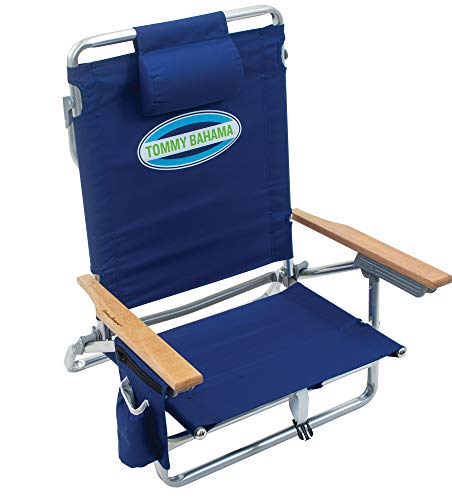
Tommy Bahama 5-Position Lay-Flat Backpack Beach Chair — Best Overall
The Tommy Bahama backpack chair is the category’s benchmark because it refuses to make you choose between carrying well and sitting well. It folds into a backpack — straps on, hands free — and opens into a five-position chair that includes a full lay-flat setting, with an 8.5-inch seat height, a pillow, a cup holder, and a storage pouch, per its listing. That is the entire beach-chair wish list in one flat package, and it is why this chair has become the default recommendation of beach rental shops and repeat buyers alike.
Strengths
- Backpack carry with a flat fold: the trunk, closet, and boardwalk all approve.
- Five positions including lay-flat — sit up for lunch, recline for the book, lie flat for the sun, in one chair.
- Pillow, cup holder, and storage pouch included: the accessories other chairs sell as a bundle are simply the chair.
Trade-offs
- The 8.5-inch seat height is properly low — glorious in the sand, a real effort to stand up from for stiff knees and hips.
- Feature-complete means more parts: more straps, zips, and joints to rinse and maintain than a minimalist chair.
- It is the popular choice at a popular tier; value hunters should compare the Rio before deciding.
Key specs (from the manufacturer’s listing): Positions: 5, including lay-flat · Seat height: 8.5 in · Carry: backpack straps · Included: pillow, cup holder, storage pouch · Color shown: Navy
What keeps this chair on top is the lay-flat position’s effect on a beach day. Most chairs recline to a nap; this one converts to a cot, which changes tanning, reading on your stomach, and the afternoon sleep from compromises into the chair’s native modes. The backpack format then erases the usual penalty for a full-featured chair — it still carries like nothing, flat against your back, with the pouch swallowing the sunscreen and paperback that otherwise need a third hand. If you buy one chair from this guide for a general beach life, buy this one, and buy it in the color your household will still be able to find in a crowded trunk in year three.
Best for: most beachgoers — walkers, readers, tanners, and families carrying for several. / Not suited for: buyers who need a higher seat for easy standing.

Rio Brands 4-Position Lace-Up Backpack Beach Chair — Best Classic Backpack Chair
Rio’s backpack chair is the original formula executed faithfully: an aluminum frame — light, and indifferent to salt air in the way steel is not — four positions, backpack straps, a pillow, a cup holder, a storage pouch, and the detail that sets it apart, lace-up suspension seating. Instead of fabric stretched drum-tight over the frame, the seat is laced, which lets it give and contour under you. Its 11-inch seat height also sits noticeably higher than the Tommy Bahama’s, a difference some legs will vote for.
Strengths
- Aluminum frame: the corrosion-sensible, weight-sensible material for a chair that lives in salt air.
- Lace-up suspension seat contours instead of hammocking or board-sitting — the comfort connoisseur’s detail.
- 11-inch seat height is easier to rise from than the lowest chairs here, while still beach-low.
Trade-offs
- Four positions and no full lay-flat: tanners wanting a true flat mode should take the Tommy Bahama.
- Lacing is a maintenance item over years — it can stretch and may need re-tensioning or replacement eventually.
- Classic styling is exactly that; buyers wanting a modern aesthetic have flashier options in this guide.
Key specs (from the manufacturer’s listing): Positions: 4 · Seat height: 11 in · Frame: aluminum · Seat: lace-up suspension · Carry: backpack · Included: pillow, cup holder, storage pouch
The Rio is the pick for buyers who sit for a long time. Beach sitting is measured in chapters and innings, and a suspension seat that distributes weight the way a good camp chair does will out-comfort a flat fabric seat across a six-hour day, every time. The aluminum frame is the other long-game virtue: beach chairs die of rust at the joints more than of any other cause, and aluminum simply declines to participate in that failure mode. Choose the Rio when your beach days are long, your walk is moderate, and your priorities run comfort-per-hour over positions-per-chair.
Best for: long-sit beachgoers, salt-air regulars, and anyone preferring a slightly higher seat. / Not suited for: buyers who require a lay-flat position.

Coleman Utopia Breeze Lightweight Beach Chair — Best Lightweight
The Utopia Breeze makes its case on the scale: 5.3 pounds, stated in Coleman’s listing, in a low design built for leg comfort, with a relaxed back rest, a mesh cup holder, and a seatback pocket. Five pounds is the weight class where a chair stops being cargo and becomes clothing — the thing you grab without a decision, carry a mile without a story, and hang on a garage hook without a shelf. For beachgoers whose walk is long or whose crew is large, that number is the review.
Strengths
- A stated 5.3 pounds — the lightest carry in this guide, from a brand that knows outdoor gear.
- Low design with a relaxed back rest, shaped for the classic legs-out beach sprawl.
- Mesh cup holder drains instead of pooling, and the seatback pocket keeps the small things off the sand.
Trade-offs
- Lightweight construction is minimalist construction: fewer positions and less structure than the backpack chairs.
- Hand-carried rather than backpack-carried, so it occupies a hand the backpack chairs leave free.
- Low seat, same caveat as the class: rising takes effort for some users.
Key specs (from the manufacturer’s listing): Weight: 5.3 lb · Design: low profile, relaxed back rest · Included: mesh cup holder, seatback pocket
Every household with a beach habit eventually discovers that chair math is person math: four chairs for a family, plus cooler, plus bag, plus umbrella, is a logistics exercise, and the Utopia Breeze is the chair that makes the arithmetic kind. At 5.3 pounds, one adult can carry two and still hold a child’s hand. It is also the natural second chair — the one bought for guests, teenagers, and the spontaneous extra beach day — because its storage ask is a hook and its carry ask is nothing. What it gives up in positions and plushness it repays every single trip, at the exact moment of the walk.
Best for: long walks, families carrying multiple chairs, and minimalists. / Not suited for: buyers wanting multiple recline positions or backpack carry.

Neso Beach Chairs — Best for Small Cars and Storage
Neso built its name on beach gear that packs down — its tents are famous for fitting in a carry bag — and its beach chair applies the same philosophy: a lightweight, portable, foldable recliner positioned by its listing for park, camping, and outdoor adventures as much as for the beach. That travel-first design brief is what this slot honors: the Neso is the chair for the hatchback trunk, the apartment closet, the RV bay, and the beach house whose storage is a rumor.
Strengths
- Pack-down design philosophy from a brand whose reputation is compact beach gear.
- Recliner function in a travel format — the chair does not ask you to sit bolt upright for your portability.
- Beach, park, and camping versatility: one chair serving the whole outdoor calendar stores better than three specialists.
Trade-offs
- The verified listing states no weight or folded dimensions, so confirm both on the listing before counting on a specific trunk fit.
- Travel-format chairs trade some sitting structure for their packed size; long-day sitters may prefer the Rio’s suspension seat.
- Feature list is leaner than the backpack chairs — no pillow-and-pouch bundle is claimed in the listing.
Key specs (from the manufacturer’s listing): Format: lightweight portable foldable recliner · Positioning: beach, park, camping, outdoor · Weight/folded size: not stated in the listing
The Neso’s buyer knows their constraint precisely, and it is not the sitting — it is the storage. City beachgoers, small-car owners, and anyone whose beach gear lives in a hall closet between trips will recognize the problem this chair solves: the best chair is the one that fits the life around the beach. Its recliner function keeps it honest as furniture rather than emergency seating, and its multi-setting positioning means it earns its storage the rest of the year at parks and campsites. Confirm the folded figure on the listing, measure your space, and if the two agree, this is your chair.
Best for: small cars, apartments, RVs, and multi-use outdoor gear kits. / Not suited for: buyers who need stated specifications before purchase or maximum sitting structure.

Sport-Brella Beach Chair with UPF 50+ Adjustable Umbrella — Best With Shade
Sport-Brella’s answer to compactability is integration: instead of a chair plus a separate umbrella — two carries, two setups, one inevitable forgotten item — the shade is part of the chair, an adjustable umbrella rated UPF 50+ by its listing. For fair-skinned beachgoers, parents parking a chair for a long tournament day, and anyone whose dermatologist has opinions, a chair that brings its own shade collapses two packing problems into one folded package.
Strengths
- Integrated UPF 50+ adjustable umbrella: shade that cannot be left in the garage, aimed where you sit.
- One folded unit replaces chair-plus-umbrella logistics — the compactability of a system, not just a seat.
- Adjustability lets the shade track the sun instead of committing you to a morning or afternoon side.
Trade-offs
- An integrated umbrella shades one chair; groups still need a main umbrella for shared space and gear.
- More mechanism means more setup and more to rinse; the umbrella joint is a moving part in a sandy world.
- Wind is the enemy of all shade; on gusty days any umbrella, attached or not, becomes a sail to manage.
Key specs (from the manufacturer’s listing): Shade: integrated adjustable umbrella, UPF 50+ · Format: folding beach chair with attached canopy · Color shown: Midnight Blue
Think of the Sport-Brella chair as personal shade infrastructure. The beach umbrella shades a territory; this shades a person, precisely, all day, including the sideline, the fishing pier, and the solo morning beach where a full umbrella is absurd. Its compactability argument is systemic: one item on the packing list, one item in the trunk, one item on the walk. For the solo reader, the sideline parent, and the medically shade-serious, that integration is worth more than any single sitting feature in this guide.
Best for: solo beachgoers, fair skin, sideline parents, and long stationary days. / Not suited for: groups needing shared shade or buyers wanting the simplest possible chair.

Ostrich The Original Chaise Lounge — Best for Tanning and Lounging
The Ostrich chaise is the specialist’s specialist: a 72-inch-long portable reclining lounger, in a category the brand essentially owns, designed for the full-length beach day — tanning, reading lying down, and the serious afternoon nap. Seventy-two inches is adult height, which is the point: this is not a chair you perch on but a bed you unfold, and remarkably for its size, it folds into the flat, carryable form this search demands.
Strengths
- Full 72-inch length: true head-to-toe lounging that no standard beach chair offers.
- Reclining lounger format built for prone and supine sun time — the tanner’s and reader’s native postures.
- Folds flat and portable despite its size; a lounger that still respects the walk and the trunk.
Trade-offs
- It is a lounger, not a chair: upright social sitting, eating, and card games are awkward on it.
- The largest packed footprint here even folded — compact for a chaise is not compact for a chair.
- Ground-level lounging is the hardest format to get up from; mobility-limited users should choose a higher seat.
Key specs (from the manufacturer’s listing): Length: 72 in · Width: 22 in · Format: portable reclining chaise lounger · Positioning: pool and beach tanning chair · Color shown: Blue
The Ostrich exists because a real constituency spends its beach day horizontal, and for them every chair in this guide is a compromise with armrests. The chaise format lets you tan the back without a towel on bare sand, read a novel at full stretch, and nap at a length your spine recognizes. Its presence in a compactability guide is earned by its fold: a 72-inch lounger that packs flat enough to slide into a trunk alongside everything else is an engineering courtesy. Buy it as your specialist instrument — most owners pair it with a standard chair for upright hours — and it will be the most-loved object in the beach kit.
Best for: tanners, prone readers, and dedicated loungers. / Not suited for: upright social sitting, small trunks already at capacity, or anyone who struggles to rise from ground level.
Comparison Table
| Pick | Badge | Key spec | Best for |
|---|---|---|---|
| Tommy Bahama Backpack Chair | Best Overall | 5 positions incl. lay-flat, backpack carry, 8.5 in seat | Most beachgoers |
| Rio Backpack Chair | Best Classic Backpack Chair | Aluminum frame, lace-up seat, 11 in seat height | Long sitting days |
| Coleman Utopia Breeze | Best Lightweight | 5.3 lb, low relaxed design | Long walks, families |
| Neso Beach Chair | Best for Small Cars and Storage | Pack-down foldable recliner | Apartments, RVs, travel |
| Sport-Brella Chair | Best With Shade | Integrated UPF 50+ adjustable umbrella | Solo shade, sidelines |
| Ostrich Chaise Lounge | Best for Tanning and Lounging | 72 in full-length reclining lounger | Tanners, prone readers |
How to Choose a Compactable Beach Chair
Start with the carry, because it is the feature you use twice every trip and the sitting only in between. If your walk exceeds a few hundred yards, backpack carry — the Tommy Bahama and Rio format — is the single highest-value feature in this category: it moves the load to your strongest axis and frees both hands for the cooler, the bag, and the child. If your walk is short but your crew is large, raw weight rules instead, and the Coleman’s stated 5.3 pounds lets one person move a family’s worth of chairs. If your constraint is not the walk but the storage — the trunk, the closet, the RV bay — measure that space and shop folded dimensions, confirming them on the listing where, as with the Neso, the figure is not printed in our verified data.
Then choose your sitting honestly. Count the positions you will actually use: most beachgoers use two (upright and reclined), readers and tanners genuinely use the lay-flat, and nobody uses a position a chair does not have on the day they want it. Weigh seat height against your knees: the 8.5-inch Tommy Bahama and other low chairs put you in the sand’s social layer and make standing an exercise, while the Rio’s 11 inches is the kinder compromise — and a chair you cannot rise from gracefully is a chair that stops being invited. Consider shade as a system: an integrated UPF 50+ umbrella like the Sport-Brella’s covers one person perfectly, while groups should treat it as a supplement to a main umbrella, not a replacement.
Finally, buy for the second season, not the first afternoon. Aluminum frames shrug off salt air that rusts steel at the hinges; fabrics that rinse clean and dry fast survive the trunk-forgotten weekend that mildews lesser chairs; and a chair whose accessories are integrated — pillows, pouches, cup holders — has fewer separate pieces to lose. The compact chair that wins is not the one with the smallest folded number on a spec sheet; it is the one whose folded size, carry, and sitting all fit the same life, yours, for years of walks it makes shorter.
How to Pack, Carry, and Store Beach Chairs So They Last
The routine starts at the beach, not at home: shake the sand out before folding, because sand in the hinges is grinding paste, and a chair folded full of beach carries the beach into your trunk and its joints into early retirement. Rinse chairs with fresh water after salt days — especially frames, joints, and any umbrella mechanism — and let them dry fully before storage; a chair put away damp is a chair being seasoned for mildew. At home, store folded chairs upright against a wall or hung on hooks rather than stacked under weight, which bends frames and creases fabric at the fold lines season after season.
For the carry itself, load like a backpacker: chairs on backs first, cooler balanced between two people or on a wide-wheel cart for long sand walks, and the soft bag last and lightest. In the car, flat-folded chairs slide under or over the flat cargo, never beneath the cooler, whose condensation and weight conspire against fabric and frame alike. Once a season, do the two-minute maintenance that doubles a chair’s life: check the hinge bolts, work the recline mechanism through its positions, inspect straps and lacing for fray, and touch any steel hardware with a rust check. Compact chairs live hard, folded lives; a little ritual is the difference between a five-season chair and a one-summer story.
Seat Height, Mobility, and the Standing-Up Test
Every compact chair in this guide sits low, because low is what beach chairs are — but “low” spans a range with real consequences, and this section exists so the consequence is chosen rather than discovered. At the bottom of the range, the Tommy Bahama’s 8.5-inch seat is essentially organized sitting on the sand: superb for the young, the flexible, and the committed sprawler, and a genuine obstacle for anyone with replaced knees, a healing hip, or a toddler to lift while rising. The Rio’s 11 inches does not sound like much of a difference and behaves like one — those extra inches are where leverage lives. Ground-level formats like the Ostrich chaise are the extreme case, wonderful once you are down and honest work to leave.
The standing-up test takes ten seconds at home and predicts years of beach satisfaction: sit on a step or a sturdy box at the height of the chair you are considering, holding a book and a drink, and stand up the way you would on sand, without a table to push on. If it is easy, buy freely. If it is a production, move up the height range, consider chairs with arms positioned for pushing (and test those the same way), or assign the low chairs to the party’s flexible members and keep a higher seat for yourself. There is no dignity lost in this arithmetic — only beach days gained. The best compactable chair is the one you can still enjoy at hour six, and hour six is measured from the seat, not the trunk.
One Chair or a System? Building the Beach Kit Around the Chair
A compact chair rarely travels alone, and the kit around it decides whether the chair’s compactness pays off. The system thinkers in this category plan in layers: shade, seat, carry, and cargo. Shade is either personal (the Sport-Brella’s integrated umbrella, one per seated person) or territorial (a single larger umbrella or canopy over the group’s center), and most families run both — territory for the cooler and the children, personal for the reader at the edge. Carry is where the kit is won: backpack chairs move the seats to backs, which frees the wheeled cart for everything else, and a wide-wheel cart is the difference between sand being a surface and sand being an argument. Cargo discipline completes the system: one bag, packed the same way every time, with the towels that double as the chair-side tablecloth and the dry bag that keeps phones out of the splash zone.
The compactability dividend compounds across the system. Flat-folding chairs stack in the trunk in the space one old tube-frame chair used to occupy, which is what makes room for the cart, which is what makes the walk pleasant, which is what makes the spontaneous Tuesday beach trip happen at all. This is the unglamorous truth under this search: people do not skip beach days because the beach disappoints them; they skip because the logistics do. Every inch and pound the kit sheds is a trip taken instead of deferred — and that, more than any position count or pouch, is what the six chairs in this guide are actually selling.
Beach Chairs for Groups: Families, Rentals, and the Loaner Fleet
Buying for a group changes the optimization, and this guide’s picks re-sort themselves when the quantity is four or six rather than one. The family fleet wants uniformity and lightness above features: chairs that stack or fold identically, light enough for the strongest adult to carry two and the oldest child to carry one, and cheap enough in spirit that a lost or broken chair is an annoyance rather than an incident. That is the Coleman’s fleet case and, at a higher feature level, the Tommy Bahama’s — a row of identical backpack chairs on a family’s backs is a genuinely beautiful logistics sight. The rental and beach-house fleet wants durability and theft-indifference: aluminum frames that ignore salt, fabrics that hose clean, and nothing so precious that a renter’s sunscreen experiment matters.
The loaner principle governs both: in any fleet, one chair should be the designated guest chair — the highest seat, the easiest rise, the one offered to grandparents and visitors without discussion. Groups that plan this chair in advance avoid the small daily negotiation that otherwise opens every beach morning. And fleets should be bought in one order where possible, because beach chair models revise quietly between seasons — colors shift, pouches move, a position disappears — and a matched set bought together stays matched, stacks together, and confuses no one at the trunk. The single buyer optimizes a chair; the group buyer optimizes a system, and the six picks in this guide were chosen to work as both.
Materials and Longevity: What Five Seasons at the Beach Do to a Chair
A beach chair’s enemies are salt, ultraviolet light, and sand in the joints, and the materials in this guide were chosen with those enemies named. Aluminum frames, like the Rio’s, answer salt directly — the metal’s oxide layer protects it, which is why marine hardware trusts it — while steel frames survive on coatings that sand eventually breaches at the hinges. Fabrics face the ultraviolet: solution-dyed and tightly woven polyester canvases fade gracefully and keep their strength, while tired fabric announces itself by chalking and tearing at the fold lines first. The moving parts — recline mechanisms, umbrella joints, backpack strap hardware — are where seasons accumulate, and they reward the rinse-and-dry ritual from the care section more than any purchase decision.
Set expectations by the calendar and the calendar will not disappoint you. A chair used twenty beach days a year and rinsed after each is a five-season chair in this guide’s class; the same chair left sandy in a hot trunk is a two-season chair with the same label. The difference is not the product — it is the two minutes at the hose, repeated. Buyers who internalize that arithmetic stop shopping for immortal chairs and start owning durable ones, which is the only version of the wish the beach actually grants.
Common Buying Mistakes
Buying for the sand and forgetting the walk. A chair’s best hour is on the beach, but its worst ten minutes are the carry — and the carry happens twice a day, every day. Weight, folded shape, and carry system deserve veto power over any sitting feature.
Ignoring seat height. Low chairs look right and sit low — very low. If rising from 8.5 inches is a project for anyone in your party, choose the higher seats here and let the tanning chairs go.
Assuming “foldable” means compact. Everything folds; not everything packs. A chair that folds into a bulky cube eats the trunk the keyword promised to save. Check folded dimensions — on the listing, where this guide’s data did not state them — before the first trip reveals them.
Counting positions instead of using them. Five positions impress; two get used. Pay for the positions your beach day actually contains — and if lay-flat is one of them, the Tommy Bahama is the honest way to buy it.
Skipping the rinse. Salt and sand are a chair’s entire enemies list. The two-minute rinse-and-dry habit is the difference between the chair in this guide lasting five seasons and its replacement being bought in two.
Final Recommendation
For most beachgoers, the Tommy Bahama Backpack Chair is the complete answer: it carries on your back, sits in five positions, lies flat, and packs its own accessories. Long-sit traditionalists should take the Rio’s aluminum frame and suspension seat; long-walk households should take the 5.3-pound Coleman; small-space households should take the pack-down Neso; shade-serious soloists should take the Sport-Brella; and horizontal beachgoers should take the Ostrich chaise and never apologize. Choose by your walk, your storage, and your sitting style — in that order — and the chair will disappear into your beach day exactly as a compact chair should. That disappearance is the real product: a chair so easy to bring that it is simply always there, folded in the trunk when the afternoon opens up, on your back when the good spot is far down the beach, and against the closet wall when winter comes, taking up nothing but the promise of the next trip. Buy the chair that disappears, and the beach will take care of the rest — the tide, the light, the long afternoon, and the walk back at dusk with the chair riding light on your back and the day riding lighter still. That is the whole promise of a compactable chair, kept one trip at a time, and every pick in this guide was chosen to keep it in a different, honest way — by backpack, by featherweight frame, by pack-down fold, by borrowed shade, or by a lounger’s flat fold. The sand is waiting either way; the only question this purchase ever really answers is how little the getting there will cost you, in hands, in pounds, and in the space the season leaves behind in your trunk, your closet, and your plans for next weekend and every weekend after.
Related guides in this series: Best Fold Up Beach Chairs, Best Large Beach Towels, Best High Quality Beach Towels, Best Thin Beach Towels, and Best Lightweight Travel Towels.
Related guides
Frequently Asked Questions
What does “compactable” mean for a beach chair?
It means the chair is designed around its packed state, not merely capable of folding: a flat or small folded form, a carry system such as backpack straps or a light hand-carry, and a weight that makes the packed chair easy to move and store. All beach chairs fold; compactable chairs fold small, carry well, and store in the leftover spaces of a car and a home. Judge the three together — folded size, carry, and weight — rather than any one figure.
Are backpack beach chairs worth it?
For any walk longer than a parking lot, emphatically yes. Backpack carry moves the chair’s weight onto your back, frees both hands for coolers, bags, and children, and makes stairs and boardwalks trivial. The two backpack chairs in this guide — the Tommy Bahama and the Rio — are its top two picks for exactly this reason. If your beach access is a few steps from the car, the advantage shrinks and a lighter hand-carried chair like the Coleman competes on simplicity.
How low is too low for a beach chair seat?
Standard beach chairs sit between roughly 8 and 12 inches. The 8.5-inch seat in this guide is a true sand-sitting height — wonderful for the legs-out sprawl, genuinely difficult for anyone with knee, hip, or mobility limitations to rise from. The Rio’s 11-inch seat is the kinder middle. When in doubt, have the least flexible member of your party test the height logic at home with a step of similar height before ordering a fleet.
Can a compact chair still be comfortable for a full day?
Yes, if its comfort engineering survived the shrinking. The Rio’s lace-up suspension seat and the Tommy Bahama’s pillow and multi-position back are full-day features in flat-packing chairs; the trade appears instead in minimal chairs like the ultralight Coleman, which exchanges structure for its 5.3 pounds. Match the chair to your day length: two-hour visits forgive minimalism that six-hour sits do not.
How do I stop my beach chair from rusting?
Choose corrosion-resistant construction where you can — the Rio’s aluminum frame is the example in this guide — and then keep the habit that matters more than material: rinse with fresh water after salt exposure, dry fully before storage, and store indoors or under cover. Hinges and hardware are where rust starts, so they deserve the rinse most. A chair treated this way measures its life in many seasons; one left sandy and damp in a trunk measures it in summers.
How much weight can these compact chairs hold?
Weight capacity is a figure this guide deliberately does not print, because the verified listing data for these six models did not state capacities — and a guessed capacity is a safety figure invented, which we will not do. The correct procedure is on the listing itself: every reputable beach chair publishes a rated capacity on its product page or packaging, and you should match that rating to the largest person who will use the chair, with margin. As a class, compact and backpack chairs trade some capacity for their packed size, and full-frame chairs rate higher; if capacity is your deciding figure, let the manufacturer’s stated number — not any guide’s silence, including ours — make the decision.
Is a chair with an attached umbrella better than a separate umbrella?
For one person, often yes: the Sport-Brella’s integrated UPF 50+ umbrella shades exactly where you sit, adjusts with the sun, and can never be forgotten separately — and it folds into the same single package, which is this search’s whole point. For groups, it supplements rather than replaces a main umbrella, which shades shared space, coolers, and the people between chairs. Many households end up with both, each doing the job it is sized for.


