Disclosure: airfryerkitchensupply.com is reader-supported. When you buy through links on our site, we may earn an affiliate commission at no extra cost to you.
Where to Buy
Every linked model in this guide to the best commercial rice japanese cookers was checked against its live Amazon listing before this guide was written. The keyword points at a specific class: large-capacity commercial rice cookers in the Japanese tradition — machines built for restaurants, sushi bars, cafeterias and caterers, where rice is cooked by the tens of cups and held at serving temperature for hours. One pick is not linked, and its review explains why.
- Panasonic Commercial Electric Rice Cooker SR-GA541FH (60-Cup Cooked) — Best Overall — Check the current price on Amazon
- Panasonic Commercial Rice Cooker and Warmer SR-GA541H (NSF) — Best for Foodservice Compliance — Check the current price on Amazon
- Panasonic Commercial Electric Rice Cooker SR-GA721L (80-Cup Cooked) — Best High Volume — Check the current price on Amazon
- Panasonic SR-42HZP Rice Cooker/Steamer (23-Cup Uncooked) — Best Classic Mid-Size — Check the current price on Amazon
- Aroma Housewares Commercial Rice Cooker ARC-1033E (60-Cup Cooked) — Best Value — Check the current price on Amazon
- Zojirushi Commercial Rice Cooker (NYC-36 class) — Best Japanese Premium — Unlinked pick — Unlinked pick — see the note in its review below.
Commercial rice cookers are sold in cooked and uncooked cup figures that differ by a factor of two, and one pick here runs on 208V rather than household voltage, so confirm capacity and voltage on the product page before ordering. If a pick is unavailable, the buying guide below explains how to read commercial rice cooker listings like a foodservice buyer.
The best commercial rice japanese cookers come from a food culture that treats rice as infrastructure. In a Japanese restaurant, rice is not a side dish that gets cooked when someone remembers; it is produced in volume, held perfectly for an entire service, and judged by regulars who can tell a tired batch from a fresh one. The commercial cookers built for that standard — overwhelmingly from Panasonic in the North American market, with Zojirushi and Tiger serving the same trade — are different machines from the fuzzy-logic countertop cookers in home kitchens: bigger, simpler, tougher, and designed around one job done at scale.
Scale is the first thing to get right, because this category measures it confusingly. Capacities are quoted in cups of cooked rice or cups of uncooked rice, and the cooked figure is roughly double the uncooked one. The verified picks here run from a 23-cup uncooked classic to an 80-cup cooked flagship. In restaurant terms, the 60-cup cooked class — three of the six picks live there — is the standard line cooker: enough for a lunch service’s rolling demand, small enough to sit on a prep counter.
Five of the six picks were verified against their Amazon listings during this guide’s research, ASINs taken from the listing responses. The sixth — Zojirushi’s commercial line — is included as a pick without a link because repeated API verification attempts during the research window were interrupted by connection failures, and this program does not publish links it has not verified. That is stated openly in its review, the same standard applied wherever verification could not be completed.
What this category is not: these are cook-and-hold production machines, not precision home cookers. They do not have induction heating, pressure cooking or a dozen grain programs, because a line cook does not need them — they need a full batch, perfectly held, an hour after an hour. Buyers shopping for home rice perfection belong in a different guide; buyers feeding a dining room belong in this one.
In this guide
Quick Picks
Six commercial rice cookers in the Japanese tradition — five listing-verified with links, one unlinked with the reason stated. Badges match the detailed reviews.
- Panasonic Commercial Electric Rice Cooker SR-GA541FH (60-Cup Cooked) — Best Overall: the standard line cooker — 60 cups cooked from 30 cups uncooked, one-touch operation, on ordinary 120V power. — check price on Amazon
- Panasonic Commercial Rice Cooker and Warmer SR-GA541H (NSF) — Best for Foodservice Compliance: the NSF-listed member of Panasonic’s commercial line — a 30-cup class cooker and warmer built for inspected kitchens. — check price on Amazon
- Panasonic Commercial Electric Rice Cooker SR-GA721L (80-Cup Cooked) — Best High Volume: the flagship batch — 80 cups cooked from 40 cups uncooked, one-touch, on 208V commercial power. Read the voltage twice before you fall in love. — check price on Amazon
- Panasonic SR-42HZP Rice Cooker/Steamer (23-Cup Uncooked) — Best Classic Mid-Size: the long-running 23-cup uncooked workhorse — roughly 46 cups cooked per batch, in the size class that built Panasonic’s commercial reputation. — check price on Amazon
- Aroma Housewares Commercial Rice Cooker ARC-1033E (60-Cup Cooked) — Best Value: the same 60-cup cooked class as the Panasonic flagship pick, from Aroma — the value route into commercial volume. — check price on Amazon
- Zojirushi Commercial Rice Cooker (NYC-36 class) — Best Japanese Premium — Unlinked pick: Zojirushi’s commercial line is the premium Japanese name in this category — included without a link because API verification could not be completed during this guide’s research window.
How These Picks Were Chosen
Verification followed the program standard: each model was searched by brand and model through the airfryerkitchensupply.com Amazon listing data connection, the Amazon title returned by the listing was matched against the intended product, and the ASIN was taken from the listing response. Five picks passed and carry links.
Selection filtered on commercial reality: capacities in the genuine production class, cook-and-hold designs rather than home fuzzy-logic machines, and representation of the category’s real structure — Panasonic’s commercial fleet in its main sizes and voltages, the value challenger, and the premium Japanese alternative in prose. Home-size Japanese cookers, however excellent, were excluded: a 3-cup Zojirushi is a wonderful machine and a dishonest answer to this search.
The 6 Best Commercial Rice Japanese Cookers, Reviewed
Each review states capacity in both cooked and uncooked terms where the listing allows, and flags voltage wherever it appears — the two facts that decide commercial rice purchases. Prices are not printed; check the current price on Amazon through the links on the verified picks.

Panasonic Commercial Electric Rice Cooker SR-GA541FH (60-Cup Cooked) — Best Overall
The SR-GA541FH is the commercial rice cooker most North American restaurants actually need, in the size most of them need it. Sixty cups of cooked rice per batch covers a serious service; one-touch operation means any staff member runs it identically; and it does all of that on standard 120V power, which means it plugs into an ordinary outlet in an ordinary kitchen without an electrician. In a category full of asterisks, the absence of asterisks is the headline.
| Capacity | 60-cup cooked / 30-cup uncooked |
|---|---|
| Power | 120V per listing |
| Operation | One-touch |
| Model | SR-GA541FH |
Strengths
- 60-cup cooked capacity is the proven restaurant line size
- Runs on standard 120V — no special circuit required
- One-touch operation: consistent results regardless of which staff member cooks
Trade-offs
- Commercial simplicity: no fuzzy logic, no grain programs, no timer theater
- A full batch is a lot of rice to hold well — small operations should size down
- Pan and lid parts are commercial consumables; budget for eventual replacements
The one-touch design is a philosophy worth understanding, because it is the opposite of the home rice cooker market’s direction. A commercial cooker’s job is repeatability under staffing reality: the rice must come out the same at lunch and dinner, cooked by whoever is on shift. Panasonic’s commercial design removes the variables — fill to the line, close, press, and the machine manages the cook and the hold. Restaurants do not buy features; they buy the absence of decisions, and this machine is that absence, engineered.
The 120V specification deserves its own emphasis because the next pick up the size ladder gives it up. Kitchens fall in love with capacity and discover voltage at installation. This model’s combination — the full 60-cup class on household-standard power — is precisely why it, and not its bigger sibling, is the overall pick for the majority of buyers reading a guide like this one.
Best for: restaurants, sushi bars, cafeterias and caterers needing the standard 60-cup class on normal power / Not suited for: home cooks wanting precision programs, or tiny operations that will hold small batches for hours
Check the current price on Amazon

Panasonic Commercial Rice Cooker and Warmer SR-GA541H (NSF) — Best for Foodservice Compliance
The SR-GA541H’s badge rests on three letters: NSF. Commercial kitchens operate under health inspection, and equipment sanitation standards are not a preference but a license condition. This Panasonic is the member of the commercial line whose listing carries the NSF designation, in a 30-cup class size that suits smaller restaurants, food trucks and institutional kitchens whose volume is real but not enormous. It cooks and warms in the same pot, like the rest of the line.
| Capacity | 30 cup class per listing |
|---|---|
| Certification | NSF per listing |
| Function | Cooker and warmer |
| Model | SR-GA541H |
Strengths
- NSF designation matters in inspected, licensed kitchens
- 30-cup class suits smaller operations that would waste a 60-cup batch
- Cook-and-warm in one unit — no separate warmer on the line
Trade-offs
- Smaller capacity: high-volume services will outrun it
- Confirm the exact certification scope on the listing against your local code before buying
- Commercial plainness throughout: function over finish
Buyers outside foodservice often skip past certifications as bureaucracy; buyers inside it know better. An inspector who questions an unlisted cooker can cost a kitchen its day, and a listed cooker ends the conversation before it starts. If your operation is licensed — or plans to be — the NSF line in this listing is not a detail. It is the product. Home and prosumer buyers can safely ignore this pick and take the better value elsewhere in the guide.
The 30-cup class also deserves respect as a size. Rice held too long degrades, and rice cooked in small, fresh batches beats rice held from a giant morning batch by the evening service. A smaller operation running this cooker twice produces better rice across the day than the same operation stretching one 60-cup batch — a quality argument for sizing down that the buying guide returns to, because it is the most common sizing error in the category.
Best for: licensed restaurants, food trucks and institutions needing listed equipment at moderate volume / Not suited for: high-volume operations, or unlicensed buyers paying for compliance they do not need
Check the current price on Amazon

Panasonic Commercial Electric Rice Cooker SR-GA721L (80-Cup Cooked) — Best High Volume
The SR-GA721L is the biggest verified cooker in this guide: eighty cups of cooked rice per batch, forty uncooked, with the same one-touch discipline as its siblings. It exists for banquet halls, large cafeterias, commissaries and high-volume restaurants where rice moves by the hotel pan. And it carries the most important specification warning in this entire article, printed in its own listing title: 208V. This is commercial power, and it decides who can buy this machine before any other feature gets a vote.
| Capacity | 80-cup cooked / 40-cup uncooked |
|---|---|
| Power | 208V per listing |
| Operation | One-touch |
| Model | SR-GA721L |
Strengths
- 80-cup cooked batches serve banquet and commissary volume
- One-touch consistency at production scale
- Panasonic commercial build and support behind the flagship size
Trade-offs
- 208V power excludes most homes and many small kitchens outright
- A full batch is heavy and a serious commitment of rice, water and counter
- Holding quality still has limits — even 80-cup demand should be batched across a long service
Voltage is the graveyard of commercial equipment purchases, so let this pick’s review serve as the guide’s standing warning: commercial appliances come in voltages that ordinary outlets do not supply, and the time to discover that is on the listing, not at installation. If your kitchen has 208V service — most true commercial kitchens do — this cooker is the natural flagship. If it does not, the 120V SR-GA541FH above is not a lesser machine; it is the same idea at the size your building can feed.
At this scale the operational question becomes batch rhythm. Eighty cups is a mountain of rice, and even excellent holding has a horizon beyond which texture and aroma fade. High-volume kitchens run the big cooker as the base load and refresh with smaller batches — which is why this pick and the 30-cup NSF model are complements in real kitchens rather than rivals. Buy the flagship for the peak you actually hit, and let rhythm, not hope, cover the rest of the day.
Best for: banquet halls, commissaries and high-volume restaurants with 208V service / Not suited for: any buyer on standard household power — check your voltage first
Check the current price on Amazon

Panasonic SR-42HZP Rice Cooker/Steamer (23-Cup Uncooked) — Best Classic Mid-Size
The SR-42HZP is the veteran of this guide: a 23-cup uncooked commercial cooker — on the order of 46 cups cooked — that has been a fixture of Asian restaurants and institutional kitchens for years. Its formula is the category’s classic one: a big pot, a simple cook cycle, a keep-warm hold and a steamer function, in a body built to be used daily and cleaned nightly. Not every buyer needs the 60-cup class; this is the size that raised a generation of line cooks.
| Capacity | 23-cup uncooked (about 46-cup cooked) |
|---|---|
| Function | Rice cooker / steamer |
| Finish | Silver |
| Model | SR-42HZP |
Strengths
- Proven, long-running commercial design with a deep user base
- Mid-large capacity fits restaurants that outgrew home cookers but not yet the 60-cup class
- Steamer function adds a second job to the same footprint
Trade-offs
- Older design language: expect utility, not interface polish
- Capacity sits between classes — confirm it against your service math before buying
- Like all cook-and-hold machines, it will not match a fuzzy-logic home cooker for small-batch perfection
There is a particular confidence in buying the model a thousand kitchens already run. Its failure modes are known, its parts exist, its behavior with a full load of short-grain rice at altitude has been discovered by someone before you. Commercial buyers pay for that knowledge whether they itemize it or not, and the SR-42HZP carries more of it than any other pick here. Newer is not a synonym for better in production equipment; proven is its own feature.
The steamer designation is worth a practical note: at commercial scale, the same pot that cooks the rice can steam vegetables and proteins in the cycle’s heat, which small kitchens use to stretch one appliance across two menu jobs. It will not replace a dedicated steamer for volume, but as a second talent in a machine already earning its counter space, it is genuinely used rather than merely listed.
Best for: established restaurants and institutions wanting the proven mid-large commercial size / Not suited for: buyers needing the full 60-cup class, or home cooks chasing precision features
Check the current price on Amazon
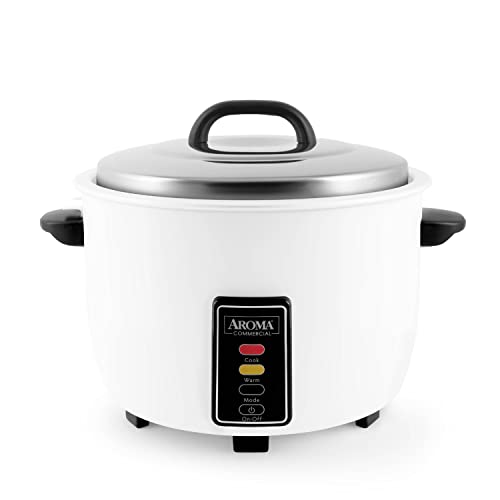
Aroma Housewares Commercial Rice Cooker ARC-1033E (60-Cup Cooked) — Best Value
The Aroma ARC-1033E is the honest value answer in the commercial class: sixty cups of cooked rice per batch — the same headline capacity as the Panasonic overall pick — from the American brand that has made a franchise of undercutting the Japanese majors on price. It is included in a guide about Japanese commercial cookers with its nationality stated plainly, because for budget-bound operations it is the machine the Panasonic gets compared against, and pretending otherwise would not serve the buyer.
| Capacity | 60-cup cooked / 30-cup uncooked |
|---|---|
| Class | Commercial rice cooker |
| Model | ARC-1033E |
Strengths
- Full 60-cup cooked commercial capacity at the value end of the class
- Simple commercial operation in the same cook-and-hold pattern
- Aroma’s US presence makes support and replacement straightforward
Trade-offs
- Not a Japanese maker — buyers specifically loyal to Panasonic or Zojirushi should buy those
- Fit, finish and long-haul durability are where the price difference lives
- Confirm voltage and certification details on the listing for licensed use
The value question in commercial rice is really a question about duty cycle. A cooker that runs one batch a day for a small operation lives an easy life, and the Aroma’s savings are real money kept. A cooker that runs back-to-back batches through every service, every day, is buying durability with every dollar of the Panasonic premium. Neither answer is wrong; the error is buying the value machine for the flagship workload, or the flagship for a workload a value machine would outlive. Match the machine to the service count, honestly counted.
Aroma also earns its place here on a simpler ground: availability and familiarity. Its commercial cooker is stocked widely, its controls need no translation for US staff, and its 60-cup class is genuine. For churches, schools, caterers starting out and restaurants whose rice volume is growing into the commercial class, it is the lowest-risk first step — with the upgrade path to the Japanese makers clearly marked when volume justifies it.
Best for: budget-bound operations stepping into the 60-cup commercial class / Not suited for: brand-loyal Japanese-equipment buyers, or the heaviest back-to-back duty cycles
Check the current price on Amazon
Zojirushi Commercial Rice Cooker (NYC-36 class) — Best Japanese Premium — Unlinked pick
Honesty first, as with any unlinked pick in this program: this entry carries no Amazon link, because the verification this guide requires — confirming the exact model and ASIN — could not be completed for Zojirushi’s commercial models during the research window, despite repeated attempts. Zojirushi belongs in this guide anyway, in clearly labeled prose, because it is the other great Japanese name in commercial rice: its commercial cookers, in the roughly 40-cup cooked class exemplified by the NYC-36 line, are the premium alternative to the Panasonic fleet above.
Strengths
- Zojirushi’s rice expertise is the deepest in the industry — its home cookers define the premium class
- Commercial models carry the brand’s build quality into production sizes
- The natural upgrade path for operations that started on Japanese home cookers
Trade-offs
- No verified link in this guide — you must locate and confirm the current listing and exact model yourself
- Premium pricing within the commercial class
- Model designations and capacities vary by market and generation; verify carefully
Why include an unverified pick at all? Because a map of Japanese commercial rice cookers that omits Zojirushi would mislead by silence, and a labeled prose entry misleads nobody. The brand’s commercial machines serve the same sushi-bar and restaurant trade as Panasonic’s, with the same cook-and-hold philosophy and a reputation for refinement that its home lineup — the benchmark against which all premium rice cookers are judged — has earned over decades. Buyers who already trust the elephant mark from their home kitchen will find the commercial line is where that trust scales up.
If a Zojirushi commercial cooker is your candidate, do the verification this guide could not: search Amazon by the full model designation, confirm the capacity in both cooked and uncooked terms, confirm the voltage, and buy from the brand or Amazon itself rather than an unfamiliar reseller. Then compare it, eyes open, against the verified Panasonic picks above — which are linked, confirmed and, for most operations, the pragmatic choice. The Zojirushi premium is real; so is the value of a verified link.
Best for: Zojirushi-loyal operations willing to verify the current commercial listing themselves / Not suited for: anyone wanting a one-click verified recommendation from this guide
Unlinked pick: no Amazon link is published because Amazon listing data verification could not be completed during the research window (repeated connection failures). Search Amazon by the full model designation and confirm capacity and voltage on the listing before buying.
Comparison Table
The six picks side by side, with key specifications from each verified listing. The unlinked pick’s row is marked, because its details could not be listing-confirmed.
| Pick | Badge | Key Spec | Best For |
|---|---|---|---|
| Panasonic Commercial Electric Rice Cooker SR-GA541FH (60-Cup Cooked) | Best Overall | 60-cup cooked, 120V, one-touch | restaurants, sushi bars, cafeterias and caterers needing the standard 60-cup class on normal power |
| Panasonic Commercial Rice Cooker and Warmer SR-GA541H (NSF) | Best for Foodservice Compliance | 30-cup class, NSF listed, cook + warm | licensed restaurants, food trucks and institutions needing listed equipment at moderate volume |
| Panasonic Commercial Electric Rice Cooker SR-GA721L (80-Cup Cooked) | Best High Volume | 80-cup cooked, 208V, one-touch | banquet halls, commissaries and high-volume restaurants with 208V service |
| Panasonic SR-42HZP Rice Cooker/Steamer (23-Cup Uncooked) | Best Classic Mid-Size | 23-cup uncooked, cooker/steamer | established restaurants and institutions wanting the proven mid-large commercial size |
| Aroma Housewares Commercial Rice Cooker ARC-1033E (60-Cup Cooked) | Best Value | 60-cup cooked commercial, value tier | budget-bound operations stepping into the 60-cup commercial class |
| Zojirushi Commercial Rice Cooker (NYC-36 class) | Best Japanese Premium — Unlinked pick | Commercial line (listing unverified in this guide) | Zojirushi-loyal operations willing to verify the current commercial listing themselves |
Capacity discipline: cooked cups are roughly double uncooked cups. A “60-cup” cooker and a “30-cup” cooker in this table may be the same size described two ways — read the uncooked figure to compare honestly.
How to Choose the Best Commercial Rice Japanese Cooker for Your Operation
Start with the arithmetic of your service, in uncooked cups. Estimate the cooked rice your busiest service actually moves, halve it to get the uncooked batch that produces it, and then ask the rhythm question: one big batch held for hours, or smaller batches refreshed? Rice quality declines in the hold, so the professional pattern is a cooker sized to the peak hour, refreshed across the service — which usually argues for the 60-cup cooked class as the main line machine and against both undersizing (running dry mid-service) and oversizing (holding a mountain into mediocrity).
Second, check the building before the brochure: voltage. The flagship pick in this guide runs on 208V. Many small kitchens, food trucks and home-based operations do not have it, and no adapter fixes that. The 120V models in this guide exist precisely for those buyers. Confirm the listing’s voltage against your outlets with the same care you would give the capacity — installation day is the wrong time to learn either.
Third, if your kitchen is licensed, certification is a purchase criterion, not a footnote. The NSF-listed pick in this guide exists for inspected operations; unlisted machines can draw findings that cost more than any price difference. Home-based and unlicensed buyers can ignore this filter entirely, which is one reason the value pick earns its place for them.
Finally, think in parts and pans. Commercial rice cookers live on their inner pans, lids and seals, all of which are consumables over a long service life. Panasonic’s commercial ecosystem — like its home one — is deep and findable, which is a genuine operational advantage over cheaper machines whose replacement pan may not exist in three years. A commercial cooker is a decade-scale purchase; buy the one whose parts will outlive your menu.
Why Japanese Commercial Rice Cookers Dominate This Category
The dominance is cultural before it is technical. Japan eats rice at a volume and to a standard that made the rice cooker a piece of national infrastructure, and its makers — Panasonic, Zojirushi, Tiger — have iterated commercial designs against the world’s most demanding rice audience for generations. The result is a design philosophy visible in every pick here: radical simplicity of operation, obsessive consistency of the cook, and a keep-warm hold engineered to preserve texture for hours rather than merely keep food hot.
That philosophy explains what these machines lack. There are no induction coils, pressure systems or program libraries in the commercial line, because a restaurant’s variables are different from a home cook’s: the rice is known, the water ratio is known, and the machine’s job is to remove every other variable. Home buyers sometimes read that simplicity as backwardness. Line cooks read it as the entire point.
It also explains the hold, which is the commercial cooker’s secret half. Home cookers hold rice adequately; commercial Japanese cookers hold it as a designed function — temperature and moisture managed so that rice served at hour three resembles rice served at hour one closely enough that regulars do not notice the difference. In a sushi bar, where the rice is the product, that hold is not a feature. It is the business.
Tiger, Zojirushi and the Wider Japanese Field: A Note for Brand Shoppers
Readers who know Japanese kitchen brands will notice this guide’s shape: Panasonic’s commercial fleet carries the linked picks, Zojirushi appears in prose, and Tiger — the third great Japanese rice name — does not appear as a pick at all. That shape is the honest result of the verification process, not a judgment on the brands. Tiger’s commercial rice cookers and warmers serve the same restaurant trade and are respected in it; Zojirushi’s commercial line is the premium alternative described in its review above. During this guide’s research window, Amazon listing data connection repeatedly failed on exactly the searches that would have verified those models, and this program’s rule is absolute: no verified ASIN, no link, no exceptions made for famous names.
The practical guidance for brand-committed shoppers is therefore procedural. If your kitchen standardizes on Tiger or Zojirushi — a real strategy, since pans, parts and staff habits then stay uniform — buy those brands’ commercial models through their listings with the same checks this guide teaches: capacity in uncooked cups, voltage, certification where your license requires it, and replacement pan availability. If your kitchen is brand-agnostic, the verified Panasonic picks above cover every size and voltage class in this category, and the Aroma covers its value floor. Either way, the decision framework in this guide applies unchanged; only the badge on the lid differs.
One related caution: Japanese domestic-market models surface in import listings at tempting prices, built for Japan’s 100V standard and Japanese cup measures. In a North American commercial kitchen they bring voltage mismatch, warranty ambiguity and parts problems that erase the saving. Buy the models built and listed for your market — every pick in this guide is one.
Water Ratios at Commercial Scale: Why the Pan’s Lines Beat Your Ratio
Home rice wisdom runs on ratios — one cup of rice to one and a quarter cups of water, adjusted by grain. Commercial cooking runs on the pan’s own fill lines, and the switch confuses experienced home cooks moving up. The lines exist because a commercial pan’s geometry, lid seal and heating pattern were calibrated together: fill rice to a mark, water to the matching mark, and the machine reproduces its designed result at any batch size the pan allows. A memorized ratio poured into a pan of different proportions quietly un-calibrates all of that.
Grain type still matters at scale. Short-grain sushi rice, long-grain, jasmine and brown rice each drink differently, and commercial pans’ lines assume the standard white short-to-medium grain of the Japanese kitchen. Operations cooking other grains should run a test batch, adjust water in small increments, and write the result on the kitchen’s batch sheet — the commercial version of dialing in. Brown rice in particular wants more water and more time than the standard cycle assumes, and many operations cook it in a dedicated batch rather than fighting the main line’s settings.
Altitude and water hardness nudge the result at the margins, as they do at home, but at commercial scale the dominant variable is consistency of measuring across staff. The kitchens with the best rice are not the ones with secret ratios; they are the ones where every cook fills to the same lines the same way, which is precisely the behavior the one-touch commercial design was built to produce.
Commercial vs. Home Rice Cookers: Which Does Your Kitchen Need?
The dividing line is batch size and hold time, not quality snobbery. A premium home cooker — the Japanese fuzzy-logic and induction models — makes smaller batches of rice to a higher per-batch standard than any commercial machine here, with programs for different grains and textures. If you cook rice for a family and care about perfection, that is your machine, and this guide’s commercial picks would serve you worse: a 60-cup cooker making four cups of rice is a poor tool used poorly.
The commercial machine wins when the batch is large, the holding is long and the operators are many. It trades per-batch refinement for volume, consistency across staff and hours of graceful holding. Caterers, restaurants, institutions, large families who cook for gatherings, and community kitchens live on the commercial side of the line. The honest buyer locates their real batch size — most days, not the biggest day — and buys the class that matches it.
How to Use a Commercial Rice Cooker for a Full Service
A commercial batch has a rhythm: cook early, hold gracefully, refresh before quality fades. This sequence reflects how the picks in this guide are actually run in service.
- Rinse and measure like it is the whole job — it nearly is. Rinse the rice until the water runs mostly clear, then measure water to the cooker’s marked line for the batch size, not by a memorized ratio: commercial pans are marked for their own geometry. Consistent measuring by whoever is on shift is what makes the one-touch cycle produce identical rice at lunch and dinner.
- Cook ahead of the rush, not during it. Start the batch so it finishes before service begins. A commercial cooker’s hold is designed to carry cooked rice gracefully, and a batch that rests briefly after cooking — undisturbed, lid closed — finishes its texture better than rice served the second the cycle ends.
- Fluff once, then leave it alone. After the rest, fluff the batch once with a rice paddle, working gently to release steam without crushing grains. Then close the lid and stop opening it: every opening dumps the moisture and heat the hold is managing. Serve from the top and one side, working across the batch evenly.
- Hold with a horizon. Even the best commercial hold has a quality window of a few hours, after which texture and aroma fade. Plan the refresh batch before the window closes — in busy operations, the second batch starts while the first is still serving, so fresh rice rotates in rather than arriving after a gap.
- Clean the pan and lid the same day. Rice residue sours fast and flavors the next batch. Wash the inner pan and inner lid daily, wipe the rim and steam path, and let everything dry before the next service. The kitchens whose rice tastes clean in year three are the ones that treated cleaning as part of the cook, not as an afterthought.
Run that rhythm and a commercial cooker does what it promises: the same rice, at the same standard, from the first seating to the last — which is the entire reputation of a Japanese rice program in one sentence.
Common Buying Mistakes
Comparing cooked-cup and uncooked-cup figures as if they were the same
They differ by roughly a factor of two, and listings use both, sometimes in the same title. A buyer who compares a rival’s “60-cup” (cooked) against another’s “30-cup” (uncooked) is comparing the same machine size and may pay double for the misunderstanding. Convert everything to uncooked cups before comparing anything.
Discovering the voltage at installation
Commercial equipment ships in commercial voltages. The 208V flagship in this guide is useless in a 120V kitchen, and the return shipping on a cooker of this size is its own punishment. Read the voltage line on the listing before the price line.
Oversizing and holding one batch all day
A giant morning batch held into the evening produces tired rice and a disappointed dining room. Size to the peak, refresh across the service, and let smaller fresh batches do what holding cannot. This is the quality mistake even well-equipped kitchens make.
Buying a commercial cooker for home perfection
Commercial machines are built for volume and consistency, not for the per-batch refinement of premium home cookers. A home cook who buys one expecting better small-batch rice gets a bigger, simpler machine and worse results at family quantities. Match the class to the batch.
Ignoring the replacement pan question
The inner pan is a wear item in daily service. Before buying any commercial cooker, confirm that replacement pans and lids are actually obtainable for that model. A cooker whose pan cannot be replaced is a cooker with an expiration date, whatever its build quality.
Final Recommendation
For most operations, the Panasonic SR-GA541FH is the commercial rice cooker to buy: the standard 60-cup class, one-touch consistency, and ordinary 120V power make it the complete answer in one machine. Licensed kitchens needing listed equipment should take the NSF SR-GA541H and accept its smaller class; banquet and commissary volume with proper power belongs to the 80-cup SR-GA721L; and established mid-size restaurants get the proven veteran in the SR-42HZP.
Budget-bound operations stepping into the class should take the Aroma ARC-1033E without embarrassment and upgrade when the duty cycle demands it — while Zojirushi loyalists have their premium path marked in prose, with the verification homework honestly assigned. Size by uncooked cups, check the voltage, plan the refresh rhythm, and any of these machines will hold up its end of a rice program for years.
To re-check the shortlist before you buy: Panasonic Commercial Electric Rice Cooker SR-GA541FH (60-Cup Cooked), Panasonic Commercial Rice Cooker and Warmer SR-GA541H (NSF), Panasonic Commercial Electric Rice Cooker SR-GA721L (80-Cup Cooked). Each link goes to the verified Amazon listing, where you can check the current price on Amazon.
For a related shortlist, see Best Asian Rice Cookers. For a related shortlist, see Best Compact Rice Cookers. For a related shortlist, see Best Ceramic Cookers. For a related shortlist, see Best Aroma Housewares Rice Cookers. For a related shortlist, see Best Healthy Rice Cookers. For a related shortlist, see Best Micom Rice Cookers With Induction Heating.
Frequently Asked Questions
What does “Japanese” mean in a commercial rice cooker?
It refers to the Japanese makers and their design tradition — Panasonic, Zojirushi and Tiger — whose commercial cookers set the category standard: simple one-touch operation, consistent large batches and a keep-warm hold engineered to preserve texture for hours. In the North American market, Panasonic’s commercial line is the most widely listed, which is why it anchors this guide.
How many cups do I need for a restaurant?
Work backward from your busiest service in cooked cups, then halve it for the uncooked batch size. A small restaurant or sushi bar typically lands in the 30-to-60-cup cooked class; banquet and institutional volume goes to 80 cups and beyond. Remember the rhythm principle: it is better to run a right-sized cooker twice than to hold one oversized batch until its quality fades.
Can I use a commercial rice cooker at home?
You can, if your batches justify it — large families, gatherings, meal prep at volume and community cooking all qualify, provided the model’s voltage suits your kitchen (choose a 120V model). For everyday family rice, a premium home cooker will make small batches better than a commercial machine idling far below its design volume.
How long can rice be held in a commercial cooker?
Commercial keep-warm is designed for service-length holding — a few hours with good texture — not for indefinite storage. Quality fades gradually, and food safety guidance for cooked rice is conservative: hold it hot, serve it within the service, refrigerate leftovers promptly and reheat them thoroughly once. Kitchens plan batch rhythm around that window rather than stretching it.
What is the difference between cooked and uncooked cup capacity?
Uncooked cups measure the dry rice that goes in; cooked cups measure the rice that comes out, which is roughly double. A 30-cup uncooked cooker is a 60-cup cooked cooker — the same machine described two ways, as several listings in this guide show side by side. Always convert to one measure before comparing models.
Does the 208V model work with an adapter or converter?
No practical one for equipment of this class and power draw. Voltage is a building specification, not an accessory decision: if your kitchen lacks 208V service, buy a 120V model — the guide’s overall pick is one — or have an electrician assess a proper circuit. Improvised power solutions and commercial cooking equipment do not belong in the same kitchen.


