Disclosure: airfryerkitchensupply.com is reader-supported. When you buy through links on our site, we may earn an affiliate commission at no extra cost to you.
Where to Buy
Every model in this guide to the best ceramic cookers was checked against its live Amazon listing before this guide was written. “Ceramic cooker” covers two related families — slow cookers with ceramic or ceramic-coated crocks, and smaller cookers like rice cookers with ceramic pots — and this guide covers both, because shoppers use the term for both and the honest differences between them matter.
- GreenLife 6 Quart Programmable Slow Cooker (Turquoise) — Best Overall — Check the current price on Amazon
- Blue Diamond 5QT Hinged-Lid Slow Cooker — Best for Serving and Small Counters — Check the current price on Amazon
- bella 6.0 Qt Manual Slow Cooker (Oatmilk) — Best Budget — Check the current price on Amazon
- Crock-Pot 6-Quart Nonstick One-Touch Slow Cooker — Best for Easy Cleanup — Check the current price on Amazon
- GreenLife 3.5QT Ceramic Nonstick Slow Cooker (Turquoise) — Best Compact — and the Pot Doubles as Cookware — Check the current price on Amazon
- BLACK+DECKER 6-Cup Rice Cooker with Ceramic Nonstick Pot — Best Ceramic Rice Cooker — Check the current price on Amazon
Ceramic coatings and glazes vary by production run, so confirm the pot material on the product page before ordering, especially if avoiding specific coating types is your reason for buying. If a pick is unavailable, the buying guide below explains how to judge a ceramic pot from a listing.
Shoppers searching for the best ceramic cookers usually want one of two things, and it is worth separating them before any product names appear. The first group wants a slow cooker whose cooking vessel is ceramic — either traditional glazed stoneware or a metal pot with a ceramic nonstick coating — because they are avoiding conventional nonstick coatings or simply prefer how ceramic cooks and cleans. The second group wants smaller ceramic-pot appliances, most often rice cookers, for the same material reasons at a smaller scale. This guide serves both groups honestly and labels which is which on every pick.
The material itself deserves a plain explanation, because “ceramic” is used loosely in listings. Traditional stoneware crocks are ceramic through and through: clay fired at high temperature, glazed inside, heavy, tolerant of metal utensils and nearly indestructible if you do not drop or thermally shock them. Ceramic nonstick pots are different — a metal pot carrying a thin silica-based ceramic coating that behaves like nonstick. That coating is what listings mean when they say “PFAS-free nonstick”: it releases food beautifully, but it is a surface, and surfaces wear. Knowing which of the two you are buying is the single most important skill in this category.
The six picks below were all verified against their Amazon listings. Four are family-size ceramic slow cookers between 5 and 6 quarts, one is a compact ceramic slow cooker whose pot can also go on the cooktop and in the oven, and one is a ceramic-pot rice cooker for the second group of shoppers. Between them they cover stoneware tradition, modern ceramic nonstick, hinged-lid convenience and one-touch simplicity.
What this category does not offer, honestly stated: there is no large ceramic pressure cooker and no ceramic multi-cooker with a sauté-and-pressure range in the current market at the level of verification this guide requires. If you need pressure speed with a ceramic-coated pot, that combination exists in a few electric pressure cookers, and the guide below points you to the right neighboring shortlist rather than pretending a pick here does that job.
In this guide
Quick Picks
Six verified ceramic cookers — five slow cookers and one rice cooker — spanning stoneware tradition and modern ceramic nonstick. Badges match the detailed reviews.
- GreenLife 6 Quart Programmable Slow Cooker (Turquoise) — Best Overall: a PFAS-free ceramic nonstick crock, five modes and delay start at family size — the most complete ceramic cooker package in the group. — check price on Amazon
- Blue Diamond 5QT Hinged-Lid Slow Cooker — Best for Serving and Small Counters: a hinged lid that stays attached and upright while you serve, a PFAS-free ceramic crock and four presets with delay and keep warm in a 5-quart footprint. — check price on Amazon
- bella 6.0 Qt Manual Slow Cooker (Oatmilk) — Best Budget: full 6 quarts with a ceramic nonstick coating at the lowest cost in the group — a manual dial, cool-touch handles and a cord wrap. — check price on Amazon
- Crock-Pot 6-Quart Nonstick One-Touch Slow Cooker — Best for Easy Cleanup: the original slow cooker brand’s simplest machine — one-touch control, high and low, and a nonstick ceramic-coated pot sized for seven or more. — check price on Amazon
- GreenLife 3.5QT Ceramic Nonstick Slow Cooker (Turquoise) — Best Compact — and the Pot Doubles as Cookware: a 3.5-quart ceramic pot that the listing rates as cooktop and oven safe, so you can sear in the same pot you slow cook in — the most versatile small ceramic cooker here. — check price on Amazon
- BLACK+DECKER 6-Cup Rice Cooker with Ceramic Nonstick Pot — Best Ceramic Rice Cooker: the small-scale ceramic option — a 6-cup rice cooker with a ceramic nonstick pot, a steaming basket and automatic keep warm for grains, oats and small sides. — check price on Amazon
How These Picks Were Chosen
Verification came first, as it does in every guide in this program: each model was searched by brand and model through the airfryerkitchensupply.com Amazon listing data connection, the Amazon title returned by the listing was matched word for word against the product we intended to recommend, and the ASIN was taken from the listing response. No ASIN in this article comes from memory or from a third-party site.
The shortlist was then filtered on the criteria that matter for ceramic specifically. The pot material had to be identifiable from the verified listing as stoneware, ceramic nonstick or ceramic-coated — listings that merely used the word “ceramic” as a color name were rejected. Capacity had to be stated plainly. And the set as a whole had to cover the real spread of the category: family slow cookers, a compact multi-use pot, and a ceramic rice cooker, rather than six near-identical machines.
The 6 Best Ceramic Cookers, Reviewed
Each review states the pot material plainly, because in this category the material is the purchase. Prices are not printed — use the Amazon links to check the current price on Amazon for the model you are considering.

GreenLife 6 Quart Programmable Slow Cooker (Turquoise) — Best Overall
The GreenLife 6 Quart earns the overall badge because it is the pick that asks the fewest compromises of a ceramic-first shopper. The crock is a removable ceramic nonstick pot that the listing specifies as PFAS-free. The controls are programmable with five modes, a delay start and an automatic keep warm. The size is the full family 6 quarts. Most ceramic cookers make you choose between the material you want and the features you want; this one declines to make you choose.
| Capacity | 6 quart |
|---|---|
| Modes | 5 modes incl. low, high, keep warm |
| Crock | Removable ceramic nonstick, PFAS-free, dishwasher safe |
| Extras | Delay start |
Strengths
- Ceramic nonstick crock is PFAS-free and releases slow-cooked food with minimal scrubbing
- Programmable timing with delay start and keep warm covers working schedules
- Crock is lighter than stoneware, which matters when it is full and hot
Trade-offs
- Ceramic coating needs silicone or wooden utensils and a soft sponge
- Delay start must be used with food safety in mind for raw meats
- The turquoise finish is a strong look that will not blend into every kitchen
GreenLife built its name on ceramic nonstick, and the coating here is the company’s core technology: a silica-derived ceramic surface rather than a fluoropolymer. In slow cooking duty that translates to beans that do not weld themselves to the pot, oatmeal that rinses out, and cheese sauces that wipe clean — the three cleanup jobs that make people abandon slow cookers. The crock is also dishwasher safe per the listing, though hand washing is the kinder choice for any coating you want to keep slick for years.
The programming deserves the same honest framing as the material. Five modes and a delay start give this cooker the widest schedule flexibility in the guide, but a delayed start means ingredients wait unheated, and raw meat should not wait for hours at room temperature. Use the delay for short windows and for plant-based dishes, and lean on the keep warm for the long tail of the evening instead. Treated that way, this is the ceramic cooker that fits a working household best.
Best for: families who want a PFAS-free ceramic crock without giving up programmable convenience / Not suited for: cooks who scrub aggressively, use metal utensils in the pot, or need a neutral finish
Check the current price on Amazon
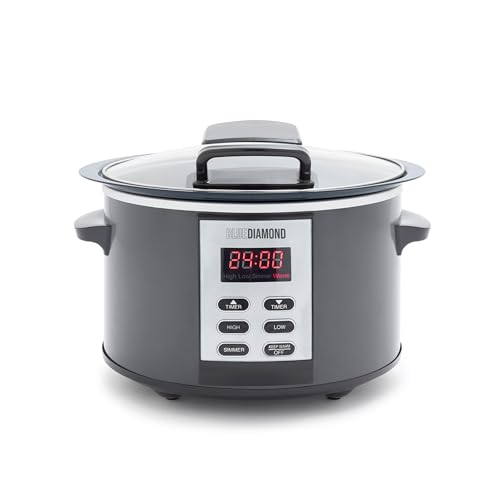
Blue Diamond 5QT Hinged-Lid Slow Cooker — Best for Serving and Small Counters
The Blue Diamond solves a small problem so well that it earns its own badge: where does the wet, dripping lid go when you serve? On this cooker, nowhere — the lid is hinged to the base, flips up and stays up, one-handed, while you ladle. Anyone who has juggled a steaming lid, a ladle and a bowl at a buffet table understands immediately why that matters. Underneath the clever lid sits a PFAS-free ceramic nonstick crock and a four-preset control set with delay and keep warm.
| Capacity | 5 quart |
|---|---|
| Lid | Hinged lid |
| Crock | Ceramic nonstick, PFAS-free, removable, dishwasher safe |
| Presets | 4 presets incl. delay and keep warm |
Strengths
- Hinged lid opens one-handed and keeps condensation off your counter
- PFAS-free ceramic crock releases food and goes in the dishwasher
- Four presets with delay and keep warm — real programming, not just a dial
Trade-offs
- 5 quarts is a step down from family 6-quart size — large roasts and double batches feel the squeeze
- Hinge mechanism is one more part to clean around
- Graphite finish and styling lean modern, which may not suit traditional kitchens
The 5-quart capacity is the honest trade in this pick, and it cuts both ways. For households of two to four, five quarts is arguably the better everyday size: slow cookers cook best between half and three-quarters full, and a smaller crock hits that zone with normal weeknight quantities instead of demanding batch cooking. The cooker also takes less counter and cabinet space, which is a real consideration in apartments. Where it loses is the big-batch jobs — the whole chicken plus vegetables, the double chili for freezing — and buyers who do those weekly should take the 6-quart GreenLife above instead.
Blue Diamond’s ceramic coating comes from the brand’s cookware line, where the pitch is durability within the ceramic nonstick class. No ceramic coating is a lifetime surface, and this one asks for the same gentle utensils and non-abrasive cleaning as every coated pick here. What you get in return is the easiest-serving, easiest-cleaning mid-size ceramic cooker in the guide — a machine designed around the two moments, serving and washing up, that other makers treat as afterthoughts.
Best for: households of two to four, buffet and potluck servers, and anyone tired of the dripping-lid problem / Not suited for: big-batch cooks who regularly fill a full 6 quarts or freeze double recipes
Check the current price on Amazon

bella 6.0 Qt Manual Slow Cooker (Oatmilk) — Best Budget
The bella 6.0 Qt is proof that ceramic nonstick does not have to cost much. This is a manual three-setting cooker — the simplest control scheme there is — wrapped around a stoneware pot with a ceramic nonstick coating, a tempered glass lid and thoughtful touches like cool-touch handles and a cord wrap. For shoppers whose first requirement is the ceramic surface and whose second is the lowest sensible price, this is the pick.
| Capacity | 6.0 quart |
|---|---|
| Settings | 3 temperature settings |
| Pot | Stoneware pot with ceramic nonstick coating, dishwasher safe |
| Extras | Cool-touch handles, cord wrap |
Strengths
- Ceramic nonstick coating among the entry options in this guide
- Cool-touch handles make carrying a full pot safer
- Cord wrap keeps a small counter or cabinet shelf tidy
Trade-offs
- Manual dial only — no timer, no automatic warm switch
- Value-brand fit and finish is a step below the Crock-Pot and GreenLife picks
- Coating longevity depends entirely on gentle utensils and cleaning
Set expectations the way bella itself implicitly does: this is a value appliance. The heating is simple and effective, the coating does the easy-release job ceramic shoppers want, and the design is genuinely attractive in the Oatmilk finish. What a budget price does not buy is the deep replacement-part ecosystem or the multi-decade track record of the heritage brands. For a first ceramic cooker — or a second one bought for a specific job like holiday side dishes — that trade is entirely reasonable.
The manual controls deserve a word in their favor, because in ceramic cookers specifically, simplicity pairs well with the material. There is no control board to fail and no program to mis-set; you turn a dial and the pot heats. If you are home when dinner finishes — and a large share of slow cooker owners are — the bella does the same cooking as machines costing considerably more, and its pot wipes clean faster than any stoneware crock here. Budget pick does not mean bad pick; it means a pick with its priorities in a specific order, and this one’s order is material first, price second, features last.
Best for: budget shoppers who want a ceramic nonstick pot at full family size / Not suited for: anyone who needs a timer or expects heritage-brand fit and finish
Check the current price on Amazon

Crock-Pot 6-Quart Nonstick One-Touch Slow Cooker — Best for Easy Cleanup
Crock-Pot invented the category, and this One-Touch model is its argument that a slow cooker should have exactly one decision on it. The control is a single touch control; the settings are high and low; the pot carries a nonstick ceramic coating and holds enough for seven or more people. For households where the cooker will be operated by whoever is home — partners, teenagers, grandparents — that radical simplicity is a feature no programmable model can match.
| Capacity | 6 quart (serves 7+) |
|---|---|
| Controls | One-touch control |
| Settings | High and low |
| Pot | Nonstick ceramic coating |
Strengths
- One-touch control eliminates dial confusion entirely
- Ceramic nonstick coating makes hand-washing genuinely quick
- Heritage brand with the deepest support and replacement ecosystem in the category
Trade-offs
- No timer, delay or separate warm program to fine-tune holding
- Two settings only — experienced cooks may miss a distinct warm hold
- Coated pot requires non-metal utensils
The cleanup claim in the badge is not marketing fluff; it is the arithmetic of this design. A ceramic nonstick surface plus a pot with no control crevices and a one-touch panel that wipes flat means the whole machine cleans in minutes. Slow cookers die of neglect more often than of failure — they get put in a cupboard dirty-ringed and faintly daunting, and they stop coming out. A cooker that washes this easily keeps getting used, which is the only performance metric that matters in year two.
The honest limitation is control. High and low cover the cooking itself completely — every slow cooker recipe ever written uses one of the two — but the holding and scheduling tricks belong to the programmable picks. If your household eats within a predictable hour of the food finishing, you will never miss them. If dinner time wanders across three hours, buy the GreenLife or the Blue Diamond and accept their slightly busier panels as the price of that flexibility.
Best for: shared households, beginners, and anyone whose top priority is a cooker that cleans in minutes / Not suited for: schedule-driven cooks who need timers and programmed warm holds
Check the current price on Amazon

GreenLife 3.5QT Ceramic Nonstick Slow Cooker (Turquoise) — Best Compact — and the Pot Doubles as Cookware
This smaller GreenLife does something no other pick in the guide can do: its ceramic inner pot is listed as cooktop and oven safe. That changes what a slow cooker is. You can sear a small roast directly in the pot on the stove, move the pot into the heating base to slow cook, and finish or keep a casserole in the oven — one vessel, no transfer, no extra pan to wash. At 3.5 quarts it is sized for one to three people, small roasts and side dishes, and it is light enough to handle easily when full.
| Capacity | 3.5 quart |
|---|---|
| Pot | Ceramic nonstick, PFAS-free, cooktop and oven safe per listing, dishwasher safe |
| Settings | 3 heat settings (low, high, warm) |
| Design | Lightweight and compact, glass lid |
Strengths
- Pot works on the cooktop and in the oven as well as in the slow cooker base
- PFAS-free ceramic nonstick releases food and is dishwasher safe
- Compact, lightweight size suits small households and small kitchens
Trade-offs
- 3.5 quarts will not take a whole chicken or a family batch
- Searing in a coated pot still requires care — preheat gently and avoid thermal shock
- Three basic settings only; no programming
The sear-then-slow-cook workflow is the main reason experienced cooks drift toward expensive multi-cookers, and this little cooker delivers the essential version of it at a fraction of the size and cost. Browning meat before a long braise builds the deep flavors a slow cooker cannot create on its own, and doing the browning in the cooking pot itself keeps every bit of that fond in the dish instead of in a separate skillet. For small households especially, this is the difference between good slow cooking and great slow cooking.
Respect the material while you do it. A ceramic-coated pot on a cooktop should be heated gradually, never blasted from cold on a high burner, and never plunged into cold water afterward — thermal shock is the enemy of every ceramic vessel in this guide. Used with that much sense, the pot is a genuinely three-way piece of cookware, and the slow cooker base becomes almost a bonus. Buy it as a small cooker and you will find you own a very useful small braising pot as well.
Best for: one-to-three-person households that want to sear and slow cook in one ceramic pot / Not suited for: families needing 6-quart capacity or cooks who regularly feed a crowd
Check the current price on Amazon

BLACK+DECKER 6-Cup Rice Cooker with Ceramic Nonstick Pot — Best Ceramic Rice Cooker
Not every ceramic cooker shopper wants a slow cooker. If your goal is a ceramic pot for the daily grain — rice, quinoa, oatmeal — this BLACK+DECKER is the verified ceramic option at that scale. It cooks up to six cups of cooked rice, switches itself to warm when the cooking finishes, and includes a steaming basket so vegetables or fish can ride above the grain. The ceramic nonstick pot is the point of the machine: easy release, easy washing, and no conventional nonstick coating in contact with your food.
| Capacity | 6-cup (cooked) rice |
|---|---|
| Pot | Ceramic nonstick pot |
| Extras | Steaming basket |
| Function | Automatic keep warm |
Strengths
- Ceramic nonstick pot sized for daily grains — no giant crock for a cup of rice
- Automatic keep warm holds rice at serving temperature after cooking
- Steaming basket turns it into a small two-part meal maker
Trade-offs
- Rice-cooker scale only — it is not a slow cooker and cannot braise
- Six cups cooked is a side dish for a crowd, not a main for one
- Basic one-function controls compared with fuzzy-logic Japanese rice cookers
The honest comparison for this pick is not against the slow cookers above but against two alternatives: a basic nonstick rice cooker and a Japanese fuzzy-logic machine. Against the first, the BLACK+DECKER wins on the pot material — that is the entire reason it is in this guide. Against the second, it loses on grain perfection: high-end Japanese cookers adjust temperature curves in ways a simple switch-based cooker cannot, and rice obsessives can taste the difference. For everyday rice, oatmeal and steamed sides, though, this machine is entirely competent, and its pot is the one your coating concerns asked for.
One practical note: the six-cup figure is cooked rice, which means roughly three cups of uncooked rice — right for a family side dish or a couple of days of meal-prep grains for one person. If you cook rice for one small serving at a time, even this pot is larger than ideal and a 3-cup class machine would suit better; if you feed five rice-eaters nightly, step up a size. Within its intended band, it is the simplest ceramic-pot grain cooker we could verify.
Best for: shoppers who want a ceramic pot for everyday rice, grains and steamed sides / Not suited for: anyone expecting slow-cooker braising or Japanese fuzzy-logic rice precision
Check the current price on Amazon
Comparison Table
The six picks side by side, with the key specification taken from each product’s verified listing.
| Pick | Badge | Key Spec | Best For |
|---|---|---|---|
| GreenLife 6 Quart Programmable Slow Cooker (Turquoise) | Best Overall | 6 qt PFAS-free ceramic crock, 5 modes | families who want a PFAS-free ceramic crock without giving up programmable convenience |
| Blue Diamond 5QT Hinged-Lid Slow Cooker | Best for Serving and Small Counters | 5 qt ceramic crock, hinged lid, 4 presets | households of two to four, buffet and potluck servers, and anyone tired of the dripping-lid problem |
| bella 6.0 Qt Manual Slow Cooker (Oatmilk) | Best Budget | 6.0 qt ceramic nonstick pot, manual dial | budget shoppers who want a ceramic nonstick pot at full family size |
| Crock-Pot 6-Quart Nonstick One-Touch Slow Cooker | Best for Easy Cleanup | 6 qt ceramic-coated pot, one-touch control | shared households, beginners, and anyone whose top priority is a cooker that cleans in minutes |
| GreenLife 3.5QT Ceramic Nonstick Slow Cooker (Turquoise) | Best Compact — and the Pot Doubles as Cookware | 3.5 qt ceramic pot, cooktop/oven safe | one-to-three-person households that want to sear and slow cook in one ceramic pot |
| BLACK+DECKER 6-Cup Rice Cooker with Ceramic Nonstick Pot | Best Ceramic Rice Cooker | 6-cup ceramic nonstick pot, steamer basket | shoppers who want a ceramic pot for everyday rice, grains and steamed sides |
Two families appear in one table on purpose: the slow cookers braise and hold; the rice cooker does grains. Choose the family first, then the model.
How to Choose the Best Ceramic Cooker: Stoneware or Ceramic Nonstick?
The first decision in this category is not size or brand — it is which kind of “ceramic” you actually want, because the two materials behave like different products. Traditional stoneware is ceramic all the way through. It is heavy, it shrugs off metal utensils, it tolerates decades of use, and its weakness is impact and thermal shock: drop it or plunge it hot into cold water and it can crack. Ceramic nonstick is a coating — a thin ceramic-derived layer over a metal pot. It is light, it releases food dramatically well, and its weakness is abrasion: metal utensils, scouring pads and years of use gradually wear the slickness away.
Match the material to your habits honestly. Cooks who reach for a metal ladle without thinking, who wash cookware hard, or who want a pot that outlives trends should buy stoneware and accept the soaking that comes with it. Cooks whose priority is easy release and quick washing — and who will happily use silicone tools — should buy ceramic nonstick and accept that the coating is a wear item with a finite, if long, life. Both choices are legitimate; buying one while living like the other is the only wrong answer.
A note on the PFAS-free language you will see on several listings here: ceramic nonstick coatings are made from silica-based materials rather than the fluoropolymers used in conventional nonstick, which is what the PFAS-free claim refers to. This guide reports that claim as the listings state it. If avoiding specific materials is a health-driven decision for your household, the conservative maximum is uncoated stoneware or stainless steel — and stoneware picks are labeled clearly in the reviews above so you can choose that route.
What Size Ceramic Cooker Do You Actually Need?
Slow cookers cook best between half and three-quarters full, so size should follow your typical batch, not your biggest one. A 3.5-quart cooker like the compact GreenLife suits one to three people, small roasts, dips and side dishes. A 5-quart suits two to four people and most weeknight mains. A 6-quart — the size of three picks here — is the family standard: whole chickens, double batches and potluck quantities, with enough headroom that recipes written for “a large slow cooker” simply work.
Rice cooker sizing follows different math, because the cup figures describe cooked output on most listings. The 6-cup BLACK+DECKER produces about six cups of cooked rice, which is a family side dish or a few days of grains for one meal-prepper. If rice is a daily staple for a large household, a bigger dedicated rice cooker — including the Japanese commercial class covered in a neighboring guide in this program — is the better tool than stretching a small one.
Storage deserves one sentence of honesty: a 6-quart ceramic crock is a big, heavy object. Measure your cabinet before you buy, and remember the crock also has to fit your sink. Apartment cooks regularly discover that the 5-quart was the right answer all along.
How Long Will a Ceramic Cooker Last? An Honest Answer by Material
Longevity questions in this category get vague answers because the two materials age on completely different clocks, so let us be specific. A glazed stoneware crock has no surface to wear out. Its enemies are accidents — a drop onto tile, a thermal shock crack, a chip that propagates — and a stoneware crock that avoids accidents can plausibly outlive the heating base it sits in, which is why replacement crocks for heritage brands sell to owners of decades-old cookers. If your time horizon is “buy it once,” stoneware is the material that honors it.
A ceramic nonstick coating ages by use rather than by accident. Each cook cycle, each wash, each utensil contact removes a microscopic amount of the surface’s slickness, and after years of regular service the pot gradually behaves more like a plain pot: still perfectly safe and usable, just less nonstick. Slow cooking is gentle duty — no high dry heat, no searing temperatures in the base — so a coated slow cooker pot should hold its release properties far longer than a ceramic frying pan used daily. Expect years, not decades, and treat the coating kindly to get the top of that range.
The heating bases across this guide are simple resistive designs with few failure points in manual models and a control board in programmable ones. In practice, the base of a manual cooker is the longest-lived component in this entire article. That is the quiet argument for the simple picks: a manual cooker with a stoneware crock is, component by component, the closest thing to a lifetime appliance that this category sells.
Can a Ceramic Cooker Replace a Multi-Cooker?
For slow cooking, yes entirely — that is what these machines are. For anything involving pressure, speed or high-heat searing at scale, no, and it is better to know that before you buy than after. A ceramic slow cooker will not pressure cook a stew in half an hour, will not air fry, and (except for the cooktop-safe compact GreenLife pot, used on the stove) will not sear. What it will do is braise gently for hours with a pot material many cooks prefer, at a price well below multi-cooker territory.
The practical household answer is often both, at different times: a multi-cooker for speed on weeknights and a ceramic slow cooker for the low, gentle cooking that ceramic does best and for serving at the table, where a stoneware or ceramic crock looks and holds heat better than a metal insert. If budget forces one choice, choose by your calendar, not by feature counts.
How to Use a Ceramic Cooker — and Keep the Pot Alive for Years
Ceramic cookers ask for a few specific habits. None are difficult, and together they are the difference between a pot that lasts two years and one that lasts twenty.
- Heat gradually, always. Whether it is a stoneware crock going into its base or a ceramic pot going onto a cooktop, bring ceramic up to temperature gently. Never put a cold ceramic pot on a preheated high burner, and never set a hot pot on a cold stone counter or a wet surface — thermal shock is the one force that reliably cracks ceramic.
- Fill to the working zone. For slow cooking, keep the crock between half and three-quarters full so food heats evenly and safely. Root vegetables at the bottom and sides, meat on top, and less liquid than a stovetop recipe suggests — a slow cooker keeps nearly all its moisture.
- Use the right tools in the pot. Silicone, wood or nylon utensils in ceramic nonstick pots; stoneware tolerates more but still prefers them. One metal ladle habit can end a coating’s best years early, so put the gentle tools where the cooker lives.
- Let it cool before water touches it. After cooking, let the pot cool down before washing. A lukewarm soak releases almost everything slow cooking leaves behind; ceramic nonstick usually needs only a wipe after the soak.
- Store the pot protected. A cloth or paper towel between the pot and anything stacked on it prevents the chips and glaze scratches that start as cosmetics and end as cracks. Store the lid separately or upside down with a pad under its rim.
Follow those five habits and a ceramic cooker is among the longest-lived appliances in a kitchen. The material has been cooking food for centuries longer than any of its rivals; it only asks to be heated and handled like ceramic, not like steel.
Common Buying Mistakes
Assuming “ceramic” always means the same thing
The most common disappointment in this category is a material misunderstanding: a buyer expects stoneware permanence and receives a coated pot, or expects nonstick release and receives glazed stoneware that needs soaking. Read the pot description on the listing — the reviews above state each pick’s material in plain words precisely so you do not have to guess.
Scrubbing a ceramic nonstick pot like a steel pan
Abrasive pads and powders strip ceramic coatings. The correct method is patience: a warm soak, then a soft sponge. If something is genuinely welded on, a longer soak and a plastic scraper will move it without costing the coating its surface.
Shocking the pot with temperature changes
Hot pot, cold water: crack. Cold pot, roaring burner: crack. Ceramic’s one true vulnerability is sudden temperature change, and nearly every cracked crock story begins with one of those two moments. Let temperatures change gradually and the pot will repay you for decades.
Buying a slow cooker when you wanted a rice cooker — or the reverse
The two families in this guide overlap in materials but not in jobs. A slow cooker makes mediocre rice; a rice cooker cannot braise a stew. Decide which job is yours before the material question even starts, and let the reviews’ family labels guide you.
Ignoring the fill rule
A nearly empty slow cooker overheats its contents at the edges; an overfilled one cooks slowly and unevenly at the center. The half-to-three-quarters rule is not fussiness — it is how these machines are engineered to work, and most “my slow cooker cooks badly” stories are fill stories in disguise.
Believing a coating makes the pot dishwasher-proof forever
Several picks here list dishwasher-safe pots, and the pots will indeed survive the dishwasher. What the dishwasher costs is time off the coating’s life: harsh detergents and jostling racks are abrasion by another name. If you bought ceramic nonstick for the release, hand washing — which the coating makes genuinely quick — is how you keep what you paid for. Save the dishwasher for the stoneware and the lids.
Final Recommendation
If you buy one ceramic cooker from this page, make it the GreenLife 6 Quart Programmable: the PFAS-free ceramic crock, real programming and family size make it the most complete answer for most kitchens. Serving-focused households should look hard at the Blue Diamond and its hinged lid, budget shoppers at the bella, and shared households at the Crock-Pot One-Touch. Small households get the most interesting machine of all in the compact GreenLife, whose pot sears on the stove before it slow cooks.
And if your ceramic search was really about grains, the BLACK+DECKER rice cooker is the honest pick — a ceramic pot doing the daily rice properly, without pretending to be anything else. Choose the material first, the family second and the model third, and any of these six will serve you well.
To re-check the shortlist before you buy: GreenLife 6 Quart Programmable Slow Cooker (Turquoise), Blue Diamond 5QT Hinged-Lid Slow Cooker, bella 6.0 Qt Manual Slow Cooker (Oatmilk). Each link goes to the verified Amazon listing, where you can check the current price on Amazon.
For a related shortlist, see Best Cheapest 6 Qt Slow Cookers. For a related shortlist, see Best 6 Quart Slow Cookers. For a related shortlist, see Best And Safest Slow Cookers. For a related shortlist, see Best Compact Rice Cookers. For a related shortlist, see Best Commercial Rice Japanese Cookers. For a related shortlist, see Best Basic Slow Cookers.
Frequently Asked Questions
Is ceramic nonstick the same as regular nonstick?
No. Conventional nonstick is a fluoropolymer coating; ceramic nonstick is a silica-based ceramic coating, which is why listings for it carry PFAS-free language. They feel similar in use — food releases easily from both — but ceramic coatings generally tolerate higher heat and wear differently: they tend to lose slickness gradually over years of use rather than peeling, and they ask for gentle utensils and non-abrasive cleaning.
Are ceramic crocks oven safe?
It depends on the specific product, which is why this guide only claims it where the verified listing does: the compact GreenLife 3.5QT lists its pot as cooktop and oven safe. For any other pick, check the product page for an explicit rating before putting a crock in the oven, and never put a slow cooker lid or heating base anywhere near an oven.
Can a ceramic pot crack in a slow cooker?
Yes, if it is thermally shocked or dropped — those are the two realistic risks. Cracks from normal slow cooking are rare because the base heats gradually. The habits in the how-to section above (gradual heat, cool before washing, no cold counters under hot pots) prevent nearly every crack story you will ever hear.
Do ceramic cookers cook differently from metal-pot cookers?
The cooking itself is the same gentle, moist heat. The differences are in handling and cleanup: ceramic holds heat a little longer at the table, releases food more easily in its nonstick form, and asks for gentler treatment. Flavor differences claimed for ceramic are, honestly, minimal — buy it for the material and the cleanup, not for magic.
How long does a ceramic nonstick coating last?
With gentle utensils and soft-sponge washing, a quality ceramic coating should stay usefully slick for years of regular slow cooking — slow cookers are a kind duty cycle, since the pot never sees high dry heat. Abrasive cleaning and metal tools shorten that life significantly. Stoneware, by contrast, has no coating to wear and can last decades.
What is the best ceramic cooker for a family of five?
A 6-quart model, and in this guide that means the GreenLife 6 Quart Programmable for features, the bella for budget, or the Crock-Pot One-Touch for simplicity. Five people with appetites will outgrow a 5-quart quickly on main dishes, and a 3.5-quart is a side-dish tool at that household size.


