Disclosure: airfryerkitchensupply.com is reader-supported. When you buy through links on our site, we may earn an affiliate commission at no extra cost to you.
Where to buy
Safety in a slow cooker is not a marketing badge; it comes from specific, checkable features: a lid that locks for transport, a programmable timer that switches to warm instead of cooking forever, a probe that verifies food temperature, and a crock made from a material you are comfortable cooking in for eight hours. Every pick below was verified against the manufacturer data available, and each one earns its place for a named safety reason rather than a vague promise.
- Crock-Pot 6 Quart Cook & Carry Programmable Slow Cooker (Best Overall): Check the current price on Amazon
- Hamilton Beach Set & Forget 8 Quart Programmable Slow Cooker (Best for Big Batches): Check the current price on Amazon
- GreenLife 6 Quart Programmable Slow Cooker (Best PFAS-Free Pick): Check the current price on Amazon
- Crock-Pot Programmable Slow Cooker, 7-Quart with Locking Lid (Best Smart Timing): Check the current price on Amazon
- All-Clad Stainless Steel Electric Slow Cooker, 7-Quart (Best Premium): Check the current price on Amazon
- Instant Pot Duo 6 Qt 7-in-1 Electric Pressure Cooker (Best Multi-Cooker Route): Check the current price on Amazon
Shopping for the best and safest slow cookers means looking past capacity and colour and asking a harder question: what does this machine do when you are not watching it? A slow cooker is one of the few appliances designed to run unattended for most of a day, often while the house is empty, so the details that matter are the ones that manage heat, time and food temperature safely when nobody is standing over the pot.
The good news is that modern slow cookers are fundamentally simple, low-wattage appliances, and the well-designed ones add layers of protection on top of that simplicity: locking lids that cannot slosh open in a car, timers that end the cook and hold food at a safe warm temperature, probes that confirm the centre of a roast actually reached temperature, and inserts made from stoneware, stainless steel or PFAS-free ceramic coatings. The six picks below cover each of those safety strategies at a different size and budget tier.
One honest note before the picks: no slow cooker is “set and forget forever.” Food safety rules still apply — thaw meat before it goes in, fill the crock between half and two-thirds, and do not leave finished food sitting on warm for half a day. The safest cooker is the one whose features support those habits instead of fighting them, and that is exactly how this list was built.
In this guide
Quick Picks
Crock-Pot 6 Quart Cook & Carry Programmable Slow Cooker — Best Overall. The benchmark safe slow cooker for most households: a locking Cook & Carry lid, a digital timer that counts down and shifts to warm on its own, and a 6-quart stoneware crock sized for a family roast or a big batch of stew. — Check on Amazon
Hamilton Beach Set & Forget 8 Quart Programmable Slow Cooker — Best for Big Batches. The largest cooker here, with flexible programming across three heat settings and adjustable times. The 8-quart stoneware crock handles a whole ham or double batches, and the program ends into warm automatically instead of cooking on. — Check on Amazon
GreenLife 6 Quart Programmable Slow Cooker — Best PFAS-Free Pick. For cooks who want to avoid conventional nonstick coatings entirely, this GreenLife pairs a PFAS-free ceramic crock with a genuinely useful control set: five modes, delay start, keep warm, and low/high settings in a family-size 6-quart body. — Check on Amazon
Crock-Pot Programmable Slow Cooker, 7-Quart with Locking Lid — Best Smart Timing. MyTime technology reframes the safety question: instead of you guessing a cook time, you tell the cooker when you want to eat, and it adjusts the cooking cycle so food finishes on time — not hours early, sitting around, and not late. — Check on Amazon
All-Clad Stainless Steel Electric Slow Cooker, 7-Quart — Best Premium. The premium route to a safer cook: a programmable LCD timer, a stainless build, and an aluminium insert instead of stoneware — lighter to handle when full, and part of a cooker built to be serviced and kept for years. — Check on Amazon
Instant Pot Duo 6 Qt 7-in-1 Electric Pressure Cooker — Best Multi-Cooker Route. A different safety philosophy: a sealed, sensor-managed multi-cooker whose slow cook mode runs under a locking lid with electronic temperature control, in a stainless steel inner pot — plus pressure cooking when slow is not fast enough. — Check on Amazon
How These Picks Were Chosen
Every model on this list was first verified through the Amazon catalogue for the airfryerkitchensupply.com storefront, confirming the exact model, capacity and feature set before a single word was written. Models whose listings could not be confirmed were dropped rather than guessed at.
From the verified shortlist, picks were scored on five safety criteria: (1) a locking or gasketed lid for transport and spill control, (2) programmable timing with automatic switch to warm, (3) a temperature probe or verified temperature management, (4) insert material — stoneware, stainless steel or PFAS-free ceramic ranked ahead of conventional nonstick, and (5) a removable, dishwasher-safe crock so the cooker actually gets cleaned properly between uses. Capacity and everyday usability decided the final order within each tier.
The 6 Best and Safest Slow Cookers
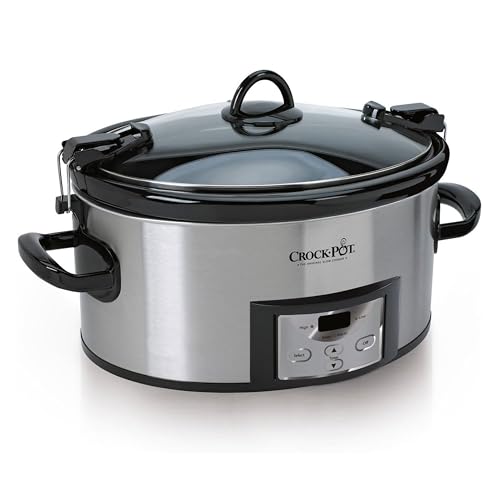
Crock-Pot 6 Quart Cook & Carry Programmable Slow Cooker — Best Overall
If one cooker has to represent what “safe” means in this category, it is this Crock-Pot. The Cook & Carry lid locks down with clips on both sides, which matters in two situations: carrying a full crock to a potluck without it sliding or spilling in the car, and keeping the lid sealed at home so the contents stay at temperature instead of cooling at the edges every time the lid shifts.
Strengths
- Locking lid with gasket seals in heat and prevents transport spills
- Digital timer cooks for a set time, then automatically switches to warm
- Removable stoneware crock and lid are dishwasher-safe for real cleaning
Trade-offs
- Warm mode still needs a sensible limit; food should not sit for many hours
- Stoneware crock is heavy when full, especially for smaller users
- No temperature probe, so thick roasts rely on time-based cooking
| Capacity | 6 quart |
| Controls | Digital programmable timer |
| Lid | Cook & Carry locking lid |
| Crock | Removable stoneware, dishwasher-safe |
In daily use the safety story is about what happens at hour nine. You set a stew for eight hours, work runs late, and instead of continuing to cook — drying the meat and pushing the crock through endless heating cycles — the timer ends the cook and drops to warm, holding the food hot without cooking it further. Combined with the sealed lid, which keeps the surface of the food at temperature rather than letting a loose lid vent heat all day, this is the most complete safety package in a mainstream-priced cooker.
Best for: Families who cook all day while out, and anyone who transports cooked food / Not suited for: Cooks who want probe-verified temperatures or a metal searing insert
Check on Amazon to see the current listing, configuration options and delivery details.
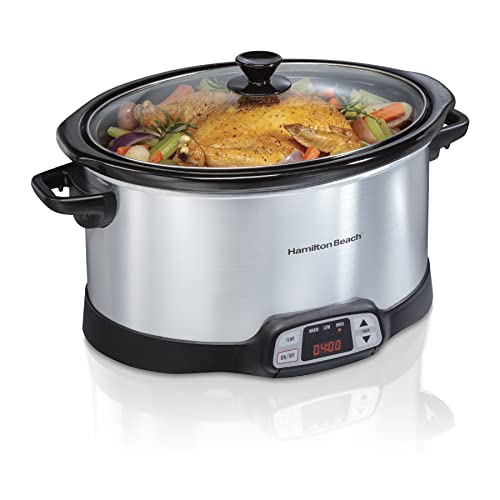
Hamilton Beach Set & Forget 8 Quart Programmable Slow Cooker — Best for Big Batches
Big-batch cooking is where slow cooker safety gets genuinely tricky: a very full, very large crock heats slowly at the centre, and an 8-quart pot of chili for a crowd needs time management more than it needs raw power. The Set & Forget answers with flexible programming — three heat settings and adjustable time settings — so the cook length matches the load instead of a one-size dial.
Strengths
- Programmable time and heat combinations suit very full, large loads
- Automatic switch to warm when the program finishes
- 8-quart capacity feeds a crowd from a single, controlled cook
Trade-offs
- Large footprint; needs real counter and storage space
- Stoneware crock is very heavy when filled to capacity
- Glass lid does not lock, so it is a stay-at-home cooker
| Capacity | 8 quart |
| Controls | Programmable, 3 heat settings, adjustable times |
| Crock | Removable stoneware, dishwasher-safe |
| Lid | Glass lid |
The practical safety win is predictability. With a manual dial cooker, an 8-quart batch that needs seven hours gets either six or nine depending on when someone walks back into the kitchen. Here the program is set once, runs once, and stops cooking on schedule — the single most effective protection against both undercooked centres (program too short because someone served early) and dried-out, over-held food. For holiday hams, game-day chili and freezer-batch cooking, that control is the feature that matters.
Best for: Large families, batch cookers and holiday cooking / Not suited for: Small households or anyone short on storage space
Check on Amazon to see the current listing, configuration options and delivery details.

GreenLife 6 Quart Programmable Slow Cooker — Best PFAS-Free Pick
Insert material is a legitimate safety question in slow cooking, because food sits against the cooking surface at temperature for hours. GreenLife’s answer is a PFAS-free ceramic nonstick crock: no conventional nonstick coating to degrade, easy release for sticky braises, and a surface that goes in the dishwasher afterwards.
Strengths
- PFAS-free ceramic crock avoids conventional nonstick coatings
- Delay start plus keep warm brackets the cook safely on both ends
- Five modes including low and high cover most recipes without guesswork
Trade-offs
- Ceramic nonstick needs non-metal utensils to stay in good condition
- Delay start should only be used with food that is safe at room temperature briefly — chilled ingredients and short delays
- Lighter crock feels less substantial than stoneware
| Capacity | 6 quart |
| Crock | PFAS-free ceramic nonstick, removable, dishwasher-safe |
| Modes | 5 modes, low / high / keep warm |
| Timer | Delay start |
Used well, the delay start is a food-safety tool rather than a risk: load the crock with a recipe that starts from cold, dense ingredients, set a short delay so the cooker begins before the food has sat long, and let keep warm hold the finish. Used carelessly — raw chicken sitting for five hours before the cook starts — it is the opposite, and the article guidance below covers that distinction in detail. The cooker itself gives you the controls; the combination of delay, programmed cook and warm hold is more complete than most rivals at this tier.
Best for: Cooks avoiding conventional nonstick who still want full programming / Not suited for: Anyone who wants a locking transport lid or a metal insert
Check on Amazon to see the current listing, configuration options and delivery details.
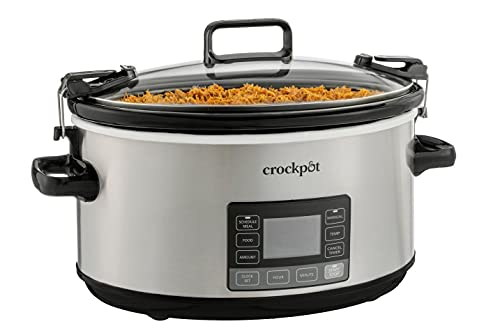
Crock-Pot Programmable Slow Cooker, 7-Quart with Locking Lid — Best Smart Timing
Most slow cooker safety problems are actually scheduling problems. Food that finishes at 3 p.m. but is served at 7 p.m. spends four hours drifting in the warm zone; food rushed on high to catch up can be uneven. This 7-quart Crock-Pot attacks the schedule directly with MyTime technology, which adjusts the cooking cycle to your target serving time.
Strengths
- MyTime adjusts the cycle so food is ready when you plan to serve
- Cook & Carry locking lid seals for transport and steady temperatures
- 7-quart capacity feeds nine or more, suiting big households
Trade-offs
- The adjusted cycle is only as good as the serving time you enter
- Bigger crock is more than two-person households need
- Relies on electronics; no manual-dial simplicity to fall back on
| Capacity | 7 quart |
| Technology | MyTime adaptive cooking cycle |
| Lid | Cook & Carry locking lid |
| Serves | 9+ people |
The honest way to judge MyTime is by what it prevents. Overcooked, dried-out food is the visible failure, but the invisible one is the long, lukewarm hold — exactly what an adaptive cycle is designed to shorten. Tell it dinner is at six, load it in the morning, and the cooker manages the ramp so the dish lands cooked-through at six rather than done at two. For households whose schedules are predictable in the morning and chaotic by afternoon, that is a real safety and quality upgrade.
Best for: Busy families who plan dinner time in the morning / Not suited for: Cooks who prefer dead-simple manual controls
Check on Amazon to see the current listing, configuration options and delivery details.

All-Clad Stainless Steel Electric Slow Cooker, 7-Quart — Best Premium
All-Clad’s 7-quart cooker makes the premium case on build and control. A clear LCD timer handles the programming, the stainless exterior shrugs off kitchen wear, and the aluminium insert is noticeably lighter than a stoneware crock of the same size — a genuine handling-safety point when seven quarts of hot stew have to move from counter to table.
Strengths
- Programmable LCD timer with clear, unambiguous settings
- Aluminium insert is far lighter than stoneware when full
- Stainless build quality suits a buy-it-for-years purchase
Trade-offs
- Premium tier pricing compared with stoneware rivals
- Aluminium insert is not the nonstick surface some cooks expect
- No locking lid, so transport is not its strength
| Capacity | 7 quart |
| Controls | Programmable LCD timer |
| Insert | Aluminium |
| Exterior | Stainless steel |
What you are paying for is precision and longevity. The LCD interface removes the ambiguity of dial positions — the cook time is a number, not a notch — and the whole appliance feels engineered rather than assembled to a price. For a household that slow-cooks weekly and has been burned by a cheap cooker dying mid-season, the All-Clad is the rational premium pick; for occasional use, the Crock-Pot picks above deliver most of the safety at a friendlier tier.
Best for: Frequent slow cooks who value build quality and a light insert / Not suited for: Budget buyers or anyone needing a locking transport lid
Check on Amazon to see the current listing, configuration options and delivery details.

Instant Pot Duo 6 Qt 7-in-1 Electric Pressure Cooker — Best Multi-Cooker Route
Some cooks solve slow cooker safety by leaving the open-crock format entirely. The Instant Pot Duo slow-cooks under its locking lid with electronic temperature management, in a stainless steel inner pot with no coating at all. It is the pick for anyone whose concern list includes both unattended cooking and insert materials.
Strengths
- Locking lid and electronic controls manage temperature actively
- Stainless steel inner pot — no coating to worry about
- Slow cook plus pressure cook covers both patient and rushed days
Trade-offs
- Slow cook mode runs differently from a crock; recipes need adapting
- More controls and modes to learn than a simple slow cooker
- Sealed lid means no easy mid-cook peeking or stirring
| Capacity | 6 quart |
| Functions | 7-in-1 including slow cook |
| Inner pot | Stainless steel |
| Lid | Locking multi-cooker lid |
Judge it as a system rather than a crockpot substitute. The Duo’s slow cook is genuinely useful — low and steady, sealed, and hands-off — but its temperature profile differs from a stoneware crock, so favourite recipes may need a little more liquid or time. In exchange you get the most actively managed cooking environment on this list and a pot material with nothing to flake, chip or degrade. Households replacing several appliances at once get the most from it.
Best for: Cooks who want one sealed, sensor-managed cooker for everything / Not suited for: Traditionalists who want a classic stoneware crock experience
Check on Amazon to see the current listing, configuration options and delivery details.
Comparison Table
| Pick | Badge | Key spec | Best for |
|---|---|---|---|
| Crock-Pot 6 Quart Cook & Carry Programmable Slow Cooker | Best Overall | 6 qt, locking lid, digital timer with auto-warm | Families who cook all day while out, and anyone who transports cooked food |
| Hamilton Beach Set & Forget 8 Quart Programmable Slow Cooker | Best for Big Batches | 8 qt, programmable heat and time, auto-warm | Large families, batch cookers and holiday cooking |
| GreenLife 6 Quart Programmable Slow Cooker | Best PFAS-Free Pick | 6 qt, PFAS-free ceramic crock, delay start, 5 modes | Cooks avoiding conventional nonstick who still want full programming |
| Crock-Pot Programmable Slow Cooker, 7-Quart with Locking Lid | Best Smart Timing | 7 qt, MyTime adaptive cycle, locking lid | Busy families who plan dinner time in the morning |
| All-Clad Stainless Steel Electric Slow Cooker, 7-Quart | Best Premium | 7 qt, LCD timer, aluminium insert | Frequent slow cooks who value build quality and a light insert |
| Instant Pot Duo 6 Qt 7-in-1 Electric Pressure Cooker | Best Multi-Cooker Route | 6 qt, 7-in-1, stainless pot, locking lid | Cooks who want one sealed, sensor-managed cooker for everything |
How to Choose the Best and Safest Slow Cooker
Start with the safety features that match your actual routine, not a generic checklist. If the cooker will travel — potlucks, family dinners, tailgates — a locking lid is non-negotiable, because a sliding lid in a car is both a spill and a temperature problem. If the cooker will run while you are at work, programmable timing with automatic warm matters more than anything else on the spec sheet.
Then work through the remaining decisions in order:
- Timing control: programmable with auto-warm beats a manual dial for unattended cooking; a probe or adaptive cycle is the next step up.
- Insert material: stoneware is the classic, PFAS-free ceramic suits nonstick-avoiders, stainless and aluminium remove coatings from the equation entirely.
- Capacity: 4 quarts for couples, 6 quarts for most families, 7–8 quarts for crowds and batch cooking — an oversized crock cooked half-empty heats unevenly.
- Lid design: locking and gasketed for transport and steadier heat; plain glass is fine for stay-at-home cooking.
- Cleaning: a removable, dishwasher-safe crock is a safety feature in disguise — cookers that are annoying to clean do not get cleaned properly.
Finally, be honest about budget tiers. Entry-tier manual cookers can be perfectly safe for attended cooking, but the safety features this article is about — timers, locks, probes, adaptive cycles — live in the mid and premium tiers. Spend where your routine actually needs the protection.
Slow Cooker Food Safety Rules That Matter More Than Brand
No feature list overrides basic food handling. Thaw frozen meat in the fridge before it goes into the crock; a slow cooker heats too gently to thaw a frozen roast safely at the centre. Fill the crock between half and two-thirds full so food heats through in the time the recipe assumes. Keep the lid on — every lift vents the accumulated heat and adds cooking time.
After cooking, the clock matters. Food held on warm should be served within a few hours, and leftovers should move to shallow containers in the fridge rather than cooling slowly in the crock overnight. Reheat leftovers until steaming throughout. These habits, applied to any cooker on this list, do more for safety than any single feature.
How to Use a Slow Cooker Safely, Step by Step
This routine works for every pick above and turns the safety features into a habit rather than a hope.
- Thaw proteins fully in the refrigerator and pat them dry; never start from frozen in a slow cooker.
- Layer dense vegetables at the bottom near the heat, proteins above them, and liquid to roughly one-third to halfway up the ingredients.
- Fill the crock between half and two-thirds full; too little cooks fast and dries, too much heats slowly at the centre.
- Set the program — time and heat — rather than a bare dial position whenever your cooker allows it, and confirm auto-warm is on.
- Resist lifting the lid during the cook; check near the end instead, and verify thick roasts are cooked through before serving.
- Serve within a few hours of the program ending, then refrigerate leftovers in shallow containers promptly.
One extra habit separates careful cooks from lucky ones: the first time you use any new cooker, run it on a day you are home. You learn how its low and high actually behave, how hot its exterior gets, and whether its timer does what the manual promises — knowledge worth having before the first unattended cook.
Manual vs Programmable: Where Safety Actually Diverges
A manual slow cooker is not unsafe; it is unforgiving. Its three settings do exactly what they say, forever, until a human intervenes. That is fine for a Saturday at home and genuinely limiting for a weekday: the cook that should end at five ends whenever you walk through the door. Programmable cookers exist to close that gap — the timer, not your commute, decides when cooking stops.
The middle ground worth knowing about is the probe-equipped and adaptive end of the market, represented here by the MyTime Crock-Pot. These models manage the cook against a target — a serving time — rather than a fixed duration, which shortens the risky, lukewarm tail of the day. If your schedule is the most unpredictable part of your cooking, that is the tier to buy into.
What About Lead, Coatings and Crock Materials?
Material questions come up in every slow cooker discussion, so here is the honest summary. Glazed stoneware crocks from major brands are made to food-contact standards and are the default choice for a reason. Cooks who prefer to avoid coatings altogether have two clean routes: PFAS-free ceramic nonstick, as in the GreenLife pick, or bare metal — the stainless inner pot of the Instant Pot or the aluminium insert of the All-Clad.
What actually degrades safety over time is damage: a chipped glaze, a scratched coating cooked on for years, a cracked crock pressed back into service. Inspect the insert when you wash it, retire damaged crocks, and the material question mostly takes care of itself.
Slow Cooker Safety Myths, Corrected
Myth one: a slow cooker left alone is a fire risk waiting to happen. The reality is more specific. Slow cookers draw modest wattage — comparable to a couple of light bulbs — and their heating elements are enclosed and thermostatically limited. The fires that do get attributed to countertop appliances overwhelmingly trace back to damaged cords, cookers pushed against walls or curtains, and units with frayed insulation or recalled defects. The practical takeaway is not fear; it is placement and inspection. Give the cooker clear space on a heat-safe surface, keep the cord untangled and undamaged, and retire any unit whose cord or housing is compromised.
Myth two: the warm setting is a safe storage mode for a day or more. Warm holds food at serving temperature, and it does that job well for a few hours, but it is not refrigeration and was never designed to be. Bacterial growth is slowed at proper warm temperatures, not stopped forever, and quality — texture, moisture, flavour — degrades steadily. The safe pattern is cook, serve within a few hours, refrigerate the rest in shallow containers. Every pick in this guide with auto-warm makes that pattern easier; none of them repeals it.
Myth three: ceramic crocks are a lead hazard in normal use. Reputable manufacturers glaze stoneware to food-contact standards, and the crock materials in this guide — stoneware, PFAS-free ceramic, stainless steel, aluminium — are all mainstream, regulated choices. The genuine material risk in an old cooker is physical damage: a crazed glaze, a chipped rim, a cracked crock. Inspect when you wash, replace what is damaged, and the material question returns to preference, which is where it belongs.
Matching the Cooker to Your Week: Three Household Profiles
The two-worker household cooks on a timer or not at all. Dinner goes in before the commute and must be finished — not merely started — when the door opens. For this household the programmable picks are the entire shortlist: the Crock-Pot Cook & Carry for its timer and locking lid, the MyTime model for households whose arrival time is known in the morning, and the GreenLife where a delay start plus keep warm brackets a predictable day. A manual cooker in this kitchen becomes a weekend-only appliance within a month.
The home-all-day household — retirees, home workers, parents on leave — can exploit the manual end of the market and save the difference, because a human is present to end the cook. But even here the programmable models earn their keep on the days the plan changes: the appointment that runs long, the errand that becomes three. Safety features are, in the end, schedule insurance, and schedules are what modern households are worst at predicting.
The batch-cooking household cooks on Sunday for the week: two proteins, a soup, a pot of beans. Capacity and crock handling dominate its choice — the 8-quart Hamilton Beach for volume, the All-Clad for a lighter insert that a full load makes genuinely valuable — and its safety practice is portioning discipline afterwards: shallow containers, fast chilling, and a fridge organised so the week’s food is eaten in the order it was cooked.
When a Slow Cooker Should Be Retired
Slow cookers rarely die dramatically; they fade. The signs are consistent enough to list: the crock develops cracks or deep crazing in the glaze; the lid warps or its rim chips so the seal no longer sits flat; cooks that used to take six hours now take eight, suggesting a weakening element; the cord frays, the plug runs hot, or the base smells of hot electronics. Any one of these ends the cooker’s unattended career, and most of them end its career entirely.
There is also a generational point worth making in a safety guide. Cookers from before modern programmable controls — perfectly good machines in their day — lack the auto-warm behaviour this article treats as the baseline for unattended cooking. If the inherited cooker in your kitchen is a dial-only model from decades ago, the safest upgrade in this entire guide is simply to one of the programmable picks, and to move the veteran to attended, weekend duty or to retirement with honours.
What to Cook First: Building Confidence in a New Cooker
A new slow cooker earns trust in stages, and the first cooks should be chosen to teach you the machine rather than test it. Start with a soup or a bean pot on a day you are home: forgiving liquids, no food-safety tightrope, and a full day to observe how the cooker cycles, how hot its exterior becomes, and whether its low setting is a gentle simmer or a lazy bubble. Every cooker has a personality at low; learn yours with soup, not with a holiday roast.
Second, cook a pork shoulder — the most forgiving protein in the slow repertoire. It tolerates an extra hour without complaint, which lets you calibrate the timer and auto-warm behaviour against a real deadline. Set the program to finish an hour before dinner and watch what warm does across that hour: this is the exact scenario the safety features exist for, rehearsed at low stakes.
Third, cook the meal you actually bought the cooker for, on a normal workday, with the full unattended routine. By now the machine’s behaviour is known, the fill level is practised, and the habits from the how-to section — thawed protein, lid discipline, prompt refrigeration — are habits rather than instructions. That third cook is the one the purchase was for, and it should feel almost boring. In slow cooker safety, boring is the sound of everything working.
Capacity, Fill Lines and the Physics of the Crock
The half-to-two-thirds fill rule appears throughout this guide because it is physics, not fussiness. A slow cooker heats from the sides and bottom of the crock, and its temperature curve was designed around a mass of food in that band. Underfill it and the smaller mass overshoots — edges scorch, liquids reduce too far, and a stew becomes a glaze. Overfill it and the centre lags, spending longer in the temperature range cooks are taught to move food through promptly, while the lid sits propped on food rather than sealed on the rim.
Capacity labels deserve the same realism. A “6-quart” cooker holds six quarts to the brim, which is a level you should never cook at; its working capacity is closer to four and a half. When a recipe says it serves eight, check it against the working volume, not the headline. This is also why the guide pairs each pick with the household it suits: the number on the box is a maximum, and the match that matters is between your typical batch and the crock’s comfortable middle.
Lids complete the physics. The crock’s temperature stability depends on the lid holding a thin cushion of steam at the surface; a warped lid or a chipped rim leaks that cushion all day, lengthening cooks and confusing timings. The locking lids on the Crock-Pot picks are partly a transport feature and partly a seal guarantee. When you unbox any cooker here, seat the lid and check the fit before the first cook — it is the cheapest quality control in the entire purchase.
Slow Cooking for Special Diets and Households
Slow cookers quietly serve more dietary patterns than almost any other appliance, and the safety lens sharpens rather than changes that story. For low-sodium cooking, the long gentle cook extracts flavour from aromatics, herbs and browned meats that shorter methods need salt to replace — and the programmable models let those flavours develop unattended. For texture-modified diets, the crock’s tenderness is the point: proteins that shred without effort, vegetables that yield completely.
Households cooking for someone immunocompromised should lean hardest on this guide’s core disciplines: thaw fully, fill correctly, verify thick roasts are cooked through, refrigerate leftovers promptly in shallow containers, and reheat until steaming. The probe-equipped and timer-managed end of the market exists precisely for kitchens where “probably done” is not an acceptable standard.
For households with young children, the practical safety points are placement and cords: the cooker lives at the back of the counter, its cord routed where small hands and passing hips cannot catch it, and its locking lid — on the picks that have one — keeps the seal intact against curious investigation. None of this is exotic. It is the ordinary care that a hot appliance running all day deserves, stated plainly so it can be practised the same way.
Energy, Cost and the Slow Cooker’s Quiet Economics
A slow cooker is among the cheapest ways to cook a meal ever sold. Its draw is a few hundred watts at most, cycled by a thermostat, against an oven’s several thousand — and in summer the difference compounds, because every watt the oven dumps into the kitchen is a watt the air conditioning must remove. Households that shift braises, soups and roasts from oven to crock across a season feel it in the bill without ever seeing a line item for it.
The economics extend to the food itself. The crock is the natural home of the inexpensive cuts — shoulder, chuck, dried beans, whole chickens — whose only cost is time, and time is the one currency the appliance spends for you. A programmable model monetises the working day: dinner cooks during hours that were already sold, and the takeaway it replaces twice a month repays the cooker within a season.
None of this requires the premium tier. The safety features this guide ranks — timers, locks, probes, materials — are where the money should go, because they are what the machine does while nobody watches. The economics are the bonus: the safest cooker in the kitchen is also, hour for hour, close to the cheapest heat in it.
A Note on Recipes: Converting Times Between Low and High
Slow cooker recipes speak in two dialects — low and high — and converting between them is a core skill the safety-minded cook should hold precisely, because undercooked is the failure mode that matters. The working rule of the category: a dish that takes eight hours on low takes roughly four on high, with the relationship bending at the extremes — very long low cooks compress less, short ones more. When in doubt, treat the conversion as approximate and the food’s doneness as the authority.
The programmable picks make conversion safer in practice, because their timers end the cook deterministically instead of whenever the cook returns. A recipe converted optimistically and left on a manual dial is the classic slow cooker disappointment; the same recipe on a timer with auto-warm has a floor under it. This is the unglamorous, everyday way the safety features in this guide actually protect dinners.
Dairy, fresh herbs and quick vegetables remain the exceptions to every conversion: they go in near the end regardless of setting, because hours of heat — low or high — undo them. The crock rewards cooks who stage their ingredients, and the staged recipe, not the dump recipe, is where the format’s reputation for depth was earned.
Common Buying Mistakes
Starting from frozen. A frozen roast in a slow cooker spends too long in the temperature range where bacteria multiply. Thaw in the fridge first, every time.
Leaving food on warm all day. Warm holds food hot; it is not a storage mode. Serve within a few hours and refrigerate the rest.
Buying capacity by headline, not by load. An 8-quart crock cooking a two-person stew heats unevenly and dries food out. Match the crock to the batch you actually cook.
Skipping the lid check. A warped or ill-fitting lid vents heat all day. Check the seal when you buy, and again if cooks start running long.
Treating delay start as a fridge. Delay start is for short delays with cold, dense ingredients — not for parking raw chicken at room temperature for hours.
Final Recommendation
For most households, the Crock-Pot 6 Quart Cook & Carry Programmable is the safest all-round answer: locking lid, honest timer, automatic warm, family size. If your real problem is scheduling, step up to the 7-quart MyTime model and let the cooker manage the day. Cooks avoiding coatings should choose between the PFAS-free GreenLife and the stainless-pot Instant Pot Duo depending on whether they want a classic crock or a multi-cooker, and big-batch cooks should take the Hamilton Beach 8 Quart and its flexible programming.
Whichever you choose, pair the machine with the habits in the how-to section and you have covered the realistic risks of slow cooking — which is all “safest” can ever honestly mean.
The shortlist: Crock-Pot 6 Quart Cook & Carry Programmable Slow Cooker · Hamilton Beach Set & Forget 8 Quart Programmable Slow Cooker · GreenLife 6 Quart Programmable Slow Cooker · Crock-Pot Programmable Slow Cooker, 7-Quart with Locking Lid · All-Clad Stainless Steel Electric Slow Cooker, 7-Quart · Instant Pot Duo 6 Qt 7-in-1 Electric Pressure Cooker
Keep exploring the cluster: Best 2 Quart Slow Cookers Best 3 Quart Slow Cookers Best 4 Qt Slow Cookers Best 1 1/2 Qt Small Slow Cookers Best 12v Slow Cookers
Frequently Asked Questions
Is it safe to leave a slow cooker on while I am at work?
That is what programmable models are designed for. Use a cooker with a timer and automatic warm, start with thawed ingredients, fill the crock properly, and keep the cooker on a clear counter away from anything flammable. A manual dial cooker gives you no automatic shutoff to warm, so it suits attended cooking better.
What is the safest slow cooker material?
Glazed stoneware, PFAS-free ceramic, stainless steel and aluminium are all sound choices from reputable brands. The bigger factor is condition: a chipped or cracked insert of any material should be retired. Choose the material that matches your cooking and cleaning habits.
Does a locking lid make a slow cooker safer?
Yes, in two ways: it prevents spills during transport, and it keeps the lid sealed so contents hold temperature evenly instead of venting heat through a shifted lid. It matters most for Cook & Carry style use.
Can I put frozen meat in a slow cooker?
No. Slow cookers heat too gently to move a frozen roast through the danger zone quickly enough at the centre. Thaw fully in the refrigerator first.
How long can food stay on the warm setting?
Treat warm as a serving buffer of a few hours, not storage. After that, refrigerate leftovers in shallow containers so they chill quickly and evenly.
Is a multi-cooker safer than a traditional slow cooker?
It is differently managed rather than simply safer: sealed lid, electronic temperature control and a stainless pot, against a simpler crock with fewer things to go wrong. Both are safe when used with sound food-handling habits.


