Disclosure: airfryerkitchensupply.com is reader-supported. When you buy through links on our site, we may earn an affiliate commission at no extra cost to you.
Where to buy
For best commercial 270 smokers, start here: This search names a specific maker — 270 Smokers — whose cabinets sell direct rather than through Amazon, so the verified linked picks below are the commercial-cabinet alternatives, and the 270 line itself is covered in full as a pick without a link. Every linked pick below was verified against Amazon’s catalog before this guide was written, so the product you land on is the product described. Linked picks say “check price on Amazon” because live pricing changes too often to print honestly. Picks marked as unlinked are real products sold mainly outside Amazon; they are described in full, with no purchase link, rather than replaced with a weaker substitute.
HAKKA Commercial Electric Smoker DSH-S50B (Best Electric Commercial Cabinet): Check on Amazon — check the current price on Amazon.
IntXanth Electric BBQ Meat Smoker, Commercial Vertical (Best Mid-Size Commercial): Check on Amazon — check the current price on Amazon.
CLIVIA Electric Smoker, 4-Rack Digital Commercial (Best Compact Commercial): Check on Amazon — check the current price on Amazon.
Pellet Pro 2300 Vertical Pellet Smoker Cabinet (Best Pellet Cabinet): Check on Amazon — check the current price on Amazon.
Introduction: what actually matters here
Searchers typing best commercial 270 smokers usually mean one of two things: the competition-grade insulated cabinets built by 270 Smokers, or a commercial-capacity cabinet in that class generally. This guide serves both honestly. The 270 Smokers line — sold direct by the maker, not through stable Amazon listings — is covered as detailed unlinked picks, because inventing a purchase link for them would be a lie of convenience. Alongside them sit verified commercial cabinets you can actually buy through Amazon, checked, for caterers and serious home competitors who need a cooker this season.
What defines the class: an insulated vertical cabinet, charcoal-fired with a water pan in the 270 pattern (or electric/pellet in the commercial alternatives), holding competition temperatures for many hours on one load, with rack capacity measured in whole packer briskets and pork butts rather than in marketing square inches. These are low-and-slow instruments for barbecue as a discipline — catering, competition and serious volume cooking at home.
The buying divide is fuel and workflow. The charcoal cabinet tradition (270 and its peers) prizes flavour, independence from power and competition legitimacy. Electric and pellet cabinets trade a measure of that tradition for set-and-forget labour economics — decisive in a catering business where the cook’s hours are the scarcest ingredient. The picks below are organised by that divide, not by a single league table.
In this guide
Quick Picks
270 Smokers Sumo (maker’s mid-size competition cabinet) — Best Overall — no link: The centre of the 270 range and the cabinet most searchers mean: a mid-size insulated charcoal smoker in the maker’s water-pan tradition, sized for a competition team’s full programme or a caterer’s core menu. — sold direct / unlinked pick (see review)
270 Smokers Mighty Mini (maker’s compact cabinet) — Best Compact 270 — no link: The small-format entry to the maker’s line: the same insulated, water-pan cabinet idea scaled for smaller teams, home competitors and focused single-meat programmes. — sold direct / unlinked pick (see review)
HAKKA Commercial Electric Smoker DSH-S50B — Best Electric Commercial Cabinet: An 8-rack electric smoke oven in a commercial cabinet — the labour-light catering alternative, verified and buyable now. — Check on Amazon
IntXanth Electric BBQ Meat Smoker, Commercial Vertical — Best Mid-Size Commercial: A 5-rack digital cabinet with a side chip loader — mid-size commercial capacity with convenient smoke replenishment. — Check on Amazon
CLIVIA Electric Smoker, 4-Rack Digital Commercial — Best Compact Commercial: A stainless 4-rack digital cabinet — the entry point to commercial-format smoking for small producers and serious home charcuterie. — Check on Amazon
Pellet Pro 2300 Vertical Pellet Smoker Cabinet — Best Pellet Cabinet: Pellet-fired cabinet convenience in a vertical format — long, unattended cooks with real wood fire at the heart. — Check on Amazon
How These Picks Were Chosen
Selections were made on cabinet fundamentals: insulation quality, temperature stability over long cooks, rack layout for whole cuts, build and serviceability, and — for the commercial alternatives — verified availability. The 270 Smokers models are described from the maker’s known line structure as unlinked entries with no purchase link, per this site’s rule that only listing-confirmed listings receive links; the four linked alternatives were each matched by brand and model against a Amazon listing title.
Capacity claims are translated into food throughout: racks and cabinets are described by what they hold — briskets, butts, ribs, sausage — because that is the unit caterers and competitors actually plan in. Where a maker’s range spans sizes, the review names the role of each size rather than pretending one cabinet serves a food truck and a backyard identically.
A commercial caution belongs in the method section: cooking for paying customers brings local health-code, fire and insurance requirements that vary by jurisdiction and that no product listing settles. The guide flags where a cabinet’s format suits commercial duty; the paperwork remains, properly, the buyer’s local homework.
The 6 Best Options: Best commercial 270 smokers in detail
270 Smokers Sumo (maker’s mid-size competition cabinet) — Best Overall — no link
The Sumo-class cabinet is where the 270 idea fully expresses itself: insulation thick enough to shrug at winter contests, a fire system designed for long, stable burns on one load, and rack spacing planned around briskets and butts rather than around a brochure. Teams choose it because temperature discipline across a twelve-hour cook is the product, and everything else is cabinetry.
Strengths
- Insulated cabinet holds low-and-slow temperatures through long cooks and cold nights
- Water-pan charcoal format produces the bark and moisture profile competition judges expect
- Rack layout planned for whole competition cuts, not domestic portions
Trade-offs
- Sold direct by the maker — ordering, freight and lead time are part of the purchase
- Charcoal workflow demands fire craft an electric cabinet does not
- Weight and size assume a trailer or dedicated cook space, not a casual patio move
Key specs (verified): Insulated vertical charcoal cabinet in the maker’s mid-size competition format; described qualitatively — verify current configuration with the maker
Its reputation rests on overnight behaviour: load it, set it, and sleep in the confidence that the graph in the morning will be boring. In competition barbecue, boring graphs win money. Caterers borrowing the format should note the labour model honestly — someone owns the fire — and price their menus with that craft included rather than apologising for it.
Sumo-class buyers should plan the ownership ecosystem with the order: a fitted cover or sheltered home, a charcoal supply habit (consistent fuel is a temperature feature), spare door-seal material, and a relationship with the maker’s support before it is needed. Direct-sale equipment rewards owners who treat the maker as a supplier-partner — questions asked in the off-season get leisurely, expert answers that a contest-week phone call cannot.
Best for: Competition teams and caterers committed to charcoal cabinet cooking / Not suited for: Buyers needing a cooker delivered this week through a marketplace
Unlinked pick: this model is sold mainly through the maker or specialty dealers rather than as a stable Amazon listing, so no purchase link is given. It is included because leaving it out would make the shortlist less honest, not more convenient.
270 Smokers Mighty Mini (maker’s compact cabinet) — Best Compact 270 — no link
Compact cabinets are the connoisseur’s format: one brisket, or a pair of butts, cooked in a chamber whose thermal mass is matched to the load instead of dwarfing it. The Mighty Mini class serves the home competitor who cooks championship quality at domestic quantity, and the team that wants a dedicated chicken or ribs cooker beside a larger cabinet.
Strengths
- Right-sized thermal mass for small loads — efficient charcoal use per cook
- Same insulated-cabinet discipline as the maker’s larger models
- Manageable footprint for home competition setups and small trailers
Trade-offs
- Capacity is the ceiling — a catering surge outgrows it immediately
- Direct-sale purchase process, as with the whole line
- Small chambers forgive less sloppy fire management, not more
Key specs (verified): Compact insulated charcoal cabinet in the maker’s small format; described qualitatively — verify current configuration with the maker
Judged as a specialist, it shines: competition programmes are won category by category, and a dedicated small cabinet that holds its category’s temperature perfectly is a rational purchase beside a big cooker. Judged as an only cooker for a growing caterer, it is a waystation — buy it knowing which judgement describes you.
The compact 270’s competition logic extends to practice: a small cabinet makes weekday practice affordable in fuel and time, and programmes are built in practice, not at contests. Teams that cook their categories weekly in a right-sized chamber arrive with timings and instincts the occasional full-scale rehearsal cannot teach — the mini cabinet is, in this reading, not a smaller smoker but a training instrument that also produces dinner.
Best for: Home competitors and teams wanting a dedicated small-category cabinet / Not suited for: Caterers needing volume from their only cooker
Unlinked pick: this model is sold mainly through the maker or specialty dealers rather than as a stable Amazon listing, so no purchase link is given. It is included because leaving it out would make the shortlist less honest, not more convenient.

HAKKA Commercial Electric Smoker DSH-S50B — Best Electric Commercial Cabinet
The HAKKA DSH-S50B answers the commercial question with electricity: eight racks in a vertical cabinet, steady electric heat, and a workflow one member of staff can run alongside other kitchen work. For sausage, bacon, pastrami and smoked chicken programmes — the charcuterie end of commercial smoking — its controlled, repeatable environment is arguably better matched than a charcoal fire.
Strengths
- Eight-rack vertical capacity suits batch production of sausage, bacon and poultry
- Electric heat gives repeatable, staff-friendly operation
- Cabinet format fits commercial kitchen and commissary layouts
Trade-offs
- Electric smoke character differs from charcoal tradition — sample before menu promises
- Commercial buyers must confirm local code acceptance for their premises
- Throughput per batch is fixed by the cabinet; surge demand needs a second unit or a bigger class
Key specs (verified): Vertical electric smoke oven, 8 racks, commercial cabinet format (per Amazon title)
Its honest comparison to the 270 line is labour: a catering business sells hours as much as food, and an electric cabinet that holds programme while the team preps, serves and cleans changes the staffing maths of a smoke-based menu. Flavour purists will keep their charcoal cabinets for brisket; production managers will keep this for everything else, and both are right.
HAKKA owners should exploit the electric cabinet’s documentation friendliness: programme, time and temperature are inherently recordable, and a simple batch log turns that into the consistency evidence commercial customers and inspectors both respect. Electric production’s flavour debate gets the attention, but its paperwork virtue wins contracts — the deli or caterer who can show the log is the one who gets the wholesale conversation.
Best for: Caterers and producers running sausage, bacon and poultry programmes / Not suited for: Competition teams seeking charcoal-cabinet flavour tradition
Check on Amazon — check the current price on Amazon before you buy, and confirm the exact configuration in the listing title matches the model reviewed here.
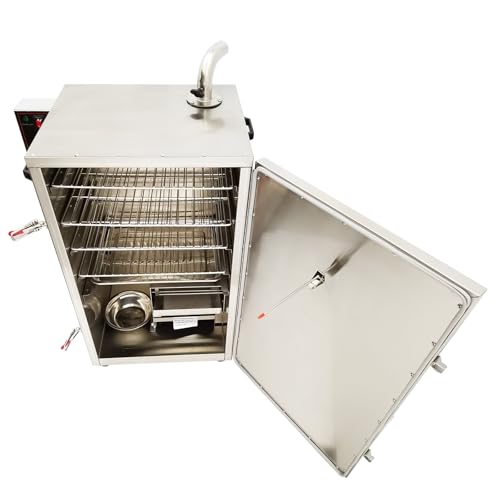
IntXanth Electric BBQ Meat Smoker, Commercial Vertical — Best Mid-Size Commercial
The IntXanth sits between compact and full commercial: five detachable racks, digital control, and a side wood-chip loader that lets smoke be renewed without opening the cabinet and dumping its heat — a small feature that matters enormously across a long production day, when every door opening is temperature and time lost.
Strengths
- Side chip loader renews smoke without opening the cabinet
- Five-rack capacity covers mid-size batch production
- Digital control suits repeatable, documented production runs
Trade-offs
- Brand support network is thinner than heritage makers — buy with spares in mind
- 110V electric format ties it to suitable premises power
- Competition-charcoal buyers will find the flavour profile different by design
Key specs (verified): 5 detachable racks, digital control, side wood-chip loader, 110V (per Amazon title)
Mid-size producers — the farm shop, the deli adding a smoked line, the food truck with a commissary base — are its natural owners. It offers the production virtues of the electric class (repeatability, documentation, staff operation) at a scale matched to businesses whose smoked range is a department, not the whole identity.
IntXanth’s side loader changes mid-cook behaviour in a way worth training into staff: smoke renewal becomes a scheduled, door-closed task, so build it into the production sheet with times, not impulses. New operators open cabinets to ‘check’ — the loader exists to break that habit, and a written refill schedule completes what the hardware starts. Temperature graphs, reviewed weekly, will show the difference in a language everyone believes.
Best for: Mid-size producers and delis adding a smoked range / Not suited for: High-volume brisket programmes needing charcoal scale
Check on Amazon — check the current price on Amazon before you buy, and confirm the exact configuration in the listing title matches the model reviewed here.

CLIVIA Electric Smoker, 4-Rack Digital Commercial — Best Compact Commercial
The CLIVIA cabinet packages the commercial format at its most accessible: stainless construction, digital temperature control with a timer and auto shutoff, and four racks sized for jerky, sausage, fish and turkey work. For a small producer validating a smoked product line — or a home charcuterie enthusiast outgrowing a domestic smoker — it is a first commercial step that does not require commercial premises to justify.
Strengths
- Stainless cabinet and digital control suit food-production hygiene and repeatability
- Timer with auto shutoff supports unattended, documented runs
- Format excels at jerky, sausage and fish — the small-producer staples
Trade-offs
- Four racks cap batch size — validate your volumes before committing a product line
- Electric smoke profile; charcoal traditionalists should taste before they menu
- As with all commercial use, local code compliance is the buyer’s to confirm
Key specs (verified): 4 racks, digital temperature control, timer with auto shutoff, stainless cabinet (per Amazon title)
Its strategic use is validation: launch the jerky, prove the sausage, learn the true demand curve, and let the business case for a larger cabinet write itself from sales rather than hope. Equipment bought in that order rarely becomes a regret parked in a storeroom.
CLIVIA-scale producers should treat the cabinet as market research with a heating element: every batch is a priced experiment — yield, labour minutes, sell-through — recorded against the product it tested. Two seasons of that data tells you the size of your next cabinet, or tells you the line should stay small and profitable. Either answer is a success; the only failure is scaling on enthusiasm instead of evidence.
Best for: Small producers validating a smoked line, and serious home charcuterie / Not suited for: Established caterers needing maximum batch volume
Check on Amazon — check the current price on Amazon before you buy, and confirm the exact configuration in the listing title matches the model reviewed here.

Pellet Pro 2300 Vertical Pellet Smoker Cabinet — Best Pellet Cabinet
The Pellet Pro cabinet splits the difference between the charcoal tradition and electric convenience: a real wood-pellet fire, thermostatically fed, in a vertical cabinet layout. For caterers whose identity is wood smoke but whose staffing cannot tend a charcoal fire all night, it is the compromise that respects both constraints — and for home competitors, it turns overnight briskets into a supervised-by-thermostat routine.
Strengths
- Real wood-pellet fire with thermostatic feeding — flavour tradition, modern labour
- Vertical cabinet layout suits whole cuts and batch arrangement
- Long unattended cooks suit overnight production schedules
Trade-offs
- Pellet supply and quality become part of your production planning
- Moving parts (auger, fan) add service considerations charcoal lacks
- Competition sanctioning for pellet cookers varies by organisation — check your circuit’s rules
Key specs (verified): Vertical pellet smoker cabinet format (per cache listing)
Its buyers should decide with eyes open about identity: pellet smoke is real smoke, judged blind it performs respectably, and the labour saving is genuine. What it is not is the 270 charcoal ritual — and for many businesses, that trade is not a compromise at all but the entire point.
Pellet Pro owners should standardise their pellet supply as carefully as their meat supply: brand, blend and storage conditions all move the smoke profile and the auger’s happiness. Buy pellets dry, store them drier, and treat a change of supplier as a recipe change — tested on a practice batch before it meets a paying customer’s brisket. The thermostat forgives many things; variable fuel is not among them.
Best for: Caterers and home competitors wanting wood flavour without fire-tending / Not suited for: Purists committed to charcoal-only cooking and competition formats
Check on Amazon — check the current price on Amazon before you buy, and confirm the exact configuration in the listing title matches the model reviewed here.
Comparison Table
| Pick | Badge | Key spec | Best for |
|---|---|---|---|
| 270 Smokers Sumo (maker’s mid-size competition cabinet) | Best Overall — no link | Insulated charcoal cabinet | Competition teams and caterers committed to charcoal cabinet cooking |
| 270 Smokers Mighty Mini (maker’s compact cabinet) | Best Compact 270 — no link | Compact insulated cabinet | Home competitors and teams wanting a dedicated small-category cabinet |
| HAKKA Commercial Electric Smoker DSH-S50B — Check on Amazon | Best Electric Commercial Cabinet | 8 racks / electric cabinet | Caterers and producers running sausage, bacon and poultry programmes |
| IntXanth Electric BBQ Meat Smoker, Commercial Vertical — Check on Amazon | Best Mid-Size Commercial | 5 racks / chip loader | Mid-size producers and delis adding a smoked range |
| CLIVIA Electric Smoker, 4-Rack Digital Commercial — Check on Amazon | Best Compact Commercial | 4 racks / digital / stainless | Small producers validating a smoked line, and serious home charcuterie |
| Pellet Pro 2300 Vertical Pellet Smoker Cabinet — Check on Amazon | Best Pellet Cabinet | Pellet cabinet | Caterers and home competitors wanting wood flavour without fire-tending |
How Do You Cost a Commercial Smoked Product Honestly?
Price from the batch sheet, not from optimism: meat cost at true yield (a brisket’s cooked, trimmed yield is a fraction of its raw weight, and the fraction is yours to measure), fuel across the full cook including stabilisation, labour minutes at the cabinet’s actual rhythm, packaging, and the overheads your jurisdiction attaches to selling food. The cabinets in this guide change different lines of that sheet — electric and pellet move labour, charcoal moves fuel and craft premium — which is why the fuel decision is a pricing decision.
Yield is the number new producers get wrong longest, because it varies by cut, trim style and cook. Weigh in and out for your first twenty batches and let your own cabinet’s data replace folklore; the logbook discipline this guide keeps recommending is, in commercial terms, your costing department. Products priced on measured yield survive; products priced on hope subsidise the customer until the money runs out.
Finally, price the craft where the market can see it: charcoal-cabinet barbecue sells a story as well as a sandwich, and menus that name the method honestly — insulated charcoal cabinet, overnight cook — support the premium that method’s labour requires. Underpricing tradition is as fatal as overpricing convenience; the batch sheet tells you which sin you are committing.
What Maintenance Keeps a Commercial Cabinet Earning for a Decade?
Daily discipline is small: ash and grease managed while the cabinet is warm, grates cleaned to the standard your food deserves, door seals wiped and inspected. Weekly discipline is structural: check seal compression, clear drainage and grease paths, verify thermometer readings against a trusted reference, and review the cook log for drift — a cabinet that needs more fuel for the same result is telling you something, usually about seals or buildup.
Seasonal discipline is mechanical sympathy: gaskets replaced before they fail publicly, hinges and latches serviced, electric elements and pellet augers inspected by the manual’s schedule rather than by breakdown. Commercial equipment rarely dies suddenly; it declines audibly for months first, and the maintenance rhythm exists to hear it early, when the fix is a part and an hour.
Keep the maker’s documentation, your service contacts and a small stock of the consumable parts your format eats — seals, probes, igniters where fitted — in one known place. The cabinet that returns to service in a day protects a menu; the one awaiting a remembered password and a shipped gasket rewrites it.
How Should a Growing Operation Scale From One Cabinet to a System?
Scale by programme, not by appetite: add the cabinet that removes your proven bottleneck — a dedicated small cabinet for the category that monopolises the big one, an electric unit for the charcuterie line that interrupts brisket days, a second identical unit when batch rhythm, not size, is the constraint. Each addition in this guide’s picks maps to one of those logics, which is why the list spans formats instead of merely sizes.
Identical twins deserve their reputation: two of the same cabinet share parts, habits and logs, and any operator runs either. Growth that buys a different machine each time buys a new learning curve each time — sometimes justified by a new programme, never by restlessness. Let the batch data argue for variety; let habit argue for twins; and let the argument happen on paper before it happens on a loading dock.
Above all, scale the system around the iron at the same pace: cold storage, prep space, staffing rhythm and the sales channels that absorb the new capacity. A second cabinet in an unchanged kitchen produces a queue, not a business. The operations that grow well treat the smoker as one instrument in an orchestra they are deliberately, measurably enlarging.
Which Operation Scenario Fits Which Cabinet? A Decision Walk-Through
Scenario one: a competition team serious about its circuit, cooking the full programme across a season. The 270 line, bought direct, is the home-field choice — the Sumo class as the main cabinet, the compact as the category specialist and practice instrument. Budget the ecosystem with it: fuel consistency, spares, shelter and the logbook habit. Teams at this level are buying temperature discipline and sleep; the cabinet is merely where those things live.
Scenario two: a caterer whose menu leans smoked — weddings, markets, a food truck with a commissary base. Decide by rota: if a named fire-keeper exists at your busiest week, the charcoal cabinet tradition (270 or the Pellet Pro as the staffed-lightly bridge) carries the brand; if the team is thin, the HAKKA’s electric production protects the menu from the staffing chart. Price from the batch sheet either way, and let the sheet — not the romance — arbitrate.
Scenario three: a small producer building a smoked line — jerky, sausage, bacon, smoked fish — for shops and markets. Start at validation scale with the CLIVIA, prove the products and the demand, then step to the IntXanth or HAKKA as the batch data instructs. The producers who survive are the ones whose second cabinet was bought by their first cabinet’s sales figures; this scenario is the guide’s clearest case for buying in the order the evidence arrives.
Scenario four: a serious home competitor or a household that cooks volume for gatherings, without commercial paperwork. The compact 270 serves the craft purist; the Pellet Pro serves the household that wants overnight briskets without overnight attendance. Both are legitimate summits for a non-commercial buyer — choose by whether your pleasure lives in the fire or in the results, and be honest, because you will live with the answer every weekend for years.
Your Pre-Purchase Checklist: Seven Questions Before You Commit
One: have you translated capacity into your actual product — briskets, butts, racks, kilos — with airflow space included, at your busiest realistic batch? Two: which fire does your rota honestly staff at that busiest week — a named fire-keeper for charcoal, a pellet routine, an electric programme — and does the cabinet you are admiring match the rota you actually have, rather than the one you intend to hire someday?
Three: what do your local health, fire and insurance requirements demand of this equipment and your premises — answered by local authorities, in advance, in writing where it matters? Four: what is the full landed cost — freight for direct-sale cabinets, electrical work for commercial electrics, the cover, probes, spares and fuel stock that make a cabinet a system — and does the total still respect the business case?
Five: what does the batch sheet say — your measured yield, fuel and labour for the products this cabinet will carry — and does the menu price survive it? Six: who maintains it, on what daily, weekly and seasonal rhythm, with which parts stocked on the shelf? Commercial cabinets decline audibly for months before they fail; the checklist assigns someone to listen.
Seven: what is the growth trigger for the next cabinet — which bottleneck, proven by which numbers, in the cook log — and does today’s purchase expand toward that future or get replaced by it? Operations that can answer all seven questions buy equipment the way they should buy meat: by specification, by weight, and without romance doing the arithmetic.
After the First Month of Cooks: Reading Your Own Data
Thirty days and a dozen cooks in, the logbook — if you kept it, as this guide keeps insisting — becomes the most valuable document in the operation. Fuel per cook, stabilisation times, yields by cut, the door openings you could not resist and what they cost: your cabinet’s true specification sheet, written in your conditions, for your product. Every future decision — pricing, staffing, the second cabinet — should be argued from those pages, because no manufacturer’s numbers know your weather, your wood or your menu.
Month one also settles the identity question with evidence. Charcoal owners learn whether the fire rhythm fits their real rota or merely their intentions; electric and pellet owners learn whether their customers’ plates can tell the difference the debate promised. Both lessons are cheaper at month one than at month twelve, and both are survivable — workflows can be re-staffed, menus re-worded, programmes rebalanced — provided the data, not pride, is chairing the meeting.
Close the month with the maintenance the cabinet has earned and the adjustments it has requested: seals checked against the fuel trend, probes verified, the production sheet updated with the loader refills and rotation times that are now habits. Commercial smoking rewards the operators who treat month one as calibration rather than verdict — the cabinet is not being judged anymore; the system around it is being built, one logged, deliberate cook at a time.
A Note on Used Cabinets, Waiting Lists and Buying the Maker’s Ecosystem
Serious cabinets circulate in a small world: competition teams upgrade, caterers retire, and a used insulated cabinet with a known history — its logbook, its contest record, its maker’s service familiarity — can be the wisest purchase in this entire guide. Inspect what the format’s life depends on: door seals and their compression, the firebox’s condition, rack integrity, and the honest answer to why it is being sold. In a community this size, reputations attach to equipment as well as to people, and a cabinet with a good name carries part of its value in it.
Direct-sale makers run on lead times that reward planning: order in the off-season, confirm freight and placement before the build completes, and let the waiting period do useful work — the pad or shelter prepared, the fuel supply standardised, the logbook started with the practice cooks on your current equipment. Teams that treat the wait as preparation arrive at delivery day with a system ready to receive the cabinet; teams that treat it as dead time spend their first season improvising around a very expensive centrepiece.
Whichever route — new, used or the verified alternatives — buy into the ecosystem deliberately: the maker’s support relationship, the community of owners who answer questions at midnight before a contest, the parts that exist because a model has a following. A commercial cabinet is a decade-long membership as much as a purchase, and the membership, in the end, is what keeps the iron earning.
How to Choose a Commercial Cabinet Smoker: Capacity in Cuts, Not Inches?
Plan capacity in the units you sell: whole packer briskets, pork butts, racks of ribs, kilos of sausage. A cabinet’s rack count and spacing decide how many of those units cook evenly at once — and ‘evenly’ is the operative word, because a cabinet stuffed beyond its airflow design produces a gradient of done-ness no rotation schedule fully fixes. The reviews above describe each cabinet in those terms deliberately; demand the same translation from any listing you read.
Then cost the labour model, not just the cooker. Charcoal cabinets sell craft and charge attention; electric and pellet cabinets sell repeatability and charge electricity or pellets. In a commercial setting the cook’s hours across a year dwarf the purchase price difference between any two picks here — choose the workflow your staffing can actually sustain at your busiest week, not your most romantic one.
Finally, verify the unglamorous: door seals, rack material and spacing, grease management, cleanability, and the maker’s parts and support reality. Commercial equipment is bought for a decade of weekly service; the cabinet that can be cleaned fast and repaired locally earns money on days the brochure never mentions.
What Does ‘Commercial’ Require Beyond the Smoker Itself?
Cooking commercially brings obligations a product page cannot discharge: local health-department approval of your process and premises, fire-code compliance for solid-fuel or electric equipment, ventilation, food-safety documentation and insurance that knows you smoke food. Requirements vary widely by jurisdiction; the time to learn yours is before the cooker arrives, and local authorities are the only reliable source.
Operationally, build the system around the cabinet: cold storage for raw product, a prep workflow that separates raw and cooked, thermometers you trust and calibrate, and a cleaning rhythm the cabinet’s design makes easy. The insulated-cabinet format helps genuinely here — stable temperatures are a food-safety feature as well as a quality one — but the system, not the smoker, is what an inspector approves.
For competition buyers the parallel homework is sanctioning-body rules: fuel types, fire-starting rules and equipment classes differ between organisations. The 270 charcoal tradition sits comfortably in mainstream competition; pellet and electric entries should verify their circuit’s current rules before entry fees join equipment costs in the budget.
Charcoal, Electric or Pellet: Which Fire Suits Your Programme?
Charcoal in an insulated cabinet — the 270 pattern — gives the deepest traditional flavour, total independence from power, and the longest competition legitimacy. Its costs are attention and craft: fire management is a skill your operation must employ, schedule and keep. Choose it when flavour identity is the brand and a fire-keeper is genuinely on the rota.
Electric cabinets give the tightest repeatability and the simplest staffing, with a smoke profile shaped by chip or puck systems rather than a live fire bed. They suit charcuterie, fish, cheese-adjacent and poultry programmes where control outranks tradition — the HAKKA, IntXanth and CLIVIA picks map that territory at three scales.
Pellet cabinets burn real wood with thermostatic discipline, splitting the difference: wood-fire flavour, unattended hours, mechanical complexity in between. They suit overnight production and wood-identity menus with thin staffing. None of the three fires is ‘best’ — each is best at a different business, and this guide’s picks are labelled by the business they serve.
How to Run a Long Cabinet Cook: From Loading to the Hold?
Cabinet smoking rewards a calm, repeatable routine more than any other barbecue format. Build the cook around the sequence below and log every run — commercial consistency is written down, not remembered.
- Start the cabinet early and let it stabilise at target temperature with its water pan (charcoal format) or programme set (electric/pellet) before any meat approaches it.
- Load cold product in a planned arrangement — thickest cuts toward the cabinet’s known warm zones, space between pieces for airflow, pans positioned to catch drips away from the fire path.
- Resist opening the door: every inspection costs heat and time. Monitor through probes and the cabinet’s own readings, and schedule any necessary rotation as a single planned opening.
- Manage the fire or fuel on the cabinet’s rhythm — charcoal additions, chip-loader refills or pellet checks at planned intervals, logged with times and temperatures.
- Cook to tenderness and internal temperature together, not to the clock; cabinet loads vary and the product, probed properly, is the only reliable narrator.
- Rest and hold safely: move finished product to a controlled hold at safe temperature, record the run’s data while it is fresh, and clean the cabinet while residues are warm and cooperative.
Keep the log. Batch after batch, the notebook of loads, weather, fuel and results is what turns a cabinet from an appliance into an asset — and it is the first thing a second operator, an inspector or a buyer of your business will ask to see.
Common Buying Mistakes
Buying capacity in square inches. Plan in briskets, butts and kilos of sausage, with airflow space included. A stuffed cabinet cooks unevenly no matter what the brochure total says.
Ignoring the labour model. A charcoal cabinet without a fire-keeper on the rota is a menu promise you cannot keep. Match fuel to staffing before matching it to romance.
Skipping local compliance homework. Health, fire and insurance requirements for commercial smoking are local and real. Learn them before the equipment arrives, not after.
Chasing temperature by opening the door. Cabinets recover slowly and punish curiosity. Probes, patience and planned openings are the professional method.
Neglecting seals and cleaning. Grease and tired door seals quietly tax temperature stability and hygiene together. Commercial cabinets earn their keep when maintained like commercial equipment.
Final Recommendation
If the 270 Smokers line itself is your destination, buy it direct with open eyes: the Sumo class for a full competition or catering programme, the compact cabinet for focused or home-scale work — both unlinked here because honesty about links outranks convenience. If you need a buyable commercial cabinet now, the HAKKA serves charcuterie-scale production, the IntXanth mid-size batches, the CLIVIA validates small lines, and the Pellet Pro brings wood fire to unattended schedules.
Whichever fire you choose, plan capacity in cuts, staff the workflow you actually bought, and keep the cook log — those three habits separate commercial smoking as a business from smoking as an expensive hobby.
Shortlist again, for convenience: HAKKA Commercial Electric Smoker DSH-S50B — Check on Amazon; IntXanth Electric BBQ Meat Smoker, Commercial Vertical — Check on Amazon; CLIVIA Electric Smoker, 4-Rack Digital Commercial — Check on Amazon.
Related reading on this site: Best Commercial Smokers; Best Clean Air Machine For Smokers; Best Color Paint For Smokers; Best Smokers; Best Pellet Smokers.
Related guides
Frequently Asked Questions
Can I buy a 270 Smokers cabinet on Amazon?
The maker’s cabinets are sold direct rather than through stable Amazon listings, which is why this guide covers them as a pick without a link with no purchase link. The linked alternatives in the guide are commercial cabinets verified through Amazon’s catalog for buyers who need a cooker now.
How much capacity does a catering operation need?
Plan in product: whole briskets, pork butts, racks of ribs or kilos of sausage per batch, with airflow space around each piece. Buy for your busiest realistic week, and remember a second smaller cabinet often serves a varied menu better than one oversized chamber.
Is an electric cabinet acceptable for commercial smoking?
For many programmes — sausage, bacon, poultry, jerky — electric cabinets offer repeatability and staffing economics that suit commercial work well. What ‘acceptable’ means legally is local: health, fire and insurance requirements for your premises are yours to confirm with local authorities before trading.
Charcoal or pellet for a food business?
Charcoal sells tradition and charges attention — someone owns the fire. Pellet burns real wood with thermostatic discipline, suiting thin staffing and overnight production. Choose by the rota you can actually staff at your busiest week, not by ideology.
What else does commercial smoking require besides the smoker?
Cold storage, a raw-to-cooked workflow, calibrated thermometers, a cleaning rhythm, and the local approvals for your premises. Stable cabinet temperatures help quality and food safety alike, but the system around the cabinet is what makes an operation compliant and consistent.
Do competition rules allow pellet or electric cookers?
It varies by sanctioning body and can change. Charcoal cabinets like the 270 pattern sit comfortably in mainstream competition; pellet and electric entrants should verify their circuit’s current rules before entering — and before buying with a specific contest in mind.


