Disclosure: airfryerkitchensupply.com is reader-supported. When you buy through links on our site, we may earn an affiliate commission at no extra cost to you.
Where to buy
Every linked pick in this guide to the best combination ovens microwave convection was verified against Amazon’s own catalog data before writing, so each link below leads to a real, currently listed product. Use the links in this box, in the quick picks, in each review and in the comparison table to check live availability and the current price on Amazon.
- Toshiba 4-in-1 Microwave Oven with Air Fryer Combo 1.5 Cu.Ft — Check the current price on Amazon
- Panasonic HomeChef 4-in-1 NN-CV88QS Class — Check the current price on Amazon
- Toshiba OptiChef PRO MAX Air Fryer Combo 1.3 Cu.Ft — Check the current price on Amazon
- Frigidaire 1.2 Cu Ft Microwave Air Fryer Convection Combo — Check the current price on Amazon
- Sharp SMC0985KS 3-in-1 Convection Air Fry Microwave 0.9 Cu Ft — Check the current price on Amazon
- BLACK+DECKER 5-in-1 Microwave Air Fryer Combo 0.9 Cu.Ft — Check the current price on Amazon
The best combination ovens microwave convection buyers can choose promise something no ordinary appliance delivers: one box that reheats like a microwave, roasts and bakes like a convection oven, and — in the current generation — air fries as well. For small kitchens, dorms, offices, RVs and anyone whose main oven is unreliable or absent, that is not a gimmick; it is the whole kitchen in a countertop footprint. This guide covers the six verified combinations worth buying, from a 1.5 cubic foot Toshiba flagship to compact 0.9 cubic foot models that still roast a chicken credibly.
The category needs one honest warning up front. A combination oven is two appliances sharing a cavity, and each side has limits: the microwave side is as fast as any microwave, but the convection side heats a smaller cavity with less power than a full oven, so roasting takes longer and batch sizes stay modest. The best models manage the compromise intelligently — inverter microwave power for even reheating, true convection heat for browning, and combination modes that use both at once to cook faster than either alone. The worst are microwaves with a heating element and a dream. Every pick below is from the first group.
All six were verified against Amazon’s catalog data before writing, and their capacities, wattages and function sets below come from those verified listings. They divide by size and philosophy: Toshiba’s big 1.5 and smart 1.3 cubic foot models, Panasonic’s inverter HomeChef, Frigidaire’s mid-size entry, and two compact 0.9 cubic foot options from Sharp and BLACK+DECKER for the smallest kitchens.
Key Takeaways
- A combination oven is a real convection oven plus a real microwave in one cavity — judge both sides, not just the microwave wattage.
- Inverter microwave power (Panasonic, Toshiba OptiChef) reheats and defrosts noticeably more evenly than cycling on-off power.
- Combination cooking modes use microwave speed with convection browning — the feature that justifies the category.
- Size runs 0.9 to 1.5 cu ft here: 1.2 and up roasts a family chicken comfortably; 0.9 suits singles, couples and RVs.
- Never use metal in pure microwave mode; combination and convection modes have their own cookware rules — the manual is not optional.
In this guide
Quick Picks
Six picks for the best combination ovens microwave convection, each with a distinct job. The badge beside each name is used consistently through the reviews and the comparison table, so you can track a pick from this summary to its full review.
- Best Overall: Toshiba 4-in-1 Microwave Oven with Air Fryer Combo 1.5 Cu.Ft — The family-size benchmark: 1.5 cu ft, 1000W, convection and air fry modes, smart sensor cooking and a position-memory turntable. Check the current price on Amazon
- Best Inverter Microwave: Panasonic HomeChef 4-in-1 NN-CV88QS Class — Panasonic’s inverter-driven 4-in-1 at 1.2 cu ft — the even-heating specialist, with 20 presets and app-linked recipes. Check the current price on Amazon
- Best Smart Features: Toshiba OptiChef PRO MAX Air Fryer Combo 1.3 Cu.Ft — Toshiba’s smart flagship: 1.3 cu ft, 1100W Origin inverter power, a colour screen and voice-assistant compatibility. Check the current price on Amazon
- Best Mid-Size All-Rounder: Frigidaire 1.2 Cu Ft Microwave Air Fryer Convection Combo — Frigidaire’s 1.2 cu ft stainless combination with its Combo-Fry mode — a mainstream brand’s balanced take on the category. Check the current price on Amazon
- Best Compact: Sharp SMC0985KS 3-in-1 Convection Air Fry Microwave 0.9 Cu Ft — Sharp’s 0.9 cu ft, 900W three-in-one — convection and air fry in a compact stainless box for singles, couples and small kitchens. Check the current price on Amazon
- Best Budget Compact: BLACK+DECKER 5-in-1 Microwave Air Fryer Combo 0.9 Cu.Ft — A 0.9 cu ft, 900W five-in-one with convection bake and roast, ten power levels and a child lock — the budget compact, aimed at small kitchens and RVs. Check the current price on Amazon
How These Picks Were Chosen
Candidates were verified against Amazon’s catalog data through the site’s own product data connection, confirming each unit is a genuine microwave-convection combination — with a real convection heating system, not merely a grill element — and pinning down its verified capacity, microwave wattage and function set. Plain microwaves with browning claims, and convection ovens with no microwave at all, were excluded from a list that promises both.
The shortlist was judged on the balance of the two halves: microwave power and evenness (where inverter technology separates the field), convection temperature range and browning ability, the usefulness of combination and air fry modes, cavity size against footprint, turntable behaviour — including position-memory designs that return the handle to you — and controls that keep two appliances’ worth of functions usable rather than bewildering.
The six arrange themselves by household. Toshiba’s 1.5 cubic foot 4-in-1 is the overall family pick. Panasonic’s HomeChef is the inverter purist’s choice. Toshiba’s OptiChef PRO MAX adds smart features and a colour screen at 1.3 cubic feet. Frigidaire’s 1.2 is the mid-size all-rounder. Sharp’s 0.9 and BLACK+DECKER’s 5-in-1 close the list as the compact options, the latter explicitly aimed at small kitchens and RVs. Prices are not printed — check the current price on Amazon — but each step on the ladder buys size or intelligence, never just styling.
The 6 Best Combination Ovens Microwave Convection
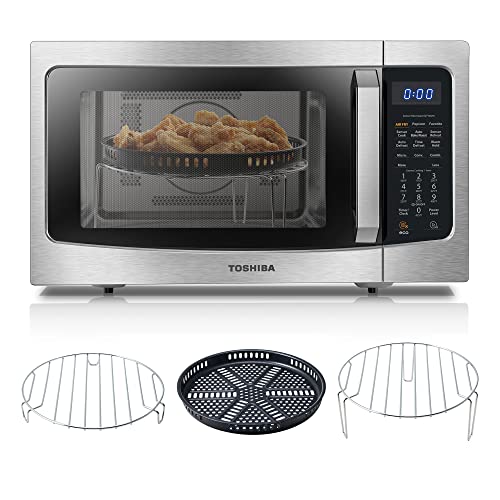
Toshiba 4-in-1 Microwave Oven with Air Fryer Combo 1.5 Cu.Ft — Best Overall
This Toshiba is the combination oven most households should buy, because it refuses to be small about anything: a 1.5 cubic foot cavity that takes a family chicken and a full-size dinner plate with room to spare, 1000W of microwave power, convection and air fry functions, and the thoughtful details — a smart sensor that judges reheating by steam, a mute function for open-plan peace, and a turntable that returns your mug handle to the front. It is the one-box kitchen at its most complete.
Strengths
- Largest cavity in this guide with family-size convection cooking
- Four functions in one: microwave, convection, air fry and combination work
- Position-memory turntable and mute function are daily-life refinements rivals skip
Trade-offs
- The footprint is a commitment — measure the counter, including door swing
- 1000W microwave is strong but not the fastest class for very large loads
- Feature depth means a first week spent learning the controls
| Specification | Detail |
|---|---|
| Capacity | 1.5 cu ft |
| Microwave power | 1000W |
| Functions | Microwave, convection, air fry, combination (4-in-1) |
| Extras | Smart sensor, mute, position-memory turntable |
Size is this pick’s argument and it is a strong one: combination ovens earn their counter space by replacing two appliances, and only the larger cavities genuinely replace the oven half of the bargain. At 1.5 cubic feet, the convection side roasts and bakes family quantities rather than token portions, and the air fry mode takes a full layer instead of a handful. Smaller combos are excellent reheating stations; this one is a cooker.
The refinements matter because combination ovens are used constantly, in both modes, by everyone in the house. A sensor that reheats without drying edges, a mute for late-night use, a turntable that stops where it started — none of these headline a box, and all of them are felt weekly. For the household buying one combination oven to serve for years, this is the complete answer.
Best for: families wanting one box that truly microwaves, roasts, bakes and air fries / Not suited for: the smallest counters or RVs, where the compact picks belong
Check the current price on Amazon
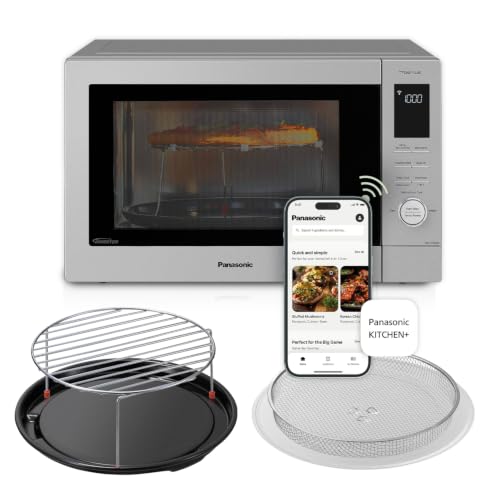
Panasonic HomeChef 4-in-1 NN-CV88QS Class — Best Inverter Microwave
Panasonic invented the inverter microwave, and the HomeChef is why that still matters: instead of blasting food at full power in cycles, inverter power delivers a true, steady lower wattage, so defrosting stops cooking the edges, reheating stops creating lava-and-ice plates, and delicate work like melting and softening becomes controllable. Around that core sits a 4-in-1 multi-oven — microwave, air fry, convection and combination — at a family-friendly 1.2 cubic feet, with 20 presets and app-linked recipes for guidance.
Strengths
- Inverter power: genuinely even defrosting, reheating and low-power control
- 4-in-1 versatility with convection technology in a 1.2 cu ft cavity
- 20 presets plus app-linked recipes lower the learning curve
Trade-offs
- Smaller cavity than the Toshiba flagship — large families should measure their dishes
- App features are garnish; the oven must earn its place without them
- Premium positioning for the inverter technology
| Specification | Detail |
|---|---|
| Capacity | 1.2 cu ft |
| Microwave power | 1000W inverter |
| Functions | 4-in-1 multi-oven with convection and air fry |
| Extras | 20 presets, app-linked recipes |
Judge this pick by the microwave half of the combination, because that is where it separates itself. Most households microwave daily and roast weekly; an inverter’s evenness improves the daily experience in a way a slightly larger cavity cannot. Defrosted mince without cooked edges, reheated pasta without rubber, baby bottles and sauces handled gently — the unglamorous work, done properly.
The convection and air fry sides are fully credible rather than decorative, and the preset library is written for real combination cooking rather than copied from a microwave-only model. If your usage skews microwave-heavy with serious cooking ambitions, the HomeChef is the connoisseur’s pick in this guide.
Best for: microwave-heavy households wanting the most even heating plus real convection / Not suited for: families needing the largest cavity above all else
Check the current price on Amazon

Toshiba OptiChef PRO MAX Air Fryer Combo 1.3 Cu.Ft — Best Smart Features
The OptiChef PRO MAX is the combination oven as a modern smart appliance: Toshiba’s Origin inverter technology for even microwave power, the strongest microwave wattage in this guide at 1100W, a 2.4-inch colour screen that makes two appliances’ worth of functions navigable, smart sensor cooking, and voice-assistant compatibility for hands-full moments. At 1.3 cubic feet it sits between the compact class and the flagship Toshiba, sized for serious family cooking.
Strengths
- Origin inverter power at 1100W — fast and even in microwave mode
- Colour screen makes a deep function set genuinely usable
- Smart sensor and voice compatibility for modern kitchens
Trade-offs
- Smart features age faster than heating elements — buy it for the oven first
- Voice control requires the household to live in that ecosystem
- Higher tier than the mid-size picks for its intelligence
| Specification | Detail |
|---|---|
| Capacity | 1.3 cu ft |
| Microwave power | 1100W, Origin inverter |
| Functions | Microwave, air fry combo, convection-class cooking |
| Extras | 2.4in colour screen, smart sensor, voice-assistant compatible |
The usability problem of combination ovens is real: two appliances’ functions behind one control panel can become a manual-dependent maze. The colour screen is this model’s substantive answer, presenting modes and steps visually instead of as codes to memorise. Combined with inverter power — the feature this guide rates most highly on the microwave side — the OptiChef is the pick for buyers who want the category’s full capability without the category’s usual friction.
Treat the voice compatibility as a pleasant extra rather than a reason: the oven earns its tier on power, evenness and interface. Households that do live by voice assistants will simply enjoy it more.
Best for: tech-comfortable households wanting inverter power with the easiest controls / Not suited for: buyers who prefer simple dials and the lowest tier that does the job
Check the current price on Amazon

Frigidaire 1.2 Cu Ft Microwave Air Fryer Convection Combo — Best Mid-Size All-Rounder
Frigidaire’s entry stakes out the middle of the category and occupies it sensibly: 1.2 cubic feet described as XL capacity for the class, microwave plus digital air fry plus convection in a stainless finish, and a combination mode — its Combo-Fry — that uses the technologies together the way this category promises. For buyers who trust an established appliance brand’s service network and want no extremes in any direction, it is the comfortable choice.
Strengths
- Balanced 1.2 cu ft size suits most families and counters
- Dedicated combination mode uses microwave and convection together
- Stainless finish and a major appliance brand behind it
Trade-offs
- No inverter — microwave power cycles conventionally
- Fewer smart refinements than the Toshiba and Panasonic picks
- Mid-size means the largest roasts still belong to the 1.5 cu ft flagship
| Specification | Detail |
|---|---|
| Capacity | 1.2 cu ft |
| Functions | Microwave, air fry, convection, combination (Combo-Fry) |
| Finish | Stainless steel |
| Class | Mid-size countertop combo |
There is a type of buyer this guide should serve plainly: the one who wants the category’s benefits without researching its theology. The Frigidaire is that buyer’s oven — a known brand, a sensible size, the full function triangle of microwave, convection and air fry, and a combination mode that delivers the speed-with-browning trick that justifies combination ovens in the first place.
Its compromises are the honest mid-range ones: conventional rather than inverter microwave power, and a feature set without the flagship garnishes. Neither prevents it cooking family food well for years, which is the actual assignment.
Best for: mainstream households wanting a balanced, brand-backed combination oven / Not suited for: inverter purists or the largest families
Check the current price on Amazon

Sharp SMC0985KS 3-in-1 Convection Air Fry Microwave 0.9 Cu Ft — Best Compact
Sharp more or less invented the home microwave’s popular form, and this compact combination shows the discipline: 0.9 cubic feet and 900W, with convection and air fry modes that make it a genuine small oven rather than a reheating box with ambitions. It suits the single or couple household, the small kitchen where the 1.5 cu ft flagship physically cannot go, and the office or studio that cooks real lunches.
Strengths
- True combination cooking in a compact footprint
- 900W microwave power is honest for the size class
- Stainless finish suits permanent counter residence
Trade-offs
- 0.9 cu ft limits convection batches and dish sizes — family roasts need the bigger picks
- Three functions rather than the four-in-one flagship set
- Compact cavities heat fast but crowd easily; single layers are mandatory
| Specification | Detail |
|---|---|
| Capacity | 0.9 cu ft |
| Microwave power | 900W |
| Functions | 3-in-1: microwave, convection, air fry |
| Finish | Stainless steel |
Compact combination ovens live or die on whether the convection side is real. In this Sharp it is: the cavity roasts and bakes in portions sized for its audience — a couple of chicken portions, a small tray of vegetables, a personal pizza — with browning a microwave alone cannot approach. That transforms a small kitchen’s cooking far more than a slightly faster reheating time would.
Buy it with eyes open about scale: it is a two-person oven wearing a family category’s clothes only in miniature. For its intended households, that is not a limitation but the entire point — full combination capability that fits the counter they actually have.
Best for: singles, couples, small kitchens and offices wanting real combination cooking / Not suited for: families or batch cooks, who need 1.2 cu ft and up
Check the current price on Amazon

BLACK+DECKER 5-in-1 Microwave Air Fryer Combo 0.9 Cu.Ft — Best Budget Compact
BLACK+DECKER’s compact makes the value case for the whole category: five functions around a 0.9 cubic foot, 900W core — microwave, air fry, and convection bake and roast among them — with ten power levels for control and a child lock for family and shared spaces. Its listing aims it squarely at small kitchens and RVs, which is exactly where a budget combination oven does the most good: one appliance, every cooking method, minimal counter.
Strengths
- Five functions at the budget tier of the combination category
- Convection bake and roast modes, not just microwave and air fry
- Child lock and compact size suit RVs, dorms and family micro-kitchens
Trade-offs
- 0.9 cu ft and 900W set firm limits on batch size and speed
- Budget-tier finish and controls compared with Sharp’s compact
- Ten power levels still cycle conventionally — no inverter evenness
| Specification | Detail |
|---|---|
| Capacity | 0.9 cu ft |
| Microwave power | 900W, 10 power levels |
| Functions | 5-in-1 incl. convection bake and roast, air fry |
| Extras | Child lock; small-kitchen and RV positioning |
The correct comparison for this pick is not the flagship Toshiba; it is the plain microwave it replaces in a tiny kitchen. Against that baseline, adding convection bake and roast plus air frying for a modest step up transforms what a small space can cook — real roasted food, baked food, crisped food — rather than merely reheated food. In an RV, where it may be the only oven aboard, that transformation is the whole holiday’s cooking.
Accept its scale and it will not disappoint: portions for one or two, single layers, sensible dishes. Ask it to cater for six and the fault is the brief, not the oven. As the budget door into combination cooking, it is honestly built and honestly badged here.
Best for: budget buyers, RVs, dorms and the smallest kitchens needing every method in one box / Not suited for: families or anyone regularly cooking for three or more
Check the current price on Amazon
Comparison Table
| Pick | Badge | Key spec | Best for |
|---|---|---|---|
| Toshiba 4-in-1 Microwave Oven with Air Fryer Combo 1.5 Cu.Ft | Best Overall | 1.5 cu ft, 1000W, 4-in-1 with convection | families wanting one box that truly microwaves, roasts, bakes and air fries |
| Panasonic HomeChef 4-in-1 NN-CV88QS Class | Best Inverter Microwave | 1.2 cu ft, 1000W inverter, 4-in-1 | microwave-heavy households wanting the most even heating plus real convection |
| Toshiba OptiChef PRO MAX Air Fryer Combo 1.3 Cu.Ft | Best Smart Features | 1.3 cu ft, 1100W inverter, colour screen | tech-comfortable households wanting inverter power with the easiest controls |
| Frigidaire 1.2 Cu Ft Microwave Air Fryer Convection Combo | Best Mid-Size All-Rounder | 1.2 cu ft, microwave + convection + air fry | mainstream households wanting a balanced, brand-backed combination oven |
| Sharp SMC0985KS 3-in-1 Convection Air Fry Microwave 0.9 Cu Ft | Best Compact | 0.9 cu ft, 900W, 3-in-1 compact | singles, couples, small kitchens and offices wanting real combination cooking |
| BLACK+DECKER 5-in-1 Microwave Air Fryer Combo 0.9 Cu.Ft | Best Budget Compact | 0.9 cu ft, 900W, 5-in-1 budget compact | budget buyers, RVs, dorms and the smallest kitchens needing every method in one box |
How to Choose the Best Combination Ovens: Microwave Convection
Decide which half of the combination you will use more, because the field splits on it. Microwave-dominant households should prioritise inverter power and sensor reheating — the Panasonic and the Toshiba OptiChef — since those decide daily satisfaction. Cooking-dominant households should prioritise cavity size and convection strength — the 1.5 cu ft Toshiba first — since a combination oven asked to be an oven must have room to be one. Households in the middle, which is most, are exactly who the 1.2 cu ft Frigidaire and HomeChef serve.
Capacity and the dish test
Apply the dish test before the litre test: measure your most-used oven dish and your largest dinner plate, and compare them with the cavity and turntable dimensions in the listing. A 0.9 cu ft oven serves singles and couples with standard plates; 1.2 cu ft takes family dishes and a respectable chicken; 1.5 cu ft is the only class here that stops feeling like a compromise for family roasting. Turntable diameter, not the brochure capacity, is the number that decides what fits.
Inverter versus conventional microwave power
Conventional microwaves deliver lower power by cycling full power on and off, which is why their defrosting cooks edges and their reheating stratifies. Inverter models deliver true continuous lower power, and the difference is tasted daily: even defrosting, gentle melting, reheats without rubber. It is the single most consequential technology choice in this category, and this guide weights it accordingly — while noting that conventional models at the right size and price still serve many households well.
Combination modes and cookware rules
The combination mode — microwave speed with convection heat — is the category’s signature: food cooks through faster than convection alone while browning as microwaves never can. Learn its cookware rules from the manual before the first use: pure microwave mode forbids metal; convection mode welcomes it; combination mode has its own specific allowances, usually the supplied rack and specified dishes. Every pick here ships with the rack its combination cooking expects — keep it with the oven, not in a drawer across the kitchen.
Living with a Combination Oven
Expect a learning curve of about a week. The cooks who thrive with these ovens build a small repertoire — the sensor reheat for leftovers, the combination roast for a weeknight chicken, the air fry mode for the foods that made them buy it — and let the preset library teach them the rest gradually. The cooks who struggle try to use it as a faster version of their old oven from day one; convection in a compact cavity runs hotter and faster than a big oven’s habits suggest, so early checks beat late regrets.
Keep the cavity clean with unusual diligence: a combination oven reheats breakfast in a space that roasted garlic the night before, and flavours travel. A wipe after fatty cooks and a bowl of water microwaved to steam-loosen residue weekly keeps the two halves of the appliance on speaking terms. The turntable and rack wash like any dish.
Finally, give the oven electrical and physical room: its own sensible circuit share, clearance for the convection heat it vents, and a permanent counter position. A combination oven that must be fetched from a cupboard is a combination oven that will be used as neither — the whole value of the category is that the one box is always there, ready in both its personalities.
Combination Ovens in Small Spaces: Flats, RVs and Offices
The combination oven’s natural habitat is the small kitchen, and each habitat has its own logic. In a studio or small flat, the combination oven is often the only oven, full stop — which argues for the largest cavity the counter can honestly hold, because every compromise lands on every meal. The 1.2 and 1.5 cu ft picks exist for these kitchens: they roast Sunday food, bake real bread-adjacent goods, and still reheat Tuesday’s leftovers at microwave speed. Measure the counter as if furnishing a room, because that is what you are doing.
In an RV or caravan, the calculus inverts: space and power are both rationed, the oven may be the vehicle’s only cooker beyond a hob, and the compact picks earn their place. The BLACK+DECKER’s explicit small-kitchen and RV positioning reflects real design priorities — modest draw, child lock for travelling families, every cooking method in the smallest honest box. Ventilation matters more on the move: convection mode produces real heat and cooking moisture in a small sealed volume, so the vehicle’s vents become part of the cooking system.
Offices and shared spaces are the third habitat, where the combination oven upgrades a reheating station into a place that can cook: sensor reheating for lunches, air frying for the foods a plain microwave ruins, and a mute function — the Toshiba flagship’s quiet courtesy — that open-plan colleagues will appreciate more than any cooking specification. In shared spaces, ease of cleaning decides whether the appliance stays welcome, which is one more argument for the simple-cavity models and a house rule about wiping after use.
What Combination Ovens Still Cannot Do
Honesty about limits is what separates a guide from a brochure, and this category has four real ones. First, batch size: even the largest combination cavity cooks for a family, not for a crowd, and air frying in particular punishes crowding — a dedicated large air fryer or countertop oven serves a big household’s crispy food better. Second, top-end baking: delicate, large-format baking — tall layer cakes, full-size loaves in quantity — belongs in a real oven whose heat is gentler and whose space is honest. The combination oven bakes well within its scale and should not be asked to pretend otherwise.
Third, simultaneous duties: one cavity means one temperature and one mode at a time, so the combination oven cannot reheat while it roasts — the two-oven problem it solves is sequential, not parallel. Households that regularly cook a main and a side at different temperatures simultaneously are the natural customers for the big countertop convection ovens in the companion guide, or for keeping a simple microwave beside a countertop oven instead of combining them.
Fourth, longevity of complexity: two appliances in one box means two systems’ worth of things that can age, and the smart features of the newest models will date faster than their heating elements. None of this diminishes the category — for its intended households it remains the highest-value box on the counter — but buyers who recognise their own cooking in these limits will choose better: the dedicated large oven, the separate microwave, or the combination, each in the kitchen it actually fits.
Presets, Sensors and the Learning Curve, Honestly Assessed
Combination ovens arrive wearing their intelligence on the panel — twenty presets here, a sensor there, an app beyond — and a buyer’s guide should sort the substance from the garnish. Sensor cooking is substance: measuring the steam a dish releases to judge its reheating or cooking progress is a genuine feedback loop, and it removes the most common microwave failure, the guess-the-time reheat that emerges half cold, half volcanic. If you evaluate nothing else about a model’s intelligence, evaluate its sensor claims and its inverter, because those two decide the daily experience.
Preset libraries are half substance. The good ones encode real combination programmes — the power balance between microwave and convection for a roast, a bake, a frozen dish — that would take a new owner weeks of experiments to find alone. The filler ones are microwave-only shortcuts wearing combination clothing. The tell is specificity: presets that ask for the food’s weight and dish type are programmes; presets that are merely named buttons are marketing. Both Toshiba picks and the Panasonic score well here, which is part of why they lead the list.
App-linked recipes and voice control are garnish — pleasant, occasionally handy, and the first features to age. Buy the oven whose heating, cavity and controls justify it with the app ignored, and let the connectivity be a bonus that delights rather than a foundation that dates. The households that love these ovens in year three are the ones that bought the appliance; the ones that bought the software update are shopping again.
The First Fortnight: A Sensible Way to Learn Your Combination Oven
New owners get the most from these ovens by staging their ambitions. Spend the first days on the microwave half alone — sensor reheats, inverter defrosting, the everyday work — until its controls are muscle memory. Then add one convection dish you already know well from a conventional oven, and compare: the same traybake or roast vegetables, cooked in the new cavity, teaches you its speed and hot spots in a single meal. Only then graduate to combination mode with the roast in the how-to section, where the payoff for the whole category lives.
Keep a small notebook — paper on the fridge beats an app — of the settings that worked for your five regular dishes. Combination ovens reward households that codify their own presets this way, because no factory programme knows your casserole dish, your portions, or your oven’s individual temperament. A fortnight of this gentle empiricism converts a bewildering two-in-one appliance into the most-used box in the kitchen, which is the outcome every pick in this guide was chosen to deliver.
How to Use Combination Mode for a Weeknight Roast Chicken
Combination cooking is the feature that justifies these ovens, and a small roast chicken is its perfect demonstration: microwave energy cooks the bird through quickly while convection browns and crisps the skin. The method below is generic across the guide’s picks — follow your model’s manual for its exact combination settings and cookware rules.
- Choose a chicken sized to the cavity with room for air to circulate around it — combination cooking still obeys convection’s rule that crowded food steams.
- Pat the skin dry, season, and truss loosely if you wish. Place the bird on the oven’s supplied low rack over a microwave-and-convection-safe dish to catch juices, following your manual’s cookware guidance for combination mode.
- Select the combination (microwave + convection) roast programme or set the convection temperature your manual recommends for combination roasting, and enter the weight if the oven asks — its programme is built around it.
- Start cooking and resist opening the door for the first half of the time; combination cavities are small and lose their heat advantage quickly.
- Check the internal temperature with a probe in the thickest part of the thigh near the end of the programme. The bird is done at safe poultry temperature regardless of what any timer believes.
- Rest the chicken, loosely covered, for ten minutes while you make a quick sauce from the dish juices. The skin stays crisp; the meat settles.
- Wipe the cavity while it is still warm — a combination oven that smells of roast at breakfast has been cleaned too late.
Adapt the same pattern to other foods and combination mode becomes a habit: jacket potatoes crisp-skinned in a fraction of oven time, gratins cooked through and browned on top, frozen-to-cooked dishes where the microwave half thaws and cooks while the convection half finishes. Start from the oven’s preset library for each food class before improvising your own settings; the presets encode the power balance the makers tested.
If results brown too fast, the convection share is dominating — drop the temperature a step. If food cooks through but stays pale, raise it. One variable at a time, and write down what worked: your oven’s ideal combination settings for your five regular dishes are worth a note on the cupboard door.
Common Buying Mistakes
Using metal in pure microwave mode
The oldest rule in microwave cooking does not retire because the oven gained functions. Metal is for convection mode; combination mode allows only what the manual specifies, typically the supplied rack and approved dishes. When in doubt, stop and check — the ten seconds of reading are cheaper than the alternative.
Buying the smallest cavity for a family
A 0.9 cu ft combination oven is a fine appliance for two people and a frustration machine for five. Dish and turntable dimensions decide real capacity, and no function list compensates for a chicken that does not fit. Size the oven to the household first; compare features second.
Judging the category by microwave wattage alone
Wattage describes only the reheating half. Convection temperature range, combination programmes, cavity size and sensor quality decide the cooking half — the half that justifies the purchase. A balanced 1000W combination oven out-cooks a 1200W microwave with a token grill every day of the week.
Expecting full-oven speed from the convection side
A compact convection cavity powered from a countertop appliance roasts more slowly than a full-size oven, especially loaded. Combination mode exists precisely to close that gap — use it for roasts and bakes rather than running convection alone and concluding the category is slow.
Skipping the manual’s combination cookware rules
Each model specifies which racks and dishes its combination mode allows, and they differ. The supplied rack is part of the cooking system, not packaging. Read the two pages that govern combination cooking before the first roast; they are the highest-value pages in the book.
Final Recommendation
Buy the Toshiba 1.5 cu ft 4-in-1 if one box must serve a family as microwave, oven and air fryer without apology — it is the most complete combination here. Choose the Panasonic HomeChef if your microwave work is daily and demanding and inverter evenness will be tasted every day. The OptiChef PRO MAX adds the smart interface and the strongest inverter power for tech-comfortable homes, while the Frigidaire is the balanced mainstream middle. Small households are genuinely well served by the Sharp, and the BLACK+DECKER opens the category at the budget tier for RVs and micro-kitchens.
Whichever model you choose, learn its combination mode on one good roast and the appliance will reorganise your weeknight cooking around itself. Readers comparing the other route to a second oven — pure convection, no microwave — will find the larger dedicated models in Best And Biggest Countertop Convection Ovens, and the cooling racks every roast deserves in Best Baking Cooling Racks.
Related guides in this program: Best And Biggest Countertop Convection Ovens; Best Baking Cooling Racks; Best Air Fryer Convection Ovens; Best Countertop Convection Ovens; Best 1.1 Cu Ft Microwaves.
Frequently Asked Questions
Can a combination microwave convection oven really replace a regular oven?
For small households and most dishes, yes: it roasts, bakes and browns genuinely, in portions sized to its cavity. Its limits are scale and speed — family-feast quantities and the largest trays belong to a full oven or a large countertop convection model. As a sole oven for singles, couples and small families, and as a second oven for everyone else, it is a legitimate replacement rather than a compromise novelty.
What is the advantage of an inverter combination oven?
Evenness. Inverter microwaves deliver continuous true power at lower settings instead of cycling full power on and off, so defrosting stops cooking edges, reheating stops stratifying into hot and cold zones, and delicate tasks like melting become controllable. Since most households microwave far more often than they roast, that daily improvement is why this guide rates inverter models so highly.
What does combination mode actually do?
It runs microwave and convection cooking together or in programmed sequence: the microwave energy cooks the food through quickly while the convection heat browns and crisps the outside. The result is roast-style food in substantially less time than convection alone, with a finish microwaves alone cannot produce. It is the defining capability of the category and the first feature new owners should learn.
Can I use my normal oven dishes in a combination oven?
In convection mode, yes — ovenproof dishes work as they would in any oven. In microwave mode, only microwave-safe dishes. In combination mode, follow your model’s manual precisely: typically the supplied rack and specified heat-and-microwave-safe dishes are approved. The turntable size also limits dish diameter, so measure your favourite dish against the cavity before assuming it fits.
What size combination oven does a family need?
As a working rule: 0.9 cu ft serves one or two people, 1.2 cu ft serves a small family, and 1.5 cu ft is the size at which family roasting stops feeling constrained. Judge by your largest regular dish and plate diameter against the turntable, not by the brochure number alone — and remember the oven’s footprint grows with the cavity, so measure the counter too.
Is an air fry mode in a combination oven as good as a dedicated air fryer?
For the portions a combination cavity holds, it is genuinely effective — the same hot, fast air does the same work. A dedicated air fryer wins on batch size for big families and on basket convenience; the combination wins on counter space, giving one appliance three jobs. Households that air fry for one or two will not miss the dedicated unit; households that air fry for six should read the large-oven guide instead.