Disclosure: airfryerkitchensupply.com is reader-supported. When you buy through links on our site, we may earn an affiliate commission at no extra cost to you.
Where to buy
Every verified pick below is listed on Amazon. Start with the top pick, compare the runner-up, compare the third pick, and keep the final pick in mind. Stock and prices move, so check price on Amazon on the day you order.
Coffee hour is a ministry of its own, and the best coffee makers for church use are the urns that never embarrass the volunteers running them. Church coffee is a specific job: fifty to a hundred cups across a fellowship hour, brewed by rotating helpers of varying experience, served to a line that forms all at once, and cleaned up by whoever drew the short straw. This guide is built entirely from large-capacity urns matched to that job, from 42-cup workhorses to the 100-cup vessels that cover Easter morning.
Size is the first honesty this category demands. Urn ‘cups’ are small coffee-service cups, not mugs — roughly five ounces each — so a 45-cup urn pours about twenty-five generous mugs. The reviews translate every capacity into realistic serving counts, because the classic church coffee failure is an urn that runs dry at the twenty-minute mark with a line still standing. Buy for your biggest regular Sunday, not your average one, and let the smaller picks here cover midweek groups and meetings.
The second honesty is about workflow. An urn is not just a brewer; it is the server, the warmer and the centrepiece of the coffee table. Spigot behaviour, drip trays, water-level visibility, and how the urn washes in a church kitchen sink matter as much as brew speed. Each review covers those serving details, and the buying guide turns them into a checklist your hospitality team can use with confidence.
In this guide
Quick Picks
Six church coffee urns made the cut. Each one earned its badge for a different reason, and the same badge follows the product into its full review below so you can track it through the article.
- Hamilton Beach 45 Cup Coffee Urn and Hot Beverage Dispenser, 40515G — Best Overall for Most Churches. 45-cup coffee urn and hot beverage dispenser. Check price on Amazon
- Hamilton Beach 45 Cup Fast Brew Coffee Urn, 40521G — Best for Back-to-Back Services. 45-cup fast-brew coffee urn and hot beverage dispenser. Check price on Amazon
- West Bend 100-Cup Commercial Coffee Urn, NSF — Best for Large Congregations and Events. 100-cup commercial coffee urn, polished aluminium, NSF approved. Check price on Amazon
- West Bend 42-Cup Coffee Urn — Best Value for Small-to-Mid Churches. 42-cup coffee urn, polished aluminium. Check price on Amazon
- Zulay 50 Cup Coffee Urn, Double-Wall Stainless Steel — Best Double-Wall Serving Quality. 50-cup coffee urn, double-wall stainless steel, commercial styling. Check price on Amazon
- Hamilton Beach Commercial 60 Cup Coffee Urn D50065 — Best Commercial-Grade for Heavy Use. 60-cup commercial coffee urn, polished stainless steel, commercial line. Check price on Amazon
How These Picks Were Chosen
Every urn was verified against Amazon listing for this site, so capacities and constructions match real current listings; only confirmed models received purchase links. The church filter then weighed serving reality: batch size against fellowship-hour demand, brew time against a volunteer’s morning, spigot and serving ergonomics for a self-serve line, and clean-up that fits a standard church kitchen.
Badges follow congregation size and role. The overall pick balances capacity, speed and price tier for the typical mid-size church. Others cover very large gatherings, fast turnaround between services, double-wall serving quality, and the commercial-grade option for churches whose urn works several days a week. No prices are printed — check price on Amazon — and remember that a church urn is a ten-year appliance: buy the capacity once, correctly.
Two practical screens were applied that product listings never mention. First, sink fit: every urn here can be washed in an ordinary church kitchen sink without gymnastics. Second, serviceability by ordinary people: lids, spigots and seals that a volunteer can rinse, descale and reassemble without tools or a manual. Church equipment is maintained by goodwill, and designs that respect that fact stay in service for decades while cleverer machines quietly disappear into a storage closet.
The 6 Best Options: Best coffee makers for church in Detail

Hamilton Beach 45 Cup Coffee Urn and Hot Beverage Dispenser, 40515G — Best Overall for Most Churches
The 40515G is the urn that lives in more church kitchens than any other for good reasons: 45 cups is the honest sweet spot for a mid-size fellowship hour, it brews at a pace a volunteer can manage between setting up chairs and unlocking doors, and the serving hardware — smooth spigot, drip tray, clear level view — suits a self-serve line of all ages. It doubles as a hot water dispenser for tea, which quietly serves the half of the congregation that does not drink coffee. Churches that run one service and one coffee hour will find this is simply the right size of right tool, at a tier that fits a hospitality budget.
Strengths
- 45-cup capacity matches a mid-size fellowship hour
- Serves as a hot beverage dispenser for tea drinkers too
- Volunteer-friendly controls and serving hardware
Trade-offs
- Two services back-to-back will outrun a single batch
- Too small for the biggest holiday mornings
- Batch coffee is best within the first hour of serving
| Key spec | 45-cup coffee urn and hot beverage dispenser |
|---|---|
| Format | High-capacity coffee urn — brews and serves a full batch from one vessel |
Run the maths with your own attendance: at roughly two small cups per coffee drinker, this urn covers a fellowship hour of about twenty to twenty-five coffee drinkers per batch — and it reheats its reputation every week by simply never being the problem.
In church service, Hamilton Beach 45 Cup Coffee Urn and Hot Beverage Dispenser, 40515G will be run by many hands — the early-morning regular, the new volunteer, the teenager helping before youth group — and its design assumes exactly that: controls that explain themselves, a spigot a line of people can operate without instruction, and cleaning that fits an ordinary kitchen. That volunteer-proofing is the real specification for church equipment, more than any single capacity figure, because the coffee ministry succeeds or fails on its least experienced morning. An urn that only performs for experts will eventually embarrass the ministry; Hamilton Beach 45 Cup Coffee Urn and Hot Beverage Dispenser, 40515G performs for everyone, which is why it holds its badge.
In weekly church use, the Hamilton Beach 45 Cup Coffee Urn and Hot Beverage Dispenser, 40515G is judged by people who never think about coffee equipment — which is the point. It either produces the right amount of coffee, at the right time, without a story attached, or it becomes the thing the hospitality team complains about in the kitchen. The 45-cup coffee urn and hot beverage dispenser format defines the volunteer routine around it: when it must be started, how the line moves past it, and how the wash-up goes at the end of the morning. Its Best Overall for Most Churches badge reflects how completely it fits the real rhythm of a congregation’s Sunday, including the parts of the morning nobody plans for.
Best for: mid-size churches and fellowship hours / Not suited for: very large congregations and multi-service mornings
Check on Amazon — check price on Amazon for the current listing before you buy.

Hamilton Beach 45 Cup Fast Brew Coffee Urn, 40521G — Best for Back-to-Back Services
The Fast Brew version of Hamilton Beach’s 45-cup urn exists for one schedule: the twenty minutes between services when the first urn is empty, the second congregation is arriving, and the volunteer team needs coffee now. Faster brewing turns the refill from a crisis into a routine, and everything else about the platform — serving hardware, dispenser duty, volunteer-proof operation — carries over. If your church brews once and serves once, the standard model above is the smarter buy; if your Sunday is a relay, the fast brew earns its tier every single week.
Strengths
- Faster brew cycle built for inter-service turnarounds
- Same proven 45-cup serving platform
- Hot beverage dispenser duty for tea and cocoa
Trade-offs
- Speed is wasted on single-service schedules
- Still a 45-cup batch — big mornings need a second vessel
- Fast cycles reward a volunteer who starts it on time
| Key spec | 45-cup fast-brew coffee urn and hot beverage dispenser |
|---|---|
| Format | High-capacity coffee urn — brews and serves a full batch from one vessel |
The practical system for two-service churches is choreography: first urn started before the first service, second batch started the moment the first service ends. This urn is the one that makes that choreography physically possible.
In church service, Hamilton Beach 45 Cup Fast Brew Coffee Urn, 40521G will be run by many hands — the early-morning regular, the new volunteer, the teenager helping before youth group — and its design assumes exactly that: controls that explain themselves, a spigot a line of people can operate without instruction, and cleaning that fits an ordinary kitchen. That volunteer-proofing is the real specification for church equipment, more than any single capacity figure, because the coffee ministry succeeds or fails on its least experienced morning. An urn that only performs for experts will eventually embarrass the ministry; Hamilton Beach 45 Cup Fast Brew Coffee Urn, 40521G performs for everyone, which is why it holds its badge.
Across a church year, the Hamilton Beach 45 Cup Fast Brew Coffee Urn, 40521G will face the full calendar: ordinary Sundays, the Christmas and Easter peaks, a wedding, a funeral with two hours’ notice. Equipment that only suits the ordinary weeks fails the ministry precisely when the community needs it most. The 45-cup fast-brew coffee urn and hot beverage dispenser design was assessed against that whole calendar — capacity for the peaks, economy for the ordinary weeks, and operation simple enough for the substitute volunteer who gets the phone call on Saturday night. That breadth is what the Best for Back-to-Back Services badge is certifying here.
Best for: churches running two services with a short turnaround / Not suited for: single-service churches that brew well ahead
Check on Amazon — check price on Amazon for the current listing before you buy.

West Bend 100-Cup Commercial Coffee Urn, NSF — Best for Large Congregations and Events
One hundred cups is the scale of Easter, of conference weekends, of the funeral reception where the whole town comes through the fellowship hall. West Bend’s big urn — polished aluminium, NSF approved — is the institutional classic for exactly those days, and for large churches it is the weekly driver rather than the special-occasion piece. NSF approval matters in church life more than people expect: many church kitchens host outside groups, preschools and inspected food programs, and listed equipment keeps all of that simple. The honest caveat is scale discipline — a 100-cup urn brewing for a twelve-person Bible study wastes coffee and electricity, which is why large churches pair it with a smaller urn from this list.
Strengths
- 100-cup capacity covers the biggest church mornings
- NSF approved for inspected and multi-use kitchens
- Institutional design proven across decades of service
Trade-offs
- Oversized and wasteful for small gatherings
- Long brew time demands early volunteer starts
- Aluminium care — keep it bright with proper washing
| Key spec | 100-cup commercial coffee urn, polished aluminium, NSF approved |
|---|---|
| Format | High-capacity coffee urn — brews and serves a full batch from one vessel |
Churches that own this urn describe the same relief: the biggest days stop being logistics problems. Pair it with any 45-cup pick for ordinary weeks and the coffee ministry is equipped for the whole calendar.
In church service, West Bend 100-Cup Commercial Coffee Urn, NSF will be run by many hands — the early-morning regular, the new volunteer, the teenager helping before youth group — and its design assumes exactly that: controls that explain themselves, a spigot a line of people can operate without instruction, and cleaning that fits an ordinary kitchen. That volunteer-proofing is the real specification for church equipment, more than any single capacity figure, because the coffee ministry succeeds or fails on its least experienced morning. An urn that only performs for experts will eventually embarrass the ministry; West Bend 100-Cup Commercial Coffee Urn, NSF performs for everyone, which is why it holds its badge.
In weekly church use, the West Bend 100-Cup Commercial Coffee Urn, NSF is judged by people who never think about coffee equipment — which is the point. It either produces the right amount of coffee, at the right time, without a story attached, or it becomes the thing the hospitality team complains about in the kitchen. The 100-cup commercial coffee urn, polished aluminium, NSF approved format defines the volunteer routine around it: when it must be started, how the line moves past it, and how the wash-up goes at the end of the morning. Its Best for Large Congregations and Events badge reflects how completely it fits the real rhythm of a congregation’s Sunday, including the parts of the morning nobody plans for.
Best for: large churches, conferences and wedding/funeral receptions / Not suited for: small churches — it will brew mostly air
Check on Amazon — check price on Amazon for the current listing before you buy.
West Bend 42-Cup Coffee Urn — Best Value for Small-to-Mid Churches
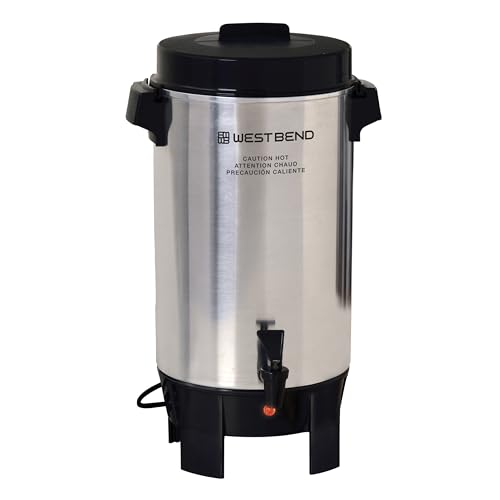
West Bend’s 42-cup urn is the value expression of the same institutional idea: polished aluminium, simple controls, a spigot line of people can work, and a capacity that honestly covers a small-to-mid fellowship hour. It lacks the NSF listing and the sheer scale of its 100-cup sibling, and for a church whose kitchen serves its own congregation, that trade is often exactly right. It is also the natural second urn — the one that handles decaf beside the big urn’s regular, or covers the midweek meetings while the big vessel rests. Church coffee programs frequently end up as a two-urn system, and this is the most economical way to own the smaller half.
Strengths
- 42 cups at the friendliest tier in this guide
- Simple, volunteer-proof operation
- Ideal second urn for decaf or midweek duty
Trade-offs
- No NSF listing for inspected settings
- Single batch per fellowship hour at its size
- Aluminium finish needs proper care to stay bright
| Key spec | 42-cup coffee urn, polished aluminium |
|---|---|
| Format | High-capacity coffee urn — brews and serves a full batch from one vessel |
Decaf deserves a sentence: at most churches it is a fifth to a quarter of coffee demand, and a dedicated smaller urn ends the sticky-note-on-the-urn era. This is the urn that usually gets that honourable job.
In church service, West Bend 42-Cup Coffee Urn will be run by many hands — the early-morning regular, the new volunteer, the teenager helping before youth group — and its design assumes exactly that: controls that explain themselves, a spigot a line of people can operate without instruction, and cleaning that fits an ordinary kitchen. That volunteer-proofing is the real specification for church equipment, more than any single capacity figure, because the coffee ministry succeeds or fails on its least experienced morning. An urn that only performs for experts will eventually embarrass the ministry; West Bend 42-Cup Coffee Urn performs for everyone, which is why it holds its badge.
Across a church year, the West Bend 42-Cup Coffee Urn will face the full calendar: ordinary Sundays, the Christmas and Easter peaks, a wedding, a funeral with two hours’ notice. Equipment that only suits the ordinary weeks fails the ministry precisely when the community needs it most. The 42-cup coffee urn, polished aluminium design was assessed against that whole calendar — capacity for the peaks, economy for the ordinary weeks, and operation simple enough for the substitute volunteer who gets the phone call on Saturday night. That breadth is what the Best Value for Small-to-Mid Churches badge is certifying here.
Best for: small-to-mid churches watching the budget / Not suited for: large or multi-service congregations
Check on Amazon — check price on Amazon for the current listing before you buy.

Zulay 50 Cup Coffee Urn, Double-Wall Stainless Steel — Best Double-Wall Serving Quality
The Zulay’s argument is what happens after brewing: double-wall stainless insulation holds the coffee’s temperature — and therefore its flavour — through a long fellowship hour without a heating element steadily cooking it, and the exterior stays safer to touch around a crowded serving table. Fifty cups sits a step above the 45-cup class, covering mid-size churches with a little headroom, and the stainless build presents well in the hall. It is heavier than aluminium rivals, as double-wall stainless always is, and the brand’s church-kitchen track record is shorter than the heritage names — the two honest costs of its serving-quality advantage.
Strengths
- Double-wall insulation protects flavour across a long coffee hour
- 50-cup capacity with headroom over the 45-cup class
- Stainless exterior stays cooler and presents well
Trade-offs
- Heavier to carry to the sink when full or empty
- Shorter institutional track record than West Bend or Hamilton Beach
- Premium tier within this urn class
| Key spec | 50-cup coffee urn, double-wall stainless steel, commercial styling |
|---|---|
| Format | High-capacity coffee urn — brews and serves a full batch from one vessel |
For churches where coffee hour genuinely runs an hour or more — the ones where the fellowship is the point — holding quality across that hour is not a luxury. This is the urn built around that reality.
In church service, Zulay 50 Cup Coffee Urn, Double-Wall Stainless Steel will be run by many hands — the early-morning regular, the new volunteer, the teenager helping before youth group — and its design assumes exactly that: controls that explain themselves, a spigot a line of people can operate without instruction, and cleaning that fits an ordinary kitchen. That volunteer-proofing is the real specification for church equipment, more than any single capacity figure, because the coffee ministry succeeds or fails on its least experienced morning. An urn that only performs for experts will eventually embarrass the ministry; Zulay 50 Cup Coffee Urn, Double-Wall Stainless Steel performs for everyone, which is why it holds its badge.
In weekly church use, the Zulay 50 Cup Coffee Urn, Double-Wall Stainless Steel is judged by people who never think about coffee equipment — which is the point. It either produces the right amount of coffee, at the right time, without a story attached, or it becomes the thing the hospitality team complains about in the kitchen. The 50-cup coffee urn, double-wall stainless steel, commercial styling format defines the volunteer routine around it: when it must be started, how the line moves past it, and how the wash-up goes at the end of the morning. Its Best Double-Wall Serving Quality badge reflects how completely it fits the real rhythm of a congregation’s Sunday, including the parts of the morning nobody plans for.
Best for: churches whose coffee hour runs long / Not suited for: volunteers wanting the lightest possible urn to carry
Check on Amazon — check price on Amazon for the current listing before you buy.

Hamilton Beach Commercial 60 Cup Coffee Urn D50065 — Best Commercial-Grade for Heavy Use
Some church urns work one morning a week; others serve Sunday services, a weekday school, Wednesday suppers and every reception in between. The D50065 comes from Hamilton Beach’s commercial line for that heavier life: 60 cups, polished stainless, and construction specified for repeated commercial duty. It is the urn to buy when the coffee ministry is really a small hospitality operation, and when the cost of a failure is measured in events, not Sundays. For a once-a-week small church it is more machine and more capacity than the job needs — the 45-cup picks serve that life better and cheaper.
Strengths
- Commercial-line build for multi-day weekly duty
- 60 cups bridges fellowship hours and events
- Polished stainless suits public-facing serving
Trade-offs
- More capacity and cost than small churches need
- Large footprint in the kitchen and in storage
- Batch timing still rules quality — capacity is not freshness
| Key spec | 60-cup commercial coffee urn, polished stainless steel, commercial line |
|---|---|
| Format | High-capacity coffee urn — brews and serves a full batch from one vessel |
Think of this as the urn for a church campus rather than a church kitchen. If your building hosts people six days a week, the commercial line is not an upgrade; it is the correct specification.
In church service, Hamilton Beach Commercial 60 Cup Coffee Urn D50065 will be run by many hands — the early-morning regular, the new volunteer, the teenager helping before youth group — and its design assumes exactly that: controls that explain themselves, a spigot a line of people can operate without instruction, and cleaning that fits an ordinary kitchen. That volunteer-proofing is the real specification for church equipment, more than any single capacity figure, because the coffee ministry succeeds or fails on its least experienced morning. An urn that only performs for experts will eventually embarrass the ministry; Hamilton Beach Commercial 60 Cup Coffee Urn D50065 performs for everyone, which is why it holds its badge.
Across a church year, the Hamilton Beach Commercial 60 Cup Coffee Urn D50065 will face the full calendar: ordinary Sundays, the Christmas and Easter peaks, a wedding, a funeral with two hours’ notice. Equipment that only suits the ordinary weeks fails the ministry precisely when the community needs it most. The 60-cup commercial coffee urn, polished stainless steel, commercial line design was assessed against that whole calendar — capacity for the peaks, economy for the ordinary weeks, and operation simple enough for the substitute volunteer who gets the phone call on Saturday night. That breadth is what the Best Commercial-Grade for Heavy Use badge is certifying here.
Best for: churches with several services, schools or daily programs / Not suited for: small churches brewing once a week
Check on Amazon — check price on Amazon for the current listing before you buy.
Comparison Table
| Pick | Badge | Key spec | Best for |
|---|---|---|---|
| Hamilton Beach 45 Cup Coffee Urn and Hot Beverage Dispenser, 40515G | Best Overall for Most Churches | 45-cup coffee urn and hot beverage dispenser | mid-size churches and fellowship hours |
| Hamilton Beach 45 Cup Fast Brew Coffee Urn, 40521G | Best for Back-to-Back Services | 45-cup fast-brew coffee urn and hot beverage dispenser | churches running two services with a short turnaround |
| West Bend 100-Cup Commercial Coffee Urn, NSF | Best for Large Congregations and Events | 100-cup commercial coffee urn, polished aluminium, NSF approved | large churches, conferences and wedding/funeral receptions |
| West Bend 42-Cup Coffee Urn | Best Value for Small-to-Mid Churches | 42-cup coffee urn, polished aluminium | small-to-mid churches watching the budget |
| Zulay 50 Cup Coffee Urn, Double-Wall Stainless Steel | Best Double-Wall Serving Quality | 50-cup coffee urn, double-wall stainless steel, commercial styling | churches whose coffee hour runs long |
| Hamilton Beach Commercial 60 Cup Coffee Urn D50065 | Best Commercial-Grade for Heavy Use | 60-cup commercial coffee urn, polished stainless steel, commercial line | churches with several services, schools or daily programs |
Read the table as a map, not a ranking. The badges matter more than the order: a pick that wins on capacity and serving speed can still be the wrong buy if your daily routine points the other way.
How big an urn does your church actually need?
Count coffee drinkers at your biggest regular gathering, multiply by two small cups each, and add headroom for guests — then buy that size. A 45-cup urn serves roughly twenty to twenty-five drinkers per batch; the 100-cup covers fifty-plus. Churches between sizes should buy the larger urn plus a small second urn for decaf and midweek, rather than one mid-size compromise that is wrong in both directions. Holiday peaks can be covered by brewing a second batch or borrowing — do not buy a giant urn for two Sundays a year.
Regular, decaf and tea: planning the full table
A complete church coffee station is a system: a main urn for regular, a smaller urn for decaf (clearly labelled — decaf drinkers are loyal and vocal), and hot water for tea and cocoa, which several urns here provide in dispenser mode or which a kettle covers. Label everything, put the sweeteners and cups where the line flows naturally, and the station runs itself with one volunteer supervising instead of three serving.
Brew timing for volunteers
Urn coffee has a rhythm: a full batch takes the better part of an hour on standard models, faster on the fast-brew pick. Work backwards from the service end time, assign the urn start to a named role — not ‘someone’ — and tape the start time to the urn itself. The fast-brew model exists for churches whose schedule cannot start early enough; everyone else solves timing with choreography, which is free.
Cleaning and care in a church kitchen
Urn coffee oils build up invisibly and turn next week’s coffee stale-tasting, so the routine matters: rinse after every use, wash with detergent weekly, and run a descaling or urn-cleaning cycle on a posted schedule — monthly in hard-water areas. Store urns dry with lids ajar. Churches that post the cleaning rota beside the urn never have the mystery of why the coffee ‘tastes off lately’.
What does a church coffee program cost to run well?
The urn itself is the small part — check price on Amazon for the vessel, then budget honestly for the system: coffee in food-service quantities, cups and lids, sweeteners, a second smaller urn for decaf, and the cleaning supplies on the posted rota. Even generously costed, a church coffee hour runs at a remarkably low cost per cup, because the labour is volunteered and the equipment lasts for years. The expensive version of church coffee is the false economy: an undersized urn, a line that runs dry, and a replacement bought in a hurry at whatever price the week demands.
How to Run Church Coffee Hour Without the Panic
A simple, repeatable system any volunteer can run, sized for the urns above.
- The day before: check coffee, filters if your urn uses them, cups, sweeteners and the decaf supply. Running out is a planning failure, not a Sunday surprise.
- On the morning: fill the urn with fresh cold water to the batch line, add coffee per the urn’s measure, and start it at the posted time — before the first service for most churches.
- Set the serving table while it brews: urn at one end, cups and lids next, sweeteners and stirrers after, so the line flows in one direction.
- At serving time, draw and taste a small cup yourself first. If anything is wrong, you want to know before the line does.
- Start the second batch or the decaf urn as the first service ends if your schedule has two waves.
- After coffee hour: grounds to the bin, rinse the urn, wash the spigot area carefully, and leave the urn dry and open to air.
Post those six steps inside the kitchen cupboard door. Volunteer turnover is the constant of church life, and a posted system is how the coffee stays good regardless of whose Sunday it is.
Common Buying Mistakes
Buying for the average Sunday
Average Sundays forgive everything; Easter does not. Size the main urn for the biggest regular gathering and cover ordinary weeks with the same urn or a smaller partner.
One urn, three jobs
Regular, decaf and hot water from a single vessel means two of the three are improvised badly. The two-urn system — main plus a 42 or 45-cup partner — is the standard fix.
No named owner of the start time
‘Someone should start the coffee’ is how coffee hour starts late. A named role and a taped start time end the problem permanently.
Neglecting the wash rota
Church urns fail by flavour before they fail by function. Posted cleaning schedules keep both the coffee and the volunteers’ confidence intact.
Final Recommendation
Most churches should buy the Hamilton Beach 45-Cup (40515G) and run it with the posted system in this guide. Two-service churches should choose the Fast Brew 40521G or add it as the second urn; large congregations and event-heavy churches step up to the West Bend 100-Cup or the commercial Hamilton Beach 60-Cup; and long, lingering coffee hours are best served by the double-wall Zulay.
Equip the station as a system — main urn, decaf partner, labels, posted times, wash rota — and coffee hour becomes what it is meant to be: the easiest hour of the church week to host well.
Ready to buy? Compare the full shortlist on Amazon: Hamilton Beach 45 Cup Coffee Urn and Hot Beverage Dispenser, 40515G, Hamilton Beach 45 Cup Fast Brew Coffee Urn, 40521G, West Bend 100-Cup Commercial Coffee Urn, NSF, West Bend 42-Cup Coffee Urn, Zulay 50 Cup Coffee Urn, Double-Wall Stainless Steel, Hamilton Beach Commercial 60 Cup Coffee Urn D50065. Check price on Amazon for each before ordering, since listings, bundles and stock change often.
Keep exploring the same cluster on this site: Best Coffee Makers For Cafe Best Coffee Makers For Campers Best 20 Cup Coffee Makers Best 30 50 Cup Coffee Makers Best Coffee Makers For Beginners
The Hospitality Details Around the Urn
The urn is the engine, but the table is the experience. Put the cups where hands expect them, keep a small bin for stirrers and empty packets within reach of the line’s end, and station a volunteer with a cloth for the drips that every spigot eventually produces. Those details, repeated weekly, are what make a coffee hour feel cared for rather than merely supplied.
Labelling deserves its own emphasis in church life: regular and decaf urns must be labelled in a way that survives volunteer rotation — a fixed sign or a coloured band that never moves, not a sticky note. Decaf drinkers often have medical reasons for their choice, and the church that labels reliably is practising a small, real form of care.
Finally, recruit the coffee team like the ministry it is. A rota of trained pairs, a posted system and equipment sized honestly means no single volunteer carries the morning, and the urn you chose from this guide will still be serving — and being thanked for — a decade from now.
Recruiting and keeping coffee volunteers is an equipment issue in disguise. People repeat tasks that are set up to succeed: a labelled station, a posted start time, an urn sized so they are never apologising for an empty pot. Churches that treat the coffee rota as a real ministry — with training, thanks and working equipment — stop having a volunteer problem at the coffee table.
Accessibility at the serving table is worth one deliberate pass: a spigot height and lever that seated members and children can manage, cups placed before the urn in the line’s flow, and a clear path that does not cross the kitchen door. The urns in this guide all serve from a simple lever spigot, which is one reason the class suits congregations so well.
Consider, as well, what the coffee hour says to a first-time visitor. Long before they can judge a sermon or a small group, a guest has judged the welcome — and a well-run coffee station, with a full urn, clear labels and a volunteer who is free to talk rather than troubleshoot, is the welcome in physical form. The equipment decisions in this guide are, in that sense, hospitality decisions: capacity that never runs dry in front of a guest, labels that never confuse, and a system that leaves the hosts free to host.
Succession is the other quiet argument for the simple, standard equipment chosen here. Church ministries outlive their founders; the coffee team of 2035 will inherit whatever is bought today. Mainstream urns with posted routines and available parts hand over gracefully, while idiosyncratic equipment retires with the one volunteer who understood it. Buy the urn the next generation of volunteers can run, and the ministry survives its own success.
Finally, keep a small reserve in the coffee budget for the inevitable: a dropped decanter equivalent in the urn world is a failed spigot seal or a cracked lid on the biggest Sunday of the season. Churches with a spare-parts envelope and the supplier already identified turn those moments into footnotes; churches without one turn them into announcements. The urns here all have obtainable parts — the reserve is what makes that fact useful at 8 a.m. on Easter.
Do not forget the decaf drinkers in the signage budget: a permanent, dignified label — not a handwritten note — tells a real part of the congregation that they were planned for. Churches report that decaf loyalty is fierce precisely because those drinkers have so often been an afterthought elsewhere; the second urn and the proper label are a small purchase that reads as genuine care.
Temperature at the table is the other detail guests notice without naming: an urn stationed away from exterior doors and drafts holds its serving quality noticeably better through a long fellowship hour, and cups stacked beside it stay cleaner than cups stored across a busy kitchen. Station placement is free, and it is worth one deliberate decision rather than a decade of habit.
Review the whole coffee ministry once a year — urn condition, rota health, supplies, and whether the congregation’s size still matches the equipment. Churches grow and shrink; the coffee system that was right at purchase drifts out of fit quietly. An annual ten-minute review keeps the urn, the team and the welcome in step with the church they serve.
And a word for the volunteer who inherits the urn mid-morning with no handover: the posted system in this guide is written for you. Start times on the urn, steps inside the cupboard door, labels that never move — a station designed so that a willing stranger can run it well is a station designed correctly, and every equipment choice in this guide was made with that stranger’s morning in mind.
One final church note: nobody joins a church because of its coffee urn, but plenty of people feel at home in a congregation sooner because somebody handed them a good cup and had time to talk. Equipment that never runs dry, never confuses and never breaks down mid-morning is what buys the volunteers that time — and time, at coffee hour, is the whole ministry.
Frequently Asked Questions
How many cups of coffee does a church of 100 need?
Expect roughly half to two-thirds of adults to drink coffee, at about two small urn cups each — so 100 to 130 small cups across a full fellowship hour, meaning a 100-cup urn plus a second batch, or a 100-cup urn and a 45-cup partner running decaf and overflow.
Is an NSF-approved urn necessary for a church?
Not for serving your own congregation in most places, but it becomes important when the kitchen hosts inspected programs, preschools or outside groups. The West Bend 100-cup here carries the listing if your situation needs it.
Can one urn make both coffee and hot water for tea?
An urn brews one batch at a time. Churches either dedicate a second smaller urn or a kettle to hot water, or use a dispenser-model urn for water after the coffee batch. Plan the tea drinkers into the system, not around it.
How long does a big urn take to brew?
Standard urns brew roughly a cup a minute or slower, so a full 100-cup batch approaches an hour or more; the fast-brew 45-cup model shortens its cycle notably. Always work backwards from serving time.
How do you keep urn coffee tasting fresh through a long coffee hour?
Brew as close to serving as the schedule allows, keep the lid closed between pours, and prefer double-wall insulation for long hours. Coffee held past about an hour declines regardless of the vessel.
What coffee should a church buy for an urn?
A medium-roast, pre-ground coffee bought in food-service quantities suits urn brewing and broad tastes. Consistency matters more than prestige — the congregation’s loyalty is to the cup they expect.


