Disclosure: airfryerkitchensupply.com is reader-supported. When you buy through links on our site, we may earn an affiliate commission at no extra cost to you.
Where to buy
Every pick in this guide to the best 20 cup coffee makers was verified against a current Amazon listing, so the models, capacities and specifications below are the manufacturers’ own.
Urn capacities are stated in the same five-ounce ‘cups’ as drip machines — every pick below is a verified listing, and each review gives the batch range in cups so you can plan for your actual headcount.
- Nesco Professional Coffee Urn, 30 Cups, Stainless Steel — Check the current price on Amazon
- VEVOR Commercial Coffee Urn, 30 Cup — Check the current price on Amazon
- NUPANT Commercial Coffee Urn 30 Cup / 4.5L — Check the current price on Amazon
- West Bend Coffee Urn, Highly-Polished Aluminum — Check the current price on Amazon
- BLACK+DECKER 40-Cup Coffee Urn — Check the current price on Amazon
- Hamilton Beach 45 Cup Coffee Urn and Hot Beverage Dispenser — Check the current price on Amazon
Here is the honest starting point for the best 20 cup coffee makers: machines labeled exactly ’20-cup’ are rare to the point of near-nonexistence in the current verified market. Coffee urns — the machines that serve this volume — cluster at 30, 40, 45 and 50 cups, because those are the sizes event service standardized on. The good news is that the best urns brew partial batches gracefully: a 30-cup urn asked for 20 cups is operating comfortably inside its range, not straining at its edge. This guide therefore ranks the smallest, most flexible urns that cover a 20-cup need properly — and says plainly that this, not a mythical 20-cup label, is how the category actually works.
Who brews twenty cups? A small office’s morning, a church coffee hour, a team meeting, a family reunion’s breakfast, a bake sale table. It is the volume where a 12 or 14-cup drip machine fails visibly — two pots in, the line is still waiting — and where a 50-cup commercial urn is theatrical overkill that brews tired coffee by the event’s second hour. The 20-cup need is real, common and oddly underserved by labels, which is why this guide exists in this form.
The six picks below were verified, with batch ranges taken from their listings. We ranked them by the things that decide urn satisfaction at this scale: how well they handle a partial batch, how fast they brew, how cleanly the spigot pours for a self-serve line, and how manageable the vessel is to fill, carry and clean when the event is over and everyone else has gone home.
In this guide
Quick Picks
Six urns that cover 20 cups the right way — flexible 30-cup models first, then larger urns for hosts whose ’20-cup’ events keep growing.
- Best Overall for 20 Cups — Nesco Professional Coffee Urn, 30 Cups, Stainless Steel: A 30-cup stainless urn whose size puts a 20-cup batch in the middle of its range — the natural fit for this need. Check price on Amazon.
- Best Value for 20 Cups — VEVOR Commercial Coffee Urn, 30 Cup: A 30-cup stainless urn at a value tier, with a 1090W element that respects an event timeline. Check price on Amazon.
- Best 30-Cup for Coffee Quality — NUPANT Commercial Coffee Urn 30 Cup / 4.5L: 304 stainless steel and an upgraded percolator design aimed at more even extraction in the 30-cup class. Check price on Amazon.
- Best Classic Urn — West Bend Coffee Urn, Highly-Polished Aluminum: The heritage pick: West Bend’s polished aluminum urn with automatic temperature control and cup-per-minute brewing heritage. Check price on Amazon.
- Best If Your Events Are Growing — BLACK+DECKER 40-Cup Coffee Urn: A 40-cup urn with a drip-free spigot — buy it when ’20-cup events’ have started ending with an empty urn. Check price on Amazon.
- Best Flexible Large Urn — Hamilton Beach 45 Cup Coffee Urn and Hot Beverage Dispenser: The flexibility champion: a documented 15-to-45-cup batch range with fast brewing, covering 20 cups and everything around it. Check price on Amazon.
How These Picks Were Chosen
Capacity logic came first, and it inverted the usual ranking: for a 20-cup need, the best machine is the smallest urn that covers it well, not the largest. Smaller urns brew faster per event, waste less when attendance dips, and store in a closet instead of a garage. That logic puts the flexible 30-cup class at the top of this guide and treats the 40 and 45-cup models as growth options for hosts whose events keep expanding.
Partial-batch behavior was the second filter. An urn that brews 20 cups well needs a minimum batch comfortably below 20 and even percolation across its range — the Hamilton Beach 45-cup’s stated 15-to-45 range is the documented example of the flexibility we looked for. Models whose sweet spot starts at their maximum were ranked down, because a 20-cup event should sit in an urn’s middle, not at its floor or ceiling.
Service details finished the ranking: spigot design for drip-free self-service, lid security for transport between kitchen and hall, and the unglamorous question of how the vessel cleans. An urn is event infrastructure; the event is remembered for the coffee line moving and the floor staying dry, and those are spigot-and-lid outcomes as much as brewing ones.
The 6 Best Coffee Makers for 20-Cup Service (Urn Guide)

1. Nesco Professional Coffee Urn, 30 Cups, Stainless Steel — Best Overall for 20 Cups
Nesco’s Professional 30-cup urn is a stainless steel event brewer sized for offices, church halls and medium gatherings.
The Nesco Professional 30-cup urn leads this guide because arithmetic favors it: a 20-cup event sits at two-thirds of its capacity, squarely in the zone where an urn percolates evenly and holds temperature without strain. It is stainless, professionally styled for an office or church hall, and sized so that one person can fill it, move it and clean it without recruiting help — the unglamorous property that decides whether an urn gets used for the tenth event or quietly avoided after the third.
Strengths
- 30-cup size hits the sweet spot for offices and medium gatherings
- Stainless steel body looks right in professional settings
- Nesco is an established urn brand with a long product history
Trade-offs
- 30 cups is the ceiling — bigger events need a second urn
- Percolator brewing needs coarse grounds for best results
- No partial-batch finesse of smaller home machines; plan your batch size
| Key spec | 30-cup urn, stainless steel, professional positioning |
|---|---|
| Format | 30-cup urn, stainless steel, professional |
Nesco’s long history with urns shows in the details that matter at service: the vessel is built for repeated event duty rather than occasional novelty use. For a 20-cup brief, its headroom is also insurance — the meeting that grows to twenty-six cups does not require a second machine, just a fuller batch. Hosts whose events fluctuate between fifteen and thirty servings will find this the most forgiving single purchase in the guide.
The percolator character applies, as it does to every urn here: bold, hot, hold-friendly coffee rather than delicate drip nuance. At a coffee hour, that is the correct profile — the cup is meant to accompany conversation and a pastry, not to be cupped and scored. Buyers who accept the format’s nature get a machine that performs its role for years; buyers who wanted drip subtlety at volume should read our 14-cup guide and brew twice.
Best for: offices, churches and hosts serving 15–30 cups per event / Not suited for: drip purists — urn coffee is percolator coffee, proudly
Check on Amazon — check price on Amazon before you buy, since listings and configurations change.

2. VEVOR Commercial Coffee Urn, 30 Cup — Best Value for 20 Cups
VEVOR’s 30-cup commercial urn is a 1090W stainless hot beverage dispenser for catering, business, party and church use.
VEVOR’s 30-cup urn is the budget route into this guide’s sweet spot: the same event arithmetic as the Nesco — twenty cups in the middle of the range — in stainless steel with a 1090W element, at the value tier VEVOR is known for. For a community group, a small business or a family that hosts a few large gatherings a year, it converts a recurring rental or a chaotic two-pot routine into owned infrastructure at a modest cost.
Strengths
- 30-cup size suits catering, business and church gatherings
- 1090W element is respectable heating power for the size
- Stainless build at a value price tier
Trade-offs
- Value-tier brand; inspect the spigot and lid fit on arrival
- 30-cup ceiling for growing events
- Percolator-style flavor, like all urns
| Key spec | 30-cup / 4.8 qt urn, 1090W hot beverage dispenser |
|---|---|
| Format | 30-cup / 4.8 qt urn, 1090W, stainless |
Value-tier ownership asks for one habit: inspect on arrival. Check the spigot’s seal, the lid’s fit and the base’s stability before the first event, while a return is painless — advice that applies to every urn in this guide but matters most where fit and finish vary more between units. An urn that passes its arrival inspection will generally serve its events without drama, because the underlying design — a heated percolator vessel — is mature and simple.
The 1090W element is honest mid-range power for the size: a full 30-cup batch takes a while, a 20-cup batch proportionally less, and neither timeline embarrasses an event that starts setup an hour ahead. Hosts who cut setup to the last fifteen minutes should look at the faster-brewing Hamilton Beach below; hosts with normal timelines will never notice the difference.
Best for: value-led groups and occasional hosts needing a proper 20–30 cup urn / Not suited for: daily-duty venues that need premium fit and finish
Check on Amazon — check price on Amazon before you buy, since listings and configurations change.

3. NUPANT Commercial Coffee Urn 30 Cup / 4.5L — Best 30-Cup for Coffee Quality
NUPANT’s 30-cup urn uses 304 stainless steel with an upgraded percolator design for small commercial and gathering use.
The NUPANT 30-cup entry competes on materials and extraction: 304 stainless steel — the food-grade grade buyers look for — and an upgraded percolator design intended to cycle water more evenly through the grounds. In a format where the coffee is frankly bold, even extraction is the difference between bold-and-pleasant and bold-and-bitter, so the design intent matters more here than another cup of capacity would.
Strengths
- 304 stainless steel is the food-grade standard buyers look for
- Upgraded percolator design aims at more even extraction
- 30-cup size is manageable to lift, fill and store
Trade-offs
- Newer brand with a shorter track record than Nesco or West Bend
- 30 cups maximum — plan a second batch for bigger crowds
- Thermostat behavior needs a first test run before a real event
| Key spec | 30-cup / 4.5L, upgraded percolator, 304 stainless steel |
|---|---|
| Format | 30-cup / 4.5L, upgraded percolator, 304 stainless steel |
As a newer brand, NUPANT asks the familiar trade: design ambition against track record. The mitigation is the same arrival inspection recommended for the VEVOR, plus a test batch before the first real event — brew twenty cups for the household or the office on a quiet day, taste at the start and at the hour mark, and learn the machine’s thermostat behavior when the stakes are a Tuesday rather than a wedding.
Its 4.5-liter scale keeps it the most manageable of the 30-cup class to lift and store, a property hosts feel in the cleanup hour more than the serving hour. For a 20-cup brief with an eye on cup quality and a tolerance for newer brands, it is a genuinely competitive pick rather than a curiosity.
Best for: quality-minded hosts in the 20–30 cup range comfortable with a newer brand / Not suited for: buyers who want a decades-long model track record behind their urn
Check on Amazon — check price on Amazon before you buy, since listings and configurations change.
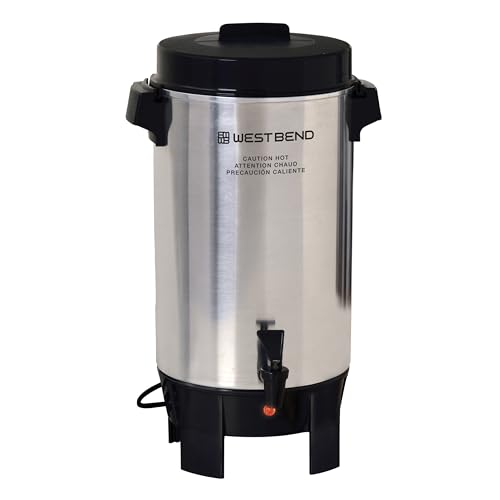
4. West Bend Coffee Urn, Highly-Polished Aluminum — Best Classic Urn
West Bend’s polished aluminum urn is the classic American coffee urn format, with automatic temperature control and cup-per-minute brewing heritage.
West Bend’s urn is the classic American answer to group coffee — the polished aluminum vessel that defined the category for generations of church halls and community events. Its automatic temperature control holds serving temperature after brewing, and its cup-per-minute brewing heritage means a 20-cup batch is a roughly twenty-minute affair once the water is hot. For hosts who value the proven over the novel, this is the guide’s anchor of tradition.
Strengths
- West Bend essentially defined the home urn category — deep product heritage
- Automatic temperature control holds serving temperature after brewing
- Polished aluminum is light to move and quick to cool for cleaning
Trade-offs
- Aluminum needs gentler cleaning than stainless steel
- Classic design lacks modern extras like programmable timers
- Confirm the exact cup capacity of the listing configuration before a big event
| Key spec | Coffee urn, polished aluminum, automatic temperature control, cup-per-minute brewing |
|---|---|
| Format | Polished aluminum urn, automatic temperature control, cup-per-minute brewing |
Aluminum is the material story: lighter than stainless to carry and quicker to cool for cleaning, at the price of gentler handling — it prefers soft cloths to scouring pads and rewards a dry-storage habit. Generations of these urns have survived decades of coffee hours on exactly that care, which is a track record no newer listing can argue with.
One diligence note applies to this pick specifically: West Bend has sold urns in several capacities under similar descriptions across the years, so confirm the exact cup capacity of the listing configuration before an event depends on it. With that confirmed, the classic earns its place on performance and heritage alike — the rare pick that is both the nostalgic choice and a rational one.
Best for: traditional hosts and institutions that value proven designs / Not suited for: buyers who want stainless steel’s harder-wearing finish
Check on Amazon — check price on Amazon before you buy, since listings and configurations change.

5. BLACK+DECKER 40-Cup Coffee Urn — Best If Your Events Are Growing
BLACK+DECKER’s 40-cup urn is a fast-brewing event urn with a drip-free spigot, sized for parties, offices and community events.
The BLACK+DECKER 40-cup urn enters this guide as the growth pick: the machine for hosts whose headcounts keep lying to them. If your last three ‘twenty-cup’ events served twenty-four, twenty-eight and thirty-one, the honest machine is a 40-cup urn, and this one’s drip-free spigot addresses the self-serve line’s most visible failure — the puddle under the urn that every attendee steps around for three hours.
Strengths
- 40-cup capacity sits between home urns and full commercial units
- Drip-free spigot reduces the puddle problem at self-serve tables
- BLACK+DECKER availability makes replacement and support straightforward
Trade-offs
- Still an event appliance — storage and setup are real commitments
- Urn brewing favors bold, hot coffee over subtle flavors
- Check the spigot seal after each event; it is the wear point
| Key spec | 40-cup urn, fast brew, drip-free spigot |
|---|---|
| Format | 40-cup urn, fast brew, drip-free spigot |
Brewing twenty cups in a forty-cup vessel is workable but should be a waypoint, not a lifestyle: partial batches near an urn’s floor percolate less evenly than mid-range ones. If your events stabilize back at twenty, the 30-cup picks serve you better; if they keep climbing, this capacity buys you years of headroom. The machine cannot know which future is yours — the host’s last three events usually can.
BLACK+DECKER’s distribution is the ownership comfort here: replacement and support channels are as mainstream as appliance retail gets. For an institution buying with a committee’s money and a decade’s horizon, that infrastructure is a legitimate deciding factor, and it is why this pick outranks larger generic urns for the growth slot.
Best for: hosts whose events reliably outgrow their estimates / Not suited for: stable 20-cup hosts — a 30-cup urn brews your batch better
Check on Amazon — check price on Amazon before you buy, since listings and configurations change.

6. Hamilton Beach 45 Cup Coffee Urn and Hot Beverage Dispenser — Best Flexible Large Urn
Hamilton Beach’s 45-cup urn brews anywhere from 15 to 45 cups with fast per-cup brewing, and doubles as a hot beverage dispenser for events.
Hamilton Beach’s 45-cup urn closes the guide as the range champion: its stated batch flexibility — fifteen to forty-five cups — is the widest documented here, and its fast brewing at roughly a cup a minute means a 20-cup batch is ready in about twenty minutes and a full 45 in about forty-five. For a venue whose calendar swings between a book club and a banquet, one urn with this range replaces two machines and a storage problem.
Strengths
- Flexible 15-to-45-cup batch range covers small meetings and big events
- Fast brewing at roughly a cup a minute once it is going
- Hamilton Beach support and parts network behind a proven urn design
Trade-offs
- Too large for everyday home brewing — this is event equipment
- Urn coffee is percolator-style; flavor is hearty, not delicate
- Needs storage space and a pre-event descaling routine
| Key spec | 45-cup urn, brews 15–45 cups, fast brewing about a minute per cup |
|---|---|
| Format | 45-cup urn, brews 15–45 cups, fast brewing about a minute per cup |
That flexibility is why it outranks its size for this brief: the 20-cup event sits inside its proven operating range rather than at its floor, which is the percolation-quality concern that pushed other large urns down this list. Hamilton Beach’s support network stands behind it, and the model family’s long production run means the spigots, lids and knowledge base of a mature product.
The costs are physical: a 45-cup vessel is the largest storage commitment in this guide and the heaviest to move when full — fill it where it serves, without exception. Venues with the closet space and the variable calendar will find it the most capable single urn here; hosts with a fixed 20-cup world should take the Nesco and the closet space back.
Best for: venues with widely varying event sizes, 15 to 45 cups / Not suited for: fixed-size small events — its capacity is capability you will store more than use
Check on Amazon — check price on Amazon before you buy, since listings and configurations change.
Comparison Table
| Pick | Badge | Key spec | Best for |
|---|---|---|---|
| Nesco Professional Coffee Urn, 30 Cups, Stainless Steel | Best Overall for 20 Cups | 30-cup urn, stainless steel, professional positioning | offices, churches and hosts serving 15–30 cups per event |
| VEVOR Commercial Coffee Urn, 30 Cup | Best Value for 20 Cups | 30-cup / 4.8 qt urn, 1090W hot beverage dispenser | value-led groups and occasional hosts needing a proper 20–30 cup urn |
| NUPANT Commercial Coffee Urn 30 Cup / 4.5L | Best 30-Cup for Coffee Quality | 30-cup / 4.5L, upgraded percolator, 304 stainless steel | quality-minded hosts in the 20–30 cup range comfortable with a newer brand |
| West Bend Coffee Urn, Highly-Polished Aluminum | Best Classic Urn | Coffee urn, polished aluminum, automatic temperature control, cup-per-minute brewing | traditional hosts and institutions that value proven designs |
| BLACK+DECKER 40-Cup Coffee Urn | Best If Your Events Are Growing | 40-cup urn, fast brew, drip-free spigot | hosts whose events reliably outgrow their estimates |
| Hamilton Beach 45 Cup Coffee Urn and Hot Beverage Dispenser | Best Flexible Large Urn | 45-cup urn, brews 15–45 cups, fast brewing about a minute per cup | venues with widely varying event sizes, 15 to 45 cups |
How to Choose a Coffee Maker for 20-Cup Service
Buy the urn whose middle is your event. Percolator urns brew their best coffee in the middle of their batch range, where water circulation and grounds contact are balanced. For a true 20-cup need, that means a 30-cup urn as the default, a flexible 45-cup urn if your calendar varies wildly, and a firm refusal of the 100-cup bargain that will spend its life brewing at a fifth of its design volume. The counterintuitive truth of this category is that the smaller adequate urn makes better coffee than the impressive one.
Convert headcount to batches before the event, not during. Twenty cups at the five-ounce standard is one hundred ounces — but real mugs at a self-serve table run eight to twelve ounces, which means your ’20-cup event’ of twenty people may need thirty cups of urn capacity if everyone takes a full mug, and forty if half of them refill. Count people, multiply by your real serving size, add a refill factor, and only then choose the batch. This arithmetic, done on paper, is the difference between a coffee line that flows and one that watches an urn re-brew.
Plan the service, not just the brew. An urn needs a stable, heat-safe surface, a circuit that can carry a heating appliance without sharing with another, a fill location at the serving location — a full urn is a heavy urn — and a drip plan under the spigot. Hosts who walk the setup once, the day before, discover the missing extension of counter or the awkward outlet while discovery is still free.
Finally, budget the cleanup into the event plan. An urn that is rinsed while warm, descaled on a schedule and stored dry will serve for years; an urn left full overnight after every event will flavor the next event with the last one. Assign the urn’s cleanup to a named human in the event plan — infrastructure without an owner declines, and coffee urns are infrastructure.
Urn Coffee, Honestly: What Percolation Does to a 20-Cup Batch
A coffee urn is a percolator: heated water rises through a tube and showers repeatedly over the grounds, cycling until the batch reaches strength. That repetition is why urn coffee tastes the way it does — bold, hot and unified, with the delicate top notes of drip coffee traded away for body and holding power. At a 20-cup event, that trade is usually correct. The coffee must stay good in the vessel for one to three hours of service, accompany food, and please a crowd of varied palates — a brief that percolation was, in effect, designed around over a century of coffee hours.
The format’s known vice is bitterness from over-cycling: leave an urn actively perking long past its brew and the repeated extraction pulls harsher compounds from the grounds. The management is simple and separates good urn hosts from average ones — brew the batch, then let the urn hold temperature without aggressive continued percolation, and serve within a sensible window. A batch brewed at nine and served until eleven, held properly, will please a room. The same batch perked continuously until noon is a complaint with a spigot.
Grounds choice helps too: a coarser grind suits percolation’s repeated passes, and a medium roast survives the format better than a delicate light roast whose subtleties the cycling will erase anyway. None of this requires expertise — it requires only that the host respect the format’s nature instead of wishing it were a drip machine of unusual size. Urns reward that respect with decades of service and rooms full of people holding warm cups, which was always the actual product being bought.
How to Brew and Serve 20 Cups in an Urn, Step by Step
Step 1: Set up where you will serve. Place the urn on its serving surface, confirm the circuit can carry it, and fill it there — twenty cups of water is over six liters, and a filled urn should travel inches, not rooms. Add the basket with coarse-ground coffee scaled to your batch: roughly a tablespoon per two cups as a starting point for percolator strength, adjusted after your first event’s feedback.
Step 2: Start the brew early. Allow about a minute per cup of brewing once the cycle is going, plus heat-up time — for twenty cups, starting forty-five minutes before service is a comfortable, unhurried timeline. The urn forgives early brewing far better than late brewing, because held coffee declines slowly while a line of guests declines not at all.
Step 3: Taste before the line forms. Draw a small cup at the point the brew completes: too weak means more grounds next time — note it on the urn’s own card — and too strong can be softened with a measure of hot water. Then set the urn to hold, arrange cups, sweeteners and the drip plan, and let the self-serve line do what it does.
Step 4: Close down like a professional. When service ends, unplug, let the urn cool to handling temperature, discard the grounds, and rinse the vessel, basket and spigot while residue is still warm and soluble. Run a plain-water cycle if the urn will sit stored. Descale on a calendar rhythm based on your water. The next event’s coffee quality is decided largely in this half hour.
The Host’s Urn Card: Recording What Each Event Teaches You
Experienced urn hosts share a habit that looks like fussiness and is actually the whole secret: they keep a card with the urn. On it, each event leaves three lines — the batch size brewed, the grounds measure used, and one sentence of verdict (‘strong, cut back half a tablespoon’ or ‘gone by ten, brew thirty next time’). An urn is a repeatable instrument, but only for a host who records its settings; without the card, every event is a first event, with the same guesses made and the same lessons re-learned at the price of a room’s coffee.
The card also settles the capacity question empirically over time. Three events recorded honestly will tell you whether your ’20-cup’ gatherings are truly twenty, or twenty-six with refills, or eighteen with cake competing — and that record, not any guide’s estimate, should drive the decision to keep the 30-cup urn or graduate to the 45. Buy the machine for the events you have; let the card tell you when the events have changed. It is the cheapest consulting in the entire catering world, and it lives taped inside the urn’s lid.
The 20-Cup Event Playbook: Quantities, Timing and the Second Pot Decision
Running a 20-cup event well is a logistics exercise with a coffee flavor, and the numbers reward being written down. Twenty urn cups is one hundred ounces; in real mugs that is ten to twelve full servings before refills, which surprises every first-time host. If your event is twenty people, your true requirement is usually twenty-eight to thirty-five urn cups once refills are counted — which is why this guide’s 30-cup picks, and not a hypothetical smaller vessel, are the working answer. Write the serving math on the event plan itself: people, times servings per person, times ounces per serving, divided by five for urn cups. The formula fits on an index card and prevents the category’s only unforgivable failure, which is running dry in front of a line.
Timing runs backward from the first guest. The urn starts forty-five minutes before service for a 20-cup batch on the faster machines, an hour on the slower ones, because the cost of coffee ready twenty minutes early is negligible and the cost of coffee ready ten minutes late is the event’s opening impression. Set the urn to hold when the brew completes, taste a small draw yourself before the line forms, and only then arrange the cups. The host’s taste-check is not vanity — it is the last quality gate, and it catches the under-dosed batch while a correction is still possible.
The second-pot decision should be made by the urn’s level, not by optimism. When a 20-cup batch falls to its last quarter and the event has an hour to run, start a fresh half batch immediately — urns forgive a surplus and never forgive a gap. At close-down, note the actual consumption against the plan on the event card. Three events of honest records will calibrate your serving math to your actual crowd better than any guide’s estimate, and the fourth event will run like the venue does this every week — because by then, in every way that matters, it does.
Urn Etiquette and Safety at a Self-Serve Table
A self-serve urn concentrates a small crowd around a vessel of near-boiling liquid, and the host’s duty of care is mostly arrangement. Place the urn where the line forms away from doorways and children’s circulation, on a surface that cannot be rocked by a leaning guest, with the spigot over a drip tray rather than a tablecloth’s edge. Keep the power cord routed where feet cannot find it — behind the table, taped or covered if it must cross a walkway — because the category’s worst accident is not a burn from the spigot but a tripped cord and a moving urn.
Temperature honesty is the second duty: urn coffee is served hot enough to scald, and a small sign or a word to the room — ‘coffee’s fresh and very hot’ — is a kindness with legal overtones. Provide cups with handles or sleeves that insulate, keep lids available for anyone carrying coffee across the room, and station sweeteners and milk far enough from the spigot that the pour zone stays single-file and unhurried. None of this requires equipment beyond thoughtfulness, and all of it is invisible when done well — which is the definition of good hosting at any scale.
Finally, plan the urn’s afterlife at the event’s end before the event begins: who unplugs it, where it cools, who rinses it while it is warm. An urn left full and hot for hours after the last guest is a burn risk, a flavor crime against itself and a cleaning debt with interest. The events remembered fondly are the ones whose endings were as considered as their beginnings — and at twenty cups, the ending is a five-minute routine that this guide’s how-to section spells out step by step.
Renting vs. Owning at Twenty Cups: The Break-Even Nobody Computes
Twenty cups is the volume where renting an urn feels sensible — until the arithmetic is done. A rental urn for a weekend event costs a meaningful fraction of a value 30-cup urn’s purchase price, plus the trip to fetch it, the deposit, the unfamiliar machine’s learning curve at the worst possible moment, and the trip to return it. Two or three events a year at that rate repurchase the VEVOR-class pick in this guide outright — and the owned urn arrives at each event as a known instrument with a recorded dose card, rather than as a stranger with someone else’s descaling history flavoring the first batch.
Ownership’s costs are real but smaller than they look: storage space for a vessel the size of a stockpot, a descaling habit, and the discipline of the arrival inspection this guide keeps recommending. Against them, ownership buys the thing rentals structurally cannot — familiarity. The host who has run their own urn five times knows its thermostat’s moods, its spigot’s flow and its exact brew timeline, and that knowledge is worth more at a live event than any specification on any listing. Events are performances; professionals do not rent their instruments when they can own them at this price.
The rental case survives in exactly one scenario: the genuinely annual event, where storage costs twelve months of closet for one morning of service and the host has no second use in the calendar. Even there, the break-even is closer than instinct suggests, because the owned urn’s second life — the office kitchen, the club, the loan to a friend that returns as goodwill — has a way of appearing. Count your events honestly, price both paths fully, and let the arithmetic host the decision. At twenty cups, it usually votes to own.
What Twenty Cups Taught the Catering World
There is a reason the catering world standardized its urns just above this guide’s target size rather than at it: events are easier to over-serve than to exactly serve, and the cost of five cups too many is a sink drain while the cost of five cups too few is a room’s memory. The 30-cup urn’s dominance at the 20-cup brief is that asymmetry made of stainless steel. Hosts internalize it after one event run dry — an event nobody in this guide’s readership needs to have, because the arithmetic is printed here in advance: size for the refills, hold rather than perk, and let the surplus, when it happens, be the cheapest insurance you bought all year.
Common Buying Mistakes
- Buying the biggest urn on sale. A 100-cup urn brewing twenty cups operates at the bottom of its range, percolates unevenly and stores like furniture. Buy the urn whose middle is your event.
- Counting people instead of ounces. Twenty guests with real mugs and refills can need forty urn-cups. Do the serving math on paper before the event, not at the spigot during it.
- Carrying a full urn. A filled urn is heavy, hot and sloshing. Fill at the serving spot, every time, without exception.
- Letting the urn perk for hours. Continuous percolation after brewing is how urn coffee turns bitter. Brew, then hold — the distinction is the whole craft.
- Skipping the test batch. Every urn has thermostat and timing quirks. Discover them at a quiet rehearsal, not in front of forty guests.
Final Recommendation
For the classic 20-cup need, the Nesco 30-cup urn is the guide’s answer: your batch in the middle of its range, stainless build, one-person manageability. The VEVOR covers the same ground at a value tier, the NUPANT competes on materials and extraction, and the West Bend carries the traditionalists. Hosts whose events keep growing should skip a size and take the BLACK+DECKER 40 or the wide-range Hamilton Beach 45.
Whichever urn you choose, run it like infrastructure: fill it where it serves, brew before the line forms, hold rather than perk, and clean it while it is warm. Twenty cups is the volume where coffee stops being a kitchen task and becomes event craft — and with the right urn, it is a craft that makes its host look effortlessly competent.
Shortlist again: Nesco Professional Coffee Urn, 30 Cups, Stainless Steel, VEVOR Commercial Coffee Urn, 30 Cup and NUPANT Commercial Coffee Urn 30 Cup / 4.5L cover the three most common needs in this category.
Keep exploring the same coffee maker cluster: Best 30 50 Cup Coffee Makers Best 50 Cup Coffee Makers Best 14 Cup Coffee Makers Best 1400 Watt Coffee Makers Best 12 Cup Coffee Makers
Frequently Asked Questions
Is there a coffee maker that brews exactly 20 cups?
Purpose-labeled 20-cup home machines are effectively absent from the current market — urns standardize at 30 cups and up. The correct tool for 20-cup service is a 30-cup urn brewing a partial batch, which sits comfortably in its operating range, as this guide’s top picks demonstrate.
How long does an urn take to brew 20 cups?
As a planning figure, about a minute per cup once brewing is underway, plus initial heat-up — so roughly twenty to thirty minutes for a 20-cup batch on the faster urns here. Starting forty-five minutes before service is a safe, unhurried rule.
How much coffee do I need for 20 cups in an urn?
Start around ten tablespoons of coarse-ground coffee for a 20-cup batch — roughly a tablespoon per two cups — and adjust by your crowd’s taste across events. Percolators extract thoroughly, so err slightly light on the first batch and strengthen the next if needed.
Can I make tea or hot water in a coffee urn?
Yes, and venues do it constantly — but run plain-water cycles and rinse thoroughly first, because an urn’s interior holds coffee oils that will flavor tea noticeably. Some venues keep a second, smaller urn dedicated to water for exactly this reason.
Urn or two drip machines for a 20-cup event?
For a single serving window, the urn wins: one vessel, one fill, continuous service. Two drip machines make fresher small batches but demand an attendant and produce carafe logistics. Events with a long, slow service window are the urn’s home ground.
How do I keep urn coffee from tasting bitter?
Brew the batch, then stop active percolation and simply hold temperature; use coarse grounds and a medium roast; serve within about two hours. Bitterness in urn coffee is almost always over-cycling or over-holding, both of which are process choices rather than machine faults.


