Disclosure: airfryerkitchensupply.com is reader-supported. When you buy through links on our site, we may earn an affiliate commission at no extra cost to you.
Where to buy
Finding the best 50 cup coffee makers means shopping the coffee urn category, and the fastest way to compare this list is on Amazon, where capacity, finish and delivery terms sit on each product page. Start with the Hamilton Beach 45 Cup Coffee Urn for the all-round pick, the Hamilton Beach 45 Cup Fast Brew Urn for one-handed serving lines, the West Bend 55-Cup Commercial Urn for NSF-listed commercial duty, the Zulay 50 Cup Coffee Urn for an exact 50-cup double-wall design, the West Bend 42-Cup Urn for a lightweight aluminum classic, or the Hamilton Beach Commercial 60 Cup Urn when your crowd outgrows the 50-cup class. Check the current price on Amazon for the configuration you need.
The best 50 cup coffee makers are not really kitchen appliances in the everyday sense — they are event equipment. Nobody brews fifty cups for a Tuesday breakfast. A 50-cup urn exists for the mornings and afternoons when coffee has to serve a room: office all-hands meetings, church fellowship halls, school events, wedding receptions, funeral luncheons, farmers-market stalls, open houses, training days and holiday parties where the alternative is four drip machines cycling in panic or a catering bill for coffee alone. In that setting the buying questions change completely. Nobody cares about a bloom phase; everybody cares whether the urn brews before the crowd arrives, holds temperature through a two-hour event, pours without dripping down the tablecloth, and cleans up before the volunteers go home.
One honest note about the category before the picks: an exact “50-cup” rating is less common than the sizes around it. The urn market clusters at 42 to 45 cups on the smaller side and 55 to 60 cups on the larger side, with a smaller number of true 50-cup models — the Zulay in this list is one — in between. That clustering is not a problem once you translate cups into servings. Urn makers count a cup at roughly 5 to 6 ounces, so a 45-cup urn pours about 225 to 270 ounces — enough for roughly 28 to 33 real 8-ounce servings — while a 55-cup urn pours about 275 to 330 ounces. In other words, the 42-to-60-cup band all serves the same event size of roughly 25 to 40 coffee drinkers, and this guide treats that whole band as the 50-cup class, flagging each model’s true rating so you can size precisely. What separates the picks is not a few nominal cups; it is brew speed, heat retention, faucet design, build material and how gracefully each urn handles a serving line.
In this guide
Quick Picks
- Best Overall — Hamilton Beach 45 Cup Coffee Urn (40515G): The default event urn: fast per-cup brewing, a two-way lever for single pours or continuous filling, and a size that covers most gatherings. Check the current price on Amazon.
- Best for Fast, One-Handed Serving — Hamilton Beach 45 Cup Fast Brew Urn (40521G): An easy-push lever guests can work with one hand while holding a plate, plus a clear water window for hosts. Check the current price on Amazon.
- Best Commercial Grade — West Bend 55-Cup Commercial Coffee Urn: An NSF-approved polished aluminum urn with automatic temperature control, built for venues that serve coffee every week. Check the current price on Amazon.
- Best True 50-Cup — Zulay 50 Cup Coffee Urn: An exact 50-cup rating in double-wall stainless steel that keeps coffee hot and the exterior safer to be around. Check the current price on Amazon.
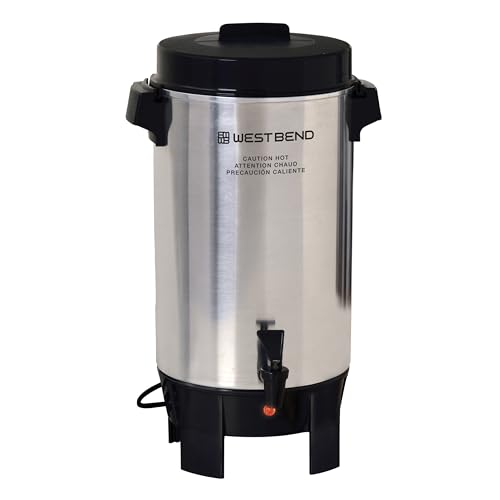
- Best Lightweight Classic — West Bend 42-Cup Coffee Urn: A polished aluminum percolator-style urn with automatic temperature control, an in-basket measuring guide and a ready light. Check the current price on Amazon.
- Best for Bigger Crowds — Hamilton Beach Commercial 60 Cup Urn (D50065): A polished stainless commercial urn that stretches the class to 60 cups for receptions and venues that regularly outgrow 45. Check the current price on Amazon.
How These Picks Were Chosen
Every urn on this list was verified against Amazon’s catalog before inclusion, so the model numbers, rated capacities and headline features below match the actual listings. From the verified shortlist we filtered on the things that decide event success. First, honest capacity: the urn had to sit in the 42-to-60-cup band that serves the 50-cup use case, and we state each model’s real rating rather than rounding it to fifty. Second, brew speed: an urn that takes over an hour to come ready forces hosts to start absurdly early, so per-cup brew pace mattered. Third, serving ergonomics: faucet design — lever versus push, one-handed versus two-handed, drip behavior — was weighed heavily because the faucet is the only part your guests touch. Fourth, heat strategy: how the urn holds temperature across a long event, and whether the exterior stays safe in a crowded room. Fifth, cleanup and storage: urns live in closets and church kitchens between events, so weight, cleanability and cord management counted. Prices are not printed here because they shift with promotions; use the links to check price on Amazon when you shop, and expect no fixed ratings or review counts in this guide for the same reason.
The 6 Best 50 Cup Coffee Makers

Hamilton Beach 45 Cup Coffee Urn (40515G) — Best Overall
The Hamilton Beach 40515G is the urn we recommend when someone says “we need coffee for about forty people” and wants the decision finished. It brews its 15-to-45-cup range at roughly a minute per cup, so a full urn is ready in about the time it takes to set up chairs, and its two-way dispensing lever pours a single cup when pressed and locked down, or runs continuously when you are filling a carafe or a row of mugs at the start of an event. It suits offices, churches, clubs, schools and home hosts who run several gatherings a year and want one dependable urn rather than a rotation of borrowed ones. It is not the pick for daily commercial service in a café or diner, where the NSF-listed commercial models below are built for that duty cycle.
Strengths
- Fast brewing at about a cup a minute means a full 45-cup urn is event-ready in roughly three quarters of an hour.
- The two-way lever handles both single guest pours and continuous filling, which speeds up pre-event setup.
- The 15-cup minimum batch makes the same urn usable for smaller meetings, not only full-capacity events.
Trade-offs
- At 45 cups it is the smaller side of this class; events expecting more than about 35 coffee drinkers should size up.
- Single-wall construction means the exterior gets hot during service and loses heat faster than double-wall rivals.
- The faucet, like most urn levers, can drip if guests half-press it; a drip tray or mat underneath is wise on good tables.
| Spec snapshot (verified from listing) | |
|---|---|
| Capacity | 15 to 45 cups |
| Brew speed | Fast brewing, about 1 minute per cup |
| Dispensing | Two-way lever, manual or continuous pour |
| Model | 40515G, silver |
What makes this the overall pick is the absence of surprises. The water window tells you where the level stands, the ready light tells you when brewing is done, the lid and handles behave the way a decade of urn users expect, and replacement familiarity matters: this model family has been the default event urn for years, so any volunteer who has ever run a coffee station already knows it. For a host, that familiarity is a feature — you can hand the urn to a helper with one sentence of instruction. Brew with the basket’s measured fill, use coarse-to-medium ground coffee made for percolator-style urns, and start the cycle before guests arrive; the urn holds temperature from there. If your events regularly push past forty coffee drinkers, treat this as your second urn rather than your only one, or step directly to the 55 and 60-cup picks below.
Best for: Offices, churches and home hosts serving up to about 35 coffee drinkers per event. / Not suited for: Daily commercial café service or crowds well beyond 40 drinkers.

Hamilton Beach 45 Cup Fast Brew Coffee Urn (40521G) — Best for Fast, One-Handed Serving
The Hamilton Beach Fast Brew 40521G is the sibling pick for events where the serving line itself is the bottleneck. Its easy-push dispensing lever is designed for one-handed operation: a guest holding a plate, a program and a conversation can still pour a cup without setting everything down or asking for help. It brews at the same fast roughly-a-minute-per-cup pace as the overall pick and carries a clear water window so the host can see at a glance when a refill decision is coming. It suits receptions, buffets, conferences and any event where guests serve themselves while carrying food. Hosts who mostly fill carafes for table service, rather than running a self-serve line, will get more from the two-way lever of the 40515G above.
Strengths
- Easy-push lever pours one-handed, which keeps buffet and reception lines moving.
- Fast brewing pace gets a full urn ready in about 45 minutes from a cold start.
- The water window makes level checks instant during service, preventing the empty-urn surprise mid-event.
Trade-offs
- Same 45-cup ceiling as the overall pick; very large events still need a second urn or a bigger model.
- Push-lever faucets reward a full press; tentative guests may dribble, so place the urn on a tray.
- Single-wall body runs hot to the touch during long service, so position it away from crowded edges.
| Spec snapshot (verified from listing) | |
|---|---|
| Capacity | 15 to 45 cups |
| Brew speed | Fast brewing, about 1 minute per cup |
| Dispensing | Easy-push lever, one-handed operation |
| Model | 40521G, silver |
Choosing between the two Hamilton Beach 45-cup urns is a serving-style question, not a quality question. If your events pour coffee into many individual cups at a self-serve station — the most common pattern — the Fast Brew’s lever is the better tool and its small conveniences compound across a two-hour line. If you set tables with filled carafes or pitchers, the standard model’s continuous-pour lever does that job faster. Either way, run the same host routine: brew a first full urn before doors open, and if the crowd is drinking faster than expected, start a second batch early rather than after the urn runs dry, because even a fast urn needs its three quarters of an hour.
Best for: Self-serve buffets, receptions and conferences where guests pour one-handed. / Not suited for: Table-service events built around filled carafes, or crowds beyond the 45-cup class.

West Bend 55-Cup Commercial Coffee Urn — Best Commercial Grade
The West Bend 55-Cup Commercial Urn is the pick for venues where coffee service is a weekly obligation rather than an occasional event. It is NSF approved, which matters when a health inspector, a facility manager or an insurance policy has opinions about your beverage equipment, and its highly polished aluminum body with automatic temperature control is designed for the percolate-and-hold rhythm of institutional service. The 55-cup capacity sits at the top of the 50-cup class, covering events of roughly 35 to 45 coffee drinkers without a second urn. It suits cafeterias, banquet halls, rental inventories, large churches and workplaces with daily break-room volume. A once-a-year home host will find it more urn than they need, and its aluminum construction asks for the no-abrasives cleaning discipline described later.
Strengths
- NSF approval suits inspected commercial and institutional settings where consumer urns may not be acceptable.
- 55-cup capacity covers the whole 50-cup class with headroom, reducing mid-event rebrewing.
- Automatic temperature control holds serving temperature through long events without host attention.
Trade-offs
- Aluminum body is lighter but dents more readily than stainless and needs gentler cleaning to keep its finish.
- Its size and commercial positioning are overkill for occasional small gatherings.
- Percolator-style brewing rewards the correct coarse grind; fine drip grind can produce a harsher cup at this scale.
| Spec snapshot (verified from listing) | |
|---|---|
| Capacity | 55 cups |
| Certification | NSF approved, commercial |
| Body | Highly polished aluminum |
| Control | Automatic temperature control |
Commercial buyers should think in duty cycles. A consumer urn pressed into daily service will usually fail at the faucet or the thermostat within a season or two, and it will fail on the busiest morning. The West Bend commercial line is built and certified for exactly that repetition, and its quick-brewing design acknowledges that institutional coffee is often brewed back-to-back. If your venue serves coffee most days, this is the responsible default in the 50-cup class; if your venue serves coffee most Sundays, the standard Hamilton Beach picks will do the job at a gentler tier and this becomes the stretch option.
Best for: Institutions and venues serving coffee weekly or daily under commercial expectations. / Not suited for: Occasional home hosts or anyone needing a compact, lightweight urn.

Zulay 50 Cup Coffee Urn — Best True 50-Cup
The Zulay 50 Cup Coffee Urn earns its place by being exactly what the search promised: a true 50-cup rating, in a double-wall stainless steel body. The double wall is the meaningful engineering here — the inner wall holds the coffee’s heat while the outer wall stays considerably more comfortable and safer in a crowded serving area, and the insulation reduces how hard the element must cycle to hold temperature through a long event. Zulay positions this urn for events and catering, and that is precisely its home ground: weddings, parties, conferences and community events where the urn sits within arm’s reach of guests in good clothes. It suits hosts who want the exact class size without rounding down to 45 or up to 55, and anyone who has worried about a hot single-wall urn at elbow height in a crowd. Venues needing NSF paperwork should still choose the West Bend commercial pick above.
Strengths
- Exact 50-cup capacity matches the class precisely, with double-wall insulation for heat retention.
- Stainless steel construction inside and out cleans easily and resists the staining aluminum can develop.
- The cooler exterior is a genuine safety and comfort advantage at crowded self-serve stations.
Trade-offs
- Double-wall stainless construction is heavier to carry and store than the aluminum West Bend models.
- It is a consumer/event-grade urn rather than an NSF-listed commercial unit.
- Like all large urns, it needs a full or near-full batch to brew at its best; tiny batches belong in a smaller machine.
| Spec snapshot (verified from listing) | |
|---|---|
| Capacity | 50 cups |
| Body | Double-wall stainless steel |
| Use case | Events and catering hot beverage service |
| Brand line | Zulay Kitchen commercial-style urn |
In practice the Zulay is the urn we would place at a wedding or a school fundraiser without a second thought about the room. The insulation buys you a longer grace period between brewing and the last pour, the stainless interior releases coffee oils with a proper wash instead of seasoning into the metal, and the true 50-cup rating makes head-count math simple: plan on roughly 30 to 38 real servings depending on cup size, and you will land the event comfortably. Pair it with a drip tray, set it where the exterior will not be leaned on regardless, and it does the quiet, competent job this category exists for.
Best for: Weddings, fundraisers and catered-style events wanting an exact 50-cup, guest-safe urn. / Not suited for: Inspected commercial kitchens that require NSF-listed equipment.
West Bend 42-Cup Coffee Urn — Best Lightweight Classic
The West Bend 42-Cup Urn represents the traditional American coffee urn in its purest form: highly polished aluminum, percolator brewing, automatic temperature control, a measuring guide inside the basket so the coffee-to-water math is printed where you need it, and a ready light that ends the guessing. At 42 cups it is the smallest urn in this guide, and that is a deliberate inclusion: many real gatherings — a scout troop breakfast, a small congregation, a club meeting, a family reunion’s coffee corner — draw 20 to 28 coffee drinkers, for whom a 42-cup urn is correctly sized while a 60-cup urn brews a wasteful, stewing surplus. Aluminum keeps it light enough for one person to carry from storage, wash at a utility sink and put away without help. It suits community groups, smaller venues and hosts who value light weight and simplicity. It does not suit hosts who need stainless durability or commercial certification.
Strengths
- Lightweight aluminum body is easy for one person to transport, wash and store.
- The in-basket measuring guide removes the most common urn error — wrong coffee-to-water ratio.
- Automatic temperature control and a ready light make operation nearly instruction-free for volunteers.
Trade-offs
- 42 cups is the floor of this class; crowds beyond roughly 28 drinkers will empty it mid-event.
- Aluminum can discolor with coffee oils and hard water if cleaning lapses, and it dents more easily than steel.
- No double-wall insulation, so the exterior runs hot and heat loss over very long events is faster.
| Spec snapshot (verified from listing) | |
|---|---|
| Capacity | 42 cups |
| Body | Highly polished aluminum |
| Control | Automatic temperature control, ready light |
| Guide | In-basket measuring guide |
There is a reason this design has persisted for decades in church kitchens: it asks almost nothing of its operator. Fill to the line, measure grounds by the basket guide, plug it in, and wait for the light. For organizations run by rotating volunteers, that operational simplicity is worth more than features. Keep it descaled, wash the basket and stem after every event so old oils do not haunt the next pot, and this style of urn will serve for years of Saturdays.
Best for: Small congregations, clubs and community groups serving about 20 to 28 drinkers. / Not suited for: Large events, commercial certification needs, or buyers wanting stainless construction.

Hamilton Beach Commercial 60 Cup Coffee Urn (D50065) — Best for Bigger Crowds
The Hamilton Beach Commercial D50065 stretches this guide’s class upward for the hosts who keep underestimating their crowds. Its 60-cup capacity in polished stainless steel covers events of roughly 40 to 50 coffee drinkers, and its commercial build brief — this is Hamilton Beach’s commercial line, not its household line — suits banquet venues, large congregations, conference centers and rental fleets. It suits any host whose last event ended with an empty 45-cup urn and a apologetic note on the coffee station. It is the wrong purchase for modest gatherings: an urn brewed at a third of capacity wastes coffee and counter space, and its size demands real storage room between events.
Strengths
- 60-cup capacity provides genuine headroom for receptions and venues that outgrow the 45-cup class.
- Polished stainless steel construction suits front-of-house presentation and wipes clean.
- Commercial-line build targets repeated service rather than occasional use.
Trade-offs
- The largest and heaviest style of urn here to lift, wash and store — plan the closet space first.
- Oversized for events under about 30 drinkers, where the 42 and 45-cup picks brew fresher, right-sized batches.
- Full batches take proportionally longer to brew, so event timelines must start earlier.
| Spec snapshot (verified from listing) | |
|---|---|
| Capacity | 60 cups |
| Body | Polished stainless steel |
| Line | Hamilton Beach Commercial |
| Model | D50065 |
The honest way to decide on the 60-cup is by your failure mode. If your events fail by running out — the urn dry at the break, guests drifting to a café — the headroom here is the fix, and one large urn is simpler to run than two medium ones. If your events fail by leftover waste, stay at 45 cups and brew a second batch when the level drops. Experienced hosts often end up owning one of each size over time; if you are buying your first and your crowds are genuinely growing, this is the buy-once answer at the top of the class.
Best for: Banquet venues, large congregations and hosts who keep running dry at 45 cups. / Not suited for: Small gatherings or anyone short on storage space.
Comparison Table
| Pick | Badge | Key spec | Best for |
|---|---|---|---|
| Hamilton Beach 40515G | Best Overall | 45 cups, two-way lever, fast brew | General events up to ~35 drinkers |
| Hamilton Beach 40521G | Best for Fast Serving | 45 cups, easy-push one-hand lever | Self-serve buffet lines |
| West Bend 55-Cup Commercial | Best Commercial Grade | 55 cups, NSF approved, aluminum | Weekly institutional service |
| Zulay 50 Cup | Best True 50-Cup | 50 cups, double-wall stainless | Weddings and catered events |
| West Bend 42-Cup | Best Lightweight Classic | 42 cups, aluminum, basket guide | Small groups, volunteer-run events |
| Hamilton Beach Commercial D50065 | Best for Bigger Crowds | 60 cups, polished stainless | Receptions and large venues |
How to Choose the Right Urn Size for Your Event
Size an urn by drinkers, not by the number on the box. Count your expected coffee drinkers — typically 60 to 75 percent of total guests at a morning event, fewer after lunch — then allow one and a half servings per drinker for a short event and two servings for a long one, because urns invite refills. Convert with the urn maker’s cup of about 5 to 6 ounces against an 8-ounce serving: a 45-cup urn yields roughly 30 real servings, a 50-cup about 33, a 55-cup about 37 and a 60-cup about 40. A wedding of 80 guests with perhaps 55 coffee drinkers taking a cup and a half each needs on the order of 80 servings — two urns, or one 60-cup urn plus a plan to rebrew during a natural pause. Buying one size up from your calculation is cheap insurance; buying two sizes up guarantees leftover coffee that stews while you pay to brew it.
Also weigh the room, not just the crowd. An urn needs a stable surface near an outlet, clearance above for the lid and steam, and a serving position where the line does not cross the kitchen workflow. Check the urn’s height against any overhang, plan a drip tray under the faucet, and keep the cord path out of foot traffic. If the venue’s circuits are shared with chafing dishes and slow cookers, ask which circuit the urn gets before the event, not during the breaker trip.
Faucets, Walls and Materials: The Three Hardware Decisions
The faucet decides your guests’ experience. A two-way lever, like the overall pick’s, pours single cups and locks open for filling pitchers — best for hosts who serve tables. An easy-push lever, like the Fast Brew’s, pours one-handed — best for buffet lines where the other hand holds a plate. What matters most is a full, confident press: teach it with a small sign if your crowd is new to urns, and always park a tray beneath, because every faucet design drips in the hands of a hesitant guest.
Wall construction decides heat and safety. Single-wall urns are lighter and simpler but run hot outside and lose temperature faster; double-wall stainless, like the Zulay, keeps heat in the coffee and the exterior calmer in a crowd, at the cost of weight. Material decides maintenance: polished aluminum, the West Bend tradition, is light and conducts heat evenly but wants gentle cleaning and prompt washing to avoid discoloration, while stainless tolerates more vigorous scrubbing and hides a working life more gracefully. None of these is universally best — match them to whether your priority is a light carry, a safe crowd, or a scrubbed-clean reset between weekly events.
How to Set Up and Run a 50-Cup Urn on Event Day
- Position and pre-check. Set the urn on a stable, heat-safe surface near its outlet, on a drip tray, with the faucet overhanging the edge for cup clearance. Confirm the basket, stem and lid are clean and the faucet moves freely before any water goes in.
- Fill with cold, fresh water. Fill to the level for the batch you actually need — never below the model’s minimum (the Hamilton Beach picks brew as little as 15 cups) and never above the max line, which invites overflow during percolation.
- Measure coffee by the guide. Use the in-basket measuring guide where provided, or the maker’s chart for your batch size, with a coarse-to-medium urn grind. Level the grounds in the basket so water percolates evenly instead of channeling.
- Start early. Begin brewing well before doors open: at roughly a minute per cup, a full 45-to-55-cup batch needs about three quarters of an hour to an hour, plus a few minutes for the coffee to settle after the cycle ends.
- Let it finish, then serve. Wait for the ready light or the end of percolation before the first pour; drawing early cups weakens the whole batch. Remove the basket if your model’s instructions direct it, to stop over-extraction during a long hold.
- Manage the level during service. Watch the water/coffee window or gauge. If the crowd is draining the urn faster than planned, note the time a fresh batch would need and decide early — a second urn or a timely rebrew beats a dry faucet at the break.
- Cool, wash and dry before storage. After the event, let the urn cool, discard grounds, wash the interior, basket and stem with mild detergent, run clean water through the faucet, descale if your water is hard, and dry fully before lidding it for storage so no stale odor seasons the next event.
Making Urn Coffee Taste Good at Scale
Urn coffee has an unfair reputation, because most bad urn coffee is a process failure rather than an equipment failure. The percolating cycle in these machines recirculates brewed coffee through the grounds, which means time is an ingredient: a batch left percolating or held for many hours will keep extracting and turn harsh no matter which urn you bought. The fixes are simple and free. Measure honestly — the single most common cause of weak event coffee is a host stretching grounds across a bigger batch than the recipe intends, and the second most common is the opposite, an over-measured basket that percolates into bitterness. Use the basket guide, brew the batch size you measured for, and if the event runs long, brew a fresh second batch rather than topping up the old one with water and hope.
Beans and water matter at scale exactly as they do at home, only multiplied by fifty. Coffee bought in large food-service cans is a legitimate choice for a weekly venue, but it should be stored sealed and bought in quantities the venue actually finishes while it is fresh; a smaller bag of decent coffee opened the morning of the event beats a stale institutional drum every time. If your venue’s water is heavily chlorinated, let filled urn water sit uncovered briefly before brewing or use filtered water for the first fill — at 300 ounces, water flavor is the coffee’s flavor. Finally, serve promptly and protect the hold: once brewing completes, the urn’s job is temperature maintenance, not continued extraction, so follow your model’s guidance about the basket, keep the lid closed between pours, and plan service so the last cup is poured within a couple of hours of the first. Hosts who run that routine discover that guests compliment urn coffee they would have sworn came from somewhere fancier.
Renting vs Buying, Power and Event Logistics
The buy-versus-rent line in this category is frequency. A venue or family hosting two or more coffee events a year generally comes out ahead owning one of the mid-tier picks here, because rental fees, pickup trips and the uncertainty of an unfamiliar urn repeat every event, while an owned urn is a known quantity that lives in your closet. Rent instead when the event is a true one-off at unusual scale — a 200-guest wedding wants rental-grade volume and a caterer’s problem-solving, not your new purchase. Organizations should also think about the second urn earlier than intuition suggests: two 45-cup urns give redundancy if one fails, let you run regular and decaf side by side, and can split between two serving stations in a large room, which is why experienced churches and halls so often end up owning a pair.
Power deserves a paragraph of its own because urns are among the heavier electrical loads at an event. Plug the urn into its circuit before other warmers join it, avoid long household extension cords, and if the venue is a hall or sanctuary with shared circuits, ask the facility contact which outlets are separately circuited. Set the urn where its cord cannot cross a walkway, give the lid room to open without hitting shelving, and station cups, lids, sweeteners and a small waste bin within the same reach so the line forms once instead of scattering. Put one named person in charge of the urn for the event — checking the level at set intervals, starting a second batch on time, and shutting down and washing afterward. Nearly every urn failure story is really an ownership story: the machine was fine, and nobody’s job was the coffee.
Running Two Beverages: Decaf, Tea and Hot Water Strategy
Most events discover, about twenty minutes in, that coffee was only the first request. A meaningful share of guests want decaf by the evening, some want tea, and parents want hot water for cocoa or instant drinks. Plan this before the event rather than improvising it at the faucet. The cleanest solution at 50-cup scale is a division of labor: the main urn runs regular coffee, and decaf is handled either by a second, smaller urn, by a standard household drip machine cycling small pots, or — at evening events where decaf demand is real but thin — by a clearly labeled carafe filled from a fresh small batch. Label everything at the station with tent cards; the costliest beverage mistake at an event is not running out, it is a guest discovering the unlabeled urn was decaf after they needed to drive home alert, or the reverse.
Tea and hot water should not share the coffee urn mid-event. Water drawn from a coffee urn carries coffee flavor, and refilling a half-empty coffee urn with water to serve tea ruins both beverages. If hot water service matters, dedicate a separate vessel — a second urn that has been washed and reserved for water only, clearly labeled, or an electric kettle station for smaller demand. Hosts who run the same event repeatedly, like a weekly fellowship hour, often settle this permanently: one urn lives as the coffee urn, one vessel lives as the water urn, and the two never swap. That small discipline, plus labels, is what makes a beverage station feel catered rather than assembled.
A Note on Backup Plans for Big Events
Experienced hosts plan for the urn the way they plan for weather: assume something will be forgotten, spilled or slower than expected, and make the failure cheap. Keep a spare measure of coffee and a backup plan for power — knowing where the second circuit is — at every event. If the urn is borrowed or newly bought, run a full water-only cycle at home first: it flushes manufacturing residue, proves the faucet seals, and teaches you the machine’s timing before an audience exists. On the day, stage cups, lids and supplies before brewing starts, because a ready urn surrounded by a scavenger hunt for cups still produces a line. These are small disciplines, but they are the difference between coffee service that guests never think about — the highest compliment in this category — and coffee service that becomes the event’s subplot.
Common Buying Mistakes
- Trusting the cup number literally. Fifty urn “cups” is roughly thirty-three 8-ounce servings. Hosts who skip this math run dry; hosts who double it brew a lake of leftovers.
- Buying a consumer urn for inspected commercial service. If your venue answers to health inspections or facility rules, choose the NSF-listed commercial pick from the start.
- Ignoring the faucet style. A table-service event and a buffet line want different levers; the wrong one slows service all day.
- Forgetting brew lead time. A full urn is an hour’s project. Buying the right urn and starting it when guests arrive is the classic event failure.
- Using fine drip grind in a percolating urn. Fine grounds over-extract and can clog the basket at urn scale; buy an urn-appropriate grind and measure it by the guide.
- Storing the urn dirty or sealed damp. Coffee oils and moisture in a closed urn guarantee the next event’s first cups taste like the last event. Wash, dry, then store.
Final Recommendation
Most hosts should buy the Hamilton Beach 45 Cup Urn (40515G): it brews fast, serves both ways, and covers the great majority of gatherings without drama. If your events are self-serve buffets, pick its sibling, the Fast Brew 40521G, for the one-handed lever. Venues with weekly or inspected service should go straight to the West Bend 55-Cup Commercial, and hosts who want the exact class size in a guest-friendly double-wall body should choose the Zulay 50 Cup. Smaller groups are honestly better served by the light West Bend 42-Cup, while chronically underestimating hosts should size up to the Hamilton Beach Commercial 60 Cup. Check price on Amazon for the model you choose, since finishes and bundles vary.
Planning coffee for a crowd usually sits inside a bigger kitchen plan, so keep exploring the cluster: Best 5 To 10 Cup Coffee Makers covers the household end of the same category, and Best 6 Cup Coffee Makers handles the smallest daily brewers. Hosts comparing event gear across this program can also start from Best 50 Cup Coffee Makers sibling coverage as new guides publish.
Frequently Asked Questions
How many people does a 50-cup coffee urn actually serve?
Roughly 30 to 35 people at one 8-ounce serving each, or about 20 to 25 people if most take a refill during a longer event. Urn cups are measured at about 5 to 6 ounces, so the honest conversion is servings, not the headline number. For weddings and conferences, plan with the refill assumption and consider a second urn.
How long does a 50-cup urn take to brew?
Plan on about 45 to 60 minutes for a full batch. Fast models in this guide brew at roughly a minute per cup, so a 45-cup urn is ready in about three quarters of an hour. Start the cycle before guests arrive, and let the coffee settle for a few minutes after brewing ends before the first pour.
Can I make tea or hot water in a coffee urn?
You can dispense hot water from an urn, and many hosts do for tea at the same event. Be aware that a urn seasoned by coffee will lend hot water a faint coffee note unless it is thoroughly washed and descaled first. For mixed service, many hosts dedicate one urn to coffee and run a second, well-cleaned urn or a kettle station for tea.
What grind of coffee should I use in a large urn?
A coarse-to-medium grind made for percolators and urns. Fine drip grind over-extracts during the longer urn cycle, can turn the batch bitter, and may clog the basket. Measure with the urn’s own guide — several picks here print the measuring guide inside the basket — rather than scaling up a home recipe by guesswork.
Is a double-wall urn worth it for events?
For crowded self-serve events, usually yes. The insulation keeps coffee hot longer with less element cycling, and the exterior stays calmer around guests, children and good table linens. The trade-off is weight: a double-wall stainless urn is noticeably heavier to carry, wash and store than a single-wall aluminum model.
How do I clean and store a coffee urn between events?
Wash the interior, basket, stem and lid with mild detergent after every event, flush clean water through the faucet, and descale periodically if your water is hard — scale slows brewing and dulls flavor. Dry everything completely before closing the lid for storage, and store the urn where the cord and faucet will not be knocked; most urn damage happens in the closet, not at the event.


