Disclosure: airfryerkitchensupply.com is reader-supported. When you buy through links on our site, we may earn an affiliate commission at no extra cost to you.
Where to buy
Every verified pick below is listed on Amazon. Start with the top pick, compare the runner-up, compare the third pick, and keep the final pick in mind. Stock and prices move, so check price on Amazon on the day you order.
Choosing the best coffee makers for cafe service is a different discipline from buying for a home, even a serious home. A café brewer is judged on throughput during the morning rush, consistency across a hundred pots, tolerance of hard water and heavy use, and how gracefully it fails — because it will be serviced, descaled and repaired rather than replaced. This shortlist is built from genuine commercial pourover brewers and high-capacity urns that small cafés, bakeries, offices-with-café-ambitions and food trucks actually run.
Be clear-eyed about the category: these are filter coffee workhorses, not espresso machines. A café built on espresso needs a separate, much larger investment, and no brewer here pretends otherwise. What these machines do is the backbone service — fresh drip coffee, pot after pot, plus urn capacity for events and self-serve stations. For many small cafés, bakeries and deli counters, that backbone is the majority of cups sold.
Two service models divide the picks. Decanter brewers with warming stations keep several pots staged and visible, suiting counter service where staff pour. Airpot brewers pump coffee into sealed insulated servers, suiting self-serve stations, quality-focused service (no hot-plate stewing) and anywhere the coffee must travel from the brewer. Both models appear below, and the buying guide helps you pick the right one before you spend commercial money.
In this guide
Quick Picks
Six commercial brewers made the cut. Each one earned its badge for a different reason, and the same badge follows the product into its full review below so you can track it through the article.
- BUNN VP17-1SS Pourover Coffee Brewer, 1 Warmer — Best Overall for a Small Café. Commercial pourover brewer, 1 warmer, stainless steel, manual-fill — no plumbing required. Check price on Amazon
- BUNN VP17-3 Pourover Commercial Coffee Brewer, 3 Lower Warmers — Best for Rush Capacity. Commercial pourover brewer with 3 lower warmers, 120V. Check price on Amazon
- BUNN VPR APS Commercial Pour Over Air Pot Coffee Brewer — Best for Airpot and Self-Serve Service. Commercial pourover brewer designed for airpot servers, 120V. Check price on Amazon
- BUNN VPS 12-Cup Pourover Commercial Coffee Brewer, 3 Warming Stations — Best Classic Counter Presence. 12-cup commercial pourover brewer with 3 warming stations. Check price on Amazon
- Hamilton Beach Commercial 60 Cup Coffee Urn D50065 — Best for Events and Banquets. 60-cup commercial coffee urn, polished stainless steel. Check price on Amazon
- West Bend 55-Cup Commercial Coffee Urn, NSF — Best NSF-Certified Urn. 55-cup commercial coffee urn, polished aluminium, NSF approved. Check price on Amazon
How These Picks Were Chosen
All models were verified against Amazon listing for this site, so model numbers, warmer counts and formats match real current listings; only confirmed models carry purchase links. The café filter then applied commercial criteria: stainless construction, standard 120V service that a small premises can supply without rewiring, pourover operation that needs no plumbing works, and designs from manufacturers with commercial parts and service networks.
Badges follow café roles. The overall winner is the default single-group café brewer. Others cover multi-warmer rush capacity, airpot quality service, and urn-scale event volume. A practical note repeated through the reviews: decanters, airpots and filters are working consumables in a café — budget for spares from day one, because a brewer without a spare decanter is a brewer one accident away from a closed coffee service.
Availability of service was treated as a selection criterion in its own right. Commercial brewers from manufacturers with established parts catalogues and technician networks were preferred over newer entrants with comparable specifications, because a café cannot wait a month for a proprietary part. Every pick here can be kept in service with standard parts and ordinary technician skills — a requirement that quietly eliminates a surprising share of the commercial market.
The 6 Best Options: Best coffee makers for cafe in Detail

BUNN VP17-1SS Pourover Coffee Brewer, 1 Warmer — Best Overall for a Small Café
The VP17-1SS is where small café coffee usually starts: a stainless commercial pourover brewer you fill by hand, so it installs on any counter with a standard outlet — no plumber, no water line, no landlord negotiations. It brews a full decanter quickly, keeps it warm on the single warmer, and does it with the mechanical simplicity that makes BUNN the default name in this class. For a café whose filter volume is a steady pot or two at a time, this is the complete answer: commercial build, commercial pace, domestic installation. Cafés that outgrow it keep it as the decaf or backup brewer, which tells you how the trade regards it.
Strengths
- Manual-fill pourover — installs anywhere with a standard outlet
- Full stainless commercial construction built for daily service
- Fast brew cycles keep up with a small café’s morning rhythm
Trade-offs
- Single warmer limits staging during a rush
- Decanters are separate — budget for at least two plus a spare
- Manual filling is a staff task every single pot
| Key spec | Commercial pourover brewer, 1 warmer, stainless steel, manual-fill — no plumbing required |
|---|---|
| Format | Commercial pourover brewer — plumbed or manual-fill, decanters/airpots sold and managed separately |
Operationally, the discipline this machine teaches is water management: keep a filled pitcher stationed beside it, and the fill-brew-pour cycle becomes a smooth thirty-second routine even mid-rush.
In café service, BUNN VP17-1SS Pourover Coffee Brewer, 1 Warmer is judged by a harsher jury than any home brewer: the Saturday rush, the new staff member, the hard-water month nobody noticed. Its commercial construction, standard parts and simple pourover operation are what let it survive that jury — there is little to misunderstand, little that cannot be cleaned, descaled or replaced, and nothing that needs an app or a firmware update before the morning pot. Cafés do not need novelty from their filter brewer; they need the same pot, at the same quality, at the same speed, every day of the year — and that repeatability is exactly the case for BUNN VP17-1SS Pourover Coffee Brewer, 1 Warmer.
In daily café use, the BUNN VP17-1SS Pourover Coffee Brewer, 1 Warmer lives or dies on its unglamorous qualities: how fast it recovers between pots, whether the hundredth brew of the week matches the first, and how a relief staff member handles it without training. Machines of this class are bought for that repeatability, and the service record behind the format — Commercial pourover brewer, 1 warmer, stainless steel, manual-fill — no plumbing required — is long enough that cafés can predict its behaviour across years, including which parts wear and what they cost. Its Best Overall for a Small Café badge reflects the role it fills in a working coffee program, judged by operators’ priorities: uptime first, consistency second, and everything else after.
Best for: small cafés and bakeries starting filter service / Not suited for: high-volume counters that need several pots staged
Check on Amazon — check price on Amazon for the current listing before you buy.

BUNN VP17-3 Pourover Commercial Coffee Brewer, 3 Lower Warmers — Best for Rush Capacity
Three warmers change what a small café can promise. Regular on one, decaf on the second, a rotating single-origin or the next fresh pot on the third — the VP17-3 turns the morning rush from a brewing bottleneck into a pouring exercise. It keeps the same pourover, no-plumbing installation as its smaller sibling, in a black finish that suits front-of-house counters. The management task grows with the capacity: three pots are three freshness clocks, and cafés that stage this much coffee need a discard discipline — a pot past its window gets dumped, not served, or the capacity you bought for quality becomes the reason quality slips.
Strengths
- Three warmers stage multiple coffees through the rush
- Same no-plumbing pourover installation as the 1-warmer model
- Commercial build rated for all-day café duty
Trade-offs
- More pots to manage means more waste without freshness discipline
- Larger footprint on the counter
- Warmers cook coffee held too long — staff training matters
| Key spec | Commercial pourover brewer with 3 lower warmers, 120V |
|---|---|
| Format | Commercial pourover brewer — plumbed or manual-fill, decanters/airpots sold and managed separately |
Cost it honestly: three warmers want at least four decanters in rotation and one spare. Cafés that make that small investment find this class of brewer transformative; cafés that do not, find it frustrating for reasons that are not the machine’s fault.
In café service, BUNN VP17-3 Pourover Commercial Coffee Brewer, 3 Lower Warmers is judged by a harsher jury than any home brewer: the Saturday rush, the new staff member, the hard-water month nobody noticed. Its commercial construction, standard parts and simple pourover operation are what let it survive that jury — there is little to misunderstand, little that cannot be cleaned, descaled or replaced, and nothing that needs an app or a firmware update before the morning pot. Cafés do not need novelty from their filter brewer; they need the same pot, at the same quality, at the same speed, every day of the year — and that repeatability is exactly the case for BUNN VP17-3 Pourover Commercial Coffee Brewer, 3 Lower Warmers.
After a season of service, cafés report the same pattern with the BUNN VP17-3 Pourover Commercial Coffee Brewer, 3 Lower Warmers: it stops being equipment and becomes infrastructure, noticed only during the descale rota or the rare service visit. That invisibility is the highest praise commercial gear can earn. The Commercial pourover brewer with 3 lower warmers, 120V configuration does shape the working day — staging, washing rhythm and where the station’s bottleneck sits — and the reviews above were written to make those operational consequences explicit before purchase, because in a business the cost of a wrong fit is paid every single morning, not once.
Best for: busy cafés staging regular, decaf and a house blend at once / Not suited for: tiny counters with modest filter volume
Check on Amazon — check price on Amazon for the current listing before you buy.
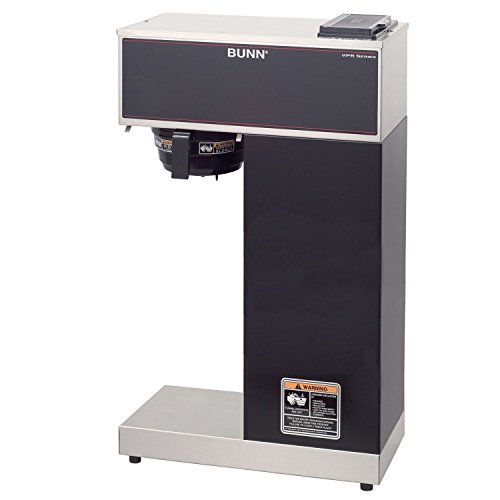
BUNN VPR APS Commercial Pour Over Air Pot Coffee Brewer — Best for Airpot and Self-Serve Service
The VPR APS brews directly into airpots — sealed, insulated, pump-served servers that hold coffee at quality far longer than any warmer plate can. That makes it the pick for self-serve stations, bakery cases, meeting-room service and any café that refuses to serve stewed coffee. An airpot can also leave the counter: catering trays, market stalls and office deliveries all run on the same server you brewed into. The trade is presentation and pace — no glowing row of decanters, and airpots are another item to buy, wash and eventually re-seal — but for flavour-led service this is the professional choice.
Strengths
- Brews into airpots that protect flavour for hours
- Servers travel — catering and satellite stations from one brewer
- No hot-plate stewing anywhere in the service chain
Trade-offs
- Airpots are a separate purchase and a washing routine
- Less visual theatre than decanter service
- Pump mechanisms need periodic deep cleaning
| Key spec | Commercial pourover brewer designed for airpot servers, 120V |
|---|---|
| Format | Commercial pourover brewer — plumbed or manual-fill, decanters/airpots sold and managed separately |
Airpot discipline is simple: brew, label with the time, serve within the window, wash nightly. Cafés that adopt it consistently report the fewest ‘your coffee tastes old’ complaints of any service model in this guide.
In café service, BUNN VPR APS Commercial Pour Over Air Pot Coffee Brewer is judged by a harsher jury than any home brewer: the Saturday rush, the new staff member, the hard-water month nobody noticed. Its commercial construction, standard parts and simple pourover operation are what let it survive that jury — there is little to misunderstand, little that cannot be cleaned, descaled or replaced, and nothing that needs an app or a firmware update before the morning pot. Cafés do not need novelty from their filter brewer; they need the same pot, at the same quality, at the same speed, every day of the year — and that repeatability is exactly the case for BUNN VPR APS Commercial Pour Over Air Pot Coffee Brewer.
In daily café use, the BUNN VPR APS Commercial Pour Over Air Pot Coffee Brewer lives or dies on its unglamorous qualities: how fast it recovers between pots, whether the hundredth brew of the week matches the first, and how a relief staff member handles it without training. Machines of this class are bought for that repeatability, and the service record behind the format — Commercial pourover brewer designed for airpot servers, 120V — is long enough that cafés can predict its behaviour across years, including which parts wear and what they cost. Its Best for Airpot and Self-Serve Service badge reflects the role it fills in a working coffee program, judged by operators’ priorities: uptime first, consistency second, and everything else after.
Best for: cafés with self-serve stations and quality-first service / Not suited for: traditional counter service built on visible decanters
Check on Amazon — check price on Amazon for the current listing before you buy.

BUNN VPS 12-Cup Pourover Commercial Coffee Brewer, 3 Warming Stations — Best Classic Counter Presence
The VPS is the classic American café-counter silhouette: a pourover brewer flanked by three warming stations, pots staged and ready, coffee service visible from the door. For diners, bakeries and traditional cafés, that visibility sells coffee — customers see fresh pots and order. It shares the family virtues: stainless build, no plumbing, standard power, fast cycles. Choose it over the VP17-3 when the staged row of pots is part of your service theatre and your staff pour every cup; choose the airpot route instead if self-serve or flavour-holding matters more than the look.
Strengths
- Classic three-station counter presence that merchandises coffee
- Proven commercial platform with deep parts availability
- No-plumbing installation on standard power
Trade-offs
- Warmer-held coffee needs the same freshness discipline as any hot plate
- Bulkiest counter footprint of the decanter picks
- Decanter fleet and spares are on your budget
| Key spec | 12-cup commercial pourover brewer with 3 warming stations |
|---|---|
| Format | Commercial pourover brewer — plumbed or manual-fill, decanters/airpots sold and managed separately |
There is a reason this format defined café counters for decades: it is fast, legible and repairable. In a staff-poured setting with honest discard habits, it remains a thoroughly rational purchase.
In café service, BUNN VPS 12-Cup Pourover Commercial Coffee Brewer, 3 Warming Stations is judged by a harsher jury than any home brewer: the Saturday rush, the new staff member, the hard-water month nobody noticed. Its commercial construction, standard parts and simple pourover operation are what let it survive that jury — there is little to misunderstand, little that cannot be cleaned, descaled or replaced, and nothing that needs an app or a firmware update before the morning pot. Cafés do not need novelty from their filter brewer; they need the same pot, at the same quality, at the same speed, every day of the year — and that repeatability is exactly the case for BUNN VPS 12-Cup Pourover Commercial Coffee Brewer, 3 Warming Stations.
After a season of service, cafés report the same pattern with the BUNN VPS 12-Cup Pourover Commercial Coffee Brewer, 3 Warming Stations: it stops being equipment and becomes infrastructure, noticed only during the descale rota or the rare service visit. That invisibility is the highest praise commercial gear can earn. The 12-cup commercial pourover brewer with 3 warming stations configuration does shape the working day — staging, washing rhythm and where the station’s bottleneck sits — and the reviews above were written to make those operational consequences explicit before purchase, because in a business the cost of a wrong fit is paid every single morning, not once.
Best for: traditional cafés and diners wanting the classic staged-pot counter / Not suited for: premises planning airpot or urn service instead
Check on Amazon — check price on Amazon for the current listing before you buy.

Hamilton Beach Commercial 60 Cup Coffee Urn D50065 — Best for Events and Banquets
Some café coffee is not sold by the cup across a counter — it is served by the urn at weddings, conferences, church halls and café-run catering. The D50065 is built for that world: 60 cups in one brew, polished stainless presentation, commercial construction from Hamilton Beach’s professional line. A café with any events business should own this class of machine, because renting or improvising large-volume coffee is where quality and margins both go to die. It is not a daily pot brewer — coffee sits as a batch, and small services deserve fresher tools — but for volume service it is the professional answer.
Strengths
- 60-cup single batch covers serious event volume
- Polished stainless suits front-of-house presentation
- Commercial line build for repeated event duty
Trade-offs
- Batch coffee cannot match fresh-pot quality for small service
- Large and storage-hungry between events
- Long initial brew time needs event-timeline planning
| Key spec | 60-cup commercial coffee urn, polished stainless steel |
|---|---|
| Format | Commercial pourover brewer — plumbed or manual-fill, decanters/airpots sold and managed separately |
Event maths matters: an urn started when the room opens is a complaint by the second hour. Start it early enough to be ready at doors, and its volume becomes the easiest money in café catering.
In café service, Hamilton Beach Commercial 60 Cup Coffee Urn D50065 is judged by a harsher jury than any home brewer: the Saturday rush, the new staff member, the hard-water month nobody noticed. Its commercial construction, standard parts and simple pourover operation are what let it survive that jury — there is little to misunderstand, little that cannot be cleaned, descaled or replaced, and nothing that needs an app or a firmware update before the morning pot. Cafés do not need novelty from their filter brewer; they need the same pot, at the same quality, at the same speed, every day of the year — and that repeatability is exactly the case for Hamilton Beach Commercial 60 Cup Coffee Urn D50065.
In daily café use, the Hamilton Beach Commercial 60 Cup Coffee Urn D50065 lives or dies on its unglamorous qualities: how fast it recovers between pots, whether the hundredth brew of the week matches the first, and how a relief staff member handles it without training. Machines of this class are bought for that repeatability, and the service record behind the format — 60-cup commercial coffee urn, polished stainless steel — is long enough that cafés can predict its behaviour across years, including which parts wear and what they cost. Its Best for Events and Banquets badge reflects the role it fills in a working coffee program, judged by operators’ priorities: uptime first, consistency second, and everything else after.
Best for: cafés running events, banquets and large self-serve volumes / Not suited for: small cafés needing pot-by-pot freshness
Check on Amazon — check price on Amazon for the current listing before you buy.

West Bend 55-Cup Commercial Coffee Urn, NSF — Best NSF-Certified Urn
West Bend’s commercial urns are the old American standard for institutional coffee, and this 55-cup model carries NSF approval — the listing many health departments and institutional buyers look for when equipment is inspected. The polished aluminium body is light for its size, heats evenly, and has served school functions, halls and cafés for generations of product cycles. For a café supplying contract catering or operating in an inspected institutional setting, that certification is not a nicety; it can be the difference between passing and explaining. Capacity sits just below the Hamilton Beach, presentation is classic, and the design is as proven as equipment gets.
Strengths
- NSF approval for inspected and institutional settings
- 55-cup capacity in a comparatively light aluminium body
- Decades-proven design with familiar operation
Trade-offs
- Aluminium needs appropriate cleaning care to stay bright
- Batch format shares the urn freshness limits
- Fewer modern touches than newer urn designs
| Key spec | 55-cup commercial coffee urn, polished aluminium, NSF approved |
|---|---|
| Format | Commercial pourover brewer — plumbed or manual-fill, decanters/airpots sold and managed separately |
If your café’s growth path includes schools, offices or venues with equipment rules, buy the listed urn first and skip the awkward conversation later. It also doubles as the house’s high-volume backup on the busiest retail days.
In café service, West Bend 55-Cup Commercial Coffee Urn, NSF is judged by a harsher jury than any home brewer: the Saturday rush, the new staff member, the hard-water month nobody noticed. Its commercial construction, standard parts and simple pourover operation are what let it survive that jury — there is little to misunderstand, little that cannot be cleaned, descaled or replaced, and nothing that needs an app or a firmware update before the morning pot. Cafés do not need novelty from their filter brewer; they need the same pot, at the same quality, at the same speed, every day of the year — and that repeatability is exactly the case for West Bend 55-Cup Commercial Coffee Urn, NSF.
After a season of service, cafés report the same pattern with the West Bend 55-Cup Commercial Coffee Urn, NSF: it stops being equipment and becomes infrastructure, noticed only during the descale rota or the rare service visit. That invisibility is the highest praise commercial gear can earn. The 55-cup commercial coffee urn, polished aluminium, NSF approved configuration does shape the working day — staging, washing rhythm and where the station’s bottleneck sits — and the reviews above were written to make those operational consequences explicit before purchase, because in a business the cost of a wrong fit is paid every single morning, not once.
Best for: venues and cafés whose health inspections require NSF-listed equipment / Not suited for: buyers who prefer stainless over aluminium
Check on Amazon — check price on Amazon for the current listing before you buy.
Comparison Table
| Pick | Badge | Key spec | Best for |
|---|---|---|---|
| BUNN VP17-1SS Pourover Coffee Brewer, 1 Warmer | Best Overall for a Small Café | Commercial pourover brewer, 1 warmer, stainless steel, manual-fill — no plumbing required | small cafés and bakeries starting filter service |
| BUNN VP17-3 Pourover Commercial Coffee Brewer, 3 Lower Warmers | Best for Rush Capacity | Commercial pourover brewer with 3 lower warmers, 120V | busy cafés staging regular, decaf and a house blend at once |
| BUNN VPR APS Commercial Pour Over Air Pot Coffee Brewer | Best for Airpot and Self-Serve Service | Commercial pourover brewer designed for airpot servers, 120V | cafés with self-serve stations and quality-first service |
| BUNN VPS 12-Cup Pourover Commercial Coffee Brewer, 3 Warming Stations | Best Classic Counter Presence | 12-cup commercial pourover brewer with 3 warming stations | traditional cafés and diners wanting the classic staged-pot counter |
| Hamilton Beach Commercial 60 Cup Coffee Urn D50065 | Best for Events and Banquets | 60-cup commercial coffee urn, polished stainless steel | cafés running events, banquets and large self-serve volumes |
| West Bend 55-Cup Commercial Coffee Urn, NSF | Best NSF-Certified Urn | 55-cup commercial coffee urn, polished aluminium, NSF approved | venues and cafés whose health inspections require NSF-listed equipment |
Read the table as a map, not a ranking. The badges matter more than the order: a pick that wins on throughput and service model can still be the wrong buy if your daily routine points the other way.
Decanters, airpots or urns — which service model fits your café?
Decanters with warmers suit staff-poured counters where pots turn over fast; the coffee’s short life is hidden by volume. Airpots suit self-serve, quality-led service and any coffee that must wait or travel. Urns suit events and institutional volume where coffee is a batch, not a brew. Many real cafés run two models — decanter or airpot for daily service, an urn for events — and this guide’s picks are chosen to combine without overlap.
What does ‘commercial’ actually buy you over a home machine?
Duty cycle and serviceability. A home machine brewed twenty times a day will fail early and is rarely worth repairing; commercial brewers are built for continuous cycling, use standard parts, and are designed to be opened, descaled and repaired by technicians. You also get speed — commercial elements recover fast between pots — and honest capacities. In a business, the machine’s cost is small next to a single closed morning, which is why cafés buy this class.
Water, power and installation realities
Every pick here runs on standard 120V service and fills by hand, which is deliberate: it keeps installation to a counter and an outlet, with no plumbing works or electrician. The hidden workload is water quality. Café volumes scale boilers fast in hard-water areas, so budget for filtration or a strict descale rota from day one — scale is the number one killer of commercial brewers, and it is entirely preventable.
How many decanters, airpots and spares should you budget?
For decanter service: at least two per warmer position plus one spare per café, because glass breaks on the busiest morning, never the quietest. For airpots: one per coffee offered plus one in the wash. Add filters by the case, a spare spray head, and the descaler your water demands. None of this is glamorous, and all of it is the difference between a coffee program and a coffee problem. Check price on Amazon for the brewer and the consumables together before committing.
Should a small café buy one brewer or two?
Two, whenever the budget can stretch — and the second can be modest. A single brewer is a single point of failure standing between the café and its coffee revenue, and commercial machines, however reliable, choose the busiest morning to need a seal or a switch. Many cafés run the main brewer for regular and a second, smaller unit for decaf, which doubles as the emergency backup for both. Priced against one closed morning of coffee sales, the redundancy is the cheapest insurance in the building. Check price on Amazon for a paired setup before assuming it is out of reach.
How to Set Up a Café Filter Coffee Station That Survives the Rush
Equipment is half the system. This station setup, used with any brewer above, is the other half.
- Place the brewer where water, waste and cups form a triangle a staff member can work without crossing the customer flow.
- Station a filled water pitcher and a measured coffee dose system beside the brewer — pre-dosed filters or a scoop-and-scale routine everyone follows identically.
- Label every pot and airpot with its brew time, and set the discard window your café will actually honour.
- Stage the decanter or airpot fleet in rotation order, so the oldest coffee is always poured first and nothing hides at the back.
- Put the spare decanter, spare spray head and descaler in a labelled box near the station — not in a storeroom across the building.
- End each day with the wash routine: decanters and airpots washed, brewer wiped, and the next morning’s first pot staged.
Run that system for a month and review the two numbers that matter: how many pots were discarded for age, and how many rush minutes were lost to the station. Adjust batch sizes and staging to those numbers, not to guesses.
Common Buying Mistakes
Running a home machine in a café
It voids warranties, fails under duty, and costs more in closures than the commercial machine would have. The price gap closes the first time a home unit dies mid-rush.
Serving warmer-held coffee past its window
Capacity tempts cafés to stretch pots. A discarded pot costs cents; a reputation for old coffee costs customers. Set the window and honour it publicly.
Skipping water treatment
Scale strangles commercial brewers slowly, then suddenly. Filtration or scheduled descaling is not optional at café volumes.
Buying the brewer and forgetting the fleet
One decanter is a closure waiting for a dropped pot. The spares budget is part of the machine budget.
Final Recommendation
Open with the BUNN VP17-1SS if your café’s filter service is a pot or two at a time — it is the proven, install-anywhere default. Step up to the VP17-3 or the VPS when the rush demands staged pots, choose the VPR APS if self-serve or flavour-holding matters most, and add the Hamilton Beach 60-cup urn or the NSF-listed West Bend the moment events enter your business.
Treat the brewer as a system — fleet, water, discard discipline — and a modest café coffee program becomes one of the most reliable profit lines in the building. The machines above have run that program in thousands of small cafés; the design work left to you is only the routine around them.
Ready to buy? Compare the full shortlist on Amazon: BUNN VP17-1SS Pourover Coffee Brewer, 1 Warmer, BUNN VP17-3 Pourover Commercial Coffee Brewer, 3 Lower Warmers, BUNN VPR APS Commercial Pour Over Air Pot Coffee Brewer, BUNN VPS 12-Cup Pourover Commercial Coffee Brewer, 3 Warming Stations, Hamilton Beach Commercial 60 Cup Coffee Urn D50065, West Bend 55-Cup Commercial Coffee Urn, NSF. Check price on Amazon for each before ordering, since listings, bundles and stock change often.
Keep exploring the same cluster on this site: Best Coffee Makers For Church Best Coffee Makers For Beginners Best Coffee Makers For Best Tasting Coffee Best 12 Cup Coffee Makers Best Coffee Makers For Coffee All Day
Café Coffee Economics in Plain Terms
Filter coffee is quietly one of the best margins in a small café: the ingredient cost per cup is low, the labour is measured in seconds, and the equipment in this guide is modest next to an espresso program. The margin leaks in exactly three places — discarded stale pots, broken decanters without spares, and machine downtime from scale. The systems in this article exist to plug those three leaks, and a café that plugs them keeps the margin the category promises.
Menu design helps too. A regular, a decaf and one rotating feature coffee cover nearly all filter demand; a fourth pot is usually waste wearing a costume. Price the feature coffee to celebrate it, keep the regular priced as the everyday anchor, and let the staging on the counter do the selling — visible fresh pots are the oldest and best café advertising there is.
Finally, train every staff member on the station, not just the opener. Café coffee fails at shift changes, when the person who knew the routine leaves and the pots stop being timed. A labelled station and a one-page routine taped inside a cupboard door are worth more than any single equipment upgrade in this guide.
Staff training is the invisible specification. A café’s coffee quality is set by the least-trained person who works the station, so the brewer decision and the routine decision are the same decision: measured doses, timed pots, labelled staging. The machines in this guide were chosen partly for how little proprietary knowledge they demand — a new hire should be brewing correctly within one supervised shift.
Energy and water costs deserve one line in the business case. Pourover brewers with warmers draw modest, predictable power; the real operating cost is discarded coffee and descaling labour, both of which the systems in this article are designed to minimise. Track pots brewed against pots sold for a month and you will know your true coffee margin to the cent.
Insurance and compliance rarely appear in café equipment guides, but they belong in this one. Commercial premises answer to health inspections, insurers and landlords in ways home kitchens never do, and equipment with recognised commercial listings — NSF approval where it applies, established manufacturer documentation, standard electrical specifications — makes every one of those conversations shorter. The picks here were screened with that paperwork reality in mind, because a brewer that complicates an inspection is a liability wearing a bargain’s clothes.
Think, too, about the second year rather than the second week. Café brewers live on a maintenance calendar: descaling by water hardness, seals and spray heads on inspection, decanters replaced as they chip and cloud. Budget that calendar when you buy — a modest monthly set-aside per machine — and the equipment in this guide will still be the backbone of the coffee program when the café’s fifth anniversary arrives, having paid for itself many times over in the meantime.
And plan the growth path now, while it is cheap: the counter layout that fits today’s single brewer should leave a marked space for the second, the decaf unit or the airpot station. Cafés that grow their coffee program inside a planned station look intentional at every stage; cafés that improvise it look like they are coping. The equipment is the same either way — the planning is the difference customers can see.
Customer perception deserves a line in the operations plan: coffee that is seen being brewed, staged in clean decanters or pumped from labelled airpots, sells itself. The station’s tidiness is part of the product. Wipe the brewer’s face, polish the pots, keep the discard bucket out of sight, and the same coffee reads as a café’s pride rather than its afterthought — a return no equipment upgrade can buy separately.
Waste tracking closes the loop on the freshness discipline this guide keeps returning to. A simple tally — pots brewed, pots discarded, cups sold — kept for one month tells a café its true batch rhythm: which hours over-brew, which services under-brew, and where the second brewer or the smaller batch pays for itself. The machines here support any of those corrections; the tally is what tells you which one you need.
And keep the supplier relationship boring in the best way: filters, seals and descaler ordered before they are needed, from the same source, on a standing rhythm. Café coffee programs rarely fail dramatically — they fray through small shortages and skipped maintenance, and a dull, reliable supply routine is the cheapest protection there is.
A final operational note: keep the brewer’s manual, the parts list and the service contact in one folder at the station, not in an office across the building. When a seal fails at 7 a.m., the difference between a ten-minute fix and a closed coffee service is whether the person standing there can find the part number and the phone number without a search party.
One final café note: regulars can taste a neglected station before they can name what is wrong with it, and they can taste a cared-for one just as fast. The brewers in this guide, run with the systems around them, put your café permanently in the second group — which is where the queue at the counter, and the reputation that built it, both come from.
Frequently Asked Questions
Do these café brewers need plumbing?
No. Every pick here is a pourover model filled by hand, running on standard 120V power. Plumbed automatics exist for higher volumes, but they add installation cost these picks deliberately avoid.
Can a café run on filter coffee alone, without espresso?
Many do — bakeries, delis, diners and filter-focused cafés. Espresso is a separate program with its own machine, grinder and training costs; nothing here substitutes for it, and nothing here needs it to succeed.
How long can coffee sit on a warmer or in an airpot?
On a warmer, plan around thirty minutes before flavour visibly declines. In a sealed airpot, coffee holds quality far longer — commonly a couple of hours. Set your discard window by taste at your own station.
What size urn does a café need for events?
Match the urn to your largest regular event with headroom: the 55 and 60 cup models here cover most café catering. Two smaller urns beat one giant one when events split across rooms.
Are these brewers repairable, or disposable?
Repairable by design — that is the commercial difference. Elements, switches, spray heads and seals are service parts, and BUNN in particular has a deep service network.
What filters do commercial brewers use?
Larger-format commercial paper filters matched to the brew basket. Buy by the case for café use, and confirm the size for your model before ordering in bulk.


