Disclosure: airfryerkitchensupply.com is reader-supported. When you buy through links on our site, we may earn an affiliate commission at no extra cost to you.
Where to buy
The fastest way to shop for best coffee makers 200 degrees is on Amazon, where every pick below is sold with full specifications, sizing and configuration options on the product page. Start with our top recommendation, the Technivorm Moccamaster KBGV Select 10-Cup — check price on Amazon — then compare it against the other five picks in the Quick Picks table before you decide.
Every machine on this page was chosen for one measurable virtue: delivering brewing water in the ideal band around 200 degrees Fahrenheit and holding it there. If a brewer could not demonstrate that discipline — by certification, by design, or by reputation earned over years — it is not here, whatever else it offers, and several famous machines were left off this page for exactly that reason.
The search for the best coffee makers 200 degrees is really a search for the single number that decides what drip coffee tastes like. Water temperature governs extraction: in the band around 200 degrees Fahrenheit — formally, the 195-to-205 window the specialty coffee world brews by — hot water pulls the sweet, balanced compounds out of ground coffee at the right rate. Cooler than that, the cup turns sour and thin. Hotter, and bitter compounds take over. Most disappointing home coffee is not a bean problem or a machine-brand problem; it is a temperature problem wearing those disguises.
The uncomfortable truth is that many coffee makers never reach the band, or reach it only in a spike at the end of the brew while the first half of the pot extracted lukewarm — and the drinker, tasting the averaged result, blames the beans, the grind, the water and the roast, in rotation, for what is actually a heating element quietly failing at its one job. Manufacturers know this, which is why the honest ones submit to measurement: SCA certification, the badge carried by two picks below, exists precisely to verify that a brewer holds the band through the whole cycle. The six machines in this guide are the ones that pass the temperature test by certification, by engineering, or by long-earned reputation — at every tier from mid-range value to hand-built premium.
A note on what this guide is not: 200 degrees is the water temperature inside the brewer, not the temperature in your cup, which will always be lower after the carafe, the air and the mug take their share. Chasing cup temperature with a hotter brewer is a mistake — you would scorch the extraction to warm the mug. Preheat the mug instead, and let the brewer do its one job at the right number, undistracted by a job that belongs to the carafe and the cupboard.
In this guide
Quick Picks
Short on time? These are the six best coffee makers 200 degrees options we would buy ourselves, each chosen for a different need and budget tier. Every badge below matches the badge used in the full review further down, so you can jump straight to the model that fits you.
- Technivorm Moccamaster KBGV Select 10-Cup — Best Overall at 200 Degrees. The reference machine for brew temperature: its copper element holds the water in the heart of the ideal band for the entire brew, which is why its coffee tastes sweeter from the same beans. Check price on Amazon.
- Bonavita 8-Cup Coffee Maker BV1901TS — Best Value Certified Temperature. SCA certified — independently verified to brew in the proper temperature band — with a thermal carafe and a bloom mode, at the mid tier. Check price on Amazon.
- OXO Brew 8-Cup Coffee Maker — Best Compact Certified Brewer. The other SCA-certified name on this page, in a smaller body, with a single-serve mode — certified temperature for kitchens that cannot house a big machine. Check price on Amazon.
- Breville Precision Brewer BDC400 — Best Adjustable Temperature. Where the certified machines hold one temperature beautifully, this one lets you set it: adjustable brew temperature, bloom and flow, with a Gold Cup preset when you want the standard applied for you. Check price on Amazon.
- Ratio Six Series 2 Drip Coffee Maker — Best Premium Design. A hand-assembled, design-led brewer built around the same temperature discipline — borosilicate glass, steel and walnut, with an 8-cup thermal carafe. Check price on Amazon.
- Fellow Aiden Precision Smart Drip Coffee Maker — Best Smart Precision Brewer. The app-connected precision brewer: guided recipes, scheduled brewing and tight temperature control — the 200-degree discipline, automated and programmable at last. Check price on Amazon.
How These Picks Were Chosen
Temperature evidence decided this list, in a deliberate hierarchy. First, independent certification: SCA Certified Home Brewers have been measured against the Golden Cup standard, and two picks carry that badge. Second, engineering: heating systems — copper elements, high-power heaters, precision controls — designed explicitly to reach and hold the band. Third, adjustability and smart control, for readers who want to set the number themselves. A famous name with no temperature story did not qualify, however good its other features.
Every model was verified against the Amazon catalogue data available to this site before being linked. We also required the rest of the brewing system to respect the temperature work: even showerheads so the hot water is used evenly, and carafes — thermal wherever the tier allows — that do not undo the extraction by cooking the result on a plate.
Finally, we kept the guide honest about proof. Where a machine’s temperature performance rests on design and reputation rather than certification, the review says so. Readers deserve to know which claims were measured and which were engineered, and in a category full of thermal marketing, that distinction is the most useful thing this page can offer.
One more selection note, because readers of a temperature guide are measurers by temperament: we did not rank these machines by a single laboratory number, and you should be suspicious of any guide that does. Brew temperature interacts with flow rate, saturation and time, and a machine a degree cooler with an even showerhead will out-brew a machine a degree hotter that channels water through the middle of the basket. The badges therefore reward the whole temperature system — heat, hold, distribution, and a carafe that respects the result — which is the system your palate will actually judge.
The 6 Best Coffee Makers That Brew at 200 Degrees

Technivorm Moccamaster KBGV Select 10-Cup — Best Overall at 200 Degrees
Every machine in this guide is here because of temperature, and the Moccamaster is the standard the others are measured against. Its copper heating element does the two things that matter: it reaches the ideal extraction band — the zone around 200 degrees Fahrenheit, within the wider 195–205 window the specialty standard defines — and it stays there for the whole brew. Most brewers fail the second half of that sentence: they start cool, spike late, and extract the same grounds unevenly in both directions. The Moccamaster’s flat, disciplined temperature curve is why identical beans taste noticeably sweeter and clearer through it.
Strengths
- Holds the ideal temperature band for the entire brew, not just at peak
- Even showerhead distribution matches the temperature discipline
- Repairable build keeps that performance for decades
Trade-offs
- No timer or programmability
- Glass carafe — decant or drink promptly
- Premium tier pricing
| Specification | Detail |
|---|---|
| Capacity | 10 cups / 40 oz (1.25 L) |
| Heating | Copper boiling element |
| Brew time | Full pot in roughly six minutes |
The rest of the machine serves that one virtue. A nine-hole showerhead distributes the hot water evenly instead of drilling a channel through the middle of the basket, the full pot brews in about six minutes so the grounds spend the right amount of time in contact with the water, and the build — metal, hand-assembled, serviceable — means the temperature performance you buy is the performance you still have in fifteen years. Temperature discipline that decays with scale and wear is a temporary feature; in this machine it is a property of the design.
The familiar trade-offs apply: no timer, no programmability, a glass carafe on a hot plate, and the highest tier in this guide. But this article’s question is narrow — which coffee makers truly brew at the right temperature — and on that question the Moccamaster is not merely the winner, it is the reason the question has a satisfying answer at all.
Best for: anyone whose priority is extraction quality above features / Not suited for: households that need scheduled, programmable brewing
Check on Amazon — check the current price on Amazon before you buy, because configurations and bundle options change over time.

Bonavita 8-Cup Coffee Maker BV1901TS — Best Value Certified Temperature
Certification is the honest shortcut in this category, and the Bonavita wears it: as an SCA Certified Home Brewer, its temperature performance — brewing within the recognised band, consistently — has been measured by the specialty coffee industry’s own body rather than asserted by its marketing department. For a reader who wants a machine that provably brews around 200 degrees without paying the Moccamaster’s premium, this is the shortest path to certainty.
Strengths
- Independently certified temperature performance
- Bloom mode and even showerhead extraction
- Thermal carafe protects the brewed result
Trade-offs
- 8-cup capacity only
- No programmability
- Functional rather than premium build
| Specification | Detail |
|---|---|
| Capacity | 8 cups |
| Certification | SCA Certified Home Brewer |
| Carafe | Stainless steel thermal, double wall |
| Extras | Optional pre-infusion mode |
The design spends its budget where temperature is won: a powerful heater sized to hold the band through the whole cycle, a wide showerhead for even saturation, and an optional pre-infusion mode that wets the grounds and lets them bloom before the main flow — the behaviour of a careful pour-over, automated. The thermal carafe then protects the result, holding the coffee hot by insulation rather than by continued cooking on a plate, which matters more in a temperature-focused guide than anywhere: a brewer that nails 200 degrees and then serves from a scorching plate has won the battle and lost the cup.
Capacity is the main limit — eight cups suits households, not crowds — and there is no timer for the wake-up pot. The build is functional rather than heirloom. But measured purely on verified temperature per unit of money, this is the strongest value in the guide, and the pick we would hand to any reader who asked the title’s question on a sensible budget.
Best for: budget-aware buyers who want certified 200-degree brewing / Not suited for: large households needing bigger pots
Check on Amazon — check the current price on Amazon before you buy, because configurations and bundle options change over time.

OXO Brew 8-Cup Coffee Maker — Best Compact Certified Brewer
The OXO Brew 8-Cup carries the same SCA certification as the Bonavita — the same independently verified temperature discipline — in a machine designed for the kitchens the Bonavita’s owners often do not have. It is the compact option among certified brewers, and it adds a capability neither certified rival matches: a single-serve mode that brews a smaller amount for one drinker through the same temperature-controlled system, so the solo morning cup gets the same 200-degree discipline as the Saturday pot.
Strengths
- Certified temperature in the most compact body here
- Single-serve mode with the same brewing discipline
- Thermal carafe and simple, clear controls
Trade-offs
- 8-cup ceiling for entertaining
- Single serve is a brew cycle, not instant
- Costs a premium for its capacity class
| Specification | Detail |
|---|---|
| Capacity | 8-cup thermal carafe plus single-serve |
| Certification | SCA Certified Home Brewer |
| Design | Compact footprint, stainless thermal carafe |
That flexibility maps perfectly onto how small households actually drink: one or two cups on weekdays, a carafe when friends come. The thermal carafe guards the pot’s quality, the controls follow OXO’s one-job-per-control clarity, and the machine’s footprint and upkeep suit apartments, small counters and under-cabinet spaces where a full-size brewer simply does not fit. Temperature performance usually costs size as well as money; this is the pick that declines to charge the size.
The ceiling is capacity and the single-serve’s nature: eight cups is eight cups, and the single serve is a basket brew — excellent, but measured in minutes rather than a pod machine’s seconds. Readers for whom those are footnotes get certified temperature in its most livable form.
Best for: small households that refuse to compromise on temperature / Not suited for: big families and frequent entertainers
Check on Amazon — check the current price on Amazon before you buy, because configurations and bundle options change over time.
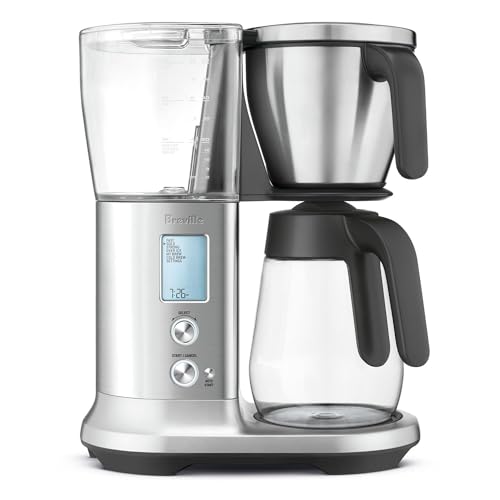
Breville Precision Brewer BDC400 — Best Adjustable Temperature
There are two philosophies of brewing at 200 degrees: hold the standard perfectly, or hand the drinker the dial. The Precision Brewer is the second philosophy, engineered seriously. Its temperature is adjustable, so a light roast that extracts best at the top of the band and a dark roast that prefers the middle can both be brewed at their number rather than at a compromise. Bloom time and flow rate are adjustable alongside, and the Gold Cup preset applies the recognised standard automatically when you want the machine’s judgement instead of your own.
Strengths
- True user-set temperature across the ideal band
- Bloom and flow controls for full extraction tuning
- Gold Cup preset plus cold brew and pour-over modes
Trade-offs
- Premium tier and large footprint
- Rewards knowledge — can be set wrong as precisely as right
- Complexity most households will never use
| Specification | Detail |
|---|---|
| Controls | Adjustable brew temperature, bloom time and flow rate |
| Presets | Gold Cup (specialty standard) plus custom My Brew |
| Modes | Drip, cold brew, pour-over capable |
For the reader whose search for ‘200 degrees’ is really a search for control, this is the most capable machine in the guide. It is also the most versatile: a genuine cold brew programme and pour-over capability make it three brewers in one footprint, and the thermal carafe keeps the results honest. In skilled hands it can match any fixed-temperature rival and then go places they cannot — a degree hotter for this bean, a longer bloom for that one.
The discipline it demands is the trade-off. Adjustability is only an asset if you adjust thoughtfully; left on a random custom setting, it will brew at the wrong temperature more precisely than a cheap machine manages by accident. It is also premium-tier and large. Buy it as an instrument and it rewards you; buy it as an appliance and the certified one-button picks above serve you better.
Best for: enthusiasts who want to dial temperature per bean / Not suited for: set-and-forget households that want the standard applied for them
Check on Amazon — check the current price on Amazon before you buy, because configurations and bundle options change over time.

Ratio Six Series 2 Drip Coffee Maker — Best Premium Design
The Ratio Six exists for the reader who wants the temperature discipline of this guide’s top picks in a machine that looks like it belongs in a design museum rather than a diner. Beneath the borosilicate glass, steel and walnut is a serious brewer: a powerful heating system engineered to deliver water in the ideal band, a showerhead arrangement that treats the grounds evenly, and a thermal carafe that keeps the result at temperature without a plate. It brews like the certified machines and presents like furniture.
Strengths
- Serious temperature engineering in a design-led body
- Premium materials and hand assembly
- Thermal carafe keeps the result uncooked
Trade-offs
- Top-tier pricing for 8-cup capacity
- No SCA certification, unlike two rivals here
- A considered purchase, not a value one
| Specification | Detail |
|---|---|
| Capacity | 8-cup thermal carafe |
| Build | Borosilicate glass, stainless steel, walnut accents |
| Assembly | Hand-assembled design-led construction |
That combination — performance with presence — is rarer than it should be, because most manufacturers spend the premium budget on either engineering or appearance. Ratio spends it on both and charges accordingly, positioning the Six at the top of this guide’s tiers alongside the Moccamaster. The ownership experience matches: hand assembly, quality materials throughout, and a machine owners display rather than store.
The honest costs are the tier itself and the 8-cup capacity, which is modest for the money if your household brews for crowds. It also lacks the independent SCA certification the Bonavita and OXO carry — its temperature credentials rest on its design and reputation rather than the association’s measurement, which certification purists should weigh. As the premium-design expression of hot, disciplined brewing, though, it earns its place on this page.
Best for: design-conscious buyers who want performance with presence / Not suited for: value seekers and certification purists
Check on Amazon — check the current price on Amazon before you buy, because configurations and bundle options change over time.

Fellow Aiden Precision Smart Drip Coffee Maker — Best Smart Precision Brewer
Every other machine in this guide makes you choose between temperature discipline and convenience: the disciplined ones have no timer, and the programmable ones rarely certify their heat. The Fellow Aiden is the attempt to refuse that choice — a precision drip brewer with tight temperature control at its core, wrapped in the connectivity modern households expect: guided brew profiles, the ability to schedule a pot, and batch or single-serve flexibility from the same machine.
Strengths
- Precision temperature with scheduling — the rare combination
- Guided profiles make tuning approachable
- Batch and single-serve flexibility
Trade-offs
- Newer platform than the proven mechanical rivals
- App-connected design will not suit everyone
- Premium tier pricing
| Specification | Detail |
|---|---|
| Control | Precision temperature control with guided profiles |
| Features | App connectivity, scheduled brewing |
| Format | Smart drip coffee maker, batch and single-serve capable |
The profile system is its distinctive idea. Rather than one fixed recipe, the Aiden works from brew profiles — guided parameter sets for different coffees — which brings a measure of the Breville’s adjustability to users who would rather follow a recipe than invent one. For the temperature-focused reader, the appeal is direct: this is a machine designed by a company whose reputation rests on temperature-controlled kettles, applying that obsession to drip, with the scheduling the Moccamaster famously lacks.
The caveats are those of any smart appliance: it is a newer platform than the decades-proven designs above it, its app-mediated experience will not suit buyers who distrust connected kitchen gear, and it sits in the premium tier. Readers who want certified, mechanical simplicity should take the Bonavita or the Moccamaster. Readers who want the temperature and the timer in one machine finally have a serious candidate, and it closes this guide as the future-facing pick.
Best for: tech-comfortable households wanting temperature and a timer / Not suited for: buyers who prefer mechanical, offline appliances
Check on Amazon — check the current price on Amazon before you buy, because configurations and bundle options change over time.
Comparison Table
| Pick | Badge | Key spec | Best for |
|---|---|---|---|
| Technivorm Moccamaster KBGV Select 10-Cup | Best Overall at 200 Degrees | 10-cup (40 oz / 1.25 L), copper heating element, fast full-pot brew | anyone whose priority is extraction quality above features |
| Bonavita 8-Cup Coffee Maker BV1901TS | Best Value Certified Temperature | 8-cup, SCA Certified Home Brewer, thermal carafe, pre-infusion mode | budget-aware buyers who want certified 200-degree brewing |
| OXO Brew 8-Cup Coffee Maker | Best Compact Certified Brewer | 8-cup thermal carafe, SCA Certified, single-serve brewing, compact body | small households that refuse to compromise on temperature |
| Breville Precision Brewer BDC400 | Best Adjustable Temperature | Adjustable temperature, bloom and flow controls; Gold Cup preset; cold brew mode | enthusiasts who want to dial temperature per bean |
| Ratio Six Series 2 Drip Coffee Maker | Best Premium Design | 8-cup thermal carafe, hand-assembled, premium materials | design-conscious buyers who want performance with presence |
| Fellow Aiden Precision Smart Drip Coffee Maker | Best Smart Precision Brewer | Precision temperature control, app-guided brew profiles, scheduling | tech-comfortable households wanting temperature and a timer |
Best coffee makers 200 degrees: why is that the right temperature for brewing coffee?
Extraction is chemistry with a thermostat. Coffee grounds contain a spectrum of compounds: bright acids that extract easily, sugars and caramelised compounds that need real heat and time, and bitter, ashy compounds that extract last and fastest at high temperatures. Water in the band around 200 degrees Fahrenheit threads that spectrum — hot enough to pull the sweet middle fully, restrained enough to leave most of the bitter end behind. The specialty standard formalises the window as roughly 195 to 205 degrees, and 200 sits at its centre, which is why the number has become the shorthand for correct brewing.
Below the band, the failure is called under-extraction: the acids dominate because the desirable compounds never dissolved, and the cup tastes sour, salty and thin regardless of the beans’ quality. Above the band, over-extraction: bitterness and astringency swamp everything, and the coffee tastes harsh no matter how fresh the grind. The cruelty of temperature errors is that both failures get blamed on the beans — drinkers switch roasters for months when the brewer was the problem all along.
Time interacts with temperature, which is why the full system matters. A brewer that delivers the right temperature but rushes water through in three minutes under-extracts by the clock instead of by the thermometer. The machines in this guide pair their temperature discipline with sane brew times and even saturation, because extraction is temperature multiplied by time multiplied by evenness — and a zero in any factor ruins the product.
How can you tell if your current coffee maker brews hot enough?
The crudest test is also the most revealing: taste the first pot of the day against the second. Many under-powered brewers only reach the band once the machine itself is warm, so pot two — brewed through a hot machine — tastes noticeably sweeter than pot one from cold. If your machine has a ‘good pot’ and a ‘bad pot’ personality split by order rather than by beans, you have measured its temperature problem with your tongue.
For a direct measurement, run a brew cycle with water only and probe the stream where it meets the basket with a kitchen thermometer, or measure the slurry in the basket mid-brew. You are looking for readings in the 195–205 band through the middle of the cycle, not a single heroic spike at the end. Readings in the 180s — common in ageing and budget machines — explain years of sour coffee in one number.
Before condemning the machine, descale it and measure again. Scale insulates heating elements and is the leading reversible cause of temperature sag; a brewer restored by descaling can gain back several degrees. If a clean machine still cannot reach the band, no bean, grind or filter will save it — that is the moment this guide’s shortlist becomes your shopping list.
What does SCA certification actually verify?
The Specialty Coffee Association’s Certified Home Brewer programme puts machines through laboratory brewing tests against its Golden Cup standard: water temperature delivered in the correct band and held there, brewing time within range, and extraction measured in the finished cup — the strength and extraction percentages that define a properly brewed pot. Machines that pass carry the badge; machines that fail are not listed, which makes the badge meaningful in a way self-declared specifications are not.
Two picks in this guide — the Bonavita BV1901TS and the OXO Brew 8-Cup — carry the certification, and they are the recommendations we make with the least qualification to readers who want verified temperature at sensible tiers. Certification is not the only road to the band: the Moccamaster’s reputation was built over decades of independent measurement by reviewers and laboratories, and the Breville and Fellow machines offer user-controlled precision instead. But certification is the only road where a third party has already done the measuring for you.
Read badges precisely, though. ‘Brews at 200 degrees’ as marketing copy, a ‘hotter coffee’ claim, or a temperature figure for the warming plate are not certification and not evidence. In this category, the difference between a measured claim and an asserted one is the difference between the machines above and the machines we left out — and it is a difference you can taste in the first pot.
Does brew temperature matter more than beans or grind?
It matters differently. Beans set the ceiling — no temperature rescues stale coffee — and grind evenness decides how much of that ceiling you reach. Temperature is the gatekeeper between them: a brewer outside the band cannot express good beans ground well, and will make both taste like a brewer problem. In diagnostic order, temperature is also the variable home drinkers check last and should check first, because it is the only one that can be silently wrong for years while every other input is perfect.
Practically: if your coffee is sour or bitter in a way that survives changes of bean and grind, suspect temperature before spending another dollar on inputs. The test in the section above costs ten minutes and one thermometer. Readers who find their machine innocent can return to beans and grind with a clear conscience — and readers who find it guilty have just located the highest-value upgrade in home coffee, which is what this entire guide exists to shortlist.
How do you keep a brewer at 200 degrees for years?
Temperature discipline decays by one mechanism above all: scale. Mineral deposits coat the heating element and the water path, insulating the element so effectively that a machine specified for the band can sag below it within a year in hard-water country — while looking, sounding and behaving exactly as it always did. The defence is a descale rhythm matched to your water: monthly in hard areas, quarterly in soft, and whenever brew times stretch or the cup turns sour despite fresh beans. It is the same maintenance sermon as every guide in this programme preaches, but in a temperature-focused purchase it is not housekeeping — it is the preservation of the very specification you paid for.
Two habits support it. Filtered water slows scale formation and improves taste simultaneously, the rare double win. And running the machine’s full cycles rather than constant half-pots keeps the heating system working across its designed range. Treat temperature as a maintained property rather than a purchased one, and any pick in this guide will still be brewing at its number long after a neglected rival has drifted, silently and completely, into the 180s.
Should you adjust temperature for different coffees?
Within the band, yes — that is what the band’s width is for, and it is the case for the adjustable picks in this guide. Light roasts are dense and extract reluctantly; they reward the top of the band, 203–205 degrees, and the patience of a bloom. Dark roasts are porous and extract eagerly; they are often sweetest at 195–198, where their bitterness stays in check. Decaf frequently behaves like a darker roast and prefers the cooler end. A fixed-temperature machine brews the band’s centre and serves all three well; an adjustable machine lets the enthusiast chase each bean’s best degree.
Change temperature before you change grind when a new bag disappoints, and change one degree or two at a time. The interaction is forgiving inside the band and punishing outside it, which is the practical summary of this whole page: the band is wide enough for taste and narrow enough to matter, and every machine above was chosen because it lives inside it.
What about the temperature of the coffee in the cup?
Drinkers conflate two temperatures, and the confusion sells bad machines. Brew temperature — the water meeting the grounds — decides extraction and belongs in the band. Serving temperature — the coffee in the mug — decides comfort and aroma perception, and it will always be lower: the carafe, the pour and the mug itself each take a share, and coffee is typically drunk somewhere in the 130s and 140s Fahrenheit by preference, whatever it brewed at. A machine advertising extreme serving heat is often just a hot plate cooking the pot, trading the cup’s flavour for its temperature.
If your coffee reaches the table cooler than you like, fix the serving side, not the brewing side: preheat the thermal carafe with hot water before brewing, preheat the mug the same way, and keep the pot in its insulated carafe rather than a glass one on a plate. Those three simple habits recover more drinking temperature than any brewer change, without touching the extraction that the 200-degree discipline exists to protect.
How to Brew at the Right Temperature From Day One
Whatever machine you choose from this guide, this routine extracts its best:
- Flush the new machine with two full water-only cycles, then descale on a calendar rhythm from day one — temperature discipline is maintained, not bought once.
- Use filtered water if yours is hard or chlorinated; it protects both the heating element and the flavour.
- Preheat the carafe — especially thermal carafes — with hot water while you grind, so the vessel does not steal the brew’s heat.
- Grind fresh, dose consistently (about two tablespoons per six ounces of water), and let the machine’s full cycle run without stealing a cup mid-brew, which starves the rest of the pot.
- Serve promptly, or hold in the thermal carafe. Do not park brewed coffee on a hot plate and expect the temperature discipline you paid for to survive the hour.
- Taste and adjust one variable at a time — dose, then grind, then (on adjustable machines) temperature — keeping notes until the routine sets.
Within a week the routine disappears into habit, and what remains is the thing this guide promised: coffee that tastes like the beans, because the water finally did its job at the right number. Keep the thermometer in the drawer even so — a twice-a-year spot check, slurry measured mid-brew, confirms the discipline is holding and turns descaling from a calendar guess into a decision based on the machine in front of you.
Common Buying Mistakes
The category’s defining mistake is buying temperature claims instead of temperature evidence — a box that says ‘hotter coffee’ in place of a certification, a measurement, or a design that explains itself. The second is chasing the wrong temperature entirely: demanding hotter coffee in the cup and buying a scorching hot plate, when the brewing band was already right and the mug was the problem.
- Judging a brewer’s temperature by its first pot from cold, when many machines need a warm-up cycle to show their true band.
- Letting scale accumulate until the machine sags out of the band, then blaming the beans for a sour year.
- On adjustable machines, changing temperature, grind and dose simultaneously and learning nothing from the result.
- Assuming expensive means hot: plenty of premium-priced machines sell features, and plenty of honest mid-tier machines — two of them certified — sell temperature.
And the quietest mistake: never measuring. Ten minutes with a thermometer turns years of suspicion into a number, and in this category the number is the whole story. Readers who measure before they shop buy once, with evidence, and spend the following years thinking about beans instead of about machinery — which is, in the end, the entire point of getting the temperature right.
Final Recommendation
If you want the temperature discipline in its purest form, buy the Technivorm Moccamaster — it is the reference machine for brewing in the band and it will hold that standard for decades. If you want the same assurance verified and affordable, the Bonavita BV1901TS is the certified value pick, and the OXO Brew 8-Cup is its compact, single-serve-flexible sibling. Choose the Breville Precision Brewer to set the number yourself, the Ratio Six to house it beautifully, and the Fellow Aiden to finally combine precision with a timer.
Whichever you bring home, descale it on schedule and preheat the carafe. Temperature is a discipline, and these are simply the machines that keep it with you. Buy the evidence, maintain the number, and the sour, luck-based coffee that sent you to this page becomes a story you tell about your old machine — briefly, and only when somebody else’s cup reminds you of it.
Complete the picture with Best Coffee Makers for the full category roundup, Best Coffee Grinder For Drip Coffee Makers for the extraction partner, Best Coffee Makers Accessories for thermometers, filters and care kit, and Best Coffee Grinder And Coffee Makers For Office if the machine is headed for a shared kitchen.
To recap the shortlist with links in one place: Technivorm Moccamaster KBGV Select 10-Cup, Bonavita 8-Cup Coffee Maker BV1901TS, OXO Brew 8-Cup Coffee Maker, Breville Precision Brewer BDC400, Ratio Six Series 2 Drip Coffee Maker, Fellow Aiden Precision Smart Drip Coffee Maker. Check price on Amazon for the one that matches your needs, and re-read its review above if you are torn between two badges.
One last practical note: availability and configurations change on Amazon without notice, so confirm the exact variant you want on the product page before ordering. The reasoning behind every badge above, though, does not change — each pick earned its place on the criteria in this guide, and those criteria are the ones your own shortlist should be judged by too.
Related guides
Frequently Asked Questions
What temperature should a coffee maker brew at?
In the band around 200 degrees Fahrenheit — formally about 195 to 205 degrees — where coffee extracts its sweet, balanced compounds without the sourness of cooler water or the bitterness of hotter. Every pick in this guide was chosen for holding that band through the whole brew, not just touching it.
How do I know a coffee maker really brews at 200 degrees?
Look for evidence, in order: SCA certification (an independent laboratory measurement), a heating design that explains itself, such as the Moccamaster’s copper element, or precise user temperature control. Marketing phrases like ‘hotter coffee’ are not evidence. You can also measure any machine’s basket slurry mid-brew with a kitchen thermometer.
Is coffee brewed at 200 degrees too hot to drink?
Brewing temperature is not drinking temperature. Coffee brewed at 200 degrees loses heat to the carafe, the air and the mug, and is typically drunk far cooler, in a comfortable range. Preheat your mug and carafe if you like it hotter — never solve serving temperature by over-heating the brew, which scorches the extraction.
Why does my coffee taste sour even with good beans?
Under-extraction is the usual cause, and cool brewing water is its leading suspect: below the band, the sweet compounds never dissolve and the acids dominate. Descale the machine first — scale is the reversible cause — and measure the brew temperature. If a clean machine still brews in the 180s, the brewer, not the beans, is the problem.
Does an adjustable-temperature coffee maker make better coffee?
It can, in informed hands: light roasts reward the top of the band and dark roasts the bottom, and a machine like the Breville Precision Brewer lets you brew each at its number. For most households a certified fixed-temperature machine that holds the band’s centre automatically is the better buy — the standard exists because it suits nearly everything.
Can descaling really change brew temperature?
Yes — measurably. Scale coats the heating element and insulates it, so the water leaves cooler and the brew runs slower; owners routinely blame beans for the resulting sour cup. A descale cycle restores the element’s contact with the water and can return a sagging machine to its proper band, which is why this guide treats descaling as temperature maintenance, not cleaning trivia.
Should I preheat a thermal carafe?
Yes, if you want the coffee’s first hour at its best. A room-temperature thermal carafe is a large cold mass that pulls heat from the first brew poured into it; thirty seconds of hot tap water inside it while the machine brews removes that tax entirely. It is the cheapest temperature upgrade in this entire guide, and it applies to every thermal pick on the page.


