Disclosure: airfryerkitchensupply.com is reader-supported. When you buy through links on our site, we may earn an affiliate commission at no extra cost to you.
Where to buy
Every pick in this best coffee makers under 200.00 guide is sold on Amazon. Each pick below was matched against Amazon listing data product feed for this site, and each sat within the $200 frame when we checked the feed on the day of writing. Use the links to check the current price on Amazon — we print no prices, because this tier is discounted so aggressively that any printed figure would be a rumour within weeks.
- Ninja Specialty Coffee Maker CM401 — check the current price on Amazon
- Bonavita 8 Cup Coffee Maker BV1900TS — check the current price on Amazon
- Braun MultiServe Plus 10-Cup Drip Coffee Maker — check the current price on Amazon
- Cuisinart Brew Central 12-Cup Programmable Coffeemaker DCC-1200 — check the current price on Amazon
- BLACK+DECKER 12-Cup Thermal Coffeemaker CM2046S — check the current price on Amazon
- Mr. Coffee 10-Cup Programmable Thermal Coffee Maker — check the current price on Amazon
The best coffee makers under 200.00 dollars occupy the most interesting ground in the whole category: this is the tier where a second hundred, spent well, buys the things the first hundred could not — certified brewing temperatures, thermal carafes from serious makers, multi-size flexibility, and extraction quality that a café would not apologise for. It is also the tier where money is most easily wasted on chrome, screens and brand theatre. This guide separates the two with six machines that each spend the budget on something you can taste or use daily.
Every pick was verified against Amazon listing data feed, model against live listing, and price-checked in the feed against the search’s $200 frame on the day of writing. The resulting shortlist is deliberately varied: a specialty-drinks machine, two certified-quality brewers at different sizes, a multi-serve system that replaces several appliances, a stainless classic, and a thermal value pick that undercuts the tier while delivering its most-wanted feature. If your household’s shape is anywhere in that list, your machine is here.
What this tier still will not buy — honestly stated — is a premium grind-and-brew flagship or a hand-built European brewer; those live in the under-$300 and under-$500 guides in this series. What it buys, chosen well, is the end of the upgrade itch for most households: machines good enough that the next improvement in your coffee will come from beans and technique, not from hardware.
In this guide
Quick Picks
Six ways to spend up to $200 wisely — on extraction, insulation, flexibility or value. The badges say what each machine spent the money on.
- Ninja Specialty Coffee Maker CM401 — Best Overall Under $200: The variety flagship of the tier: a 10-cup carafe machine with specialty brew styles and a fold-away frother for lattes and cappuccinos at home — the machine for households whose order changes daily.
- Bonavita 8 Cup Coffee Maker BV1900TS — Best Tasting Under $200: The original certified value: SCA-certified pour-over-style brewing into a thermal carafe at a price that embarrasses machines with longer feature lists — for households that judge a brewer in the cup.
- Braun MultiServe Plus 10-Cup Drip Coffee Maker — Most Versatile Sizes: Seven brewing sizes from a single cup to a full 10-cup pot, cold brew, a dedicated hot water dispenser and auto start — pod-free flexibility for households whose cup count changes by the hour.
- Cuisinart Brew Central 12-Cup Programmable Coffeemaker DCC-1200 — Best Classic Stainless Pick: The enduring classic: a 12-cup programmable stainless machine with the ergonomic details — dripless spout, knuckle guard, comfortable handle — that two decades of owners have validated.
- BLACK+DECKER 12-Cup Thermal Coffeemaker CM2046S — Best Thermal Value: The tier’s thermal bargain: a full 12-cup programmable machine with a thermal carafe, brew strength control and Vortex shower — the most-wanted upgrade features at a price well inside the frame.
- Mr. Coffee 10-Cup Programmable Thermal Coffee Maker — Best Compact Thermal: A 10-cup thermal machine with a strong brew selector that brews hotter and faster, per its listing — the smaller household’s route to the thermal upgrade without the 12-cup footprint.
How These Picks Were Chosen
Three gates, as throughout this series. The model had to match a live Amazon listing feed attached to this site. Its feed price on the day of writing had to sit under the $200 frame of the keyword. And it had to justify its tier — a machine recommendable at this price must offer something the under-$100 guide cannot, whether that is certified extraction, a thermal carafe, drink variety or multi-size range; a merely prettier basic brewer was rejected however famous its badge.
Ranking then followed the money. We asked of each machine: if a household upgraded to this from a competent budget brewer, what would they notice on day one, and what would they still be noticing in year three? Machines whose answers were ‘the taste’ or ‘every single morning’s convenience’ ranked; machines whose answer was ‘the logo’ did not appear. Build and parts availability were checked with the same long view — at $200, a machine is a five-year appliance and should be sourced like one.
Two near-misses are worth naming for transparency: several excellent brewers sit just over this line at their everyday prices and appear instead in our under-$300 guide, and one famous certified brewer’s larger sibling crossed the line in the feed on check day. Tier discipline is the point of this series; the ladders connect, and the placeholders at the end of this article will walk you up them.
The 6 Best Coffee Makers Under 200.00

Ninja Specialty Coffee Maker CM401 — Best Overall Under $200
The CM401 spends its budget on range. Where a standard drip machine makes one drink well, the Specialty was designed for the household that wants drip in the morning, an iced coffee in the afternoon, a latte-style drink on the weekend and a concentrated specialty brew for homemade coffeehouse recipes — with a fold-away frother that appears when needed and vanishes when not. In a tier full of excellent one-trick brewers, that versatility is the day-one difference an upgrading household actually notices.
Strengths
- Brew styles span classic drip to specialty and iced preparations
- Fold-away frother adds milk drinks without a second appliance
- 10-cup carafe keeps family capacity while adding café range
Trade-offs
- Variety is wasted on households that only ever drink plain drip
- More parts and modes to learn than a one-button brewer
- Glass carafe format — thermal seekers should look below
Key specs (from the verified listing):
- 10-cup carafe
- Fold-away frother
- Specialty brew styles including iced
- Black finish, model CM401
The frother’s fold-away design is the detail that makes the concept work in a real kitchen: milk capability that costs zero counter space on the five days a week it is not used. Households that have bought a separate frother and watched it migrate to a cupboard will recognise the wisdom. The specialty brew setting — a smaller, concentrated extraction — is the other quiet star, because it is the base for the iced and coffeehouse-style drinks that make this machine a café substitute rather than a pot with ambitions.
Against the certified brewers below, the Ninja trades a measure of drip purity for its range. Households that drink straight drip and nothing else should take the Bonavita’s side of that trade; households whose fridge door is a café menu should take the Ninja’s.
A note on the specialty concentrate: it is also the household’s iced-coffee engine in summer, brewed strong over ice without the dilution disaster of pouring ordinary drip over cubes. Households that currently buy iced coffee out will find this setting quietly becomes the machine’s most-used summer feature — plan the carafe rotation accordingly.
Best for: households that drink several coffee styles across the week / Not suited for: straight-drip purists, who should choose a certified brewer
Check on Amazon — check the current price on Amazon.

Bonavita 8 Cup Coffee Maker BV1900TS — Best Tasting Under $200
The BV1900TS is the machine that built Bonavita’s reputation, and it remains the taste benchmark of this tier: a heater that actually reaches proper brewing temperature, a shower that mimics a pour-over kettle’s even wetting, one button, and a thermal carafe. The SCA certification is the receipt — measured extraction performance, not a marketing adjective. Everything the machine omits (timer, display, modes) was omitted on purpose, and the money is in the cup.
Strengths
- SCA-certified temperature and extraction at a mid-tier price
- One-touch operation — the simplest routine in this guide
- Thermal carafe protects the finished pot for a couple of hours
Trade-offs
- No timer and no programmability of any kind
- 8-cup ceiling for large households
- Feature minimalism will frustrate gadget-minded buyers
Key specs (from the verified listing):
- 8-cup capacity
- Thermal carafe
- SCA Certified
- One-touch pour-over style brewing
- Stainless steel finish
- Model BV1900TS
Temperature is the whole argument. Most drip machines brew with water cooler than the ideal extraction range, and the result — sour, thin coffee blamed on the beans — is the most common disappointment in home coffee. Bonavita’s heater was engineered to hold the proper range and certified to prove it. Drinkers upgrading from a budget machine routinely describe the first pot from this brewer as the moment they understood what their beans were supposed to taste like.
The 8-cup format is part of the same philosophy: a pot sized to be finished fresh, held in insulation rather than stewed on a plate. Households of two to four who drink together will find it perfectly judged; households of six should look at the MultiServe or step up a tier.
Owners stepping up from the under-$100 tier should expect one adjustment: this machine’s correct temperature extracts more, so a dose that tasted balanced in a cooler brewer may taste strong here. Drop the dose slightly before judging the machine — the BV1900TS is not harsher, it is more complete, and the recipe should meet it halfway.
Best for: taste-first households of two to four drinkers / Not suited for: timer-dependent or very large households
Check on Amazon — check the current price on Amazon.

Braun MultiServe Plus 10-Cup Drip Coffee Maker — Most Versatile Sizes
The MultiServe Plus attacks a different problem from the other picks: not how to brew one pot perfectly, but how to serve a household whose demand arrives in every size — one mug at dawn, a travel cup for the commute, a half pot for the weekend, a full pot for guests, and hot water for tea in between. Seven brew sizes, a pod-free design that uses ordinary grounds, cold brew capability and a separate hot water dispenser make it less a coffee maker than a drinks station, and Braun’s build quality keeps the ambition credible.
Strengths
- Seven sizes from single cup to full pot — no batch-size compromises
- Pod-free single cups: grounds economy at single-serve convenience
- Dedicated hot water dispenser serves tea drinkers too
- Cold brew and auto start broaden the daily repertoire
Trade-offs
- The most complex machine here to learn fully
- Warming plate rather than a thermal carafe
- Footprint and price sit at the tier’s serious end
Key specs (from the verified listing):
- 10-cup capacity
- 7 brewing sizes, single cup to full pot
- Cold brew function
- Auto start
- Dedicated hot water dispenser
- Pod-free design
- Warming plate
The pod-free single cup is the economic heart of the design. Pod machines charge their convenience per cup, forever; the MultiServe’s single-cup mode uses the same grounds as its full pot, so a household’s solo cups cost what drip coffee costs. For a mixed household — pot people and single-cup people under one roof — that ends both the two-machine problem and the pod subscription in one purchase.
Cold brew and the hot water dispenser round out a machine that clearly intends to be the household’s only hot-drinks appliance. If that is the job you are hiring for, nothing else in the tier applies for it as completely.
The hot water dispenser deserves a household warning in the best sense: once a family discovers instant tea, cocoa and noodle water from the coffee machine, the kettle’s workload collapses and the MultiServe becomes the kitchen’s hot tap. Buy it for coffee; expect it to be promoted by acclamation within the month.
Best for: mixed households needing every size from one machine / Not suited for: minimalists who want one perfect pot and nothing else
Check on Amazon — check the current price on Amazon.

Cuisinart Brew Central 12-Cup Programmable Coffeemaker DCC-1200 — Best Classic Stainless Pick
Some machines earn their place by outlasting trends, and the Brew Central is the tier’s elder statesman: a fully programmable 12-cup drip machine in stainless, with the small ergonomic refinements that only a long production life teaches — a spout that does not dribble, a handle positioned so your knuckles miss the hot carafe, controls that make sense to a guest. It is not the newest design in this guide, and for many households that is precisely the recommendation: every weakness it ever had has been found and fixed by time.
Strengths
- Proven design with an exceptionally long owner track record
- Ergonomic carafe details — dripless spout, knuckle guard — used daily
- Full programmability in a classic stainless format
Trade-offs
- Brewing technology is a generation behind the certified picks
- No strength-focused or small-batch specialisation
- Glass carafe on a warming plate, as its era dictates
Key specs (from the verified listing):
- 12-cup capacity
- Programmable
- Glass carafe with dripless spout and ergonomic handle
- Stainless finish
- Model DCC-1200
There is a rational case for buying the perfected version of a mature design over the first version of a clever one, and this machine is that case in stainless steel. Parts are everywhere, failure modes are documented, and the daily experience — the pour that does not dribble, the handle that does not burn — has been refined by more owner feedback than any rival here can claim. Households that keep appliances for a decade should weight that heavily.
The trade is extraction sophistication: certified machines brew measurably closer to the ideal, and sensitive palates will taste it. The Brew Central’s drinkers, across twenty years, have largely decided the difference is smaller than the reliability is worth. Both positions are defensible; the badges exist so you can pick yours.
The Brew Central’s longevity has a second dividend: the second-hand and hand-me-down market knows it. These machines pass between households — to students, to first flats, to offices — with their parts still orderable at every stage. A machine that can be handed down is worth more than its own lifespan, and few models at any price can claim that as confidently.
Best for: buyers who value proven longevity over the newest brewing tech / Not suited for: extraction purists, who should take a certified pick
Check on Amazon — check the current price on Amazon.
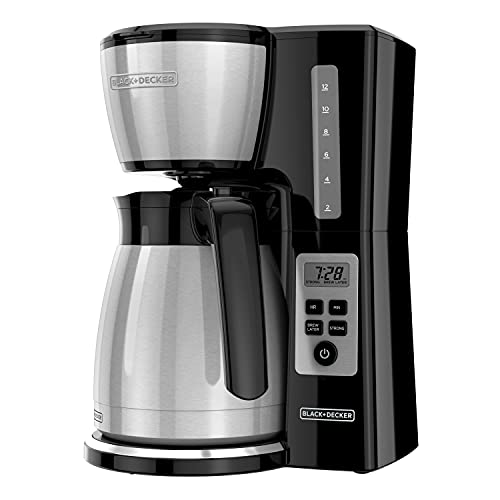
BLACK+DECKER 12-Cup Thermal Coffeemaker CM2046S — Best Thermal Value
Ask budget upgraders what they want and the answer is remarkably consistent: a thermal carafe, a strength setting, and a timer. The CM2046S is the machine that bundles exactly those three at a price that sits comfortably — not marginally — inside this tier, with BLACK+DECKER’s Vortex shower addressing extraction evenness as a bonus. It is the value pick not because it is cheap, but because its feature-per-dollar on the things households actually request is the best in this guide.
Strengths
- Thermal carafe at a price rivals charge for glass
- Brew strength selector plus full programmability
- Vortex shower works on extraction evenness
- Full 12-cup family capacity
Trade-offs
- Thermal carafe is vacuum-style and heavier than glass
- Fit and finish are workmanlike rather than premium
- Shower performance depends on descaling discipline
Key specs (from the verified listing):
- 12-cup capacity
- Thermal carafe
- Programmable
- Brew strength selector
- VORTEX shower technology
- Black/steel finish
- Model CM2046S
The thermal carafe changes a household’s coffee more than any other single feature at this price, because it changes the last cup rather than the first. Coffee held in insulation at drinking temperature stays recognisably itself for a couple of hours; coffee held on a plate becomes a different, worse drink. Slow households — the pot brewed at six, finished at nine — gain more from this one feature than from any heater upgrade, and here it arrives without the certified machines’ price.
Pair the carafe with the strength selector and the programme, and the CM2046S covers the complete upgrade checklist that brings most households to this tier. It is the pick we would hand a friend who said ‘just make my mornings better’ and named this budget.
Thermal carafe care is this machine’s one curriculum item: pre-warm the vessel with hot water on cold mornings and the first pot holds its temperature noticeably longer; rinse it daily and deep-clean it monthly against the coffee film that dulls both taste and insulation performance. Small rituals, directly repaid in the last cup.
Best for: slow-morning households wanting thermal value at full size / Not suited for: buyers prioritising premium materials and finish
Check on Amazon — check the current price on Amazon.
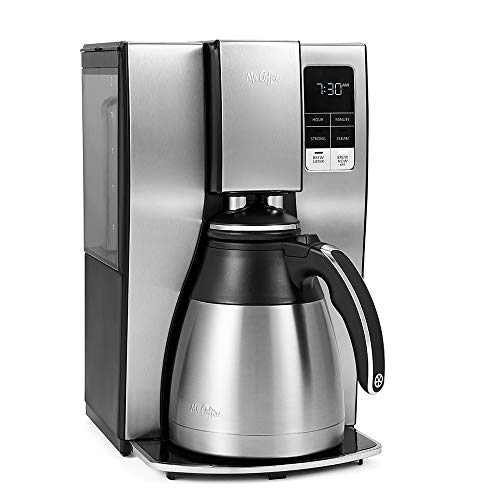
Mr. Coffee 10-Cup Programmable Thermal Coffee Maker — Best Compact Thermal
Not every household needs twelve cups, and the thermal upgrade should not require them. This Mr. Coffee pairs a 10-cup insulated thermal carafe with a strong brew selector and a listing that emphasises hotter, faster brewing — the two extraction variables budget machines most often get wrong. It is the considered middle of this guide: smaller than the family flagships, more serious than the glass-carafe tier below, and programmed for the weekday routine.
Strengths
- Thermal carafe in a right-sized 10-cup format
- Strong brew selector for darker palates
- Hotter, faster brewing brief addresses budget extraction flaws
- Auto pause for the first cup
Trade-offs
- 10 cups will not stretch to big gatherings
- Mr. Coffee’s premium-tier polish trails Braun and Cuisinart
- Fewer long-term reviews than the classic picks here
Key specs (from the verified listing):
- 10-cup capacity
- Insulated thermal carafe
- Strong brew selector
- Programmable
- Auto pause
The hotter-and-faster brief deserves respect because it names the correct enemies. Under-temperature brewing is the silent flaw of cheap machines, and a maker that designs against it — and says so in the listing — is aiming at the cup rather than the brochure. Combined with the strong selector, the machine gives a smaller household genuine control over the two variables it will actually adjust: how hot it brews and how bold it tastes.
Size it honestly: ten coffee-maker cups is a generous morning for two to four drinkers and a stretch for six. Households inside that range get the thermal life — no plate, no stewing, a pot that travels to the table or the desk — in the footprint their counter actually has.
For households torn between this and the larger BLACK+DECKER thermal, decide by the second pot: if your home regularly brews twice — a dawn pot and a mid-morning pot — the 10-cup format’s faster turnaround is a feature, not a limitation. Capacity should match the pot you finish, and a smaller pot finished fresh beats a larger one finished stale.
Best for: two-to-four-drinker households wanting thermal without bulk / Not suited for: large families or frequent hosts
Check on Amazon — check the current price on Amazon.
Comparison Table
| Pick | Badge | Key spec | Best for |
|---|---|---|---|
| Ninja Specialty Coffee Maker CM401 | Best Overall Under $200 | 10-cup carafe, fold-away frother, specialty + iced styles | households that drink several coffee styles across the week |
| Bonavita 8 Cup Coffee Maker BV1900TS | Best Tasting Under $200 | 8-cup thermal, SCA Certified, one-touch pour-over style | taste-first households of two to four drinkers |
| Braun MultiServe Plus 10-Cup Drip Coffee Maker | Most Versatile Sizes | 7 brew sizes, 10-cup pot, cold brew, hot water dispenser, pod-free | mixed households needing every size from one machine |
| Cuisinart Brew Central 12-Cup Programmable Coffeemaker DCC-1200 | Best Classic Stainless Pick | 12-cup programmable, stainless, ergonomic glass carafe | buyers who value proven longevity over the newest brewing tech |
| BLACK+DECKER 12-Cup Thermal Coffeemaker CM2046S | Best Thermal Value | 12-cup thermal carafe, strength selector, programmable, Vortex | slow-morning households wanting thermal value at full size |
| Mr. Coffee 10-Cup Programmable Thermal Coffee Maker | Best Compact Thermal | 10-cup insulated thermal, strong selector, programmable | two-to-four-drinker households wanting thermal without bulk |
How to Choose a Coffee Maker Under $200
Decide what the second hundred is for before you spend it. In this tier the money can buy exactly one of four upgrades over the under-$100 machines: certified extraction (Bonavita), drink variety (Ninja), size flexibility (Braun), or insulation at scale (the thermal picks). A machine that spreads the money across all four buys none of them properly. Name your upgrade first; the shortlist then shrinks to one or two names, and the choice becomes easy.
Thermal versus glass is the tier’s defining fork, and it should be decided by the pot’s lifespan in your kitchen. Under half an hour, glass on a plate is fine and cheaper. Over an hour — the slow household, the home office, the weekend paper — thermal is not a luxury but the difference between coffee and a brown reminder of coffee. Two of this guide’s six picks are thermal for a reason: at this price, insulation is the upgrade households report valuing most in year two.
Certification is worth understanding precisely. SCA certification measures brew temperature and extraction against specialty standards — it is the only claim in this category with a test behind it. If your household buys good beans and tastes carefully, a certified machine is where the second hundred does its most honest work. If your household drinks standard beans with milk and sugar, the same money buys more happiness in flexibility or capacity.
Do not let the tier talk you out of the tier below. If a household’s needs are a standard pot on a timer, the under-$100 guide’s flagship does that job completely, and the saved hundred buys a year of better beans — which will improve the cup more than any machine upgrade at that level. This tier is for households who know which specific limitation they are paying to remove.
Finally, at $200 you are buying a five-year appliance, so buy the maker’s ecosystem with it: replacement carafes in production, filters on supermarket shelves, a service network that answers. Every pick here clears that bar, and any machine you consider beyond the guide should be asked the same questions before its features are allowed to charm you.
Where the Second Hundred Goes: A Tier Anatomy
Strip a $200 coffee maker down and the extra money over a $100 one lives in four places. The heater comes first: holding water in the narrow ideal extraction band, batch after batch, requires a more powerful element and better control, and it is the least visible, most tasted upgrade in the tier. The shower head comes second — wider, more deliberate water distribution costs engineering and parts. Third is the carafe: a vacuum-insulated thermal vessel is simply a more expensive object than a glass jug. Fourth is mechanism: multi-size brewing, frothers and dispensers are pumps, valves and seals that a basic brewer does not carry.
Notice what is not on that list: the timer, the display and the programme modes cost almost nothing, which is why they appear at every price. The discipline this tier demands is to pay for the four expensive things and treat the cheap things as free — because they are. A $200 machine whose brochure leads with its clock is telling you where its money did not go.
The corollary is that the tier’s best values look boring in a feature grid and taste expensive in the cup. The Bonavita in this guide has one button. It is also, by measured extraction, among the best home brewers at any price. Let that calibrate your shopping: at $200, subtraction is often the sign of a maker that spent the budget on the brew.
Two Households, One Budget: How the Same $200 Gets Spent Twice
Consider two households with the same budget arriving at opposite ends of this guide, because the contrast teaches the tier better than any spec table. The first is a couple in a small flat who drink two large mugs each morning, buy beans from a local roaster, and read coffee articles for pleasure. Their $200 belongs to extraction: the Bonavita’s certified brew will be tasted in every cup they drink for five years, and its 8-cup format fits their pot exactly. Every other feature in the tier — sizes, frothers, dispensers — is a solution to problems they do not have, and buying one would spend their money on other people’s mornings.
The second household is a family of five plus a grandparent, spanning drip drinkers, a tea drinker, a cold-brew teenager and a parent who leaves with a travel mug at dawn. Their $200 belongs to logistics: the Braun’s seven sizes, hot water dispenser and auto start touch every member daily, and its extraction — good, if not certified — is entirely sufficient for coffee drunk with breakfast rather than contemplated after it. Neither household bought ‘the best $200 machine.’ Each bought the machine whose strengths are load-bearing in their kitchen, and that is the only correct way to shop this tier.
If you are between the two — a small household with varied tastes — the Ninja CM401 is the guide’s deliberate bridge: specialty range for the varied tastes, carafe capacity for the shared mornings, at a price that leaves change for the beans both households in this story agree are non-negotiable.
Ownership Costs at $200: Filters, Carafes and the Five-Year Ledger
A machine at this price should be costed across five years, and the ledger is reassuringly dull for every pick here. Filters: paper baskets cost pennies; permanent filters cost nothing but washing. Descaler: a few cycles a year. The carafe is the one real exposure — a dropped thermal or glass vessel is the most common mid-size cost of ownership — and it is precisely why this guide favoured makers whose carafes are listed, priced and stocked as spare parts. Check that listing before you buy the machine; a $200 brewer whose carafe cannot be replaced is a $200 brewer with a glass deadline.
Energy is the other quiet line. A warming plate cycles modest power for as long as it holds; a thermal carafe uses none. Households that hold coffee for hours daily will find the thermal picks repay a slice of their price in electricity as well as in taste — one more reason the carafe decision, made by habit, keeps proving itself the tier’s pivotal one.
Against those costs, set the tier’s saving: a household that moves its café habit home at this level typically recovers the machine’s price within a season, and the five-year ledger thereafter is beans and pennies. That is the economic context in which ‘spend the second hundred well’ stops being a slogan: the machine is nearly free over its life, so the only real question is whether it is the right one.
What to Do With the Change: Spending the Rest of the $200 Well
Several picks in this guide sit comfortably inside the frame rather than at its edge, and the leftover money has a best use that this series recommends in every tier: beans. The difference between a month of fresh, well-stored, medium-roast beans from a real roaster and a month of whatever was discounted is larger in the cup than the difference between any two machines in this article. A household that buys the BLACK+DECKER thermal and spends the remainder on a bean subscription has made a better coffee decision than one that stretches to the tier’s ceiling and feeds the machine stale grounds.
The second-best use is the unglamorous kit: a simple scale for dosing, a thermal mug that fits the household’s car holders, a descaler supply for the year. None of it photographs well and all of it is tasted daily. The tier’s discipline is to spend to the need, not to the number — the frame is a ceiling, not a target, and the guide’s value picks exist to prove it.
The $200 Question in the Group Chat: What We Tell Friends
When a friend asks which coffee maker to buy at this level, the honest answer this guide gives is a question back: what is wrong with your coffee now? If the answer is taste, the certified Bonavita ends the conversation. If the answer is that mornings are chaos, the Braun’s sizes and auto start end it. If the answer is that the last cup is always sad, a thermal pick ends it. If the answer is that the household wants café drinks, the Ninja ends it. The tier’s secret is that ‘best’ was never a property of the machines — it is a property of the match, and the match takes one honest sentence to find.
Friends who cannot name a problem are told, kindly, to buy the under-$100 flagship and a month of excellent beans, and to return when they can name one. That advice has saved more money than any discount code, and it is the same advice this guide gives its readers, because the tier rewards the specific and punishes the vague.
A Last Word on the Middle Tier
The middle tier is where coffee stops being a purchase and becomes a position: the household has decided what it values — taste, calm, range, warmth — and spent accordingly. That is why this guide resisted crowning a single winner. The $200 frame buys conviction in any of four directions, and the only wrong purchase is the one made without the sentence that names the direction. Say the sentence, pick the badge, and let the machine prove the sentence right every morning.
How to Upgrade From a Budget Brewer Without Wasting the Money
Most readers of this guide already own a working budget machine. This sequence makes the upgrade deliberate instead of impulsive.
- Name the limitation in one sentence: ‘the last cup tastes stewed,’ ‘we cannot make one cup well,’ ‘the coffee tastes sour.’ If you cannot name it, the under-$100 tier plus better beans is your upgrade — stop here and save the money.
- Match the limitation to the tier’s four upgrades: stewed last cups mean thermal; sour cups mean certified temperature; one-cup waste means multi-size flexibility; café cravings mean a frother machine.
- Keep your old machine through the first month of the new one if you can. Side-by-side pots with the same beans will confirm the upgrade is real — and teach you the new machine’s settings faster than any manual.
- Re-dial your dose for the new brewer: a better shower and hotter water extract more, so a dose that suited the old machine may taste strong in the new one. Adjust in small steps over the first week.
- Pass the old machine on rather than cupboarding it — a working brewer is a gift to a first flat, an office or a charity shop, and a cleared counter is part of the upgrade.
An upgrade chosen this way — limitation named, upgrade matched, difference verified — is the kind households never regret. The machines in this guide were shortlisted to be the answer to a named limitation; bring yours, and the right badge will be obvious.
Common Buying Mistakes
Buying the logo instead of the upgrade. At $200, famous names sell basic brewers in premium clothing. Ask what the money bought — heater, shower, carafe, mechanism — and walk if the answer is styling.
Double-buying features you already own. If your budget machine’s timer delights you, you do not need to pay for a fancier one; spend the tier on extraction or insulation instead.
Choosing glass when your pot lives for hours. The stewed last cup is the most common complaint in home coffee, and it is a carafe problem, not a machine problem. Thermal is the fix, and this tier is where it becomes affordable at full size.
Assuming certified means complicated. The certified picks here are the simplest machines in the guide — one button, no programme. Certification is about the brew, not the interface.
Forgetting the running gear. Thermal carafes, multi-size machines and frothers all carry filters, seals and parts; confirm they are stocked and priced before the machine is on your counter.
Final Recommendation
Name your upgrade and the choice makes itself: the Ninja CM401 for drink variety, the Bonavita BV1900TS for certified taste, the Braun MultiServe Plus for every-size flexibility, the Cuisinart Brew Central for proven classic reliability, the BLACK+DECKER CM2046S for thermal value at full size, and the Mr. Coffee thermal for the same idea in a smaller footprint. Each was verified inside the $200 frame when checked, and each spends the tier’s money on something real.
The ladders continue in both directions: Best Coffee Makers Under $100 Dollars shows what to keep if the second hundred is better spent on beans, and Best Coffee Makers Under $300 and Best Coffee Makers Under $500 Dollars show where the ceiling rises next. The format guides — Best Coffee Makers Whole Bean for grind-fresh households and Best Coffee Makers To Have At Home for the general picture — complete the cluster.
Shortlist again, in badge order:
- Ninja Specialty Coffee Maker CM401
- Bonavita 8 Cup Coffee Maker BV1900TS
- Braun MultiServe Plus 10-Cup Drip Coffee Maker
- Cuisinart Brew Central 12-Cup Programmable Coffeemaker DCC-1200
- BLACK+DECKER 12-Cup Thermal Coffeemaker CM2046S
- Mr. Coffee 10-Cup Programmable Thermal Coffee Maker
Best Coffee Makers Under $100 Dollars
Best Coffee Makers Under $500 Dollars
Best Coffee Makers To Have At Home
Frequently Asked Questions
What does a $200 coffee maker do that a $100 one cannot?
Four things, mainly: hold certified brewing temperatures, insulate a full pot in a thermal carafe, brew many sizes from one cup to a pot, or make café-style drinks with a frother. The extra money buys one of those done properly — which is why this guide insists you name your upgrade first.
Is SCA certification worth paying for?
If you buy good beans and drink coffee black, yes — it is a measured guarantee of temperature and extraction, and the difference is tasteable from the first pot. If your household drinks standard beans with milk, the same money returns more happiness spent on flexibility or a thermal carafe.
Thermal or glass carafe at this price?
Decide by the pot’s lifespan. Finished within half an hour, glass is fine. Nursed over one to three hours — slow mornings, home offices — thermal transforms the last cup and is the upgrade owners praise most in hindsight.
Should I buy a $200 drip machine or save toward $300?
If your named limitation is extraction, insulation or flexibility, $200 solves it completely and the extra hundred is better spent on beans. Save toward $300 only if you want premium grind-and-brew integration or a flagship multi-function machine — the under-$300 guide shows exactly what waits there.
How long should a machine at this price last?
Five years of daily use is a fair expectation from the makers in this guide, with descaling and ordinary care; the classic designs here have owner histories well beyond that. At this tier, parts availability becomes a real selection criterion, and every pick was checked for it.
Can a $200 machine make espresso?
No — espresso requires pressure hardware that lives in a different appliance category and price structure. Machines here with frothers and specialty settings make excellent coffee-based drinks, including concentrated brews for iced and café-style recipes, but true espresso is a separate purchase.
Is it worth waiting for a sale at this tier?
If your current machine still brews, yes — this tier discounts deeply and predictably around the major sale seasons, and a pick chosen calmly from this guide can often be bought a full tier’s worth of patience later for noticeably less. If your current machine has died, buy now without guilt: the difference a sale makes is smaller than a month of café coffee, which is the alternative most households actually live on while they wait.


