Disclosure: airfryerkitchensupply.com is reader-supported. When you buy through links on our site, we may earn an affiliate commission at no extra cost to you.
Where to buy
Every machine in this best coffee makers under 300 guide is sold on Amazon. Every machine below was matched against Amazon listing data product feed for this site and sat within the $300 frame when the feed was checked on the day of writing. The links take you to the live listings to check the current price on Amazon — we print no prices, because at this tier a sale can move a machine by a fifth of its cost overnight, and a printed figure would age disgracefully.
- Breville Precision Brewer BDC400 — check the current price on Amazon
- OXO Brew 8-Cup Coffee Maker — check the current price on Amazon
- Technivorm Moccamaster KBGV Select 10-Cup — check the current price on Amazon
- Bonavita Enthusiast 8 Cup Coffee Brewer (Thermal Carafe) — check the current price on Amazon
- Ninja DualBrew Pro Specialty Coffee System CFP301 — check the current price on Amazon
- Cuisinart Grind & Brew DGB-800 — check the current price on Amazon
The best coffee makers under 300 dollars are where home brewing stops apologising. This is the tier of certified precision brewers with programmable recipes, of hand-assembled European machines with decade-long horizons, of grind-and-brew units with real burr grinders, and of multi-format systems that end the pods-versus-grounds debate by winning both sides of it. A household that shops carefully here is not buying a better appliance than the tier below so much as buying the last coffee maker it will need for a very long time.
Each pick was verified against Amazon listing data feed for this site — brand and model matched to the live listing — and price-checked in that feed against the $300 frame on the day of writing. The six that survived divide the tier by philosophy: precision you can programme, precision that is certified, longevity as a feature, modern design around a certified core, total format flexibility, and fresh-ground convenience. Read the badges as philosophies and your household’s will announce itself.
One boundary stated plainly: this tier still excludes the true flagships — the hand-finished statement machines and the most advanced grind-and-brew units live in our under-$500 guide. What under $300 buys instead is arguably smarter: the point where measured brew quality, build and features peak together before diminishing returns begin their long reign. For most serious home drinkers, this is the last tier they will ever need to read about.
In this guide
Quick Picks
Six philosophies under $300: programme it, certify it, keep it for a decade, design it, flex it, or grind it fresh. Your household’s philosophy picks its machine.
- Breville Precision Brewer BDC400 — Best Overall Under $300: The programmable precision flagship: six brew modes including a Gold setting tuned to specialty standards, plus Fast, Strong, Iced and Cold Brew — the machine for households that want one brewer to be every brewer.
- OXO Brew 8-Cup Coffee Maker — Best Certified Precision: SCA-certified brewing with a thermal carafe and a genuine single-serve mode — the precision pick for households split between solo cups and shared pots.
- Technivorm Moccamaster KBGV Select 10-Cup — Best Built to Last: The longevity legend: a hand-assembled Dutch brewer with a copper heating element, a 10-cup glass carafe and a half/full batch switch — bought by people who intend to keep it for a very long time.
- Bonavita Enthusiast 8 Cup Coffee Brewer (Thermal Carafe) — Best Modern Certified Design: Bonavita’s certified brewing in its modern form: SCA-certified pour-over extraction, a thermal carafe, a removable reservoir and a stainless panel — the design-conscious route to a measured brew.
- Ninja DualBrew Pro Specialty Coffee System CFP301 — Most Versatile Under $300: Both worlds, one machine: grounds or K-Cup pods, thirteen sizes from a single cup to a full pot, four brew styles and a frother — the definitive answer for the divided household.
- Cuisinart Grind & Brew DGB-800 — Best Grind & Brew Under $300: Fresh-ground at family scale, inside the frame: a fully automatic burr grind-and-brew machine with a 12-cup glass carafe — the whole-bean household’s seat in this tier.
How These Picks Were Chosen
The gates matched this series’ standard — a confident Amazon listing data match for every linked model, and a feed price under the search’s $300 frame on check day — with one addition appropriate to the tier: a longevity screen. At this price a machine should be a five-to-ten-year purchase, so we favoured makers with service networks, replaceable carafes and seals, and designs that can be descaled and maintained rather than sealed and discarded.
Ranking weighed the tier’s three currencies: extraction quality (measured where certification exists, assessed from design where it does not), build horizon, and the usefulness — not the count — of features. A programmable bloom phase is a feature a coffee household uses daily; a colour touchscreen is a feature it uses at unboxing. The picks reflect that accounting throughout, and each review states what its machine declined to spend money on, because at $300 the omissions are as diagnostic as the inclusions.
Grind-and-brew earns one seat here, deliberately: at this tier the integrated burr grinder becomes a serious instrument rather than a compromise, and the Cuisinart that holds the seat was chosen over flashier rivals for the size and honesty of its proposition. The companion guides cover the full grind-and-brew field for readers whose priority is freshness above all.
The 6 Best Coffee Makers Under 300
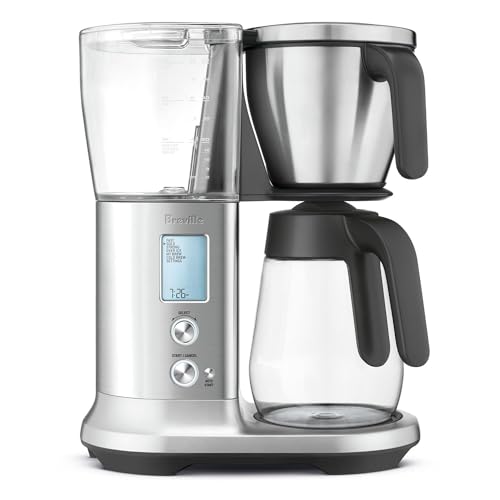
Breville Precision Brewer BDC400 — Best Overall Under $300
The Precision Brewer is the tier’s most complete argument. Its Gold mode brews to the specialty industry’s recognised parameters; its other modes cover the rest of a household’s real life — a fast pot, a strong pot, iced coffee, cold brew — and beneath the presets sits genuine programmability for the drinker who wants to set bloom time and flow to a particular bean. It is the rare machine that serves the one-button household and the experimenting household from the same panel, which is why it leads this guide.
Strengths
- Gold mode brews to certified-style parameters; five more modes cover the week
- Deep customisation available when wanted, invisible when not
- Cold brew and iced modes replace separate seasonal gadgets
- Breville’s build and service network suit the tier’s long horizon
Trade-offs
- Glass carafe in this configuration — thermal seekers, see below
- The menu rewards a read of the manual; guests may need a pointer
- Footprint is flagship-sized
Key specs (from the verified listing):
- Glass carafe
- 6 brew modes: Gold, Fast, Strong, Iced, Cold Brew and custom
- Brushed stainless steel finish
- Model BDC400
The Gold setting deserves its reputation: it is a preset built to the temperature and contact-time parameters that specialty standards specify, which means the household that never opens the custom menu still brews at the level the certified machines in this guide are measured by. The custom layer then exists for the beans that reward it — the light roast that wants a longer bloom, the decaf that wants a gentler flow. Most households will live in the presets; the point is that the ceiling is there when a special bag arrives.
Cold brew from the same machine is the sleeper feature: summer households that currently keep a separate cold-brew vessel can retire it, and the counter reclaims the space. Versatility that deletes appliances is the only kind worth paying flagship money for, and the Precision Brewer is built from it.
For households hosting coffee-serious guests, the Precision Brewer has a parlour trick with substance: brew the same beans on Gold and on a custom profile side by side and let the table taste what extraction parameters actually do. It converts the machine from an appliance into the household’s standing coffee education — and it is the moment most owners stop wondering whether the custom menu was worth having.
Best for: households wanting one programmable brewer for every style and season / Not suited for: buyers who want a thermal carafe above programmability
Check on Amazon — check the current price on Amazon.

OXO Brew 8-Cup Coffee Maker — Best Certified Precision
OXO’s brewer carries the certification this tier respects — SCA Certified Home Brewer, measured against specialty temperature and extraction standards — and adds the flexibility the other certified machines lack: a true single-serve mode alongside the 8-cup thermal carafe. That pairing solves the certified category’s standing dilemma, which is that precision machines usually insist on a pot. Here, the solo morning and the family morning get the same measured brew.
Strengths
- SCA-certified extraction in both pot and single-serve modes
- Thermal carafe protects the pot without a warming plate
- Compact, design-led footprint for a certified machine
Trade-offs
- 8-cup ceiling, as with all the certified compact brewers
- No grind integration and minimal programmability
- Single-serve mode uses grounds, not pods — pod households, look elsewhere
Key specs (from the verified listing):
- 8-cup capacity
- Thermal carafe
- SCA Certified Home Brewer
- Single-serve mode
- Stainless steel finish
OXO’s design intelligence shows in the details other makers treat as afterthoughts: the carafe pours cleanly, the controls are legible at dawn, the whole machine wipes down without a forensic kit. In a tier where several rivals are engineering statements, this is the one designed by people who also thought about the sink. Certification plus usability is a rarer combination than it should be, and it is the reason this machine anchors the precision seat over technically similar rivals.
The single-serve mode deserves its emphasis because it changes the machine’s household maths: a certified brewer that also serves the one-cup drinker removes the last reason to keep a pod machine on the counter. Grounds in, measured brew out, at any size the day demands.
OXO’s single-serve mode also makes this the tier’s best travel-mug machine: a full travel mug brewed directly, at certified parameters, without a pot in between. Commuters who currently brew a pot to fill one mug are wasting coffee and time in equal measure; this machine ends both with the same button.
Best for: precision-minded households split between pots and solo cups / Not suited for: pod loyalists or very large households
Check on Amazon — check the current price on Amazon.

Technivorm Moccamaster KBGV Select 10-Cup — Best Built to Last
The Moccamaster is the machine other machines are measured against for build horizon. Technivorm hand-assembles them in the Netherlands around a copper heating element that brings water to the ideal range fast and holds it there, and the design philosophy is serviceability: parts are available, the machine comes apart for cleaning, and the expected lifespan is measured in decades rather than product cycles. The KBGV Select adds the half-batch switch that makes a 10-cup machine honest for smaller households.
Strengths
- Copper element delivers fast, stable, ideal-range brewing temperatures
- Hand-assembled, serviceable design with a decades-long horizon
- Select switch brews half batches properly, not as an afterthought
- Quiet, fast and entirely free of gimmicks
Trade-offs
- No timer, no programmability — it brews when you switch it on
- Glass carafe and hot plate in this configuration
- The aesthetic is industrial; design-led kitchens may prefer the Café-style picks in this series
Key specs (from the verified listing):
- 10-cup capacity, 40 oz / 1.25 l
- Glass carafe
- Copper heating element
- Half/full batch Select switch
- Polished silver finish
- Model 53941 KBGV Select
Every era of coffee writing rediscovers the Moccamaster, and the reason is that its proposition never changes: correct temperature, correct contact, nothing else, forever. In a guide full of machines competing on modes, its confidence is almost stark — one switch, one job, executed at a level most brewers never reach. Owners’ machines routinely outlive the kitchens they were bought for, and the second-hand market treats them accordingly.
The absence of a timer is the deliberate trade, and this guide will not pretend otherwise: households built around a programmed dawn pot should take the Breville or the Café route in this series. Households that brew when they wake, and want that brew to be right every time for twenty years, have found their machine.
A practical note on the KBGV’s glass carafe: Technivorm sells the carafe, the lid, the shower arm and effectively every working part as spares, and the machine’s panels open for real descaling access. Owners who enjoy maintaining things describe servicing it as closer to caring for a bicycle than an appliance — and that relationship, repeated over years, is the actual product being sold.
Best for: buy-once households that value longevity over automation / Not suited for: timer-dependent routines
Check on Amazon — check the current price on Amazon.

Bonavita Enthusiast 8 Cup Coffee Brewer (Thermal Carafe) — Best Modern Certified Design
The Enthusiast is what happened when Bonavita wrapped its certified brewing core in the conveniences owners had asked for: a removable water reservoir that fills at the sink, a thermal carafe, and a cleaner, more modern panel design. The SCA certification remains the foundation — this is still a machine bought for what happens in the basket — but the daily experience around that core is noticeably more polished than the brand’s original minimalist brewers.
Strengths
- SCA-certified pour-over-style extraction
- Removable reservoir — the convenience owners request most
- Thermal carafe and modern stainless design
Trade-offs
- 8-cup format, as with the certified class generally
- No timer or app layer
- Newer model line than the classic BV1900 series
Key specs (from the verified listing):
- 8-cup capacity
- Thermal carafe
- SCA Certified
- Pour-over style brewing
- Removable water reservoir
- Stainless steel panel
Position this machine against its own sibling in the under-$200 guide and the tier logic becomes clear: the extra money buys the reservoir you can carry to the tap, the carafe that travels to the table, and a machine that looks deliberate on a modern counter — while the certified core stays the same. Households often underrate how much the reservoir matters; it is the difference between filling with a jug under a cabinet and filling at the sink like a civilised person, twice a day, for years.
For the design-conscious precision buyer, this is the guide’s answer: the measured brew of the certified class without the laboratory aesthetic. It brews like an instrument and lives like an appliance.
The Enthusiast’s removable reservoir also makes it the easiest certified machine to descale properly, because the tank itself can be treated at the sink rather than only flushed in place. Hard-water households should weight that heavily: the certified heater’s performance depends on a scale-free path, and the machine that makes descaling easy is the machine that stays certified in practice.
Best for: design-conscious households wanting certified brewing with modern conveniences / Not suited for: large households or timer-first buyers
Check on Amazon — check the current price on Amazon.

Ninja DualBrew Pro Specialty Coffee System CFP301 — Most Versatile Under $300
The DualBrew Pro is the machine for the household that has been running two machines and resenting it. One side of its personality brews grounds — from a single cup to a full carafe across thirteen sizes and four styles — and the other accepts K-Cup pods for the drinkers who want them, with a frother standing by for milk drinks. Earlier hybrids compromised both formats; this one was engineered as a system, and it shows in the details, down to the paper-filter grounds basket that keeps the two worlds from flavouring each other.
Strengths
- Grounds and pods in one footprint — thirteen sizes cover every drinker
- Four brew styles plus a frother for café-style drinks
- Ends the two-machine counter and the format argument together
Trade-offs
- The largest, most complex machine in this guide
- Two brewing systems means two cleaning routines
- Pod side inherits pod costs for those who use it
Key specs (from the verified listing):
- DualBrew: grounds and K-Cup pods
- 13 sizes, cup to full pot
- 4 brew styles
- Built-in frother
- Paper filter grounds basket
- Model CFP301
Judge the DualBrew as household infrastructure. The morning pot runs on grounds at drip prices; the afternoon solo cup runs on a pod at pod convenience; the weekend latte uses the frother; the guest who drinks only decaf gets a pod of it without a second pot. Each of those moments previously required either a compromise or a second appliance. The machine’s premium over a plain drip brewer is simply the sum of the compromises it deletes.
The discipline it asks in return is housekeeping: two systems, two sets of parts, one owner who keeps both clean. Households that accept that trade get the most capable under-$300 machine in this series; households that know they will neglect the second system should buy the simpler Breville and spend the difference on beans.
One management tip for DualBrew households: assign the two systems their own supplies geography — pods in one drawer, grounds and filters in another — and the machine’s dual nature stays organised instead of becoming a countertop negotiation. Owners who set the station up once report the hybrid runs itself; the machine does the switching, the household just keeps the two fuel lines stocked.
Best for: divided households ready to retire their second machine / Not suited for: single-format households that value simplicity
Check on Amazon — check the current price on Amazon.

Cuisinart Grind & Brew DGB-800 — Best Grind & Brew Under $300
Grind-and-brew machines divide opinion until this tier, where the burr grinders become serious and the proposition resolves: whole beans in the hopper, a fully automatic cycle, and a 12-cup pot of coffee that was beans minutes before it was breakfast. The DGB-800 is the tier’s representative because it does that job at the largest family scale and at a price comfortably inside the frame, leaving budget for the beans it exists to honour.
Strengths
- Real burr grinder integrated — fresh-ground coffee with no second appliance
- Fully automatic cycle suits timer-driven family mornings
- 12-cup glass carafe serves the whole household at once
Trade-offs
- Grinder cleaning is a weekly obligation, as with all grind-and-brew
- Glass carafe and warming plate rather than thermal
- Grinding at dawn is loud — plan the programme time accordingly
Key specs (from the verified listing):
- 12-cup capacity
- Glass carafe
- Built-in burr grinder
- Fully automatic grind and brew cycle
- Silver finish
The freshness mathematics are this machine’s whole case, and they are compelling: pre-ground coffee loses aroma by the hour, while beans in a hopper lose it by the week. A household that switches from pre-ground to this machine tastes a larger improvement than any heater or shower upgrade in this guide can offer, because it changes the ingredient rather than the process. That is why grind-and-brew holds a seat in a tier otherwise devoted to extraction refinement.
The honest costs are the weekly brush-out of the grind path and the dawn noise of a full batch grinding. Households in this series’ whole-bean guide will recognise the routine; households new to it should read that guide’s cleaning sections before committing. Committed, they get the freshest pot in this article.
The DGB-800 has one more role worth naming in this tier: it is the gateway machine for households curious about whole-bean coffee but not ready to commit counter space and budget to a separate grinder. If the household falls in love with fresh-ground coffee, nothing is wasted — the machine remains a superb timer brewer. If it does not, the experiment cost one appliance, not two.
Best for: whole-bean households wanting fresh-ground coffee at family scale / Not suited for: households unwilling to keep a weekly grinder-cleaning habit
Check on Amazon — check the current price on Amazon.
Comparison Table
| Pick | Badge | Key spec | Best for |
|---|---|---|---|
| Breville Precision Brewer BDC400 | Best Overall Under $300 | 6 brew modes incl. Gold + Cold Brew, glass carafe, stainless | households wanting one programmable brewer for every style and season |
| OXO Brew 8-Cup Coffee Maker | Best Certified Precision | 8-cup thermal, SCA Certified, single-serve mode | precision-minded households split between pots and solo cups |
| Technivorm Moccamaster KBGV Select 10-Cup | Best Built to Last | 10-cup glass, copper element, half/full Select, hand-assembled | buy-once households that value longevity over automation |
| Bonavita Enthusiast 8 Cup Coffee Brewer (Thermal Carafe) | Best Modern Certified Design | 8-cup thermal, SCA Certified, removable reservoir | design-conscious households wanting certified brewing with modern conveniences |
| Ninja DualBrew Pro Specialty Coffee System CFP301 | Most Versatile Under $300 | Pods + grounds, 13 sizes, 4 styles, frother | divided households ready to retire their second machine |
| Cuisinart Grind & Brew DGB-800 | Best Grind & Brew Under $300 | 12-cup glass, burr grind & brew, fully automatic | whole-bean households wanting fresh-ground coffee at family scale |
How to Choose a Coffee Maker Under $300
At this tier, choose by philosophy before features. The philosophies on offer: programmable precision (Breville), certified simplicity (OXO, Bonavita), longevity (Technivorm), total flexibility (Ninja), and integrated freshness (Cuisinart). A household that knows which philosophy it holds will find its machine in one reading of the badges; a household shopping feature-by-feature will drown in a tier where every machine does almost everything.
Treat certification as the tier’s ground truth. SCA certification is a measurement, not a mood, and three of the six picks carry it or brew to its parameters. If your household’s complaint about its current coffee is taste — sour, thin, inconsistent — the certified route is the highest-probability fix in this guide, ahead of any feature addition. If the complaint is logistics — sizes, formats, schedules — the flexible and programmable picks answer it instead.
Thermal versus glass reappears here with higher stakes, because at $300 the carafe is a decade-long companion. The certified compacts and the OXO chose thermal; the Breville and Technivorm in these configurations chose glass with their own reasoning — programmability and tradition respectively. Your pot’s lifespan decides, as it did a tier down; what changes here is that both answers are now available at full quality.
Budget the machine’s life, not its launch. At this level, ask about descaling access, carafe replacement prices, and whether the maker sells seals and baskets separately. The Technivorm’s entire legend rests on those answers; the others were screened for them. A $300 machine that cannot be maintained is a $100 machine with a longer honeymoon.
Finally, resist the flagship pull unless it is truly yours. The under-$500 guide contains beautiful machines, and some households belong there. But for measured brew quality — the thing in the cup — this tier is where the curve flattens. Spend the difference on a year of excellent beans and your total coffee outcome will be better than the flagship owner’s, a sentence this guide is happy to sign.
The Point of Diminishing Returns, Measured in Coffee
Every product category has a price where quality stops tracking money, and coffee makers reach theirs here. The reasons are physical: extraction quality is governed by water temperature stability, shower evenness and contact time, and all three are fully solvable problems at this tier — certified machines prove it with instruments. Beyond this point, money buys materials, design, brand heritage and ever-narrower refinements, which are legitimate pleasures but different ones from better coffee.
This is also the tier where build quality converges with brew quality. Heaters rated for a decade, carafes that survive dishwashers for years, switches that do not wobble — the under-$300 machines are built as appliances rather than as seasonal goods, and the cost-per-year arithmetic quietly favours them over replacing a budget machine three times. The Moccamaster’s following is simply this arithmetic, believed completely.
None of which makes the tiers above pointless — it makes them honest. Buy beyond $300 for the object, the ritual or the flagship features, and enjoy them as such. Buy within this tier for the coffee, and know that the coffee, measured blind, is not the thing being compromised.
The Certified Class, Compared From the Inside
Three of this guide’s picks carry specialty certification or brew to its parameters, and readers choosing among them deserve the internal differences stated plainly. The OXO is the flexible purist: certification plus a true single-serve mode, in the most compact and design-aware package. The Bonavita Enthusiast is the convenient purist: the same certified philosophy with the removable reservoir and modern panel that make the daily routine smoother. The Breville Precision Brewer is the programmable purist: a Gold mode at certified parameters, surrounded by modes and customisation the other two deliberately refuse. None is the ‘best certified machine’ in the abstract; each is the best for a household that knows whether its second priority is size flexibility, daily convenience or control.
What unites them matters more than what divides them: all three hold brewing water in the proper range and distribute it evenly, which is to say all three remove the machine as the limiting factor in the cup. A household that buys any of them and still tastes ordinary coffee has been handed useful information — the limitation is now the beans, the water or the dose — and that diagnostic clarity is itself part of what certification buys.
The uncertified picks in this guide earn their places on other axes entirely: the Technivorm on horizon, the Ninja on household logistics, the Cuisinart on freshness of ingredient. A tier is healthy when its non-certified members are not pretending to be certified, and this one is honest in both directions.
Counter Planning for a Serious Brewer
Machines at this tier are larger, heavier and hotter-running than budget brewers, and the counter deserves a plan before the box arrives. Measure three heights: the machine closed, the machine with its lid or reservoir access fully open, and the gap to the cabinet above — the second number is the one that strands owners. Check the reservoir’s fill path: a removable tank needs a route to the sink that does not cross the hob, and a fixed tank needs jug room under the cabinet. These sound like details because they are, twice a day, for a decade.
Heat and steam shape placement too. A serious brewer exhales a real plume; give it air on at least two sides, keep it out of the direct line of wooden cabinet undersides where possible, and never box it into a closed appliance garage without ventilation. The reward for this planning is invisible — a machine that is simply always where the routine wants it — which is exactly what a decade-long appliance should be.
Finally, plan the station, not just the spot: beans and filters within arm’s reach, the grinder (where separate) close enough that grounds travel inches, mugs above or beside. The certified precision of these machines deserves a workflow that does not fumble it, and a station laid out once will serve every machine you own after this one too.
A Word on Water: The Ingredient This Tier Finally Tastes
Precision machines have an unforgiving virtue: they reveal the water. A household that upgrades to a certified brewer and tastes an unexpected flatness or a chemical edge is usually meeting its tap water honestly for the first time, because lesser machines masked it under their own inconsistency. The remedies are mundane and effective: a carbon filter jug for the reservoir fill, or the built-in filtration some households already own, transforms the cup more cheaply than any accessory in this tier. Coffee is roughly ninety-eight percent water; at this level of equipment, the water is the recipe’s largest ingredient and deserves a line in the budget.
Hard water adds the second argument: scale forms in proportion to mineral content, and precision heaters are the least tolerant of it. Households on hard water should treat filtered water and scheduled descaling as part of this tier’s purchase price — a small, predictable tax that keeps a certified machine certified in practice for its whole life.
Buying the Tier on Sale: A Short Field Guide
This tier’s machines are the most sale-responsive in the category: flagship-adjacent models are the ones retailers discount to make headlines, and a patient household can routinely buy a pick here for the price of the tier below. The discipline is to decide the machine first — from this guide, by philosophy and fit — and then wait for its price to move, rather than letting a discount choose the machine for you. A discounted machine that fits is a bargain; a discounted machine that does not is an expensive ornament with a timer.
Two cautions complete the field guide. Confirm the exact model number at checkout, because this tier is dense with near-identical variants that differ in carafe or reservoir; and confirm the seller is the maker or an authorised retailer, because flagship machines attract grey-market listings whose warranty support is a rumour. The links in this guide point at the verified listings precisely so those two checks start from solid ground.
A Last Word on Serious Machines
There is a moment, a few weeks into owning a machine from this tier, when the household stops noticing it — and that invisibility is the tier’s true deliverable. The coffee is simply right, at the right temperature, in the right amount, with no negotiation and no narrative. Budget machines announce themselves daily, in small frictions and small disappointments; serious machines retire from attention and leave the morning to the people in it. Buy the machine you will forget, and you will have bought the right one.
How to Set Up a Precision Brewer for Your Beans
A precision machine rewards a precise first week. This calibration sequence works for the programmable and certified picks alike.
- Brew the first pot exactly at the machine’s standard or Gold setting with your usual beans and dose. This is the control cup — change nothing until you have tasted it.
- Adjust the dose before the settings: if the cup is thin, add coffee; if it is heavy and harsh, remove a little. Dose is the strongest lever and the one new owners reach for last.
- On programmable machines, use the bloom or flow settings for light roasts, which need coaxing, and the standard cycle for medium and dark roasts, which do not.
- Note the water: if your tap is heavily chlorinated, a filtered jug will change the cup more than any setting on the machine. Precision brewers reveal water quality rather than hiding it.
- Write the winning combination — bean, dose, setting — on a card kept with the machine. Precision you cannot repeat is just luck with good branding.
- Revisit the calibration with each new bean, briefly. Two small test brews per bag is the entire ongoing cost of owning a machine at this level.
Households that run this sequence once discover the tier’s real product: not a machine that makes good coffee, but a machine that makes their coffee — the same, excellent cup, on demand, for years. That repeatability is what the money was for.
One final calibration note: keep the card with your winning settings somewhere the whole household can find it — the inside of the cupboard door above the machine is the traditional place — because a precision brewer’s settings are household knowledge, not one person’s memory, and the cup should survive the chief barista’s holiday intact.
Common Buying Mistakes
Buying modes instead of extraction. A long mode list on an unstable heater is decoration. At this tier, temperature discipline is the product; everything else is trim.
Ignoring the half-batch problem. A 10–12 cup machine brewed at three cups wastes its shower design. Choose a machine with a genuine small-batch or single-serve answer if your household size swings.
Skipping the manual on a programmable machine. The Precision Brewer’s best features live one menu deeper than the presets. Twenty minutes with the manual is the cheapest upgrade in this guide.
Neglecting descaling because the machine was expensive. Scale attacks copper and steel alike, and precision machines show the symptoms earliest because their owners can taste the drift. Calendar it.
Paying flagship prices for this tier’s job. If the goal is the cup, this tier finishes the argument. Step up for design or heritage knowingly, not by default.
Final Recommendation
Take the Breville Precision Brewer if one machine must do everything well; the OXO if certification plus single-serve flexibility is the household’s shape; the Moccamaster if you are buying for the decade; the Bonavita Enthusiast if you want the certified brew in a modern, removable-reservoir design; the Ninja DualBrew Pro if the household is divided by format; and the Cuisinart DGB-800 if fresh-ground beans are the non-negotiable. Every one sits inside the $300 frame as verified, and every one is a defensible final answer.
The series continues upward at Best Coffee Makers Under $500 Dollars for the flagship tier, and downward at Best Coffee Makers Under 200.00 and Best Coffee Makers Under $100 Dollars for the same discipline at tighter frames. Format-first readers should pair this guide with Best Coffee Makers Whole Bean and Best Coffee Makers Timer Grinder, where two of these philosophies get a full article each.
Shortlist again, in badge order:
- Breville Precision Brewer BDC400
- OXO Brew 8-Cup Coffee Maker
- Technivorm Moccamaster KBGV Select 10-Cup
- Bonavita Enthusiast 8 Cup Coffee Brewer (Thermal Carafe)
- Ninja DualBrew Pro Specialty Coffee System CFP301
- Cuisinart Grind & Brew DGB-800
Best Coffee Makers Under $500 Dollars
Best Coffee Makers Under 200.00
Best Coffee Makers Under $100 Dollars
Best Coffee Makers Timer Grinder
Frequently Asked Questions
Is a $300 coffee maker noticeably better than a $200 one?
In the cup, the gain is real but narrower than the jump from $100 to $200: you are buying certified precision with programmability, longer build horizons, and integrated burr grinding — refinement and longevity more than revelation. Households should step up for a named reason, as this guide’s philosophies frame it.
What does SCA certification actually guarantee?
That the brewer, as tested, heats water into the specialty standard’s temperature range and extracts coffee to its measured targets. It is the only widely recognised independent measurement in home brewing, which is why three picks in this guide carry it or brew to its parameters.
Does the Moccamaster really last decades?
Its design intends exactly that: a serviceable build, a copper element, available parts and no electronics to obsolesce. Owner histories of ten to twenty years are commonly reported for the line. It trades every modern convenience to buy that horizon, and this guide presents the trade openly.
Grind-and-brew or separate grinder at this budget?
If drip is your only method and freshness is your priority, the integrated Cuisinart here is a complete answer. If you also brew espresso, French press or pour-over, a separate grinder serves all of them and the brewer can be a certified pick — the combined route costs more but covers more ground.
Is a programmable brewer hard to live with?
The good ones hide their depth: presets like the Breville’s Gold mode deliver the machine’s best brew in one press, and the custom layers wait until curiosity arrives. Complexity is only a burden when it stands between you and the default cup, and these picks were screened against that.
Glass or thermal carafe in this tier?
Both are now available at full quality, so decide purely by habit: pots finished within the half hour suit glass; pots nursed over hours deserve thermal. Three picks here are thermal, and the glass picks were chosen for reasons — programmability, tradition — that their reviews state plainly.
Do these machines need special filters or parts I should stock?
Most take standard basket or cone paper filters available anywhere, and the sensible stock is one pack of filters, one bottle of descaler and — for thermal models — nothing else at all. Specialty parts like the Technivorm’s shower arm or a replacement carafe are orderable from the makers when eventually needed; buying them in advance is unnecessary. The exception is water-filter cartridges on models that use them: keep one spare, because a missed filter change is tasted before it is seen.


