Disclosure: airfryerkitchensupply.com is reader-supported. When you buy through links on our site, we may earn an affiliate commission at no extra cost to you.
Where to buy
The fastest way to shop for best coffee grinder for drip coffee makers is on Amazon, where every pick below is sold with full specifications, sizing and configuration options on the product page. Start with our top recommendation, the OXO Brew Conical Burr Grinder — check price on Amazon — then compare it against the other five picks in the Quick Picks table before you decide.
This guide assumes you already own the drip coffee maker — every pick is a standalone grinder evaluated as a partner to it. If you are shopping for both halves at once, our combined-machine and best coffee maker guides are linked at the end.
Choosing the best coffee grinder for drip coffee makers starts from a different place than choosing a grinder in the abstract. You are not building a coffee lab; you are completing a machine you already own. The brewer on your counter has a size, a basket shape, a daily volume and a spot in your morning routine, and the right grinder is the one that fits all four — not necessarily the one with the longest spec sheet.
That pairing lens changes the ranking. Dosing that matches your pot size matters more than exotic features. A footprint that fits beside the brewer matters more than a showroom finish. And grind quality is judged at one address — the medium band where drip lives — rather than across a hundred settings you will never visit. The six grinders below were re-evaluated under exactly that lens, which is why their order and badges differ from a general grinder roundup.
What does not change is the foundation: burrs, not blades, and fresh, not pre-ground. If your drip coffee disappoints you today, the grinder half of the partnership is where the improvement lives — typically a bigger improvement than replacing the brewer itself, and almost always the cheaper one.
In this guide
Quick Picks
Short on time? These are the six best coffee grinder for drip coffee makers options we would buy ourselves, each chosen for a different need and budget tier. Every badge below matches the badge used in the full review further down, so you can jump straight to the model that fits you.
- OXO Brew Conical Burr Grinder — Best Overall for Drip Pairing. The easiest grinder to live with next to a drip machine: set the timer to your pot’s dose once, and every morning after is one press, timed to finish while the brewer warms up. Check price on Amazon.
- Baratza Encore Conical Burr Grinder — Best for Long-Term Value. Buy it once, repair it forever: the Encore’s even grind and Baratza’s spare-parts support make it the cheapest grinder per year of service you can pair with a drip machine. Check price on Amazon.
- Capresso Infinity Plus Conical Burr Grinder — Best for Small Counters. A compact, slow-turning conical burr grinder that tucks beside a drip machine where bigger grinders will not fit — and runs quietly while it is there. Check price on Amazon.
- Cuisinart Supreme Grind Automatic Burr Mill DBM-8P1 — Best Budget Pairing. If your drip machine cost little and your budget matches, this is the grinder that still transforms it: fresh burr-ground coffee, dosed by a simple cup selector, at an entry tier. Check price on Amazon.
- Breville Smart Grinder Pro BCG820 — Best for Drip Plus More. Pair it with your drip machine today and it still has range in reserve — sixty settings, stored dose programmes and a portafilter cradle for the espresso machine you might buy next year. Check price on Amazon.
- Baratza Virtuoso+ Conical Burr Grinder — Best Precision Dosing. When the pairing goal is repeatability above all: a digital timer accurate to a tenth of a second doses your drip pot identically every morning, and the grind is a class above. Check price on Amazon.
How These Picks Were Chosen
We evaluated each grinder as a partner: how its dosing system maps to common drip pot sizes, whether its medium settings sit comfortably mid-dial, how much counter it demands next to a brewer, and how its noise and mess behave in a morning kitchen. Every model was verified against the Amazon catalogue data available to this site before being linked; unverifiable models were excluded, however well reviewed elsewhere.
Long-term pairing value counted heavily. A grinder typically outlives the drip machine it is bought for, so repairability, parts availability and brand support were scored as first-order criteria, not afterthoughts. That is a large part of why the Baratza pair places so well here despite plain feature lists.
Finally, we were honest about over-buying. Two picks in this guide carry capabilities beyond drip, and both reviews say plainly who should pay for the headroom and who should not. A pairing guide that recommends the most expensive option for every kitchen is a sales leaflet, not advice.
The 6 Best Coffee Grinders to Pair With a Drip Coffee Maker

OXO Brew Conical Burr Grinder — Best Overall for Drip Pairing
Pairing a grinder with a drip coffee maker is a workflow problem before it is a flavour problem, and the OXO Brew solves the workflow best. Its timer dial is calibrated once to the dose your specific machine needs — say the seconds that yield the right weight for your 12-cup pot — and from then on the grinder behaves like part of the brewer: one press, walk away, come back to grounds ready for the basket. That repeatability is what makes a separate grinder survive in a real kitchen, where any tool demanding daily measuring quietly falls out of use.
Strengths
- Timer dosing turns a separate grinder into a one-press routine
- Even conical-burr grind across the whole drip range
- Considerate anti-static, family-proof design
Trade-offs
- Time-based dose drifts slightly as beans change
- Not built for espresso
- Large hopper tempts over-storing beans
| Specification | Detail |
|---|---|
| Burrs | Stainless steel conical burrs |
| Dosing | One-touch start, timer dial |
| Hopper | 12 oz, UV-tinted lid |
The grind itself is proper conical-burr work, even across the medium range drip machines live in, and the details around it are unusually considerate: a hopper big enough for a standard bag with a tinted lid against light, and a grounds container shaped and treated to shed the static cling that makes other grinders redecorate the counter. If your drip machine sits in a shared or family kitchen, the OXO is also the grinder a second person can operate correctly on their first morning, which is a pairing virtue no spec sheet captures.
Its ceiling is the enthusiast’s floor: dosing by time drifts slightly as the hopper empties and beans change, so the last pot of a bag may run a gram light unless you nudge the dial. The setting range is generous for brew methods but this is not the tool for espresso ambitions. Paired with a drip machine — the exact job in this guide’s title — those are footnotes. It is the grinder we would bolt, metaphorically, to ninety percent of drip setups.
Best for: drip owners who want fresh grinding to feel automatic / Not suited for: single-dose hobbyists who weigh and switch beans daily
Check on Amazon — check the current price on Amazon before you buy, because configurations and bundle options change over time.

Baratza Encore Conical Burr Grinder — Best for Long-Term Value
The Encore takes the value crown in this pairing guide not because it is cheap — it is mid-tier — but because of what happens in years three through ten. Its conical burrs deliver the benchmark medium grind for drip, its dial is a single honest control, and when something eventually wears, Baratza sells the part and shows you how to fit it. A drip machine may be replaced twice while one Encore, maintained with a burr set and a brush, keeps its post beside each successor.
Strengths
- Benchmark drip grind consistency at a mid tier
- Repairable for years with manufacturer parts support
- Dead-simple controls that never need relearning
Trade-offs
- Manual dosing — consistency is your habit, not a timer
- Not an espresso grinder
- Some static scatter in dry conditions
| Specification | Detail |
|---|---|
| Burrs | 40mm conical steel burrs |
| Settings | 40 grind settings |
| Support | Spare parts and repair guides from the manufacturer |
As a daily partner it is deliberately unflashy. No display, no programmes: weigh or scoop your beans, turn the dial to your drip setting, hold the pulse or switch it on, done. The slow gear-reduced motor is a quiet neighbour for a countertop appliance and keeps the grind cool. Kitchens that run on routine — same pot, same time, same people — will find nothing here to fight with, and that is a compliment of the highest order for a tool used before caffeine.
Where it asks compromise: dosing is manual, so your consistency is your own habit rather than a timer’s memory, and its steps are spaced for brew methods, not for the micro-adjustments espresso demands. Static in the bin appears in dry weather, fixable with a drop of water on the beans. None of these touch its drip performance, which remains the reference point every other grinder in this guide is quietly compared against.
Best for: buyers who keep appliances for a decade / Not suited for: households wanting programmed, hands-off dosing
Check on Amazon — check the current price on Amazon before you buy, because configurations and bundle options change over time.

Capresso Infinity Plus Conical Burr Grinder — Best for Small Counters
Counter space is the silent constraint in most drip setups: the brewer already owns its territory, and a grinder must earn the strip beside it. The Infinity Plus is built for that strip — compact in footprint, tidy in profile — while still carrying commercial-grade steel conical burrs and a gear-reduced motor that turns them slowly. Slow grinding is its signature: quieter operation, less heat in the burrs, less static in the bin, and a grind quality at drip settings that embarrasses larger, faster rivals.
Strengths
- Compact footprint made for tight drip stations
- Slow, quiet, cool grinding with little static
- Steel burrs graded for commercial use
Trade-offs
- 16 settings limit multi-method experimenters
- Basic timer dosing
- Functional rather than stylish design
| Specification | Detail |
|---|---|
| Burrs | Commercial-grade steel conical burrs |
| Settings | 16 grind settings |
| Motor | Low-speed gear-reduction motor |
The sixteen settings are chosen rather than counted. Capresso spaces them across the brew range a drip household actually uses, so each click is a meaningful step rather than a cosmetic one, and the medium band — where your drip machine lives — gets the resolution it deserves. Paired with a compact drip brewer in an apartment or a small family kitchen, the whole station fits on a tray, which also makes the pair easy to move and clean around.
The trade-offs mirror its focus. Sixteen settings will not satisfy a brewer-of-everything, the dosing timer is basic, and the design language is functional rather than decorative. But as the grinder half of a space-limited drip station, it gives up nothing that matters in the cup — and in small kitchens, that restraint is the feature.
Best for: apartments and small kitchens pairing grinder with brewer / Not suited for: enthusiasts who brew six methods and want huge range
Check on Amazon — check the current price on Amazon before you buy, because configurations and bundle options change over time.

Cuisinart Supreme Grind Automatic Burr Mill DBM-8P1 — Best Budget Pairing
Not every drip machine justifies a mid-tier grinder, and pretending otherwise would make this guide useless to the owners of the millions of modest brewers already on counters. The Supreme Grind is the pairing for them: an entry-tier burr mill whose cup selector is, in effect, a pairing feature — dial the number of cups your machine is brewing and it grinds approximately that much, then shuts off. The mental overhead of matching grinder to brewer, the thing that puts beginners off separate grinders entirely, is designed down to one number.
Strengths
- Cup selector makes pairing with any drip size foolproof
- Entry tier that still delivers fresh-ground transformation
- Auto shutoff and a compact 8 oz hopper setup
Trade-offs
- Less even grind and more noise than conical rivals
- Selector dosing is approximate, not precise
- Light-duty build for heavy households
| Specification | Detail |
|---|---|
| Settings | 18 grind settings |
| Dosing | 4 to 18 cup selector with automatic shutoff |
| Hopper | 8 oz bean hopper |
In the cup, it delivers the essential miracle: coffee ground seconds before brewing instead of weeks before packaging. That freshness gap is so large that it swamps the refinement gap between this burr mill and the conical sets above it. Yes, its grind runs less even and its motor runs louder; yes, a daily two-pot household will eventually want more. But measured against the pre-ground status quo it replaces, this is the highest-value purchase in the entire guide.
Set expectations by volume and horizon. Occasional and light daily use: it serves happily for years. Two big pots every morning for a family: budget for an upgrade path to the Encore or OXO, and keep this as the decaf grinder when you do. As a first pairing, bought with open eyes, it is exactly right.
Best for: owners of modest drip machines on a firm budget / Not suited for: high-volume families who need a decade-grade grinder now
Check on Amazon — check the current price on Amazon before you buy, because configurations and bundle options change over time.
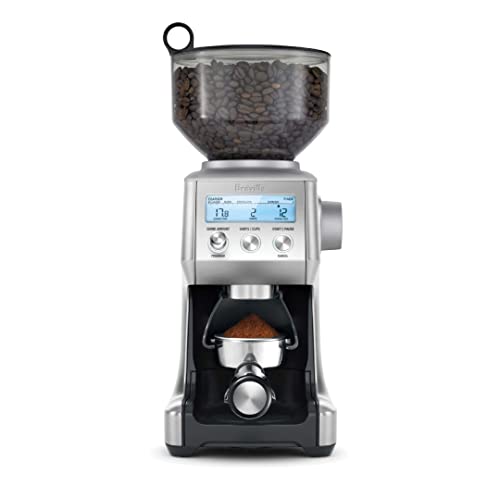
Breville Smart Grinder Pro BCG820 — Best for Drip Plus More
Some drip owners are standing at a crossroads: today’s automatic drip machine, tomorrow perhaps a pour-over habit or an espresso machine. The Smart Grinder Pro is the pairing that does not force the decision twice. Its sixty settings run from press-coarse through the drip band to a genuinely usable espresso range, its display tells you exactly where you stand, and it stores dose times per setting — so the drip programme for the weekday pot and any weekend programme coexist without disturbing each other.
Strengths
- One grinder that covers drip now and espresso later
- Stored dose programmes for different brewers
- Display-driven precision with premium build
Trade-offs
- Premium tier for capabilities drip alone cannot use
- Electronics over mechanical simplicity
- Invites adjustment beyond what drip rewards
| Specification | Detail |
|---|---|
| Settings | 60 grind settings |
| Dosing | Programmable grind time with stored settings |
| Extras | LCD display, portafilter cradle, airtight hopper |
For the drip machine itself, that programmability is luxury with a purpose: the dose repeats to a fraction of a second, which removes the last variable from a routine that depends on sameness. The airtight hopper keeps a bag fresher between brews, the build quality feels like the premium tier it occupies, and the included cradle and containers make the switch between grinding into a bin for drip and a portafilter for espresso a ten-second job.
The counter-argument is discipline: most of its range will sit unused in a drip-only home, its electronics are a long-term consideration the mechanical Encore avoids, and it is the joint-most expensive way to grind for drip in this guide. Buy it when ‘plus more’ is a real plan rather than a vague hope, and it is superb. Buy it for drip alone and you have over-purchased — the OXO and Encore exist precisely for you.
Best for: drip owners planning to add espresso or pour-over / Not suited for: single-purpose households that value simplicity
Check on Amazon — check the current price on Amazon before you buy, because configurations and bundle options change over time.

Baratza Virtuoso+ Conical Burr Grinder — Best Precision Dosing
Ask what separates a good drip routine from a great one and the honest answer is variance: the same beans, ground the same way, dosed the same weight, day after day. The Virtuoso+ is engineered at exactly that variable. Its digital timer repeats your dose to a tenth of a second, its burr set produces an unusually tight particle spread for the drip band, and it does both faster and a little quieter than its Encore sibling. Paired with a drip machine, it turns the grinder from a participant into a constant — and once the grinder is a constant, every other improvement you make, beans or brewer, becomes visible in the cup.
Strengths
- Tenth-of-a-second timer for identical daily doses
- Tightest grind consistency in this pairing guide
- Fast, quiet, and repairable like its sibling
Trade-offs
- Premium tier that light users will not feel
- Brew-focused range — not an espresso solution
- Over-specified for a single small daily pot
| Specification | Detail |
|---|---|
| Timer | Digital, accurate to 0.1 seconds |
| Settings | 40 grind settings |
| Extras | Backlit grounds bin, faster grind speed |
The ownership experience matches the precision pitch: a backlit bin for dark mornings, a front dial that falls to hand, and Baratza’s parts support behind it all. Households graduating from an entry grinder — or from the Encore itself after years — consistently describe the same surprise: not that the coffee is different, but that it is the same, in the best way, every single day.
The premium is real, and for a once-a-day small pot it buys refinement you may not taste. Its forty settings are brew-focused rather than espresso-serious, so it does not double as an espresso grinder the way the Breville attempts to. Judge it as what it is — the precision instrument of drip grinding — and the households who brew twice daily will find the maths easy.
Best for: twice-a-day drip households chasing repeatability / Not suited for: buyers who also need true espresso grinding
Check on Amazon — check the current price on Amazon before you buy, because configurations and bundle options change over time.
Comparison Table
| Pick | Badge | Key spec | Best for |
|---|---|---|---|
| OXO Brew Conical Burr Grinder | Best Overall for Drip Pairing | Stainless conical burrs, one-touch timer dosing, 12 oz hopper | drip owners who want fresh grinding to feel automatic |
| Baratza Encore Conical Burr Grinder | Best for Long-Term Value | 40mm conical steel burrs, simple stepped dial, fully repairable | buyers who keep appliances for a decade |
| Capresso Infinity Plus Conical Burr Grinder | Best for Small Counters | Commercial-grade steel burrs, 16 settings, low-speed gear motor, compact body | apartments and small kitchens pairing grinder with brewer |
| Cuisinart Supreme Grind Automatic Burr Mill DBM-8P1 | Best Budget Pairing | 18 settings, 4–18 cup selector, 8 oz hopper, auto shutoff | owners of modest drip machines on a firm budget |
| Breville Smart Grinder Pro BCG820 | Best for Drip Plus More | 60 settings, programmable dose per setting, LCD display, portafilter cradle | drip owners planning to add espresso or pour-over |
| Baratza Virtuoso+ Conical Burr Grinder | Best Precision Dosing | Digital timer (0.1s accuracy), 40 settings, backlit grounds bin | twice-a-day drip households chasing repeatability |
How do you pair a grinder with the drip machine you already own?
Start with your brewer’s numbers, not the grinder’s marketing. Note its full-pot capacity in ounces, the dose of coffee that pot wants (roughly two tablespoons per six ounces of water), and whether you usually brew full or half pots. A grinder whose timer or selector can be set to that dose — and to your half-pot dose — integrates into your routine; one that cannot leaves you weighing and watching every morning, which is where separate grinders go to die.
Check the physical pairing next. Measure the counter strip beside the brewer, including the height to any wall cabinet when the hopper lid opens. Confirm a socket plan that does not involve unplugging the brewer — a grinder that needs the brewer’s socket will be unplugged itself within a month. And think about the path from grinder bin to brew basket: two steps across a kitchen is a spill route; side by side is a system.
Last, match ambition. A basic 12-cup drip machine pairs happily with the Cuisinart or OXO; a precision brewer like a Moccamaster or a Bonavita deserves a grinder whose consistency will not bottleneck it — the Baratza pair or the Breville. Mismatched pairs waste the better half, whichever half it is.
What dose system suits your routine — timer, selector or manual?
Timer dosing, as on the OXO and Virtuoso+, is the best default for drip households: calibrate once by weighing the output of a timed grind, then let the machine repeat it. It is fast, consistent, and forgiving of sleepy operators. Its weakness is drift — as the hopper empties, the weight of beans pressing on the burrs changes and the same seconds yield slightly less coffee. Refilling the hopper at a consistent level, or topping up little and often, keeps drift below taste.
Selector dosing, the Cuisinart’s cup-number approach, trades precision for zero thought: tell it the pot size and accept an approximate dose. For entry-level setups and forgiving palates, approximate-and-fresh beats precise-and-stale by an enormous margin. Manual dosing — the Encore’s switch and your own eye or scale — sits at the other pole: full control, full responsibility. Experienced users often prefer it because it adapts instantly to any pot size, bean or method, and the Encore’s longevity makes that habit a decade-long one.
There is no wrong answer, only an honest one about your mornings. Choose the system you will still be using in month six, not the one that impresses you in week one.
How fine should you grind for different drip machines?
All drip machines drink from the same medium well, but they do not drink identically. Fast brewers and machines with small baskets — compact 5-cup models — extract quickly and suit a medium grind a touch finer than average. Large machines with slow, gentle showerheads suit true medium. Machines known for very hot, vigorous brewing, like the Moccamaster line, can turn bitter at fine settings and reward a step coarser than your instinct suggests.
- Bitter and slow-draining: one step coarser, then re-taste before moving again.
- Thin and sour: one step finer — and check your dose before blaming the setting.
- Good cup, wrong strength: change the dose, not the grind. Grind controls extraction; dose controls strength.
- New beans, same machine: expect at most one step of adjustment between roast levels.
Record the winning setting for your specific machine somewhere durable. That number is the pairing made permanent — the point at which your grinder and your brewer stop being two appliances and start being one coffee system.
What will the best coffee grinder for drip coffee makers actually change in your cup?
Set expectations precisely, because the change is real but specific. A better burr grinder does not make coffee stronger, hotter or more caffeinated. It makes the same coffee clearer: sweetness separates from bitterness, the muddy middle of the flavour disappears, and the difference between two bags of beans becomes something you can actually taste rather than something the bags claim. Drinkers usually describe the first Encore or Virtuoso+ pot against their old setup with the same word — cleaner.
The second change is consistency, and for many households it matters more. Pot-to-pot variation shrinks until the coffee becomes a constant of the morning rather than a small daily lottery. That constancy is what the precision dosing of the Virtuoso+ and the timer of the OXO are really selling, and it is why pairing guides like this one rank repeatability beside raw grind quality.
What a grinder cannot fix: stale beans, a scaled brewer brewing too cool, or water that tastes of the tap. If a new grinder disappoints, check those three before returning it — in our experience the grinder is blamed for the brewer’s scale and the cupboard’s old beans more often than for its own grinding.
How do you keep a paired grinder and brewer in sync over time?
A coffee station drifts out of tune slowly, in both halves at once. Burrs accumulate oils and the grind quietly coarsens as they wear; brewers accumulate scale and brew cooler and slower. Because both drifts push the cup in the same sour-thin direction, owners often chase the problem in the wrong half. The defence is a calendar: brush the burrs monthly, wipe the chute with them, and descale the brewer on the same day, quarterly in soft-water areas and monthly in hard ones. Ten shared minutes, four times a year, keeps the pairing calibrated.
Re-check your dose when you change anything — new beans in bulk, a replacement carafe, a different filter brand. Filters are the stealth variable: thicker paper slows drainage and mimics a finer grind. Change one thing at a time, taste one pot, and write the result on the settings card you started when you first dialled the pair in. That card, unglamorous as it is, is the difference between a station that stays tuned for years and one that is re-guessed every month.
Is it worth buying a grinder if your drip machine was inexpensive?
Yes — in fact the economics are kindest there. A modest drip machine delivers hot water competently; what it has been missing is evenly ground, fresh coffee, which is entirely the grinder’s department. Pairing even the budget Cuisinart in this guide with a basic brewer produces a cup that embarrasses expensive machines fed on pre-ground, because freshness and even extraction outweigh brewing refinements at every level of the market.
The pairing also future-proofs the spend. When the inexpensive brewer eventually fails, its replacement — any brewer, at any tier — inherits a grinder that is already dialled to your household’s taste. Money spent on the grinder half of the station is never stranded by a change in the brewer half, which is more than can be said for money spent the other way around.
The one caution is proportion. A premium grinder beside a brewer that cannot hold temperature will still improve the cup, but some of its refinement is wasted on water delivered too cool. If both halves are due for replacement, split the budget with the grinder taking the larger share — then let the brewer be simple, hot and reliable.
How long should a good drip grinder last — and what kills them early?
A quality burr grinder in home drip service should be measured in decades, not years: the duty cycle is a few minutes a day, the loads are light, and the wearing parts — the burrs themselves — are consumables designed to be replaced. The Baratza models make that replacement a home job; on most other brands it is a service job or, too often, the moment a sealed grinder is discarded with years of motor life left in it. When you read this guide’s badges, the value picks are the ones whose manufacturers treat burrs as parts, not as the product’s lifespan.
What kills grinders early is rarely grinding. It is rocks — the occasional small stone that arrives in a bag of beans and chips a burr or jams a motor — and it is neglect: oil-caked burrs forcing the motor to work harder every year, and grounds compacted in the chute until the machine labours. Shaking a new bag’s beans in a colander over the sink catches most stones before they matter, a habit worth the ten seconds it takes. The monthly brush from our maintenance section handles the rest.
Buy with that lifespan in mind and the tier maths in this guide shifts: a mid-tier grinder kept for twelve years costs less per pot than a budget grinder replaced three times, and tastes better for every one of those pots. Pairing is a long relationship; choose the partner built to stay.
What about noise when the grinder runs beside the brewer at dawn?
Grinder noise is a pairing issue because of where drip stations live: kitchens below bedrooms, apartments with thin walls, houses where the first riser makes coffee for people still asleep. Burr grinders are all audible — there is no silent way to fracture beans — but they differ meaningfully. Low-speed gear-reduced designs like the Capresso’s, and the Baratza pair’s slower motors, grind at a lower, shorter pitch than high-speed budget mills, and a ten-second grind at a civilised volume is a different household event from a twenty-second shriek.
Placement helps as much as selection. A grinder on a folded towel or a rubber mat loses its countertop sounding board and drops noticeably in volume. Grinding the night before is not a solution — freshness is the entire point — but grinding into the closed bin with the lid seated, rather than open, trims the sharpest edge of the sound. In genuinely noise-critical homes, the calculus may even favour a grind-and-brew machine with the grinder enclosed, which is the one scenario where we would steer a drip owner toward the combined format covered in our office guide.
Do not let noise veto fresh grinding altogether. Every household that has made the switch reports the same arc: the sound is remarkable for a week and furniture by the second — while the improvement in the cup stays remarkable considerably longer.
How to Set Up Your Grinder-and-Brewer Station in One Afternoon
An hour of arrangement on day one buys years of frictionless mornings:
- Place the grinder immediately beside the brewer, grinder on your dominant-hand side, with the bin’s path to the brew basket crossing no obstacles.
- Load the hopper with two or three days of beans only; store the rest of the bag sealed in a cupboard away from the oven’s heat.
- Weigh one full-pot dose, grind it on your grinder’s suggested drip setting, and brew. Taste, adjust one step if needed, and brew once more only if the first pot was clearly off.
- If your grinder doses by timer or selector, calibrate it now to the dose you just weighed, for both your full-pot and half-pot brews.
- Write the settings card: grind setting, dose, timer seconds for full and half pots, and the date. Tape it inside the nearest cupboard door.
- Set the maintenance rhythm in your calendar — burr brush monthly, descale quarterly — while the intention is fresh.
From tomorrow, the routine should be: water in, press the grinder, grounds into the basket, brew on. If any morning adds a step to that sentence, rearrange the station until it does not — the routine you keep is the only one that counts.
Common Buying Mistakes
The pairing mistake we see most: buying the grinder for the brewer you wish you owned. A precision espresso-capable grinder beside a basic drip machine, bought for a someday espresso habit, spends years using one setting — while a drip-focused grinder at half the tier would have dosed that setting more conveniently every day. Buy for the counter you have; upgrade when the someday machine actually arrives.
- Leaving the grinder across the kitchen from the brewer, guaranteeing grounds are carried, spilled and eventually pre-bought instead.
- Calibrating the dose once for a full pot, then brewing half pots at the same setting for a permanently harsh cup.
- Storing a month of beans in the hopper because it fits, and drinking the last week of it stale.
- Assuming a new grinder needs no dial-in because the box shows a drip icon — the icon is a starting point, not your machine’s setting.
And the quietest mistake: never writing the settings down. One helpful relative, one cleaning day, one moved dial — and the pairing you tuned is gone, rebuilt from memory over a week of mediocre pots.
Final Recommendation
For most drip owners the OXO Brew is the pairing to buy: its calibrated timer makes a separate grinder feel like part of the brewer, and its grind is everything drip asks for. The Baratza Encore is the choice when the horizon is a decade and repairability matters; the Virtuoso+ when repeatability is the obsession; the Capresso when the counter is small and the house is quiet; the Cuisinart when the budget is the honest headline. The Breville earns its premium only when drip is today’s plan rather than the whole plan.
Complete the pairing properly on day one with the setup routine above, and your existing brewer — whatever it cost — will make the best coffee of its life from tomorrow morning onward.
Shopping for the other half too? See Best Coffee Makers and the combined route in Best Coffee Grinder And Coffee Makers For Office. The category overview lives at Best Coffee Grinder Drip Coffee Makers, restaurant-scale pairing at Best Coffee Grinders And Coffee Makers For Restaurants, and the finishing touches at Best Coffee Makers Accessories.
To recap the shortlist with links in one place: OXO Brew Conical Burr Grinder, Baratza Encore Conical Burr Grinder, Capresso Infinity Plus Conical Burr Grinder, Cuisinart Supreme Grind Automatic Burr Mill DBM-8P1, Breville Smart Grinder Pro BCG820, Baratza Virtuoso+ Conical Burr Grinder. Check price on Amazon for the one that matches your needs, and re-read its review above if you are torn between two badges.
One last practical note: availability and configurations change on Amazon without notice, so confirm the exact variant you want on the product page before ordering. The reasoning behind every badge above, though, does not change — each pick earned its place on the criteria in this guide, and those criteria are the ones your own shortlist should be judged by too.
Frequently Asked Questions
What is the best grinder to pair with a basic 12-cup drip machine?
For most owners, the OXO Brew: calibrate its timer once to your 12-cup dose and it repeats that dose at one press, which makes fresh grinding as easy as using the machine itself. If you prefer a decade-long, repairable appliance and do not mind dosing by hand, the Baratza Encore is the alternative benchmark.
Does my drip machine need a specific grind size?
It needs the medium band, fine-tuned to its own flow: faster, smaller machines a touch finer; large, gentle machines a true medium; very hot, vigorous brewers a step coarser. One-step adjustments by taste will find your machine’s exact point within two or three pots.
Can a grinder make a cheap drip machine taste expensive?
It can close most of the gap. Fresh, evenly ground coffee is the largest single variable in drip flavour, and a burr grinder transforms a basic brewer’s output out of recognition. What it cannot fix is a brewer that brews too cool or stale beans — attend to those and the pairing is complete.
How do I stop my grinder’s dose drifting?
Timer dosing drifts as the hopper empties because bean weight above the burrs changes. Keep the hopper at a consistent fill level, or weigh the dose for a week until your eye calibrates. Precision models like the Virtuoso+ minimise drift but no timer eliminates it entirely.
Should the grinder cost more than the drip machine?
It reasonably can. The grinder determines flavour and outlives brewers; the brewer is a water heater with a basket. Many excellent home stations pair a mid-tier grinder with a modest brewer and outperform premium brewers fed by cheap grinders or pre-ground coffee.
What if two people in the house brew different pot sizes?
Choose a grinder with two recallable doses — a timer you can reset per brew, or stored programmes like the Breville’s — or keep a small scale at the station for the non-standard pot. The worst solution is one compromise setting that serves neither pot properly. A settings card inside the cupboard door, with both pot sizes’ doses written on it, resolves most two-brewer households without any new hardware at all.
How do I know when my grinder’s burrs are worn out?
The signs arrive together: the grind at your usual setting looks and feels coarser, the brew drains faster, and the cup turns thin and sour even after you step finer to compensate. Check the simple causes first — a burr carrier not fully reseated after cleaning mimics wear exactly. If the setting is right and the cup is still thin after a thorough clean, the burrs have done their service; on repairable models the replacement set restores the grinder to new, which is the moment owners of sealed grinders most envy them.


