Disclosure: airfryerkitchensupply.com is reader-supported. When you buy through links on our site, we may earn an affiliate commission at no extra cost to you.
Where to buy
Shopping for the best chopsticks for everyday use? The listing details that matter are pair count, material and care — in that order — because everyday failure is running out of clean pairs, not owning the wrong luxury set. All six sets below were verified on Amazon with those details stated. Check the pair count against your household size before anything else on the page.
- GLAMFIELDS 10 Pairs Fiberglass Chopsticks — Best Overall: Check on Amazon
- Antner 5 Pairs Natural Bamboo Chopsticks — Best Budget: Check on Amazon
- MUYOS Stainless Steel Chopsticks (Silver, 5 Pairs) — Best Metal for Every Day: Check on Amazon
- SOMOYA Iron Wood Chopsticks (10 Pairs) — Best Wooden Everyday Set: Check on Amazon
- HIWARE 10 Pairs Fiberglass Chopsticks (Gold) — Best for Guests Every Day: Check on Amazon
- Metal Chopsticks 18/8 Stainless Steel (5 Pairs) — Best Grip for Beginners: Check on Amazon
Introduction
The best chopsticks for everyday use are not the finest pair you can buy; they are the pair that is clean, matched and in the drawer every single time you reach for it. Everyday is a frequency claim — two or three meals a day, seven days a week — and at that frequency, logistics beats luxury. Quantity, washability and indifference to abuse decide what actually gets used, while beautiful fragile pairs migrate to the back of the drawer and stay there.
That is the lens this guide applies, and it changes the ranking versus a special-occasion guide. Ten honest pairs beat five exquisite ones. A material that shrugs at the dishwasher beats a material that needs a routine you will abandon by February. Tip texture still matters — everyday food is still slippery — but it matters as part of a system that includes rotation, storage and replacement.
All six picks were verified against live Amazon listings, with pair counts, materials and lengths taken from the listings themselves. They span fiberglass, bamboo, steel and hardwood, because everyday households differ: some need family scale, some need beginner grip, some need wood’s feel in quantities wood rarely comes in. The badges name those everyday jobs plainly.
Read this guide alongside its two siblings in the same cluster if your search began with a slightly different phrase: the daily-use article weighs durability and care routines most heavily, the eating article weighs grip and food handling, and this everyday article weighs the system — count, rotation, washing and replacement — that keeps a household supplied without thought. The overlap in products is honest, because the category is small; the judgements differ because the questions do.
In this guide
Quick Picks
Everyday picks, judged on availability as much as ability. Find your household’s pattern, then read the full review.
- GLAMFIELDS 10 Pairs Fiberglass Chopsticks — Best Overall: Ten pairs of non-slip 9.5-inch fiberglass — the everyday workhorse that ends the clean-pair shortage in busy households. Check on Amazon
- Antner 5 Pairs Natural Bamboo Chopsticks — Best Budget: Everyday bamboo at 8.8 inches — light, grippy and inexpensive enough that refreshing the set is a non-event. Check on Amazon
- MUYOS Stainless Steel Chopsticks (Silver, 5 Pairs) — Best Metal for Every Day: Hollow-core steel that rinses clean in seconds and never wears out — the everyday pick for hygiene-first kitchens. Check on Amazon
- SOMOYA Iron Wood Chopsticks (10 Pairs) — Best Wooden Everyday Set: Ten pairs of dense iron wood at 9.8 inches, listed dishwasher safe — natural feel in family quantity. Check on Amazon
- HIWARE 10 Pairs Fiberglass Chopsticks (Gold) — Best for Guests Every Day: Gold-finished fiberglass, ten pairs — for households where everyday includes frequent guests at the table. Check on Amazon
- Metal Chopsticks 18/8 Stainless Steel (5 Pairs) — Best Grip for Beginners: Laser-engraved 18/8 steel at 9.25 inches — maximum tip texture for learners who keep losing noodles. Check on Amazon
How These Picks Were Chosen
Everyday suitability was the filter, applied strictly. Sets had to be reusable, sensibly sized for table eating, available in quantities that support rotation, and honest about care. Disposable sleeves failed the first test, cooking lengths failed the second, delicate lacquer art failed the fourth. What survived is a shortlist of sets a household can genuinely run its daily meals on.
Verification followed the same discipline as the rest of this programme: each product was searched by brand and model on this site’s own Amazon connection, the returned listing title was matched, and only confirmed ASINs received links. Spec boxes repeat only listing-stated facts. Where a listing title is noisy — one pick below — we say so in the review rather than laundering it into false precision.
We also weighted the unglamorous metric of cost per year of service. An everyday set is a consumable system, not a monument: budget bamboo refreshed periodically, mid-tier fiberglass lasting years, steel lasting indefinitely are all rational patterns at different tiers, and the reviews price that logic in words rather than figures, since live prices move and the listings carry them.
The 6 Best Chopsticks for Everyday

GLAMFIELDS 10 Pairs Fiberglass Chopsticks — Best Overall
Everyday is a logistics word before it is a quality word: the best everyday set is the one that is always there, clean, matched and ready, on a tired Wednesday as reliably as on a planned Saturday. This GLAMFIELDS ten-pair fiberglass set wins the everyday badge on exactly that basis. The pairs eat well — non-slip shaping, sensible 9.5-inch length — and there are always enough of them, which turns out to be the feature households feel most.
| Material | Fiberglass |
|---|---|
| Length | 9.5 inches |
| Set size | 10 pairs |
| Care | Dishwasher safe, non-slip (per listing title) |
Strengths
- Ten pairs guarantee a clean matched pair at every meal
- Fiberglass tolerates daily dishwashing without ageing
- Non-slip shaping suits every skill level in the house
Trade-offs
- Uniform styling is practical rather than personal
- Fiberglass feel will not satisfy committed natural-material fans
- One length only — no shorter pairs for young children
Consider what actually goes wrong with everyday chopsticks in real homes. It is rarely breakage; it is scarcity and mismatch — three pairs clean, two in the dishwasher, one missing its partner since the move. A ten-pair set at a modest tier deletes that entire category of friction. The drawer always answers, guests are absorbed without planning, and a lost pair is a shrug rather than a set broken.
The eating quality backs the logistics. Fiberglass at 9.5 inches with non-slip shaping is the combination restaurants standardised on because it works for the widest range of hands and foods, and the same logic applies at home: visiting grandparents, teenagers, and the neighbour who only uses chopsticks twice a year all manage these without comment.
If your household currently owns a chaos drawer, this is the reset purchase. Retire the random pairs to lunchboxes and the stove, put ten matched pairs in the drawer, and notice how a small daily decision simply stops existing.
Best for: busy families who want the chopstick question permanently settled / Not suited for: collectors who enjoy varied, personal pairs
Check on Amazon — check price on Amazon for the current listing details.
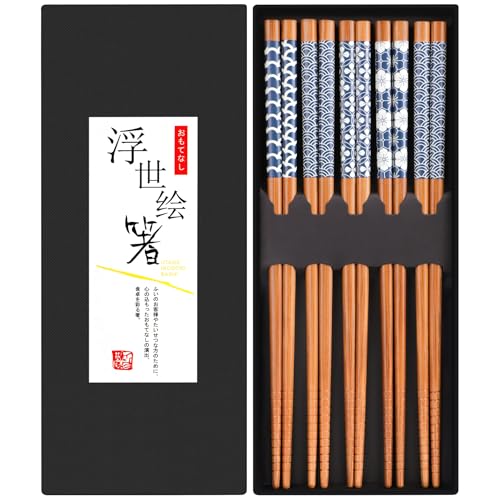
Antner 5 Pairs Natural Bamboo Chopsticks — Best Budget
The everyday budget pick has to survive a specific honesty test: it will be used hard and replaced eventually, so it must be cheap enough that replacement feels like buying sponges, not like losing an heirloom. The Antner bamboo set passes easily. It is also genuinely pleasant to eat with — bamboo is light, warm and naturally textured — and its 8.8-inch Japanese profile suits the individual bowls most weeknight meals are served in.
| Material | Natural bamboo |
|---|---|
| Length | 8.8 inches / 22.5 cm |
| Set size | 5 pairs |
| Care | Dishwasher safe (per listing title) |
Strengths
- Lowest tier cost per pair in this guide
- Bamboo is light and beginner-friendly
- Shorter profile suits individual bowls and smaller hands
Trade-offs
- Bamboo ages fastest under daily machine washing
- Five pairs is lean for families with guests
- Shorter length is not ideal for shared platters
Bamboo’s everyday economics only work if you adopt the renewable mindset from day one: rotate the five pairs, hand-wash when the evening allows, and refresh the set when the tips whiten and roughen. Households that do this get years of pleasant eating for very little money. Households that expect bamboo to behave like fiberglass get a year of slow disappointment — the material was never hiding its nature.
There is also a sustainability-flavoured comfort to bamboo that many everyday buyers value: it is fast-growing, light to ship and biodegradable at end of life in a way synthetics are not. That does not change how it eats, but for a product bought repeatedly in small quantities, it is a legitimate part of the everyday decision.
Best for: budget-first households and beginners building the habit / Not suited for: anyone wanting one purchase to last many years untouched
Check on Amazon — check price on Amazon for the current listing details.
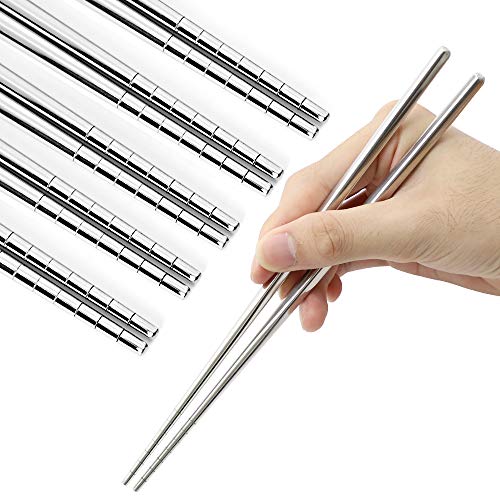
MUYOS Stainless Steel Chopsticks (Silver, 5 Pairs) — Best Metal for Every Day
Everyday use is where steel’s virtues compound. A pair that rinses truly clean in seconds, never stains from last night’s curry, never absorbs the smell of the fish course and goes in the dishwasher without a thought is a pair that fits a busy routine perfectly. The MUYOS hollow-core design keeps that routine comfortable: light in the hand, non-slip at the tip, silver and unfussy at the table.
| Material | Stainless steel, hollow core |
|---|---|
| Set size | 5 pairs |
| Tips | Non-slip tips (per listing title) |
| Care | Dishwasher safe (per listing title) |
Strengths
- Fastest, most complete clean of any material here
- Never stains, never absorbs odours, effectively permanent
- Hollow core keeps daily handling light
Trade-offs
- Conducts heat — keep out of simmering pots
- Five pairs is a starter quantity for steel converts
- Metal-on-ceramic sound is not for everyone
The hidden everyday cost of natural materials is management: sorting what can be machine-washed, remembering not to soak, inspecting tips. Steel deletes the management. For households where chopsticks are shared family tools rather than personal possessions, that hygiene-plus-simplicity combination is usually the deciding argument, and it is why steel dominates in Korean homes where chopsticks work as hard as anywhere on earth.
New steel users should allow the one-week recalibration: grip slightly higher, let the pair’s own weight assist, and notice by the second week that control on small items is actually finer than with the springy bamboo you replaced. After that, the set simply disappears into the routine — the highest praise an everyday tool can earn.
Best for: shared family sets and hygiene-first, low-fuss routines / Not suited for: hotpot households that rest chopsticks in the pot
Check on Amazon — check price on Amazon for the current listing details.
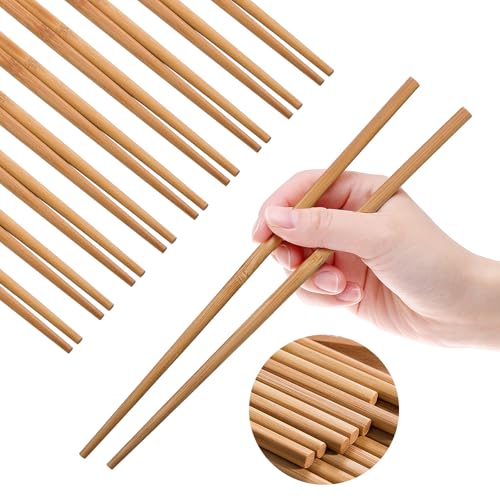
SOMOYA Iron Wood Chopsticks (10 Pairs) — Best Wooden Everyday Set
Wood lovers in family-sized households face a quantity problem: most wooden sets come in fives and age at different rates. This SOMOYA iron wood set answers with ten pairs of a notably dense hardwood at a slightly longer 9.8 inches, and a dishwasher-safe listing that makes the everyday routine easier than wood usually allows. Iron wood’s density is its character — substantial in the hand, slow to wear at the tips.
| Material | Iron wood |
|---|---|
| Length | 9.8 inches |
| Set size | 10 pairs |
| Care | Dishwasher safe (per listing title) |
Strengths
- Ten pairs brings wood to family scale
- Dense iron wood wears slowly at the tips
- Slightly longer 9.8-inch reach suits shared dishes
Trade-offs
- Listing title wording mixes material terms — verify the current listing details before ordering
- Dense wood is heavier than bamboo or fiberglass
- Natural sets still age faster than synthetics in daily machine washing
A note on honesty: this listing’s title is one of the messier ones in the category, mixing iron wood with generic bamboo and cuisine words. The verified core facts are the material claim of iron wood, the 9.8-inch length, the ten-pair count and the dishwasher-safe claim. We include the set because those facts fit a real gap — family-quantity wood — and we flag the title noise here and in our sources so you can confirm the current listing before buying, as you should with any purchase.
In use, dense hardwood eats with a reassuring solidity that bamboo cannot match, and the extra fraction of length helps at shared plates without tipping into serving territory. Treat the dishwasher claim as permission rather than a promise of immortality: rotate pairs, and expect the set to age gracefully over years rather than stay showroom-new.
Best for: wood-preferring families who need ten pairs and easy care / Not suited for: buyers who want showroom finish preserved indefinitely
Check on Amazon — check price on Amazon for the current listing details.

HIWARE 10 Pairs Fiberglass Chopsticks (Gold) — Best for Guests Every Day
Some households’ everyday genuinely includes other people: grandparents twice a week, teenagers’ friends, the neighbours who became regulars. For them the gold HIWARE set is the honest everyday pick — full fiberglass practicality underneath, a finish that makes an ordinary Tuesday dinner feel slightly hosted, and ten pairs so the guest count never triggers a drawer negotiation.
| Material | Fiberglass |
|---|---|
| Length | 9.5 inches |
| Set size | 10 pairs |
| Care | Dishwasher safe (per listing title) |
Strengths
- Presentation finish suits frequent hosting
- Ten pairs absorb guests without planning
- Fiberglass core keeps care at zero
Trade-offs
- Gold styling is unnecessary for strictly private households
- One style only — no personal variety
- Fiberglass feel remains functional rather than warm
There is a small social mechanics point here: guests eat more confidently with a proper matching pair, and hosts relax when the table looks intentional. A set that delivers that effect while also being the most washable tool in the kitchen is doing double duty that plain workhorse sets cannot. Everyday, for social households, includes the performance of welcome.
Underneath the finish this is the same proven HIWARE platform as the black set in our daily-use guide — same length, same dishwasher indifference, same family economics. Choose between black and gold purely on how your table likes to look; the eating and the care are identical.
Best for: social households and multi-generational tables / Not suited for: strictly private, minimalist kitchens
Check on Amazon — check price on Amazon for the current listing details.
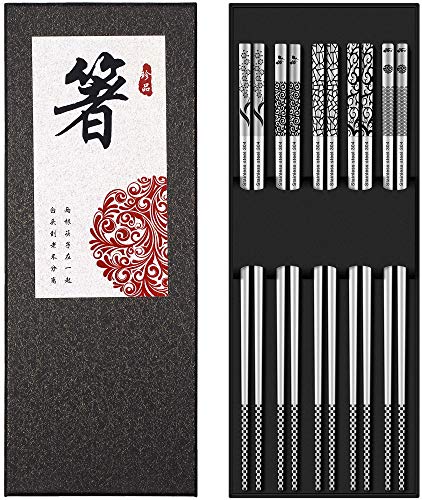
Metal Chopsticks 18/8 Stainless Steel (5 Pairs) — Best Grip for Beginners
Beginners quit chopsticks for one reason: food escapes, repeatedly, in front of people. This engraved 18/8 stainless set attacks that exact moment. The laser engraving gives the tips a file-like bite that holds noodles, beans and dumplings with minimal squeeze, so a new user’s imperfect grip still produces successful lifts — and successful lifts are what turn a frustrating week into a permanent skill.
| Material | 18/8 stainless steel |
|---|---|
| Length | 9.25 inches |
| Set size | 5 pairs |
| Finish | Laser-engraved non-slip (per listing title) |
Strengths
- Engraved tips give beginners the strongest grip margin
- 18/8 stainless is durable and dishwasher safe
- 9.25-inch length is manageable for new hands
Trade-offs
- Engraving feels assertive to experienced users who prefer smooth tips
- Steel heat conduction rules apply at hot pots
- Gift-set presentation costs more than plain bundles
Learning research on utensils is thin, but every teacher of chopsticks converges on the same advice: texture first, length moderate, food forgiving. This set is that advice manufactured. The engraving compensates while the anchored-stick habit forms, and unlike training hinges it never has to be unlearned — the pair remains a fully capable adult set long after the learning phase ends.
The Japanese-Korean crossover styling and 9.25-inch length make it a natural shared set for mixed households where one person is learning and others are not: nobody at the table is eating with a compromised tool, and the learner is not marked out with a gadget. That social invisibility matters more to adult learners than any feature on the box.
Best for: adult learners and mixed-skill households / Not suited for: experienced users who prefer smooth, classic tips
Check on Amazon — check price on Amazon for the current listing details.
Comparison Table
| Pick | Badge | Key spec | Best for |
|---|---|---|---|
| GLAMFIELDS 10 Pairs Fiberglass Chopsticks | Best Overall | Fiberglass, 9.5 in, 10 pairs | Everyday family rotation — Check on Amazon |
| Antner 5 Pairs Natural Bamboo Chopsticks | Best Budget | Bamboo, 8.8 in, 5 pairs | Budget everyday use — Check on Amazon |
| MUYOS Stainless Steel Chopsticks (Silver, 5 Pairs) | Best Metal for Every Day | Stainless, hollow core, 5 pairs | Low-fuss permanence — Check on Amazon |
| SOMOYA Iron Wood Chopsticks (10 Pairs) | Best Wooden Everyday Set | Iron wood, 9.8 in, 10 pairs | Wood at family scale — Check on Amazon |
| HIWARE 10 Pairs Fiberglass Chopsticks (Gold) | Best for Guests Every Day | Fiberglass, 9.5 in, 10 pairs, gold | Hosting-friendly everyday — Check on Amazon |
| Metal Chopsticks 18/8 Stainless Steel (5 Pairs) | Best Grip for Beginners | 18/8 steel, engraved, 9.25 in | Learning with grip help — Check on Amazon |
What does everyday use actually demand from a set?
Frequency rewrites the priorities. A special-occasion pair is used twelve times a year and judged on beauty; an everyday pair is used seven hundred times and judged on availability, washability and the absence of small daily irritations. Three demands follow.
Enough pairs for a real rotation
Rotation is the core everyday mechanic: pairs in use, pairs in the wash, pairs resting. Five pairs is the floor for a couple, ten is the comfortable number for families, and any household that hosts should count the hosting table, not the family, as its requirement. Two of our six picks are ten-pair sets for exactly this reason, and the five-pair picks are priced and styled to be doubled without pain.
A washing story you will actually keep
Decide by your real sink, not your aspirational one. If the dishwasher runs nightly and everything goes in it, fiberglass and steel are your materials and this decision is already made. If someone in the house genuinely hand-washes, wood and bamboo re-enter the picture with their warmth and grip. The everyday mistake is buying for the routine you intend to start; buy for the routine you already have.
Tips that forgive tired hands
Everyday meals are eaten tired, distracted and sometimes one-handed with a child on a hip. Textured tips — non-slip shaping, engraving, natural grain — are the forgiveness built into the tool, and they matter more at 7pm on a Wednesday than any other feature on the listing.
Everyday chopsticks by household type
A single adult eating most meals at home needs five pairs, one material, zero drama: the fiberglass or steel five-pair picks, doubled only if guests are common. The failure mode to avoid is over-buying variety — three half-sets in three materials guarantees mismatch forever.
Couples do best with either one ten-pair workhorse or two matched five-pair sets in one material, plus optionally one contrasting personal set each. Families with children should add shorter pairs for small hands rather than forcing adult lengths, and should treat the family set as a consumable system with a refresh rhythm, not a heirloom under threat.
Multi-generational and high-hosting households are the ten-pair fiberglass natural constituency, with the gold pick existing precisely for tables where presentation is part of everyday life. Renters and first-kitchen buyers should start at the bamboo budget pick, learn their own washing routine honestly for a few months, and then upgrade into the material that routine points to.
How much should an everyday set cost over time?
Think in cost per year, not cost per box — qualitatively, since live prices belong on the listings. Budget bamboo refreshed on a rhythm lands at the lowest annual figure and suits households happy with the renewable pattern. Mid-tier fiberglass spreads its cost across years of zero-maintenance service and usually wins the value argument for dishwasher homes. Steel costs the most patience at purchase and the least thereafter: its annual figure trends toward zero across a decade.
The false economy is the ultra-cheap unbranded bundle with vague materials: pairs that warp, splinter or shed finish within months cost more per year than any honest tier above, and they teach beginners that chopsticks are simply unpleasant, which is the most expensive outcome of all. Every pick in this guide exists to keep a household out of that trap at its chosen tier.
How to set up an everyday chopstick system that runs itself
The difference between households that struggle with chopsticks and households that never think about them is a small system, set up once. Here is the setup, in order.
- Count your table, then buy to the count. Seats at your largest regular meal, plus two spare pairs, is your number. Buy it in one matched purchase so every pair in the drawer is identical or deliberately paired.
- Assign the drawer properly. One insert or divider, pairs together, away from knives. A visible, matched stack is what makes the rotation self-managing — you can see at a glance when the clean count runs low.
- Fix the wash rule by material. Write the household rule in one sentence — everything in the dishwasher, or naturals rinsed and dried at the sink — and make sure everyone who washes up knows it. Most everyday set deaths are rule confusion, not wear.
- Keep one stove pair separate. A single longer, inexpensive pair lives by the cooker for turning and retrieving, so the table sets never collect cooking damage.
- Audit twice a year. Line the pairs up, retire the splintered, cracked or frayed, and top the count back up. Five minutes, twice a year, is the entire maintenance burden of a well-chosen everyday system.
Set up this way, chopsticks stop being a purchase you revisit and become kitchen infrastructure like the kettle — present, working, unremarkable. That unremarkableness is the true product this guide is selling, and every pick above was chosen for its ability to deliver it in a different household pattern.
Everyday chopsticks and sustainability, honestly
The sustainable choice in this category is the durable one, with one nuance. A steel or fiberglass set used for a decade beats a stream of disposables by an enormous margin, and beats short-lived unbranded sets comfortably too. Bamboo’s case is different: it is a renewable material with a shorter service life, and its footprint depends on the refresh rhythm being reasonable rather than wasteful.
What does not help is guilt-driven buying of fragile ‘eco’ sets that fail in months and are replaced by synthetics anyway. Choose the material your routine will keep in service longest — that is the environmental answer as well as the practical one, and for most dishwasher households it points, again, at fiberglass or steel.
What are the signs an everyday set is failing you?
Everyday failure is quiet, so it helps to name it. If your household regularly eats with mismatched pairs, the count is too low. If one material is always left in the drawer while another is always in use, the household has voted and the drawer should be re-bought to match the vote. If tips are rough, splintered or frayed and still in service, the audit rhythm has slipped and someone will eventually meet a splinter at dinner.
The subtlest sign is avoidance: family members quietly choosing forks for noodle night because the available pairs are the slippery ones, or the too-long ones, or the ones with the damaged tips. Avoidance means the tool no longer fits the eaters, and the fix is a set chosen against the guidance in this article — right length, textured tips, enough pairs — rather than another attempt to make the wrong set work through effort.
None of these failures require a large correction. Everyday chopsticks are among the cheapest systems in a kitchen to reset completely, which is why this guide encourages decisive replacement over sentimental persistence: one matched purchase, and the daily friction is simply gone.
How do everyday pairs handle travel, lunchboxes and desks?
Everyday life leaks out of the kitchen: work lunches, school bags, desk drawers, picnics. The practical pattern is to let the home set stay home and push retired-but-sound pairs into travel duty, where loss is acceptable. A pair that has aged out of table presentation is usually still perfectly serviceable for a lunchbox, and keeping a case for it costs little and prevents the classic bag-puncturing loose pair.
For buyers who travel frequently with chopsticks as a deliberate habit, the traits that matter shift slightly: shorter or standard length for cases, steel or fiberglass for hygiene in uncertain washing conditions, and nothing precious. Several picks here — the steel sets especially — serve that role well as a designated travel pair bought alongside the home set.
Desk eating deserves one honest note: the pair that lives at work should be dishwasher-or-sink simple and visibly yours, because shared office kitchens are where unmarked pairs go to disappear. The gold finish pick, whatever its table virtues, is a poor desk choice; plain black fiberglass is the classic survivor.
Everyday chopsticks for students and first flats
First kitchens run on tight budgets and tighter storage, and the everyday logic compresses accordingly: one five-pair set, one material, chosen for the washing reality of a shared house. That usually means fiberglass, because shared houses run dishwashers communally and hand-washing intentions dissolve by week three of term. The GLAMFIELDS and HIWARE formats in this programme’s guides exist at exactly this scale.
Bamboo is the other honest student answer, for a different reason: it is the cheapest respectable pair, it is light to move between flats, and losing pairs — the defining student experience — costs almost nothing. The Antner set’s role in this guide is partly this: a starter set whose loss or refresh is a non-event while habits form.
What students should not do is inherit the family chaos drawer in miniature: two pairs of unknown origin, one training pair from childhood and a takeaway sleeve. Five matched pairs in a small box outperform that drawer at every meal and take less space doing it.
What do guests actually notice about your everyday set?
Less than hosts fear, and different things than hosts expect. Guests do not grade materials or makers; they notice whether their pair matches their partner’s, whether the tips grip well enough that they are not the one dropping food, and whether the pair feels clean and sound. A uniform fiberglass set passes all three tests for almost every guest, which is why hosting value concentrates in the ten-pair picks.
The one guest-facing failure is the damaged pair — the splintered bamboo or frayed tip handed to the person you most wanted to relax. It is another argument for the twice-yearly audit: the pairs guests receive should be the audited best of the drawer, and in a matched ten-pair system there is no bad pair to hand anyone.
Presentation beyond that is pleasure, not obligation. The gold set exists for hosts who enjoy it; nobody’s dinner was ever ruined by plain black fiberglass in good condition, and many memorable dinners have run on exactly that.
Everyday annoyances, diagnosed
Problem: pairs keep vanishing. They migrate — lunchboxes, desks, the gap behind the stove, a child’s treasure box. The fix is count discipline: buy to count plus spares, and let retired pairs be the designated migrants instead of raiding the table set.
Problem: one pair of the set is always the favourite and fights break out. In matched sets this cannot happen, which is a hidden argument for uniformity in family systems. Where personal favourites exist, mark them honestly — a personal pair per person, kept apart from the family rotation.
Problem: the drawer smells faintly musty. Pairs are being stored damp, usually natural pairs in a closed container. Dry before storing, store loose and ventilated, and retire any pair whose smell survives a proper wash and a day of air — that pair’s fibres are holding more than water.
Problem: noodles defeat the whole table. Audit the tips, not the people. If the everyday set is polished and smooth, one engraved or non-slip set for noodle nights transforms the meal; technique coaching works far better once the tool stops sabotaging it.
How should you wash everyday chopsticks, by material, in one routine?
Households run one routine, not four, so here is the unified version that keeps every material in this guide safe. Scrape and rinse pairs straight after the meal — thirty seconds that prevents every dried-on problem. Fiberglass and steel go into the dishwasher basket, tips down. Wood and bamboo get a quick hand-wash with mild soap and a soft sponge, a towel dry, and ten minutes standing in an open pot before they join the drawer.
Two prohibitions protect everything: no soaking, ever, and no sealed storage while damp. Soaking is the silent killer of natural tips, and sealed damp storage is the source of every musty drawer. Both prohibitions cost nothing and together they account for most of the lifespan differences households observe between supposedly identical sets.
Once a month, give natural pairs the fingertip test — run a clean finger along the tips feeling for roughness or raised fibres. Catching early wear at the sink is how a set gets retired gracefully at the audit instead of dramatically at the table.
A short history of why everyday pairs look the way they do
The modern everyday pair is a compromise a thousand years in the making. Bamboo came first and never left, because it grows fast, works beautifully and costs little — the original everyday material, still setting the baseline in this guide. Wood followed for households that wanted more heft and ceremony, and lacquer traditions grew around protecting it from exactly the water damage this article keeps warning about.
Steel arrived with industrial Korea, matched to metal rice bowls and a cuisine of grills and stews, and proved that a pair could be a lifetime object. Fiberglass is the newest layer, standardised by Japanese restaurants that needed a pair to survive commercial washing forever, and it is no accident that it now anchors most everyday recommendations, including this one: everyday use is, in the end, a washing problem wearing a dining costume.
Knowing the lineage helps a buyer read a listing calmly. Each material is a solved answer to a particular kitchen’s constraints; your job is only to recognise your own kitchen in one of them.
Pairing everyday chopsticks with the bowls you already own
Everyday comfort is a system of pair plus vessel, and most households own the vessels already — so choose the pair to fit them. Deep noodle bowls with high rims reward the standard 9.5-inch length and punish shorter pairs, which force the hand down into the steam. Wide, shallow rice and salad bowls reverse the preference: shorter pairs feel precise and the long ones feel like oars.
Material pairing matters at the margins too. Steel on thin ceramic is the loud combination; if your everyday bowls are fine porcelain or glass, wood, bamboo and fiberglass keep breakfast quiet. Fiberglass on stoneware is the neutral middle most family kitchens land on, and it is no coincidence that it is also the easiest pairing to wash, store and replace as one system.
Before buying a second set in a new material, run the bowl test with a borrowed or budget pair for a week of real meals. Everyday fit reveals itself across a week of Tuesdays, not in a single careful test dinner — and a week is exactly the timescale this guide’s recommendations were judged on.
Common Buying Mistakes
Owning variety instead of quantity. Three pretty pairs in three materials is a collection, not a system. Everyday life needs matched depth — buy the count first, vary later if at all.
Buying for the washing routine you wish you had. Wood bought by a dishwasher household is a countdown to disappointment. Match the material to the sink you actually run.
Letting damaged pairs stay in rotation. Splinters and frayed tips are retirement notices. The audit takes five minutes; a splinter at dinner takes the shine off the whole meal.
Forcing adult lengths on children. Small hands with long pairs learn a splayed, tiring grip and conclude chopsticks are hard. Shorter pairs for children is a small purchase with an outsized effect.
Skipping the stove pair. Table pairs used at the pan collect scorched tips and oil damage. One cheap long pair by the cooker protects the whole system.
Final Recommendation
For the majority of households the GLAMFIELDS ten-pair fiberglass set is the everyday answer: always enough clean pairs, zero care, competent at every meal. Budget-first buyers should start on the Antner bamboo with the renewable mindset, wood lovers finally get family scale with the SOMOYA set, and learners get their grip head-start from the engraved steel pick.
Buy to your table count, fix one wash rule, audit twice a year. That is the whole system — and once it is running, everyday chopsticks become what they should be: invisible, dependable, and ready at every single meal without a second thought from anyone.
Keep exploring the same cluster on this site: Best Chopsticks For Daily Use Best Chopsticks For Eating Best Chopsticks For Beginners Best Chopsticks For Cooking Best Chopsticks Dishwasher Safe
Related guides
Frequently Asked Questions
What are the best chopsticks for everyday use overall?
A ten-pair fiberglass set such as the GLAMFIELDS pick: enough pairs for a full rotation, dishwasher-proof, non-slip for every skill level, and a 9.5-inch length that suits most tables. Households that hand-wash and love natural materials should look at the iron wood set instead; steel suits hygiene-first homes.
How many pairs of chopsticks does a family need?
Count your largest regular table and add two spares. For most families that lands at ten pairs, which is why two of our picks are ten-pair sets. Couples can run comfortably on five pairs with a prompt washing rhythm, and should double up before regular hosting begins rather than after the first shortfall.
Are bamboo chopsticks practical for everyday use?
Yes, with the renewable mindset: rotate pairs, hand-wash when you can, and refresh the set when tips whiten and roughen. Bamboo is light, grippy and inexpensive, which makes it a rational everyday choice for budget-first households — as long as nobody expects it to be permanent like steel or fiberglass.
Can everyday chopsticks go in the dishwasher every day?
Fiberglass and stainless steel can, indefinitely — that tolerance is their core everyday virtue. Wood and bamboo sets listed as dishwasher safe will survive the machine but age faster in it; daily machine washing is the main reason natural sets need refreshing. Match the material to your machine habit and the question answers itself.
What is the best everyday length?
Around 9.5 inches for most adults and tables, 8.8 to 9.25 inches for smaller hands, individual bowls and learners, and a touch longer — the 9.8-inch wooden pick — where shared dishes dominate. Children should have genuinely shorter pairs rather than shortened grips on adult pairs.
When should everyday chopsticks be replaced?
On evidence: splinters, cracks, frayed tips, warping, or smells that survive proper washing. Steel and fiberglass sets may go years without showing any of these; natural sets show tip wear first. A twice-yearly drawer audit catches failures before they reach the table.
Should I buy the same set twice or two different sets?
Buy the same set twice if the first set suits everyone — identical pairs make rotation, washing and replacement effortless, and a doubled five-pair pick becomes a ten-pair system with no mismatch. Buy two different sets only when the household genuinely splits: different hand sizes, a learner who needs engraved grip, or a wood lover alongside dishwasher loyalists. Difference should serve a named need, never variety for its own sake.


