Disclosure: airfryerkitchensupply.com is reader-supported. When you buy through links on our site, we may earn an affiliate commission at no extra cost to you.
Where to buy
Every pick in this guide to the best chopsticks for everyday use is sold through Amazon, which keeps ordering, delivery and returns in one place and lets you check price on Amazon before you commit. Use the short list below to jump straight to a product page, or read the full reviews further down before you decide.
Chopsticks are a classic multi-pack purchase: one set is never enough once a household converts. Ordering through Amazon makes it easy to check price on Amazon for the pack size you need and to reorder the identical pair when the drawer inevitably thins out.
- HIWARE 10 Pairs Fiberglass Chopsticks, Black, 9.5 Inches (Best Overall): Check the current price on Amazon
- GLAMFIELDS 5 Pairs Japanese Fiberglass Chopsticks Gift Set, Black (Best Japanese Style): Check the current price on Amazon
- MUYOS Stainless Steel Chopsticks, 5 Pairs, Silver (Best Metal): Check the current price on Amazon
- Antner 5 Pairs Natural Bamboo Chopsticks, 8.8 Inches (Best Bamboo): Check the current price on Amazon
- Metal Chopsticks 18/8 Stainless Steel, 5 Pairs, 9.25 Inches, Laser Engraved (Best for Beginners): Check the current price on Amazon
- GLAMFIELDS 10 Pairs Fiberglass Chopsticks, 9.5 Inches (Best Family Pack): Check the current price on Amazon
The best chopsticks for everyday use are not the prettiest pair in the drawer; they are the pair you reach for on a tired Tuesday, that survive the dishwasher three hundred times a year, grip a slick noodle without drama, and cost little enough that losing one under the stove is an annoyance, not a loss. Everyday chopsticks are a workhorse purchase, and they should be judged like one: material, grip, length and how they behave after a year of real meals.
This guide compares the three materials that dominate daily use. Fiberglass pairs are the modern default, light, dishwasher-proof and textured at the tip for grip. Stainless steel pairs are nearly indestructible and hygienic, with a learning curve for slippery foods. Bamboo is the warm, traditional, feather-light option that asks for a little more care. Every pick below was verified through this site’s Amazon data before it earned a link, and each of the six earned its place for a different kind of daily cook and eater.
A note on length before we start: most of these pairs sit around nine and a half inches, the versatile middle that suits table eating and light cooking. If you mostly cook with chopsticks in a wok, you will want a longer pair as a second set, and the buying guide explains why one length rarely does both jobs well.
In this guide
Quick Picks
If you are short on time, these are the six best chopsticks for everyday use we would buy with our own money, each chosen for a different kind of buyer. The badge next to each name is the same badge used in its full review below, so you can jump between the summary and the detail without losing your place.
- Best Overall — HIWARE 10 Pairs Fiberglass Chopsticks, Black, 9.5 Inches: The everyday default done right: ten fiberglass pairs that shrug off the dishwasher, grip noodles securely, and cost little enough to stock a whole household. — Check on Amazon
- Best Japanese Style — GLAMFIELDS 5 Pairs Japanese Fiberglass Chopsticks Gift Set, Black: A Japanese-profile fiberglass set with finer, more pointed tips for precise picking, presented as a giftable five-pair set. — Check on Amazon
- Best Metal — MUYOS Stainless Steel Chopsticks, 5 Pairs, Silver: Hollow-core stainless pairs that stay light in the hand, never stain or absorb flavors, and will likely outlast every other utensil you own. — Check on Amazon
- Best Bamboo — Antner 5 Pairs Natural Bamboo Chopsticks, 8.8 Inches: Classic natural bamboo in a shorter Japanese length: feather-light, warm in the hand, and gentle on delicate foods and nonstick pans alike. — Check on Amazon
- Best for Beginners — Metal Chopsticks 18/8 Stainless Steel, 5 Pairs, 9.25 Inches, Laser Engraved: Laser-engraved grip patterns along the tip make these the most forgiving metal pairs for learners, in food-grade 18/8 stainless. — Check on Amazon
- Best Family Pack — GLAMFIELDS 10 Pairs Fiberglass Chopsticks, 9.5 Inches: Ten fiberglass pairs with non-slip tips in a versatile Japanese-Chinese hybrid profile: the one-box answer for a whole family table. — Check on Amazon
How These Picks Were Chosen
We screened for everyday reality: could this pair be used three meals a day, washed without ceremony, and still be the pair you reach for next year? That filter favoured fiberglass and stainless steel for durability, kept one honest bamboo set for feel, and cut decorative lacquered sets whose finishes chip, novelty shapes that sacrifice grip, and any pair whose listing could not be verified. Every pick was checked through this site’s Amazon data, searching brand and model and matching the returned listing before a link was attached.
Lengths and materials in the spec boxes come only from those verified listings. We then balanced the six across the three real materials and the real user types: the durable default, the precision Japanese profile, two kinds of metal, the natural classic, and the family-quantity pack.
The 6 Best Chopsticks for Everyday Use

HIWARE 10 Pairs Fiberglass Chopsticks, Black, 9.5 Inches — Best Overall
If one set in this guide belongs in most kitchens, it is this one. HIWARE’s fiberglass pairs hit the everyday brief squarely: they do not warp, crack or absorb odors, they go straight in the dishwasher, and the tips are textured so rice noodles and dumplings stay put. Ten pairs means a family eats together, guests are covered, and a pair in the wash is never a crisis.
They suit households making the switch from disposable or mismatched pairs to one reliable standard. They are less suited to purists who love the feel of natural wood, and fiberglass has a slightly clinical hand-feel some eaters never warm to.
Strengths
- Fiberglass construction survives daily dishwashing without warping, splitting or fading
- Textured tips grip slippery foods far better than smooth lacquered pairs
- Ten-pair pack covers a family and guests at a true everyday price tier
Trade-offs
- Hand-feel is functional rather than warm or traditional
- Black finish shows water spots if your water is hard and you air-dry
- Not a cooking-length pair; keep them at the table
| Material | Fiberglass |
| Length | 9.5 inches |
| Pack | 10 pairs |
| Care | Dishwasher safe (per Amazon listing) |
The everyday case for fiberglass is really a case about entropy. Bamboo dries out and splits, wood lacquer chips, plastic melts against a hot pan rim. Fiberglass simply accumulates meals. After a year of daily use these pairs look close to new, which is why restaurants that seat hundreds a night standardise on the material. For a home that eats with chopsticks most days, that indifference to abuse is worth more than any aesthetic premium.
Grip is the other half of the story. New chopstick users often blame their technique for dropped food when the real culprit is a glossy, tapered tip. The matte texture on these tips forgives imperfect angles, which makes them the pair we hand to beginners and guests without a second thought.
Best for: Households wanting one durable standard pair for daily meals / Not suited for: Eaters who prioritise natural-material feel above all
Check on Amazon to check price on Amazon and confirm the current configuration before ordering.

GLAMFIELDS 5 Pairs Japanese Fiberglass Chopsticks Gift Set, Black — Best Japanese Style
Japanese-style chopsticks are shorter in spirit even at the same measured length: the tip tapers finer, which makes them precision instruments for picking bones from fish, placing garnishes, and eating the small, deliberate bites Japanese meals are built around. GLAMFIELDS builds that profile in fiberglass, so you get the precision without the fragility of lacquered wood, in a boxed set that gives well.
They suit sushi and Japanese home cooking fans and anyone who finds standard tips clumsy. Big-handed eaters tackling hearty noodle bowls may prefer the sturdier standard profile of the HIWARE set.
Strengths
- Fine, pointed tips excel at fish, bones and precise picking
- Fiberglass body is dishwasher safe and non-slip in use
- Gift-set presentation makes it the presentable pick of this guide
Trade-offs
- Fine tips are less forgiving for absolute beginners
- Five pairs is a smaller household quantity than the ten-pair packs
- Pointed profile is specialised; less ideal as a serving or cooking pair
| Material | Fiberglass |
| Length | 9.5 inches |
| Pack | 5 pairs, gift set |
| Style | Japanese profile, non-slip (per Amazon listing) |
The difference between Japanese and Chinese profiles is a difference in cuisine. Japanese meals feature whole fish and small side dishes, so the chopstick evolved into a scalpel. Chinese meals feature shared dishes and long noodles, so the chopstick evolved longer and sturdier. Neither is better; they are answers to different tables. If your everyday cooking leans Japanese, this set will feel right in a way a standard pair never quite does.
Because the body is fiberglass rather than lacquered wood, you keep that precision through years of dishwashing. It is the rare gift-set purchase that is also a genuinely practical daily tool, which is why it holds this slot over prettier but more delicate wooden sets.
Best for: Japanese cooking fans and precise, deliberate eaters / Not suited for: Beginners who need a forgiving, grippy tip
Check on Amazon to check price on Amazon and confirm the current configuration before ordering.
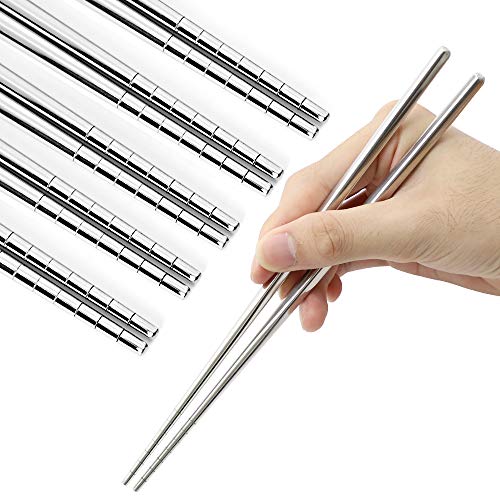
MUYOS Stainless Steel Chopsticks, 5 Pairs, Silver — Best Metal
Stainless steel is the buy-it-for-life material, and MUYOS solves its one classic problem, weight, with a hollow core that keeps each pair light enough for daily comfort. The listing calls out the two details that matter in metal: non-slip tips, because bare polished steel on a noodle is a skating rink, and dishwasher safety, which for metal is effortless. The silver finish is the timeless table look.
They suit committed daily users, households tired of replacing bamboo, and anyone who values hygiene, since steel does not harbour flavors between a curry night and a sushi night. New users should expect a short adjustment period.
Strengths
- Hollow-core build keeps metal pairs light enough for everyday use
- Steel never stains, warps, or carries yesterday’s flavors into today’s meal
- Non-slip tips address metal’s one real weakness, grip on slick foods
Trade-offs
- Metal conducts heat, so resting them in a hot pot is a mistake you make once
- They click against bowls and plates, louder than wood or fiberglass
- Grip, even textured, is a notch below fiberglass on the slipperiest noodles
| Material | Stainless steel, hollow core |
| Pack | 5 pairs |
| Finish | Silver |
| Care | Dishwasher safe, non-slip tips (per Amazon listing) |
Think of steel chopsticks the way chefs think of a good knife: the last ones you buy. There is no finish to wear, no grain to split, no replacement cycle. The MUYOS pairs add the laser-textured tip treatment that separates usable metal chopsticks from the frustrating polished kind bundled free with takeaway orders. If your household’s complaint history is a trail of split bamboo and melted plastic, this is the exit from that cycle.
The honest adjustment: for the first week, metal feels different, cooler, smoother, slightly noisier. Most daily users stop noticing by the second week and then find other materials oddly fragile-feeling. Korean barbecue fans will also recognise the format, since flat-sided Korean metal chopsticks are close cousins designed for exactly this daily, heavy use.
Best for: Long-term daily users wanting a permanent, hygienic set / Not suited for: Noise-sensitive diners or anyone who rests chopsticks in hot pans
Check on Amazon to check price on Amazon and confirm the current configuration before ordering.
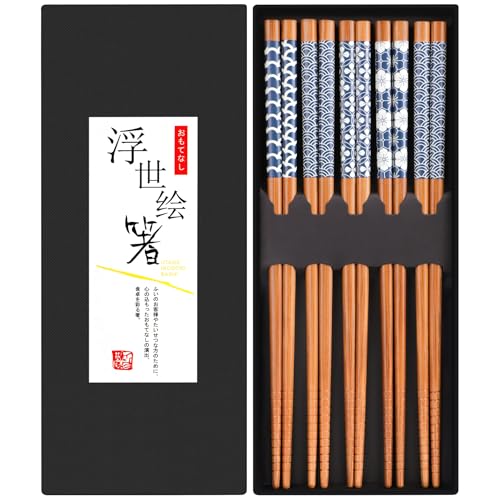
Antner 5 Pairs Natural Bamboo Chopsticks, 8.8 Inches — Best Bamboo
Bamboo is where most chopstick traditions begin, and Antner’s set shows why it endures. Bamboo is astonishingly light, naturally grippy even when smooth, kind to delicate fish and to nonstick coatings, and warm to hold in a way no synthetic matches. At 8.8 inches these follow the shorter Japanese profile, which smaller hands and precise eaters tend to love.
They suit traditionalists, smaller-handed users, and households that hand-wash or run gentle dishwasher cycles. They are not the pick for a household that will blast them in a hot dishwasher daily for years and expect them to look new.
Strengths
- Feather-light bamboo reduces hand fatigue over long meals
- Natural surface grips food confidently without texture tricks
- Shorter 8.8-inch Japanese length suits smaller hands and precise eating
Trade-offs
- Bamboo eventually dries and can split; it is a years-long, not lifetime, material
- Natural material varies slightly pair to pair
- Shorter length is less versatile for cooking and shared serving
| Material | Natural bamboo |
| Length | 8.8 inches / 22.5 cm |
| Pack | 5 pairs |
| Style | Classic Japanese style (per Amazon listing) |
Every material asks something of you, and bamboo asks for rhythm: rinse or gentle wash, dry rather than soak, replace when a pair finally splinters. In exchange it gives the most pleasant eating experience in this guide, which is why so many lifelong chopstick users refuse to switch. The Antner set’s classic shaping, neither painted nor heavily lacquered, keeps that honest bamboo feel and avoids the chipped-paint problem of decorative sets.
Choose bamboo if your meals lean Japanese, if the eaters include children learning control (light weight helps enormously), or if you simply enjoy natural tools. Just buy it knowing it is a consumable on a long fuse, and keep a spare pair or two in the drawer.
Best for: Traditional feel, smaller hands and learners who benefit from light weight / Not suited for: Set-and-forget households wanting a decade from one purchase
Check on Amazon to check price on Amazon and confirm the current configuration before ordering.
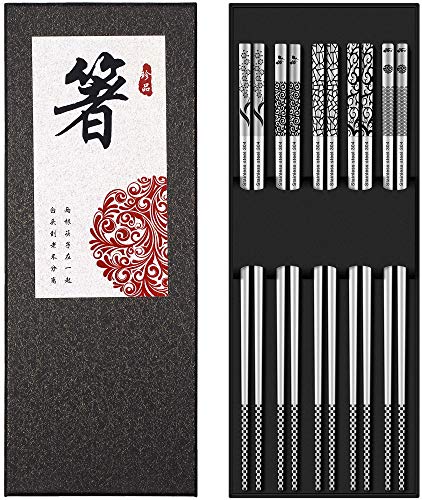
Metal Chopsticks 18/8 Stainless Steel, 5 Pairs, 9.25 Inches, Laser Engraved — Best for Beginners
Beginners drop food for two reasons: technique and equipment. These pairs fix the equipment half. The laser-engraved pattern along the eating end creates real mechanical grip, the 18/8 stainless is the food-grade standard, and the 9.25-inch length sits in the easy middle for control. If you are learning, or teaching kids and guests at your table, engraved metal removes the slippery variable so practice can do its work.
They suit learners, teachers of learners, and households wanting metal durability with training-wheel grip. Seasoned users may find the engraved look busier than plain steel.
Strengths
- Laser-engraved tips give beginners genuine grip on noodles and dumplings
- 18/8 stainless steel is the food-grade benchmark and fully dishwasher safe
- Mid length suits both eating and light cooking tasks
Trade-offs
- Engraved pattern is a look you either enjoy or do not
- Same metal traits as any steel pair: heat conduction and bowl chatter
- Grip texture can trap residue if not rinsed reasonably promptly
| Material | 18/8 stainless steel |
| Length | 9.25 inches |
| Pack | 5 pairs |
| Feature | Laser-engraved non-slip tips (per Amazon listing) |
There is a reason so many starter recommendations quietly fail: they hand a new user polished, tapered sticks and slippery food, then blame the user’s hands. Engraving changes the physics. The patterned section bites just enough that a wobbly grip still holds a noodle, and early successes build the confidence that keeps people practicing. For a household converting from forks, that on-ramp matters more than any other spec on this page.
Once technique settles, these remain perfectly good daily pairs, durable, hygienic, and long enough to turn food in a pan in a pinch. Think of them as the pair that gets a household started and then simply stays in the drawer doing daily duty for years.
Best for: Beginners, kids learning, and households converting from forks / Not suited for: Minimalists who want plain, unadorned steel
Check on Amazon to check price on Amazon and confirm the current configuration before ordering.

GLAMFIELDS 10 Pairs Fiberglass Chopsticks, 9.5 Inches — Best Family Pack
Family tables need quantity, uniformity and zero fuss, and this ten-pair fiberglass set is built for exactly that. The profile blends Japanese and Chinese shaping, the tips are non-slip, and the whole bundle goes in the dishwasher without a thought. When every place setting matches and the drawer holds spares, chopsticks stop being an occasion and become the household default, which is the entire point of an everyday pick.
It suits families, shared households and anyone hosting regular noodle nights. If you want a distinctive single pair with gift presentation, the GLAMFIELDS five-pair set above is the sibling to choose.
Strengths
- Ten matching pairs end the mismatched-drawer problem in one purchase
- Fiberglass shrugs off daily dishwashing, heat and staining foods
- Non-slip tips keep them friendly for mixed-ability tables
Trade-offs
- Uniform black pairs are practical, not decorative
- Fiberglass hand-feel will not convert bamboo loyalists
- Table length only; wok work still wants a long cooking pair
| Material | Fiberglass |
| Length | 9.5 inches |
| Pack | 10 pairs |
| Care | Dishwasher safe, non-slip (per Amazon listing) |
The hidden cost of chopsticks is attrition: pairs separate, one slides behind the drawer, a guest takes a set home in a leftovers bag. A ten-pair standard set makes attrition a non-event for years, and when the count finally drops, reordering the identical set restores order. That boring logistical excellence is what everyday actually means.
Against the HIWARE set, the choice is fine-grained: both are ten-pair fiberglass at the same length. HIWARE leans on its textured-tip reputation; GLAMFIELDS counters with its hybrid profile that some eaters find slightly nimbler. Either anchors a household; pick by which tip style your hands prefer and do not overthink it.
Best for: Families and shared households standardising on one set / Not suited for: Buyers wanting a decorative or gift-presented set
Check on Amazon to check price on Amazon and confirm the current configuration before ordering.
Comparison Table
| Pick | Badge | Key spec | Best for |
|---|---|---|---|
| HIWARE 10 Pairs Fiberglass Chopsticks, Black, 9.5 Inches | Best Overall | Fiberglass, 9.5 in, 10 pairs, dishwasher safe | Households wanting one durable standard pair for daily meals |
| GLAMFIELDS 5 Pairs Japanese Fiberglass Chopsticks Gift Set, Black | Best Japanese Style | Fiberglass, Japanese fine tip, 5 pairs | Japanese cooking fans and precise, deliberate eaters |
| MUYOS Stainless Steel Chopsticks, 5 Pairs, Silver | Best Metal | Stainless steel, hollow core, 5 pairs | Long-term daily users wanting a permanent, hygienic set |
| Antner 5 Pairs Natural Bamboo Chopsticks, 8.8 Inches | Best Bamboo | Natural bamboo, 8.8 in, 5 pairs | Traditional feel, smaller hands and learners who benefit from light weight |
| Metal Chopsticks 18/8 Stainless Steel, 5 Pairs, 9.25 Inches, Laser Engraved | Best for Beginners | 18/8 steel, laser-engraved grip, 9.25 in | Beginners, kids learning, and households converting from forks |
| GLAMFIELDS 10 Pairs Fiberglass Chopsticks, 9.5 Inches | Best Family Pack | Fiberglass, 9.5 in, 10 pairs | Families and shared households standardising on one set |
Read the table as a map, not a ranking: the best chopsticks for everyday use differ less in raw quality than in which trade-off they ask you to accept, and the right row is the one whose trade-offs match your space, your users and your habits.
How to Choose the Best Chopsticks for Everyday Use
Everyday chopsticks are a three-way decision: material, length and tip. Get those right for your table and almost any well-made pair will serve you; get them wrong and even expensive pairs end up exiled to the back of the drawer.
Material: fiberglass, steel or bamboo
Fiberglass is the modern workhorse: light, rigid, immune to warping and staining, and genuinely dishwasher-proof for years. Stainless steel is the permanent option: hygienic, unbreakable in normal use, slightly heavier and noisier, and dependent on textured tips for grip. Bamboo is the traditional pleasure: lightest and warmest, naturally grippy, but a consumable that eventually dries and splits. There is no wrong answer, only the answer that matches how your household treats utensils.
What about wood and plastic? Hardwood pairs are lovely but sit between bamboo’s feel and a shorter life than fiberglass. Melamine and plastic pairs are cheap and common in restaurants, but they can warp with heat and feel slippery; for a home standard, the three materials in this guide are stronger choices.
Length: match the job
Table chopsticks run roughly 8.8 to 9.5 inches. Shorter Japanese lengths favour precision and smaller hands; the 9.5-inch middle suits most adults and most meals. Cooking chopsticks are a separate tool, typically much longer, to keep hands away from wok heat and oil. Trying to make one pair do both jobs means a table pair that is clumsy or a cooking pair that burns fingers. Most daily users end up with table pairs from this guide plus one long cooking pair.
Tip shape and grip
Tips decide whether dinner is relaxing. Textured, matte or engraved tips grip noodles and dumplings; polished, glossy tips shed them. Taper matters too: fine Japanese tips pick bones and garnish, squarer Korean-style profiles handle grilled meats and heavier bites. If you are new, choose grip first and aesthetics second; confidence at the table is built from food that stays held.
How Many Pairs Does a Household Actually Need?
Count place settings, then add half again. A four-person household that eats with chopsticks daily does well with ten pairs: four at the table, four in rotation through the wash, and spares for guests and the inevitable stray. That arithmetic is why the ten-pair packs anchor this guide. Singles and couples can start with five pairs and reorder the same set when the drawer thins.
Standardising on one model is the quiet trick. Matching pairs stack neatly, set a table that looks intentional, and make replacement trivial. The mixed drawer of souvenir pairs is charming right up until you are setting a table for six with four and a half pairs.
Chopsticks Around the Table: Japanese, Chinese and Korean Styles Explained
The three great chopstick traditions differ because their cuisines do, and knowing the differences helps you choose your everyday pair with intent. Japanese chopsticks are the shortest and finest-tipped, shaped for a cuisine of whole fish, small dishes and precise bites eaten from individual trays; the Antner and the Japanese-profile GLAMFIELDS set in this guide follow that pattern. Chinese chopsticks run longer, built for shared dishes, communal pots and noodles, and for reaching across a lazy Susan without leaning; the 9.5-inch fiberglass standards here sit closest to this versatile middle. Korean chopsticks are typically metal, often flat-sided so they do not roll, made for barbecue grills and stainless tableware; the MUYOS and engraved steel pairs are their everyday cousins.
None of the three is the correct one in the abstract. The correct one is the one that matches the food your household actually cooks and the hands that will hold them. A sushi-loving household served by Chinese-length sticks will manage; served by the right Japanese profile, it will flourish. This is why the guide stocks all three philosophies instead of crowning a single shape.
A note on children and learners
Children learn fastest on shorter, lighter pairs, bamboo especially, because control scales with the tool. Training chopsticks with connectors have their place for the first weeks, but most children graduate to a short real pair quickly when the pair is light and the tips grip. Buy the child the small version of the household standard and the whole table learns together.
How to Set a Household Chopstick Standard and Keep It
The households that eat with chopsticks daily, without thinking about it, share a system rather than a collection. They own one model in quantity, the model chosen from a guide like this one for material and grip. They keep the pairs together, in a tray or a banded bundle, at a count that survives the dishwasher’s rotation. They keep one long cooking pair by the stove and never confuse its job with the table pairs. And they replace by reordering the same set, so the drawer never drifts back into souvenir chaos.
It sounds like a small domestic philosophy because it is one, and it is the difference between chopsticks as an occasional performance and chopsticks as simply how dinner works. The purchase that starts it is deliberately boring: ten pairs, one material, textured tips. The interesting part is everything that happens at the table afterwards, three meals a day, for years.
Caring for Each Material: A Five-Year Ownership Guide
Fiberglass asks the least of you. It goes through the dishwasher daily without complaint, resists the staining ambitions of turmeric and chilli oil, and after five years looks much as it did on arrival, with perhaps a softening of the matte texture where the tips meet the bowl. Its one enemy is being used as a cooking tool in a screaming-hot wok, where sustained heat it was never built for can mark it; keep table pairs at the table and it will not happen. When a fiberglass pair finally retires, it is usually because its partner was lost, not because it failed.
Stainless steel asks for one habit: a rinse reasonably soon after meals heavy with sauce, because the textured and engraved tips that give it grip can hold residue in their pattern if left to dry overnight. In exchange it offers the longest service in the guide, immune to warping, splitting and staining, and indifferent to dishwashers, boiling sterilisation and decades. Bamboo asks the most and gives the most while it lasts: a quick wash, a real dry, no soaking, no prolonged heat, and in return the lightest, warmest, quietest eating experience here, for a service life measured in years rather than decades. None of these is a burden; they are personalities, and matching the material to the household’s actual habits, not its aspirations, is the whole art of this purchase.
Whichever material you standardise on, one small ritual preserves the system: a monthly count. Pairs migrate, to lunch bags, to desks, to the homes of guests who loved your noodles. A ten-second count each month tells you when to reorder the same set while it is still the same set, keeping the drawer uniform for years. Everyday tools deserve everyday administration, in miniature, and chopsticks repay it three times a day.
Serving, Sharing and the Social Life of a Chopstick Drawer
Everyday chopsticks have a social dimension the specifications miss. Shared dishes call for serving chopsticks, a dedicated pair, often the longest or a distinct colour, that touches the communal plate so personal pairs do not, a courtesy your guests will notice and copy. Households that entertain often keep one visibly different pair for the purpose, which also solves the small mystery of whose pair is whose at a crowded table. At the other end of the meal, a chopstick rest is a two-dollar piece of civilisation: it keeps tips off the table, sauce off the cloth, and the whole setting looking deliberate.
There is also the matter of the gift economy. A good everyday set, the GLAMFIELDS gift set in this guide exists precisely for this, is one of the rare presents that is inexpensive, personal and used daily for years. Give the pair you actually use, in the material you actually believe in, and you have given a small piece of your own table. That is the final argument for standardising well: the set you choose becomes part of how your household eats, hosts and gives, which is a great deal of life for a drawer of sticks to carry.
One Last Test Before You Buy: The Noodle Test
Specifications can be argued; a bowl of noodles cannot. If you are choosing between finalists, order one pack of each, cook the slipperiest meal you know, dan dan noodles, a dressed soba, anything glossy, and eat it with each pair on successive nights. The pair that never makes you think about your hands is your household standard, whatever this or any guide ranked first. Our six were chosen to make that test a formality: textured fiberglass, engraved steel, honest bamboo, all pass it. But the test is yours to run, and a standard chosen by your own table, at your own noodles, is a standard that will still be in the drawer, uniform and unargued, five years from now.
How to Hold Chopsticks Correctly and Care for Them Daily
Good technique makes every pair in this guide perform better, and basic care makes them last as long as they should. Neither takes more than a few minutes to learn.
Step 1: Rest the lower stick
Lay one chopstick across the base of your thumb and rest it on your ring finger. This stick barely moves; it is the shelf everything sits on. If it wobbles, adjust until it feels planted before adding the second stick.
Step 2: Grip the upper stick like a pencil
Hold the second chopstick with thumb, index and middle finger, as if writing. This is the stick that moves. Keep the grip relaxed and a little higher than you first think; a death grip is the main cause of hand fatigue.
Step 3: Move only the top stick
Practice opening and closing the tips by moving the upper stick while the lower one stays still. The tips should meet cleanly. Pick up something forgiving first, like marshmallows or folded paper, before graduating to noodles.
Step 4: Let the tips do the gripping
Squeeze gently at the tips rather than clamping mid-stick, and choose textured-tip pairs while learning. Most dropped food comes from gripping too hard and squirting the bite out, not from gripping too softly.
Step 5: Wash according to material
Fiberglass and steel go straight in the dishwasher. Bamboo prefers a quick wash and dry, and no long soaking, which swells and splits the fibres. Never leave any pair sitting in dishwater.
Step 6: Store dry and together
Dry pairs before they go in the drawer or a countertop holder, tips up in a holder so air circulates. Bundling household pairs with a simple band or tray keeps sets together and the drawer sane.
Ten minutes of practice a day for a week is all most adults need. Children learn faster with lighter, shorter pairs, which is one more reason the bamboo set earns its place in a family drawer.
Common Buying Mistakes
Buying polished tips for learning
Glossy, lacquered tips look elegant and drop everything. Beginners and mixed-ability tables should start with textured, matte or engraved tips and upgrade aesthetics later, if ever.
Using table pairs as wok tools
A 9.5-inch pair over a ripping-hot wok puts fingers far too close to the oil, and heat damages bamboo and fiberglass alike. Buy a dedicated long cooking pair.
Soaking bamboo and wood
Long soaks swell natural fibres, which then crack as they dry. Wash, rinse, dry, done. If your household cannot manage that rhythm, choose fiberglass or steel and skip the guilt.
Buying one pair at a time
Single pairs guarantee a mismatched drawer and a shortage at every group meal. Packs of five or ten cost little more and solve the problem for years.
Judging by looks alone
Painted and lacquered designs chip in dishwashers and the chips end up in food. For everyday use, the material and tip matter; decoration is for the gift set that still has a practical core.
Final Recommendation
Start with the HIWARE fiberglass ten-pack if you want the single most sensible purchase in this guide: durable, grippy, dishwasher-proof and enough for a household. Choose the GLAMFIELDS family pack as its equal alternative, the Japanese gift set for precision eating, MUYOS or the engraved steel pairs for a permanent metal drawer, and Antner bamboo when feel matters most and a little care is no burden.
Everyday chopsticks are a small purchase that touches three meals a day. Buy the material that matches your habits, in the quantity your table actually needs, and the question is settled for years.
And if the drawer still holds a sentimental pair, the lacquered souvenir, the gift from a trip, keep it, at the back, for the meals that deserve ceremony. A household standard is not a purge; it is a backbone. The everyday pairs in this guide exist so that the special pairs can stay special, while Tuesday’s noodles are eaten with tools that never make you think about them at all. That division of labour, standard and ceremony, is the last and best reason to buy the everyday set properly, once, in quantity, and be done.
Consider, finally, what a household standard quietly teaches. Children who grow up with one good pair of chopsticks at every setting learn that tools are chosen, kept and respected, a lesson that transfers to knives, pans and everything after. Guests learn that this house eats this way, confidently, and they rise to it. And the cook learns that the drawer will never again produce the small daily friction of mismatched lengths and missing partners at the exact moment the noodles are ready. Civilisation, at table scale, is mostly the removal of small frictions, and few purchases remove more of them per dollar than the right ten pairs of chopsticks.
Order the pack, wash them once, set the table, and notice, somewhere around the third meal, that nobody at it is thinking about chopsticks at all. That invisibility is the entire achievement, and it is available this week, in a box of ten, for less than the meal they will serve.
Start your shortlist with the picks readers choose most often: HIWARE 10 Pairs Fiberglass Chopsticks, Black, 9.5 Inches, GLAMFIELDS 5 Pairs Japanese Fiberglass Chopsticks Gift Set, Black, MUYOS Stainless Steel Chopsticks, 5 Pairs, Silver. Each links to its listing so you can check price on Amazon and confirm the configuration before ordering.
Keep exploring the range with our related guides: Best Chopsticks Best Fiberglass Chopsticks Best Bamboo Chopsticks
Frequently Asked Questions
What material is best for everyday chopsticks?
For most households, fiberglass: it is light, grippy, inexpensive in packs and indifferent to the dishwasher. Stainless steel is best for permanence and hygiene, and bamboo is best for feel. The right answer is the one matching how your household washes and eats.
What length chopsticks should I buy?
Around 9.5 inches suits most adults for table eating. Shorter lengths near 8.8 inches suit smaller hands and Japanese-style meals. Keep cooking separate with a longer pair made for the wok or pot.
Are metal chopsticks harder to use?
Slightly, at first. Polished metal is slippery, but textured or engraved tips close most of the gap, and the hollow-core designs keep weight comfortable. Most daily users adapt within a week or two.
Can bamboo chopsticks go in the dishwasher?
Some listings rate them dishwasher safe, and occasional cycles are fine, but daily hot cycles dry bamboo out and shorten its life. If your household runs everything through the dishwasher daily, fiberglass or steel will outlast bamboo by years.
How often should chopsticks be replaced?
Fiberglass and steel pairs have no fixed replacement cycle; replace when tips are damaged. Bamboo pairs should be replaced when they splinter, crack, or hold stains and odors after washing, typically after extended daily use.
Why do my chopsticks cross or scissor when I eat?
Usually the lower stick is moving. Anchor it against the ring finger and base of the thumb, move only the upper stick, and hold both a little higher. A few practice sessions with forgiving foods fixes the habit.
Should I keep different pairs for different foods?
Most households do not need to. A good 9.5-inch standard pair handles noodles, rice, dumplings and grilled dishes without ceremony, which is why this guide is built around standardising. The exceptions are worth it only if your cooking leans hard one way: a fine-tipped Japanese pair if fish and delicate work dominate your table, and a long cooking pair at the stove regardless. Beyond that, one standard, kept in quantity, beats a drawer of specialists for everyday life.
Related reading on this site: Best Metal Chopsticks Best Japanese Chopsticks Best Chopsticks For Beginners

