Disclosure: airfryerkitchensupply.com is reader-supported. When you buy through links on our site, we may earn an affiliate commission at no extra cost to you.
Where to buy
Every machine in this guide to the best cheaper espresso machines sits in the budget tier of home espresso, and all are sold on Amazon. The safest first buy is the De’Longhi Stilosa; the value hunter’s pick is the CASABREWS 3700 Essential; and the learner’s pick, thanks to its pressure gauge, is the CASABREWS CM5418.
Budget espresso pricing swings hard with promotions, so use the links to check the current price on Amazon rather than trusting any number printed elsewhere. And read the grinder section below before ordering: at this tier, the grinder decision matters as much as the machine decision.
Introduction
The best cheaper espresso machines prove a point the espresso industry understates: the expensive part of espresso is not the machine. Cheap pump machines use pressurised baskets that forgive grind imperfections, steam wands that texture milk adequately, and heating systems that are ready in a minute or two. What they cannot forgive is stale coffee and neglect — and what they offer in return, for a fraction of premium money, is real espresso and real milk drinks at home, plus the full skill set that transfers to any machine you buy later.
This guide ranks six verified budget machines by the jobs they do best: the all-rounder, the rock-bottom value buy, the gauge-equipped teacher, the compact option, the semi-automatic milk specialist, and the forgiving beginner classic. Every machine was confirmed against its manufacturer’s Amazon listing before earning a link. The buying guide is unusually important at this tier, because cheap espresso is where marketing numbers — bar pressure above all — mislead the most.
In this guide
Quick Picks
1. De’Longhi Stilosa Espresso Machine (EC260) — Best Overall Cheap Espresso Machine. A 15-bar pump, a manual frother and a compact body from the world’s largest espresso maker — the budget benchmark.
2. CASABREWS 3700 Essential Espresso Machine — Best Rock-Bottom Value. A 20-bar pump, a strong steam wand and a generous 43.9oz removable tank at the friendliest tier in this guide.
3. CASABREWS CM5418 Compact Espresso Machine — Best for Learning (Pressure Gauge). The built-in pressure gauge turns guesswork into feedback — the fastest teacher in the budget tier.
4. Gevi 20 Bar Compact Espresso Machine — Best Compact Budget Machine. A slim 20-bar machine for the counters where a standard machine simply doesn’t fit.
5. Mr. Coffee Café Barista Espresso Machine — Best Semi-Automatic Milk Drinks. One-touch cappuccinos and lattes with an automatic milk carafe — the budget machine for people who don’t want a ritual.
6. De’Longhi ECP3420 Espresso Machine — Best Forgiving Beginner Classic. De’Longhi’s long-running entry machine — a simple, forgiving pump platform that has started more home espresso habits than almost any rival.
How These Picks Were Chosen
We filtered the budget tier with three rules. First, the machine must be a true pump espresso machine with a portafilter and a steam wand — no pod-only machines and no steam toys that make strong coffee rather than espresso. Second, it had to be verifiable against its manufacturer’s own Amazon listing, which removed a long tail of badge-engineered clones with invented specifications. Third, it had to teach or serve a real use case: a beginner learning skills, a household wanting milk drinks without ritual, or a small kitchen with no counter to spare.
Pressurised (dual-wall) baskets were treated as a feature, not a flaw, at this tier: they are why these machines produce crema-looking, drinkable shots from imperfect grinds, and most picks include them. We also weighed brand support honestly — a budget machine from De’Longhi or Mr. Coffee carries a service reality that anonymous brands cannot match, and that is priced into the rankings below.
The 6 Best Cheaper Espresso Machines
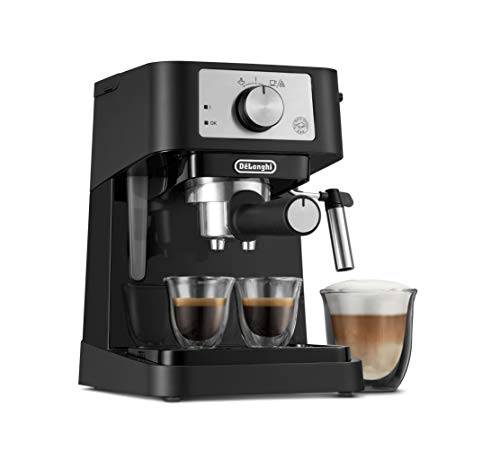
1. De’Longhi Stilosa Espresso Machine (EC260) — Best Overall Cheap Espresso Machine
The Stilosa is the budget tier done by a company that also builds machines ten times its price, and it shows in the priorities: a proper 15-bar pump, a portafilter workflow that teaches real skills, a manual frothing wand for lattes and cappuccinos, and a compact body that respects small counters. Nothing about it is decorative; everything about it makes espresso.
It suits the beginner who wants the fundamentals without the premium toll, and the household adding a second machine for a cabin, office or student flat. De’Longhi’s support and parts depth at this price is unmatched in the guide, which is why the Stilosa, rather than a cheaper clone, takes the top spot.
Strengths
- Real 15-bar pump extraction with a proper portafilter
- Manual frother teaches genuine milk technique
- De’Longhi service, parts and descaling support at a budget price
Trade-offs
- Thermoblock-class heating means a short wait between drinks
- No pressure gauge — learning is by taste and timing
- Compact tank needs regular refilling in multi-drink households
| Pump | 15 bar |
| Milk | Manual frothing wand |
| Design | Compact for small counters |
What the Stilosa gets right is the upgrade path: the skills it teaches — dosing, tamping, milk timing — are the skills of every manual machine above it, so owners who catch the espresso bug lose nothing when they step up. The pressurised baskets forgive a modest grinder while you learn, and the wand, though basic, produces honest microfoam once you learn to keep the tip near the surface.
Its limits are the tier’s limits: pace yourself between drinks, descale on schedule, and don’t expect café speed. As the default recommendation for ‘cheap espresso machine’ searches, it has earned the position the boring way — by working, for years, in a great many kitchens.
Best for: beginners and small households wanting the fundamentals done right / Not suited for: households making many milk drinks back to back
Check the current price on Amazon

2. CASABREWS 3700 Essential Espresso Machine — Best Rock-Bottom Value
The 3700 Essential is the machine for shoppers whose budget is the headline: a stainless-clad pump machine with a steam wand for cappuccinos and lattes and a 43.9oz removable water tank that is genuinely large for this class — fewer refills, easier cleaning, and a machine that can serve a household’s morning without a mid-service top-up.
It suits first-time buyers testing whether home espresso fits their life, students, and anyone furnishing a second coffee corner. CASABREWS is a younger brand than De’Longhi, so you are trading some support depth for specification per dollar — a fair trade when stated plainly, and the reason this is the value pick rather than the overall pick.
Strengths
- Large 43.9oz removable tank beats most budget rivals
- Steam wand covers the full milk-drink range
- Stainless styling looks above its tier on the counter
Trade-offs
- Younger brand — thinner service and parts network
- 20-bar headline is marketing; extraction quality depends on your coffee and basket
- Build refinement trails the De’Longhi picks
| Pump | 20 bar |
| Tank | 43.9oz, removable |
| Milk | Steam wand |
The tank deserves emphasis because budget machines usually skimp there, and a removable tank that goes to the sink beats a fixed one you fill with a jug and spill. Combined with a wand that produces respectable steam for its class, the 3700 covers the daily drinks of a small household without the friction that makes cheap machines get abandoned.
Buy it as what it is: the most complete specification at the bottom of the market, from a brand still earning its reputation. Keep the receipt, descale religiously, and it will teach you espresso while you decide whether the hobby deserves a bigger machine.
Best for: tight budgets wanting a full-featured first machine / Not suited for: buyers who rank long-term service network above all
Check the current price on Amazon

3. CASABREWS CM5418 Compact Espresso Machine — Best for Learning (Pressure Gauge)
The CM5418 adds one feature to the budget formula that changes everything for a learner: a pressure gauge on the machine’s face that shows whether your extraction is in the zone. Grind too coarse or tamp too light and the needle tells you before the taste does; adjust, and watch the needle move. No other machine at this tier closes the feedback loop so directly.
It suits the self-teaching beginner who enjoys dialing things in, and any buyer planning to pair a budget machine with a real grinder — the gauge is what turns that grinder from an expense into an instrument. The compact stainless body and steam wand cover cappuccinos and lattes for small kitchens.
Strengths
- Built-in gauge makes extraction learnable and repeatable
- Compact stainless design for small counters
- Steam wand for the full milk menu
Trade-offs
- Same young-brand support caveat as the 3700
- Gauge rewards engagement — wasted on set-and-forget users
- Compact class pace between drinks
| Pump | 20 bar |
| Gauge | Built-in pressure gauge |
| Milk | Steam wand |
Espresso education normally costs café tuition or a premium machine with a gauge; the CM5418 puts the instrument in the budget tier. Owners who use it systematically — change one variable, watch the needle, taste, repeat — compress months of superstition into a few bags of beans. That is a genuinely different product from every gauge-less rival here, aimed at a genuinely different buyer.
If you know you will never look at a dial, buy the Stilosa and save the difference. If you are the person who reads manuals and keeps notes, this is your machine, and it is not close.
Best for: analytical learners pairing a budget machine with a real grinder / Not suited for: set-and-forget drinkers who won’t use feedback
Check the current price on Amazon

4. Gevi 20 Bar Compact Espresso Machine — Best Compact Budget Machine
Counter space is the budget constraint nobody lists, and the Gevi’s compact format is its answer: a 20-bar pump machine in a slim body aimed at small kitchens, dorm-adjacent flats, office desks and caravan counters where the Stilosa’s footprint is already too much to ask.
It suits the space-poor buyer who refuses to surrender to pods. You still get a portafilter workflow and milk capability in the compact class’s usual format, in a machine sized to live where other machines visit. Gevi’s support footprint is smaller than the big brands’, which is the standing trade of the compact-budget corner.
Strengths
- Slim footprint fits counters nothing else here can
- 20-bar pump machine — real portafilter espresso, not pods
- Simple operation suits occasional and new users
Trade-offs
- Compact class means small tank and drip tray discipline
- Brand support network is modest
- Not built for multi-drink household pace
| Pump | 20 bar |
| Format | Compact |
| Type | Pump espresso machine |
Compact machines succeed or fail on honesty about their job: one or two drinks, made well, in a space that couldn’t host more. The Gevi does that job with the standard budget toolkit — pressurised baskets to forgive grind, quick heating, simple controls — and its owners’ satisfaction tracks exactly with buyers who bought it for that job.
Buy it for a tight counter and a modest daily count, and it is the right machine. Buy it to serve a family’s four-latte mornings and you have purchased a queue. The guide’s other picks exist for that household.
Best for: tiny counters, singles and occasional espresso drinkers / Not suited for: multi-drink households or heavy daily use
Check the current price on Amazon
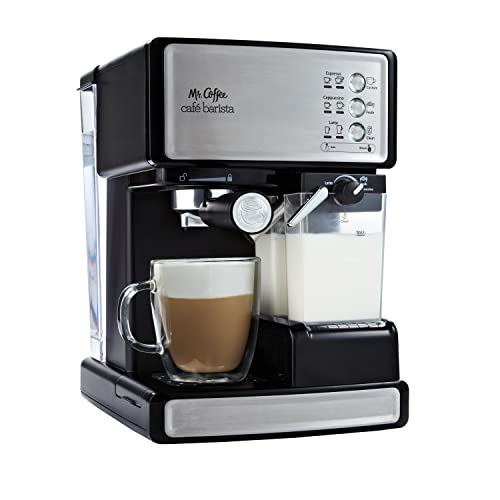
5. Mr. Coffee Café Barista Espresso Machine — Best Semi-Automatic Milk Drinks
The Café Barista removes the steam wand learning curve entirely: its automatic milk carafe froths and dispenses into the cup at the touch of a button, with one-touch controls for espresso, cappuccino and latte. For households whose drink is a morning latte rather than an espresso hobby, that automation is the entire point — and at a budget tier the big automatics can’t approach.
It suits busy families and milk-drink-first buyers. The carafe stores in the fridge between uses, the drinks are consistent without any technique, and Mr. Coffee’s mass-market support stands behind it. Purists will note the trade: you give up manual control and the skill-building of the wand machines in exchange for never learning them.
Strengths
- One-touch cappuccino and latte with automatic milk frothing
- Milk carafe stores in the fridge — minimal daily cleanup
- Zero learning curve for every household member
Trade-offs
- No manual milk control — texture is the machine’s choice
- Milk system must be cleaned diligently to stay hygienic
- Espresso itself is budget-class; the convenience is the product
| Type | Semi-automatic with milk carafe |
| Drinks | Espresso, cappuccino, latte — one-touch |
| Milk | Automatic frothing carafe |
Judge this machine by its actual competition: not the Stilosa, but the café drive-through. Against a daily bought latte, the Café Barista pays for itself quickly while asking almost nothing of its owner — fill the carafe, press the button, rinse on schedule. That is a legitimate and popular definition of ‘best,’ and budget guides that ignore it are writing for hobbyists, not households.
Its ceiling is real: the espresso is pressurised-basket class and the milk texture is programmed rather than crafted. Households that later catch the espresso bug will upgrade past it. Households that just wanted lattes will run it for years and consider it money perfectly spent.
Best for: milk-drink households wanting one-touch convenience on a budget / Not suited for: espresso hobbyists or anyone wanting manual control
Check the current price on Amazon

6. De’Longhi ECP3420 Espresso Machine — Best Forgiving Beginner Classic
The ECP3420 is the budget tier’s elder: a straightforward De’Longhi pump machine with a manual panarello-style frother, a compact footprint, and a design that has been introducing beginners to espresso for years. Its controls ask nothing, its pressurised baskets forgive everything, and its price position is perennially among the friendliest of any branded machine.
It suits the absolute beginner and the gift buyer: someone who wants espresso and cappuccinos at home with the least possible ceremony and a brand name on the box. Next to the Stilosa it trades a little refinement for simplicity and price; both are defensible, and the choice is about temperament as much as money.
Strengths
- As simple as pump espresso gets — ideal first machine
- Forgiving pressurised baskets suit pre-ground and modest grinders
- De’Longhi backing at an entry price
Trade-offs
- Basic frother produces cappuccino foam more easily than latte microfoam
- Refinement and pace trail the Stilosa
- No gauge or presets to guide learning
| Maker | De’Longhi |
| Type | Manual pump machine |
| Milk | Manual frother |
Longevity in the catalogue is evidence: machines that disappoint get discontinued, and the ECP line has sold for years because it delivers the promise on its box — espresso and frothy milk drinks at home, cheaply, without drama. The panarello frother is deliberately easy: it injects air generously, making cappuccino-style foam nearly automatic while limiting fine latte texture, a trade beginners happily accept.
Buy it when simple and cheap outrank learning and refinement, or as the gift that starts someone else’s habit. It is the floor of respectable espresso, and the floor is higher than most people expect.
Best for: absolute beginners and gift buyers wanting branded simplicity / Not suited for: learners wanting feedback or fine milk control
Check the current price on Amazon
Comparison Table
| Pick | Badge | Key spec | Best for |
|---|---|---|---|
| De’Longhi Stilosa Espresso Machine (EC260) | Best Overall Cheap Espresso Machine | 15-bar pump, manual frother, compact | Overall budget default |
| CASABREWS 3700 Essential Espresso Machine | Best Rock-Bottom Value | 20-bar pump, 43.9oz removable tank, steam wand | Lowest-cost full feature set |
| CASABREWS CM5418 Compact Espresso Machine | Best for Learning (Pressure Gauge) | 20-bar pump, built-in gauge, steam wand | Skill-building on a budget |
| Gevi 20 Bar Compact Espresso Machine | Best Compact Budget Machine | 20-bar compact pump machine | Smallest footprint |
| Mr. Coffee Café Barista Espresso Machine | Best Semi-Automatic Milk Drinks | One-touch milk drinks, auto-frothing carafe | Effortless lattes and cappuccinos |
| De’Longhi ECP3420 Espresso Machine | Best Forgiving Beginner Classic | Entry De’Longhi pump machine, manual frother | Simplest start in espresso |
How to Choose a Cheaper Espresso Machine
Decide first whether you are buying a hobby or a drink. If you want to learn espresso — grind, dose, tamp, steam — buy a manual wand machine: the Stilosa for support, the CM5418 for feedback. If you want a latte to appear each morning with no ritual, buy the Café Barista’s automation. Both are correct purchases; buying the hobby machine for a drink household is how budget espresso ends up in a cupboard by March.
Second, plan the grinder honestly. These machines ship with pressurised baskets precisely so a modest grinder or pre-ground coffee produces drinkable shots, and for many households that is enough forever. If you plan to chase café quality, reserve budget for a burr grinder and choose the gauge-equipped CM5418 to exploit it. Third, check the unglamorous specs: tank size, footprint, and whether the brand sells descaler and parts where you live.
- Choose manual wand or automatic milk by household temperament
- Pressurised baskets forgive grinders — standard baskets demand them
- Tank size and footprint decide daily friction more than pump ratings
- Prefer brands with real service networks at this tier
- Budget descaler and a milk pitcher from day one
The Truth About Bar Pressure and Other Budget Marketing
Every machine in this guide advertises 15 or 20 bar, and the number is nearly meaningless: espresso extracts at around 9 bar at the coffee, and pump maximums above that are headroom, not quality. What actually separates budget machines is basket design, temperature stability and steam performance — none of which fit on a badge. Pressurised baskets, fitted to most picks here, use a tiny outlet to build pressure artificially, which is why cheap machines make crema-topped, pleasant shots from imperfect coffee. That is honest engineering for the tier, not a scam — but it caps the ceiling, which is why enthusiasts eventually move to standard baskets and real grinders.
Apply the same scepticism to ‘Italian pump’ (a component origin, not a performance grade) and to wattage races. The buying signals that matter at this tier are the ones this guide ranked on: brand support, tank and footprint fit, milk system type, and whether the machine teaches you anything. A cheaper machine chosen on those grounds will out-serve a pricier badge chosen on bar numbers.
Pressurised vs Standard Baskets: The Budget Tier’s Central Idea
Your machine will likely arrive with both basket types or with pressurised baskets only, and understanding them is the whole budget-espresso game. A pressurised (dual-wall) basket forces brewed coffee through a pinhole, generating pressure and crema regardless of grind fineness. Shots are forgiving, consistent and a little blurred in flavour. A standard (single-wall) basket builds pressure only from the coffee puck itself: grind wrong and the shot gushes or chokes, but grind right and the flavour clarity jumps a class.
The sensible progression: start pressurised while you learn dosing and milk, enjoy genuinely good drinks, and switch to the standard basket when you own a grinder that can feed it. Machines like the Stilosa and CM5418 support that journey, which is why they anchor this guide. There is no shame in staying pressurised forever — most of the world’s home lattes are made exactly that way — but the option to grow is worth choosing at purchase.
Pairing a Grinder With a Cheap Machine Without Wasting Money
The standard advice — spend as much on the grinder as the machine — was written for standard baskets. In pressurised-basket world, the arithmetic softens: a modest burr grinder, fresh beans and consistent dosing will carry any pick in this guide to satisfying drinks. Spend first on freshness (beans roasted recently, bought in small quantities) and on a simple scale for dosing; those two upgrades beat any grinder upgrade while you run pressurised baskets.
When you do upgrade, upgrade the grinder before the machine. A better grinder improves shots on your current machine immediately (especially through the CM5418’s gauge) and remains the right grinder for your next machine. The reverse order — premium machine, sad grinder — is the most common money mistake in home espresso, and it is entirely avoidable at this tier by following the sequence: machine, beans and scale, grinder, then maybe machine again.
The Used-Market Alternative: When Second-Hand Beats These Picks
Budget buyers should at least consider the used market, where premium machines depreciate into this guide’s price tier. A used Breville or De’Longhi from the class above can out-perform any new budget machine — if it has been descaled, if the group gasket is sound, and if you can test it pulling a shot and steaming milk before money changes hands. Those are three significant ifs, and they are why this guide recommends new machines with warranties as the default: a first espresso machine that arrives broken teaches nothing but resentment.
If you do buy used, budget for a gasket, a shower screen clean, descaler and possibly a service — and price the machine as though those costs are certain. Buy the seller as much as the machine: the owner who kept the manual, the descaler and a cleaning routine is selling you a maintained appliance; the owner who ‘barely used it’ may be selling you a scale museum. New, warrantied and supported remains the recommendation for beginners; used is the connoisseur’s shortcut, taken knowingly.
Steaming Milk on a Budget Wand: What Is and Isn’t Possible
Budget steam wands divide into two families. Bare wands and simple tips, like the Stilosa’s manual frother, give you control: keep the tip just under the milk’s surface to draw in air with a gentle tearing sound, then sink it to heat and swirl. With practice these produce genuine microfoam suitable for lattes and even basic latte art — the wand is cheap, but the physics is the same as a café’s. Panarello-style wands, like the ECP3420’s, automate the air injection: foam arrives easily and abundantly, cappuccino-style, while fine latte texture stays out of reach. Neither is a defect; they serve different drinks.
Three budget-milk rules apply everywhere. Start with cold milk in a cold pitcher, and use less milk than you think — small volumes texture faster and waste less while learning. Stop at the temperature where the pitcher becomes too hot to hold comfortably against your palm; beyond that, milk scalds and sweetness dies, and no machine tier rescues it. And clean the wand the second you finish, every time: a budget wand with baked milk inside it becomes a hygiene problem and a steam problem within days. Master those habits and the milk from a budget machine surprises people who paid café prices for worse.
Temperature Surfing and Other Budget-Machine Techniques
Inexpensive machines heat water with simple thermoblocks or small boilers controlled by basic thermostats, which means brew temperature wanders within a band rather than holding a laboratory line. Enthusiasts call the workaround ‘temperature surfing’: running a blank shot to stabilise the group, timing your shot to the machine’s heating rhythm, and keeping the portafilter locked in and warm between drinks. It sounds fussy; in practice it becomes a thirty-second ritual that visibly tightens shot consistency on every manual pick in this guide.
The other high-value techniques cost nothing. Warm your cup — cold ceramic steals degrees a budget machine cannot spare. Keep the portafilter in the machine while you prep, so the basket is hot when coffee meets it. Pull shots into the same cup you warmed. And respect the machine’s pace between drinks: budget heating systems recover in a minute or two, and back-to-back-to-back drinks will drift cooler and weaker. None of this is a reason to apologise for the machine; it is simply the craft of the tier, and it is the same craft, minus the surfing, that premium machines automate away.
The Real Running Costs of Cheap Espresso
A budget machine’s purchase price is the beginning of a small, predictable cost stream, and planning it prevents the false economy of a machine abandoned for want of a minor expense. Consumables: beans (your dominant cost, and the one worth spending on), descaler a few times a year, and milk-system cleaner if you chose the Café Barista. Wear items over years: a group gasket, possibly a basket, eventually a pump on a heavily used machine. Electricity is negligible at this scale. Totalled honestly, a budget machine’s annual running cost is a small fraction of a daily café habit — which is the comparison that justifies the purchase.
The comparison worth making before buying is against your actual alternative. If the alternative is a café drink most days, any pick in this guide pays for itself in a season or two even after beans and descaler. If the alternative is a pod machine, beans undercut pods per cup by a wide margin while producing better drinks and less waste. If the alternative is no coffee at home at all, the machine must earn its counter space in pleasure — which is why this guide keeps steering no-ritual households to the Café Barista’s one-touch honesty.
Where Budget Machines Live: Dorms, Offices, Cabins and First Flats
A striking share of budget espresso machines are bought for second locations, and the picks here map neatly onto them. The Gevi’s compact body belongs in the dorm-adjacent flat and the caravan, where the counter is a rumour. The ECP3420’s simplicity suits the shared office kitchen, where the user manual will never be read and the machine must survive communal operation — pressurised baskets and a forgiving frother are exactly the spec for anonymous users. The Stilosa serves the cabin and the holiday home, where it makes proper drinks a few weekends a year and tolerates being left idle between them, provided it is drained and stored dry.
Second-location buying has one extra rule: match the machine to the water. Cabins on well water and offices on hard municipal supplies scale machines faster than home kitchens do, so the descale schedule in this guide matters doubly there. A budget machine that dies at the cabin in year two almost never died of cheapness; it died of hard water and good intentions. Buy the machine, buy the descaler at the same time, and write the first descale date on a note taped inside the cupboard door.
When to Upgrade From a Budget Machine — and When Not To
Upgrade when the machine, not your technique, becomes the ceiling. The signs are specific: your shots are consistent and you can taste the pressurised basket’s blur; you regularly queue drinks for guests and the recovery pace frustrates you; your milk texture on a manual wand has plateaued against the wand’s design rather than your skill. At that point a step-up machine — faster heating, standard baskets, stronger steam — buys real capability, and your budget machine retires honourably to a second location or a grateful friend.
Do not upgrade when the drinks are still inconsistent: that is technique, and a pricier machine will faithfully reproduce the inconsistency at higher speed. Do not upgrade for features you have not missed — a gauge, presets, automation — because the espresso hobby’s upgrade treadmill is paved with machines bought for other people’s priorities. The owners who love this tier longest are the ones who learned it fully; several picks in this guide have multi-year owners who could afford anything and stayed, because the drinks were good and the ritual was theirs.
Beans on a Budget: Getting Café Flavour Without Café Prices
The budget machine owner’s secret advantage is that beans, not hardware, dominate the cup — and beans reward shopping skill rather than spending power. Buy from roasters who print roast dates, in the smallest bag you will finish within three weeks, and favour medium roasts while learning: they extract forgivingly across the small temperature variations of budget machines, where very light roasts turn sour and very dark roasts turn ashy. Grocery-store beans with a roast date beat café beans without one, every time.
Storage matters more than origin at this tier. Keep beans in their bag, sealed, in a cupboard — not the fridge, whose moisture and odours they absorb, and not a sunny counter. Grind only what the shot needs if you own a grinder; if you buy pre-ground for pressurised baskets, buy smaller quantities more often and accept the trade knowingly. Follow those rules and a budget machine routinely out-pours the expensive machine down the street that is being fed month-old beans — the most reliable upset in home espresso.
How to Make Good Espresso on a Budget Machine: The Workflow That Matters
Budget machines reward a consistent routine more than expensive ones do, because you are supplying the consistency the machine can’t. Run every shot this way:
- Warm the machine and the cup: run a blank shot through the empty portafilter into your cup, which heats both and rinses the group
- Dose consistently — weigh the coffee if you can; with pressurised baskets, fill and level the basket the same way every time
- Tamp level, lock in immediately, and start the shot; watch for a steady, slow pour rather than drips or gushing
- Steam milk right after the shot while the machine is hot: purge the wand, keep the tip near the surface for foam, then plunge to heat
- Wipe and purge the wand instantly, knock out the puck, rinse the basket, and leave the machine clean for tomorrow
Troubleshoot by taste, one variable at a time: sour and thin usually means under-extraction — grind finer or dose more; bitter and harsh means over-extraction — ease off. With pressurised baskets your adjustments are smaller and the window is wider, which is the tier’s kindness. Keep a simple note on your phone for the first bag of beans — dose, result, change — and your second bag will taste like a different, better machine.
One last routine, weekly: remove the shower screen or basket as the manual allows, soak the portafilter and baskets in espresso-machine cleaner, rinse the tank, and wipe the machine down. Fifteen unhurried minutes a week is the entire difference between a budget machine that tastes clean in year three and one that slowly turns rancid and gets blamed for it. Cheap machines are not disposable unless their owners treat them that way.
Common Buying Mistakes
Buying by bar numbers. 15 vs 20 bar is marketing headroom. Basket type, brand support and milk system decide your experience; this guide ranked on those.
Feeding it stale pre-ground coffee forever. Pressurised baskets forgive a lot, but freshness is the cheapest flavour upgrade in espresso. Small bags, recently roasted, ground as late as possible.
Never descaling. Budget machines die of scale like any other. Descale on schedule from month one and a cheap machine lasts years.
Judging the machine on day one’s shots. Your first shots measure your inexperience, not the machine. Give it a bag of beans and the workflow in this guide before concluding anything.
Buying a manual machine for a no-ritual household. If nobody will tamp and steam, the machine becomes furniture. The Café Barista exists precisely for that household — choose honestly.
Final Recommendation
The De’Longhi Stilosa is the budget espresso default: real pump extraction, a proper wand, compact manners and the deepest support network at the tier. The CASABREWS 3700 Essential undercuts it with a bigger tank and full features for the strictest budgets, while its sibling the CM5418 is the learner’s choice for its pressure gauge. The Gevi owns the smallest counters, the Mr. Coffee Café Barista owns effortless milk drinks, and the De’Longhi ECP3420 remains the simplest branded start in the category.
Check the current price on Amazon through the links above — budget pricing moves too fast for any printed figure to survive — and pair your machine with fresh beans and, when you’re ready, a burr grinder. Cheap espresso done right is not a compromise; for a great many households it is simply espresso, full stop, honestly earned.
A closing thought for the hesitant: every experienced home barista started on a machine at or below this tier, and most remember it fondly — because it was good enough to teach them what good tastes like. That is all any first machine has to do, and every pick above does it.
Keep exploring: Best Coffee And Espresso Machines Best Calphalon Espresso Machines Best Coffee And Espresso Combo Machines Best Catering Espresso Machines
Frequently Asked Questions
Can a cheap espresso machine make real espresso?
Yes. Pump machines with portafilters — every pick in this guide — brew under pressure through ground coffee, which is the definition of espresso. Pressurised baskets make the results forgiving rather than fake. The gap to premium machines shows in consistency, temperature stability and pace, not in whether the drink is espresso.
Do I need a grinder with a budget espresso machine?
Not immediately. Pressurised baskets are designed to work with pre-ground coffee or a modest grinder, and many households stay there happily. A burr grinder becomes necessary when you switch to standard baskets and chase café-level clarity — at which point it improves your current machine before you ever upgrade it.
Why do cheap machines advertise 20 bar if espresso uses 9?
The figure is the pump’s maximum capability, not the extraction pressure; a regulator and the coffee puck bring working pressure down. Treat bar ratings as a checkbox (a real pump exists) rather than a ranking. Basket design and temperature stability matter far more to the cup.
How long will a cheap espresso machine last?
With descaling on schedule and basic cleaning, budget machines from real brands commonly serve for years of daily use. Neglect — especially scale and baked-on milk — is what shortens their lives, which is why this guide repeats the maintenance sermon in every section. The machine’s price is low; the care is the same as any machine’s.
Is a cheap machine better than a pod machine?
For flavour and running cost per cup, usually yes: fresh ground coffee through a portafilter beats pods, and beans cost less per drink. For pure convenience, pods win — no dosing, no cleanup, no learning. The Café Barista in this guide is the middle path: real espresso convenience with automatic milk.
What’s the first upgrade after buying a budget machine?
Fresh beans from a local roaster and a simple gram scale, together cheaper than any hardware and worth more. After that, a burr grinder. Hardware for the machine itself — better tamper, a spare basket — comes last. Espresso improves in that order at every budget, and the budget tier is no exception.
Are cheap espresso machines loud or slow in the morning?
Vibration pumps are audible — you will hear the machine work for the thirty seconds of a shot — and budget heating systems ask a minute or two to be ready and a similar pause between several drinks. For a household making one or two drinks, none of this registers after the first week. For a household making six drinks at 7 a.m., it registers daily, and that household should look at the faster machines in our main espresso guide.
Can I make iced espresso drinks on a budget machine?
Yes — pull a double shot directly over a glass of ice and cold water or milk, and the drink is made; nothing about iced espresso stresses a budget machine. Several households buy these machines primarily for iced lattes in summer, where the milk is cold and the steam wand rests. If iced drinks are your main use, prioritise shot quality (the Stilosa or CM5418) over milk features when choosing.
What size drinks do budget machines make best?
Singles and doubles in the classic range, and milk drinks up to a standard mug. Budget boilers and thermoblocks are sized for household drinks, not for filling a travel tumbler with a quadruple latte in one pass — make two drinks, or accept a pause between them. Within their design size, the drinks are complete; outside it, pace is the price of the tier.


